Affixation
– Adding one or more affixes to a root.
– Covers both prefixation and
suffixation.
– Most common use in English
language
What is Suffixation?
• An affix added to the end of a word
or stem, serving to form a new word
or functioning as an inflectional
ending.
For example:
improve + ment = improvement
(now, the word has different meaning)
What is Prefixation
adding a prefix to the base, with or
without a change of word
For example:
author – co-author
(the two words now have different
meanings)
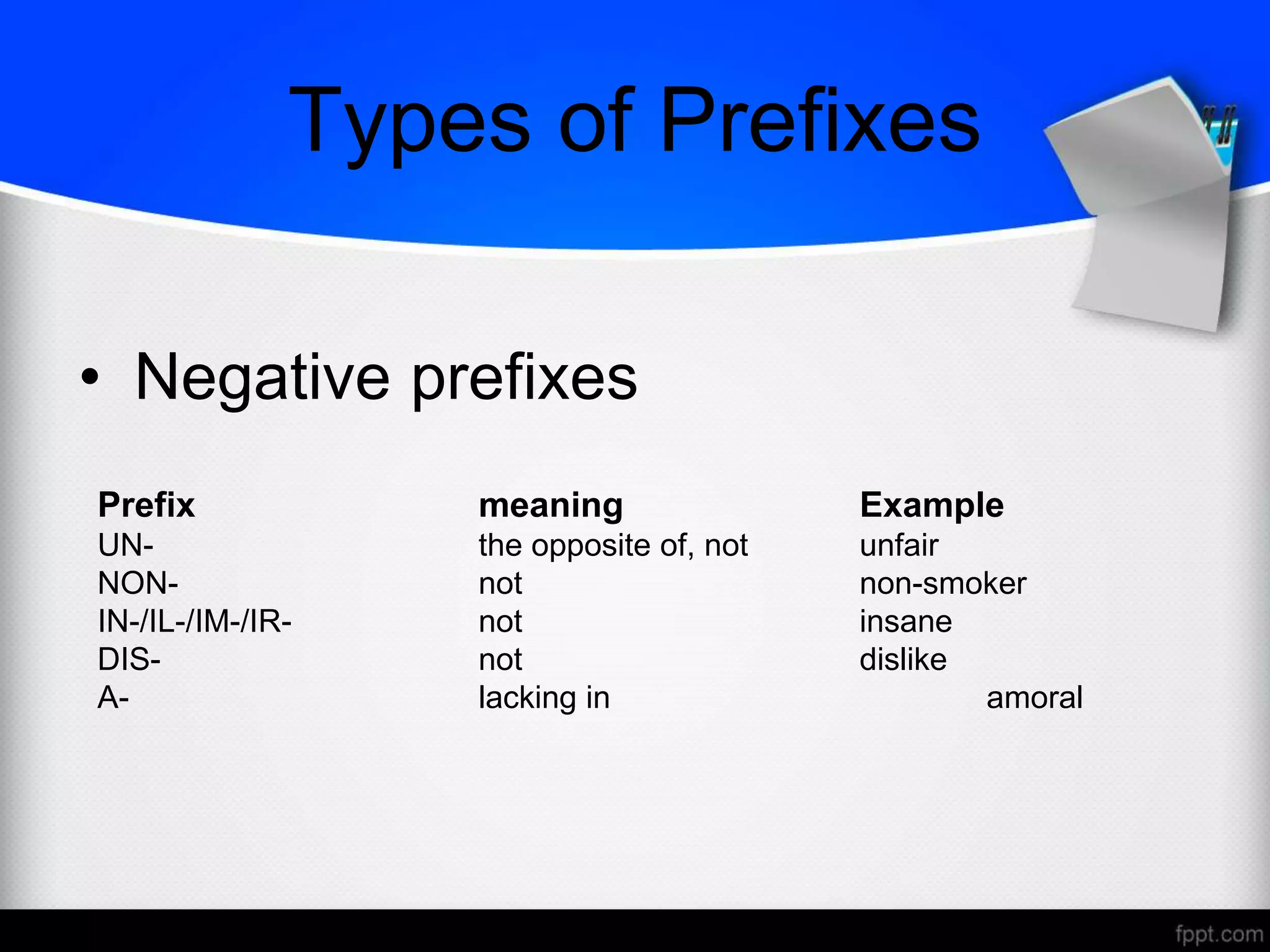
Types of Prefixes
• Negative prefixes
Prefix meaning Example
UN- the opposite of, not unfair
NON- not non-smoker
IN-/IL-/IM-/IR- not insane
DIS- not dislike
A- lacking in amoral
Reversative/Privative
Prefixes
Prefixes of Degree/Size
Prefixes of degree/ size meaning examples
ARCH- highest, worst archduke
SUPER- more than better
supernatural
OUT- to do sth. faster, longer… outlive
SUR- over and above surtax
SUB- lower/less than substandard
OVER- too much overconfident
UNDER- too little
underprivileged
HYPER- extremely hypercritical
ULTRA- extremely, beyond ultra-modern
MINI- little mini-van
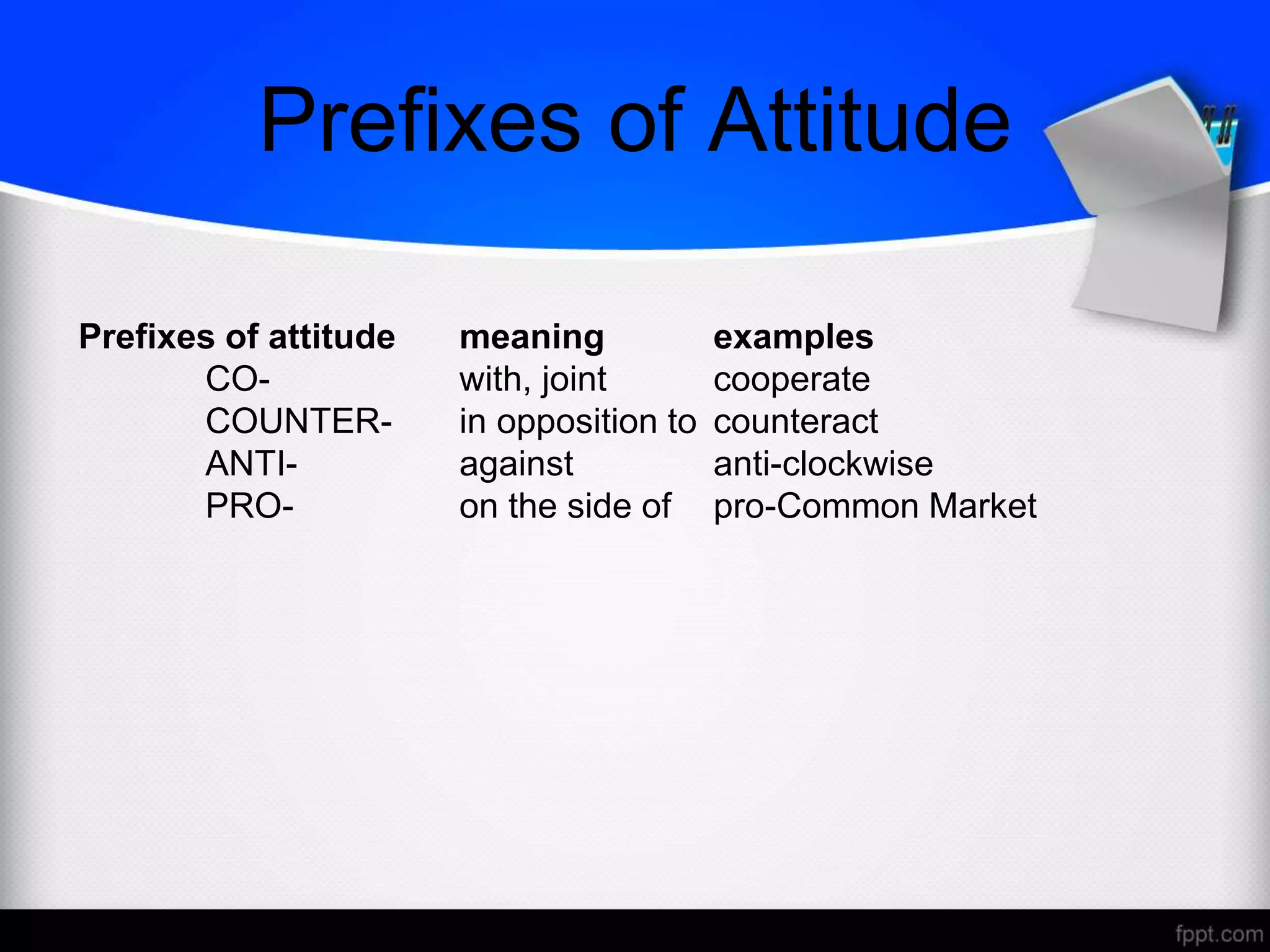
Prefixes of Attitude
Prefixes of attitude meaning examples
CO- with, joint cooperate
COUNTER- in opposition to counteract
ANTI- against anti-clockwise
PRO- on the side of pro-Common Market
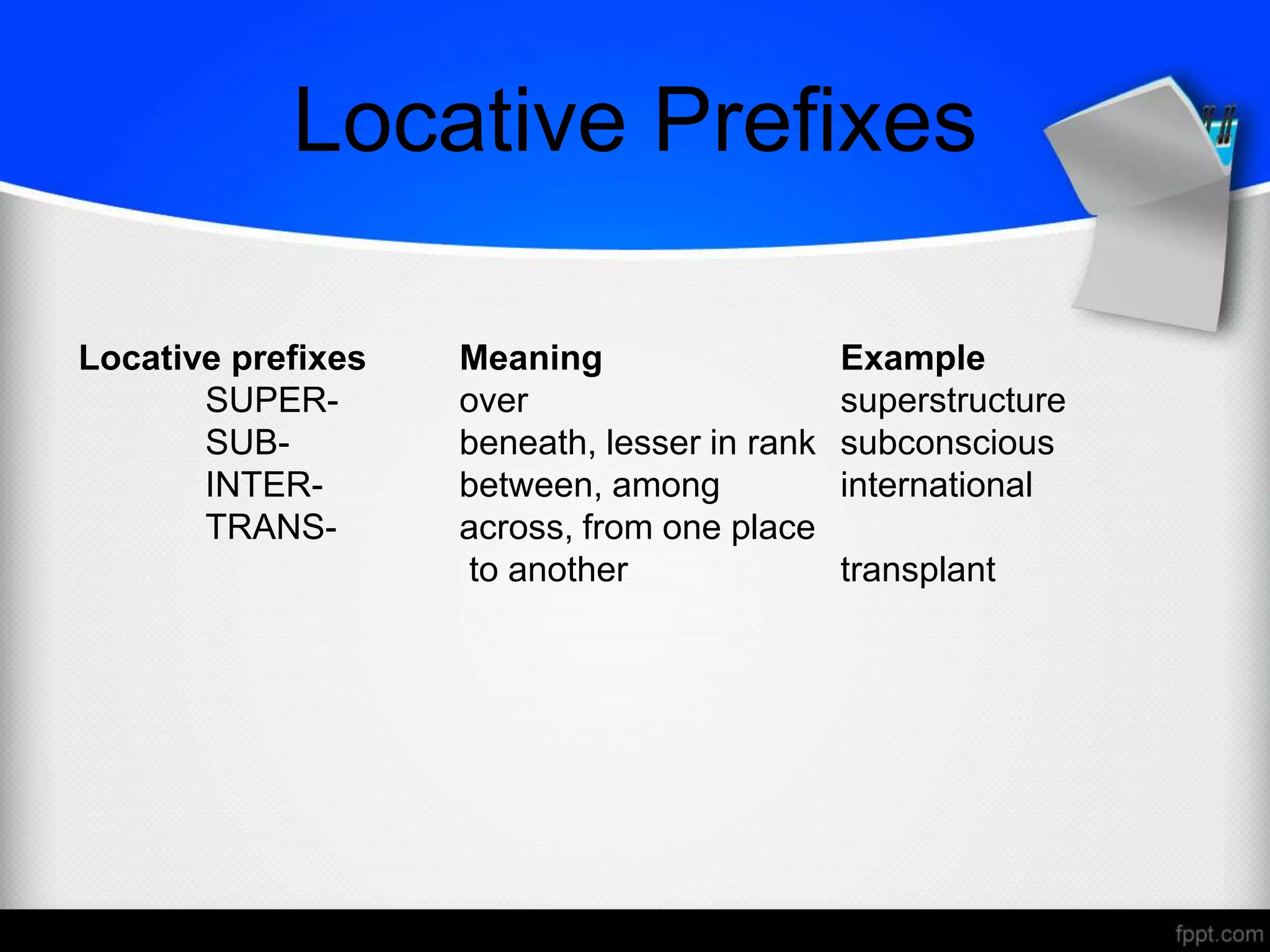
Locative Prefixes
Locative prefixes Meaning Example
SUPER- over superstructure
SUB- beneath, lesser in rank subconscious
INTER- between, among international
TRANS- across, from one place
to another transplant
Other types of Prefixes
Prefixes of time/order meaning examples
FORE- before forknowledge
PRE- before pre-marital
POST- after post-war
EX- former ex-husband
RE- again, back re-evaluate
Number prefixes
UNI-, MONO one unilateral
BI-, DI-, two bilingual
TRI- three tripartite
MULTY-, POLY- many multi-racial
Affixation result of adding an
affix to a root word. It is an act or
process of adding whether an
affix or a suffix to change the
meaning of the word given.
Prepared by:
Jamaica Tinguha

Affixation

  • 1.
  • 2.
    – Adding oneor more affixes to a root. – Covers both prefixation and suffixation. – Most common use in English language
  • 3.
    What is Suffixation? •An affix added to the end of a word or stem, serving to form a new word or functioning as an inflectional ending. For example: improve + ment = improvement (now, the word has different meaning)
  • 4.
    What is Prefixation addinga prefix to the base, with or without a change of word For example: author – co-author (the two words now have different meanings)
  • 5.
    Types of Prefixes •Negative prefixes Prefix meaning Example UN- the opposite of, not unfair NON- not non-smoker IN-/IL-/IM-/IR- not insane DIS- not dislike A- lacking in amoral
  • 6.
  • 7.
    Prefixes of Degree/Size Prefixesof degree/ size meaning examples ARCH- highest, worst archduke SUPER- more than better supernatural OUT- to do sth. faster, longer… outlive SUR- over and above surtax SUB- lower/less than substandard OVER- too much overconfident UNDER- too little underprivileged HYPER- extremely hypercritical ULTRA- extremely, beyond ultra-modern MINI- little mini-van
  • 8.
    Prefixes of Attitude Prefixesof attitude meaning examples CO- with, joint cooperate COUNTER- in opposition to counteract ANTI- against anti-clockwise PRO- on the side of pro-Common Market
  • 9.
    Locative Prefixes Locative prefixesMeaning Example SUPER- over superstructure SUB- beneath, lesser in rank subconscious INTER- between, among international TRANS- across, from one place to another transplant
  • 10.
    Other types ofPrefixes Prefixes of time/order meaning examples FORE- before forknowledge PRE- before pre-marital POST- after post-war EX- former ex-husband RE- again, back re-evaluate Number prefixes UNI-, MONO one unilateral BI-, DI-, two bilingual TRI- three tripartite MULTY-, POLY- many multi-racial
  • 11.
    Affixation result ofadding an affix to a root word. It is an act or process of adding whether an affix or a suffix to change the meaning of the word given.
  • 12.