APPLIED LINGUISTICS
1. SOU SOKHEANG
2. THANG PHOUVIENG
3. CCHEN HONGLY
4. CHREV RUN
5. REY MAB
6. SAT SOMBO
Submitted to lecturer:
Mr. Kak Sovanna
Semester I, Year IV, Batch VII,
Academic Year 2016-2017
Topic: Words and Word- formation processes
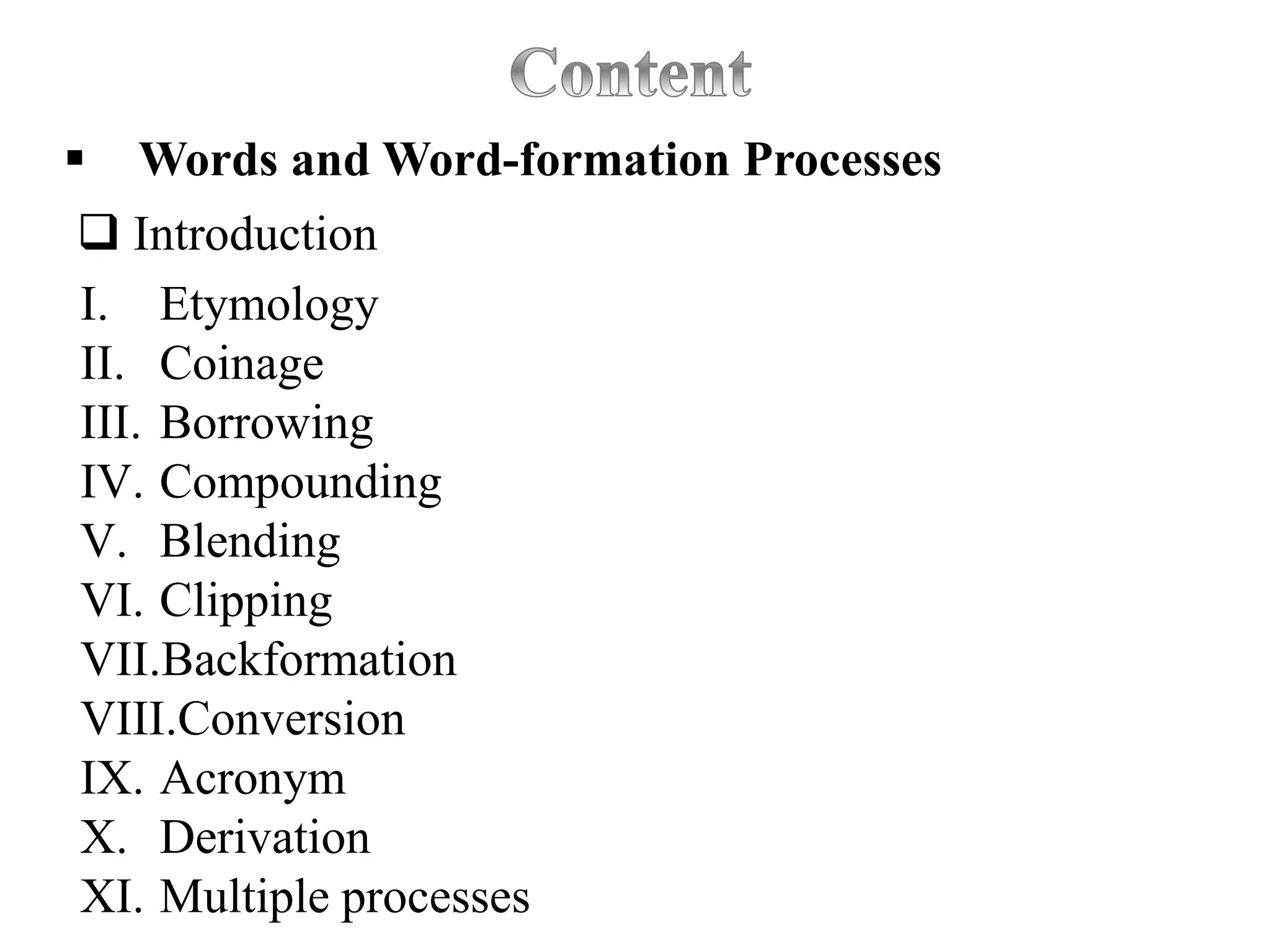
I. Etymology
II. Coinage
III. Borrowing
IV. Compounding
V. Blending
VI. Clipping
VII.Backformation
VIII.Conversion
IX. Acronym
X. Derivation
XI. Multiple processes
 Introduction
 Words and Word-formation Processes
 Introduction
Word
Part of speech
Pronunciation
Spelling
Root or Origin
Prefixes and
Suffixes
Meaning
Antonym
Synonym
Function
 Words and Word-formation Processes
What is Linguistics?
 Introduction
Linguistics is the scientific study of language.
Linguists do work on specific languages, but their
primary goal is to understand the nature of Language
in general.
Linguistics deal with the study of particular languages,
and the search for general properties common to all
languages or large group of languages.
Language is a social fact, a kind of social contact, or a
system of communication consisting of sounds, word
or grammar, or the system of communication used by
people of particular country or profession.
What is language?
 Introduction
I. Etymology
• The study of origin and history of a word is
known as its etymology, a term which, like many
of our technical words, comes to us through Latin,
but has its origins in Greek (étymon “original
form” + logia “study of”, and it not to be confused
with entomology, also from Greek(éntomon
“insect”).
II. Coinage
• One of the least common processes of word
formation in English is coinage , that is, the
invention of totally new terms. The most typical
sources are invented trade name for commercial
product. Older examples are aspirin, nylon,
Vaseline and zipper; more recent examples are
Kleenex, Teflon, Tylenol and Xerox.
• New words based on the name of a person or a
place are called eponyms. When we talked about a
hoover( or even a spangler ), we were using an
eponym. Examples : sandwich (from the
eighteenth- century Earl of gambling) and jeans
(from the Italian city of Genoa where the type of
cloth was first made).
II. Coinage
III. Borrowing
• As Bill Bryson observed in the quotation
presented earlier, one of the most common sources
of new words in English is the process simply
labelled borrowing, that is, the taking over of
words from other languages. Throughout its
history, the English language has adopted a vast
number of the words from other languages,
including croissant (French), dope (Dutch), lilac
(Persian), piano (Italian), pretzel (German), sofa
(Arab), tattoo (Tahitian), tycoon (Japanese),
yogurt (Turkish), and zebra (Bantu).
• Other languages, of course, borrow terms from
English, as in the Japanese use of suupaa or
suupaamaaketto (‘supermarket’)and
taipuraitaa (‘typewriter’), Hungarians talking
about sport, klub and futbal, or the French
discussing problems of le stress, over the glass of
le whisky, during le weekend.
III. Borrowing
• A special type of borrowing is described as loan
translation or calque. In this process, there is a
direct translation of the elements of the words into
the borrowing language. Interesting examples are
the French term grate-ciel, which literally
translates as ‘scraper sky’, the Dutch
wolkenkrabber (‘cloud scratcher’), or the German
Wolkenkratzer (‘cloud scraper’), all of which were
calques for the English skyscraper.
III. Borrowing
IV. Compounding
• In some of those examples we have just
considered, there is a joining of two separate
words to produce a single form.
• Examples :(n)
Common English compounds are bookcase,
doorknob, fingerprint, sunburn, text book,
wallpaper, wastebasket and waterbed…
• Examples :(adj)
Good- looking, old- fashion, well- known, part-
time…
V. Blending
• The combination of two separate forms to produce
a single ne term is present in the process called
blending. However, blending is typically
accomplished by taking only the beginning of the
word and joining it to the end of the word.
• Examples of blending are bit (binary/digit),
brunch (breakfast/lunch), motel (motor/hotel),
telecast (television/broadcast), infotainment
(information/entertainment), simulcast
(simultaneous/broadcast), Spanglish
(Spanish/English)…
VI. Clipping
• The element of the reduction that is noticeable in
blending is even more apparent the process
described as clipping.(It is common in movie or
‘movie pictures’
• Examples of clipping are telly (television), Aussie
(‘Australian’), Barbie (‘barbecue’), Bookie
(‘bookmarker’), brekky (‘breakfast’) and
hankie(‘handkerchief’)…
VII. Backformation
• A very specialized type of reduction process is
known as backformation.
• Example of backformation is the process whereby
the noun television first came into use and then
the verb televise was created from it.
emotion emote
option opt
enthusiasm enthuse
liaison liaise
VIII. Conversion
• A change in the function of a word, as for example
when a noun comes to be used as a verb( without
any reduction), is generally known as conversion.
Other labels for this very common process are
‘category change’ and ‘function shift’.
• A number of nouns are bottle, chair, butter,
vacation…Examples:
- We bottled the homebrew last night, have.
- Have you buttered the toast?
- Someone has to chair the meeting.
- There are vacationing in Florida.
IX. Acronym
• Acronym are new words formed from the initial
letter of a set of other words.
• Examples of acronyms are CD, VCD, NATO,
NASA, OR UNESCO…
• Examples of acronyms are radar (‘radio detecting
and ranging’), zip (‘zone improvement plan’),
ATM (‘automatic teller machine’), PIN (‘personal
identification number’)
X. Derivation
• In our list so far, we have not dealt with what is by
far the most common word formation process to
be found in the production of new English words.
These small ‘bit’ are generally described as affixes
(prefixes and suffixes) like un-, nis-, pre-, -ful, -
less, -ness, which appear in words like unhappy,
misrepresent, prejudge, joyful, careless, boyish,
terrorism and sadness…
XI. Multiple processes
• Although we have concentrated on each of these
word-formation processes in isolation, it is
possible to trace the operation of more than one
process at work in the creation of a particular
word.
• For example, the term deli seems to have become
a common American English expression via a
process of first borrowing delicatessen (from
German) and then clipping that borrowed form.
XI. Sum up of Words and Word-
formation Processes
 Etymology
 Coinage
 Borrowing
 Compounding
 Blending
 Clipping
 Backformation
 Conversion
 Acronym
 Derivation
 Multiple processes
What are the words and word- formation processes?

Word and word formation process

  • 1.
    APPLIED LINGUISTICS 1. SOUSOKHEANG 2. THANG PHOUVIENG 3. CCHEN HONGLY 4. CHREV RUN 5. REY MAB 6. SAT SOMBO Submitted to lecturer: Mr. Kak Sovanna Semester I, Year IV, Batch VII, Academic Year 2016-2017 Topic: Words and Word- formation processes
  • 2.
    I. Etymology II. Coinage III.Borrowing IV. Compounding V. Blending VI. Clipping VII.Backformation VIII.Conversion IX. Acronym X. Derivation XI. Multiple processes  Introduction  Words and Word-formation Processes
  • 3.
     Introduction Word Part ofspeech Pronunciation Spelling Root or Origin Prefixes and Suffixes Meaning Antonym Synonym Function  Words and Word-formation Processes
  • 4.
    What is Linguistics? Introduction Linguistics is the scientific study of language. Linguists do work on specific languages, but their primary goal is to understand the nature of Language in general. Linguistics deal with the study of particular languages, and the search for general properties common to all languages or large group of languages.
  • 5.
    Language is asocial fact, a kind of social contact, or a system of communication consisting of sounds, word or grammar, or the system of communication used by people of particular country or profession. What is language?  Introduction
  • 6.
    I. Etymology • Thestudy of origin and history of a word is known as its etymology, a term which, like many of our technical words, comes to us through Latin, but has its origins in Greek (étymon “original form” + logia “study of”, and it not to be confused with entomology, also from Greek(éntomon “insect”).
  • 7.
    II. Coinage • Oneof the least common processes of word formation in English is coinage , that is, the invention of totally new terms. The most typical sources are invented trade name for commercial product. Older examples are aspirin, nylon, Vaseline and zipper; more recent examples are Kleenex, Teflon, Tylenol and Xerox.
  • 8.
    • New wordsbased on the name of a person or a place are called eponyms. When we talked about a hoover( or even a spangler ), we were using an eponym. Examples : sandwich (from the eighteenth- century Earl of gambling) and jeans (from the Italian city of Genoa where the type of cloth was first made). II. Coinage
  • 9.
    III. Borrowing • AsBill Bryson observed in the quotation presented earlier, one of the most common sources of new words in English is the process simply labelled borrowing, that is, the taking over of words from other languages. Throughout its history, the English language has adopted a vast number of the words from other languages, including croissant (French), dope (Dutch), lilac (Persian), piano (Italian), pretzel (German), sofa (Arab), tattoo (Tahitian), tycoon (Japanese), yogurt (Turkish), and zebra (Bantu).
  • 10.
    • Other languages,of course, borrow terms from English, as in the Japanese use of suupaa or suupaamaaketto (‘supermarket’)and taipuraitaa (‘typewriter’), Hungarians talking about sport, klub and futbal, or the French discussing problems of le stress, over the glass of le whisky, during le weekend. III. Borrowing
  • 11.
    • A specialtype of borrowing is described as loan translation or calque. In this process, there is a direct translation of the elements of the words into the borrowing language. Interesting examples are the French term grate-ciel, which literally translates as ‘scraper sky’, the Dutch wolkenkrabber (‘cloud scratcher’), or the German Wolkenkratzer (‘cloud scraper’), all of which were calques for the English skyscraper. III. Borrowing
  • 12.
    IV. Compounding • Insome of those examples we have just considered, there is a joining of two separate words to produce a single form. • Examples :(n) Common English compounds are bookcase, doorknob, fingerprint, sunburn, text book, wallpaper, wastebasket and waterbed… • Examples :(adj) Good- looking, old- fashion, well- known, part- time…
  • 13.
    V. Blending • Thecombination of two separate forms to produce a single ne term is present in the process called blending. However, blending is typically accomplished by taking only the beginning of the word and joining it to the end of the word. • Examples of blending are bit (binary/digit), brunch (breakfast/lunch), motel (motor/hotel), telecast (television/broadcast), infotainment (information/entertainment), simulcast (simultaneous/broadcast), Spanglish (Spanish/English)…
  • 14.
    VI. Clipping • Theelement of the reduction that is noticeable in blending is even more apparent the process described as clipping.(It is common in movie or ‘movie pictures’ • Examples of clipping are telly (television), Aussie (‘Australian’), Barbie (‘barbecue’), Bookie (‘bookmarker’), brekky (‘breakfast’) and hankie(‘handkerchief’)…
  • 15.
    VII. Backformation • Avery specialized type of reduction process is known as backformation. • Example of backformation is the process whereby the noun television first came into use and then the verb televise was created from it. emotion emote option opt enthusiasm enthuse liaison liaise
  • 16.
    VIII. Conversion • Achange in the function of a word, as for example when a noun comes to be used as a verb( without any reduction), is generally known as conversion. Other labels for this very common process are ‘category change’ and ‘function shift’. • A number of nouns are bottle, chair, butter, vacation…Examples: - We bottled the homebrew last night, have. - Have you buttered the toast? - Someone has to chair the meeting. - There are vacationing in Florida.
  • 17.
    IX. Acronym • Acronymare new words formed from the initial letter of a set of other words. • Examples of acronyms are CD, VCD, NATO, NASA, OR UNESCO… • Examples of acronyms are radar (‘radio detecting and ranging’), zip (‘zone improvement plan’), ATM (‘automatic teller machine’), PIN (‘personal identification number’)
  • 18.
    X. Derivation • Inour list so far, we have not dealt with what is by far the most common word formation process to be found in the production of new English words. These small ‘bit’ are generally described as affixes (prefixes and suffixes) like un-, nis-, pre-, -ful, - less, -ness, which appear in words like unhappy, misrepresent, prejudge, joyful, careless, boyish, terrorism and sadness…
  • 19.
    XI. Multiple processes •Although we have concentrated on each of these word-formation processes in isolation, it is possible to trace the operation of more than one process at work in the creation of a particular word. • For example, the term deli seems to have become a common American English expression via a process of first borrowing delicatessen (from German) and then clipping that borrowed form.
  • 20.
    XI. Sum upof Words and Word- formation Processes  Etymology  Coinage  Borrowing  Compounding  Blending  Clipping  Backformation  Conversion  Acronym  Derivation  Multiple processes What are the words and word- formation processes?