D E F I N I T I O N S , C H A R A C T E R I S T I C S , A N D P O W E R
P P ,
4.2 What’s in a word?
Shibboleth
 Custom, use of language, or word regarded as distinctive
of a particular group (often distinguishing one group
from others).
 Oxford.com
 A shibboleth is a kind of linguistic password: A way of
speaking (a pronunciation, or the use of a particular
expression) that is used by one set of people to identify
another person as a member, or a non-member, of a
particular group. The group making the identification
has some kind of social power to set the standards for
who belongs to their group: who is "in" and who is "out”.
 rice.edu
 And the Gileadites took the passages of Jordan
before the Ephraimites: and it was so, that when
those Ephraimites which were escaped said, Let me
go over; that the men of Gilead said unto him, Art
thou an Ephraimite? If he said, Nay; Then said they
unto him, Say now Shibboleth: and he said
Sibboleth: for he could not frame to pronounce it
right. Then they took him, and slew him at the
passages of Jordan: and there fell at that time of the
Ephraimites forty and two thousand.
 — Judges 12:5–6
Parsley massacre
 In October 1937, the Spanish word for parsley,
perejil, was used as a shibboleth to identify Haitian
immigrants living along the border in the Dominican
Republic.
T H E C R E A T I O N / C O I N A G E O F W O R D S
Lexical addition
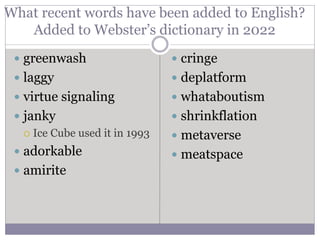
What recent words have been added to English?
Added to Webster’s dictionary in 2022
 greenwash
 laggy
 virtue signaling
 janky
 Ice Cube used it in 1993
 adorkable
 amirite
 cringe
 deplatform
 whataboutism
 shrinkflation
 metaverse
 meatspace
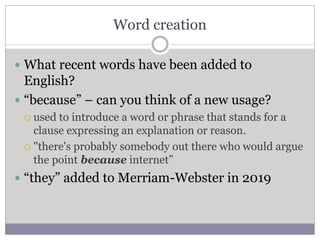
Word creation
 What recent words have been added to
English?
 “because” – can you think of a new usage?
 used to introduce a word or phrase that stands for a
clause expressing an explanation or reason.
 "there's probably somebody out there who would argue
the point because internet”
 “they” added to Merriam-Webster in 2019
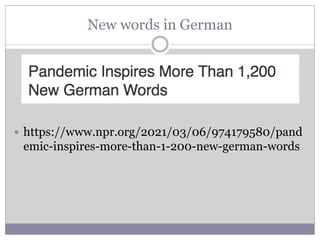
New words in German
 https://www.npr.org/2021/03/06/974179580/pand
emic-inspires-more-than-1-200-new-german-words
Word creation - rules
 Its form must conform to the rules of the
language concerned.
 People must be able to pronounce them.
 Frip might work as an English word, but phwooma
would be very unlikely.
 Must be useful in some way
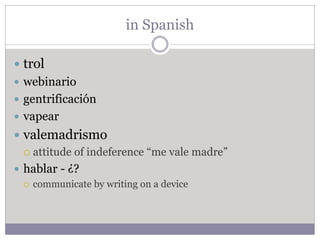
in Spanish
 trol
 webinario
 gentrificación
 vapear
 valemadrismo
 attitude of indeference “me vale madre”
 hablar - ¿?
 communicate by writing on a device
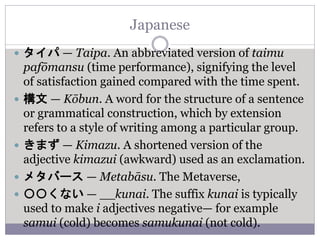
Japanese
 タイパ — Taipa. An abbreviated version of taimu
pafōmansu (time performance), signifying the level
of satisfaction gained compared with the time spent.
 構文 — Kōbun. A word for the structure of a sentence
or grammatical construction, which by extension
refers to a style of writing among a particular group.
 きまず — Kimazu. A shortened version of the
adjective kimazui (awkward) used as an exclamation.
 メタバース — Metabāsu. The Metaverse,
 〇〇くない — __kunai. The suffix kunai is typically
used to make i adjectives negative— for example
samui (cold) becomes samukunai (not cold).
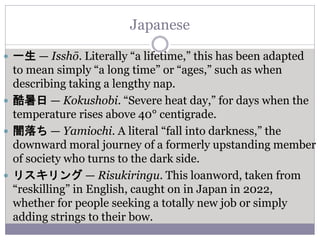
Japanese
 一生 — Isshō. Literally “a lifetime,” this has been adapted
to mean simply “a long time” or “ages,” such as when
describing taking a lengthy nap.
 酷暑日 — Kokushobi. “Severe heat day,” for days when the
temperature rises above 40° centigrade.
 闇落ち — Yamiochi. A literal “fall into darkness,” the
downward moral journey of a formerly upstanding member
of society who turns to the dark side.
 リスキリング — Risukiringu. This loanword, taken from
“reskilling” in English, caught on in Japan in 2022,
whether for people seeking a totally new job or simply
adding strings to their bow.
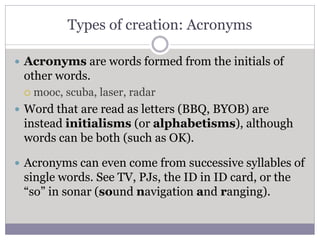
Types of creation: Acronyms
 Acronyms are words formed from the initials of
other words.
 mooc, scuba, laser, radar
 Word that are read as letters (BBQ, BYOB) are
instead initialisms (or alphabetisms), although
words can be both (such as OK).
 Acronyms can even come from successive syllables of
single words. See TV, PJs, the ID in ID card, or the
“so” in sonar (sound navigation and ranging).
Acronyms in your LS?
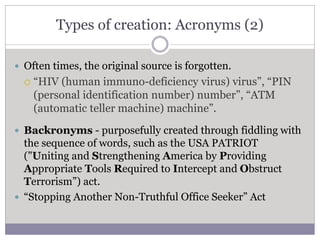
Types of creation: Acronyms (2)
 Often times, the original source is forgotten.
 “HIV (human immuno-deficiency virus) virus”, “PIN
(personal identification number) number”, “ATM
(automatic teller machine) machine”.
 Backronyms - purposefully created through fiddling with
the sequence of words, such as the USA PATRIOT
("Uniting and Strengthening America by Providing
Appropriate Tools Required to Intercept and Obstruct
Terrorism”) act.
 “Stopping Another Non-Truthful Office Seeker” Act
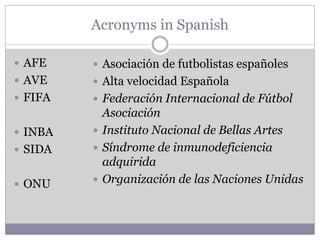
Acronyms in Spanish
 AFE
 AVE
 FIFA
 INBA
 SIDA
 ONU
 Asociación de futbolistas españoles
 Alta velocidad Española
 Federación Internacional de Fútbol
Asociación
 Instituto Nacional de Bellas Artes
 Síndrome de inmunodeficiencia
adquirida
 Organización de las Naciones Unidas
Types of creation: Shortenings
 Shortenings, or clipped words, are abbreviated
forms that end up replacing longer versions.
 The replacement can be total
 mob -- mobile vulgus)
 coexisting (dis and disrespect, cell and cellphone).
 meanings sometimes diverge (an app is now associated
with a phone, unlike an application).
 Shorter forms are often also considered colloquial or
casual, such as ‘cuz (because).
Shortenings
 Groups of 2-3
 Name 20 shortenings in English
 Go!
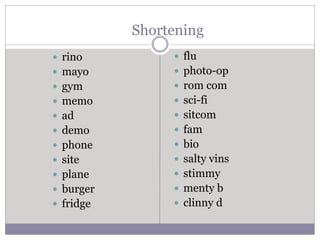
Shortening
 rino
 mayo
 gym
 memo
 ad
 demo
 phone
 site
 plane
 burger
 fridge
 flu
 photo-op
 rom com
 sci-fi
 sitcom
 fam
 bio
 salty vins
 stimmy
 menty b
 clinny d
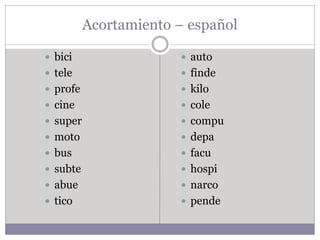
Acortamiento – español
 bici
 tele
 profe
 cine
 super
 moto
 bus
 subte
 abue
 tico
 auto
 finde
 kilo
 cole
 compu
 depa
 facu
 hospi
 narco
 pende
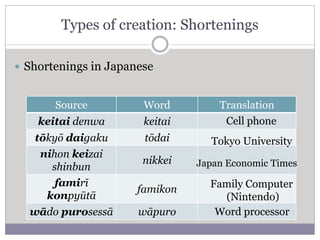
Types of creation: Shortenings
 Shortenings in Japanese
Source Word Translation
keitai denwa keitai
tōkyō daigaku tōdai
nihon keizai
shinbun
nikkei
famirī
konpyūtā
famikon
wādo purosessā wāpuro
Cell phone
Tokyo University
Japan Economic Times
Family Computer
(Nintendo)
Word processor
Shortenings in Japanese
 https://www.youtube.com/watch?v=iufg1rDAo60
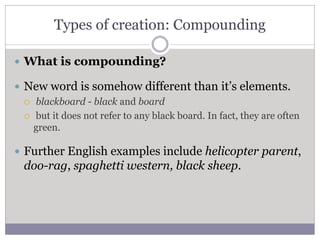
Types of creation: Compounding
 What is compounding?
 New word is somehow different than it’s elements.
 blackboard - black and board
 but it does not refer to any black board. In fact, they are often
green.
 Further English examples include helicopter parent,
doo-rag, spaghetti western, black sheep.
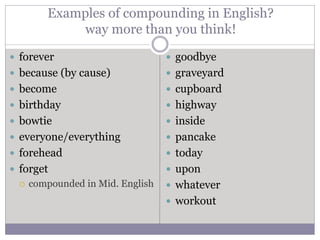
Examples of compounding in English?
way more than you think!
 forever
 because (by cause)
 become
 birthday
 bowtie
 everyone/everything
 forehead
 forget
 compounded in Mid. English
 goodbye
 graveyard
 cupboard
 highway
 inside
 pancake
 today
 upon
 whatever
 workout
Types of creation: Affixation
 Affixation is similar to compounding, but it
involves word parts that can’t stand alone like
prefixes and suffixes.
Types of creation: Backformation
 Backformation is the opposite strategy to affixation. It
refers to a word being created through the removal of
(what are thought to be) affixes from (often borrowed)
words to create new terms.
 beggar  to beg (old Rrench begart, "a member of the Beghards)
 emotion  to emote
 lazy  to laze
 Taser  to taze
 burglar  to burgle
 injury  to injure
Types of creation: Blends
 Blends are words that have been created from
combining two or more existing words into a new
one (also called a portmanteau).
 Sometimes the words are merged almost as wholes
(fantastic + fabulous to fantabulous), but other
times they involve pieces of both words (chocolate +
alcoholic to chocoholic), a word placed in another
(ambidextrous + sex to ambisextrous), or a full word
plus a piece of another (the earlier backronym or
hungry + angry to hangry).
Types of creation: Conversion
 Conversion refers to a part of speech (e.g., noun,
verb, adjective) being changed to another without
anything added.
o Verb to noun: a guess, a call, a think, a read, a big ask
o Noun to verb: to bottle, to bridge, to trash, to email
o Adjective to verb: to better, to empty, to open, to total (a car).
o Adjective to noun: a roast, a weekly, a regular, a given.
 There does not appear to be any restrictions on
conversion in English, but some languages have ways
of changing parts of speech through particles/affixes,
and therefore rarely simply use one part as another.
Types of creation: Reduplication
 Reduplication is a repetition process where all or
part of the stem of a word is repeated, creating a type
of compound.
 This is a peripheral process in English, but has
produced around 2,000 words over the years and
new ones are constantly being created.
 Some reduplications involve repetition of the whole
stem (goody-goody, fifty-fifty), others involve
rhyme (brain-drain, artsy-fartsy) or modification of
the stem vowel (dilly-dally, riff-raff).
shortening + reduplication = Tom Haverford
 https://www.youtube.com/watch?v=3mQoI_a_toU
Reduplication in other languages
 In German, examples include zickzack (zig-zag),
ruckizuki (quickly), and Mischmasch (mish-mash).
 In Japanese, a few select words like hito (person)
and toki (time) are frequently reduplicated to
indicate plurals (hitobito, people) or other meanings
tokidoki (sometimes).
Types of creation: Borrowing
 Borrowing - process where a linguistic element is
incorporated from another language.
 Words are the most commonly borrowed part of a
language, but all parts of grammar can be “on loan”.
 English has borrowings from 120+ languages!
Can Japanese Speak In Pure Japanese?
 https://www.youtube.com/watch?v=88Nh0wvQGYk
 ¿What words do you know in English that
come from other languages?
 Think of words that we use or recognize daily
that don’t have any other word in English:
 Karate (japonés)
 croissant (francés)
 opera (italiano)
 zeitgeist, blitzkrieg, shadenfreude (alemán)
 Try to think of 30 English words that come
from Spanish
 Food/drink:
 Cities/states:
 Animales:
adobe (originally Coptic
tobe, "brick")
· aficionado
· albino
· alcove
· alfalfa
· alligator (from el lagarto,
"thelizard")
• armadillo (literally, "the little
armed one")
• armada
• avocado
• banana (word, originally of
African origin, entered
English via either Spanish or
Portuguese)
• · barracuda
• · barbecue (from barbacoa,
a word of Caribbean origin)
• · bonanza
• · bronco (means "wild" or "rough" in
Spanish)
• · buckaroo
• · burrito (literally "little donkey”)
• · cafeteria (from cafetería)
• · canary
• · canasta
• · cannibal (originally of Caribbean
origin)
• · canoe
• · canyon (from cañon)
• · cargo (from cargar, "to load")
• · castanet (from castañeta)
• · chaps (from Mexican Spanish
chaparreras)
• · chihuahua (dog breed named after
Mexican city and state)
• · chile relleno (Mexican food)
· chili (derived from Nahuatl)
• · chocolate
• · cigar, cigarette (from cigarro)
• · cilantro
• · cinch (from cincho, "belt")
• · cocaine
• · cockroach
• · coco
• · conquistador
• · condor
• · corral
• · coyote (from the Nahuatl coyotl)
• · creole (from criollo)
• · desperado
• · dorado (type of fish)
• · El Niño· embargo (from
embargar, to bar)
• · enchilada
• · fajita
• · filibuster (from filibustero, derived from
Dutch vrijbuiter, "pirate")
• · flan (a type of custard)
• · flotilla
• · galleon (from Spanish galeón)
• · garbanzo (type of bean)
• · guacamole
• · guerrilla
• · hammock
• · habanero
• · hurricane
• · iguana
• · incomunicado
• · jaguar
• · jalapeño
• · jerky · key
• · lasso (from lazo)
• · llama (originally from Quechua)
• · machete
• · maize (from maíz, originally from Arawak)
• · manatee
• · mano a mano (literally, "hand to
hand")
• · matador (literally, "killer")
• · marijuana
• · mesa ·
• margarita
• · mariachi
• · mesquite
• · mestizo
• · mosquito
• · mulatto (from mulato)
• · mustang (from mestengo, "stray")
• · nacho
• · oregano (from orégano)
• · paella (a savory Spanish rice dish)
• · papaya (originally Arawak)
• · patio
• · pimento (Spanish pimiento)
• · pinto
• · piñata
• ·
• · piña colada
• · plantain (from plátano or
plántano)
• · plaza
• · poncho
• potato (from batata, a word of
Caribbean origin)
• · pueblo
• · puma (originally from Quechua)
• quesadilla
• · ranch
• · renegade (from renegado)
• · rodeo
• · salsa
• · sassafras (from sasafrás)
• · savanna
• · savvy (from sabe, a form of the
verb saber, "to know")
• · serrano (type of pepper)
• · shack
• · siesta
• · silo
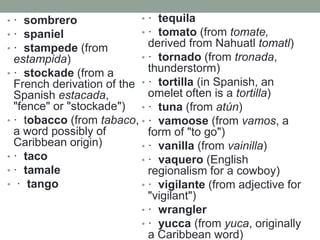
• · sombrero
• · spaniel
• · stampede (from
estampida)
• · stockade (from a
French derivation of the
Spanish estacada,
"fence" or "stockade")
• · tobacco (from tabaco,
a word possibly of
Caribbean origin)
• · taco
• · tamale
• · tango
• · tequila
• · tomato (from tomate,
derived from Nahuatl tomatl)
• · tornado (from tronada,
thunderstorm)
• · tortilla (in Spanish, an
omelet often is a tortilla)
• · tuna (from atún)
• · vamoose (from vamos, a
form of "to go")
• · vanilla (from vainilla)
• · vaquero (English
regionalism for a cowboy)
• · vigilante (from adjective for
"vigilant")
• · wrangler
• · yucca (from yuca, originally
a Caribbean word)
Types of borrowing: Calques
 Calque. This is when something is borrowed but
expressed using the borrowing language.
 A very common calque is skyscraper.
o French: gratte-ciel Literally: “scrapes sky”
o Japanese: matenrō Literally: “sky-scrape-tower”
o Chinese: mótiānlóu Literally: “sky-scrape-building”
o Dutch: wolkenkrabber Literally: “cloud scratcher”
 Calques often go unnoticed: earworm, long time no
see, brainwash, Adam’s apple, wisdom tooth
Application
 How can you use you knowledge of these terms to
improve your understanding and proficiency in your
LS?

Chapter 4.2 pptx

  • 1.
    D E FI N I T I O N S , C H A R A C T E R I S T I C S , A N D P O W E R P P , 4.2 What’s in a word?
  • 2.
    Shibboleth  Custom, useof language, or word regarded as distinctive of a particular group (often distinguishing one group from others).  Oxford.com  A shibboleth is a kind of linguistic password: A way of speaking (a pronunciation, or the use of a particular expression) that is used by one set of people to identify another person as a member, or a non-member, of a particular group. The group making the identification has some kind of social power to set the standards for who belongs to their group: who is "in" and who is "out”.  rice.edu
  • 3.
     And theGileadites took the passages of Jordan before the Ephraimites: and it was so, that when those Ephraimites which were escaped said, Let me go over; that the men of Gilead said unto him, Art thou an Ephraimite? If he said, Nay; Then said they unto him, Say now Shibboleth: and he said Sibboleth: for he could not frame to pronounce it right. Then they took him, and slew him at the passages of Jordan: and there fell at that time of the Ephraimites forty and two thousand.  — Judges 12:5–6
  • 4.
    Parsley massacre  InOctober 1937, the Spanish word for parsley, perejil, was used as a shibboleth to identify Haitian immigrants living along the border in the Dominican Republic.
  • 5.
    T H EC R E A T I O N / C O I N A G E O F W O R D S Lexical addition
  • 6.
    What recent wordshave been added to English? Added to Webster’s dictionary in 2022  greenwash  laggy  virtue signaling  janky  Ice Cube used it in 1993  adorkable  amirite  cringe  deplatform  whataboutism  shrinkflation  metaverse  meatspace
  • 7.
    Word creation  Whatrecent words have been added to English?  “because” – can you think of a new usage?  used to introduce a word or phrase that stands for a clause expressing an explanation or reason.  "there's probably somebody out there who would argue the point because internet”  “they” added to Merriam-Webster in 2019
  • 8.
    New words inGerman  https://www.npr.org/2021/03/06/974179580/pand emic-inspires-more-than-1-200-new-german-words
  • 9.
    Word creation -rules  Its form must conform to the rules of the language concerned.  People must be able to pronounce them.  Frip might work as an English word, but phwooma would be very unlikely.  Must be useful in some way
  • 10.
    in Spanish  trol webinario  gentrificación  vapear  valemadrismo  attitude of indeference “me vale madre”  hablar - ¿?  communicate by writing on a device
  • 11.
    Japanese  タイパ —Taipa. An abbreviated version of taimu pafōmansu (time performance), signifying the level of satisfaction gained compared with the time spent.  構文 — Kōbun. A word for the structure of a sentence or grammatical construction, which by extension refers to a style of writing among a particular group.  きまず — Kimazu. A shortened version of the adjective kimazui (awkward) used as an exclamation.  メタバース — Metabāsu. The Metaverse,  〇〇くない — __kunai. The suffix kunai is typically used to make i adjectives negative— for example samui (cold) becomes samukunai (not cold).
  • 12.
    Japanese  一生 —Isshō. Literally “a lifetime,” this has been adapted to mean simply “a long time” or “ages,” such as when describing taking a lengthy nap.  酷暑日 — Kokushobi. “Severe heat day,” for days when the temperature rises above 40° centigrade.  闇落ち — Yamiochi. A literal “fall into darkness,” the downward moral journey of a formerly upstanding member of society who turns to the dark side.  リスキリング — Risukiringu. This loanword, taken from “reskilling” in English, caught on in Japan in 2022, whether for people seeking a totally new job or simply adding strings to their bow.
  • 13.
    Types of creation:Acronyms  Acronyms are words formed from the initials of other words.  mooc, scuba, laser, radar  Word that are read as letters (BBQ, BYOB) are instead initialisms (or alphabetisms), although words can be both (such as OK).  Acronyms can even come from successive syllables of single words. See TV, PJs, the ID in ID card, or the “so” in sonar (sound navigation and ranging).
  • 14.
  • 15.
    Types of creation:Acronyms (2)  Often times, the original source is forgotten.  “HIV (human immuno-deficiency virus) virus”, “PIN (personal identification number) number”, “ATM (automatic teller machine) machine”.  Backronyms - purposefully created through fiddling with the sequence of words, such as the USA PATRIOT ("Uniting and Strengthening America by Providing Appropriate Tools Required to Intercept and Obstruct Terrorism”) act.  “Stopping Another Non-Truthful Office Seeker” Act
  • 16.
    Acronyms in Spanish AFE  AVE  FIFA  INBA  SIDA  ONU  Asociación de futbolistas españoles  Alta velocidad Española  Federación Internacional de Fútbol Asociación  Instituto Nacional de Bellas Artes  Síndrome de inmunodeficiencia adquirida  Organización de las Naciones Unidas
  • 17.
    Types of creation:Shortenings  Shortenings, or clipped words, are abbreviated forms that end up replacing longer versions.  The replacement can be total  mob -- mobile vulgus)  coexisting (dis and disrespect, cell and cellphone).  meanings sometimes diverge (an app is now associated with a phone, unlike an application).  Shorter forms are often also considered colloquial or casual, such as ‘cuz (because).
  • 18.
    Shortenings  Groups of2-3  Name 20 shortenings in English  Go!
  • 19.
    Shortening  rino  mayo gym  memo  ad  demo  phone  site  plane  burger  fridge  flu  photo-op  rom com  sci-fi  sitcom  fam  bio  salty vins  stimmy  menty b  clinny d
  • 20.
    Acortamiento – español bici  tele  profe  cine  super  moto  bus  subte  abue  tico  auto  finde  kilo  cole  compu  depa  facu  hospi  narco  pende
  • 21.
    Types of creation:Shortenings  Shortenings in Japanese Source Word Translation keitai denwa keitai tōkyō daigaku tōdai nihon keizai shinbun nikkei famirī konpyūtā famikon wādo purosessā wāpuro Cell phone Tokyo University Japan Economic Times Family Computer (Nintendo) Word processor
  • 22.
    Shortenings in Japanese https://www.youtube.com/watch?v=iufg1rDAo60
  • 23.
    Types of creation:Compounding  What is compounding?  New word is somehow different than it’s elements.  blackboard - black and board  but it does not refer to any black board. In fact, they are often green.  Further English examples include helicopter parent, doo-rag, spaghetti western, black sheep.
  • 24.
    Examples of compoundingin English? way more than you think!  forever  because (by cause)  become  birthday  bowtie  everyone/everything  forehead  forget  compounded in Mid. English  goodbye  graveyard  cupboard  highway  inside  pancake  today  upon  whatever  workout
  • 25.
    Types of creation:Affixation  Affixation is similar to compounding, but it involves word parts that can’t stand alone like prefixes and suffixes.
  • 26.
    Types of creation:Backformation  Backformation is the opposite strategy to affixation. It refers to a word being created through the removal of (what are thought to be) affixes from (often borrowed) words to create new terms.  beggar  to beg (old Rrench begart, "a member of the Beghards)  emotion  to emote  lazy  to laze  Taser  to taze  burglar  to burgle  injury  to injure
  • 27.
    Types of creation:Blends  Blends are words that have been created from combining two or more existing words into a new one (also called a portmanteau).  Sometimes the words are merged almost as wholes (fantastic + fabulous to fantabulous), but other times they involve pieces of both words (chocolate + alcoholic to chocoholic), a word placed in another (ambidextrous + sex to ambisextrous), or a full word plus a piece of another (the earlier backronym or hungry + angry to hangry).
  • 28.
    Types of creation:Conversion  Conversion refers to a part of speech (e.g., noun, verb, adjective) being changed to another without anything added. o Verb to noun: a guess, a call, a think, a read, a big ask o Noun to verb: to bottle, to bridge, to trash, to email o Adjective to verb: to better, to empty, to open, to total (a car). o Adjective to noun: a roast, a weekly, a regular, a given.  There does not appear to be any restrictions on conversion in English, but some languages have ways of changing parts of speech through particles/affixes, and therefore rarely simply use one part as another.
  • 29.
    Types of creation:Reduplication  Reduplication is a repetition process where all or part of the stem of a word is repeated, creating a type of compound.  This is a peripheral process in English, but has produced around 2,000 words over the years and new ones are constantly being created.  Some reduplications involve repetition of the whole stem (goody-goody, fifty-fifty), others involve rhyme (brain-drain, artsy-fartsy) or modification of the stem vowel (dilly-dally, riff-raff).
  • 30.
    shortening + reduplication= Tom Haverford  https://www.youtube.com/watch?v=3mQoI_a_toU
  • 31.
    Reduplication in otherlanguages  In German, examples include zickzack (zig-zag), ruckizuki (quickly), and Mischmasch (mish-mash).  In Japanese, a few select words like hito (person) and toki (time) are frequently reduplicated to indicate plurals (hitobito, people) or other meanings tokidoki (sometimes).
  • 32.
    Types of creation:Borrowing  Borrowing - process where a linguistic element is incorporated from another language.  Words are the most commonly borrowed part of a language, but all parts of grammar can be “on loan”.  English has borrowings from 120+ languages!
  • 33.
    Can Japanese SpeakIn Pure Japanese?  https://www.youtube.com/watch?v=88Nh0wvQGYk
  • 34.
     ¿What wordsdo you know in English that come from other languages?  Think of words that we use or recognize daily that don’t have any other word in English:  Karate (japonés)  croissant (francés)  opera (italiano)  zeitgeist, blitzkrieg, shadenfreude (alemán)
  • 35.
     Try tothink of 30 English words that come from Spanish  Food/drink:  Cities/states:  Animales:
  • 36.
    adobe (originally Coptic tobe,"brick") · aficionado · albino · alcove · alfalfa · alligator (from el lagarto, "thelizard") • armadillo (literally, "the little armed one") • armada • avocado • banana (word, originally of African origin, entered English via either Spanish or Portuguese) • · barracuda • · barbecue (from barbacoa, a word of Caribbean origin) • · bonanza • · bronco (means "wild" or "rough" in Spanish) • · buckaroo • · burrito (literally "little donkey”) • · cafeteria (from cafetería) • · canary • · canasta • · cannibal (originally of Caribbean origin) • · canoe • · canyon (from cañon) • · cargo (from cargar, "to load") • · castanet (from castañeta) • · chaps (from Mexican Spanish chaparreras) • · chihuahua (dog breed named after Mexican city and state) • · chile relleno (Mexican food)
  • 37.
    · chili (derivedfrom Nahuatl) • · chocolate • · cigar, cigarette (from cigarro) • · cilantro • · cinch (from cincho, "belt") • · cocaine • · cockroach • · coco • · conquistador • · condor • · corral • · coyote (from the Nahuatl coyotl) • · creole (from criollo) • · desperado • · dorado (type of fish) • · El Niño· embargo (from embargar, to bar) • · enchilada • · fajita • · filibuster (from filibustero, derived from Dutch vrijbuiter, "pirate") • · flan (a type of custard) • · flotilla • · galleon (from Spanish galeón) • · garbanzo (type of bean) • · guacamole • · guerrilla • · hammock • · habanero • · hurricane • · iguana • · incomunicado • · jaguar • · jalapeño • · jerky · key • · lasso (from lazo) • · llama (originally from Quechua) • · machete • · maize (from maíz, originally from Arawak)
  • 38.
    • · manatee •· mano a mano (literally, "hand to hand") • · matador (literally, "killer") • · marijuana • · mesa · • margarita • · mariachi • · mesquite • · mestizo • · mosquito • · mulatto (from mulato) • · mustang (from mestengo, "stray") • · nacho • · oregano (from orégano) • · paella (a savory Spanish rice dish) • · papaya (originally Arawak) • · patio • · pimento (Spanish pimiento) • · pinto • · piñata • · • · piña colada • · plantain (from plátano or plántano) • · plaza • · poncho • potato (from batata, a word of Caribbean origin) • · pueblo • · puma (originally from Quechua) • quesadilla • · ranch • · renegade (from renegado) • · rodeo • · salsa • · sassafras (from sasafrás) • · savanna • · savvy (from sabe, a form of the verb saber, "to know") • · serrano (type of pepper) • · shack • · siesta • · silo
  • 39.
    • · sombrero •· spaniel • · stampede (from estampida) • · stockade (from a French derivation of the Spanish estacada, "fence" or "stockade") • · tobacco (from tabaco, a word possibly of Caribbean origin) • · taco • · tamale • · tango • · tequila • · tomato (from tomate, derived from Nahuatl tomatl) • · tornado (from tronada, thunderstorm) • · tortilla (in Spanish, an omelet often is a tortilla) • · tuna (from atún) • · vamoose (from vamos, a form of "to go") • · vanilla (from vainilla) • · vaquero (English regionalism for a cowboy) • · vigilante (from adjective for "vigilant") • · wrangler • · yucca (from yuca, originally a Caribbean word)
  • 40.
    Types of borrowing:Calques  Calque. This is when something is borrowed but expressed using the borrowing language.  A very common calque is skyscraper. o French: gratte-ciel Literally: “scrapes sky” o Japanese: matenrō Literally: “sky-scrape-tower” o Chinese: mótiānlóu Literally: “sky-scrape-building” o Dutch: wolkenkrabber Literally: “cloud scratcher”  Calques often go unnoticed: earworm, long time no see, brainwash, Adam’s apple, wisdom tooth
  • 41.
    Application  How canyou use you knowledge of these terms to improve your understanding and proficiency in your LS?