Sucheta Gupta
Lalit Kumar Aggarwal
Amit Kumar
Srujana
Praveen
Parameshwari P
The Globalization of CEMEX
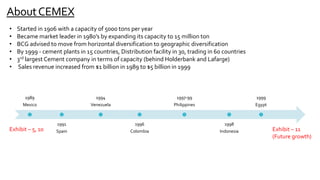
AboutCEMEX
1989
Mexico
1991
Spain
1994
Venezuela
1996
Colombia
1997-99
Philippines
1998
Indonesia
1999
Egypt
• Started in 1906 with a capacity of 5000 tons per year
• Became market leader in 1980’s by expanding its capacity to 15 million ton
• BCG advised to move from horizontal diversification to geographic diversification
• By 1999 - cement plants in 15 countries, Distribution facility in 30, trading in 60 countries
• 3rd largest Cement company in terms of capacity (behind Holderbank and Lafarge)
• Sales revenue increased from $1 billion in 1989 to $5 billion in 1999
Exhibit – 5, 10 Exhibit – 11
(Future growth)
About Industry
• Used as a binding agent
• Production process remain unchanged with no major innovation (considered mature) [exhibit 1]
• Production facility near raw material quarries
• High transportation cost limited sale to nearby areas (1/3rd of total delivered cost) [exhibit 2]
• Demand related to GDP
• Other factors : Rainfall, Population density,Warm climate, coastline length and government expenditure
• Bulk sales sensitive to GDP growth, interest rate and other macroeconomic factors
• Retail sales tends to be less cyclical and offered opportunity for branding
• Leadership pricing strategy to avoid overcapacity
• 6 major international players controlled 500 million ton of capacity. (12% concentration ratio) [exhibit 3,4,5]
• Major acquisition happened at the bottom of the local economic cycle
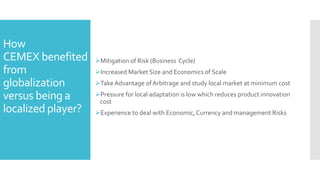
How
CEMEX benefited
from
globalization
versus being a
localized player?
Mitigation of Risk (Business Cycle)
Increased Market Size and Economics of Scale
TakeAdvantage ofArbitrage and study local market at minimum cost
Pressure for local adaptation is low which reduces product innovation
cost
Experience to deal with Economic,Currency and management Risks
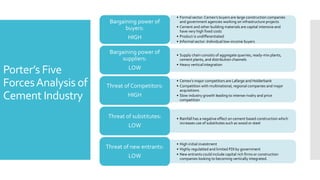
Porter’s Five
ForcesAnalysis of
Cement Industry
• Formal sector: Cemex’s buyers are large construction companies
and government agencies working on infrastructure projects
• Cement and other building materials are capital intensive and
have very high fixed costs
• Product is undifferentiated
• Informal sector: Individual low-income buyers
Bargaining power of
buyers:
HIGH
• Supply chain consists of aggregate quarries, ready-mix plants,
cement plants, and distribution channels
• Heavy vertical integration
Bargaining power of
suppliers:
LOW
• Cemex’s major competitors are Lafarge and Holderbank
• Competition with multinational, regional companies and major
acquisitions
• Slow industry growth leading to intense rivalry and price
competition
Threat of Competitors:
HIGH
• Rainfall has a negative effect on cement based construction which
increases use of substitutes such as wood or steel
Threat of substitutes:
LOW
• High initial investment
• Highly regulatted and limited FDI by government
• New entrants could include capital rich firms or construction
companies looking to becoming vertically integrated.
Threat of new entrants:
LOW
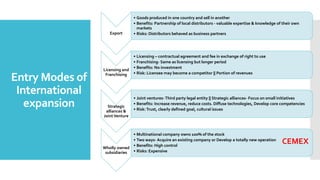
Entry Modes of
International
expansion
Export
• Goods produced in one country and sell in another
• Benefits: Partnership of local distributors - valuable expertise & knowledge of their own
markets
• Risks: Distributors behaved as business partners
Licensing and
Franchising
• Licensing – contractual agreement and fee in exchange of right to use
• Franchising- Same as licensing but longer period
• Benefits: No investment
• Risk: Licensee may become a competitor || Portion of revenues
Strategic
alliances &
JointVenture
• Joint ventures-Third party legal entity || Strategic alliances- Focus on small initiatives
• Benefits: Increase revenue, reduce costs. Diffuse technologies, Develop core competencies
• Risk:Trust, clearly defined goal, cultural issues
Wholly owned
subsidiaries
• Multinational company owns 100% of the stock
• Two ways- Acquire an existing company or Develop a totally new operation
• Benefits: High control
• Risks: Expensive
CEMEX
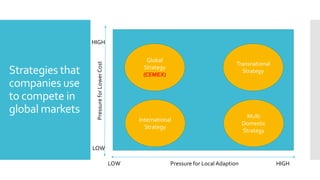
Strategies that
companies use
to compete in
global markets
Transnational
Strategy
Global
Strategy
(CEMEX)
Multi
Domestic
Strategy
International
Strategy
Pressure for Local Adaption
PressureforLowerCost
LOW
LOW
HIGH
HIGH
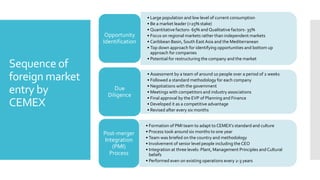
Sequence of
foreign market
entry by
CEMEX
• Large population and low level of current consumption
• Be a market leader (>25% stake)
• Quantitative factors- 65% and Qualitative factors- 35%
• Focus on regional markets rather than independent markets
• Caribbean Basin, South East Asia and the Mediterranean
• Top down approach for identifying opportunities and bottom up
approach for companies
• Potential for restructuring the company and the market
Opportunity
Identification
• Assessment by a team of around 10 people over a period of 2 weeks
• Followed a standard methodology for each company
• Negotiations with the government
• Meetings with competitors and industry associations
• Final approval by the EVP of Planning and Finance
• Developed it as a competitive advantage
• Revised after every six months
Due
Diligence
• Formation of PMI team to adapt to CEMEX’s standard and culture
• Process took around six months to one year
• Team was briefed on the country and methodology
• Involvement of senior level people including the CEO
• Integration at three levels: Plant, Management Principles and Cultural
beliefs
• Performed even on existing operations every 2-3 years
Post-merger
Integration
(PMI)
Process
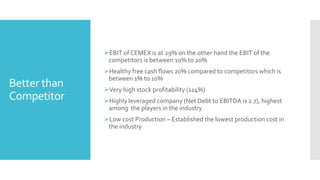
Better than
Competitor
EBIT of CEMEX is at 29% on the other hand the EBIT of the
competitors is between 10% to 20%
Healthy free cash flows 20% compared to competitors which is
between 1% to 10%
Very high stock profitability (114%)
Highly leveraged company (Net Debt to EBITDA is 2.7), highest
among the players in the industry
Low cost Production – Established the lowest production cost in
the industry
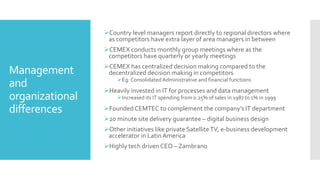
Management
and
organizational
differences
Country level managers report directly to regional directors where
as competitors have extra layer of area managers in between
CEMEX conducts monthly group meetings where as the
competitors have quarterly or yearly meetings
CEMEX has centralized decision making compared to the
decentralized decision making in competitors
Eg: Consolidated Administrative and financial functions
Heavily invested in IT for processes and data management
Increased its IT spending from 0.25% of sales in 1987 to 1% in 1999
Founded CEMTEC to complement the company’s IT department
20 minute site delivery guarantee – digital business design
Other initiatives like private SatelliteTV, e-business development
accelerator in LatinAmerica
Highly tech driven CEO – Zambrano
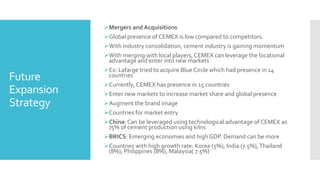
Future
Expansion
Strategy
Mergers and Acquisitions
Global presence of CEMEX is low compared to competitors.
With industry consolidation, cement industry is gaining momentum
With merging with local players, CEMEX can leverage the locational
advantage and enter into new markets
Ex: Lafarge tried to acquire Blue Circle which had presence in 14
countries
Currently, CEMEX has presence in 15 countries
Enter new markets to increase market share and global presence
Augment the brand image
Countries for market entry
China: Can be leveraged using technological advantage of CEMEX as
75% of cement production using kilns
BRICS: Emerging economies and high GDP. Demand can be more
Countries with high growth rate: Korea (5%), India (7.5%),Thailand
(8%), Philippines (8%), Malaysia( 7.5%)

Sm cemex final_1

  • 1.
    Sucheta Gupta Lalit KumarAggarwal Amit Kumar Srujana Praveen Parameshwari P The Globalization of CEMEX
  • 2.
    AboutCEMEX 1989 Mexico 1991 Spain 1994 Venezuela 1996 Colombia 1997-99 Philippines 1998 Indonesia 1999 Egypt • Started in1906 with a capacity of 5000 tons per year • Became market leader in 1980’s by expanding its capacity to 15 million ton • BCG advised to move from horizontal diversification to geographic diversification • By 1999 - cement plants in 15 countries, Distribution facility in 30, trading in 60 countries • 3rd largest Cement company in terms of capacity (behind Holderbank and Lafarge) • Sales revenue increased from $1 billion in 1989 to $5 billion in 1999 Exhibit – 5, 10 Exhibit – 11 (Future growth)
  • 3.
    About Industry • Usedas a binding agent • Production process remain unchanged with no major innovation (considered mature) [exhibit 1] • Production facility near raw material quarries • High transportation cost limited sale to nearby areas (1/3rd of total delivered cost) [exhibit 2] • Demand related to GDP • Other factors : Rainfall, Population density,Warm climate, coastline length and government expenditure • Bulk sales sensitive to GDP growth, interest rate and other macroeconomic factors • Retail sales tends to be less cyclical and offered opportunity for branding • Leadership pricing strategy to avoid overcapacity • 6 major international players controlled 500 million ton of capacity. (12% concentration ratio) [exhibit 3,4,5] • Major acquisition happened at the bottom of the local economic cycle
  • 4.
    How CEMEX benefited from globalization versus beinga localized player? Mitigation of Risk (Business Cycle) Increased Market Size and Economics of Scale TakeAdvantage ofArbitrage and study local market at minimum cost Pressure for local adaptation is low which reduces product innovation cost Experience to deal with Economic,Currency and management Risks
  • 5.
    Porter’s Five ForcesAnalysis of CementIndustry • Formal sector: Cemex’s buyers are large construction companies and government agencies working on infrastructure projects • Cement and other building materials are capital intensive and have very high fixed costs • Product is undifferentiated • Informal sector: Individual low-income buyers Bargaining power of buyers: HIGH • Supply chain consists of aggregate quarries, ready-mix plants, cement plants, and distribution channels • Heavy vertical integration Bargaining power of suppliers: LOW • Cemex’s major competitors are Lafarge and Holderbank • Competition with multinational, regional companies and major acquisitions • Slow industry growth leading to intense rivalry and price competition Threat of Competitors: HIGH • Rainfall has a negative effect on cement based construction which increases use of substitutes such as wood or steel Threat of substitutes: LOW • High initial investment • Highly regulatted and limited FDI by government • New entrants could include capital rich firms or construction companies looking to becoming vertically integrated. Threat of new entrants: LOW
  • 6.
    Entry Modes of International expansion Export •Goods produced in one country and sell in another • Benefits: Partnership of local distributors - valuable expertise & knowledge of their own markets • Risks: Distributors behaved as business partners Licensing and Franchising • Licensing – contractual agreement and fee in exchange of right to use • Franchising- Same as licensing but longer period • Benefits: No investment • Risk: Licensee may become a competitor || Portion of revenues Strategic alliances & JointVenture • Joint ventures-Third party legal entity || Strategic alliances- Focus on small initiatives • Benefits: Increase revenue, reduce costs. Diffuse technologies, Develop core competencies • Risk:Trust, clearly defined goal, cultural issues Wholly owned subsidiaries • Multinational company owns 100% of the stock • Two ways- Acquire an existing company or Develop a totally new operation • Benefits: High control • Risks: Expensive CEMEX
  • 7.
    Strategies that companies use tocompete in global markets Transnational Strategy Global Strategy (CEMEX) Multi Domestic Strategy International Strategy Pressure for Local Adaption PressureforLowerCost LOW LOW HIGH HIGH
  • 8.
    Sequence of foreign market entryby CEMEX • Large population and low level of current consumption • Be a market leader (>25% stake) • Quantitative factors- 65% and Qualitative factors- 35% • Focus on regional markets rather than independent markets • Caribbean Basin, South East Asia and the Mediterranean • Top down approach for identifying opportunities and bottom up approach for companies • Potential for restructuring the company and the market Opportunity Identification • Assessment by a team of around 10 people over a period of 2 weeks • Followed a standard methodology for each company • Negotiations with the government • Meetings with competitors and industry associations • Final approval by the EVP of Planning and Finance • Developed it as a competitive advantage • Revised after every six months Due Diligence • Formation of PMI team to adapt to CEMEX’s standard and culture • Process took around six months to one year • Team was briefed on the country and methodology • Involvement of senior level people including the CEO • Integration at three levels: Plant, Management Principles and Cultural beliefs • Performed even on existing operations every 2-3 years Post-merger Integration (PMI) Process
  • 9.
    Better than Competitor EBIT ofCEMEX is at 29% on the other hand the EBIT of the competitors is between 10% to 20% Healthy free cash flows 20% compared to competitors which is between 1% to 10% Very high stock profitability (114%) Highly leveraged company (Net Debt to EBITDA is 2.7), highest among the players in the industry Low cost Production – Established the lowest production cost in the industry
  • 10.
    Management and organizational differences Country level managersreport directly to regional directors where as competitors have extra layer of area managers in between CEMEX conducts monthly group meetings where as the competitors have quarterly or yearly meetings CEMEX has centralized decision making compared to the decentralized decision making in competitors Eg: Consolidated Administrative and financial functions Heavily invested in IT for processes and data management Increased its IT spending from 0.25% of sales in 1987 to 1% in 1999 Founded CEMTEC to complement the company’s IT department 20 minute site delivery guarantee – digital business design Other initiatives like private SatelliteTV, e-business development accelerator in LatinAmerica Highly tech driven CEO – Zambrano
  • 11.
    Future Expansion Strategy Mergers and Acquisitions Globalpresence of CEMEX is low compared to competitors. With industry consolidation, cement industry is gaining momentum With merging with local players, CEMEX can leverage the locational advantage and enter into new markets Ex: Lafarge tried to acquire Blue Circle which had presence in 14 countries Currently, CEMEX has presence in 15 countries Enter new markets to increase market share and global presence Augment the brand image Countries for market entry China: Can be leveraged using technological advantage of CEMEX as 75% of cement production using kilns BRICS: Emerging economies and high GDP. Demand can be more Countries with high growth rate: Korea (5%), India (7.5%),Thailand (8%), Philippines (8%), Malaysia( 7.5%)