University of the Punjab
Department of English Language & Literature
Lahore, Pakistan
Syntax
The study of:
• Grammatical relations between words and
other units within the sentence
• Word order
• Sentence formation
Syntax
• Languages differ not only in sounds, but also the ways in
which words can be put together into larger units this is Syntax
• Rules about how words can be put together differ according to
language , dialect, social group, time frame etc
• “They know not what they do”
– does not follow the rules we use
– for modern English, but was totally normal in the 17th
Century
• Even though the word meanings haven’t changed, the syntax
has
Syntactic Theory
• Syntactic theory is about the rules and principles that
determine:
– how people combine words to make meaningful sentences
• Sentences are not just strings of words
– in the same way that words are not just strings of
morphemes
• There are strict syntactic rules about the structure of sentences
– how to combine words in specific way to reach a certain
meaning
• Structure at a phrasal and sentence level
Bag of words
• Consider these words: Bit A The Dog Cat
–A cat bit the dog
–The cat bit a dog
–A dog bit the cat
–The dog bit a cat
• All of these have specific, and different meanings
• These different meanings come about solely from our
combinations of words
Syntactic Categories
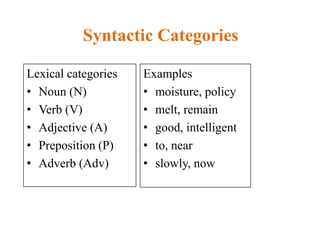
Lexical categories
• Noun (N)
• Verb (V)
• Adjective (A)
• Preposition (P)
• Adverb (Adv)
Examples
• moisture, policy
• melt, remain
• good, intelligent
• to, near
• slowly, now
Syntactic Categories
Non-lexical categories
 Determiner (Det)
 Degree word (Deg)
 Qualifier (Qual)
 Auxiliary (Aux)
 Conjunction (Con)
Examples
 the, this
 very, more
 always, perhaps
 will, can
 and, or
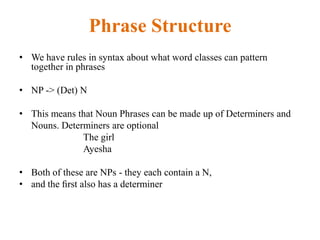
Phrase Structure
• We have rules in syntax about what word classes can pattern
together in phrases
• NP -> (Det) N
• This means that Noun Phrases can be made up of Determiners and
Nouns. Determiners are optional
The girl
Ayesha
• Both of these are NPs - they each contain a N,
• and the first also has a determiner
NP Rule
• First, DET means determiner
– Function words like the, a, this, several
• NP  (DET) N
– That means a noun phrase can have a determiner, and it
must have a noun
– S  NP VP
– VP  V NP
– NP  (DET) (ADJ) N
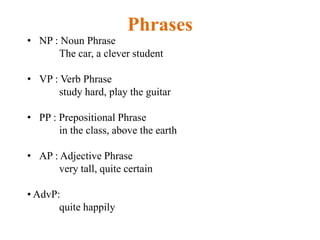
Phrases
• NP : Noun Phrase
The car, a clever student
• VP : Verb Phrase
study hard, play the guitar
• PP : Prepositional Phrase
in the class, above the earth
• AP : Adjective Phrase
very tall, quite certain
• AdvP:
quite happily
Noun Phrase Structure Rules
• NP (Det) N (PP)
• PP P NP
The bus (NP)
The
NDet
bus
The bus in the yard
NP
The
NDet
bus
PP
in
NPP
the
Det N
yard
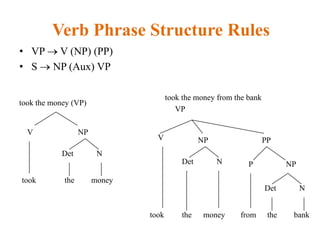
Verb Phrase Structure Rules
• VP V (NP) (PP)
• S NP (Aux) VP
took the money (VP)
took
NPV
took the money from the bank
VP
took
NPV PP
from
NPP
the
Det N
bank
the
Det N
money
the
Det N
money
PP
P NP
from Det N PP
a boy P NP
in Det N
a bubble
Prepositional Phrase Structure Rules
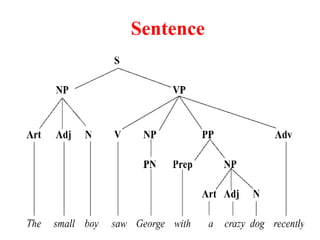
Sentence
Sentence structure
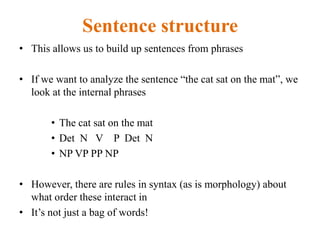
• This allows us to build up sentences from phrases
• If we want to analyze the sentence “the cat sat on the mat”, we
look at the internal phrases
• The cat sat on the mat
• Det N V P Det N
• NP VP PP NP
• However, there are rules in syntax (as is morphology) about
what order these interact in
• It’s not just a bag of words!
Constituency
• A sentence is divided into groups of words
• The connections between words in one group is closer than
between words belonging to different groups
• A group of words that cling together is called a constituent
– To test whether a group of words is a constituent, we have
3 tests:
• Replacement/Substitution:
– a constituent can be replaced by a single word
• Movement:
– a constituent as a whole, can be placed in a different
• position in a sentence
– Clefting: Change sentences to “it was...”
All languages have constituents
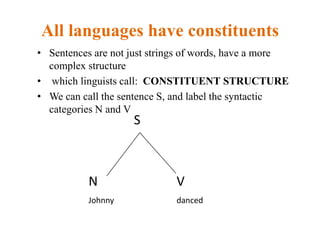
• Sentences are not just strings of words, have a more
complex structure
• which linguists call: CONSTITUENT STRUCTURE
• We can call the sentence S, and label the syntactic
categories N and V
S
N
Johnny
V
danced
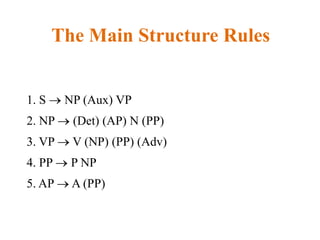
The Main Structure Rules
1. S NP (Aux) VP
2. NP (Det) (AP) N (PP)
3. VP V (NP) (PP) (Adv)
4. PP P NP
5. AP A (PP)
The Analysis of Sentence Structure
Example
The old tree swayed in the wind
old
V PP
in
NPP
the
Det N
windThe
N
swayed
S
NP VP
Det Adj
tree
Aux
past
Example
The children put the toy in the box
V PP
in
NPP
the
Det N
boxThe
N
put
S
NP VP
Det
children
NP
the
Det N
toy
Ambiguity: a word, phrase or
sentence with multiple meanings
Synthetic buffalo hides (NP) Synthetic buffalo hides (NP)
Synthetic buffalo hides Synthetic buffalo hides
Buffalo hides that are synthetic. Hides of synthetic buffalo.
Ambiguities often lead to humorous
results
• For sale: an antique desk suitable for lady with
thick legs and large drawers
 what does “thick legs and large drawers”
refer to?
The desk or the lady?
Structural Ambiguity
The boy saw the man with the telescope
V PP
with
NPP
the
Det N
telescopeThe
N
saw
S
NP VP
Det
boy
NP
the
Det N
man
Aux
past
Structural Ambiguity
The boy saw the man with the telescope
V
PP
with
NPP
the
Det N
telescopeThe
N
saw
S
NP VP
Det
boy
NP
the
Det N
man
Aux
past
Declarative – Interrogative
• Move the auxiliary to the left of the subject.
The boy will leave.
S
VPNP
Det
Aux
N
The boy will leave
Will the boy leave?
S
VPNP
Det
Aux
N
the boyWill leave
The deep structure The surface structure
V V
Reasons for studying syntax
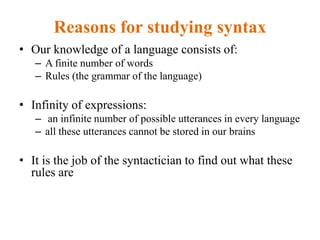
• Our knowledge of a language consists of:
– A finite number of words
– Rules (the grammar of the language)
• Infinity of expressions:
– an infinite number of possible utterances in every language
– all these utterances cannot be stored in our brains
• It is the job of the syntactician to find out what these
rules are
Language Acquisition
• Understanding syntax helps to understand:
– how young children learn their native language
– how to use the rules
• But nobody can really state exactly what the
rules are!
– it is amazing that children can do it so fast
Universal Grammar
Theory of Chomsky UG has Principles + Parameters:
• Principles, true of all languages
– All languages have the same underlying structure
• e.g. all languages have nouns and verbs
• Parameters, whose setting varies from language to language
– English and Chinese SVO; Japanese SOV
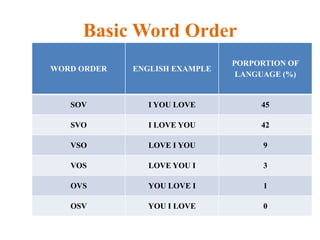
Basic Word Order
WORD ORDER ENGLISH EXAMPLE
PORPORTION OF
LANGUAGE (%)
SOV I YOU LOVE 45
SVO I LOVE YOU 42
VSO LOVE I YOU 9
VOS LOVE YOU I 3
OVS YOU LOVE I 1
OSV YOU I LOVE 0
Basic Sentences Patterns
Sentence Pattern Example
SV JOHN SLEEPS.
JILL IS EATTING
SVO I LIKE RICE.
SHE LOVES HER JOB.
SV Adj HE IS FUNNY .
THE WORKERS ARE LAZY.
SV Ad JIM IS HERE.
FLOWERS ARE EVERYWHERE.
SVN SHE IS MY MOM.
THE MEN ARE DOCTORS

Syntax

  • 1.
    University of thePunjab Department of English Language & Literature Lahore, Pakistan
  • 2.
    Syntax The study of: •Grammatical relations between words and other units within the sentence • Word order • Sentence formation
  • 3.
    Syntax • Languages differnot only in sounds, but also the ways in which words can be put together into larger units this is Syntax • Rules about how words can be put together differ according to language , dialect, social group, time frame etc • “They know not what they do” – does not follow the rules we use – for modern English, but was totally normal in the 17th Century • Even though the word meanings haven’t changed, the syntax has
  • 4.
    Syntactic Theory • Syntactictheory is about the rules and principles that determine: – how people combine words to make meaningful sentences • Sentences are not just strings of words – in the same way that words are not just strings of morphemes • There are strict syntactic rules about the structure of sentences – how to combine words in specific way to reach a certain meaning • Structure at a phrasal and sentence level
  • 5.
    Bag of words •Consider these words: Bit A The Dog Cat –A cat bit the dog –The cat bit a dog –A dog bit the cat –The dog bit a cat • All of these have specific, and different meanings • These different meanings come about solely from our combinations of words
  • 6.
    Syntactic Categories Lexical categories •Noun (N) • Verb (V) • Adjective (A) • Preposition (P) • Adverb (Adv) Examples • moisture, policy • melt, remain • good, intelligent • to, near • slowly, now
  • 7.
    Syntactic Categories Non-lexical categories Determiner (Det)  Degree word (Deg)  Qualifier (Qual)  Auxiliary (Aux)  Conjunction (Con) Examples  the, this  very, more  always, perhaps  will, can  and, or
  • 8.
    Phrase Structure • Wehave rules in syntax about what word classes can pattern together in phrases • NP -> (Det) N • This means that Noun Phrases can be made up of Determiners and Nouns. Determiners are optional The girl Ayesha • Both of these are NPs - they each contain a N, • and the first also has a determiner
  • 9.
    NP Rule • First,DET means determiner – Function words like the, a, this, several • NP  (DET) N – That means a noun phrase can have a determiner, and it must have a noun – S  NP VP – VP  V NP – NP  (DET) (ADJ) N
  • 10.
    Phrases • NP :Noun Phrase The car, a clever student • VP : Verb Phrase study hard, play the guitar • PP : Prepositional Phrase in the class, above the earth • AP : Adjective Phrase very tall, quite certain • AdvP: quite happily
  • 11.
    Noun Phrase StructureRules • NP (Det) N (PP) • PP P NP The bus (NP) The NDet bus The bus in the yard NP The NDet bus PP in NPP the Det N yard
  • 12.
    Verb Phrase StructureRules • VP V (NP) (PP) • S NP (Aux) VP took the money (VP) took NPV took the money from the bank VP took NPV PP from NPP the Det N bank the Det N money the Det N money
  • 13.
    PP P NP from DetN PP a boy P NP in Det N a bubble Prepositional Phrase Structure Rules
  • 14.
  • 15.
    Sentence structure • Thisallows us to build up sentences from phrases • If we want to analyze the sentence “the cat sat on the mat”, we look at the internal phrases • The cat sat on the mat • Det N V P Det N • NP VP PP NP • However, there are rules in syntax (as is morphology) about what order these interact in • It’s not just a bag of words!
  • 16.
    Constituency • A sentenceis divided into groups of words • The connections between words in one group is closer than between words belonging to different groups • A group of words that cling together is called a constituent – To test whether a group of words is a constituent, we have 3 tests: • Replacement/Substitution: – a constituent can be replaced by a single word • Movement: – a constituent as a whole, can be placed in a different • position in a sentence – Clefting: Change sentences to “it was...”
  • 17.
    All languages haveconstituents • Sentences are not just strings of words, have a more complex structure • which linguists call: CONSTITUENT STRUCTURE • We can call the sentence S, and label the syntactic categories N and V S N Johnny V danced
  • 18.
    The Main StructureRules 1. S NP (Aux) VP 2. NP (Det) (AP) N (PP) 3. VP V (NP) (PP) (Adv) 4. PP P NP 5. AP A (PP)
  • 19.
    The Analysis ofSentence Structure
  • 20.
    Example The old treeswayed in the wind old V PP in NPP the Det N windThe N swayed S NP VP Det Adj tree Aux past
  • 21.
    Example The children putthe toy in the box V PP in NPP the Det N boxThe N put S NP VP Det children NP the Det N toy
  • 22.
    Ambiguity: a word,phrase or sentence with multiple meanings Synthetic buffalo hides (NP) Synthetic buffalo hides (NP) Synthetic buffalo hides Synthetic buffalo hides Buffalo hides that are synthetic. Hides of synthetic buffalo.
  • 23.
    Ambiguities often leadto humorous results • For sale: an antique desk suitable for lady with thick legs and large drawers  what does “thick legs and large drawers” refer to? The desk or the lady?
  • 24.
    Structural Ambiguity The boysaw the man with the telescope V PP with NPP the Det N telescopeThe N saw S NP VP Det boy NP the Det N man Aux past
  • 25.
    Structural Ambiguity The boysaw the man with the telescope V PP with NPP the Det N telescopeThe N saw S NP VP Det boy NP the Det N man Aux past
  • 26.
    Declarative – Interrogative •Move the auxiliary to the left of the subject. The boy will leave. S VPNP Det Aux N The boy will leave Will the boy leave? S VPNP Det Aux N the boyWill leave The deep structure The surface structure V V
  • 27.
    Reasons for studyingsyntax • Our knowledge of a language consists of: – A finite number of words – Rules (the grammar of the language) • Infinity of expressions: – an infinite number of possible utterances in every language – all these utterances cannot be stored in our brains • It is the job of the syntactician to find out what these rules are
  • 28.
    Language Acquisition • Understandingsyntax helps to understand: – how young children learn their native language – how to use the rules • But nobody can really state exactly what the rules are! – it is amazing that children can do it so fast
  • 29.
    Universal Grammar Theory ofChomsky UG has Principles + Parameters: • Principles, true of all languages – All languages have the same underlying structure • e.g. all languages have nouns and verbs • Parameters, whose setting varies from language to language – English and Chinese SVO; Japanese SOV
  • 30.
    Basic Word Order WORDORDER ENGLISH EXAMPLE PORPORTION OF LANGUAGE (%) SOV I YOU LOVE 45 SVO I LOVE YOU 42 VSO LOVE I YOU 9 VOS LOVE YOU I 3 OVS YOU LOVE I 1 OSV YOU I LOVE 0
  • 31.
    Basic Sentences Patterns SentencePattern Example SV JOHN SLEEPS. JILL IS EATTING SVO I LIKE RICE. SHE LOVES HER JOB. SV Adj HE IS FUNNY . THE WORKERS ARE LAZY. SV Ad JIM IS HERE. FLOWERS ARE EVERYWHERE. SVN SHE IS MY MOM. THE MEN ARE DOCTORS