Term 2Week 4
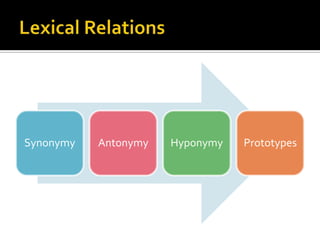
Synonymy Antonymy Hyponymy Prototypes
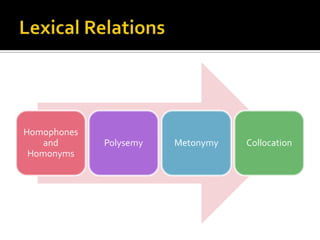
Homophones
and
Homonyms
Polysemy Metonymy Collocation
 Two or more words with very closely related
meanings are called synonyms.
 Synonyms can often, though not always, be
substituted for each other in sentences.
 In appropriate circumstances, we can say What was
his answer? or What was his reply? With much the
same meaning.
 The idea of ‘sameness’ of meaning used in
discussing synonymy is not necessarily ‘total
sameness’. There are many occasions when one
word is appropriate in a sentence, but its synonym
would be odd.
 For example, reply would be odd in this instance.
 Sandy had only one answer correct on the test
 Sandy had only one reply correct on the test.
 Synonymous forms may also differ in terms of
formal versus informal uses.
 For example, the second version, with four
synonymous replacements, sounds much more
casual or informal than the first.
 My father purchased a large automobile.
 My dad bought a big car.
 Two forms with opposite meanings are called
antonyms.
 Some common examples are the pairs: alive / dead,
big / small, fat / slow, happy / sad, hot / cold, long /
short, male / female, married / single, old / new, rich /
poor, true / false
 Antonyms are usually divided into two main types:
 gradable – opposites along a scale
 non-gradable – direct opposites
 Gradable antonyms, such as big / small, can be used
in comparative constructions like I’m bigger than you
and A pony is smaller than a horse.
 The negative of one member of a gradable pair does
not necessarily imply the other. For example, the
sentence My car isn’t old does not necessarily mean
My car is new.
 With non-gradable antonyms (also called
‘complementary pairs’) , comparative constructions
are not normally used. We don’t typically describe
someone as deader or more dead than another.
 The negative of one member of a non-gradable pair
does imply the other member. That is, My
grandparents aren’t alive does indeed mean My
grandparents are dead.
 Although we can use the ‘negative test’ to identify
non-gradable antonyms in a language, we usually
avoid describing one member of an antonymous
pair as the negative of the other.
 For example, while undress can be treated as the
opposite of dress, it does not mean ‘not dress’. It
actually means ‘do the reverse of dress’. Antonyms
of this type are called reversives.
 Other common examples of reversives are: enter /
exit, pack / unpack, lengthen / shorten, raise / lower,
tie / untie
 When the meaning of one form is included in the
meaning of another, the relationship is described as
hyponymy.
 Examples are the pairs: animal / dog, dog / poodle,
vegetable / carrot, flower / rose, tree / banyan.
 The concept of ‘inclusion’ involved in this
relationship is the idea that if an object is a rose,
then it is necessarily a flower, so the meaning of
flower is included in the meaning of rose. Or rose is a
hyponym of flower.
 When we consider hyponymous connections, we
are essentially looking at the meaning of words in
some type of hierarchical relationship.
 We can represent the relationships between a set of
words as a hierarchical diagram.
 The concept of a prototype helps explain the
meaning of certain words like bird, not in terms of
component features (e.g. ‘has feathers’, ‘has
wings’), but in terms of resemblance to the clearest
example.
 While words like canary, cormorant, dove, duck,
flamingo, parrot, pelican and robin are all equally co-
hyponyms of the super-ordinate bird, they are not
all considered to be equally good examples of the
category ‘bird’.
 According to some researchers, the most
characteristic instance of the category ‘bird’ is robin.
 Thus, even native speakers of English might wonder
if ostrich or penguin should be hyponyms of bird
(technically they are), but have no trouble deciding
about sparrow or pigeon. These last two are much
closer to the prototype.
 When two or more different (written) forms have
the same pronunciation, they are described as
homophones.
 Common examples are bare / bear, meat / meet, flour
/ flower, pail / pale, right / write, sew / so and to / too /
two.
 We use the term homonyms when one form
(written or spoken) has two or more unrelated
meanings, as in these examples:
bank ( of a river) – bank (financial institution)
Bat (flying creature) – bat (used in sports)
mole (on skin) – mole (small animal)
pupil (at school) – pupil (in the eye)
race (contest of speed) – race (ethnic group)
bank ( of a river) – bank (financial institution)
 The temptation is to think that the two types of
bank must be related in meaning.They are not.
 Homonyms are words that have separate histories
and meanings, but have accidentally come to have
exactly the same form.
 When we encounter two or more words with the
same form and related meanings, we have what is
technically known as polysemy.
 Polysemy can be defined as one form (written or
spoken) having multiple meanings that are all
related by extension.
 Examples are the word head, used to refer to the
object on top of your body, on top of a glass of beer,
person at the top of a company or department and
many other things.
 Other examples of polysemy are foot (of person, of
bed, of mountain) or run (person does, water does,
colours do).
 If we are not sure whether different uses of a single
word are examples of homonymy or polysemy, we
can check in a dictionary.
 If the word has multiple meanings (i.e. it is
polysemous), then there will be a single entry, with
a numbered list of the different meanings of the
word.
 If the two words are treated as homonyms, they will
typically have two separate entries.
 It is possible for two forms to be distinguished via
homonymy and for one of the forms also to have
uses via polysemy.
 The words date (= a thing we eat) and date (= a point
in time) are homonyms.
 Date (= a point in time) is polysemous in terms of a
particular day and month (= on a letter), an
arranged meeting time (= an appointment), a social
meeting (= with someone we like), and even a
person (= that person we like).
 A type of relationship based on a close connection
in everyday experience, which can be based on:
 container-contents relation (bottle / water, can /
juice)
 whole-part relation (car / wheels, house / roof)
 representative-symbol relationship (king / crown,
the President /White House)
 Using one of these words to refer to the other is an
example of metonymy.
 It is our familiarity with metonymy that makes it
possible for us to understand He drank the whole
bottle although it sounds absurd literally (i.e. he
drank the liquid, not the glass object).
 We also accept The White House has announced… or
Downing Street protested… without being puzzled
that buildings appear to be talking.
 Many examples of metonymy are highly
conventionalized and easy to interpret. However,
other examples depend on an ability to infer what
the speaker has in mind. Examples include:
Get your butt over here.
The strings are too quiet.
I prefer cable.
 Making sense of such expressions often depends on
context, background knowledge and inference.
 We know that some words tend to occur with other
words. If you ask a thousand people what they think
of when you say hammer, more than half will say
nail. If you say table, they will mostly say chair, and
butter elicits bread, needle elicits thread and salt
elicits pepper.
 One way we seem to organize our knowledge of
words is simply on the basis of collocation, or
frequently occurring together.
How can we apply our understanding of semantic
features, semantic roles and lexical relations in
discourse analysis?

Lexical relations

  • 1.
  • 2.
  • 3.
  • 4.
     Two ormore words with very closely related meanings are called synonyms.
  • 5.
     Synonyms canoften, though not always, be substituted for each other in sentences.  In appropriate circumstances, we can say What was his answer? or What was his reply? With much the same meaning.
  • 6.
     The ideaof ‘sameness’ of meaning used in discussing synonymy is not necessarily ‘total sameness’. There are many occasions when one word is appropriate in a sentence, but its synonym would be odd.  For example, reply would be odd in this instance.  Sandy had only one answer correct on the test  Sandy had only one reply correct on the test.
  • 7.
     Synonymous formsmay also differ in terms of formal versus informal uses.  For example, the second version, with four synonymous replacements, sounds much more casual or informal than the first.  My father purchased a large automobile.  My dad bought a big car.
  • 8.
     Two formswith opposite meanings are called antonyms.  Some common examples are the pairs: alive / dead, big / small, fat / slow, happy / sad, hot / cold, long / short, male / female, married / single, old / new, rich / poor, true / false
  • 9.
     Antonyms areusually divided into two main types:  gradable – opposites along a scale  non-gradable – direct opposites
  • 10.
     Gradable antonyms,such as big / small, can be used in comparative constructions like I’m bigger than you and A pony is smaller than a horse.  The negative of one member of a gradable pair does not necessarily imply the other. For example, the sentence My car isn’t old does not necessarily mean My car is new.
  • 11.
     With non-gradableantonyms (also called ‘complementary pairs’) , comparative constructions are not normally used. We don’t typically describe someone as deader or more dead than another.  The negative of one member of a non-gradable pair does imply the other member. That is, My grandparents aren’t alive does indeed mean My grandparents are dead.
  • 12.
     Although wecan use the ‘negative test’ to identify non-gradable antonyms in a language, we usually avoid describing one member of an antonymous pair as the negative of the other.  For example, while undress can be treated as the opposite of dress, it does not mean ‘not dress’. It actually means ‘do the reverse of dress’. Antonyms of this type are called reversives.
  • 13.
     Other commonexamples of reversives are: enter / exit, pack / unpack, lengthen / shorten, raise / lower, tie / untie
  • 14.
     When themeaning of one form is included in the meaning of another, the relationship is described as hyponymy.  Examples are the pairs: animal / dog, dog / poodle, vegetable / carrot, flower / rose, tree / banyan.
  • 15.
     The conceptof ‘inclusion’ involved in this relationship is the idea that if an object is a rose, then it is necessarily a flower, so the meaning of flower is included in the meaning of rose. Or rose is a hyponym of flower.
  • 16.
     When weconsider hyponymous connections, we are essentially looking at the meaning of words in some type of hierarchical relationship.  We can represent the relationships between a set of words as a hierarchical diagram.
  • 17.
     The conceptof a prototype helps explain the meaning of certain words like bird, not in terms of component features (e.g. ‘has feathers’, ‘has wings’), but in terms of resemblance to the clearest example.
  • 18.
     While wordslike canary, cormorant, dove, duck, flamingo, parrot, pelican and robin are all equally co- hyponyms of the super-ordinate bird, they are not all considered to be equally good examples of the category ‘bird’.  According to some researchers, the most characteristic instance of the category ‘bird’ is robin.
  • 19.
     Thus, evennative speakers of English might wonder if ostrich or penguin should be hyponyms of bird (technically they are), but have no trouble deciding about sparrow or pigeon. These last two are much closer to the prototype.
  • 20.
     When twoor more different (written) forms have the same pronunciation, they are described as homophones.  Common examples are bare / bear, meat / meet, flour / flower, pail / pale, right / write, sew / so and to / too / two.
  • 21.
     We usethe term homonyms when one form (written or spoken) has two or more unrelated meanings, as in these examples: bank ( of a river) – bank (financial institution) Bat (flying creature) – bat (used in sports) mole (on skin) – mole (small animal) pupil (at school) – pupil (in the eye) race (contest of speed) – race (ethnic group)
  • 22.
    bank ( ofa river) – bank (financial institution)  The temptation is to think that the two types of bank must be related in meaning.They are not.  Homonyms are words that have separate histories and meanings, but have accidentally come to have exactly the same form.
  • 23.
     When weencounter two or more words with the same form and related meanings, we have what is technically known as polysemy.  Polysemy can be defined as one form (written or spoken) having multiple meanings that are all related by extension.
  • 24.
     Examples arethe word head, used to refer to the object on top of your body, on top of a glass of beer, person at the top of a company or department and many other things.  Other examples of polysemy are foot (of person, of bed, of mountain) or run (person does, water does, colours do).
  • 25.
     If weare not sure whether different uses of a single word are examples of homonymy or polysemy, we can check in a dictionary.
  • 26.
     If theword has multiple meanings (i.e. it is polysemous), then there will be a single entry, with a numbered list of the different meanings of the word.  If the two words are treated as homonyms, they will typically have two separate entries.
  • 27.
     It ispossible for two forms to be distinguished via homonymy and for one of the forms also to have uses via polysemy.
  • 28.
     The wordsdate (= a thing we eat) and date (= a point in time) are homonyms.  Date (= a point in time) is polysemous in terms of a particular day and month (= on a letter), an arranged meeting time (= an appointment), a social meeting (= with someone we like), and even a person (= that person we like).
  • 29.
     A typeof relationship based on a close connection in everyday experience, which can be based on:  container-contents relation (bottle / water, can / juice)  whole-part relation (car / wheels, house / roof)  representative-symbol relationship (king / crown, the President /White House)  Using one of these words to refer to the other is an example of metonymy.
  • 30.
     It isour familiarity with metonymy that makes it possible for us to understand He drank the whole bottle although it sounds absurd literally (i.e. he drank the liquid, not the glass object).  We also accept The White House has announced… or Downing Street protested… without being puzzled that buildings appear to be talking.
  • 31.
     Many examplesof metonymy are highly conventionalized and easy to interpret. However, other examples depend on an ability to infer what the speaker has in mind. Examples include: Get your butt over here. The strings are too quiet. I prefer cable.  Making sense of such expressions often depends on context, background knowledge and inference.
  • 32.
     We knowthat some words tend to occur with other words. If you ask a thousand people what they think of when you say hammer, more than half will say nail. If you say table, they will mostly say chair, and butter elicits bread, needle elicits thread and salt elicits pepper.  One way we seem to organize our knowledge of words is simply on the basis of collocation, or frequently occurring together.
  • 33.
    How can weapply our understanding of semantic features, semantic roles and lexical relations in discourse analysis?