What do we understand by “Connected
Speech”?
• In natural speech there are many processes that results in
differences between isolated words are the same words in
occurring in connected speech.
• When we speak naturally we do not pronounce a word, stop
and then continue, fluent speech flows with a rhythm and
the words bump into each other. To make speech flow
smoothly the way we pronounce the end and beginning of
some word can change depending on the sounds at the
beginning and end of those words.
• These changes that affect the quality of sounds are known as
: Features of connected speech.
Definition: If a speech is thought of as a string of
sounds linked together, assimilation is what happen
to a sound when it its influenced by one of its
neighbour.
For example, the word ‘this’ has the sound /s/ at the
end if it is pronounced on its own. But when
followed by ʃ in a word such as ‘shop’ it often
changes rapid in speech through assimilation.
Progressive : the interchange of a sound which often take place and identified
in plural form words.
Example: Dogs transcription [dɒgz]
Most of the time it changes when the consonant sound /s/ is followed by the
voiced consonant such as g, d and with the vowel e.
Regressive: when a sound influences one which precedes it; the most familiar
case of regressive assimilation in English is that of alveolar consonants, such as t,
d, s, z, n which are followed by non-alveolar consonants: assimilation results in a
change of place of articulation from alveolar to a different place
Example : Football > [fυt ] [bɔ:l] = [fυpbɔ:l]+
transcription
Fruitcake > [fru:t] + [keɪk] = [frυ:kkeik]
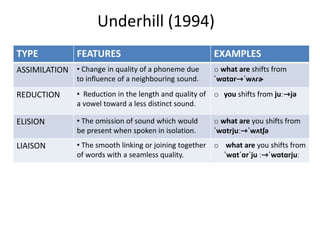
Underhill (1994)
TYPE FEATURES EXAMPLES
ASSIMILATION • Change in quality of a phoneme due
to influence of a neighbouring sound.
o what are shifts from
ˈwɑtɑr⇾ˈwʌɾɚ
REDUCTION • Reduction in the length and quality of
a vowel toward a less distinct sound.
o you shifts from juː⇾jə
ELISION • The omission of sound which would
be present when spoken in isolation.
o what are you shifts from
ˈwɑtrjuː⇾ˈwʌtʃə
LIAISON • The smooth linking or joining together
of words with a seamless quality.
o what are you shifts from
ˈwɑtˈɑrˈju ː⇾ˈwɑtɑrjuː
REDUCTION
• Reduction helps highlight important syllables in another
way by emphasizing unstressed syllables.
• The vowel in an unstressed syllable is reduced in both
length and clarity.
• The most common reduced vowel sound in English is the
“schwa” /ə/.
• Though represented by many different spellings, the schwa
is always a short, completely relaxed and open sound (like
second syllable in “pizza”).
• Contractions are another example of reduction.
• They reduce the number of syllables, and eliminate some
vowels completely. (I am/I’m, you are/you’re, etc.)
Definition of elision
• Elision is used to refer to the omission of
sounds in connected speech. In other words,
assimilation means the variation of a sound
whereas, elision means the loss of a sound.
Both consonants and vowels may be
affected, and sometimes even whole
syllables may be elided.
• The term elision describes the disappearance of a
sound.
For example, in the utterance He
leaves next week speakers would generally elide
(leave out) the /t/ in next week saying /neks
wi:k/.
• Again here, the reason is , putting certain consonant
sounds together while maintaining a regular rhythm
and speed.
Examples
The modal 'will' is special. We can use it in the
short form with a subject pronoun and with
questions words.
• She will be late.
• She'll be late.
• Who will be there?
• Who'll be there?
LIAISON
Definition: “Linking” or “joining together” of
sounds is what this French word refers. Linguistic
Pronunciation of the usually silent consonant final at
the end of a word immediately before another word
commencing with a vowel, in such a way that the
consonant is taken over as the initial sound of the
following word.
Examples
• In English the best-known case of liaison is
the “linking r” there are many words in
English (e.g. ‘car’, ‘here’, ‘tyre’) which in rhotic
accent such as General American or Scots
would be pronounced with a final r but which
in BBC pronunciation end in a vowel when
they try to pause or before a consonant
• Another aspect of liaison in English is the
movement of a single consonant at the end of
an unstressed word to the beginning of the
next if that is strongly stressed: a well-known
example is ‘not at all’, where the t of ‘at’
becomes initial.
refereence
• http://www.ukessays.com/essays/english-
language/features-of-connected-speech-in-
english-english-language-essay.php
• http://assimilationphonetics.blogspot.com/

connected speech

  • 1.
    What do weunderstand by “Connected Speech”? • In natural speech there are many processes that results in differences between isolated words are the same words in occurring in connected speech. • When we speak naturally we do not pronounce a word, stop and then continue, fluent speech flows with a rhythm and the words bump into each other. To make speech flow smoothly the way we pronounce the end and beginning of some word can change depending on the sounds at the beginning and end of those words. • These changes that affect the quality of sounds are known as : Features of connected speech.
  • 2.
    Definition: If aspeech is thought of as a string of sounds linked together, assimilation is what happen to a sound when it its influenced by one of its neighbour. For example, the word ‘this’ has the sound /s/ at the end if it is pronounced on its own. But when followed by ʃ in a word such as ‘shop’ it often changes rapid in speech through assimilation.
  • 3.
    Progressive : theinterchange of a sound which often take place and identified in plural form words. Example: Dogs transcription [dɒgz] Most of the time it changes when the consonant sound /s/ is followed by the voiced consonant such as g, d and with the vowel e.
  • 4.
    Regressive: when asound influences one which precedes it; the most familiar case of regressive assimilation in English is that of alveolar consonants, such as t, d, s, z, n which are followed by non-alveolar consonants: assimilation results in a change of place of articulation from alveolar to a different place Example : Football > [fυt ] [bɔ:l] = [fυpbɔ:l]+ transcription Fruitcake > [fru:t] + [keɪk] = [frυ:kkeik]
  • 5.
    Underhill (1994) TYPE FEATURESEXAMPLES ASSIMILATION • Change in quality of a phoneme due to influence of a neighbouring sound. o what are shifts from ˈwɑtɑr⇾ˈwʌɾɚ REDUCTION • Reduction in the length and quality of a vowel toward a less distinct sound. o you shifts from juː⇾jə ELISION • The omission of sound which would be present when spoken in isolation. o what are you shifts from ˈwɑtrjuː⇾ˈwʌtʃə LIAISON • The smooth linking or joining together of words with a seamless quality. o what are you shifts from ˈwɑtˈɑrˈju ː⇾ˈwɑtɑrjuː
  • 6.
    REDUCTION • Reduction helpshighlight important syllables in another way by emphasizing unstressed syllables. • The vowel in an unstressed syllable is reduced in both length and clarity. • The most common reduced vowel sound in English is the “schwa” /ə/. • Though represented by many different spellings, the schwa is always a short, completely relaxed and open sound (like second syllable in “pizza”). • Contractions are another example of reduction. • They reduce the number of syllables, and eliminate some vowels completely. (I am/I’m, you are/you’re, etc.)
  • 7.
    Definition of elision •Elision is used to refer to the omission of sounds in connected speech. In other words, assimilation means the variation of a sound whereas, elision means the loss of a sound. Both consonants and vowels may be affected, and sometimes even whole syllables may be elided.
  • 8.
    • The termelision describes the disappearance of a sound. For example, in the utterance He leaves next week speakers would generally elide (leave out) the /t/ in next week saying /neks wi:k/. • Again here, the reason is , putting certain consonant sounds together while maintaining a regular rhythm and speed.
  • 9.
    Examples The modal 'will'is special. We can use it in the short form with a subject pronoun and with questions words. • She will be late. • She'll be late. • Who will be there? • Who'll be there?
  • 10.
    LIAISON Definition: “Linking” or“joining together” of sounds is what this French word refers. Linguistic Pronunciation of the usually silent consonant final at the end of a word immediately before another word commencing with a vowel, in such a way that the consonant is taken over as the initial sound of the following word.
  • 11.
    Examples • In Englishthe best-known case of liaison is the “linking r” there are many words in English (e.g. ‘car’, ‘here’, ‘tyre’) which in rhotic accent such as General American or Scots would be pronounced with a final r but which in BBC pronunciation end in a vowel when they try to pause or before a consonant
  • 12.
    • Another aspectof liaison in English is the movement of a single consonant at the end of an unstressed word to the beginning of the next if that is strongly stressed: a well-known example is ‘not at all’, where the t of ‘at’ becomes initial.
  • 13.