   Introduction
   Material Specifications
   Active and passive vibrations
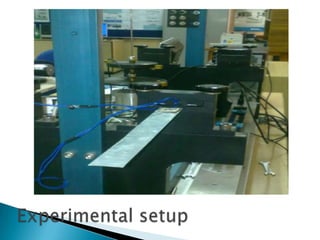
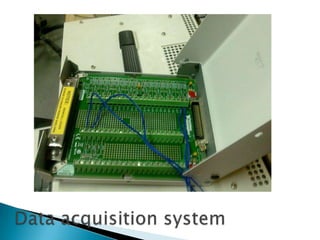
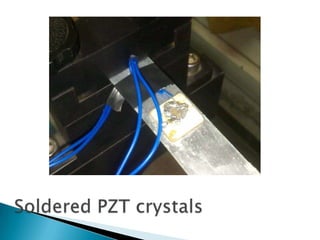
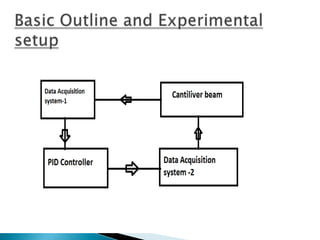
   Experimental Setup
   PD Controller
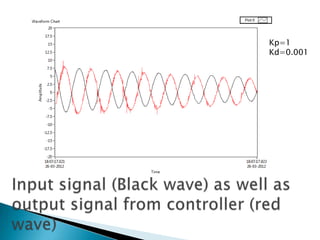
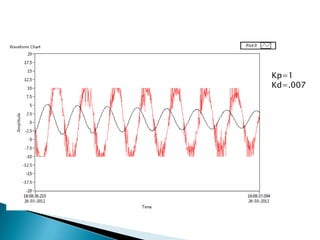
   Experimental Results
   Observations
   Conclusion and recommendation
   References
1. Dimension
    length- 27cm
    Breadth- 2.5cm
    Height- .07cm
2. Material used- Mild Steel
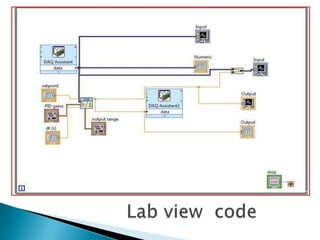
3. Software Used-Lab view
   Active vibration control is defined as a
    technique in which the vibration of a
    structure is reduced or controlled by applying
    counter force to the structure that is
    approximately out of phase but equal in
    amplitude to the original vibration.
   Techniques like the use of spring, dampers
    and pads are known as passive vibrations
    controlled.
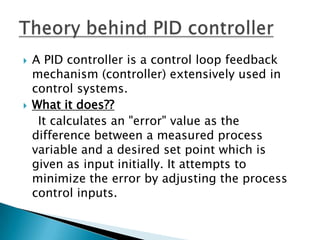
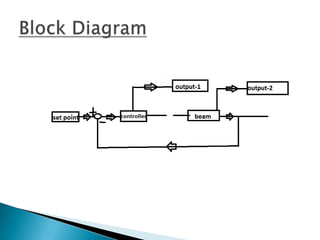
   A PID controller is a control loop feedback
    mechanism (controller) extensively used in
    control systems.
   What it does??
     It calculates an "error" value as the
    difference between a measured process
    variable and a desired set point which is
    given as input initially. It attempts to
    minimize the error by adjusting the process
    control inputs.
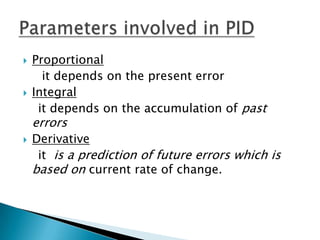
   Proportional
      it depends on the present error
   Integral
     it depends on the accumulation of past
    errors
   Derivative
     it is a prediction of future errors which is
    based on current rate of change.
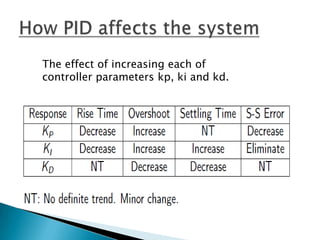
The effect of increasing each of
controller parameters kp, ki and kd.
Typical steps for designing a PID controller are

1. Determine what characteristics of the system
  needs to be improved.
2. Use KP to decrease the rise time.
3. Use KD to reduce the overshoot and settling
  time.

   This works in many cases, but what would be a
    good starting point? What if the first parameters
    we choose are totally crappy? Can we find a good
    set of initial parameters easily and quickly?
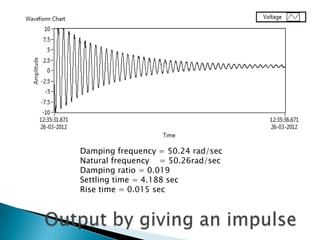
Damping frequency = 50.24 rad/sec
Natural frequency = 50.26rad/sec
Damping ratio = 0.019
Settling time = 4.188 sec
Rise time = 0.015 sec
Kp=1
Kd=0.001
Kp=1
Kd=.007
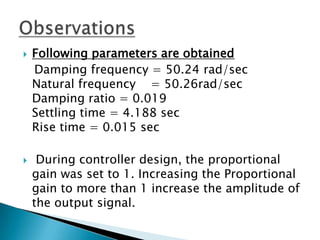
   Following parameters are obtained
    Damping frequency = 50.24 rad/sec
    Natural frequency = 50.26rad/sec
    Damping ratio = 0.019
    Settling time = 4.188 sec
    Rise time = 0.015 sec

    During controller design, the proportional
    gain was set to 1. Increasing the Proportional
    gain to more than 1 increase the amplitude of
    the output signal.
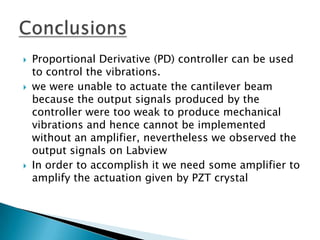
   Proportional Derivative (PD) controller can be used
    to control the vibrations.
   we were unable to actuate the cantilever beam
    because the output signals produced by the
    controller were too weak to produce mechanical
    vibrations and hence cannot be implemented
    without an amplifier, nevertheless we observed the
    output signals on Labview
   In order to accomplish it we need some amplifier to
    amplify the actuation given by PZT crystal
    K. B. Waghulde et al. /International Journal of
    Engineering and Technology Vol.2(4), 2010, 259-
    262.
    Journal of Vibration and Control March 2012 vol.
    18 no. 3 366-372.
    http://www.kyu.edu.tw/93/epaperv6/93-
    033.pdf
    Wikipedia – The free encyclopaedia..
    National Instruments (NI) manual.
    Tutorials on Controller design by National
    Instruments (NI).
Vibration project

Vibration project

  • 2.
    Introduction  Material Specifications  Active and passive vibrations  Experimental Setup  PD Controller  Experimental Results  Observations  Conclusion and recommendation  References
  • 4.
    1. Dimension length- 27cm Breadth- 2.5cm Height- .07cm 2. Material used- Mild Steel 3. Software Used-Lab view
  • 5.
    Active vibration control is defined as a technique in which the vibration of a structure is reduced or controlled by applying counter force to the structure that is approximately out of phase but equal in amplitude to the original vibration.  Techniques like the use of spring, dampers and pads are known as passive vibrations controlled.
  • 11.
    A PID controller is a control loop feedback mechanism (controller) extensively used in control systems.  What it does?? It calculates an "error" value as the difference between a measured process variable and a desired set point which is given as input initially. It attempts to minimize the error by adjusting the process control inputs.
  • 12.
    Proportional it depends on the present error  Integral it depends on the accumulation of past errors  Derivative it is a prediction of future errors which is based on current rate of change.
  • 13.
    The effect ofincreasing each of controller parameters kp, ki and kd.
  • 14.
    Typical steps fordesigning a PID controller are 1. Determine what characteristics of the system needs to be improved. 2. Use KP to decrease the rise time. 3. Use KD to reduce the overshoot and settling time.  This works in many cases, but what would be a good starting point? What if the first parameters we choose are totally crappy? Can we find a good set of initial parameters easily and quickly?
  • 16.
    Damping frequency =50.24 rad/sec Natural frequency = 50.26rad/sec Damping ratio = 0.019 Settling time = 4.188 sec Rise time = 0.015 sec
  • 17.
  • 18.
  • 19.
    Following parameters are obtained Damping frequency = 50.24 rad/sec Natural frequency = 50.26rad/sec Damping ratio = 0.019 Settling time = 4.188 sec Rise time = 0.015 sec  During controller design, the proportional gain was set to 1. Increasing the Proportional gain to more than 1 increase the amplitude of the output signal.
  • 20.
    Proportional Derivative (PD) controller can be used to control the vibrations.  we were unable to actuate the cantilever beam because the output signals produced by the controller were too weak to produce mechanical vibrations and hence cannot be implemented without an amplifier, nevertheless we observed the output signals on Labview  In order to accomplish it we need some amplifier to amplify the actuation given by PZT crystal
  • 22.
    K. B. Waghulde et al. /International Journal of Engineering and Technology Vol.2(4), 2010, 259- 262.  Journal of Vibration and Control March 2012 vol. 18 no. 3 366-372.  http://www.kyu.edu.tw/93/epaperv6/93- 033.pdf  Wikipedia – The free encyclopaedia..  National Instruments (NI) manual.  Tutorials on Controller design by National Instruments (NI).