1
Word formation Process
How new words are being formed in the
language.
Word formation is of great interest for linguists
as it sheds light on other aspects of language.
2
Why are new words needed?
3
Because of new inventions and
changes
Language is dynamic
vast amount of new inventions made
in the 20th and 21st
One of the distinctive properties of
human language is creativity
4
Entry Of a Word in a language
etymology: studies of the history of words, their
origin, and how their form and
meaning changed over time
English word formation
5
1. coinage
3. Calque
5. Derivation
2. Borrowing,
4. Compound
6. Blending
7. Backformation 8. Conversion 9.
Acronym 10. Initialism
11. Onomatopoeia 12. Clipping
1. Coinage
the word formation process of
inventing entirely new words
Ex: robotics (1941), genocide
(1943), black hole (1968),blog,
internet, google, Aspirine.
6
Some more examples
7
e-cruitment-online recruitment of employees; online
submission of resumes and cover letters
netbook–small laptop computer which weighs less
than 3 pounds and has a 7 to 10 inch screen
notspot-an area where there is slow internet access or
no connection at all
slumdog-very poor, underprivileged person who lives in
an overcrowded a slum
Eponym
8
--new words based on names of persons/
place
volt [ Alessandro Volta, Italian]
watt [James Watt, Scot scientist]
boycott [Charles Boycott, Irish]
fahrenheit [Gabriel Farenheit, German
scientist]
2. Borrowing
9
Borrowing is the process of actually borrowing words
from foreign languages.
The English language has been borrowing words from
''nearly a hundred languages in the last hundred years'‘
The other way round, many countries also have taken
many English words into their dictionaries, such as the
well-known “
OK or internet”
most of the loan words are nouns, only some of them
are verbs or adjectives.
10
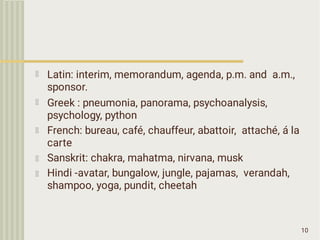
Latin: interim, memorandum, agenda, p.m. and a.m.,
sponsor.
Greek : pneumonia, panorama, psychoanalysis,
psychology, python
French: bureau, café, chauffeur, abattoir, attaché, á la
carte
Sanskrit: chakra, mahatma, nirvana, musk
Hindi -avatar, bungalow, jungle, pajamas, verandah,
shampoo, yoga, pundit, cheetah
3. Calque
11
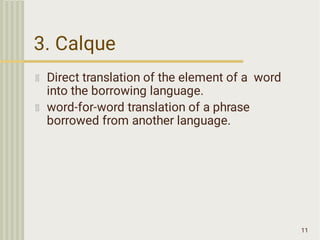
Direct translation of the element of a word
into the borrowing language.
word-for-word translation of a phrase
borrowed from another language.
4. Compounding
12
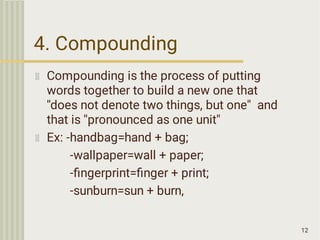
Compounding is the process of putting
words together to build a new one that
''does not denote two things, but one'' and
that is ''pronounced as one unit''
Ex: -handbag=hand + bag;
-wallpaper=wall + paper;
-fingerprint=finger + print;
-sunburn=sun + burn,
5. Derivation
13
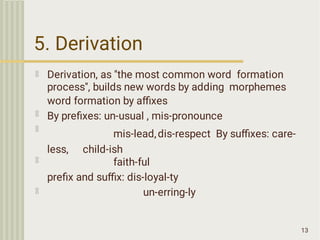
Derivation, as ''the most common word formation
process'', builds new words by adding morphemes
word formation by affixes
By prefixes: un-usual , mis-pronounce
mis-lead,dis-respect By suffixes: care-
less, child-ish
faith-ful
prefix and suffix: dis-loyal-ty
un-erring-ly
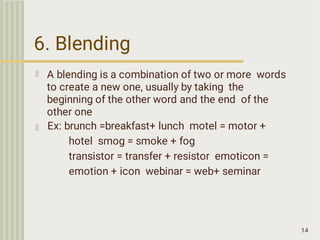
6. Blending
14
A blending is a combination of two or more words
to create a new one, usually by taking the
beginning of the other word and the end of the
other one
Ex: brunch =breakfast+ lunch motel = motor +
hotel smog = smoke + fog
transistor = transfer + resistor emoticon =
emotion + icon webinar = web+ seminar
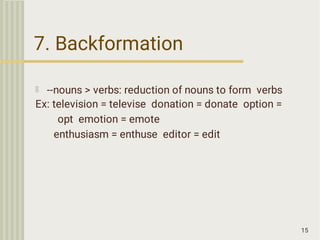
7. Backformation
15
--nouns > verbs: reduction of nouns to form verbs
Ex: television = televise donation = donate option =
opt emotion = emote
enthusiasm = enthuse editor = edit
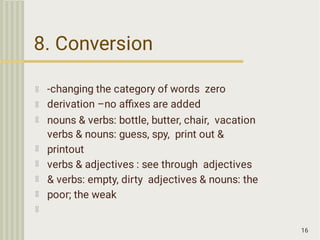
8. Conversion
16
-changing the category of words zero
derivation –no affixes are added
nouns & verbs: bottle, butter, chair, vacation
verbs & nouns: guess, spy, print out &
printout
verbs & adjectives : see through adjectives
& verbs: empty, dirty adjectives & nouns: the
poor; the weak
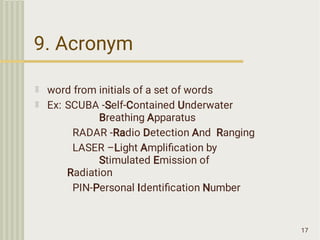
9. Acronym
17
word from initials of a set of words
Ex: SCUBA -Self-Contained Underwater
Breathing Apparatus
RADAR -Radio Detection And Ranging
LASER –Light Amplification by
Stimulated Emission of
Radiation
PIN-Personal Identification Number
10. Initialism
18
initialisms are pronounced ''as a
sequence of letters'‘
DNA- Deoxy Riboneuclic acid USA-
United states of america
11. Onomatopoeia
19
This special type of word that depicts ''the
sound associated with what is named''
Ex: buzz, hiss, cuckoo, crash, bang, etc.
12. Clipping
20
shortening of a poly-syllabic word.
Ex: facsimile = fax fanatic = fan telephone= phone
gasoline = gas influenza = flu
gym, lab, exam, math, prof.
Conclusion
21
As we have seen before, there are many ways to
create new words
So finally, if we take a look around, we will see a
mass of new words surrounding us, brought to
us both consciously by language trends and
unconsciously through language change over
time
Language changes constantly. And who knows if
the people will understand the language we are
using now in a few decades?

Share_word_formation_process.pdf

  • 1.
  • 2.
    How new wordsare being formed in the language. Word formation is of great interest for linguists as it sheds light on other aspects of language. 2
  • 3.
    Why are newwords needed? 3 Because of new inventions and changes Language is dynamic vast amount of new inventions made in the 20th and 21st One of the distinctive properties of human language is creativity
  • 4.
    4 Entry Of aWord in a language etymology: studies of the history of words, their origin, and how their form and meaning changed over time
  • 5.
    English word formation 5 1.coinage 3. Calque 5. Derivation 2. Borrowing, 4. Compound 6. Blending 7. Backformation 8. Conversion 9. Acronym 10. Initialism 11. Onomatopoeia 12. Clipping
  • 6.
    1. Coinage the wordformation process of inventing entirely new words Ex: robotics (1941), genocide (1943), black hole (1968),blog, internet, google, Aspirine. 6
  • 7.
    Some more examples 7 e-cruitment-onlinerecruitment of employees; online submission of resumes and cover letters netbook–small laptop computer which weighs less than 3 pounds and has a 7 to 10 inch screen notspot-an area where there is slow internet access or no connection at all slumdog-very poor, underprivileged person who lives in an overcrowded a slum
  • 8.
    Eponym 8 --new words basedon names of persons/ place volt [ Alessandro Volta, Italian] watt [James Watt, Scot scientist] boycott [Charles Boycott, Irish] fahrenheit [Gabriel Farenheit, German scientist]
  • 9.
    2. Borrowing 9 Borrowing isthe process of actually borrowing words from foreign languages. The English language has been borrowing words from ''nearly a hundred languages in the last hundred years'‘ The other way round, many countries also have taken many English words into their dictionaries, such as the well-known “ OK or internet” most of the loan words are nouns, only some of them are verbs or adjectives.
  • 10.
    10 Latin: interim, memorandum,agenda, p.m. and a.m., sponsor. Greek : pneumonia, panorama, psychoanalysis, psychology, python French: bureau, café, chauffeur, abattoir, attaché, á la carte Sanskrit: chakra, mahatma, nirvana, musk Hindi -avatar, bungalow, jungle, pajamas, verandah, shampoo, yoga, pundit, cheetah
  • 11.
    3. Calque 11 Direct translationof the element of a word into the borrowing language. word-for-word translation of a phrase borrowed from another language.
  • 12.
    4. Compounding 12 Compounding isthe process of putting words together to build a new one that ''does not denote two things, but one'' and that is ''pronounced as one unit'' Ex: -handbag=hand + bag; -wallpaper=wall + paper; -fingerprint=finger + print; -sunburn=sun + burn,
  • 13.
    5. Derivation 13 Derivation, as''the most common word formation process'', builds new words by adding morphemes word formation by affixes By prefixes: un-usual , mis-pronounce mis-lead,dis-respect By suffixes: care- less, child-ish faith-ful prefix and suffix: dis-loyal-ty un-erring-ly
  • 14.
    6. Blending 14 A blendingis a combination of two or more words to create a new one, usually by taking the beginning of the other word and the end of the other one Ex: brunch =breakfast+ lunch motel = motor + hotel smog = smoke + fog transistor = transfer + resistor emoticon = emotion + icon webinar = web+ seminar
  • 15.
    7. Backformation 15 --nouns >verbs: reduction of nouns to form verbs Ex: television = televise donation = donate option = opt emotion = emote enthusiasm = enthuse editor = edit
  • 16.
    8. Conversion 16 -changing thecategory of words zero derivation –no affixes are added nouns & verbs: bottle, butter, chair, vacation verbs & nouns: guess, spy, print out & printout verbs & adjectives : see through adjectives & verbs: empty, dirty adjectives & nouns: the poor; the weak
  • 17.
    9. Acronym 17 word frominitials of a set of words Ex: SCUBA -Self-Contained Underwater Breathing Apparatus RADAR -Radio Detection And Ranging LASER –Light Amplification by Stimulated Emission of Radiation PIN-Personal Identification Number
  • 18.
    10. Initialism 18 initialisms arepronounced ''as a sequence of letters'‘ DNA- Deoxy Riboneuclic acid USA- United states of america
  • 19.
    11. Onomatopoeia 19 This specialtype of word that depicts ''the sound associated with what is named'' Ex: buzz, hiss, cuckoo, crash, bang, etc.
  • 20.
    12. Clipping 20 shortening ofa poly-syllabic word. Ex: facsimile = fax fanatic = fan telephone= phone gasoline = gas influenza = flu gym, lab, exam, math, prof.
  • 21.
    Conclusion 21 As we haveseen before, there are many ways to create new words So finally, if we take a look around, we will see a mass of new words surrounding us, brought to us both consciously by language trends and unconsciously through language change over time Language changes constantly. And who knows if the people will understand the language we are using now in a few decades?