Word Formation
Dr. Apexa Dharankar
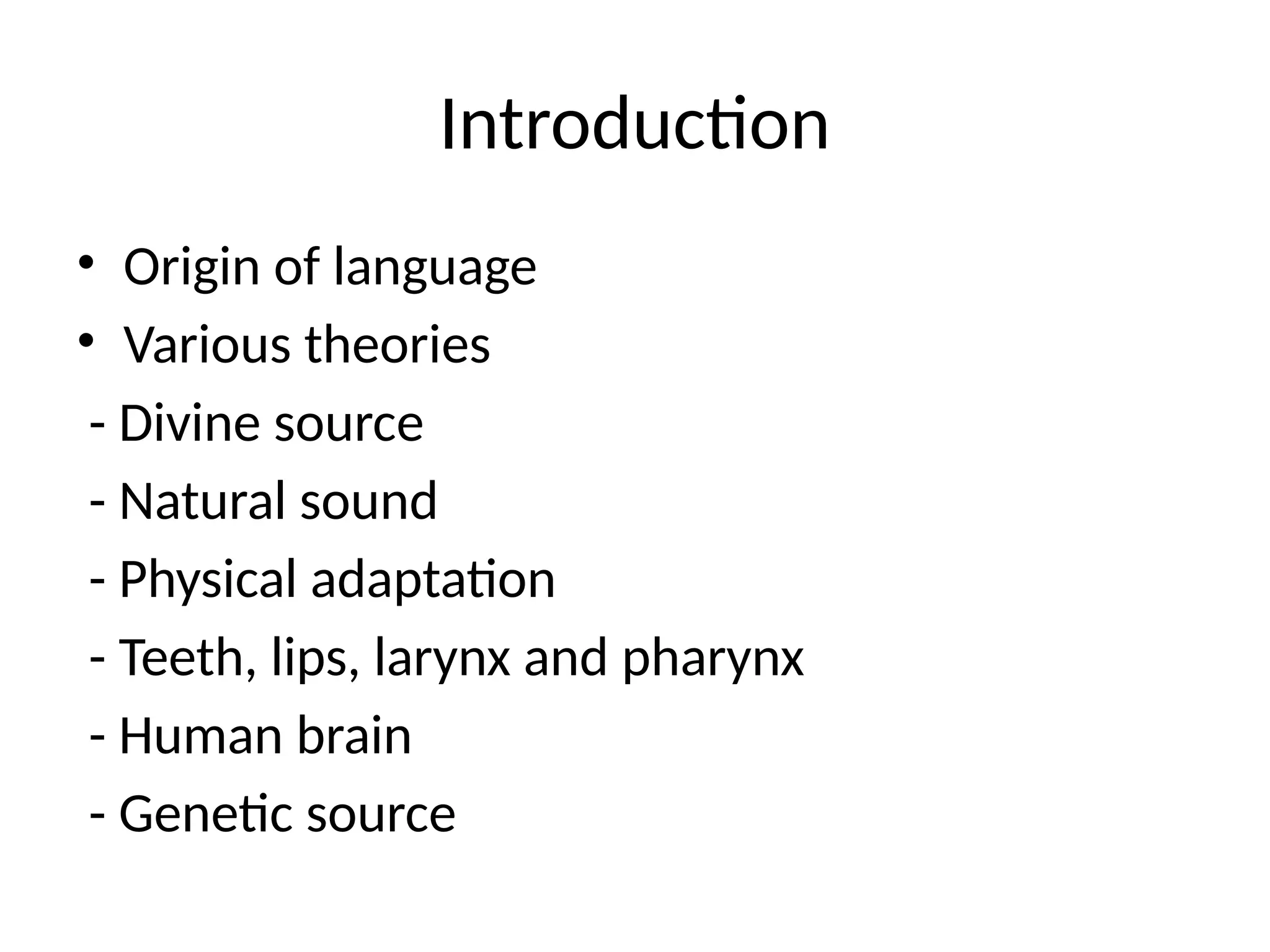
Introduction
• Origin of language
• Various theories
- Divine source
- Natural sound
- Physical adaptation
- Teeth, lips, larynx and pharynx
- Human brain
- Genetic source
Etymology
• the study of the origins and history
of words and their meanings
• an explanation of the origin and
history of a particular word
• For example, The word etymology derives
from the Greek word ἐτυμολογία
(etumología), itself from ἔτυμον (étumon),
meaning "true sense or sense of a truth",
and the suffix -logia, denoting "the study
of". The term etymon refers to a word or
morpheme (e.g., stem or root) from which
a later word or morpheme derives.
Why do we need new words?
• Your answers please!
Coinage
• Coinage is the word formation process in
which a new word is created either
deliberately or accidentally without using
the other word formation processes and
often from seemingly nothing. As
neologism or coinage, we identify
the word formation process of inventing
entirely new words (neology)
Coinage
• Least common method of word
formation
• Sources are invented trade names:
• E.g. Aspirin, vaseline, xerox
• Variant: Eponyms
• Eponyms are new words based on the
names of a place/person
Coinage
• Eponyms:
• Sandwich, Jeans
• Some eponyms are technical terms
based on the names of those who first
discovered or invented things
• E.g. Fahrenheit, Volt, Watt, Newton
Borrowing
• Taking over of words from other
languages
• E.g. piano, sofa, tattoo, tycoon, saree
• Special type of borrowing is called loan
translation or Calque
• Gratte-ciel(french) – scrape sky
• Ubermensch(german)- superman
Compounding
• Compounding is the process of
combining two words (free morphemes)
to create a new word (commonly a noun,
verb, or adjective). Also called
composition, it is from the Latin for "put
together". Compounding is the most
common type of word-formation in
English.
Compounding
• Nouns: bookcase, fingerprint,
showcase, notebook
• Adjective: Good looking, low paid,
over used, full time
Blending
• Blending is one of the many ways new
words are made in English. It refers to
joining the beginning of one word and
the end of another to make a new word
with a new meaning. Smog, from smoke
and fog, and brunch, from breakfast and
lunch, are examples of blends.
Clipping
• When there is an element of reduction
which is noticeable, it is known as
clipping. This occurs when a word or
more than one syllable is reduced is
reduced to a shorter form, usually
beginning in casual speech. E.g. fax, ad,
cab, flu
Clipping
• A special type of reduction, favored in
Australian and British English, produced
form, technically known as hypocorisms,
in which a longer word is reduced to a
single syllable, then –y or –ie is added to
the end. E.g. moving picture - movie,
Australian – Aussie, television - telly
Conversion
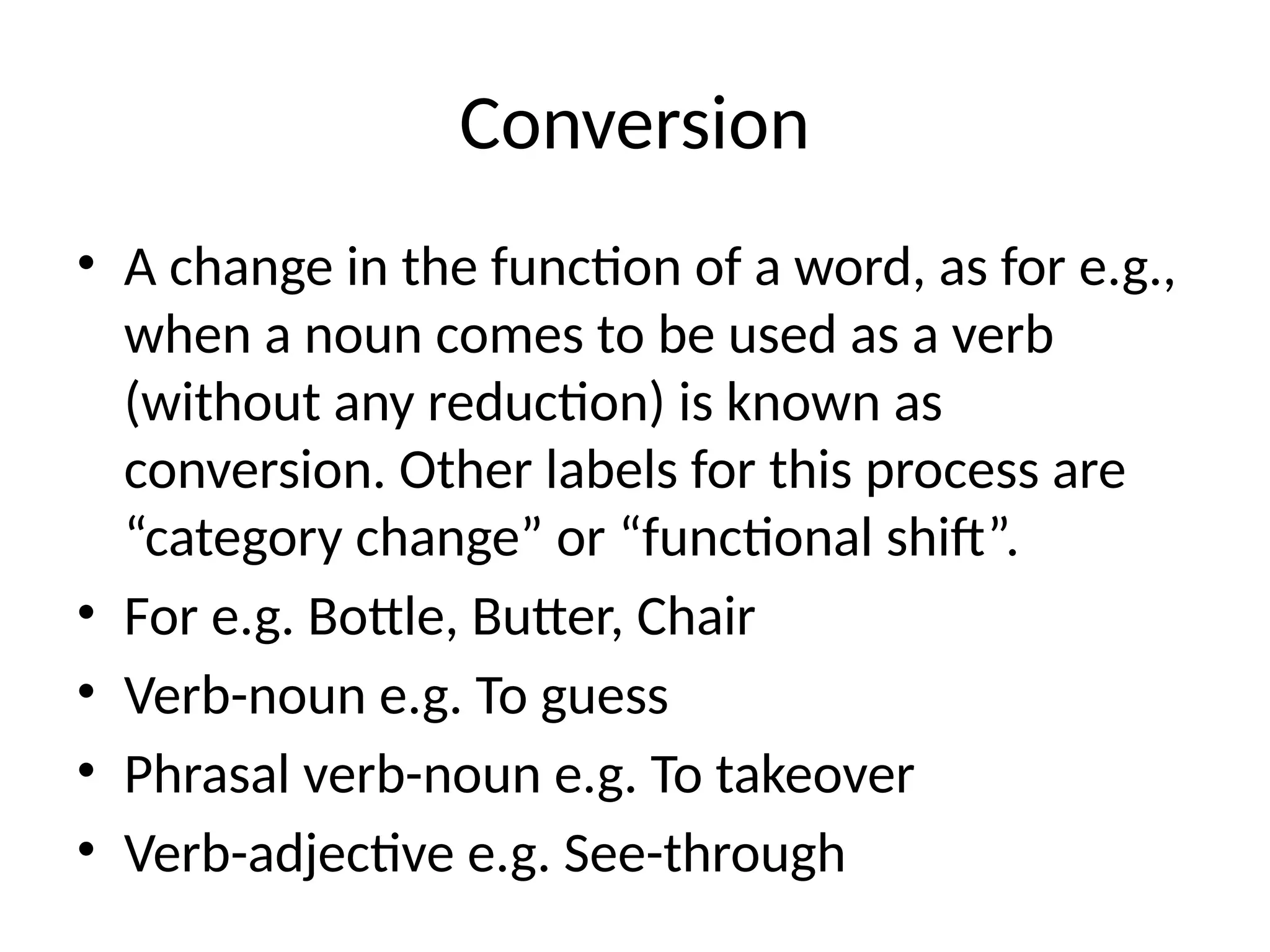
• A change in the function of a word, as for e.g.,
when a noun comes to be used as a verb
(without any reduction) is known as
conversion. Other labels for this process are
“category change” or “functional shift”.
• For e.g. Bottle, Butter, Chair
• Verb-noun e.g. To guess
• Phrasal verb-noun e.g. To takeover
• Verb-adjective e.g. See-through
Conversion
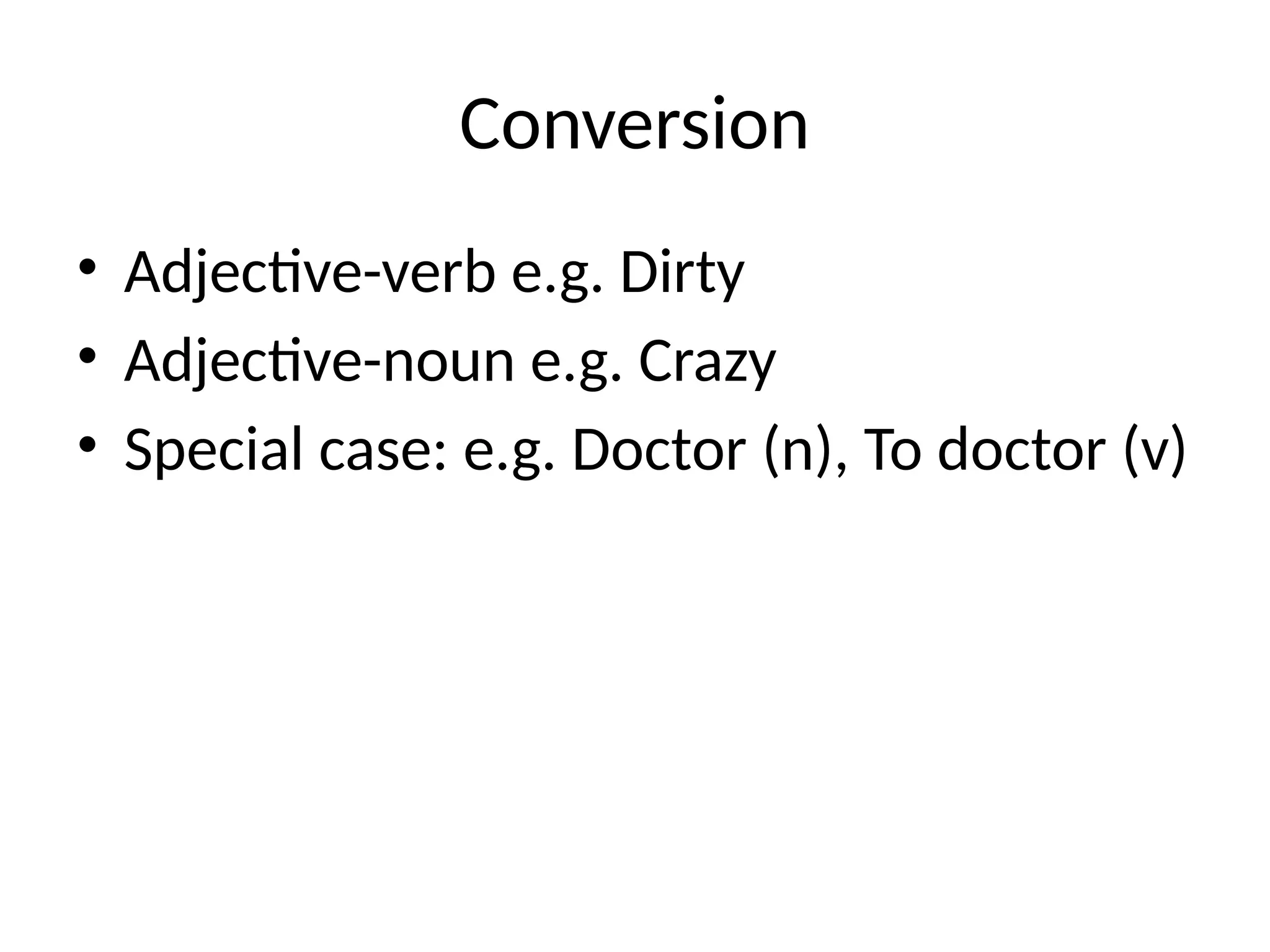
• Adjective-verb e.g. Dirty
• Adjective-noun e.g. Crazy
• Special case: e.g. Doctor (n), To doctor (v)
Acronyms
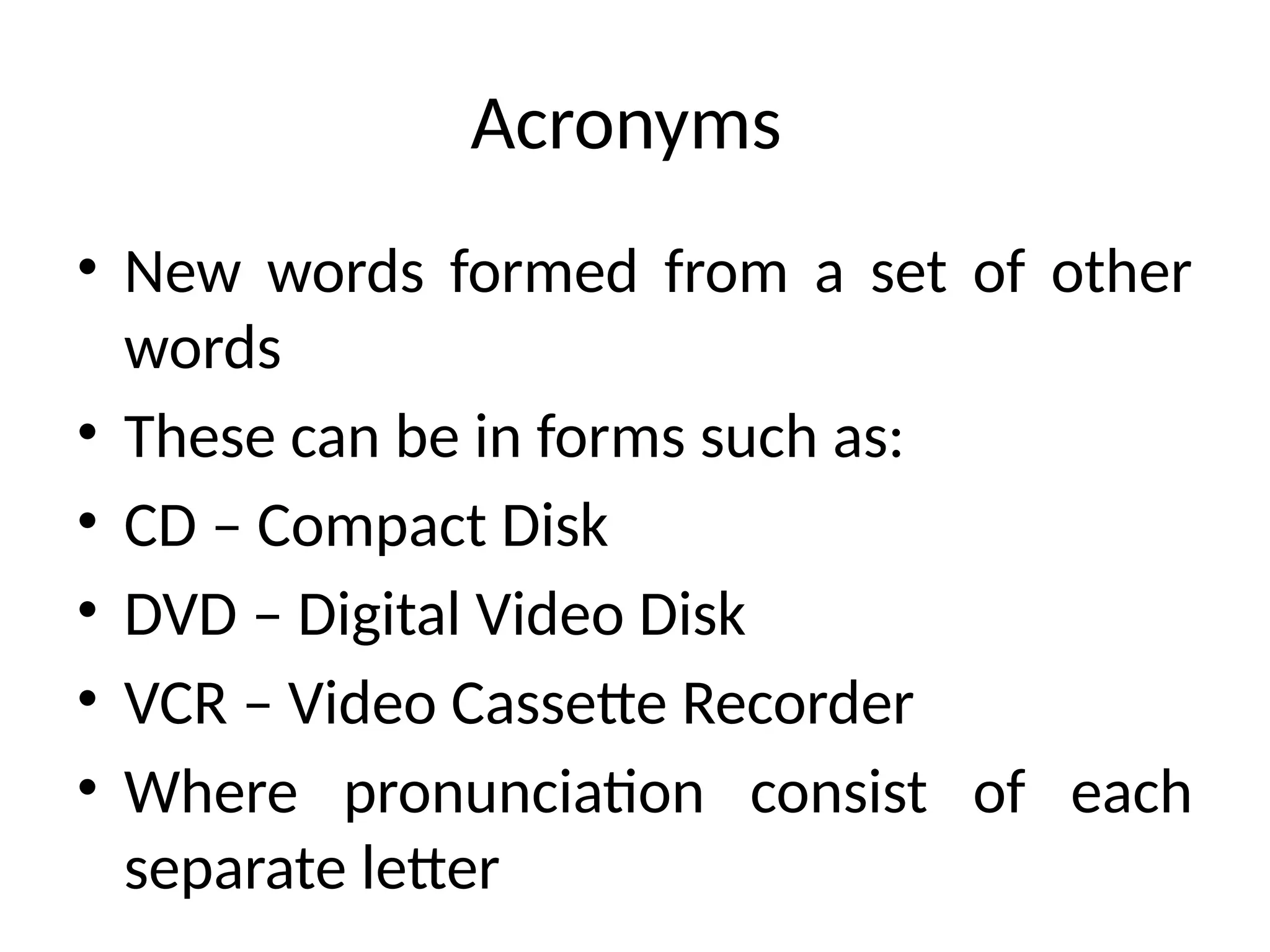
• New words formed from a set of other
words
• These can be in forms such as:
• CD – Compact Disk
• DVD – Digital Video Disk
• VCR – Video Cassette Recorder
• Where pronunciation consist of each
separate letter
Acronyms
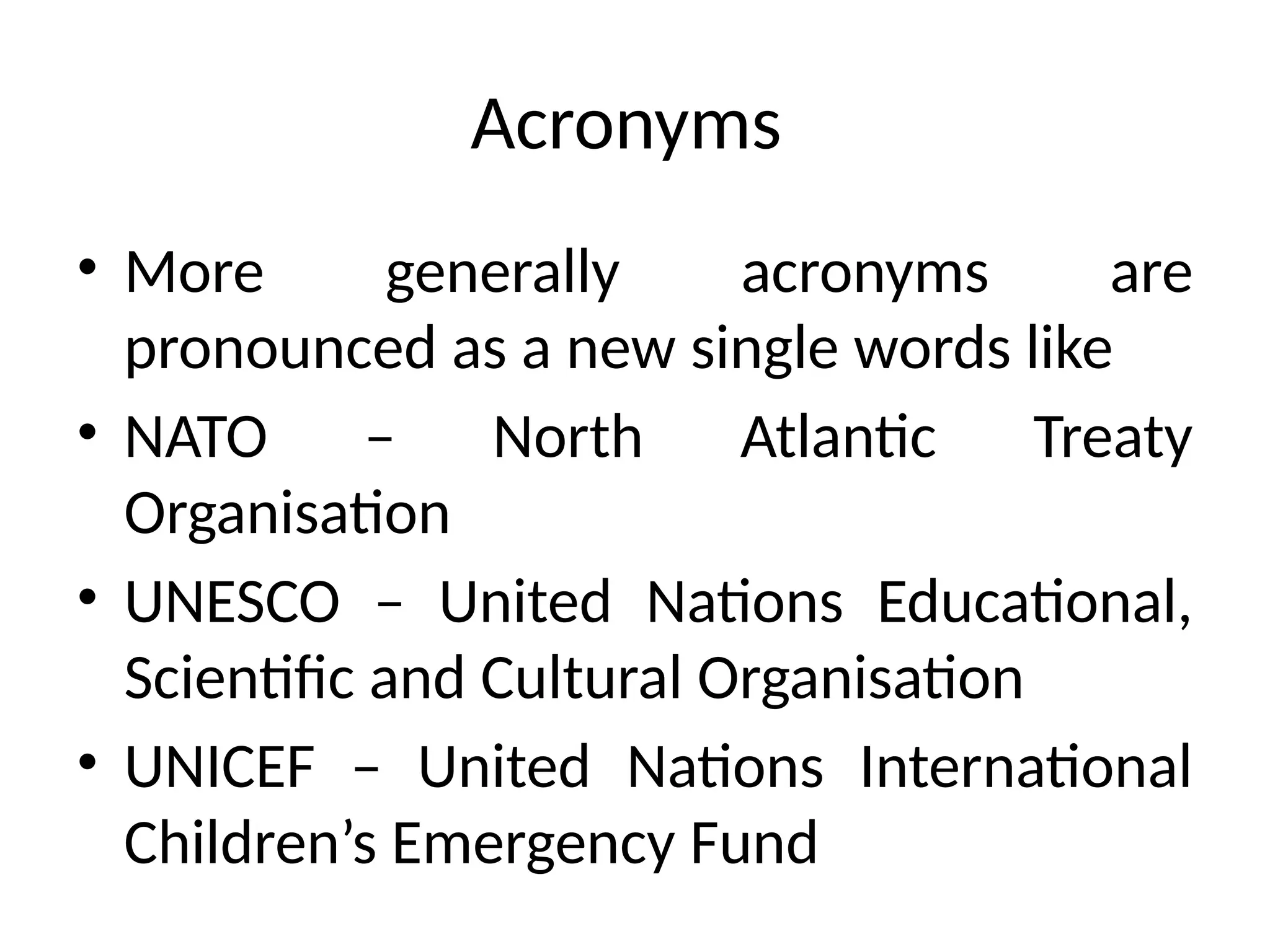
• More generally acronyms are
pronounced as a new single words like
• NATO – North Atlantic Treaty
Organisation
• UNESCO – United Nations Educational,
Scientific and Cultural Organisation
• UNICEF – United Nations International
Children’s Emergency Fund
Acronyms
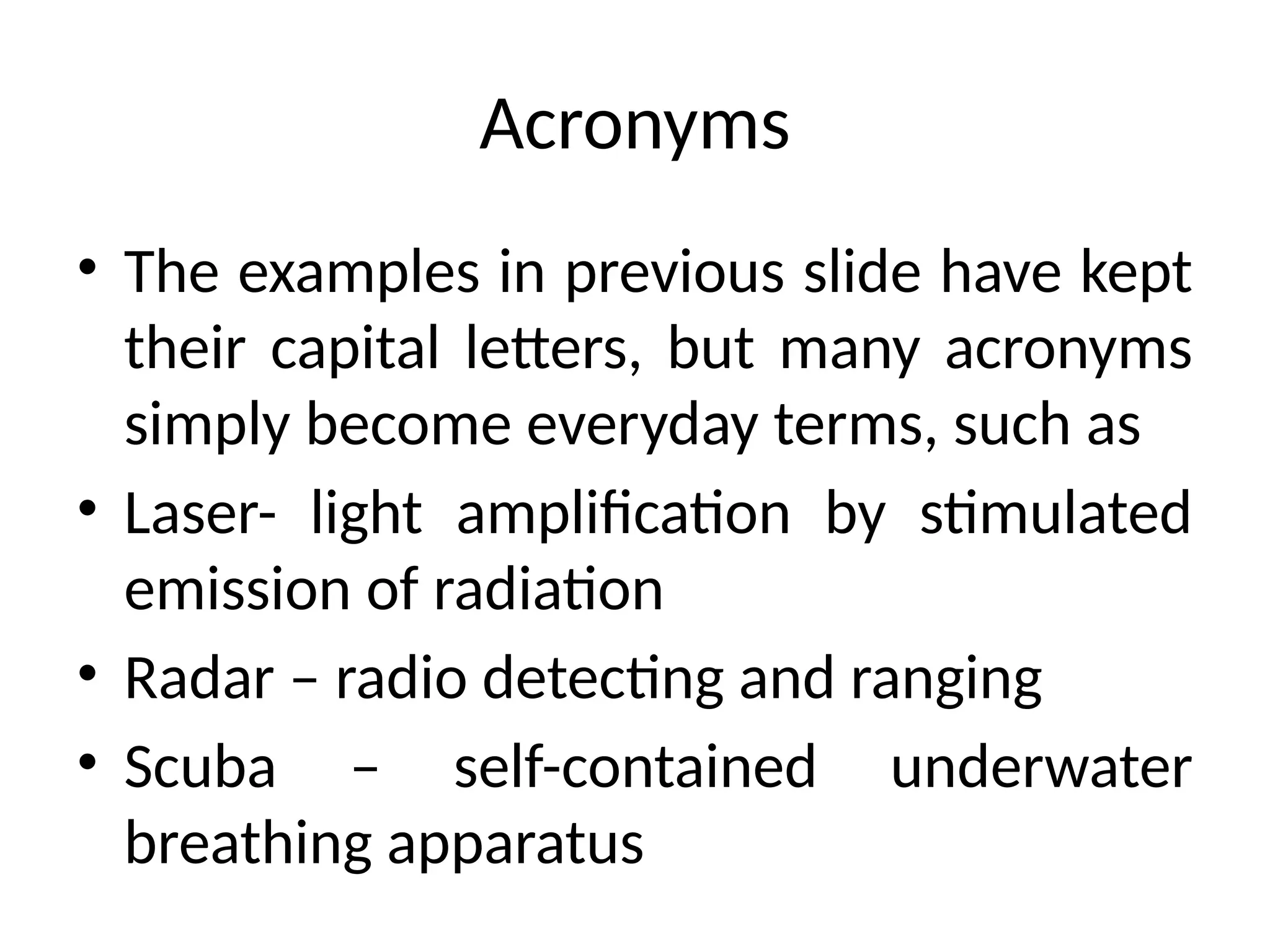
• The examples in previous slide have kept
their capital letters, but many acronyms
simply become everyday terms, such as
• Laser- light amplification by stimulated
emission of radiation
• Radar – radio detecting and ranging
• Scuba – self-contained underwater
breathing apparatus
Acronyms
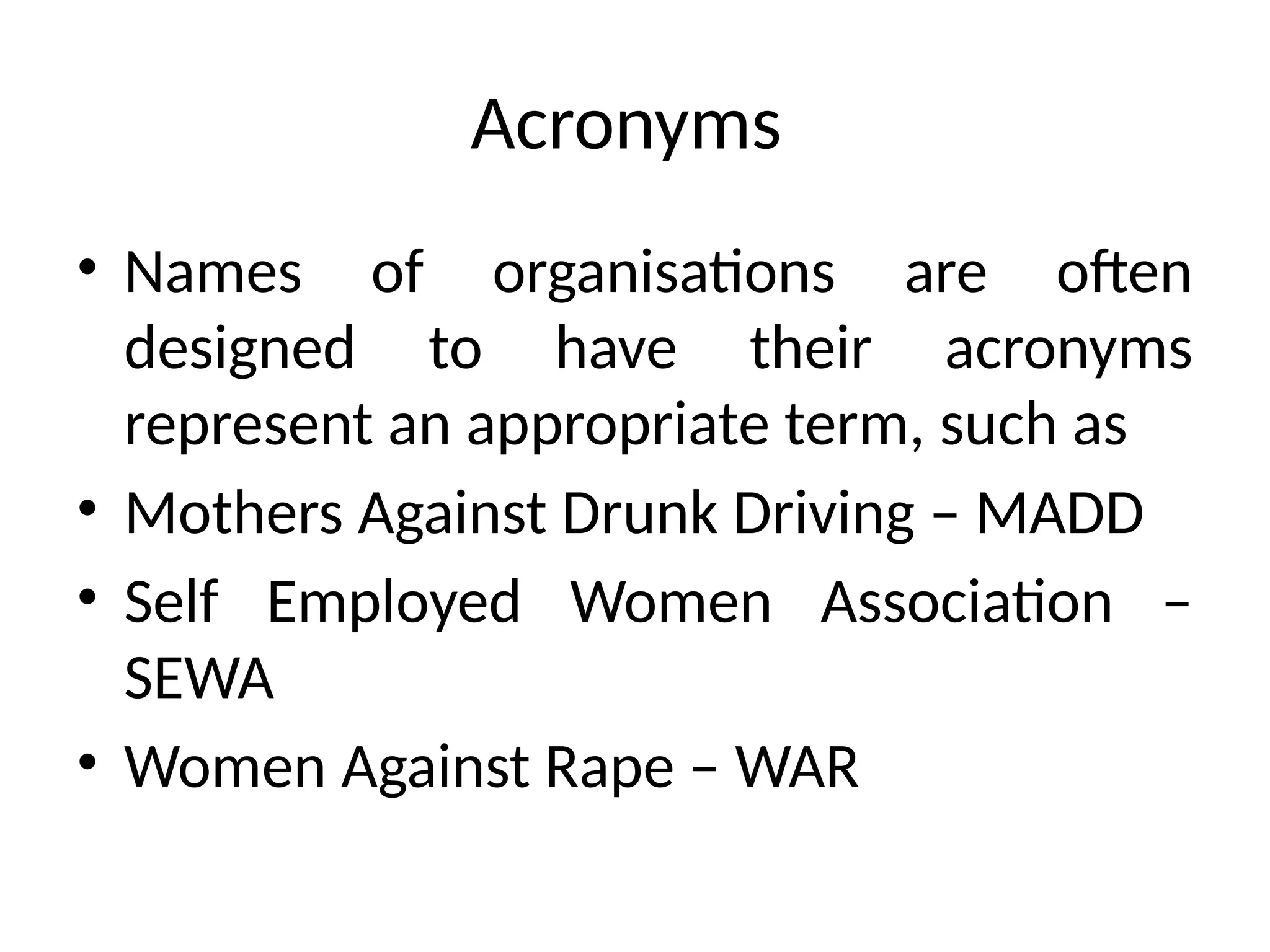
• Names of organisations are often
designed to have their acronyms
represent an appropriate term, such as
• Mothers Against Drunk Driving – MADD
• Self Employed Women Association –
SEWA
• Women Against Rape – WAR
Acronyms
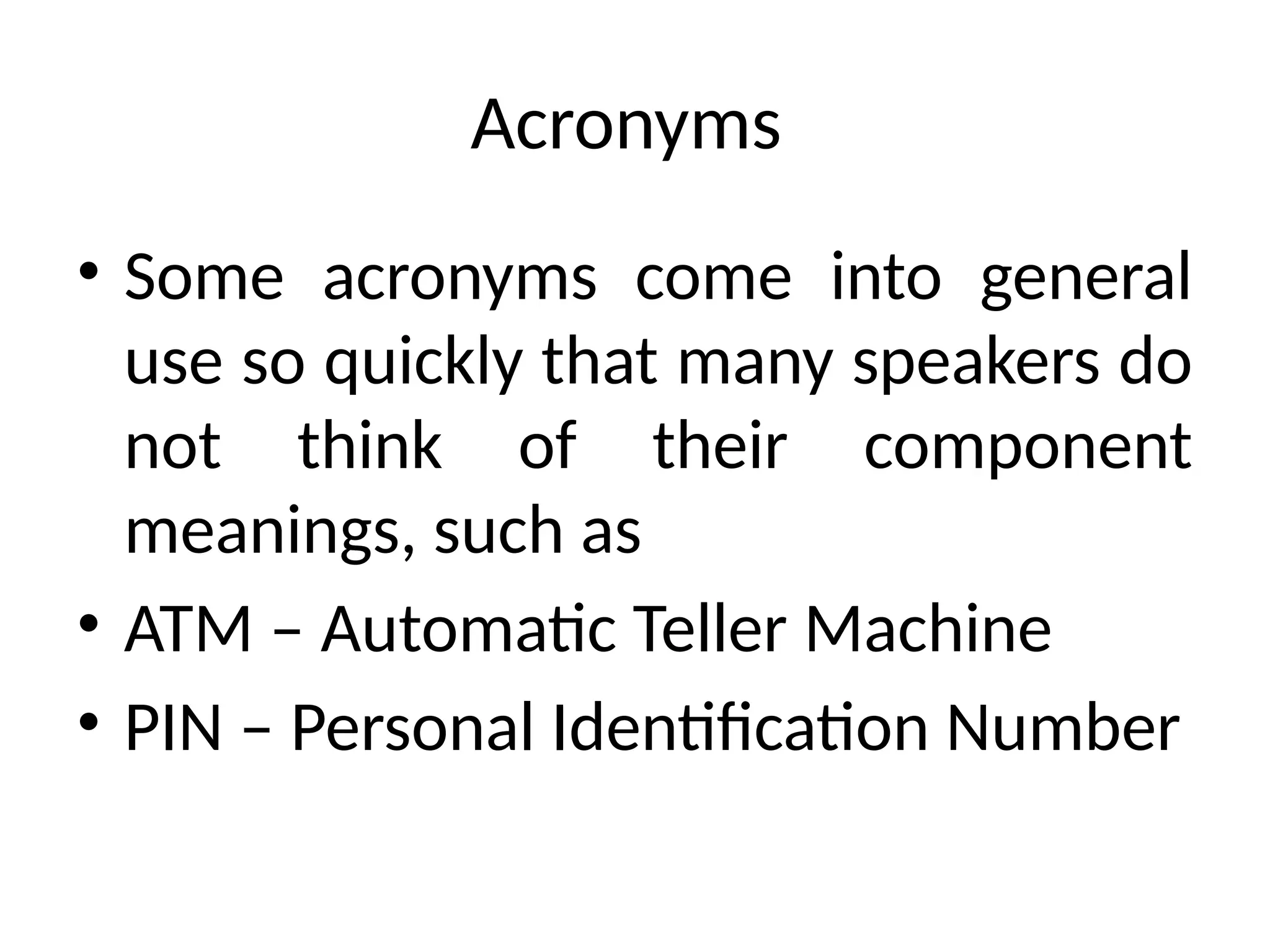
• Some acronyms come into general
use so quickly that many speakers do
not think of their component
meanings, such as
• ATM – Automatic Teller Machine
• PIN – Personal Identification Number
Standard Abbreviation
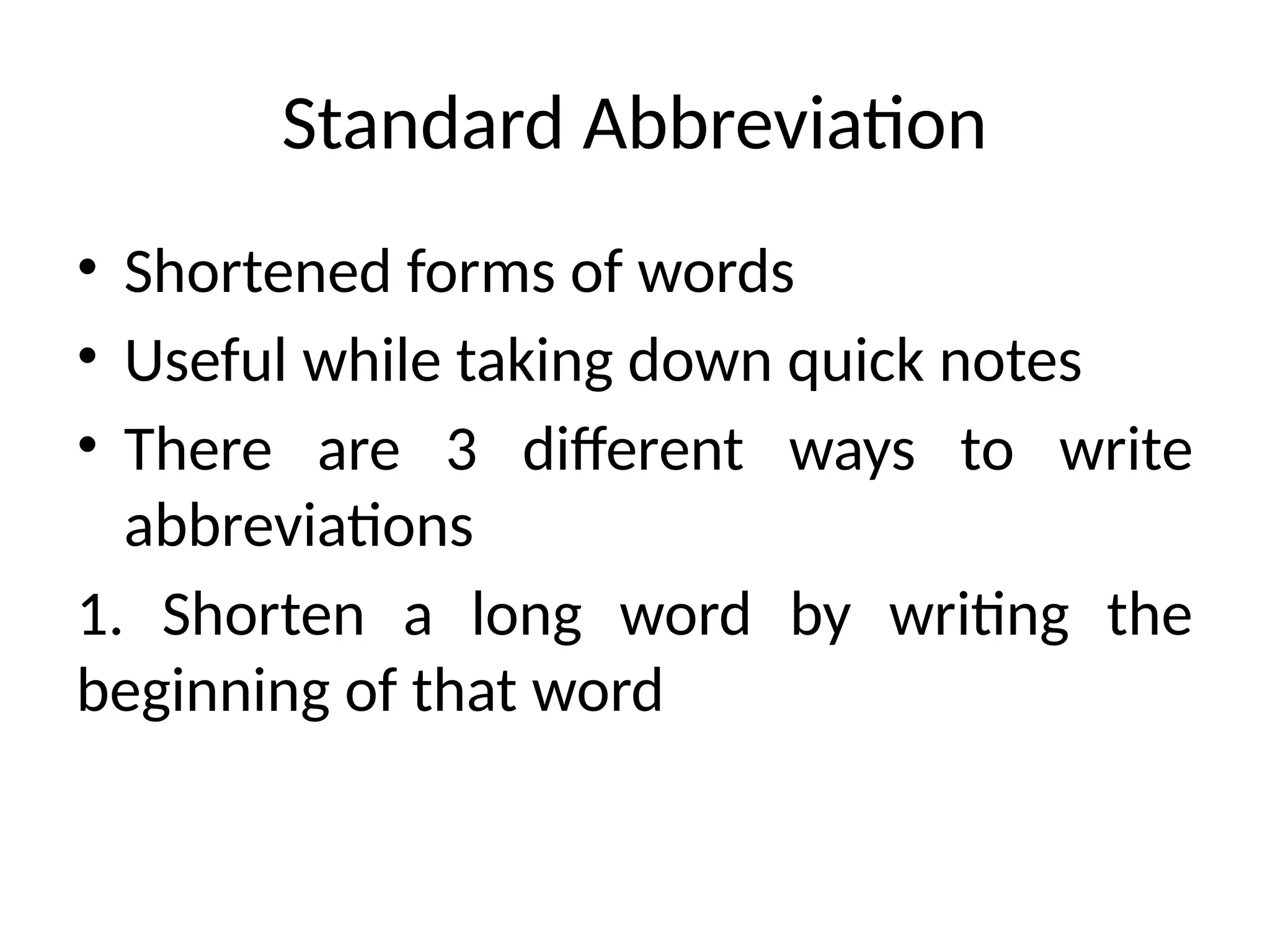
• Shortened forms of words
• Useful while taking down quick notes
• There are 3 different ways to write
abbreviations
1. Shorten a long word by writing the
beginning of that word
Standard Abbreviations
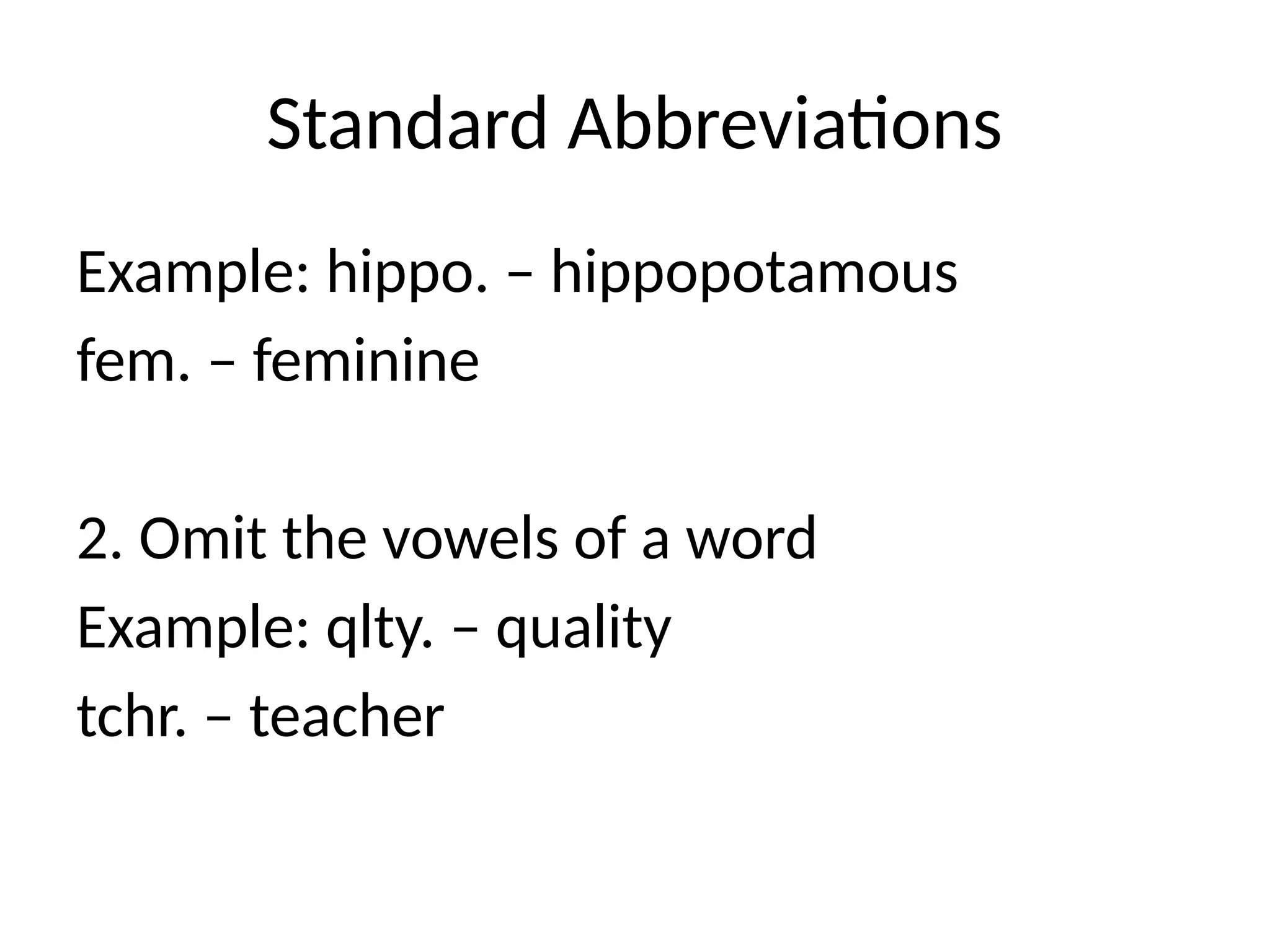
Example: hippo. – hippopotamous
fem. – feminine
2. Omit the vowels of a word
Example: qlty. – quality
tchr. – teacher
Standard Abbreviations
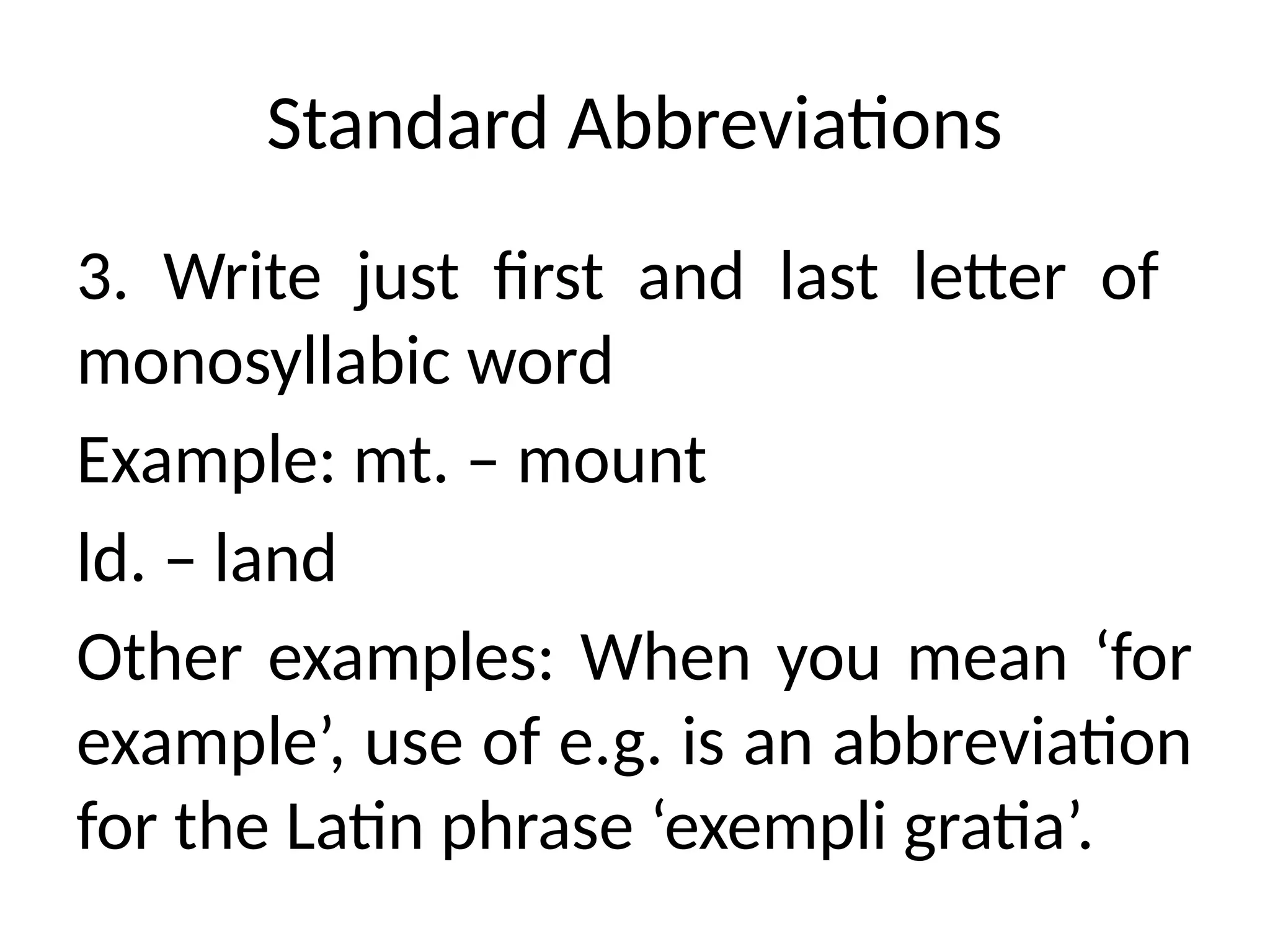
3. Write just first and last letter of
monosyllabic word
Example: mt. – mount
ld. – land
Other examples: When you mean ‘for
example’, use of e.g. is an abbreviation
for the Latin phrase ‘exempli gratia’.
Derivation
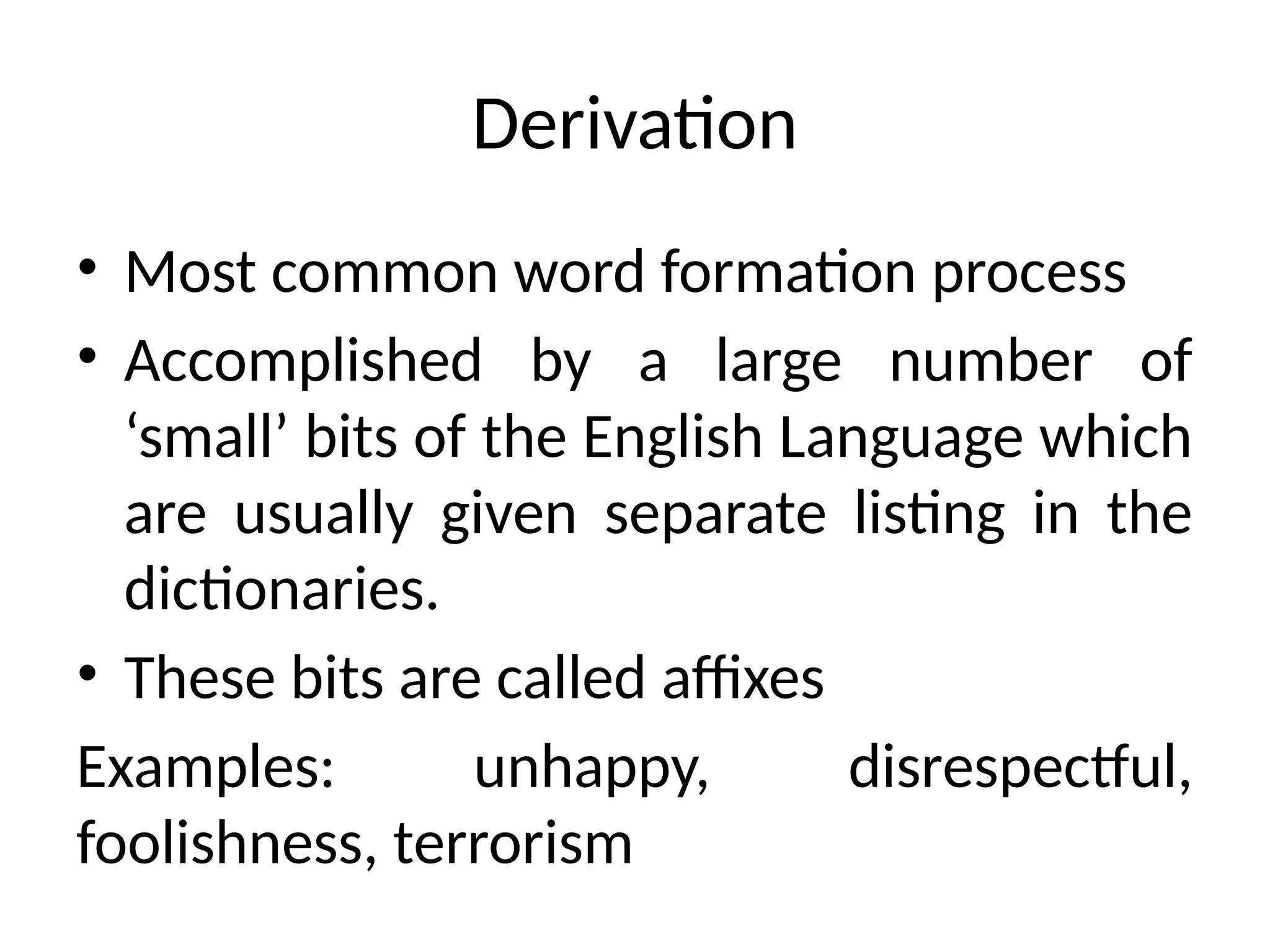
• Most common word formation process
• Accomplished by a large number of
‘small’ bits of the English Language which
are usually given separate listing in the
dictionaries.
• These bits are called affixes
Examples: unhappy, disrespectful,
foolishness, terrorism
Derivation: prefixes
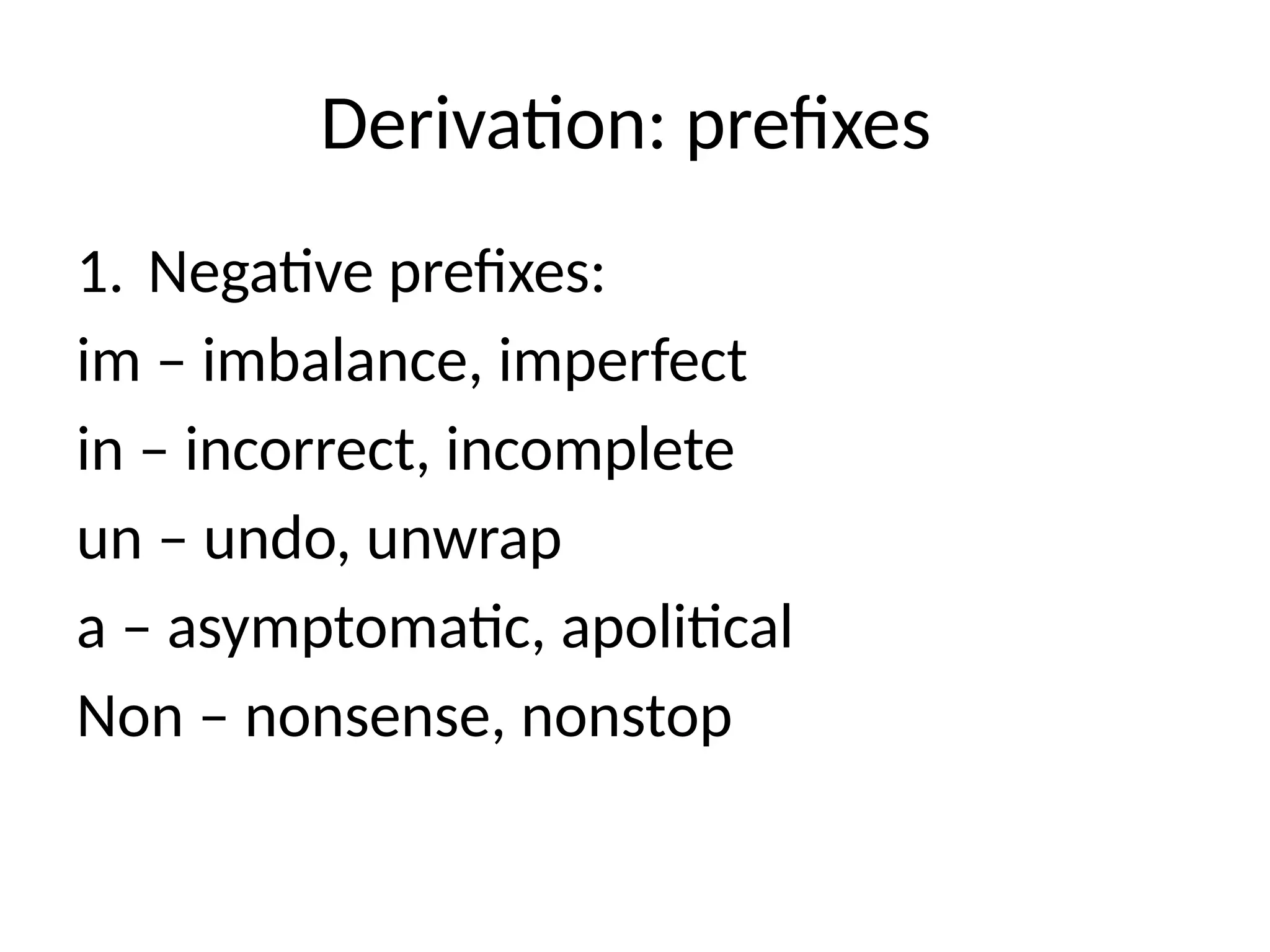
1. Negative prefixes:
im – imbalance, imperfect
in – incorrect, incomplete
un – undo, unwrap
a – asymptomatic, apolitical
Non – nonsense, nonstop
Derivation: prefixes
Dis – disagree, disable
Il – illogical, illiterate
Ir – irrelevant, irrational
De – decode, decompose
Mis – mislead, misinterpret
Pseudo – pseudo-intellectual
Anti – antisocial, antivirus
Derivation: prefixes of number
Mono – monlogue, monochrome
Uni – unipod
Bi – biannual
Di – dichromatic
Tri – tricycle
Tetra – tetrameter
Multi – mulimedia
Poly – polycentric
Derivation: prefixes of time and order
Re – revise, return
fore – forehead, foreshadow
Pre – preheat, preplan
Post – postpaid
Ex – ex-minister
Super – superficial, super-senior
Derivation: prefixes of location
Sub – submarine, subcontinent
Inter – international
Intra – intrastate
Trans – translocation
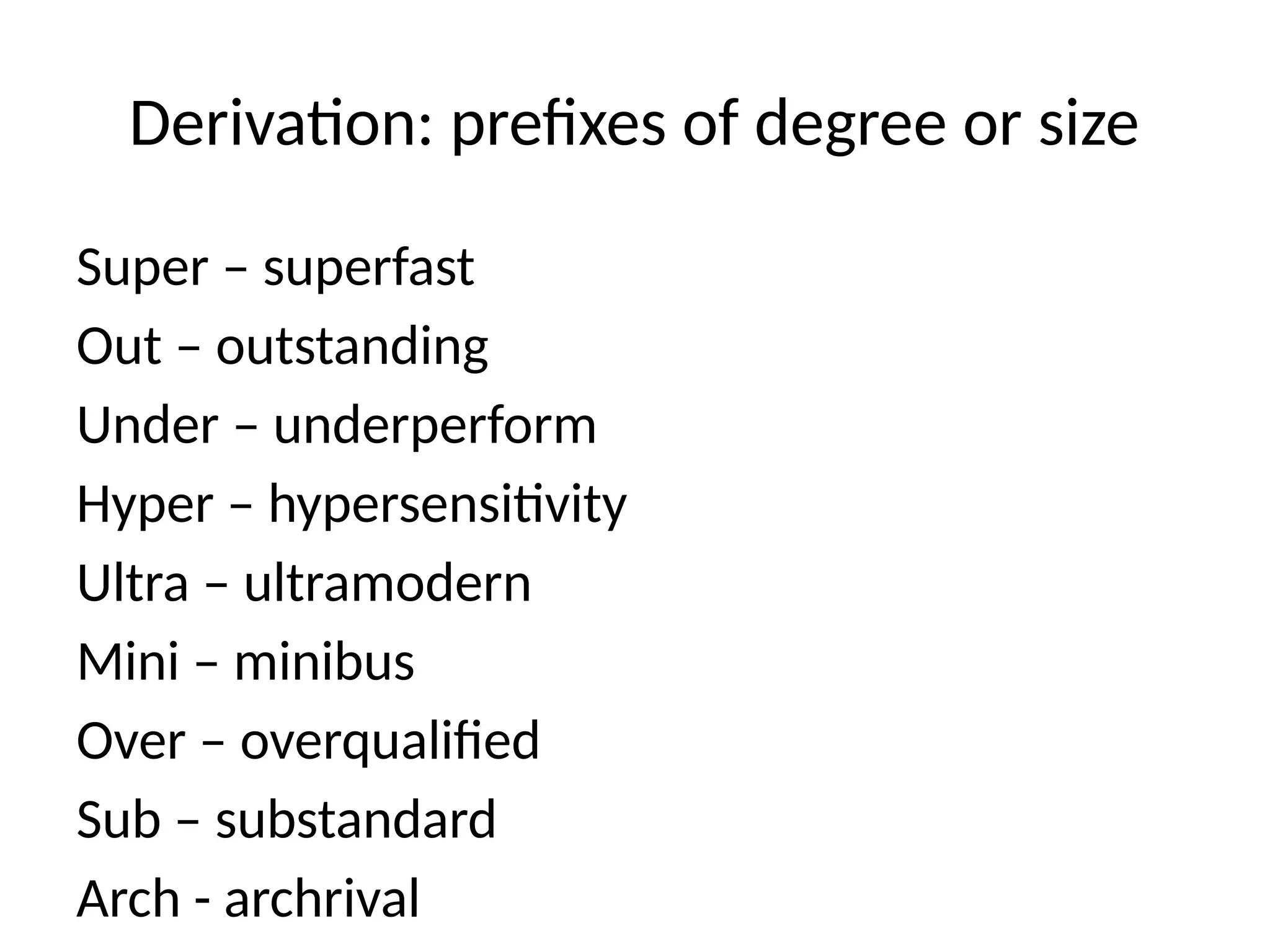
Derivation: prefixes of degree or size
Super – superfast
Out – outstanding
Under – underperform
Hyper – hypersensitivity
Ultra – ultramodern
Mini – minibus
Over – overqualified
Sub – substandard
Arch - archrival
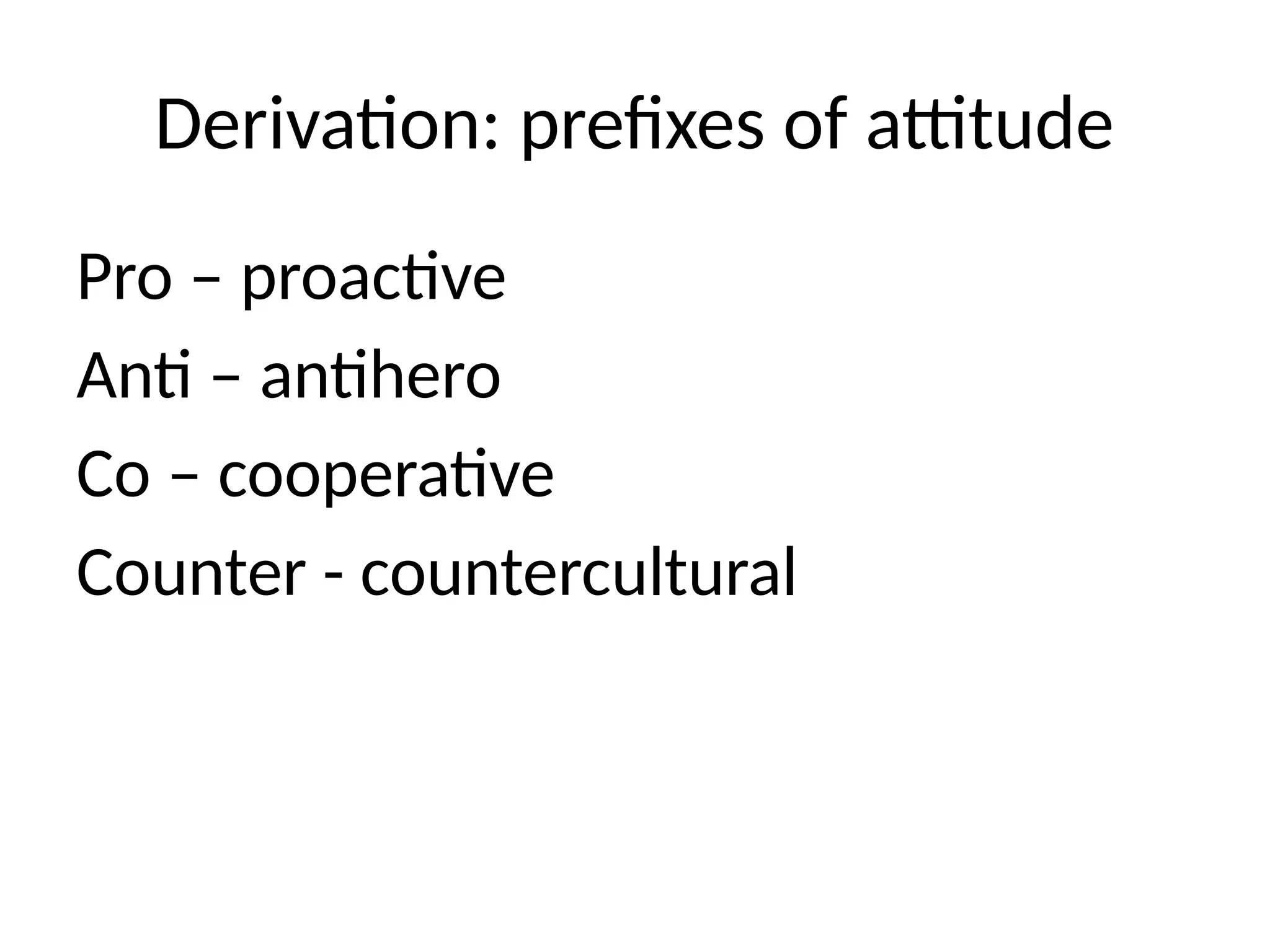
Derivation: prefixes of attitude
Pro – proactive
Anti – antihero
Co – cooperative
Counter - countercultural
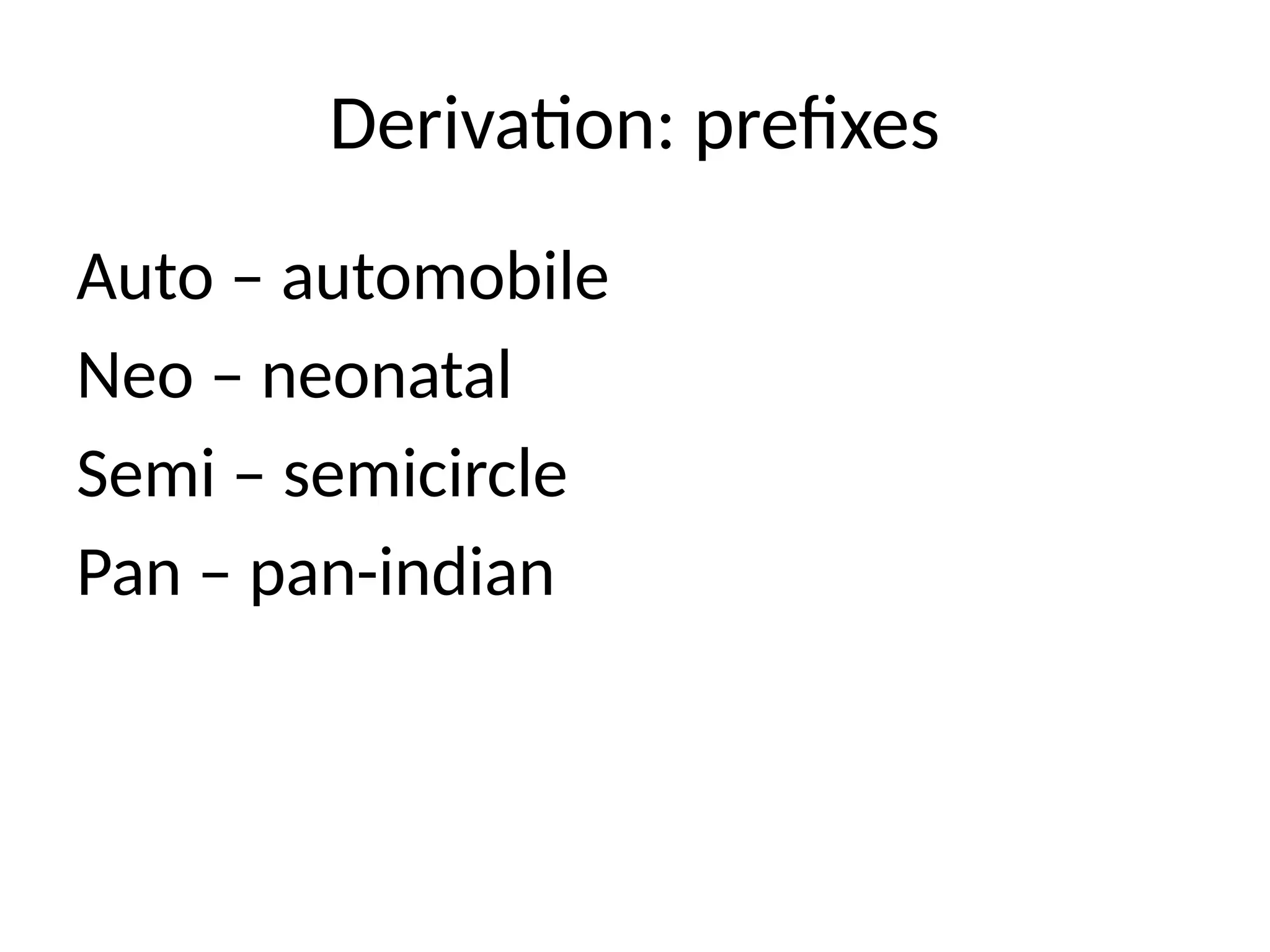
Derivation: prefixes
Auto – automobile
Neo – neonatal
Semi – semicircle
Pan – pan-indian
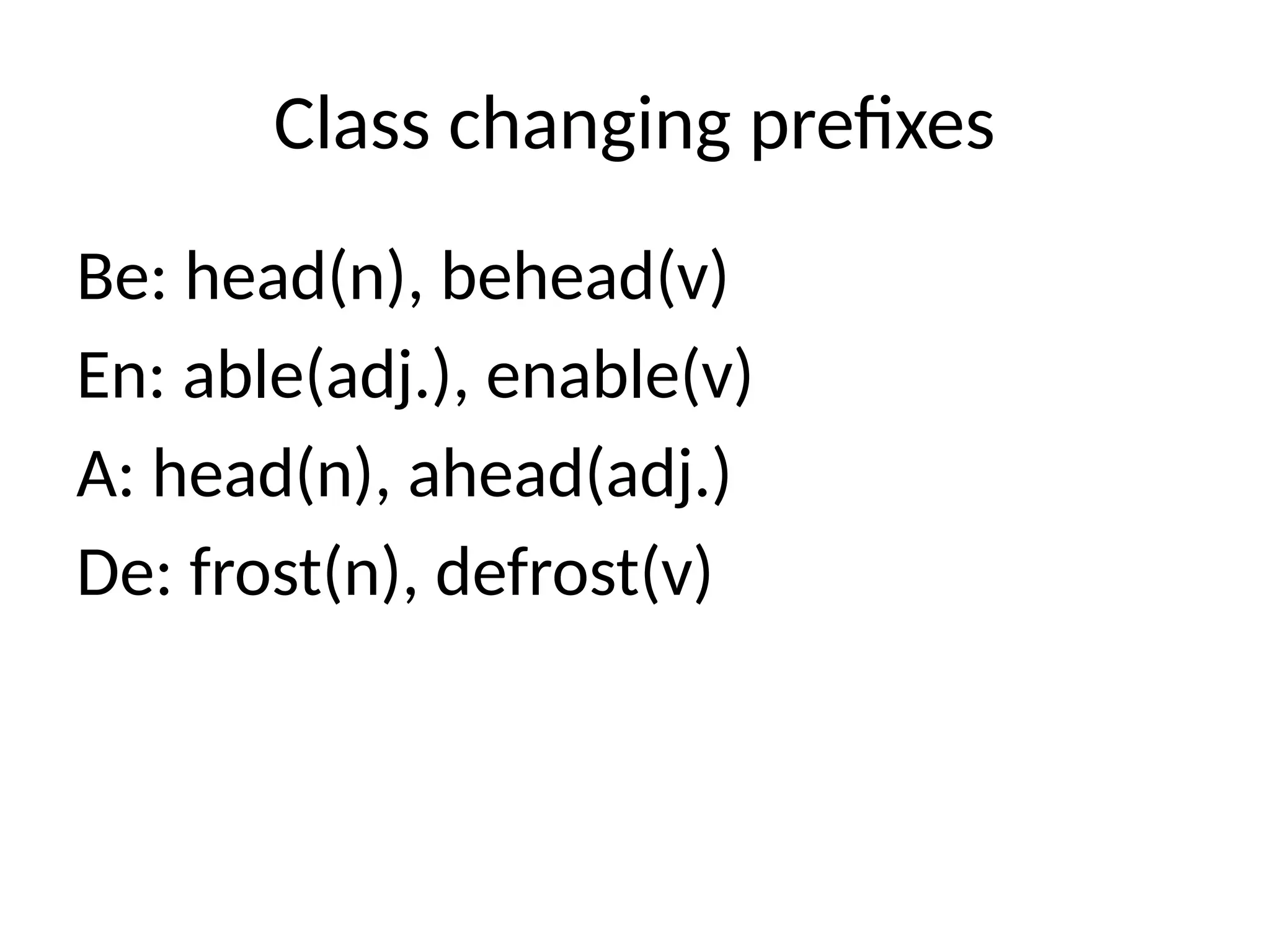
Class changing prefixes
Be: head(n), behead(v)
En: able(adj.), enable(v)
A: head(n), ahead(adj.)
De: frost(n), defrost(v)
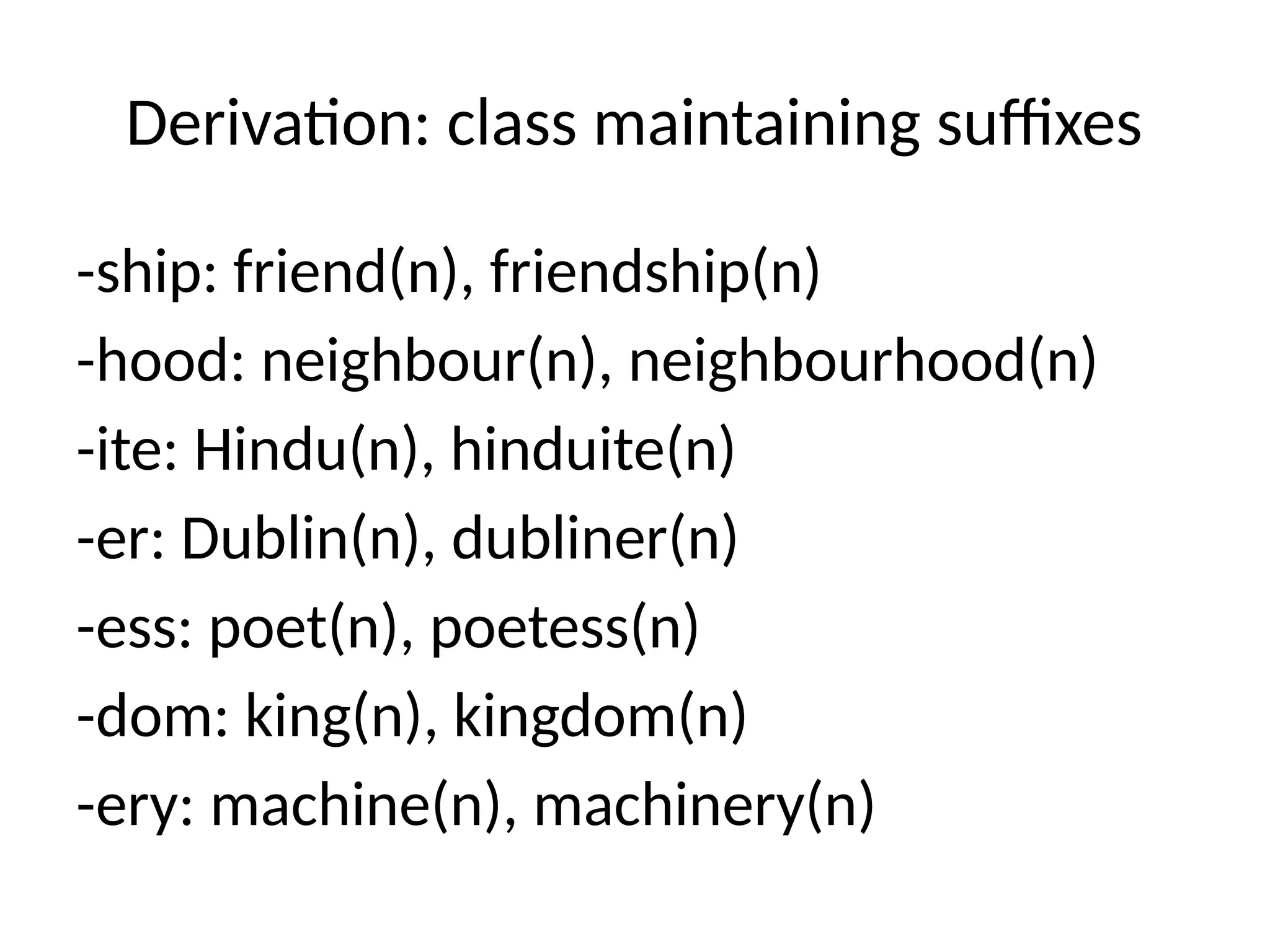
Derivation: class maintaining suffixes
-ship: friend(n), friendship(n)
-hood: neighbour(n), neighbourhood(n)
-ite: Hindu(n), hinduite(n)
-er: Dublin(n), dubliner(n)
-ess: poet(n), poetess(n)
-dom: king(n), kingdom(n)
-ery: machine(n), machinery(n)
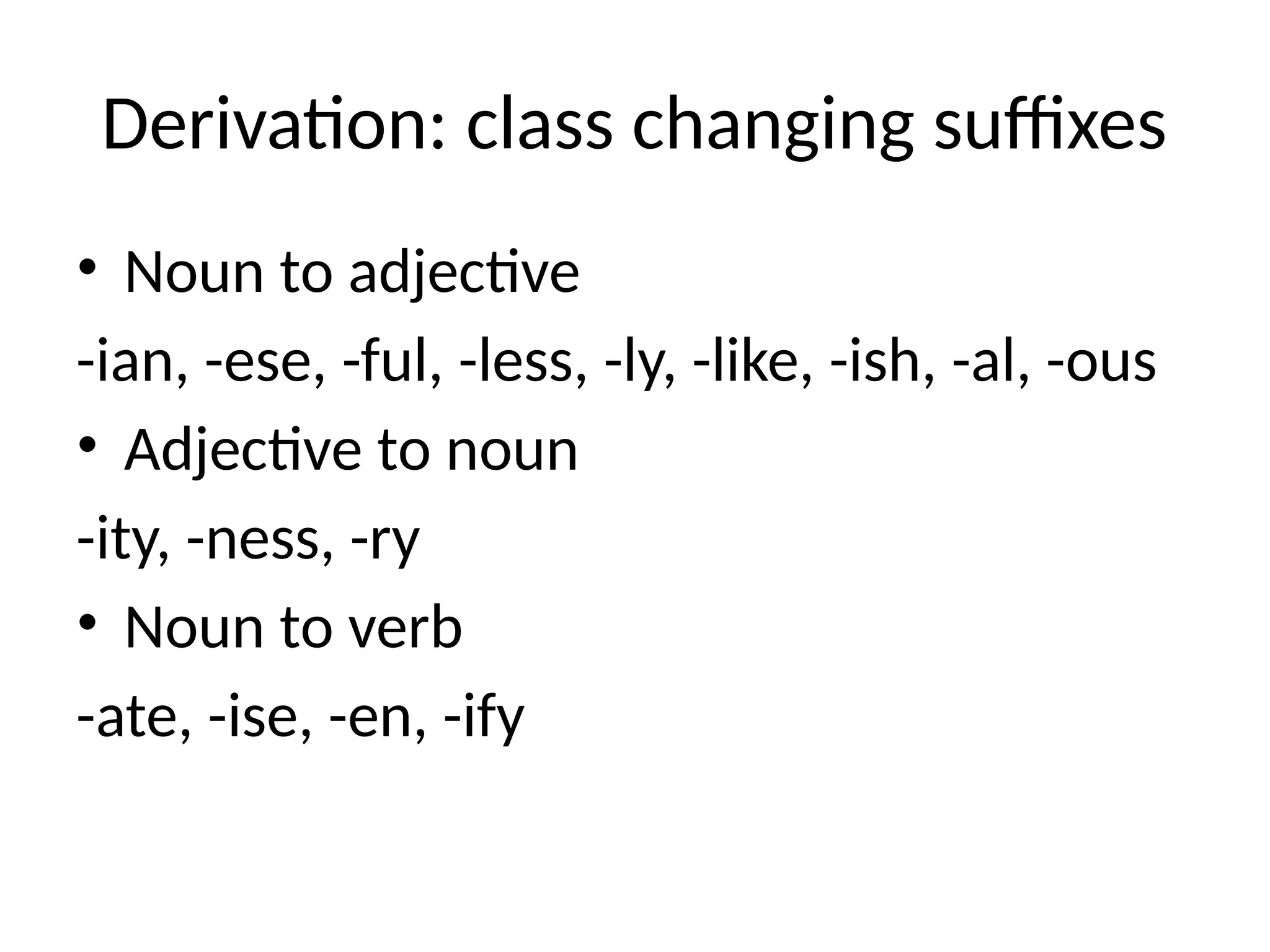
Derivation: class changing suffixes
• Noun to adjective
-ian, -ese, -ful, -less, -ly, -like, -ish, -al, -ous
• Adjective to noun
-ity, -ness, -ry
• Noun to verb
-ate, -ise, -en, -ify
Derivation: class changing suffixes
• Verb to noun
-er, -ment, -age, -ant, -ee, -ation, -al, -or
• Verb to adverb
-ily, -fully
• Adjective to adverb
-ly, -wards
Creative respelling
• Sometimes words are formed by simply
changing the spelling of a word that the
speaker wants to relate to the new word.
• Product names often involve creative
respelling
Example: color, honor, Mr. Kleen
Names: Christen, Kristen, Krysten
UNIT 1 about all the important topics that you need

  • 1.
  • 2.
    Introduction • Origin oflanguage • Various theories - Divine source - Natural sound - Physical adaptation - Teeth, lips, larynx and pharynx - Human brain - Genetic source
  • 3.
    Etymology • the studyof the origins and history of words and their meanings • an explanation of the origin and history of a particular word
  • 4.
    • For example,The word etymology derives from the Greek word ἐτυμολογία (etumología), itself from ἔτυμον (étumon), meaning "true sense or sense of a truth", and the suffix -logia, denoting "the study of". The term etymon refers to a word or morpheme (e.g., stem or root) from which a later word or morpheme derives.
  • 5.
    Why do weneed new words? • Your answers please!
  • 6.
    Coinage • Coinage isthe word formation process in which a new word is created either deliberately or accidentally without using the other word formation processes and often from seemingly nothing. As neologism or coinage, we identify the word formation process of inventing entirely new words (neology)
  • 7.
    Coinage • Least commonmethod of word formation • Sources are invented trade names: • E.g. Aspirin, vaseline, xerox • Variant: Eponyms • Eponyms are new words based on the names of a place/person
  • 8.
    Coinage • Eponyms: • Sandwich,Jeans • Some eponyms are technical terms based on the names of those who first discovered or invented things • E.g. Fahrenheit, Volt, Watt, Newton
  • 9.
    Borrowing • Taking overof words from other languages • E.g. piano, sofa, tattoo, tycoon, saree • Special type of borrowing is called loan translation or Calque • Gratte-ciel(french) – scrape sky • Ubermensch(german)- superman
  • 10.
    Compounding • Compounding isthe process of combining two words (free morphemes) to create a new word (commonly a noun, verb, or adjective). Also called composition, it is from the Latin for "put together". Compounding is the most common type of word-formation in English.
  • 11.
    Compounding • Nouns: bookcase,fingerprint, showcase, notebook • Adjective: Good looking, low paid, over used, full time
  • 12.
    Blending • Blending isone of the many ways new words are made in English. It refers to joining the beginning of one word and the end of another to make a new word with a new meaning. Smog, from smoke and fog, and brunch, from breakfast and lunch, are examples of blends.
  • 13.
    Clipping • When thereis an element of reduction which is noticeable, it is known as clipping. This occurs when a word or more than one syllable is reduced is reduced to a shorter form, usually beginning in casual speech. E.g. fax, ad, cab, flu
  • 14.
    Clipping • A specialtype of reduction, favored in Australian and British English, produced form, technically known as hypocorisms, in which a longer word is reduced to a single syllable, then –y or –ie is added to the end. E.g. moving picture - movie, Australian – Aussie, television - telly
  • 15.
    Conversion • A changein the function of a word, as for e.g., when a noun comes to be used as a verb (without any reduction) is known as conversion. Other labels for this process are “category change” or “functional shift”. • For e.g. Bottle, Butter, Chair • Verb-noun e.g. To guess • Phrasal verb-noun e.g. To takeover • Verb-adjective e.g. See-through
  • 16.
    Conversion • Adjective-verb e.g.Dirty • Adjective-noun e.g. Crazy • Special case: e.g. Doctor (n), To doctor (v)
  • 17.
    Acronyms • New wordsformed from a set of other words • These can be in forms such as: • CD – Compact Disk • DVD – Digital Video Disk • VCR – Video Cassette Recorder • Where pronunciation consist of each separate letter
  • 18.
    Acronyms • More generallyacronyms are pronounced as a new single words like • NATO – North Atlantic Treaty Organisation • UNESCO – United Nations Educational, Scientific and Cultural Organisation • UNICEF – United Nations International Children’s Emergency Fund
  • 19.
    Acronyms • The examplesin previous slide have kept their capital letters, but many acronyms simply become everyday terms, such as • Laser- light amplification by stimulated emission of radiation • Radar – radio detecting and ranging • Scuba – self-contained underwater breathing apparatus
  • 20.
    Acronyms • Names oforganisations are often designed to have their acronyms represent an appropriate term, such as • Mothers Against Drunk Driving – MADD • Self Employed Women Association – SEWA • Women Against Rape – WAR
  • 21.
    Acronyms • Some acronymscome into general use so quickly that many speakers do not think of their component meanings, such as • ATM – Automatic Teller Machine • PIN – Personal Identification Number
  • 22.
    Standard Abbreviation • Shortenedforms of words • Useful while taking down quick notes • There are 3 different ways to write abbreviations 1. Shorten a long word by writing the beginning of that word
  • 23.
    Standard Abbreviations Example: hippo.– hippopotamous fem. – feminine 2. Omit the vowels of a word Example: qlty. – quality tchr. – teacher
  • 24.
    Standard Abbreviations 3. Writejust first and last letter of monosyllabic word Example: mt. – mount ld. – land Other examples: When you mean ‘for example’, use of e.g. is an abbreviation for the Latin phrase ‘exempli gratia’.
  • 25.
    Derivation • Most commonword formation process • Accomplished by a large number of ‘small’ bits of the English Language which are usually given separate listing in the dictionaries. • These bits are called affixes Examples: unhappy, disrespectful, foolishness, terrorism
  • 26.
    Derivation: prefixes 1. Negativeprefixes: im – imbalance, imperfect in – incorrect, incomplete un – undo, unwrap a – asymptomatic, apolitical Non – nonsense, nonstop
  • 27.
    Derivation: prefixes Dis –disagree, disable Il – illogical, illiterate Ir – irrelevant, irrational De – decode, decompose Mis – mislead, misinterpret Pseudo – pseudo-intellectual Anti – antisocial, antivirus
  • 28.
    Derivation: prefixes ofnumber Mono – monlogue, monochrome Uni – unipod Bi – biannual Di – dichromatic Tri – tricycle Tetra – tetrameter Multi – mulimedia Poly – polycentric
  • 29.
    Derivation: prefixes oftime and order Re – revise, return fore – forehead, foreshadow Pre – preheat, preplan Post – postpaid Ex – ex-minister Super – superficial, super-senior
  • 30.
    Derivation: prefixes oflocation Sub – submarine, subcontinent Inter – international Intra – intrastate Trans – translocation
  • 31.
    Derivation: prefixes ofdegree or size Super – superfast Out – outstanding Under – underperform Hyper – hypersensitivity Ultra – ultramodern Mini – minibus Over – overqualified Sub – substandard Arch - archrival
  • 32.
    Derivation: prefixes ofattitude Pro – proactive Anti – antihero Co – cooperative Counter - countercultural
  • 33.
    Derivation: prefixes Auto –automobile Neo – neonatal Semi – semicircle Pan – pan-indian
  • 34.
    Class changing prefixes Be:head(n), behead(v) En: able(adj.), enable(v) A: head(n), ahead(adj.) De: frost(n), defrost(v)
  • 35.
    Derivation: class maintainingsuffixes -ship: friend(n), friendship(n) -hood: neighbour(n), neighbourhood(n) -ite: Hindu(n), hinduite(n) -er: Dublin(n), dubliner(n) -ess: poet(n), poetess(n) -dom: king(n), kingdom(n) -ery: machine(n), machinery(n)
  • 36.
    Derivation: class changingsuffixes • Noun to adjective -ian, -ese, -ful, -less, -ly, -like, -ish, -al, -ous • Adjective to noun -ity, -ness, -ry • Noun to verb -ate, -ise, -en, -ify
  • 37.
    Derivation: class changingsuffixes • Verb to noun -er, -ment, -age, -ant, -ee, -ation, -al, -or • Verb to adverb -ily, -fully • Adjective to adverb -ly, -wards
  • 38.
    Creative respelling • Sometimeswords are formed by simply changing the spelling of a word that the speaker wants to relate to the new word. • Product names often involve creative respelling Example: color, honor, Mr. Kleen Names: Christen, Kristen, Krysten