Notes on Introduction to Linguistics I
               These are the main materials for the mid-term test.


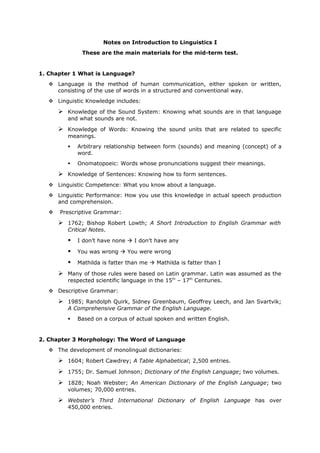
1. Chapter 1 What is Language?
    Language is the method of human communication, either spoken or written,
     consisting of the use of words in a structured and conventional way.
    Linguistic Knowledge includes:

        Knowledge of the Sound System: Knowing what sounds are in that language
          and what sounds are not.

        Knowledge of Words: Knowing the sound units that are related to specific
          meanings.
             Arbitrary relationship between form (sounds) and meaning (concept) of a
              word.
             Onomatopoeic: Words whose pronunciations suggest their meanings.

        Knowledge of Sentences: Knowing how to form sentences.
    Linguistic Competence: What you know about a language.
    Linguistic Performance: How you use this knowledge in actual speech production
     and comprehension.
      Prescriptive Grammar:

        1762; Bishop Robert Lowth; A Short Introduction to English Grammar with
          Critical Notes.

             I don’t have none  I don’t have any

             You was wrong  You were wrong

             Mathilda is fatter than me  Mathilda is fatter than I

        Many of those rules were based on Latin grammar. Latin was assumed as the
          respected scientific language in the 15th – 17th Centuries.
    Descriptive Grammar:

        1985; Randolph Quirk, Sidney Greenbaum, Geoffrey Leech, and Jan Svartvik;
          A Comprehensive Grammar of the English Language.
             Based on a corpus of actual spoken and written English.


2. Chapter 3 Morphology: The Word of Language
    The development of monolingual dictionaries:

        1604; Robert Cawdrey; A Table Alphabetical; 2,500 entries.
        1755; Dr. Samuel Johnson; Dictionary of the English Language; two volumes.
        1828; Noah Webster; An American Dictionary of the English Language; two
          volumes; 70,000 entries.

        Webster’s Third International Dictionary of English Language has over
          450,000 entries.
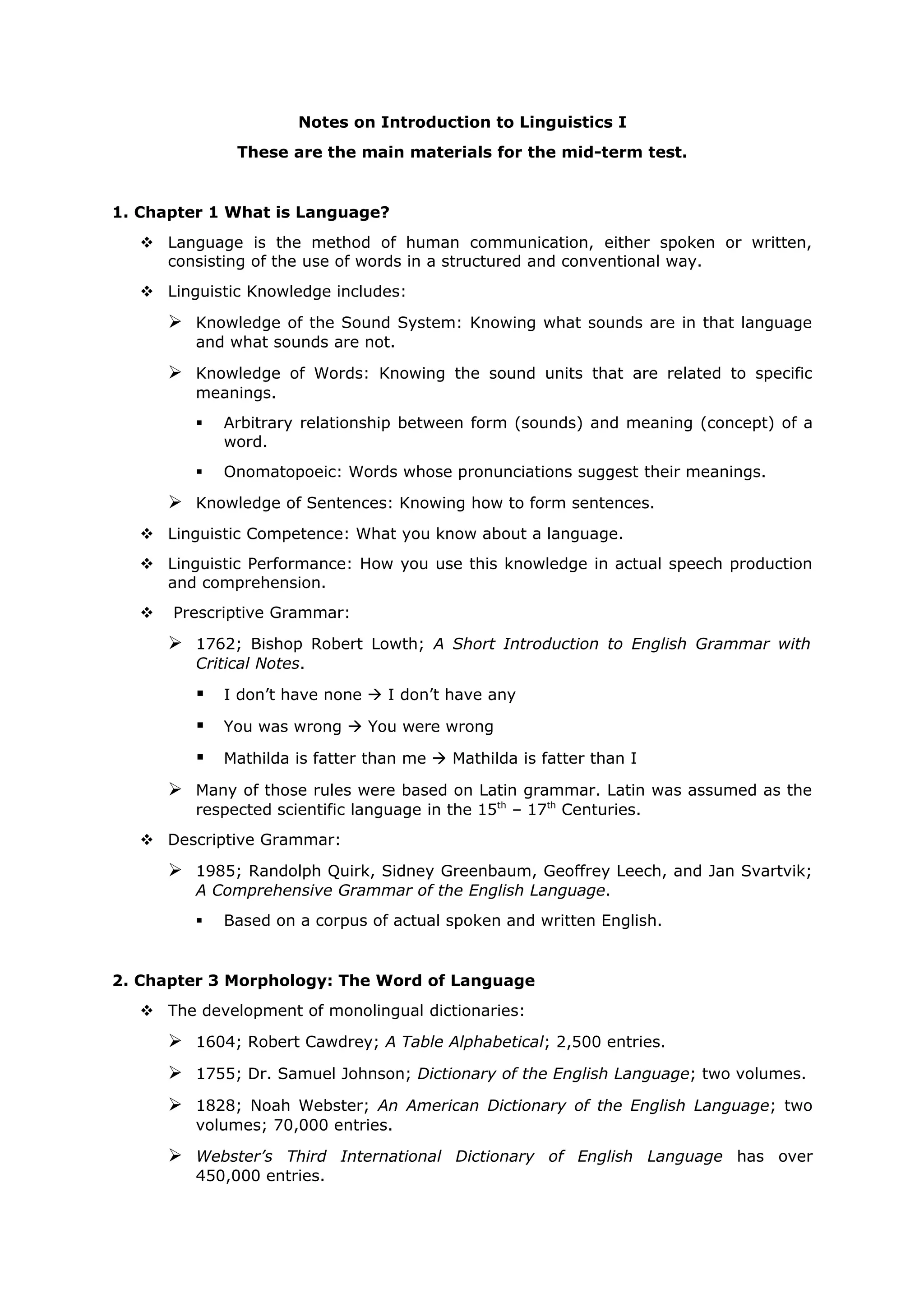
 Content words: Nouns, Verbs, Adjectives, and Adverbs.
 Function words: Conjunctions, Prepositions, Articles, Pronouns,
 Morpheme: The minimal unit of meaning.

    Free morpheme: a single morpheme that constitutes a word and can stand
      alone.

    Bound morpheme: a morpheme that must be attached to another morpheme.
 Prefix: An affix that occurs before a morpheme.

    Some examples of negative prefixes:
          Prefix               Added to                         Example

       UN-          adjectives                     unfair
       NON-         various classes                non-smoker, nonsense, non-drip
       DIS-         adjectives, verbs, nouns       disloyal, dislike, disfavour
       A-           adjectives, nouns              amoral, asymmetry

    Degree and size prefixes:
          Prefix        Meaning           Added to                    Example

       Arch-       highest, worst     nouns                 archduke, arch-enemy
       Super-      above, better      nouns, adjectives     superman, supernatural
       Over-       too much           verbs, adjectives     overeat, overconfident
       Hyper-      extremely          adjectives            hyperactive
       Sub-        lower than         adjectives            substandard
       Mini-       little             nouns                 minibus
 Suffix: An affix that occurs after a morpheme.

    Class preserving suffixation:
               Suffix           Meaning                      Example

            -er             occupation         engineer
            -ian            occupation         musician
            -ist            occupation         violinist
            -let            small              piglet

    Class changing suffixation:
           Verbs  Nouns

           Verbs  Adjectives

           Adjectives  Nouns

           Adjectives  Verbs

           Nouns  Verbs

           Nouns  Adjectives
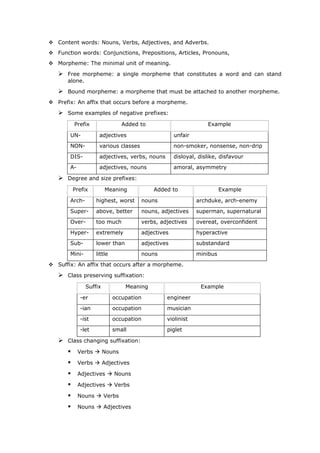
 Derivational morpheme: deriving (creating) a new word with a new meaning.
  Inflectional morpheme: changing the form of a word because of the rules of
   syntax.
  English inflectional morphemes:
        Nouns
            –s       plural
            –’s      possessive
        Verbs
             –s      third person singular present
            –ed      past tense
            –en      past participle
            –ing progressive
        Adjectives
            –er      comparative
            –est superlative


 Word Coinage: Compounds, Acronyms, Back-formations, Abbreviations,
  Eponyms, and Blends.
 Compounds: Two or more words joined together to a form a new word.
          Home + work  homework
          Pick + pocket  pickpocket
   Note: The meaning of a compound is not always the sum of the meanings of its
   parts.
          Coconut oil  oil made from coconuts.
          Olive oil  oil made from olives.
          Baby oil  .........
          cathouse  .........
          blue-movies  .........
          blue-chip  .........


 Acronyms: Words derived from the initials of several words.
          National Aeronautics and Space Agency  .........
          Self-contained underwater breathing apparatus  .........
          .........  FYI
          .........  TGIF
          .........  a.k.a


 Back-formations: Creative reduction due to incorrect morphological analysis.
          Editor (1649)  edit (1791)
          Television (1907)  televise (1927)
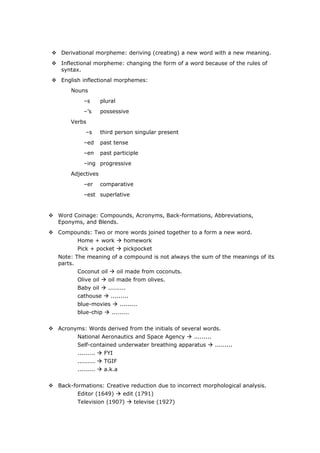
 Abbreviations (Clipping): A word which is clipped.
              Facsimile  fax
              Hamburger  burger
              Gasoline  .........
              Advertisement  .........
              Omnibus  .........


       Words from Names (Eponyms): Words derived from proper names or things.
              Sandwich
              Celsius


    Blends: Similar to compounds, but parts of the words are deleted.
              Motor + hotel  Motel
              Breakfast + lunch  .........
              modulator, demodulator  .........


Deny Arnos Kwary
Lecturer of Linguistics
Airlangga University
http://www.kwary.net

Notes itl01

  • 1.
    Notes on Introductionto Linguistics I These are the main materials for the mid-term test. 1. Chapter 1 What is Language?  Language is the method of human communication, either spoken or written, consisting of the use of words in a structured and conventional way.  Linguistic Knowledge includes:  Knowledge of the Sound System: Knowing what sounds are in that language and what sounds are not.  Knowledge of Words: Knowing the sound units that are related to specific meanings.  Arbitrary relationship between form (sounds) and meaning (concept) of a word.  Onomatopoeic: Words whose pronunciations suggest their meanings.  Knowledge of Sentences: Knowing how to form sentences.  Linguistic Competence: What you know about a language.  Linguistic Performance: How you use this knowledge in actual speech production and comprehension.  Prescriptive Grammar:  1762; Bishop Robert Lowth; A Short Introduction to English Grammar with Critical Notes.  I don’t have none  I don’t have any  You was wrong  You were wrong  Mathilda is fatter than me  Mathilda is fatter than I  Many of those rules were based on Latin grammar. Latin was assumed as the respected scientific language in the 15th – 17th Centuries.  Descriptive Grammar:  1985; Randolph Quirk, Sidney Greenbaum, Geoffrey Leech, and Jan Svartvik; A Comprehensive Grammar of the English Language.  Based on a corpus of actual spoken and written English. 2. Chapter 3 Morphology: The Word of Language  The development of monolingual dictionaries:  1604; Robert Cawdrey; A Table Alphabetical; 2,500 entries.  1755; Dr. Samuel Johnson; Dictionary of the English Language; two volumes.  1828; Noah Webster; An American Dictionary of the English Language; two volumes; 70,000 entries.  Webster’s Third International Dictionary of English Language has over 450,000 entries.
  • 2.
     Content words:Nouns, Verbs, Adjectives, and Adverbs.  Function words: Conjunctions, Prepositions, Articles, Pronouns,  Morpheme: The minimal unit of meaning.  Free morpheme: a single morpheme that constitutes a word and can stand alone.  Bound morpheme: a morpheme that must be attached to another morpheme.  Prefix: An affix that occurs before a morpheme.  Some examples of negative prefixes: Prefix Added to Example UN- adjectives unfair NON- various classes non-smoker, nonsense, non-drip DIS- adjectives, verbs, nouns disloyal, dislike, disfavour A- adjectives, nouns amoral, asymmetry  Degree and size prefixes: Prefix Meaning Added to Example Arch- highest, worst nouns archduke, arch-enemy Super- above, better nouns, adjectives superman, supernatural Over- too much verbs, adjectives overeat, overconfident Hyper- extremely adjectives hyperactive Sub- lower than adjectives substandard Mini- little nouns minibus  Suffix: An affix that occurs after a morpheme.  Class preserving suffixation: Suffix Meaning Example -er occupation engineer -ian occupation musician -ist occupation violinist -let small piglet  Class changing suffixation:  Verbs  Nouns  Verbs  Adjectives  Adjectives  Nouns  Adjectives  Verbs  Nouns  Verbs  Nouns  Adjectives
  • 3.
     Derivational morpheme:deriving (creating) a new word with a new meaning.  Inflectional morpheme: changing the form of a word because of the rules of syntax.  English inflectional morphemes: Nouns –s plural –’s possessive Verbs –s third person singular present –ed past tense –en past participle –ing progressive Adjectives –er comparative –est superlative  Word Coinage: Compounds, Acronyms, Back-formations, Abbreviations, Eponyms, and Blends.  Compounds: Two or more words joined together to a form a new word. Home + work  homework Pick + pocket  pickpocket Note: The meaning of a compound is not always the sum of the meanings of its parts. Coconut oil  oil made from coconuts. Olive oil  oil made from olives. Baby oil  ......... cathouse  ......... blue-movies  ......... blue-chip  .........  Acronyms: Words derived from the initials of several words. National Aeronautics and Space Agency  ......... Self-contained underwater breathing apparatus  ......... .........  FYI .........  TGIF .........  a.k.a  Back-formations: Creative reduction due to incorrect morphological analysis. Editor (1649)  edit (1791) Television (1907)  televise (1927)
  • 4.
     Abbreviations (Clipping):A word which is clipped. Facsimile  fax Hamburger  burger Gasoline  ......... Advertisement  ......... Omnibus  .........  Words from Names (Eponyms): Words derived from proper names or things. Sandwich Celsius  Blends: Similar to compounds, but parts of the words are deleted. Motor + hotel  Motel Breakfast + lunch  ......... modulator, demodulator  ......... Deny Arnos Kwary Lecturer of Linguistics Airlangga University http://www.kwary.net