What is Morphology?
• The term morphology is Greek, and constituted of morph standing for
‘shape’ or, ‘form’, and ology suggesting ‘the study of something’.
• In linguistics, morphology is a level of linguistics analysis and
discussion, and covers the scientific study of form and structure of
words in a language.
• The traditional concern of morphology is the identification of
morphemes, that is, the smallest, meaningful and indivisible
grammatical units of language.
• The interest of the morphologists (linguists who study morphology) is to
look at the parts or constituents that words are divided into, and study
the meanings of these individual parts.
What is Morpheme and its classification?
• A morpheme is a minimal unit of meaning or grammatical function.
• It has some value. That means each morpheme (down to a single letter has
some meaning)
Ex. Tourists: -tour (one minimal unit)
-ist (meaning “person who does something”)
-s (a third unit of grammatical function indicating plurality)
Morpheme can be of two types:
 Free Morphemes
 Bound Morphemes
What is Morpheme and its classification?
 Free Morphemes:
The morphemes that can function independently are called free or
independent morphemes.
For example: man, boy, girl etc.
These morphemes can be again categorized in two classes: Lexical
morphemes and grammatical morphemes. Lexical morphemes refer to
ordinary nouns (like: pen, rice) , verbs (like: read, go) and adjectives (like:
quickly, happily). Grammatical morphemes include auxiliary verbs (like: is,
can), determiners (like: the, much), prepositions (like: on, into) and
conjunctions (like: and, but).
What is Morpheme and its classification?
 Bound Morphemes:
There are some morphemes that cannot function independently or alone, they
are added to the root word or to the free morpheme. These type of morpheme
are called bound morphemes.
For example: -less, -ment, un-, -ly etc. as in the words Careless, Enjoyment,
Unknown, Friendly.
o Root and stem:
A word must contain an element that can stand by itself, that is, a free
morpheme, such as talk. Such an element is called a root. When they are
used with bound morphemes, the basic word-form involved is technically
known as the stem.
Word Formation Processes in English Language
• There are a lot of regularities in the word formation process in English language.
In English language, words are formed in various ways.
The processes we will explore here are:
 Etymology
 Coinage
 Borrowing
 Compounding
 Blending
 Clipping
 Backformation
 Conversion
 Acronyms
 Derivation
 Infixes
 Reduplication
Word Formation Processes in English Language
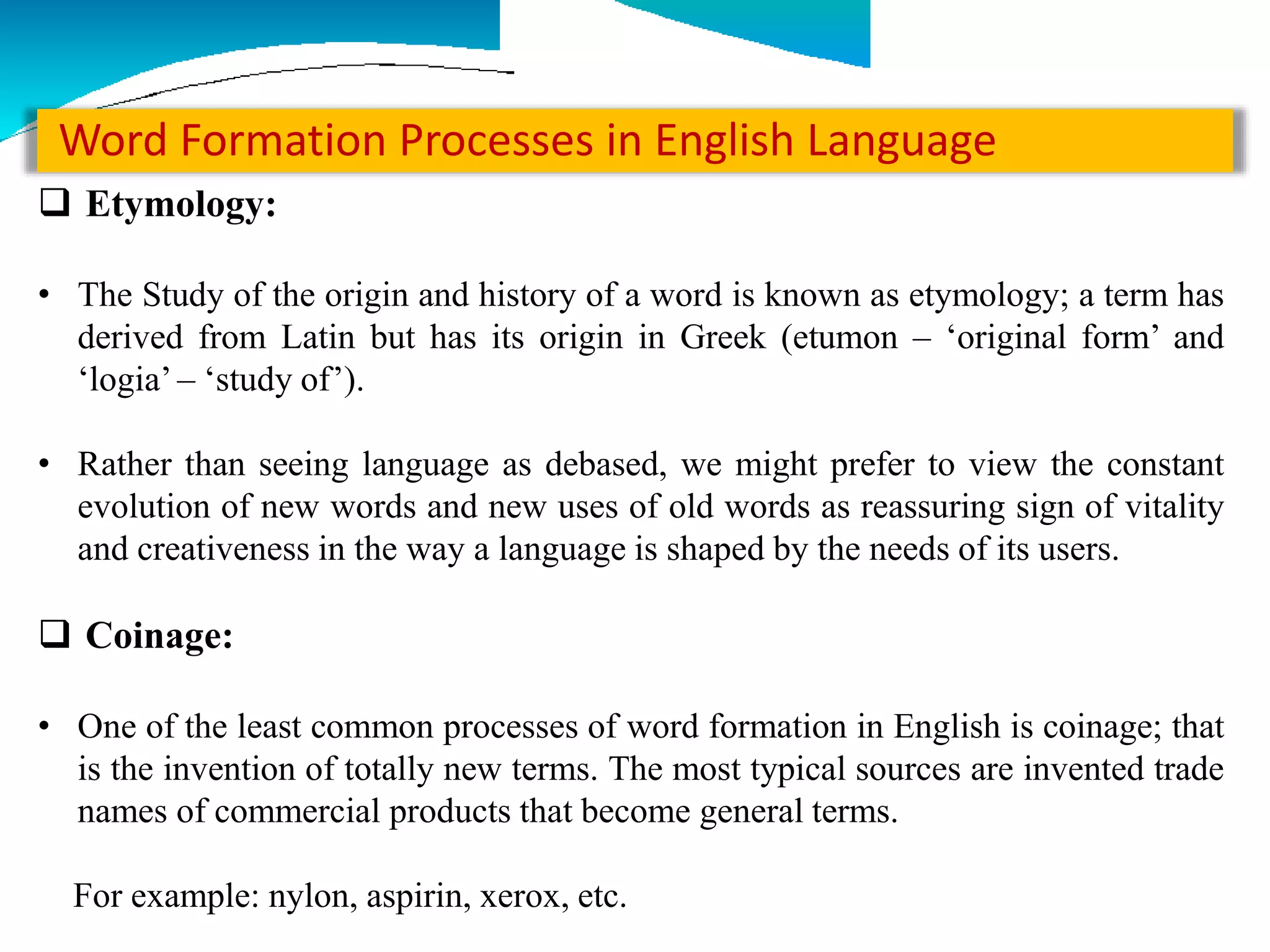
 Etymology:
• The Study of the origin and history of a word is known as etymology; a term has
derived from Latin but has its origin in Greek (etumon – ‘original form’ and
‘logia’ – ‘study of’).
• Rather than seeing language as debased, we might prefer to view the constant
evolution of new words and new uses of old words as reassuring sign of vitality
and creativeness in the way a language is shaped by the needs of its users.
 Coinage:
• One of the least common processes of word formation in English is coinage; that
is the invention of totally new terms. The most typical sources are invented trade
names of commercial products that become general terms.
For example: nylon, aspirin, xerox, etc.
Word Formation Processes in English Language
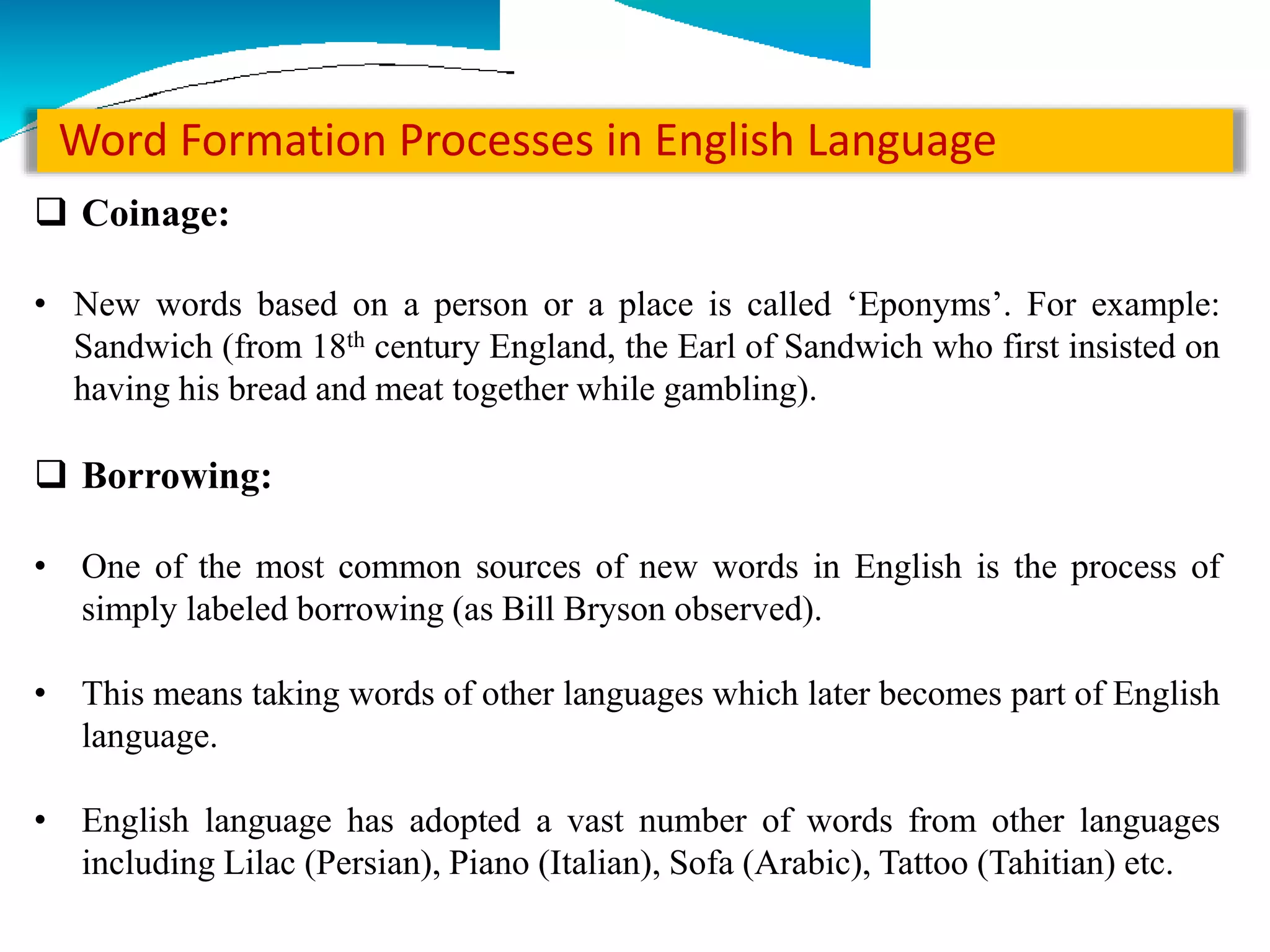
 Coinage:
• New words based on a person or a place is called ‘Eponyms’. For example:
Sandwich (from 18th century England, the Earl of Sandwich who first insisted on
having his bread and meat together while gambling).
 Borrowing:
• One of the most common sources of new words in English is the process of
simply labeled borrowing (as Bill Bryson observed).
• This means taking words of other languages which later becomes part of English
language.
• English language has adopted a vast number of words from other languages
including Lilac (Persian), Piano (Italian), Sofa (Arabic), Tattoo (Tahitian) etc.
Word Formation Processes in English Language
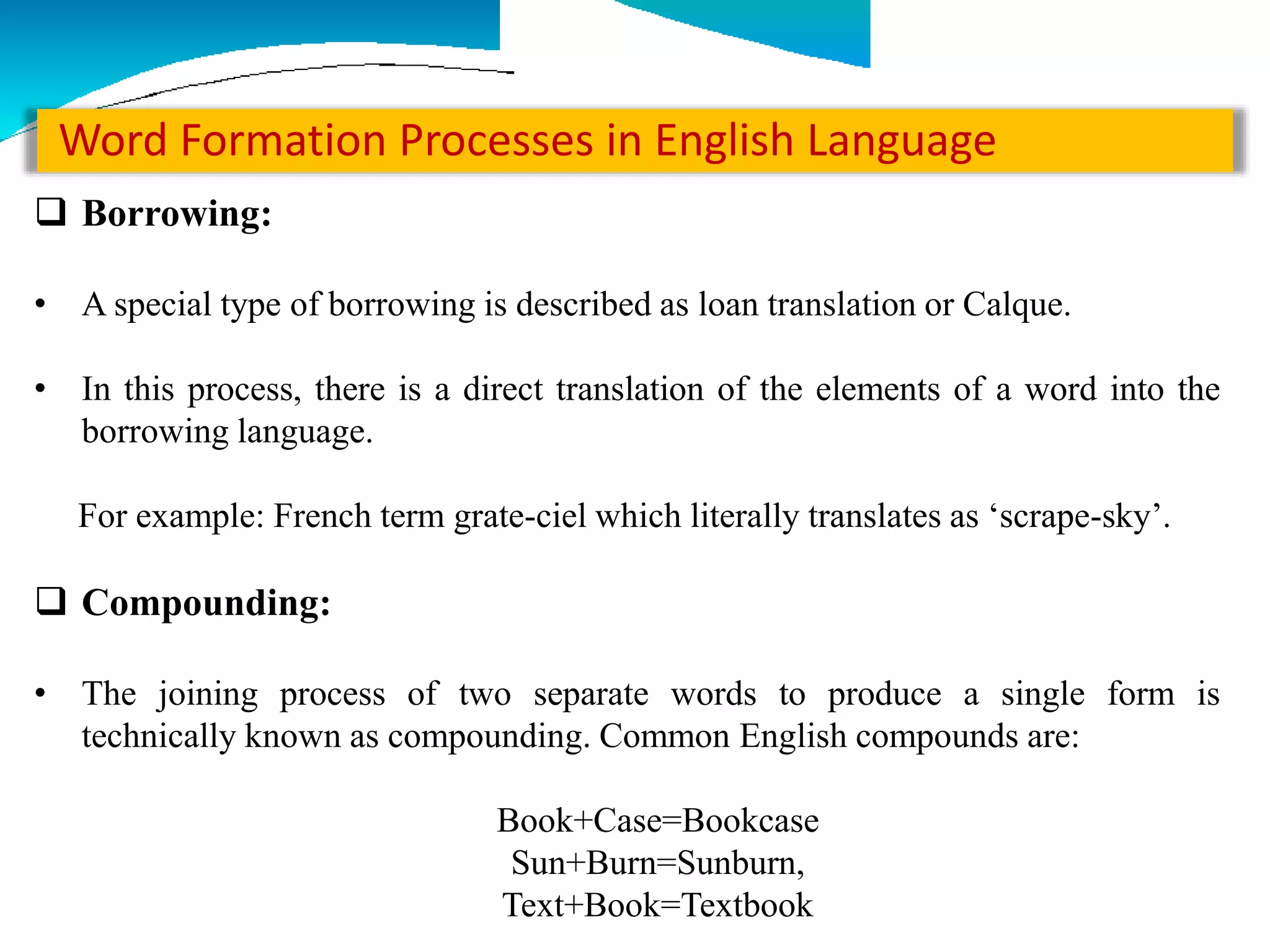
 Borrowing:
• A special type of borrowing is described as loan translation or Calque.
• In this process, there is a direct translation of the elements of a word into the
borrowing language.
For example: French term grate-ciel which literally translates as ‘scrape-sky’.
 Compounding:
• The joining process of two separate words to produce a single form is
technically known as compounding. Common English compounds are:
Book+Case=Bookcase
Sun+Burn=Sunburn,
Text+Book=Textbook
Word Formation Processes in English Language
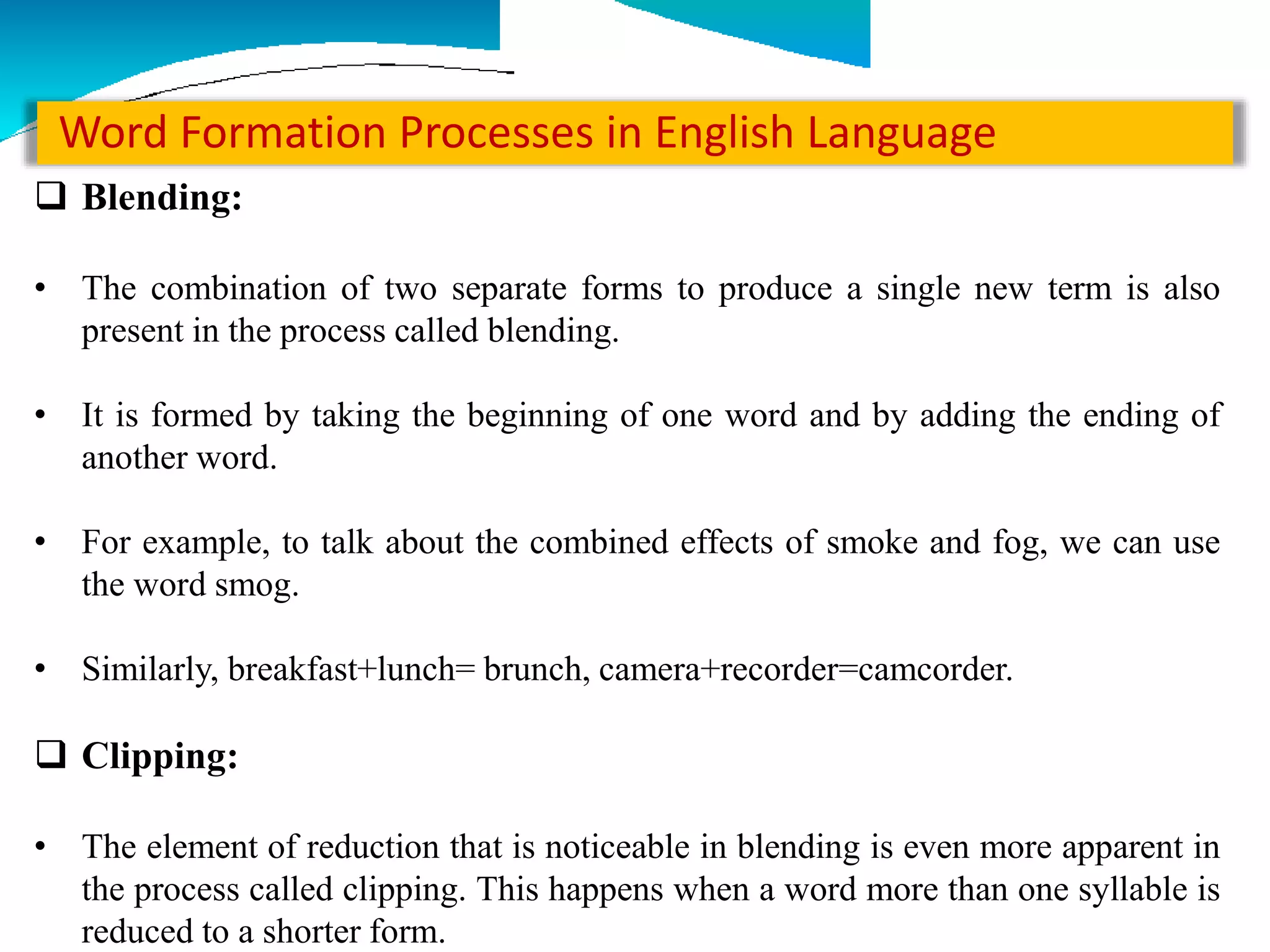
 Blending:
• The combination of two separate forms to produce a single new term is also
present in the process called blending.
• It is formed by taking the beginning of one word and by adding the ending of
another word.
• For example, to talk about the combined effects of smoke and fog, we can use
the word smog.
• Similarly, breakfast+lunch= brunch, camera+recorder=camcorder.
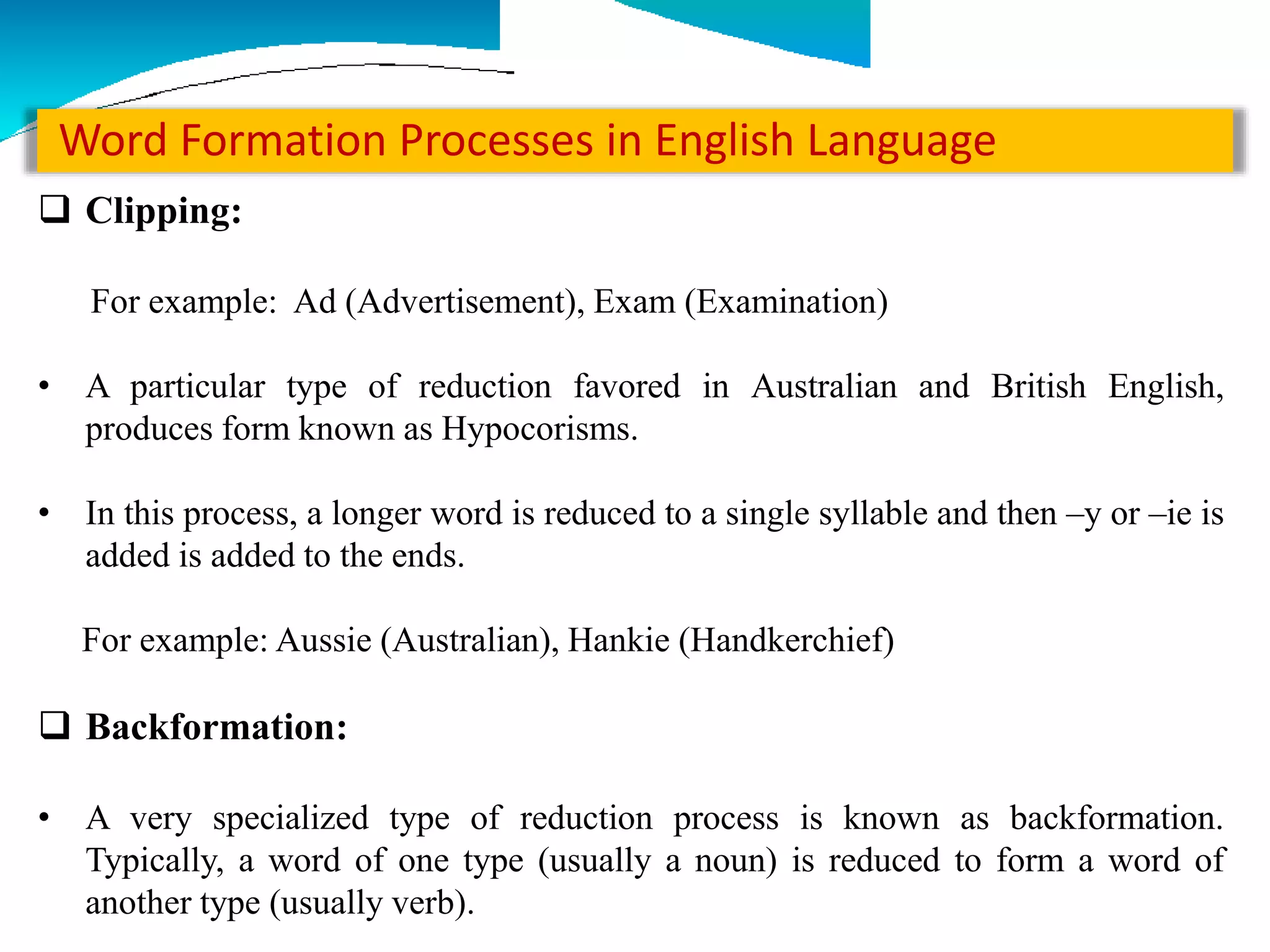
 Clipping:
• The element of reduction that is noticeable in blending is even more apparent in
the process called clipping. This happens when a word more than one syllable is
reduced to a shorter form.
Word Formation Processes in English Language
 Clipping:
For example: Ad (Advertisement), Exam (Examination)
• A particular type of reduction favored in Australian and British English,
produces form known as Hypocorisms.
• In this process, a longer word is reduced to a single syllable and then –y or –ie is
added is added to the ends.
For example: Aussie (Australian), Hankie (Handkerchief)
 Backformation:
• A very specialized type of reduction process is known as backformation.
Typically, a word of one type (usually a noun) is reduced to form a word of
another type (usually verb).
Word Formation Processes in English Language
 Backformation:
• A very specialized type of reduction process is known as backformation.
Typically, a word of one type (usually a noun) is reduced to form a word of
another type (usually verb).
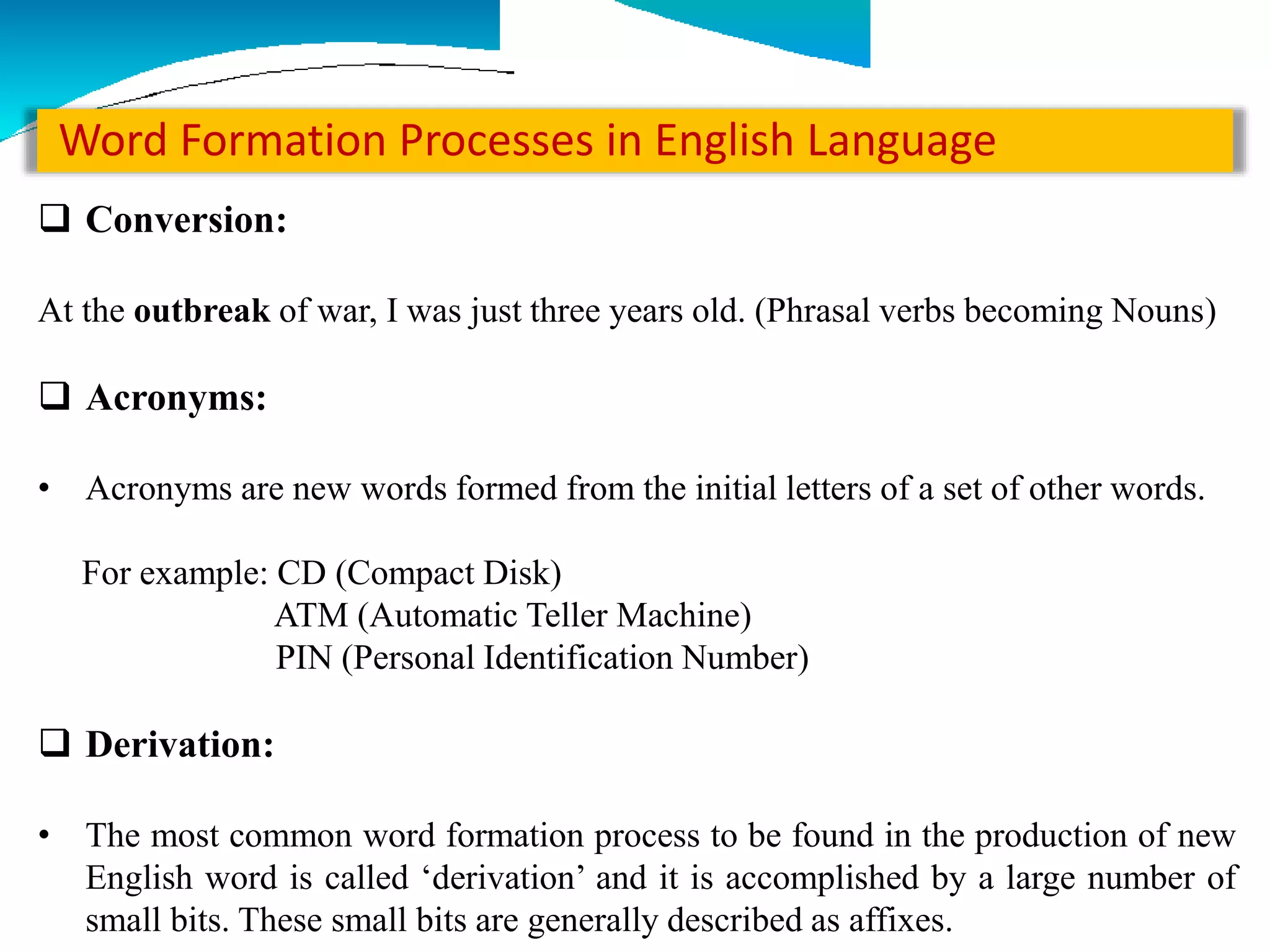
 Conversion:
• A change in the function of a word, as for example, when a noun comes to be
used as a verb (without any reduction), is generally known as Conversion.
For example: The noun butter used as verb in the following sentence- Have you
buttered the toast?
• Likewise, Sleeping sometimes serves as an escape from studying (Verbs
becoming Nouns)
A rolling stone gathers no moss. (Verbs becoming Adjectives)
Word Formation Processes in English Language
 Conversion:
At the outbreak of war, I was just three years old. (Phrasal verbs becoming Nouns)
 Acronyms:
• Acronyms are new words formed from the initial letters of a set of other words.
For example: CD (Compact Disk)
ATM (Automatic Teller Machine)
PIN (Personal Identification Number)
 Derivation:
• The most common word formation process to be found in the production of new
English word is called ‘derivation’ and it is accomplished by a large number of
small bits. These small bits are generally described as affixes.
Word Formation Processes in English Language
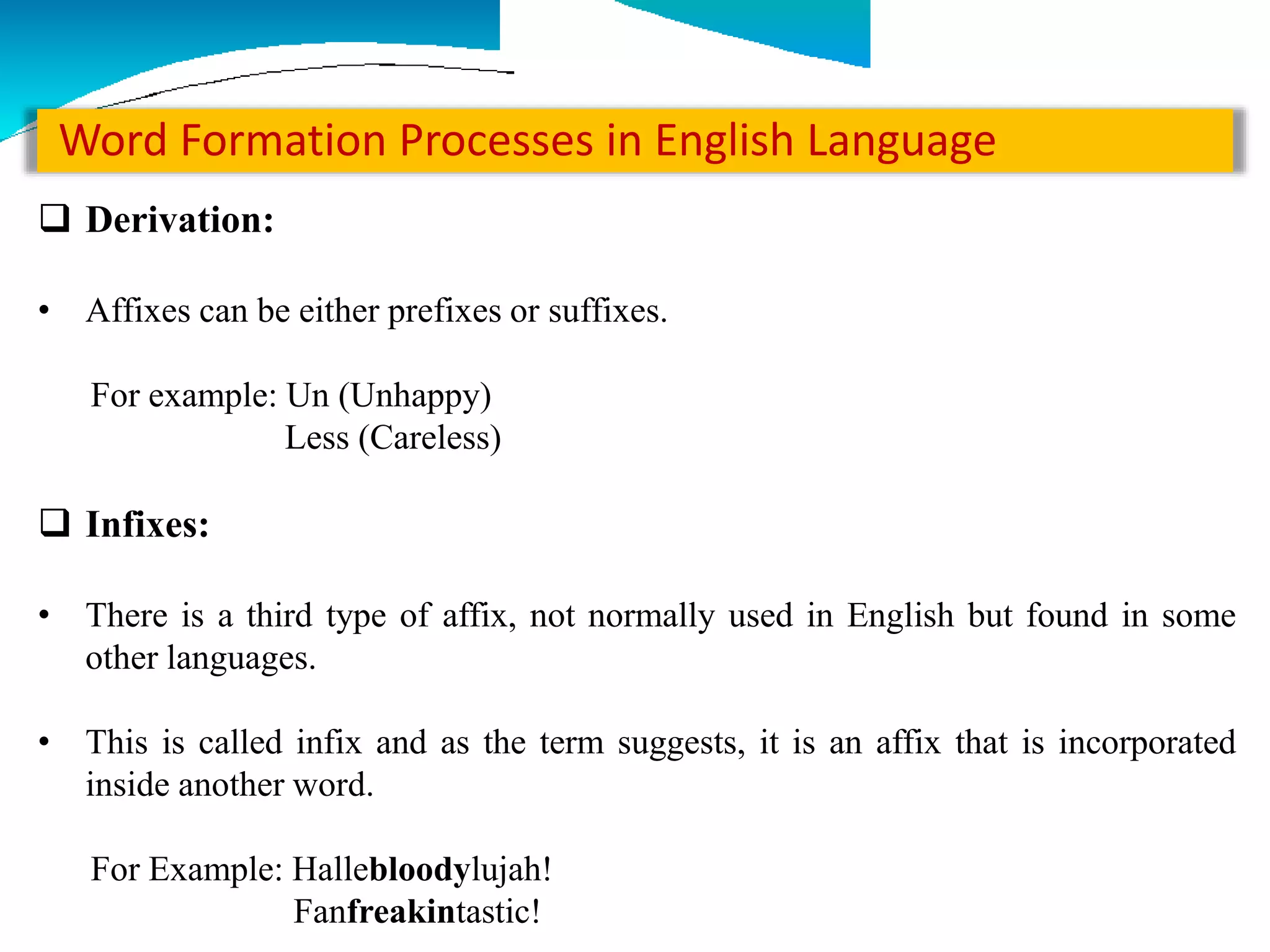
 Derivation:
• Affixes can be either prefixes or suffixes.
For example: Un (Unhappy)
Less (Careless)
 Infixes:
• There is a third type of affix, not normally used in English but found in some
other languages.
• This is called infix and as the term suggests, it is an affix that is incorporated
inside another word.
For Example: Hallebloodylujah!
Fanfreakintastic!
Word Formation Processes in English Language
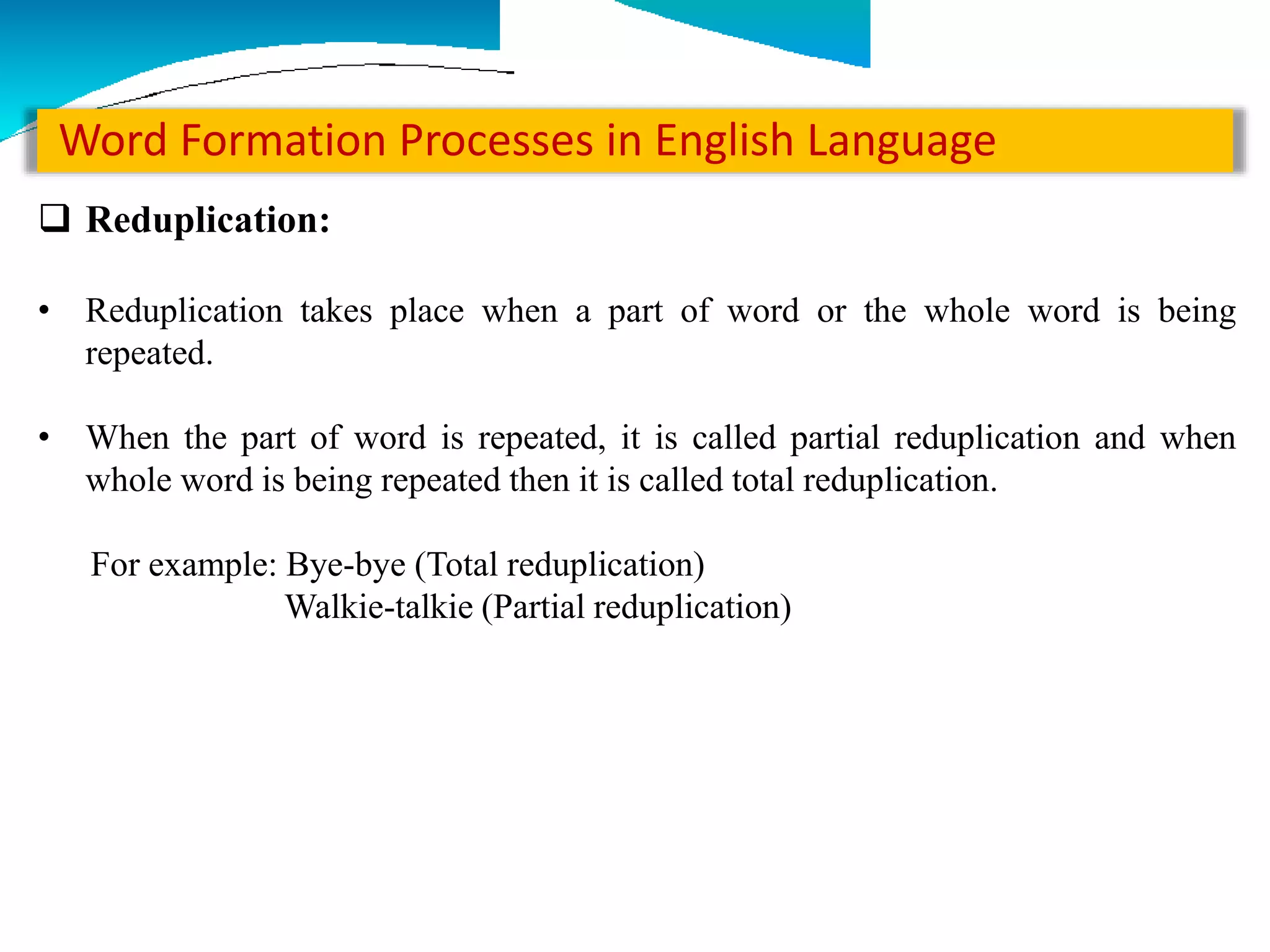
 Reduplication:
• Reduplication takes place when a part of word or the whole word is being
repeated.
• When the part of word is repeated, it is called partial reduplication and when
whole word is being repeated then it is called total reduplication.
For example: Bye-bye (Total reduplication)
Walkie-talkie (Partial reduplication)

Morphology and word formation processes

  • 2.
    What is Morphology? •The term morphology is Greek, and constituted of morph standing for ‘shape’ or, ‘form’, and ology suggesting ‘the study of something’. • In linguistics, morphology is a level of linguistics analysis and discussion, and covers the scientific study of form and structure of words in a language. • The traditional concern of morphology is the identification of morphemes, that is, the smallest, meaningful and indivisible grammatical units of language. • The interest of the morphologists (linguists who study morphology) is to look at the parts or constituents that words are divided into, and study the meanings of these individual parts.
  • 3.
    What is Morphemeand its classification? • A morpheme is a minimal unit of meaning or grammatical function. • It has some value. That means each morpheme (down to a single letter has some meaning) Ex. Tourists: -tour (one minimal unit) -ist (meaning “person who does something”) -s (a third unit of grammatical function indicating plurality) Morpheme can be of two types:  Free Morphemes  Bound Morphemes
  • 4.
    What is Morphemeand its classification?  Free Morphemes: The morphemes that can function independently are called free or independent morphemes. For example: man, boy, girl etc. These morphemes can be again categorized in two classes: Lexical morphemes and grammatical morphemes. Lexical morphemes refer to ordinary nouns (like: pen, rice) , verbs (like: read, go) and adjectives (like: quickly, happily). Grammatical morphemes include auxiliary verbs (like: is, can), determiners (like: the, much), prepositions (like: on, into) and conjunctions (like: and, but).
  • 5.
    What is Morphemeand its classification?  Bound Morphemes: There are some morphemes that cannot function independently or alone, they are added to the root word or to the free morpheme. These type of morpheme are called bound morphemes. For example: -less, -ment, un-, -ly etc. as in the words Careless, Enjoyment, Unknown, Friendly. o Root and stem: A word must contain an element that can stand by itself, that is, a free morpheme, such as talk. Such an element is called a root. When they are used with bound morphemes, the basic word-form involved is technically known as the stem.
  • 6.
    Word Formation Processesin English Language • There are a lot of regularities in the word formation process in English language. In English language, words are formed in various ways. The processes we will explore here are:  Etymology  Coinage  Borrowing  Compounding  Blending  Clipping  Backformation  Conversion  Acronyms  Derivation  Infixes  Reduplication
  • 7.
    Word Formation Processesin English Language  Etymology: • The Study of the origin and history of a word is known as etymology; a term has derived from Latin but has its origin in Greek (etumon – ‘original form’ and ‘logia’ – ‘study of’). • Rather than seeing language as debased, we might prefer to view the constant evolution of new words and new uses of old words as reassuring sign of vitality and creativeness in the way a language is shaped by the needs of its users.  Coinage: • One of the least common processes of word formation in English is coinage; that is the invention of totally new terms. The most typical sources are invented trade names of commercial products that become general terms. For example: nylon, aspirin, xerox, etc.
  • 8.
    Word Formation Processesin English Language  Coinage: • New words based on a person or a place is called ‘Eponyms’. For example: Sandwich (from 18th century England, the Earl of Sandwich who first insisted on having his bread and meat together while gambling).  Borrowing: • One of the most common sources of new words in English is the process of simply labeled borrowing (as Bill Bryson observed). • This means taking words of other languages which later becomes part of English language. • English language has adopted a vast number of words from other languages including Lilac (Persian), Piano (Italian), Sofa (Arabic), Tattoo (Tahitian) etc.
  • 9.
    Word Formation Processesin English Language  Borrowing: • A special type of borrowing is described as loan translation or Calque. • In this process, there is a direct translation of the elements of a word into the borrowing language. For example: French term grate-ciel which literally translates as ‘scrape-sky’.  Compounding: • The joining process of two separate words to produce a single form is technically known as compounding. Common English compounds are: Book+Case=Bookcase Sun+Burn=Sunburn, Text+Book=Textbook
  • 10.
    Word Formation Processesin English Language  Blending: • The combination of two separate forms to produce a single new term is also present in the process called blending. • It is formed by taking the beginning of one word and by adding the ending of another word. • For example, to talk about the combined effects of smoke and fog, we can use the word smog. • Similarly, breakfast+lunch= brunch, camera+recorder=camcorder.  Clipping: • The element of reduction that is noticeable in blending is even more apparent in the process called clipping. This happens when a word more than one syllable is reduced to a shorter form.
  • 11.
    Word Formation Processesin English Language  Clipping: For example: Ad (Advertisement), Exam (Examination) • A particular type of reduction favored in Australian and British English, produces form known as Hypocorisms. • In this process, a longer word is reduced to a single syllable and then –y or –ie is added is added to the ends. For example: Aussie (Australian), Hankie (Handkerchief)  Backformation: • A very specialized type of reduction process is known as backformation. Typically, a word of one type (usually a noun) is reduced to form a word of another type (usually verb).
  • 12.
    Word Formation Processesin English Language  Backformation: • A very specialized type of reduction process is known as backformation. Typically, a word of one type (usually a noun) is reduced to form a word of another type (usually verb).  Conversion: • A change in the function of a word, as for example, when a noun comes to be used as a verb (without any reduction), is generally known as Conversion. For example: The noun butter used as verb in the following sentence- Have you buttered the toast? • Likewise, Sleeping sometimes serves as an escape from studying (Verbs becoming Nouns) A rolling stone gathers no moss. (Verbs becoming Adjectives)
  • 13.
    Word Formation Processesin English Language  Conversion: At the outbreak of war, I was just three years old. (Phrasal verbs becoming Nouns)  Acronyms: • Acronyms are new words formed from the initial letters of a set of other words. For example: CD (Compact Disk) ATM (Automatic Teller Machine) PIN (Personal Identification Number)  Derivation: • The most common word formation process to be found in the production of new English word is called ‘derivation’ and it is accomplished by a large number of small bits. These small bits are generally described as affixes.
  • 14.
    Word Formation Processesin English Language  Derivation: • Affixes can be either prefixes or suffixes. For example: Un (Unhappy) Less (Careless)  Infixes: • There is a third type of affix, not normally used in English but found in some other languages. • This is called infix and as the term suggests, it is an affix that is incorporated inside another word. For Example: Hallebloodylujah! Fanfreakintastic!
  • 15.
    Word Formation Processesin English Language  Reduplication: • Reduplication takes place when a part of word or the whole word is being repeated. • When the part of word is repeated, it is called partial reduplication and when whole word is being repeated then it is called total reduplication. For example: Bye-bye (Total reduplication) Walkie-talkie (Partial reduplication)