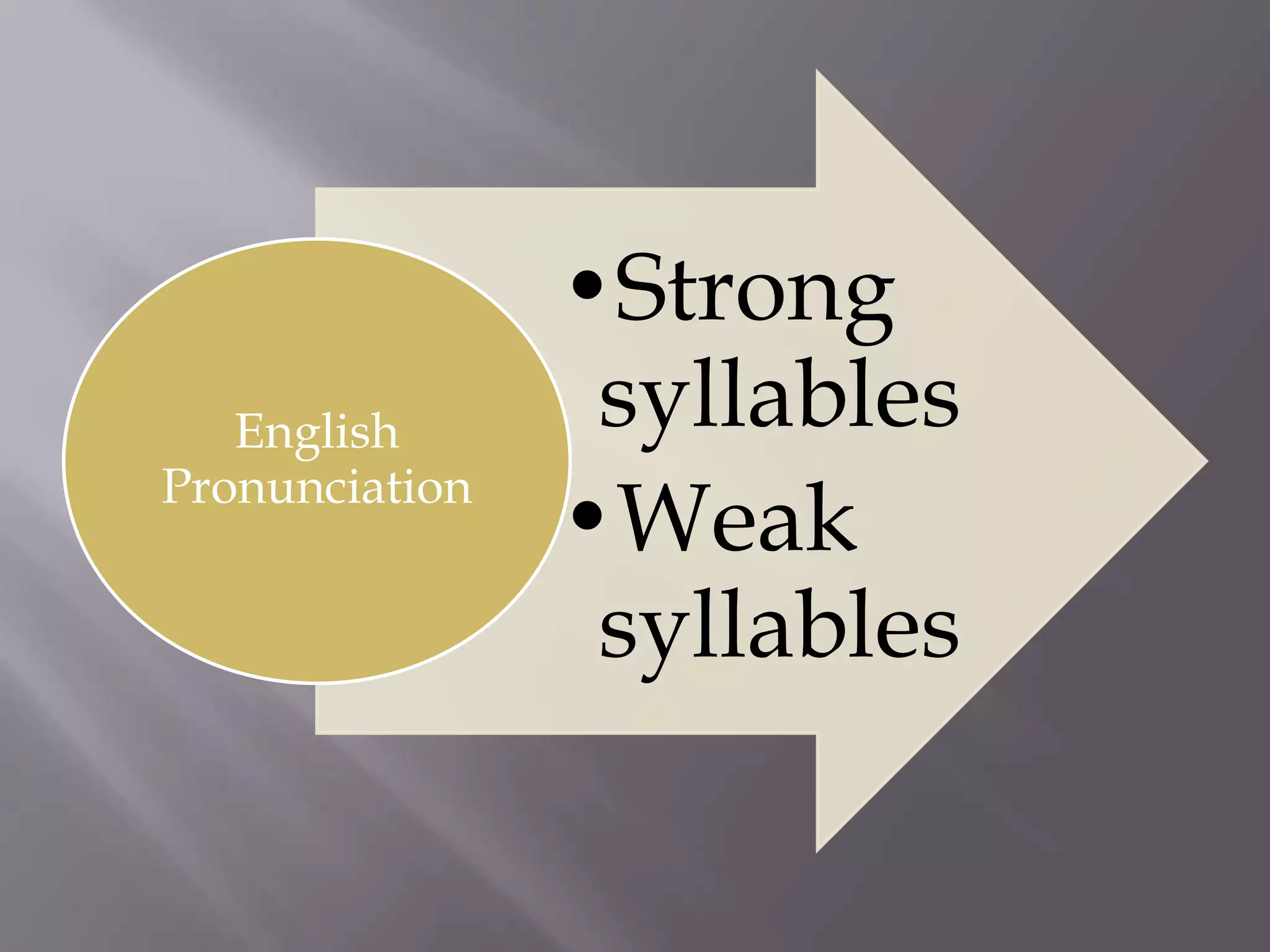
•Strong
   English       syllables
Pronunciation
                •Weak
                 syllables
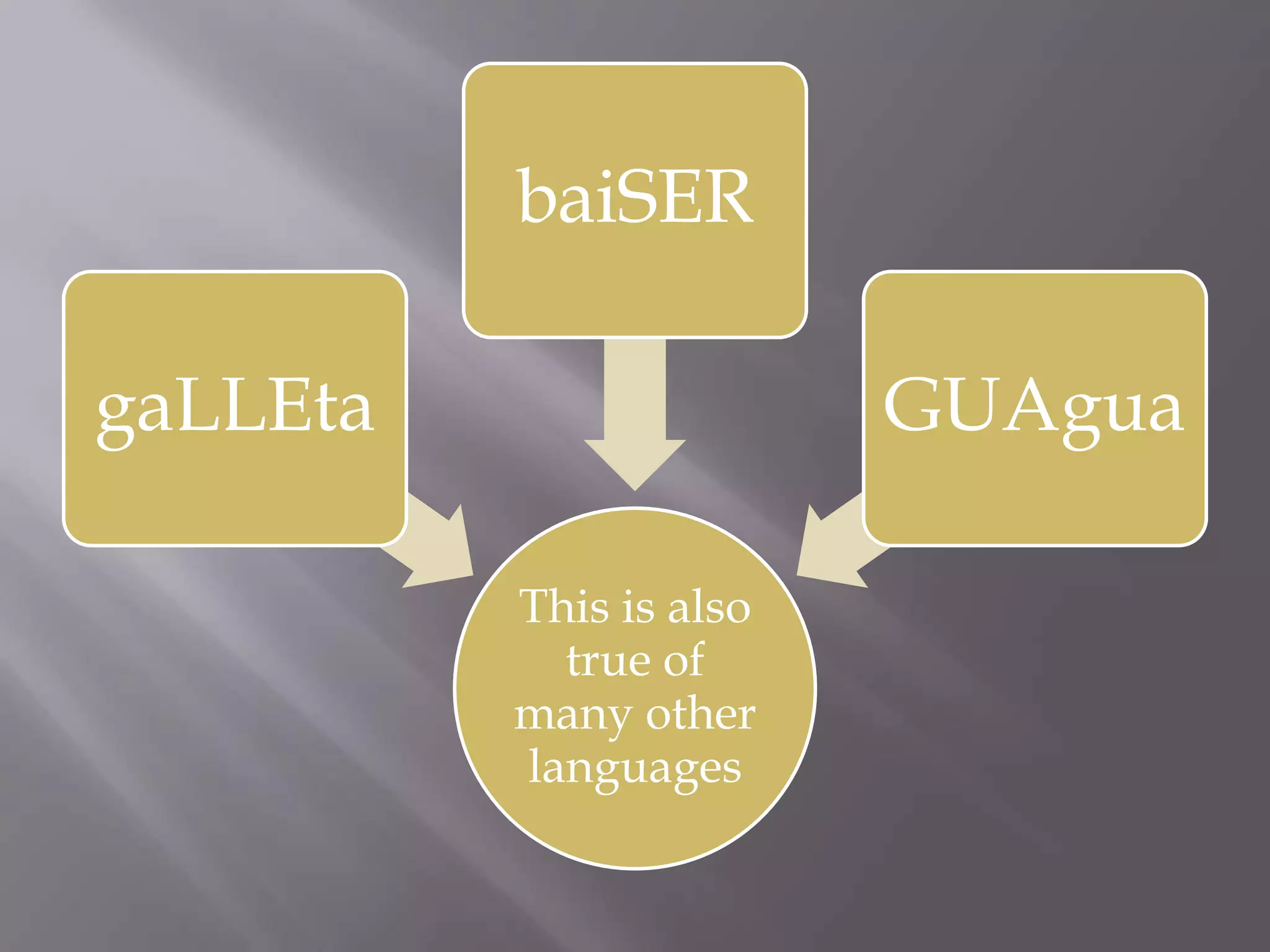
baiSER

gaLLEta                  GUAgua

          This is also
            true of
          many other
          languages
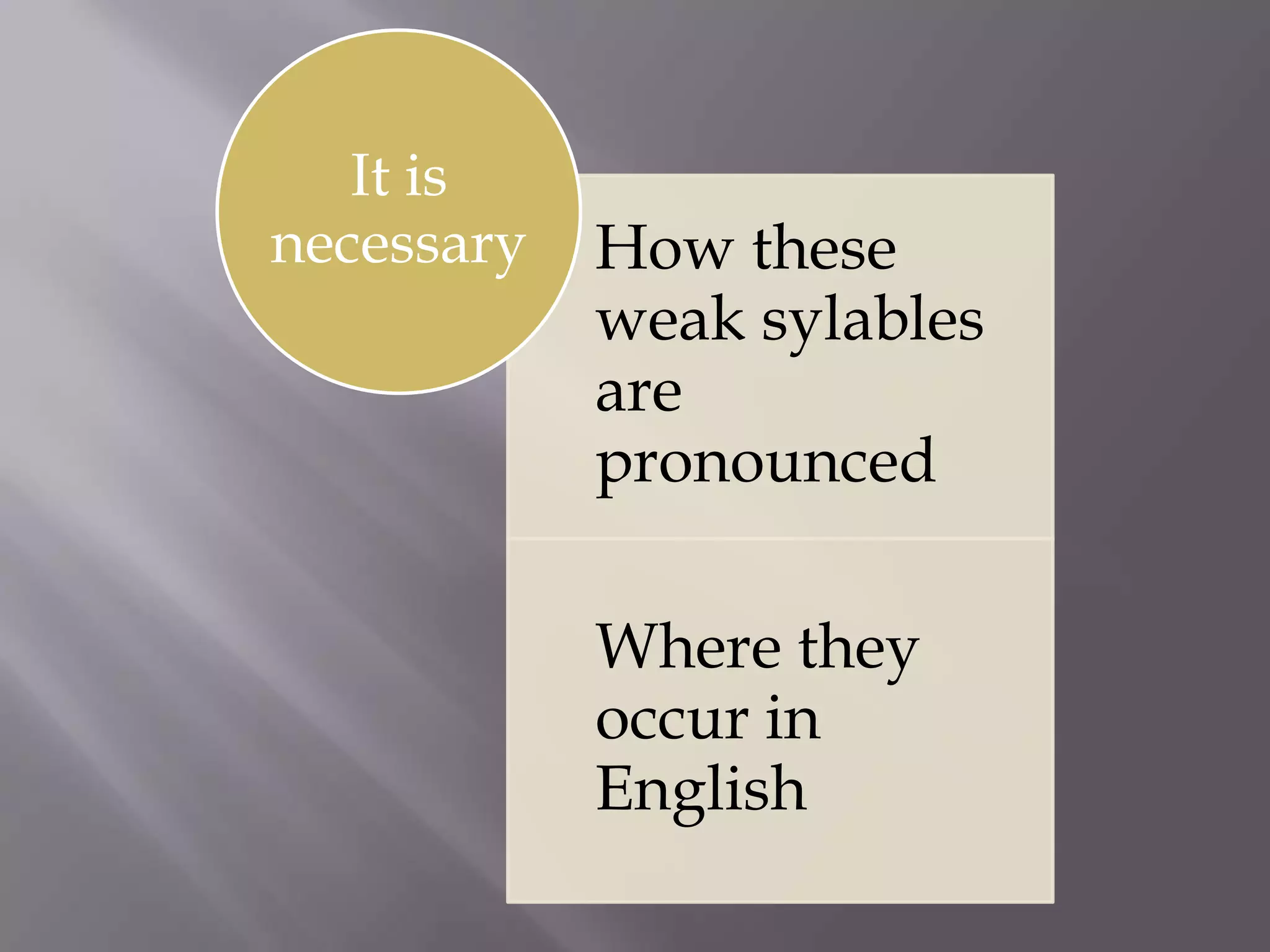
It is
necessary   How these
            weak sylables
            are
            pronounced

            Where they
            occur in
            English
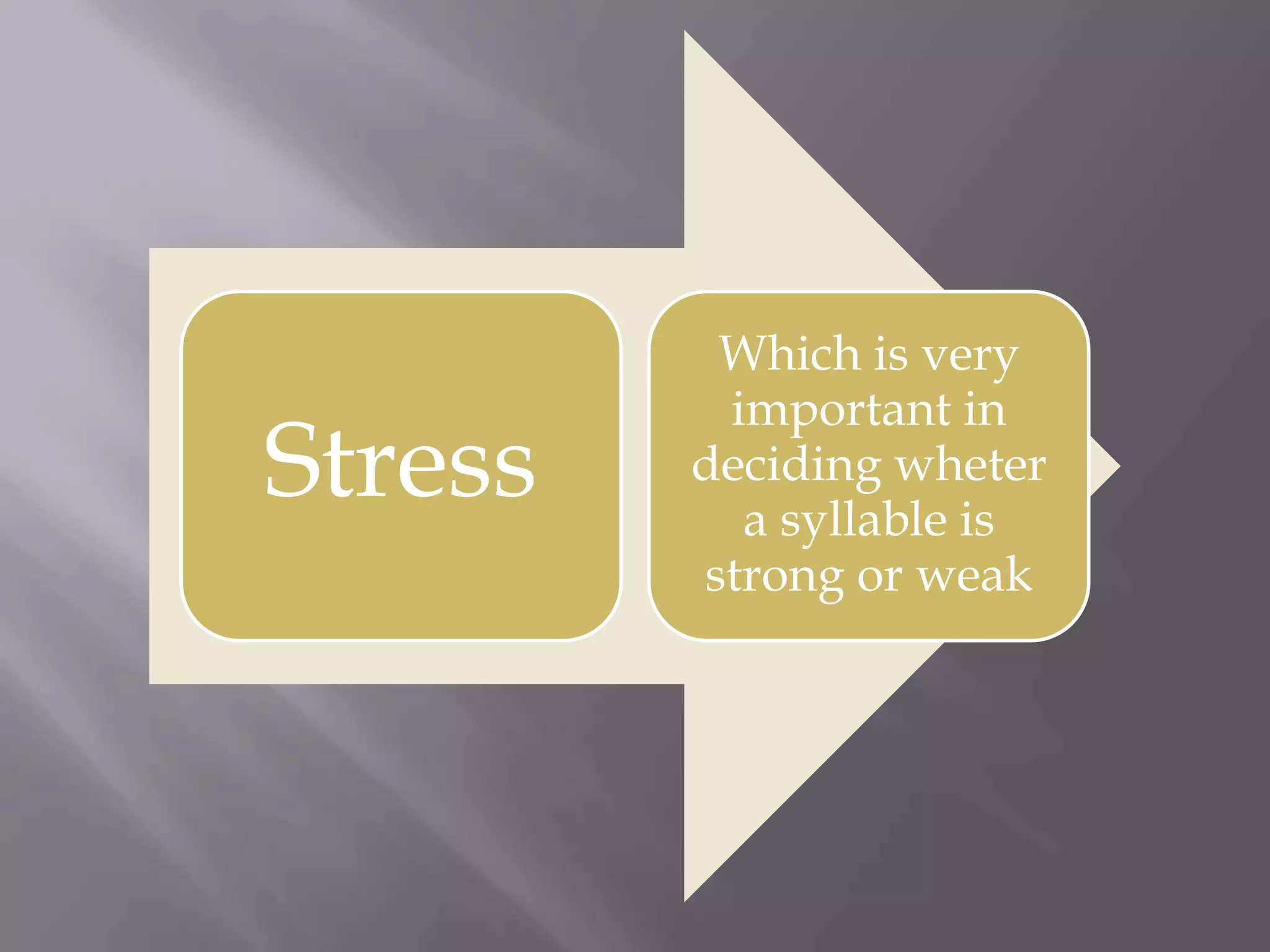
Which is very
          important in
Stress   deciding wheter
           a syllable is
         strong or weak
Elision


Intonation
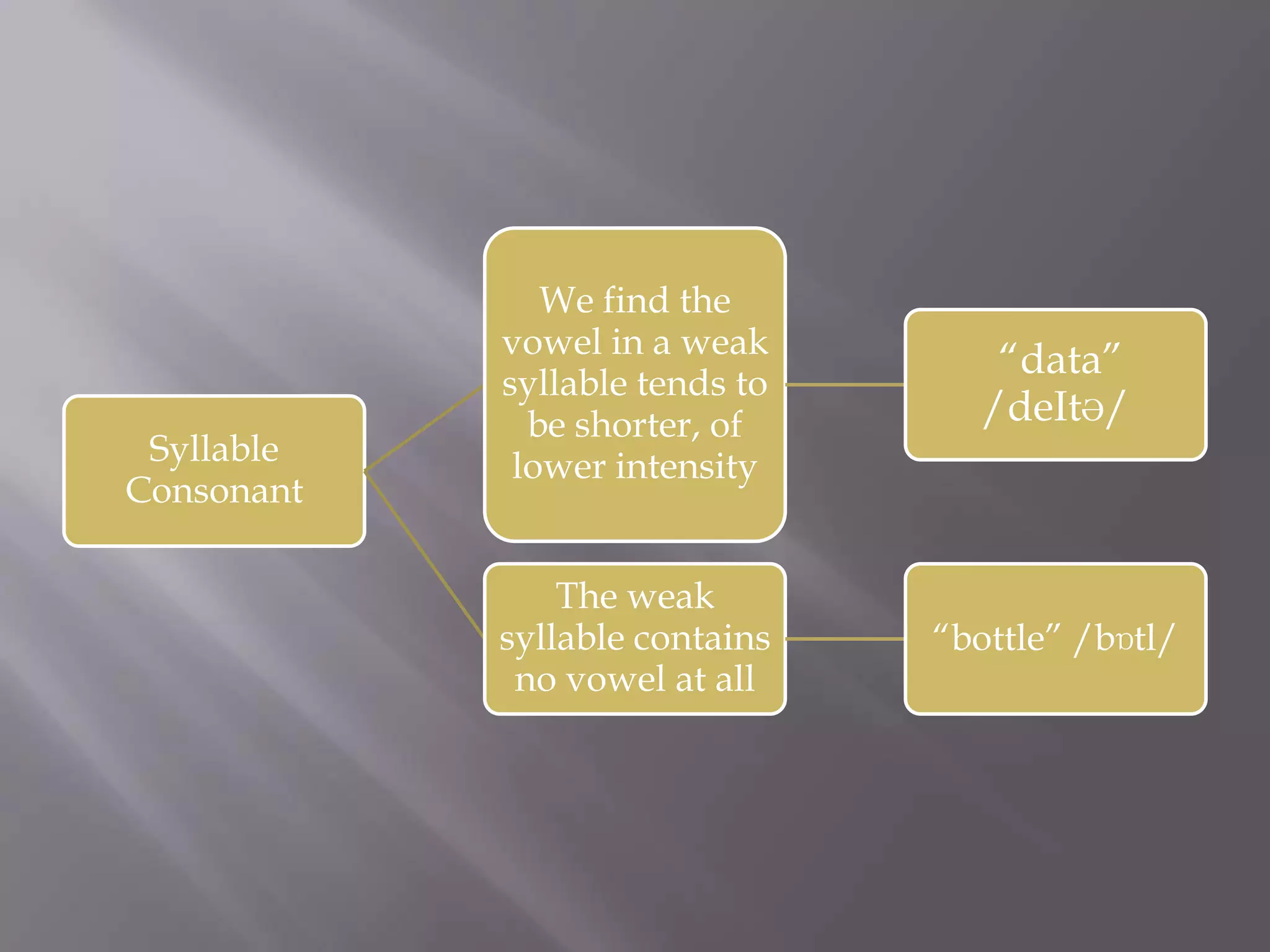
We find the
            vowel in a weak
                                   “data”
            syllable tends to
              be shorter, of      /deΙtƏ/
 Syllable    lower intensity
Consonant

                The weak
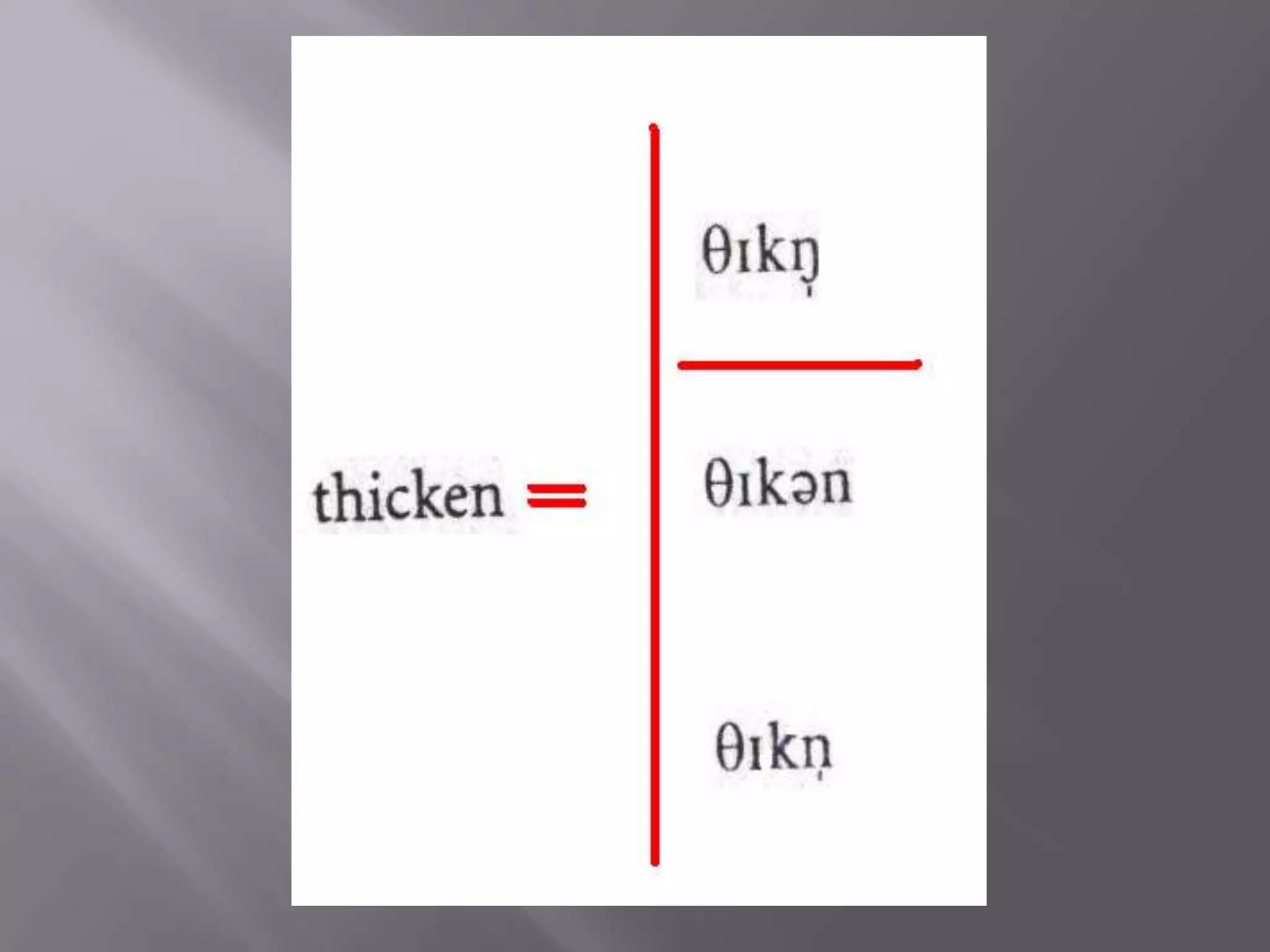
            syllable contains   “bottle” /bɒtl/
             no vowel at all
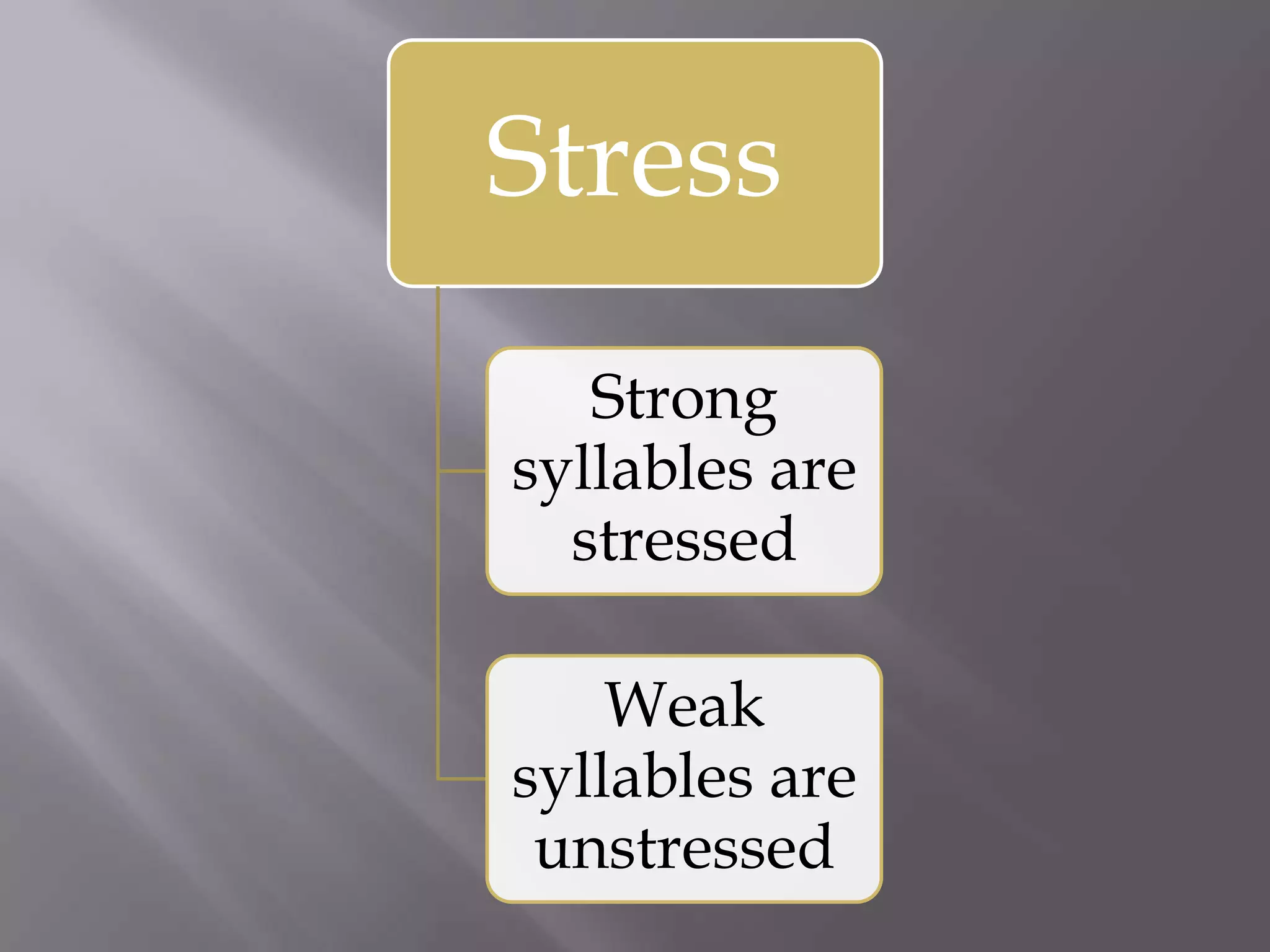
Stress
   Strong
syllables are
  stressed

    Weak
syllables are
 unstressed
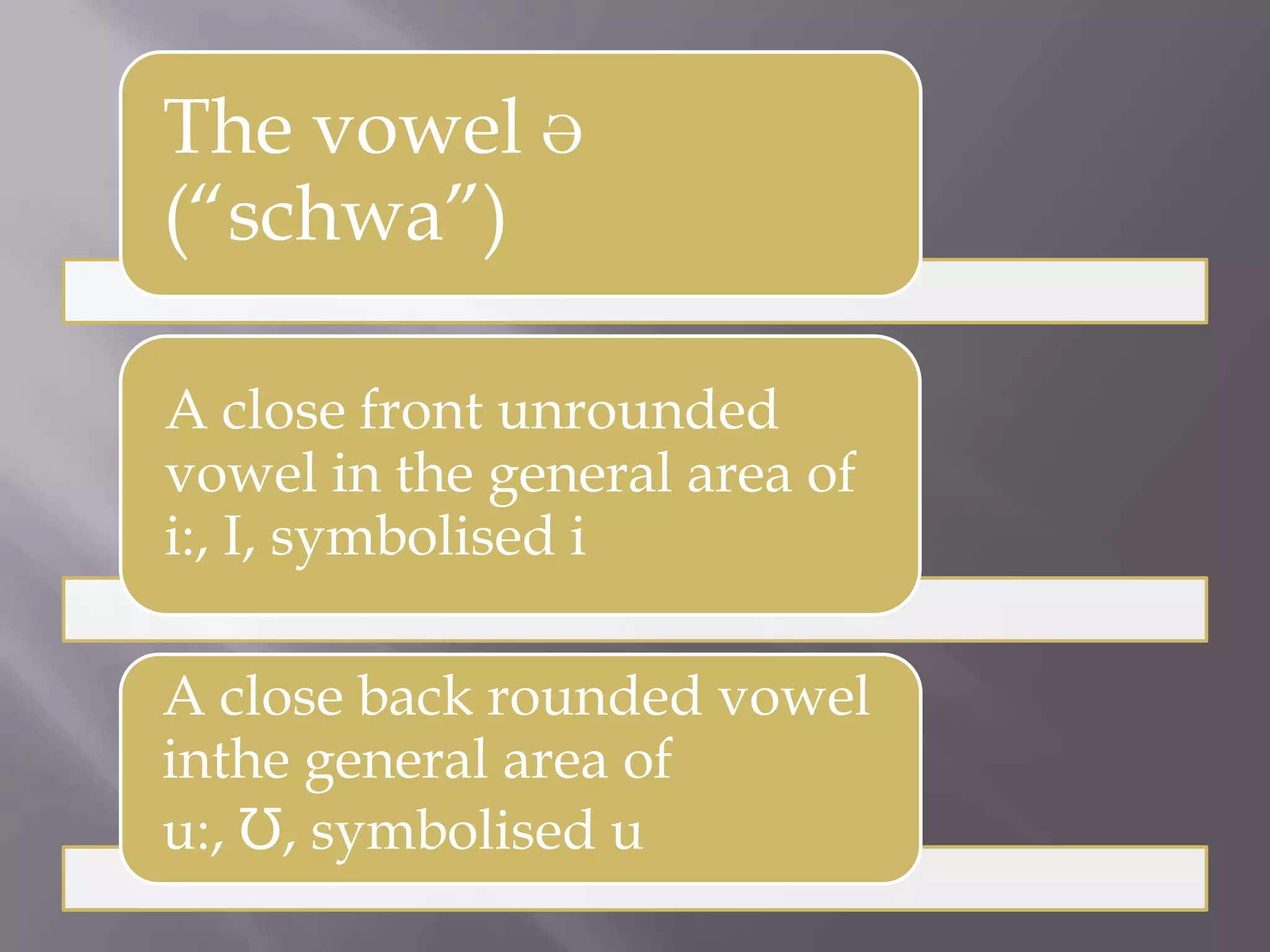
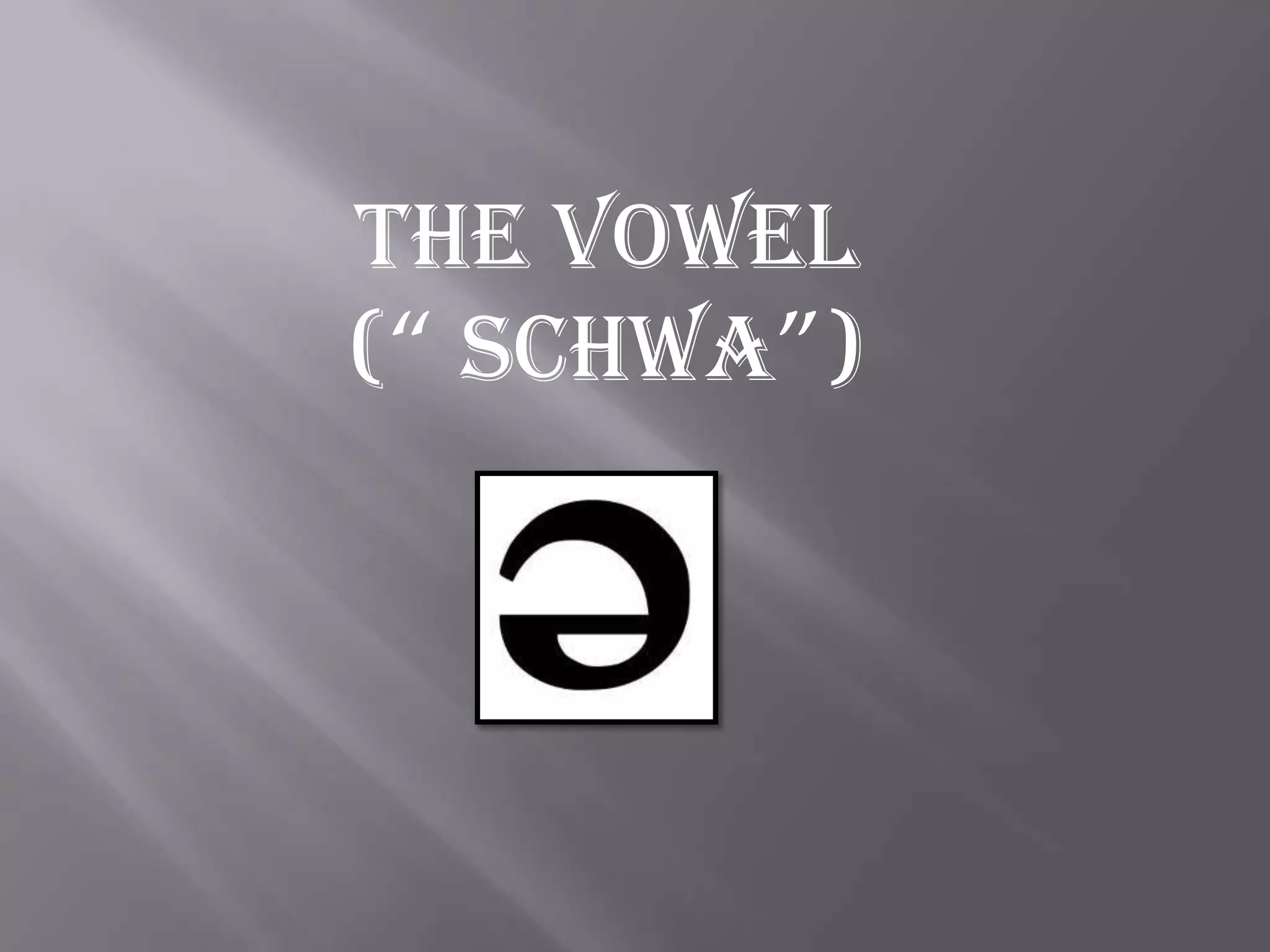
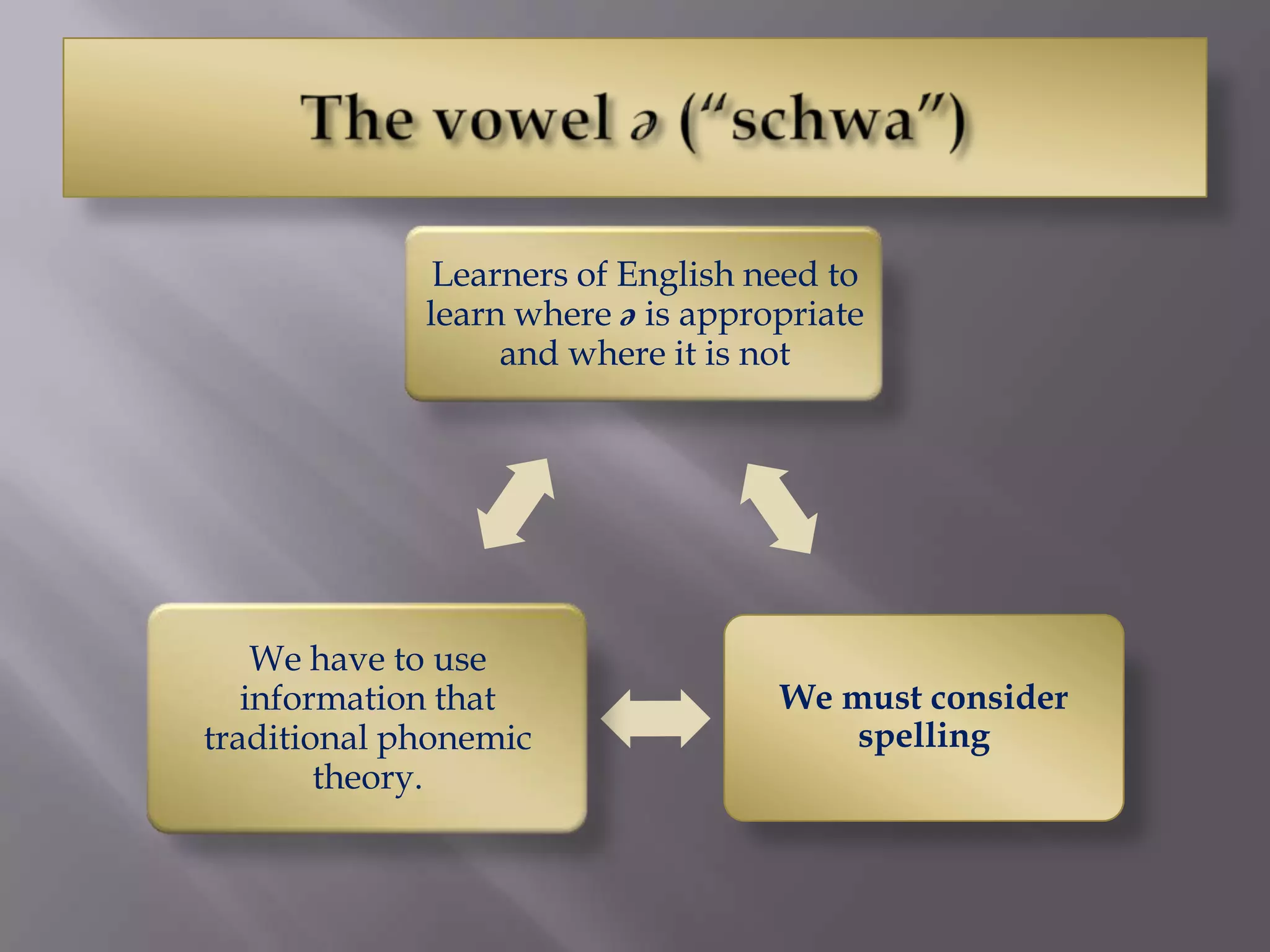
The vowel Ə
(“schwa”)

A close front unrounded
vowel in the general area of
i:, I, symbolised i

A close back rounded vowel
inthe general area of
u:, Ʊ, symbolised u
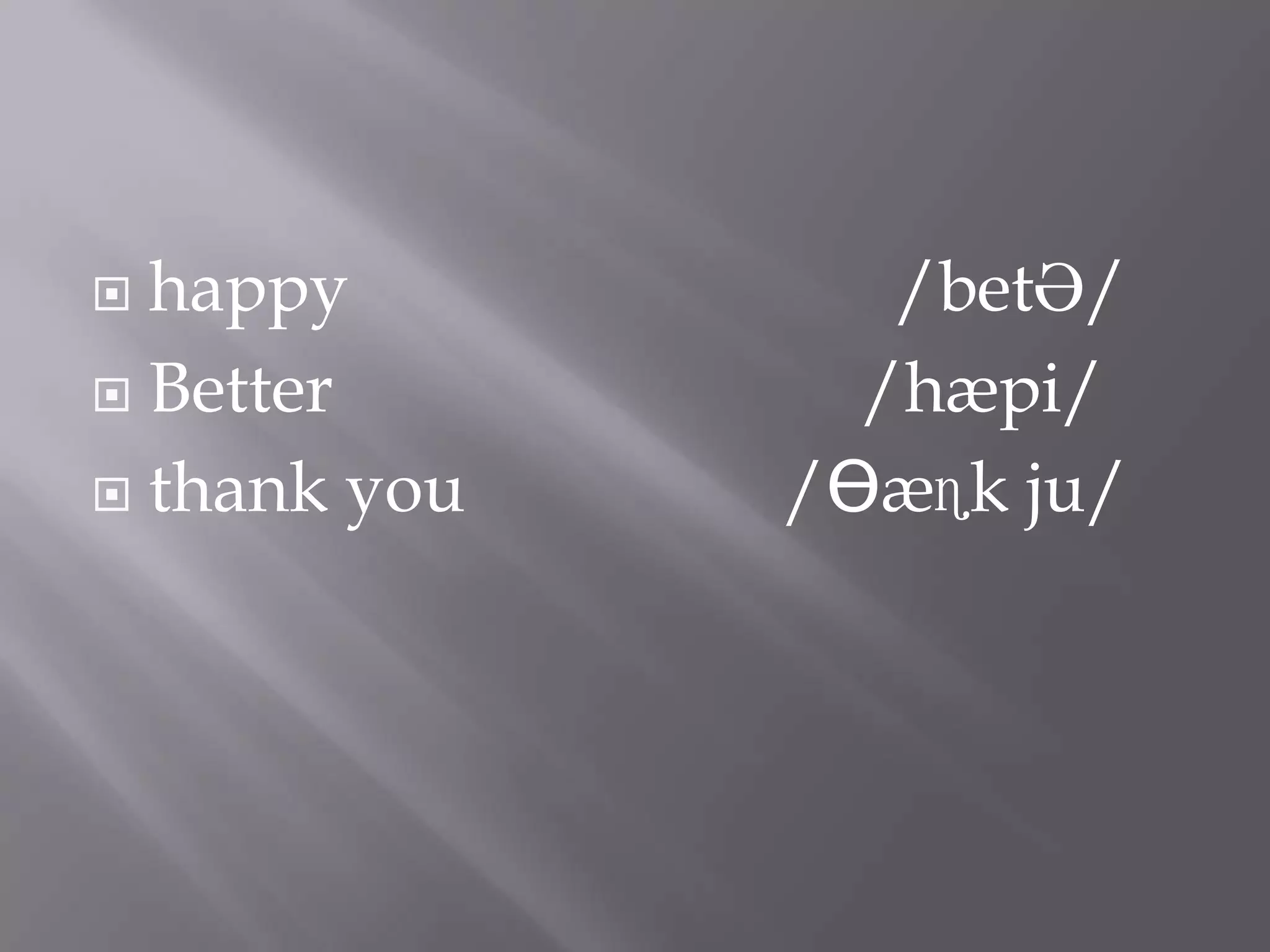
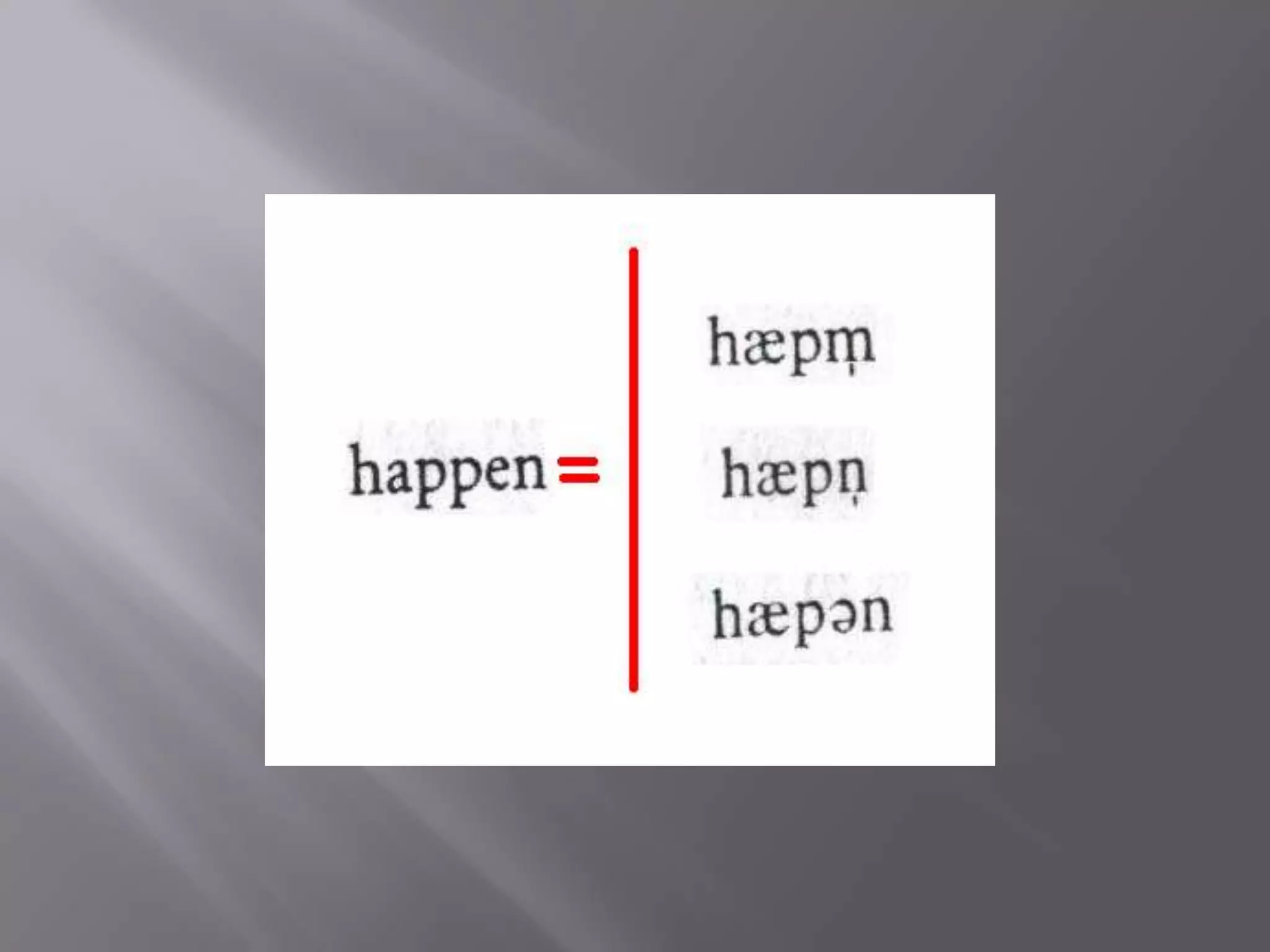
 happy          /betƏ/
 Better        /hæpi/
 thank you   /Ɵæɳk ju/
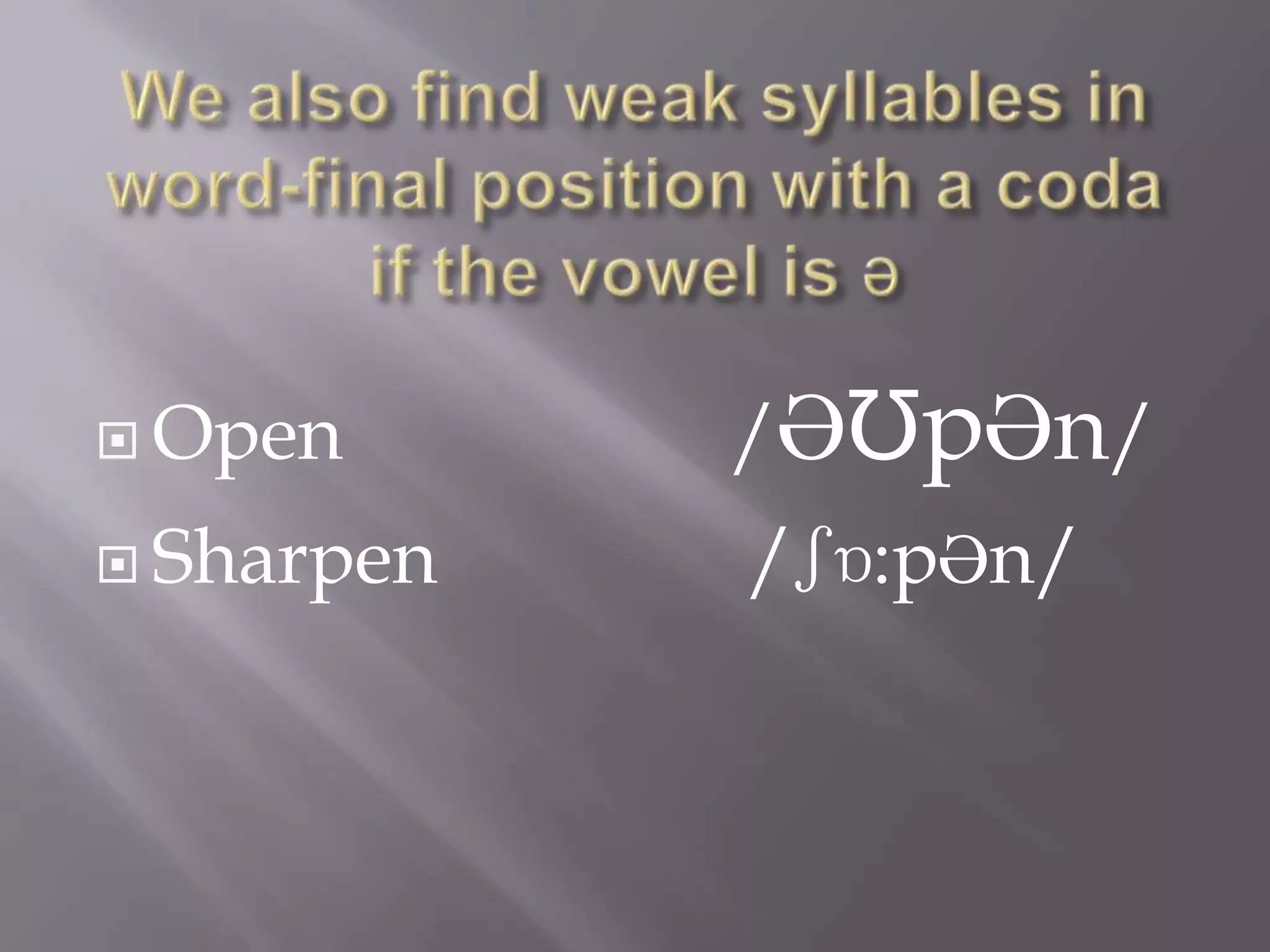
 Open      /ƏƱpƏn/
 Sharpen   /ʃɒ:pƏn/
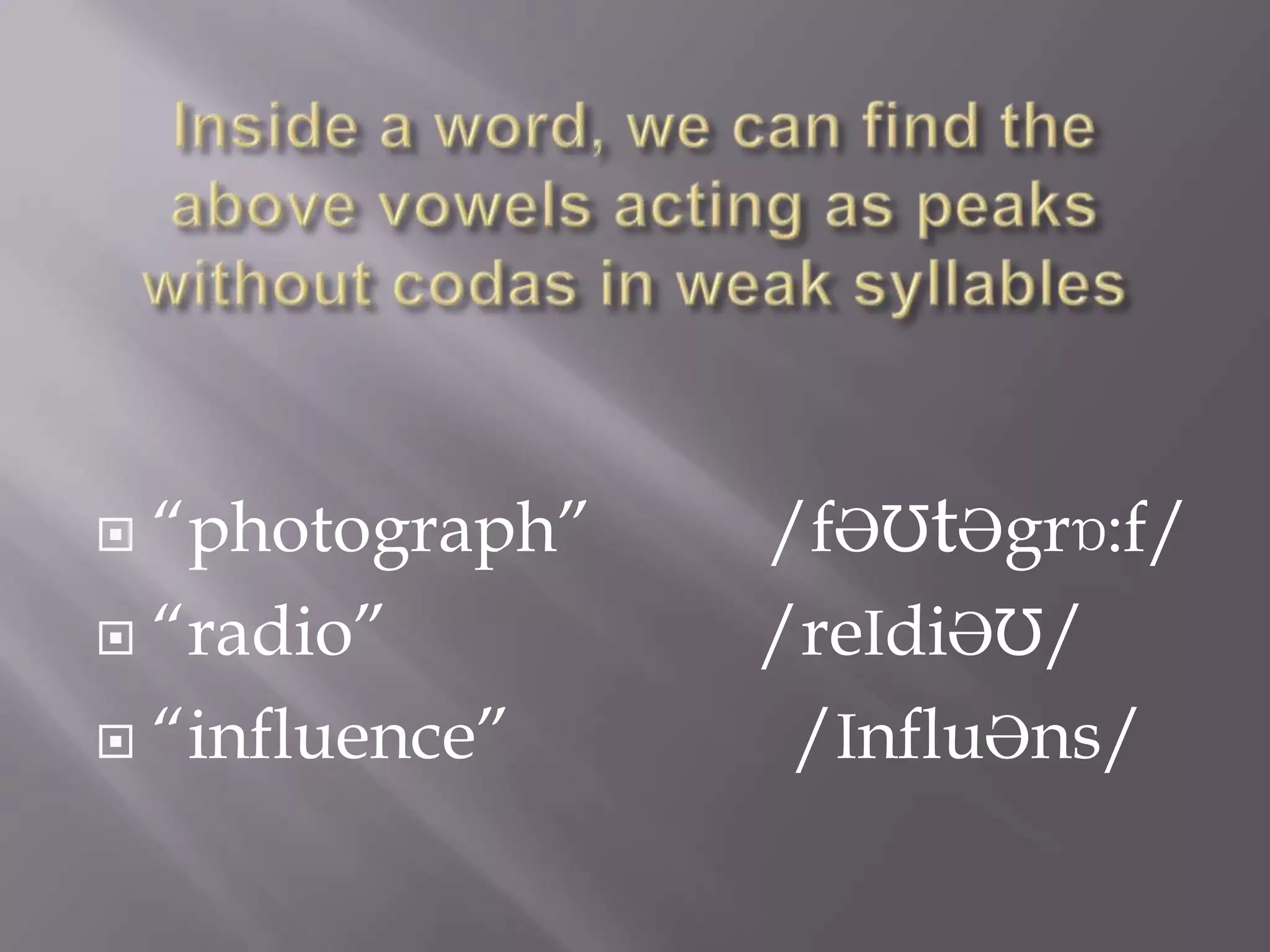
 “photograph”   /fƏƱtƏgrɒ:f/
 “radio”        /reIdiƏƱ/
 “influence”     /InfluƏns/
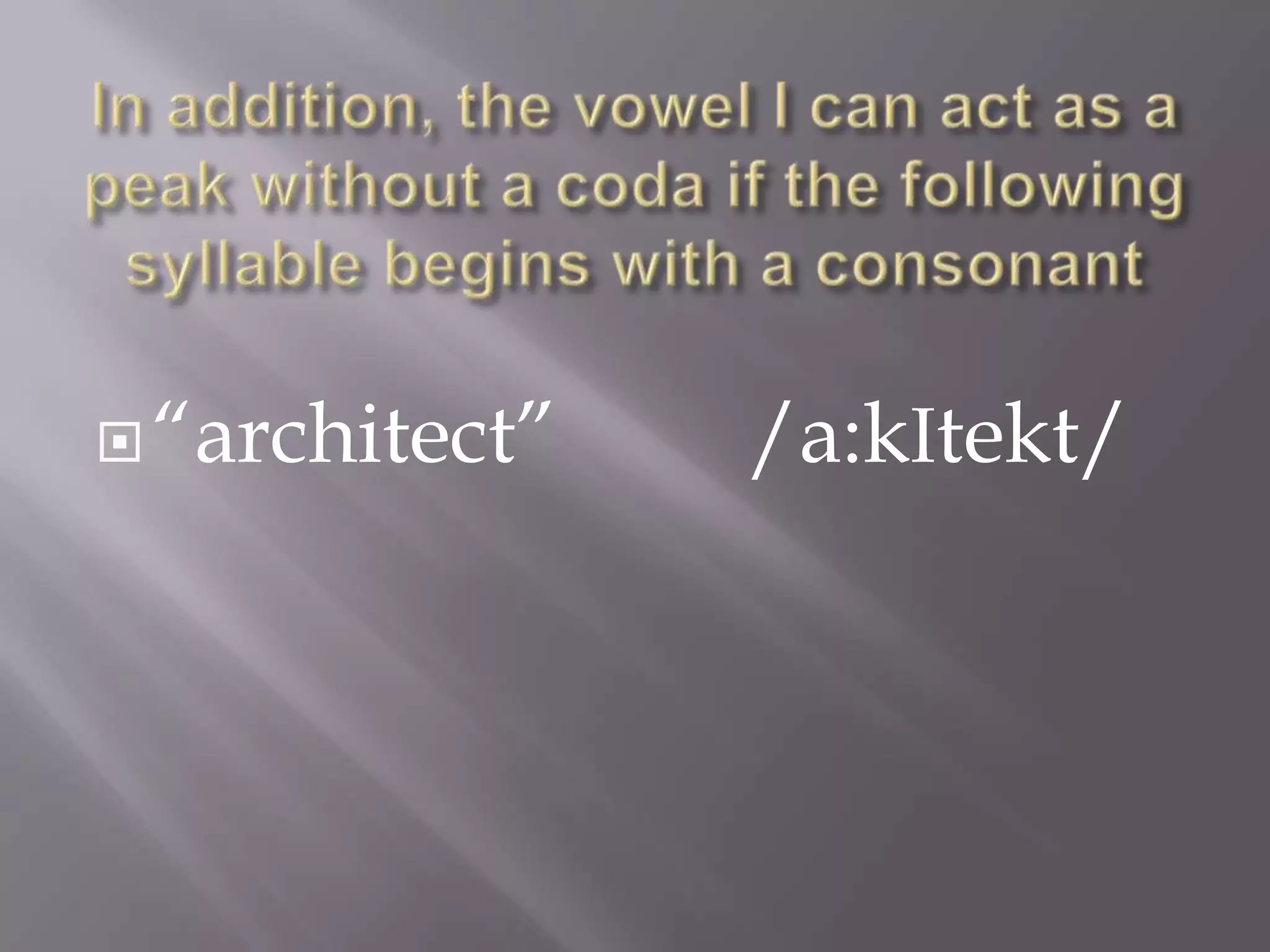
 “architect”   /a:kItekt/
PHONOLOGY

TAMARA CABRERA
GENNY NAZARENO
VANESSA SISALEMA


     4th «B»
THE VOWEL
(“ SCHWA”)
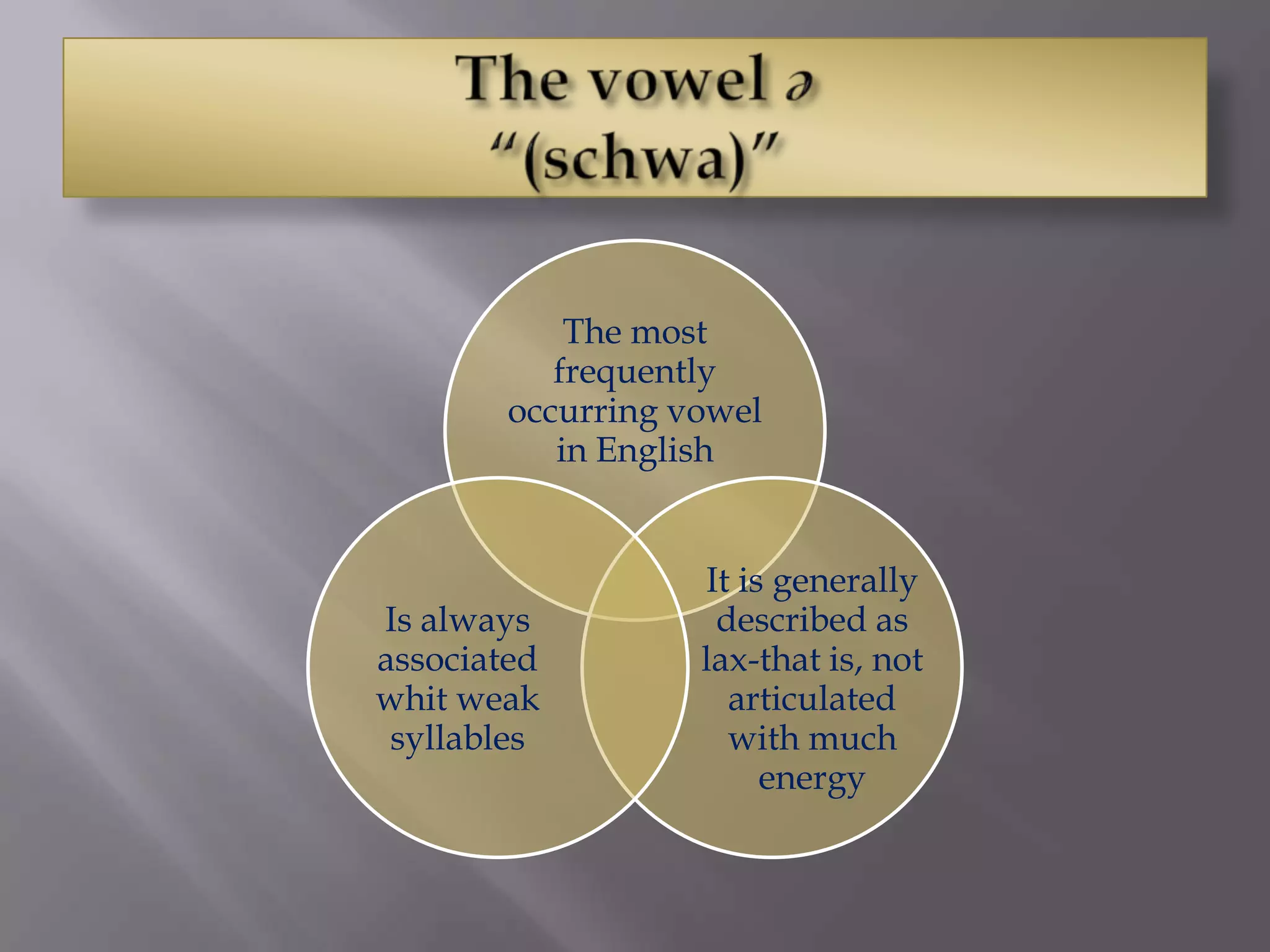
The most
           frequently
        occurring vowel
           in English


                   It is generally
Is always           described as
associated         lax-that is, not
whit weak            articulated
 syllables           with much
                        energy
Examples


-   halfway
-   between
-   close
-   open


              Note.- Not all weak syllables contain
                       ə, though many do.
Learners of English need to
             learn where ə is appropriate
                  and where it is not


    We have to use
   information that                We must consider
traditional phonemic                   spelling
        theory.
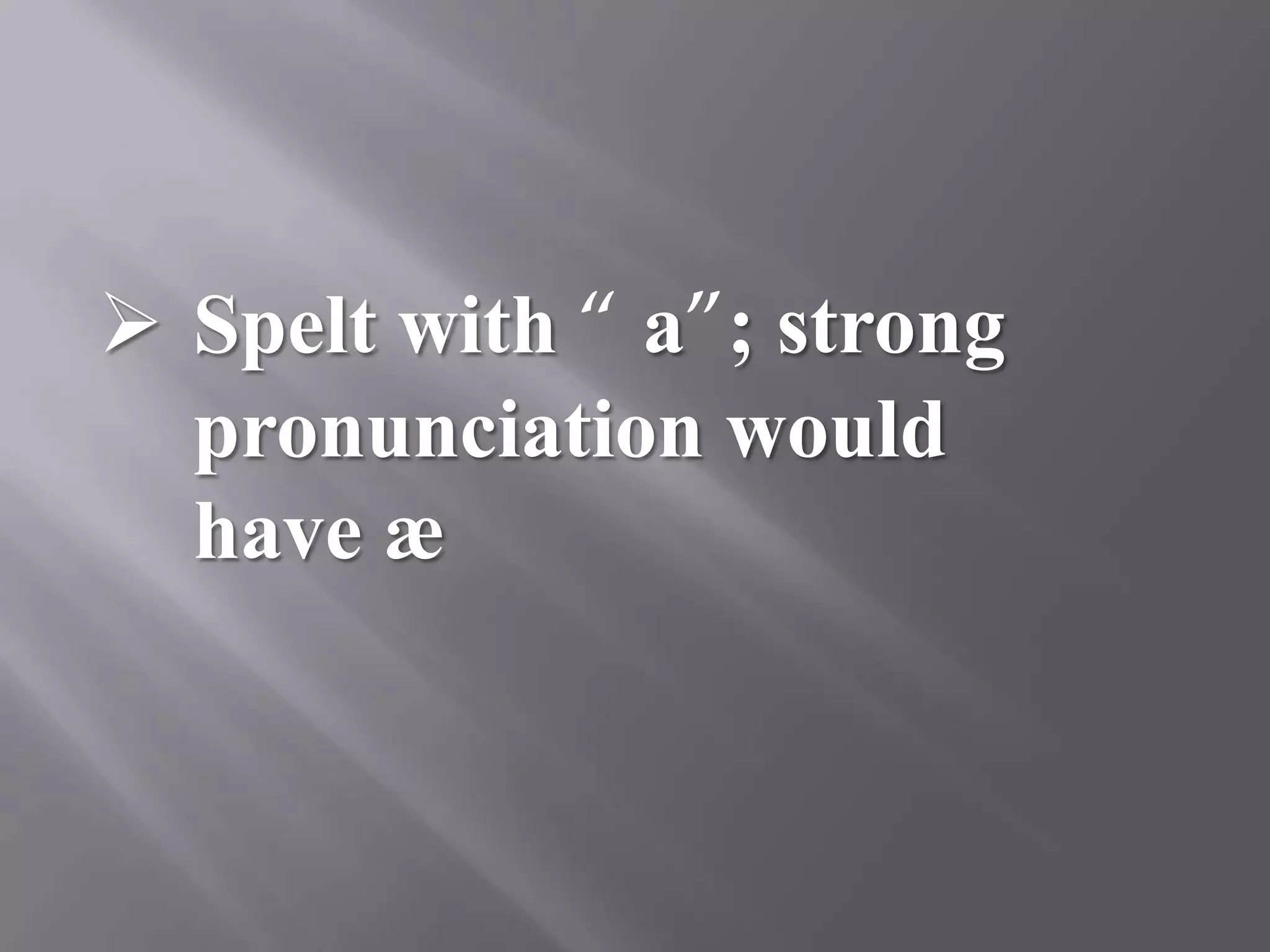
 Spelt with “ a”; strong
  pronunciation would
  have æ
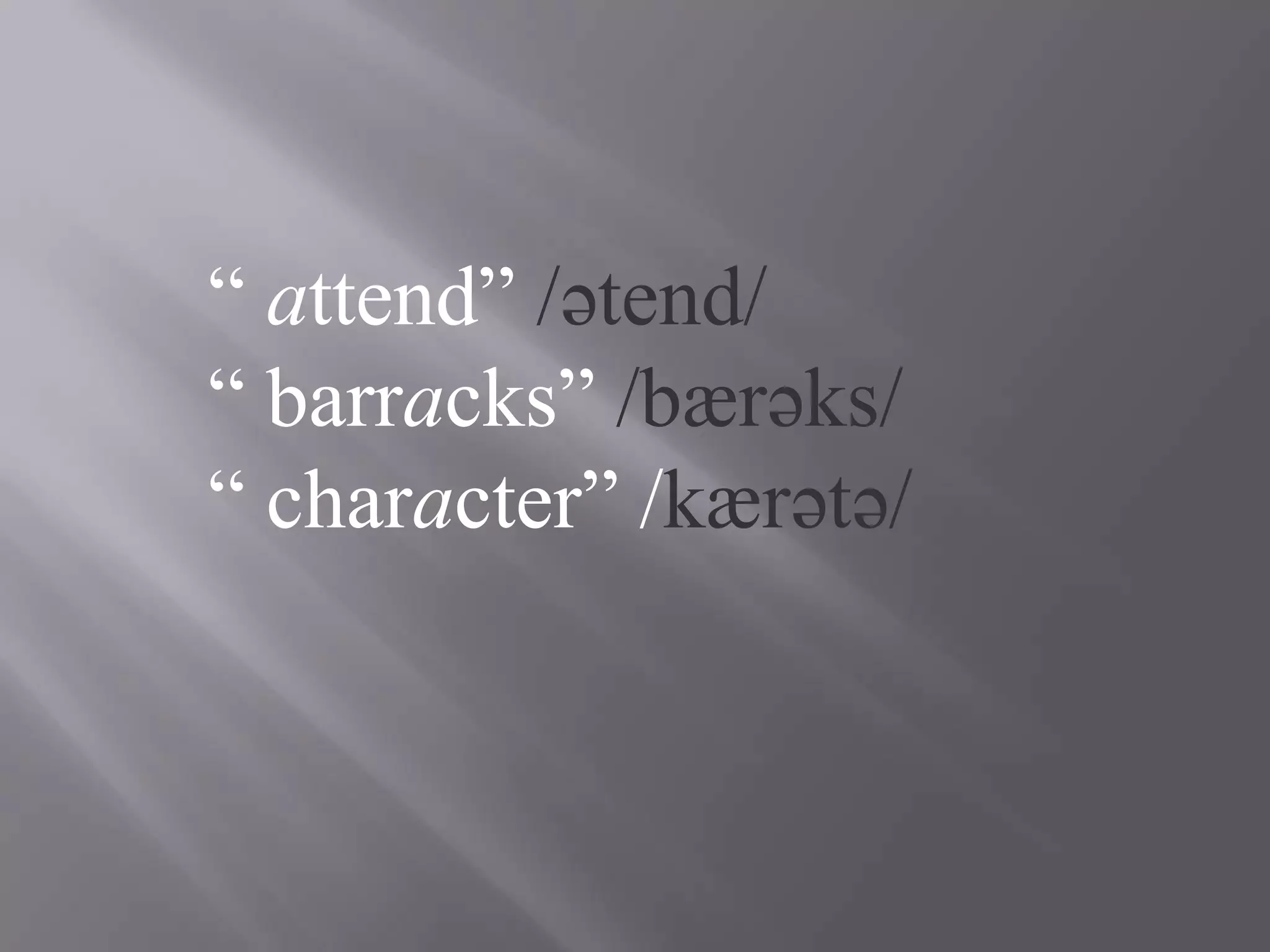
“ attend” /ətend/
“ barracks” /bærəks/
“ character” /kærətə/
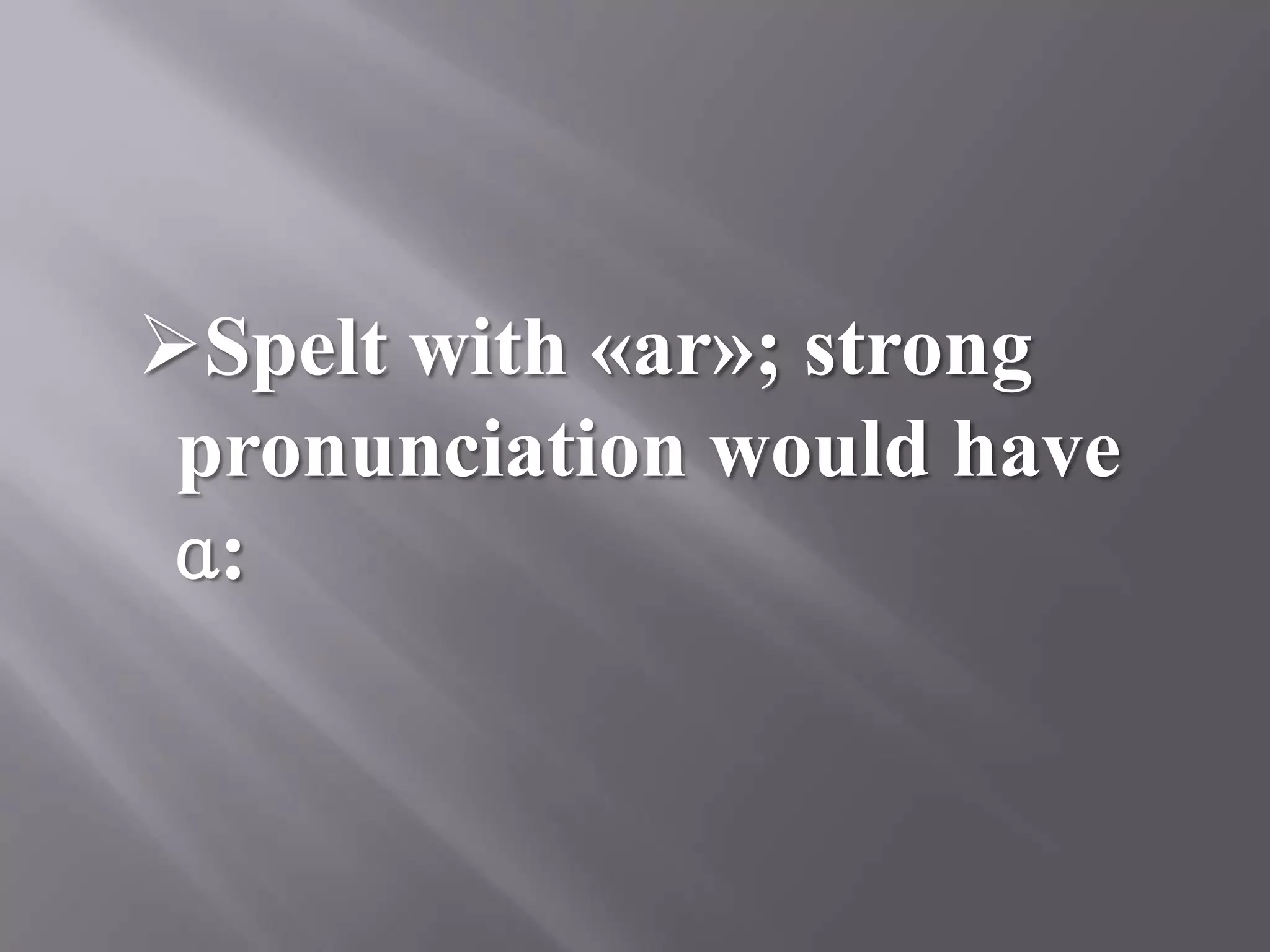
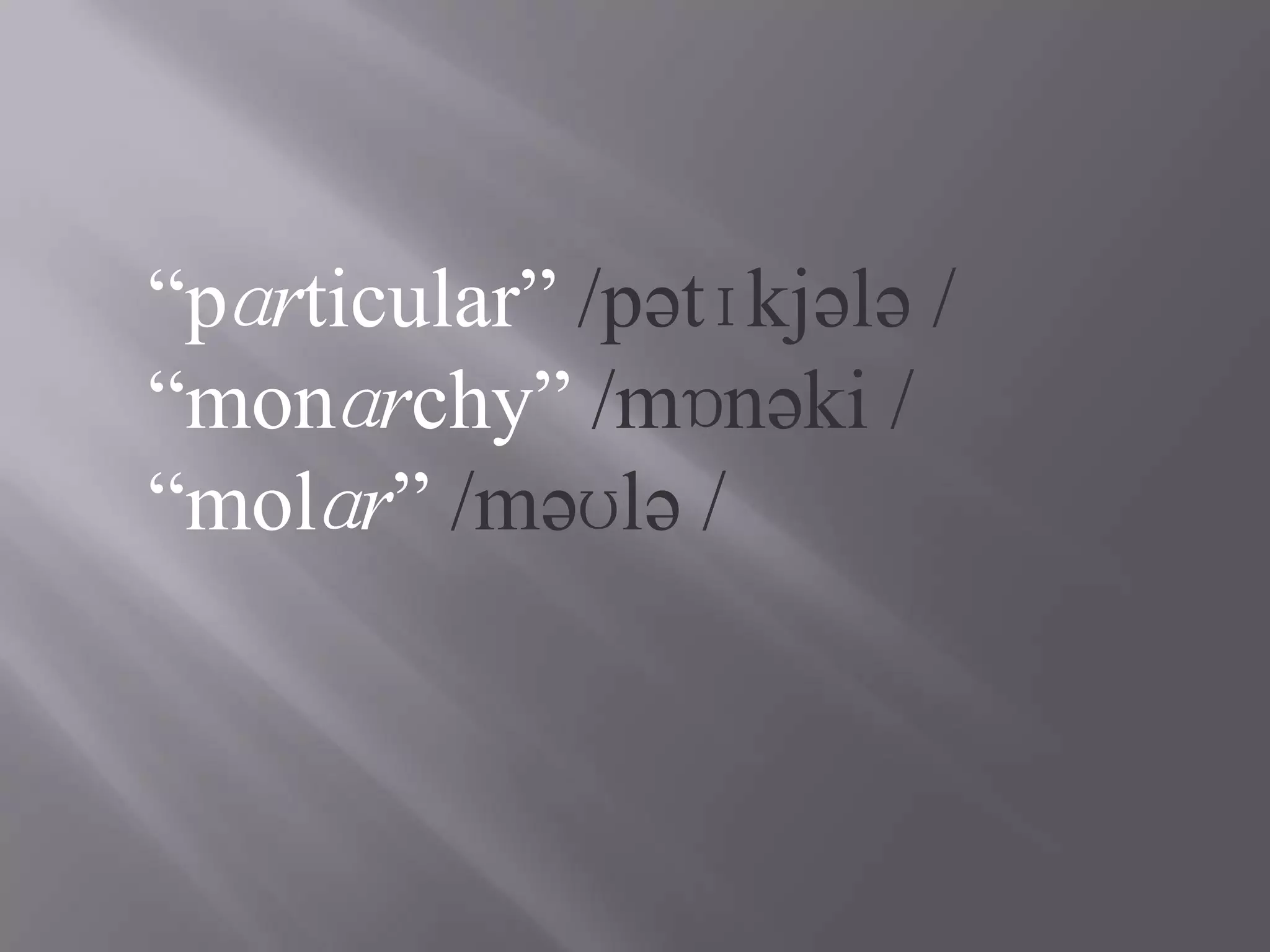
Spelt with «ar»; strong
 pronunciation would have
 ɑ:
“pɑrticular” /pətɪkjələ /
“monɑrchy” /mɒnəki /
“molɑr” /məʊlə /
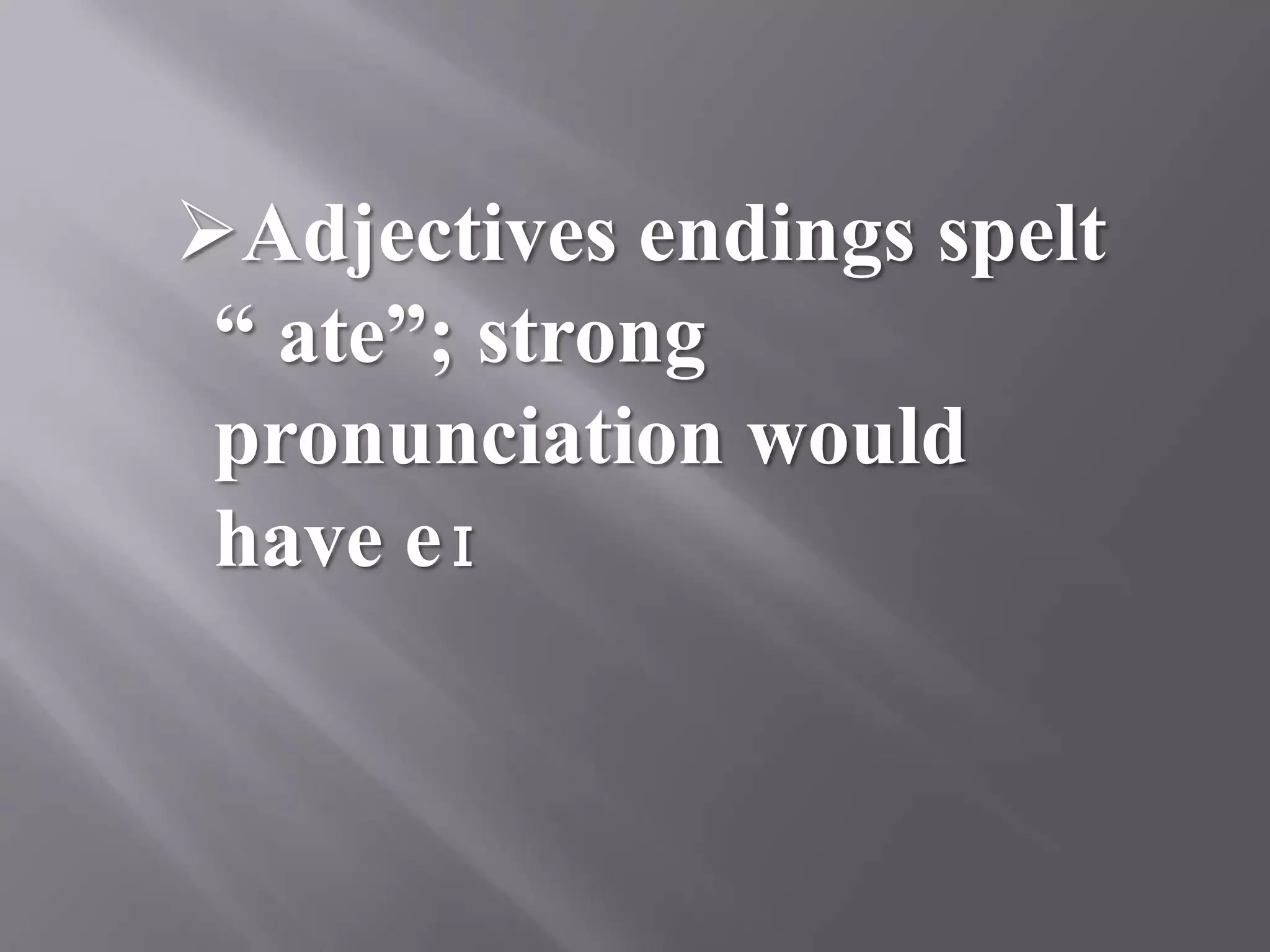
Adjectives endings spelt
 “ ate”; strong
 pronunciation would
 have eɪ
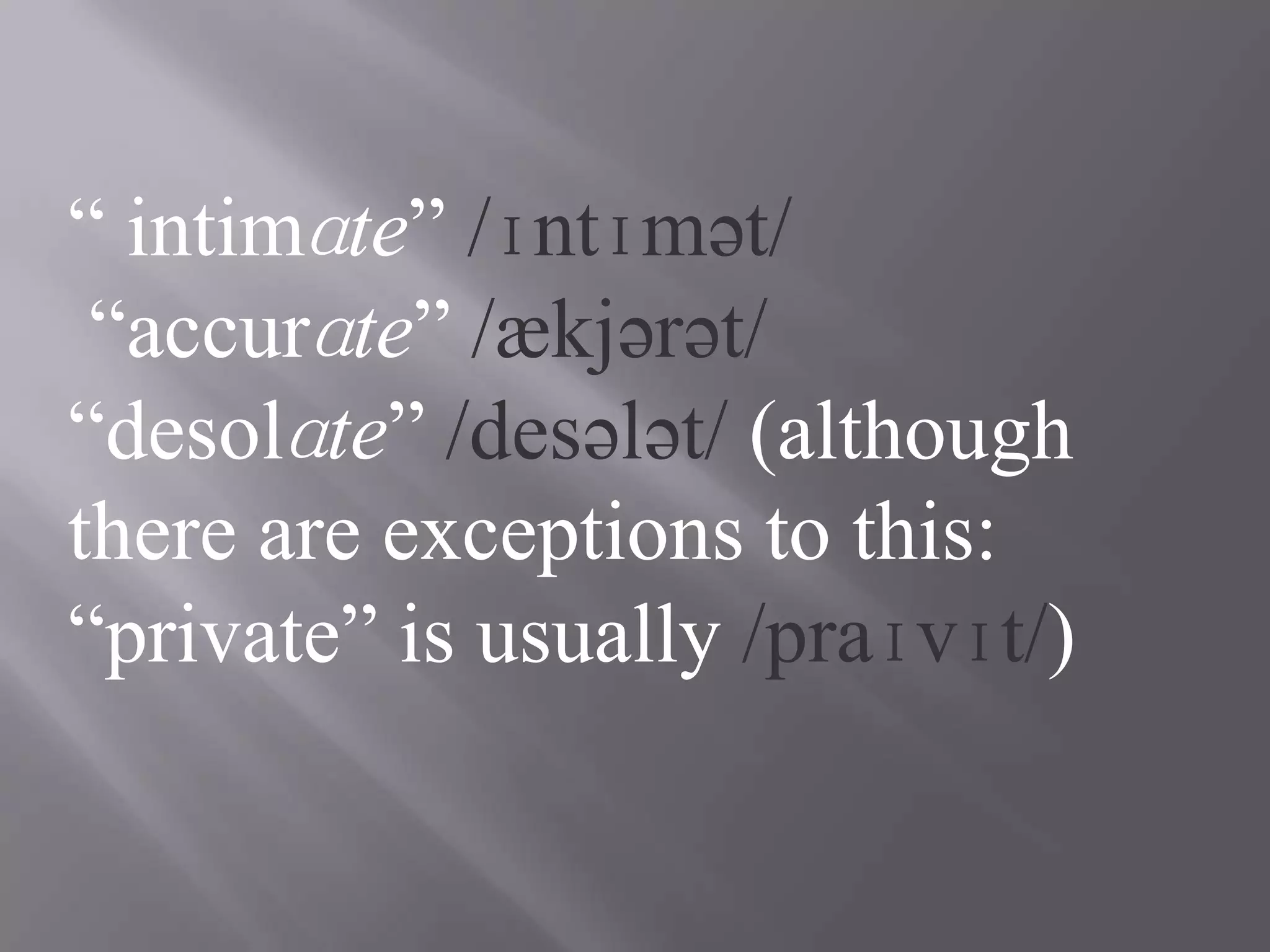
“ intimɑte” /ɪntɪmət/
 “accurɑte” /ækjərət/
“desolɑte” /desələt/ (although
there are exceptions to this:
“private” is usually /praɪvɪt/)
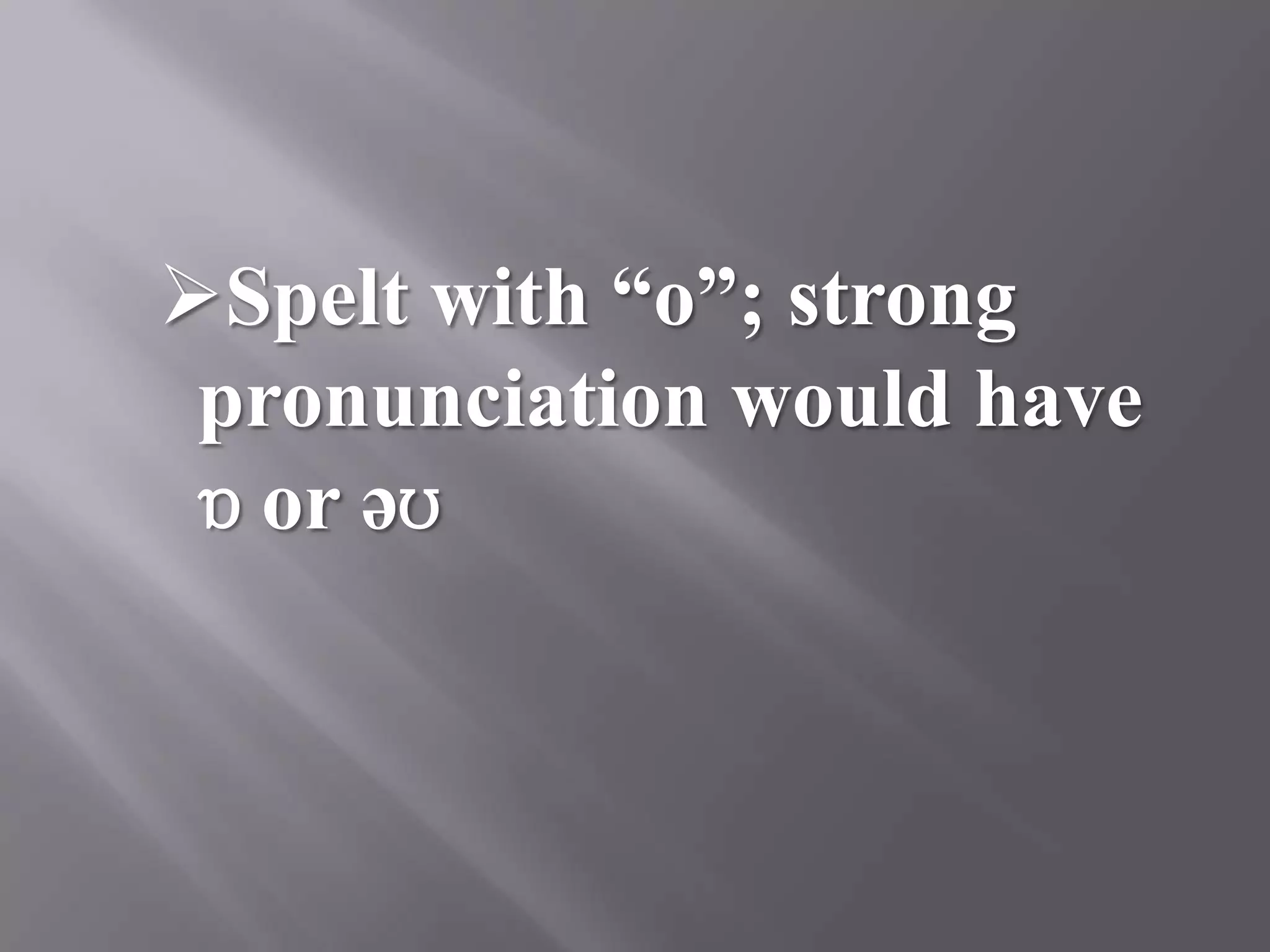
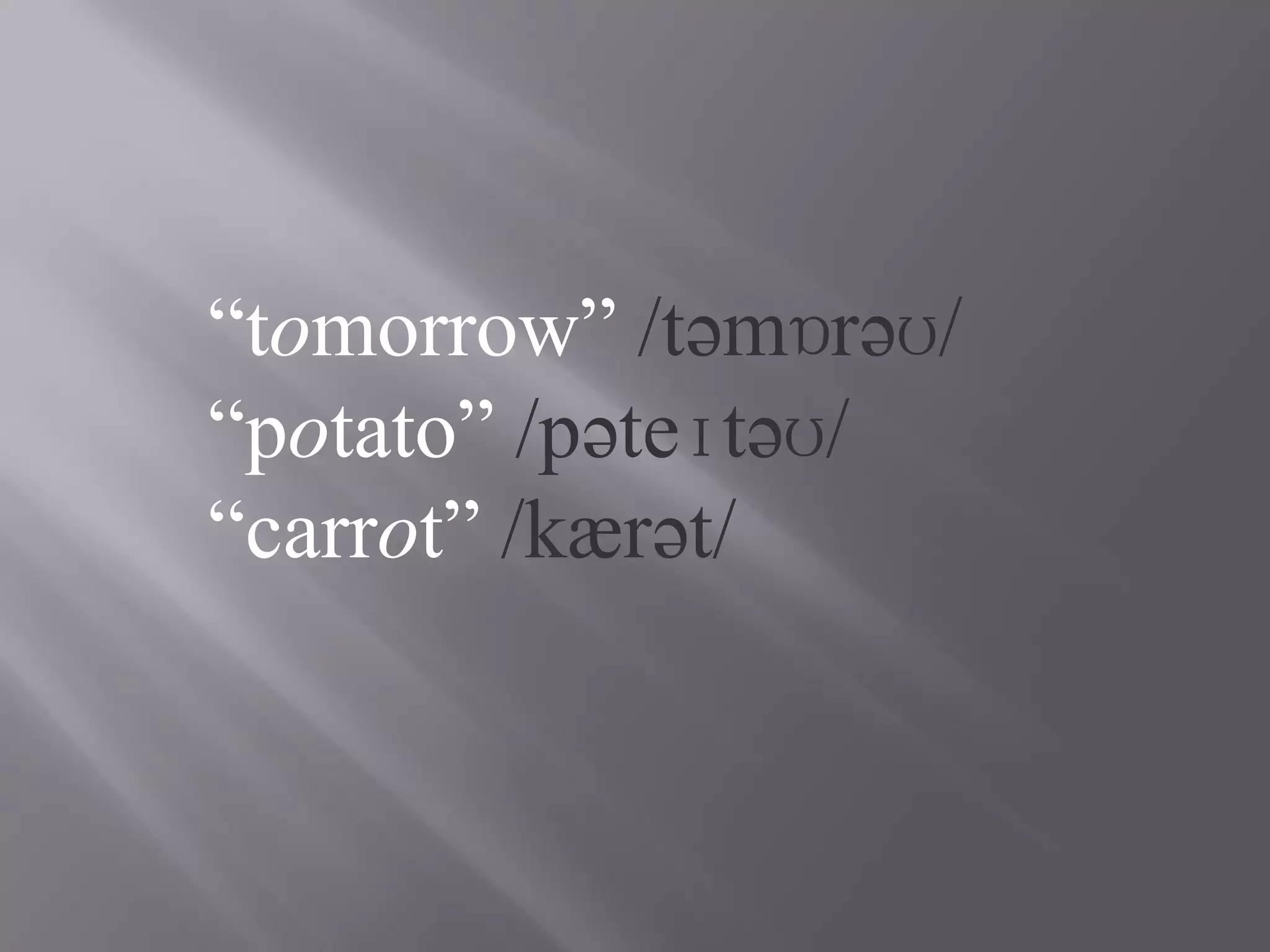
Spelt with “o”; strong
 pronunciation would have
 ɒ or əʊ
“tomorrow” /təmɒrəʊ/
“potato” /pəteɪtəʊ/
“carrot” /kærət/
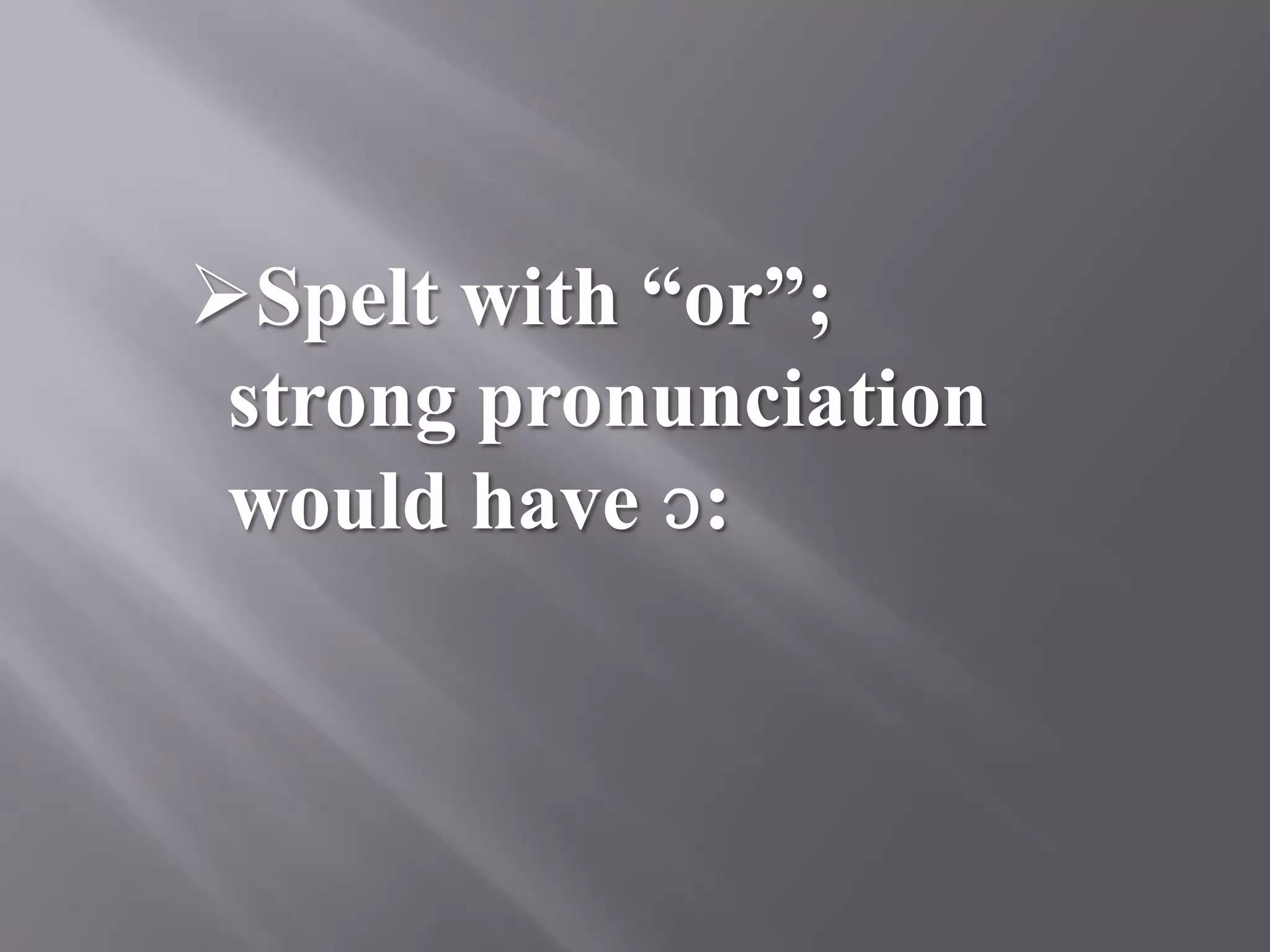
Spelt with “or”;
 strong pronunciation
 would have ɔ:
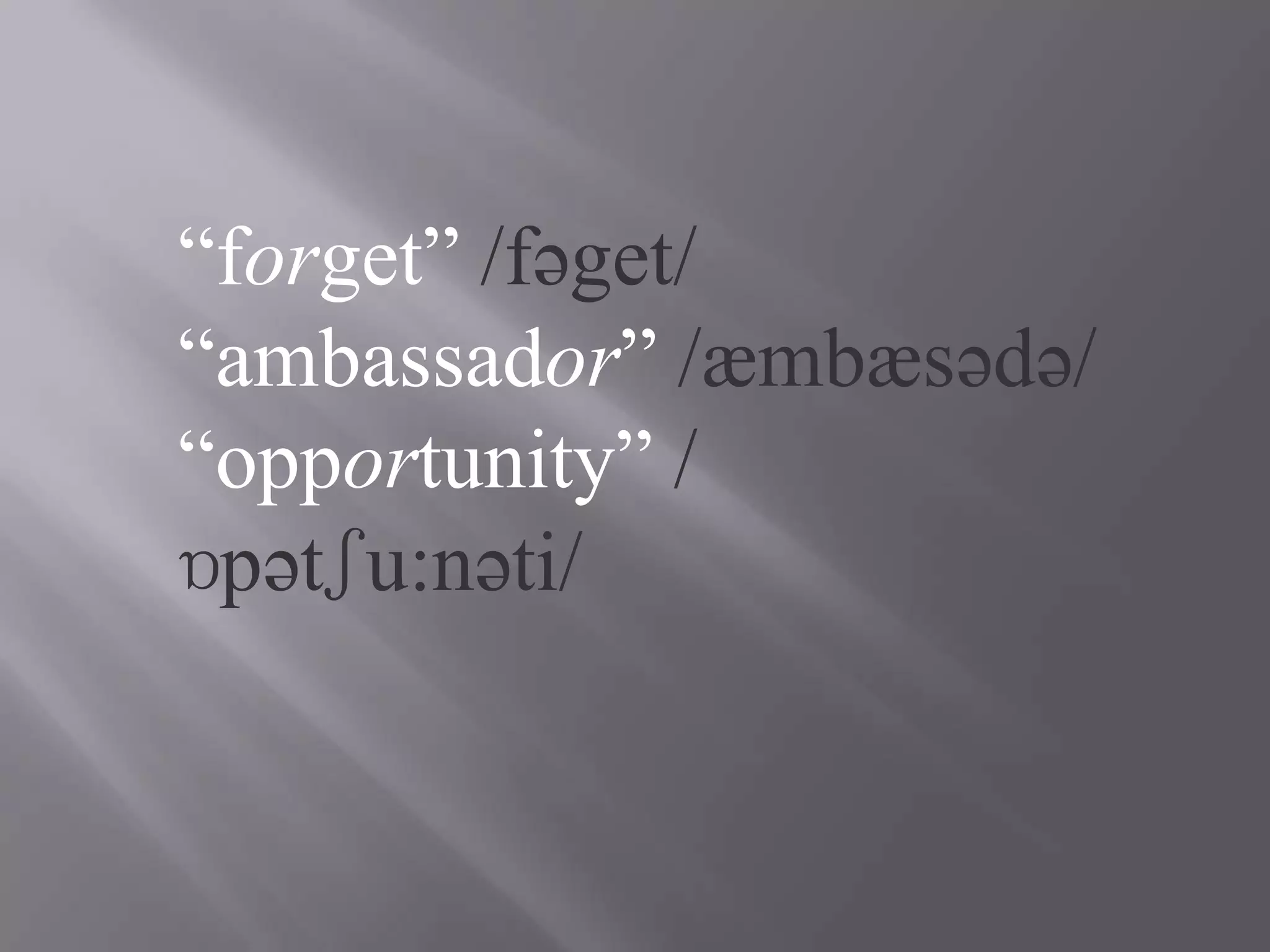
“forget” /fəget/
“ambassador” /æmbæsədə/
“opportunity” /
ɒpətʃu:nəti/
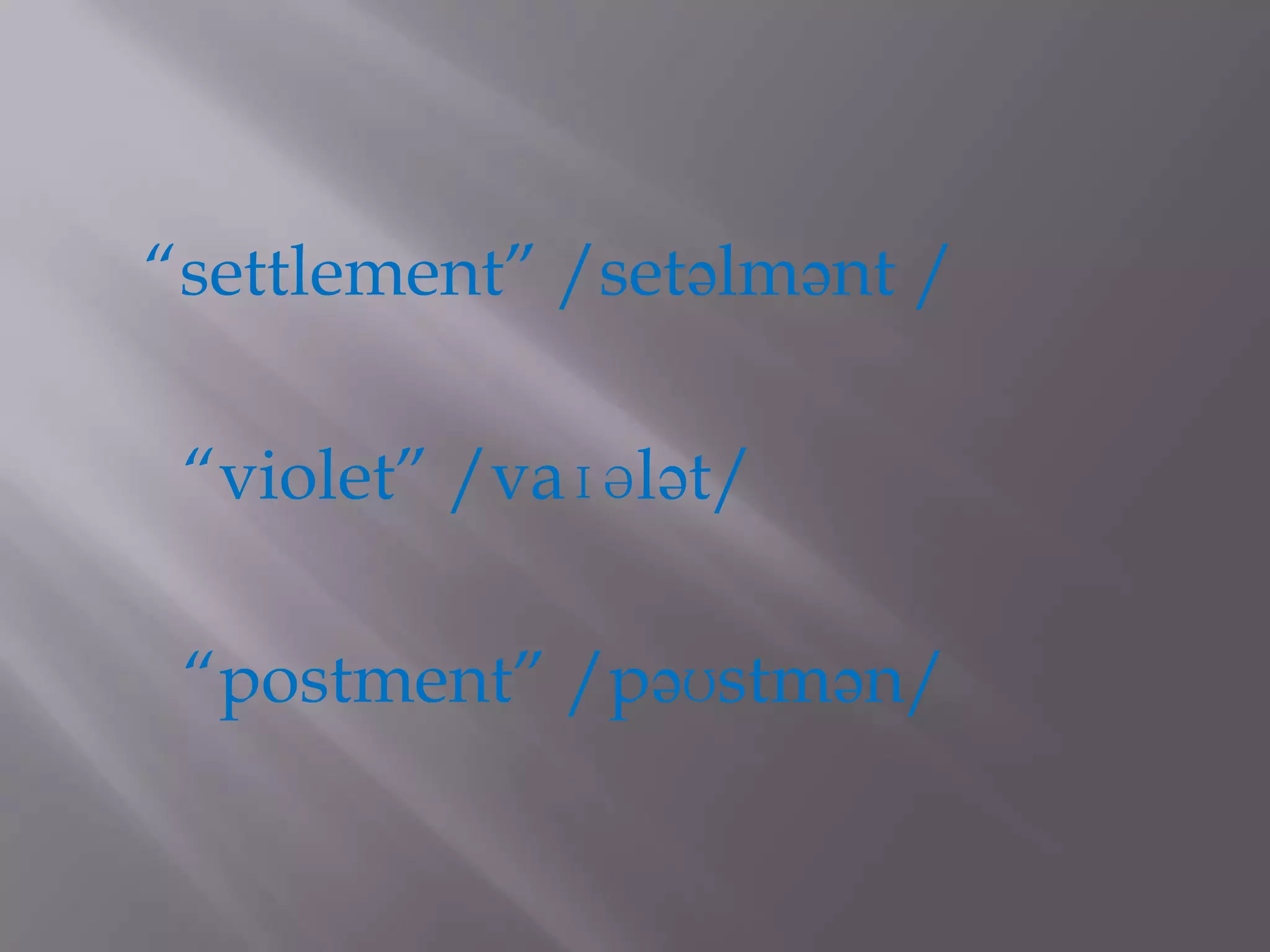
“settlement” /setəlmənt /

 “violet” /vaɪələt/

 “postment” /pəʊstmən/
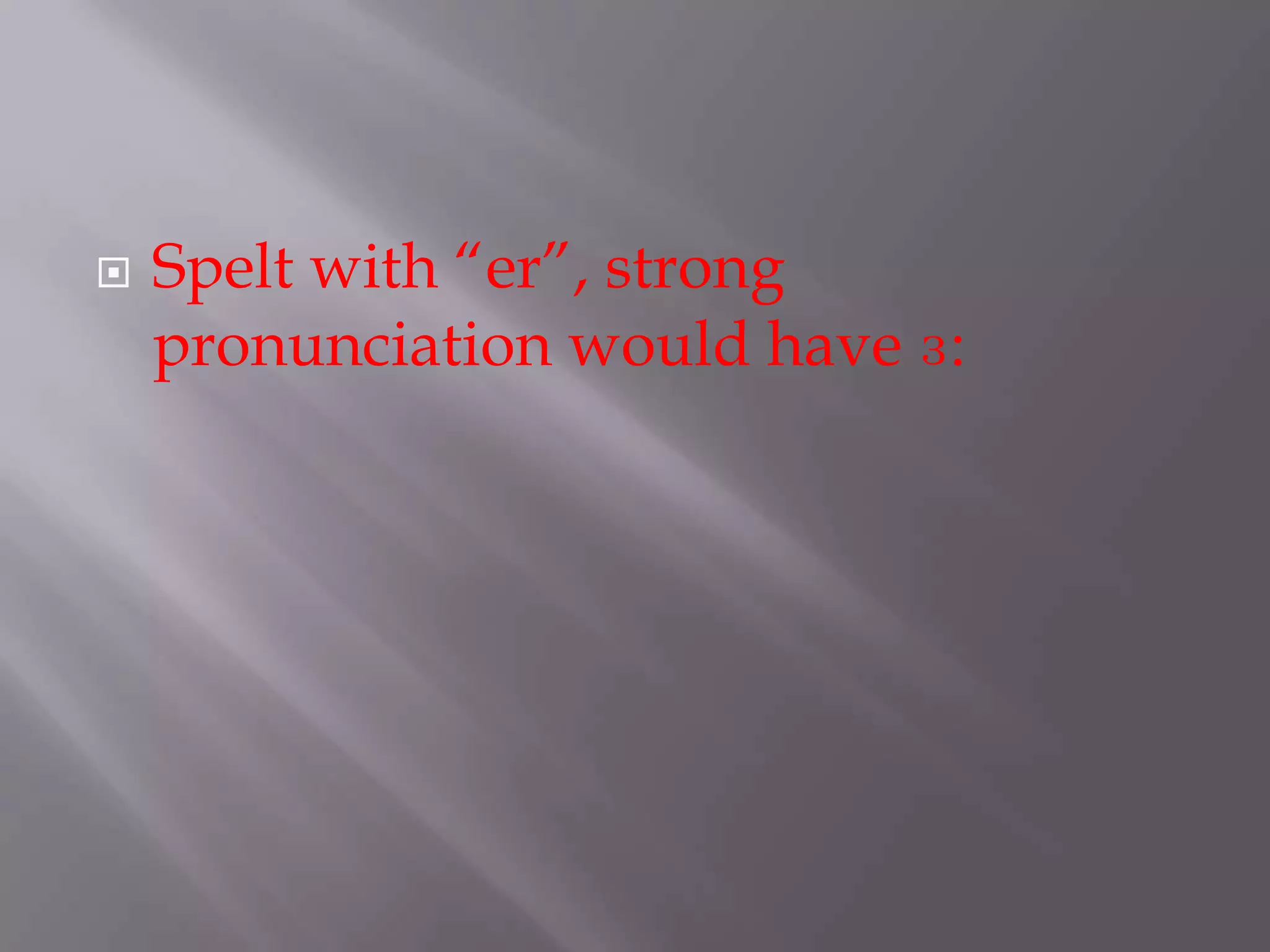
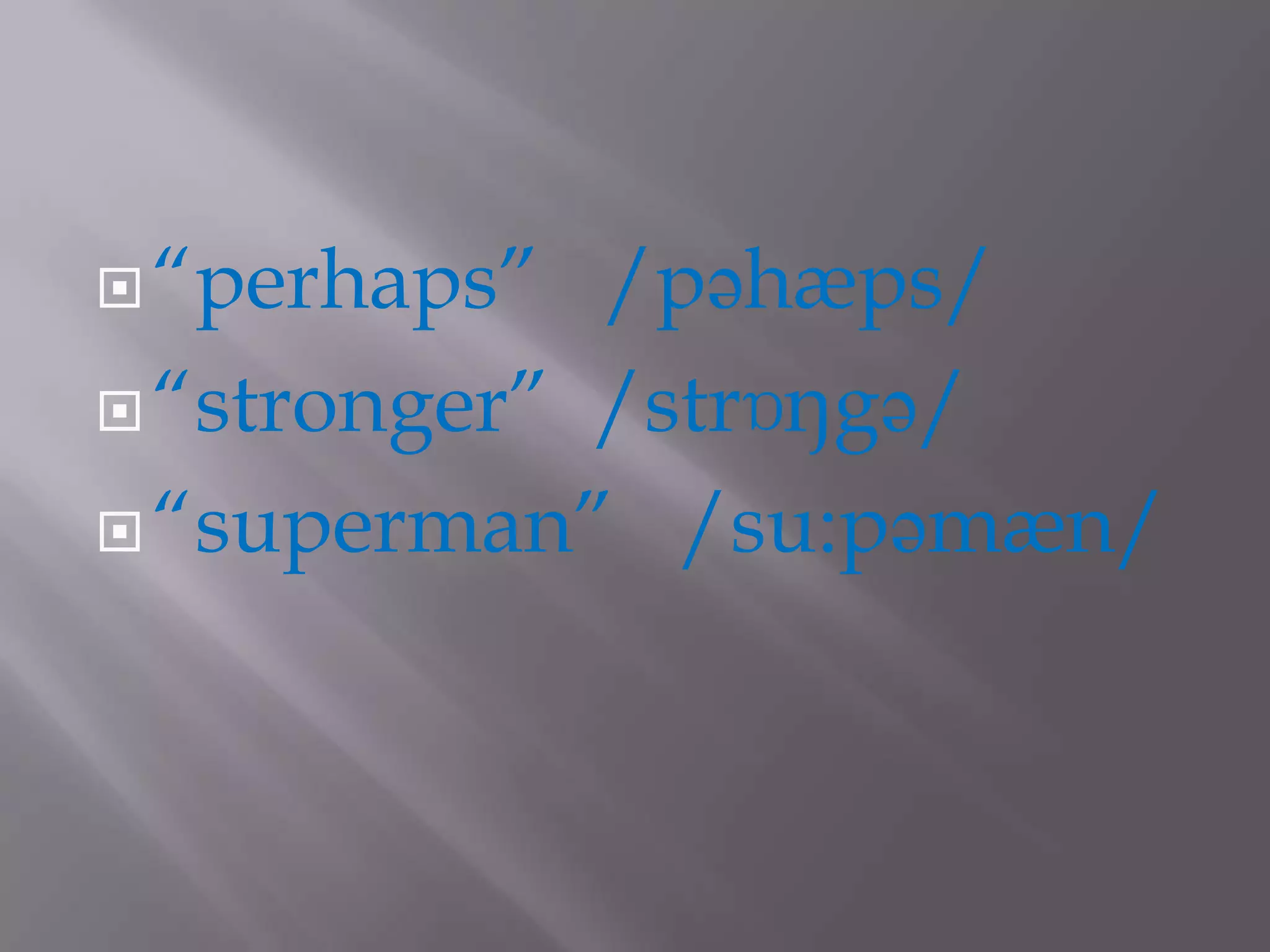
   Spelt with “er”, strong
    pronunciation would have ɜ:
 “perhaps”  /pəhæps/
 “stronger” /strɒŋgə/

 “superman” /su:pəmæn/
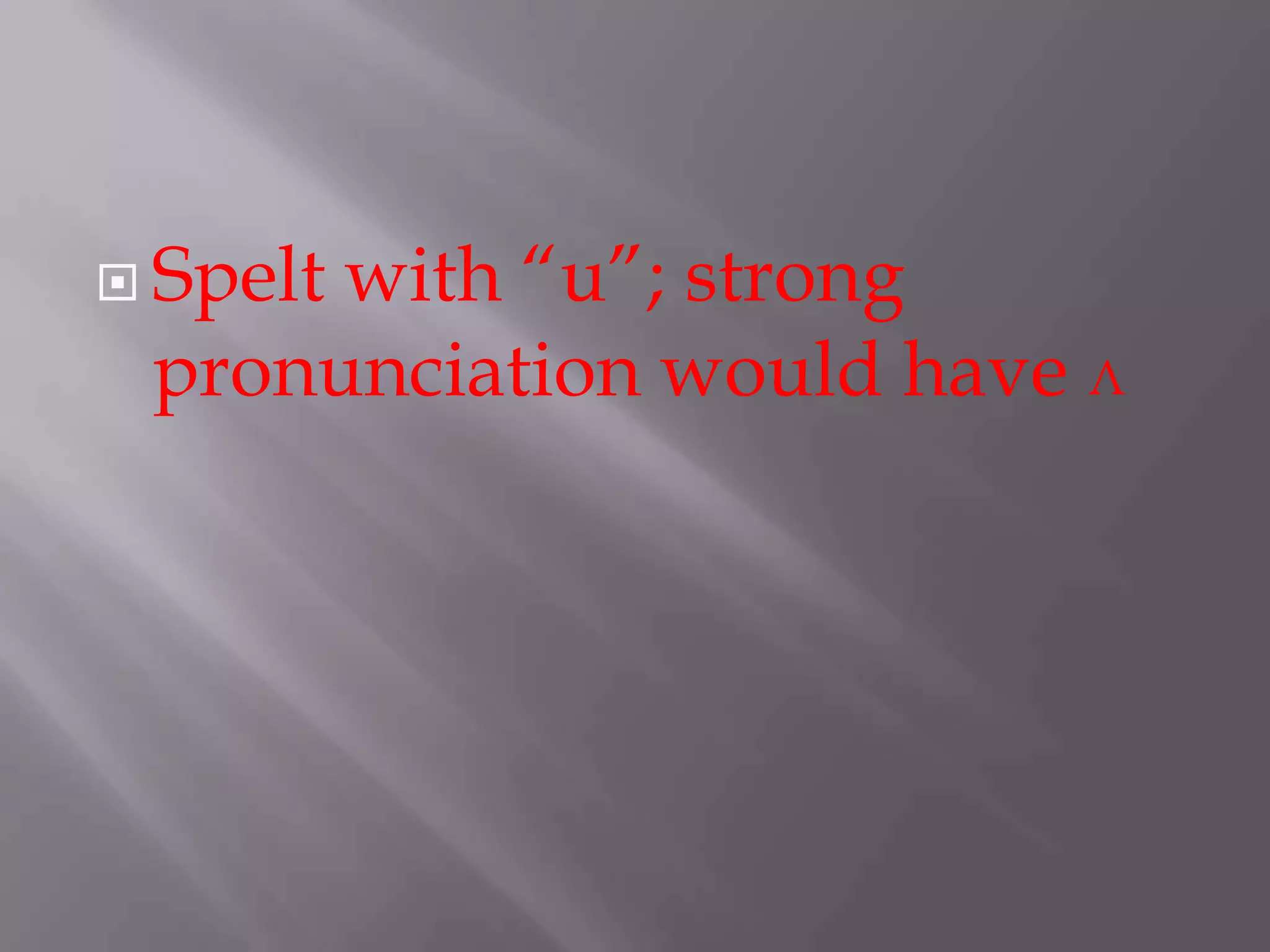
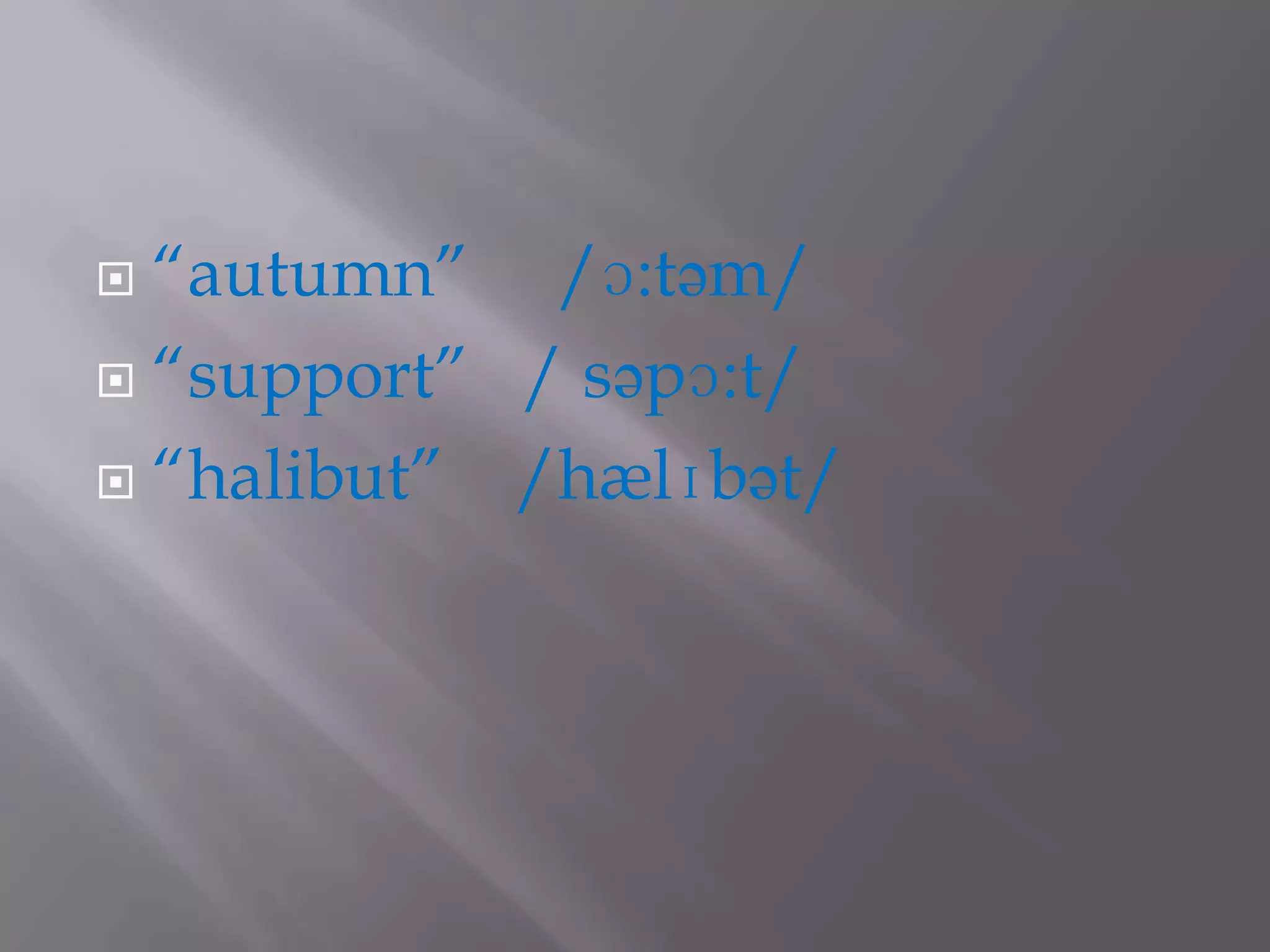
 Spelt
      with “u”; strong
 pronunciation would have ʌ
 “autumn” /ɔ:təm/
 “support” / səpɔ:t/

 “halibut” /hælɪbət/
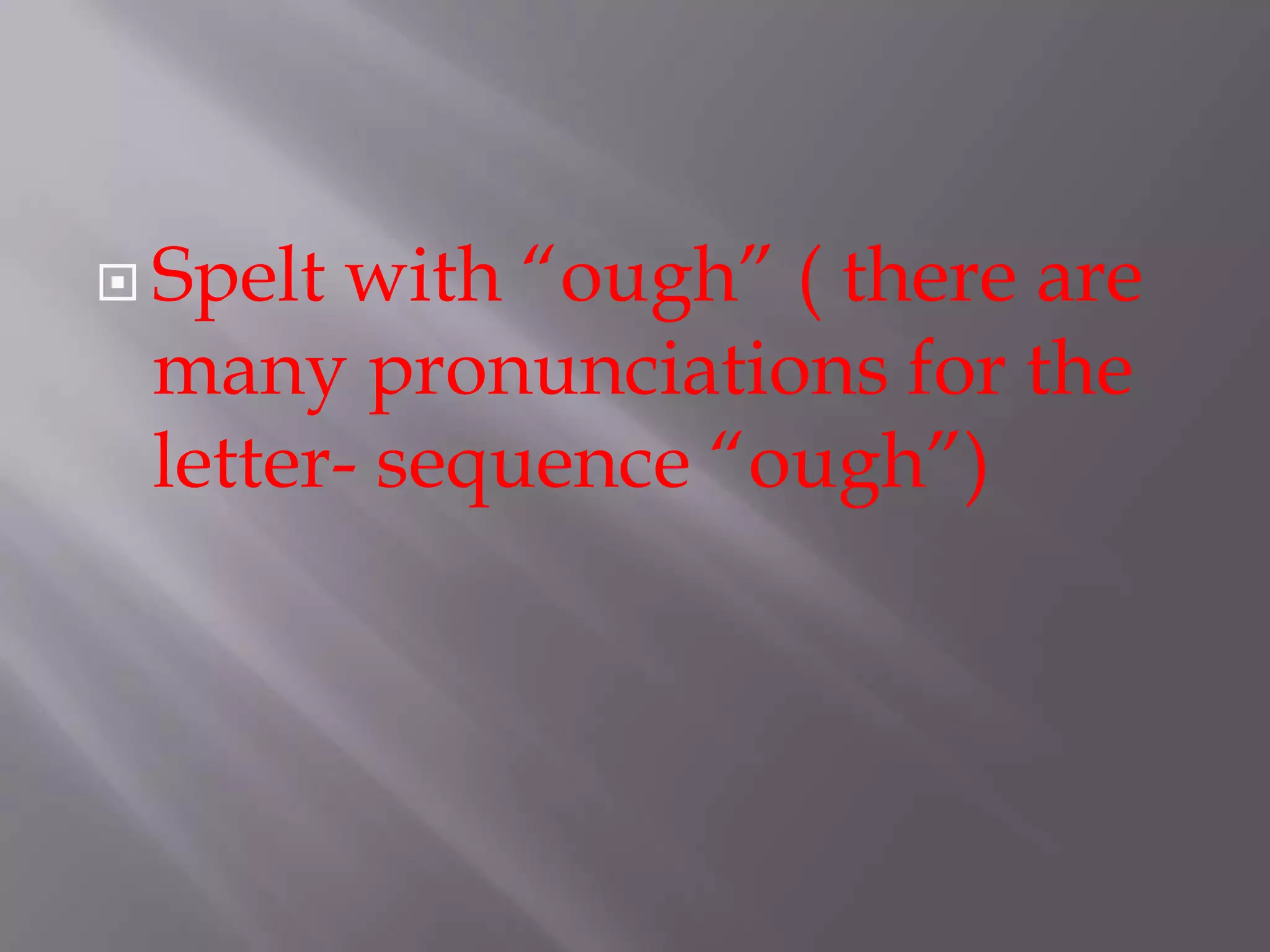
 Spelt with “ough” ( there are
 many pronunciations for the
 letter- sequence “ough”)
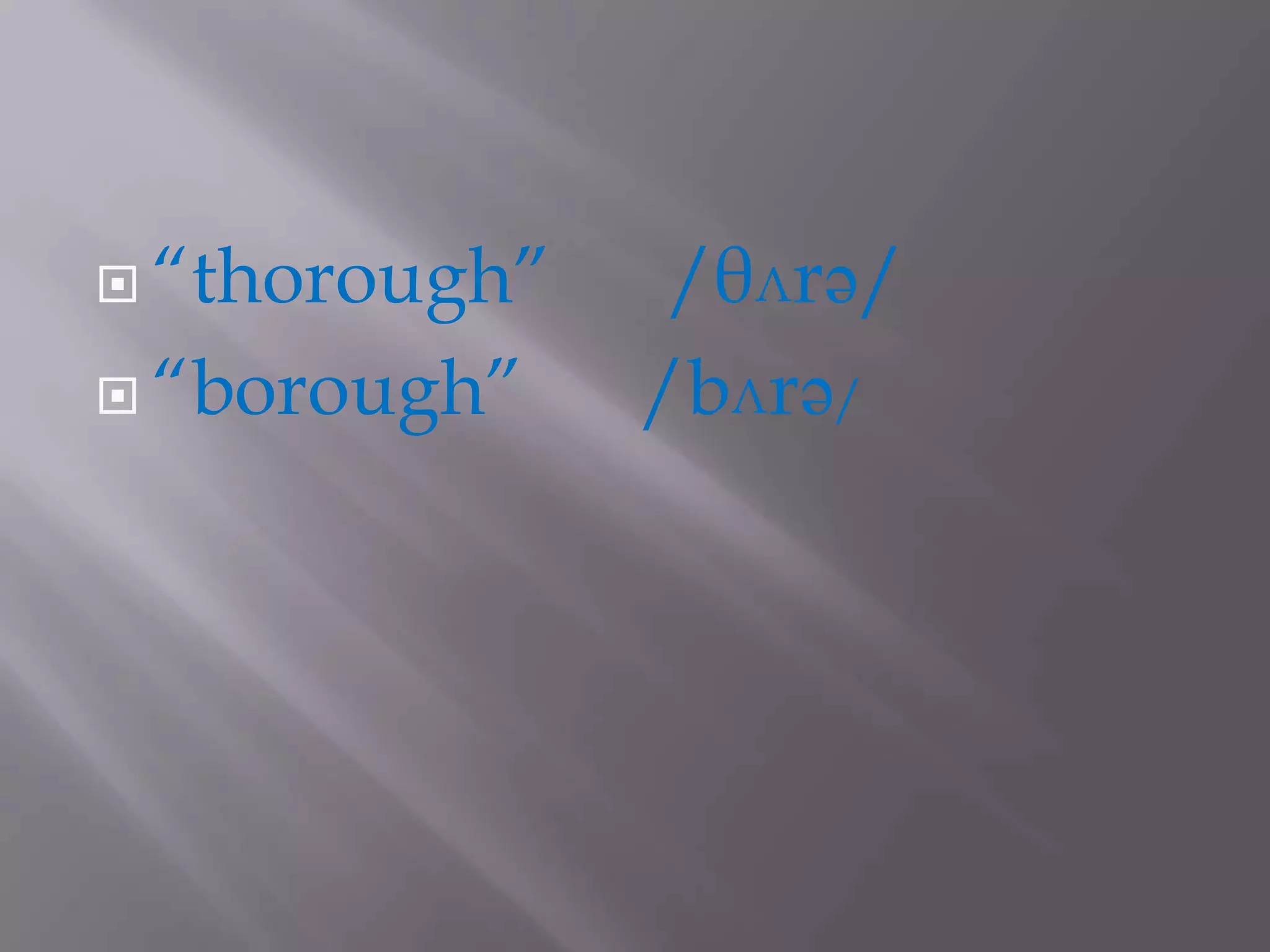
 “thorough”    /θʌrə/
 “borough”    /bʌrə/
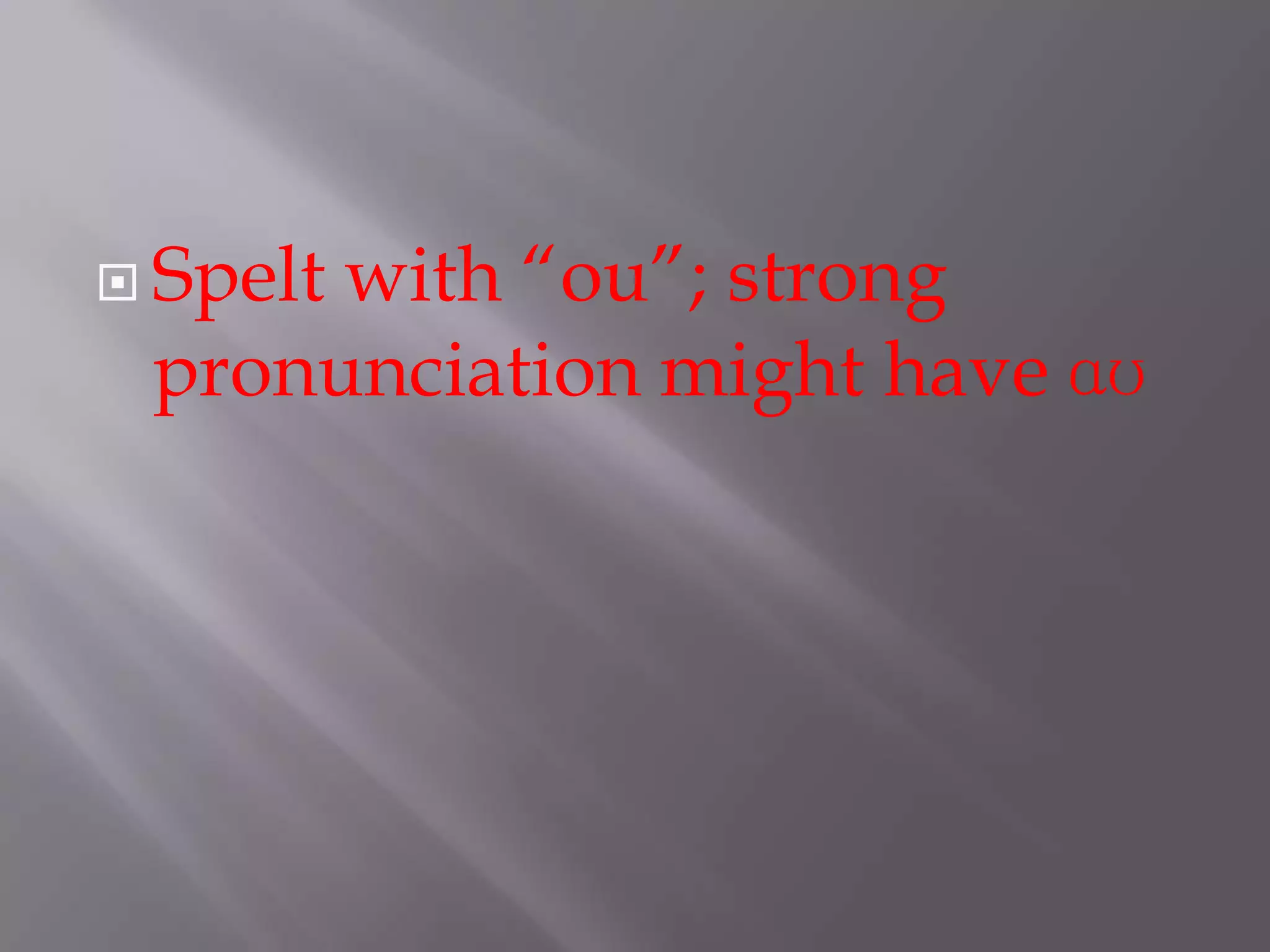
 Spelt
      with “ou”; strong
 pronunciation might have ɑʊ
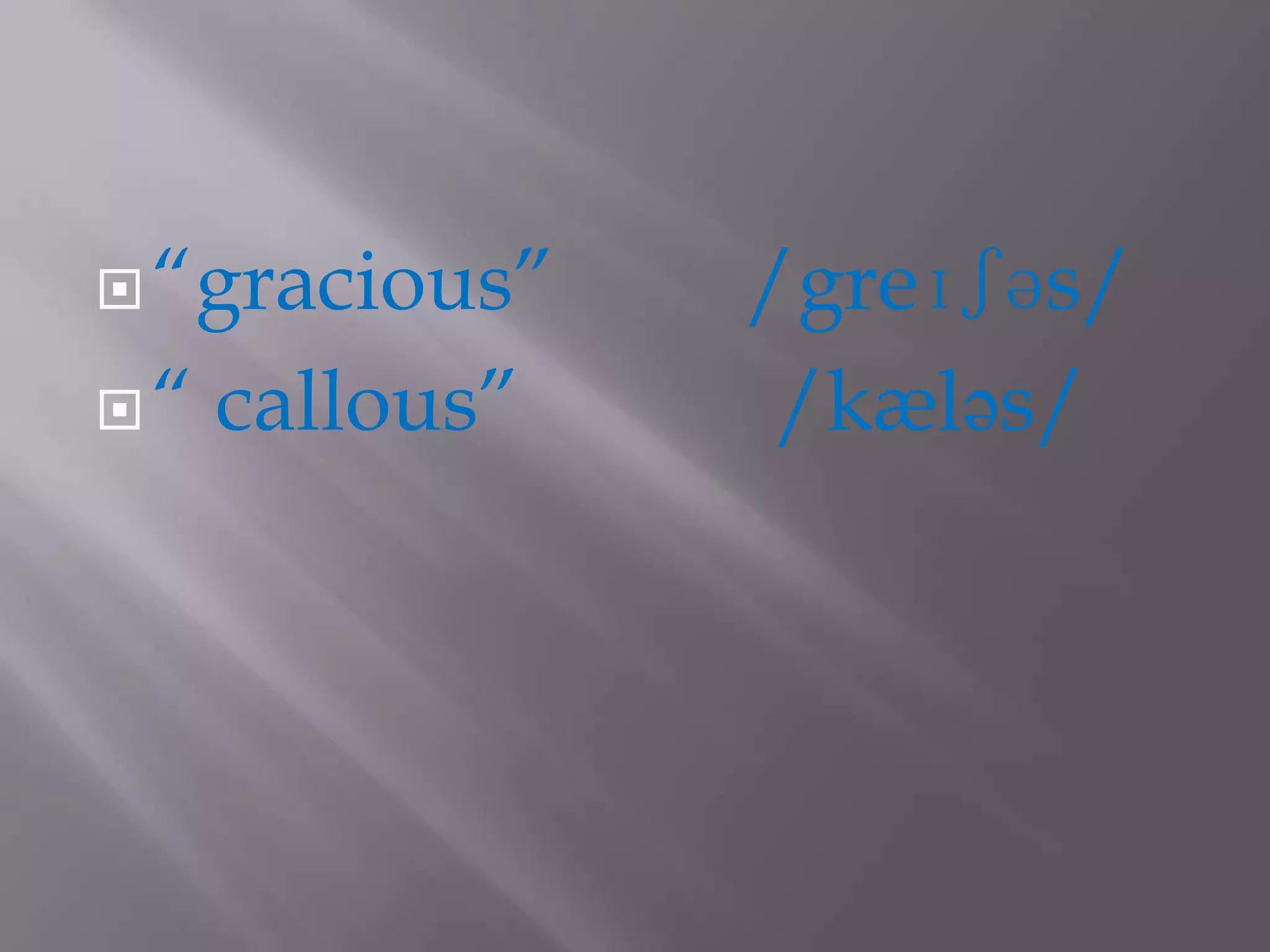
 “gracious”    /greɪʃəs/
“   callous”    /kæləs/
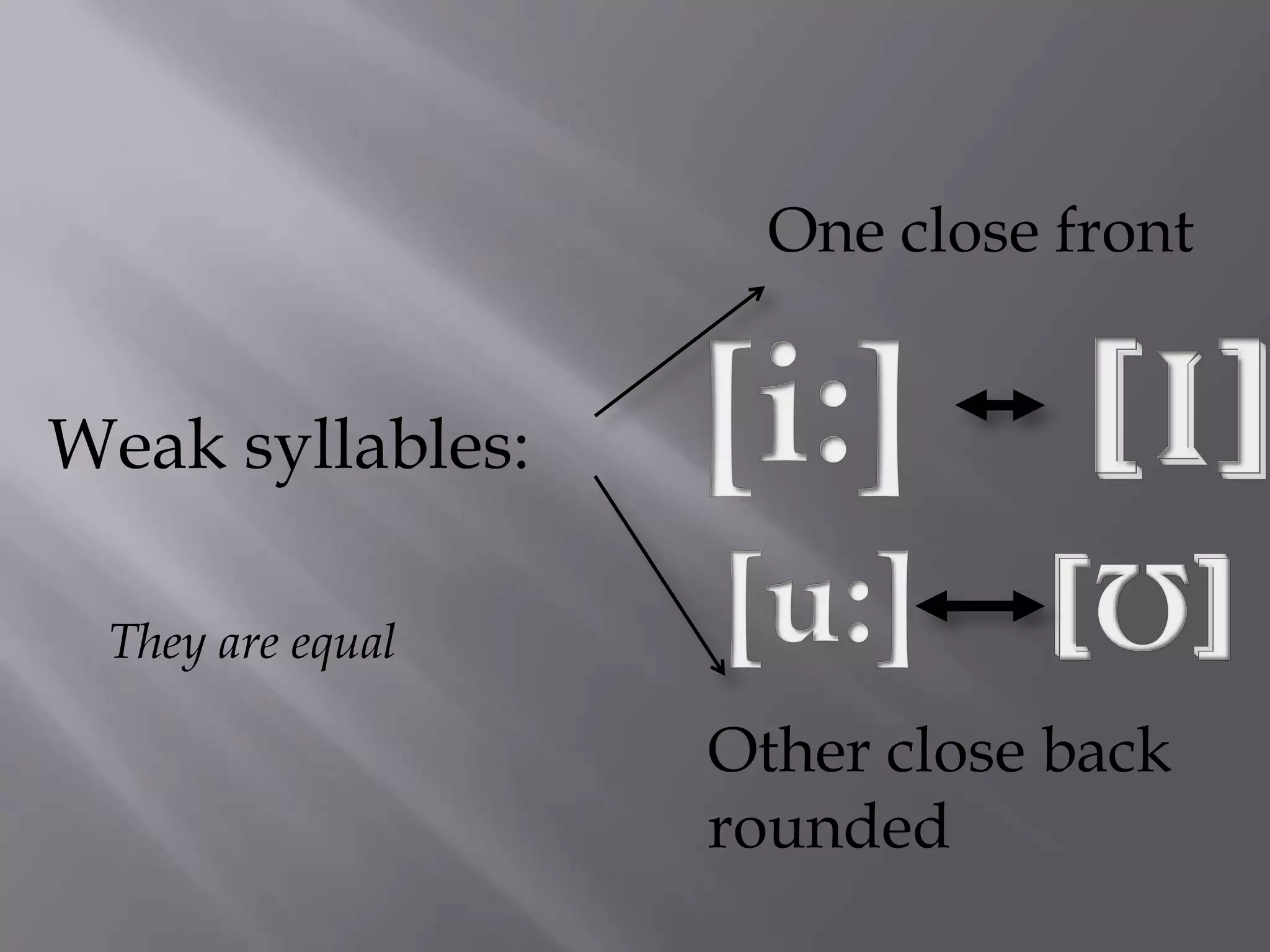
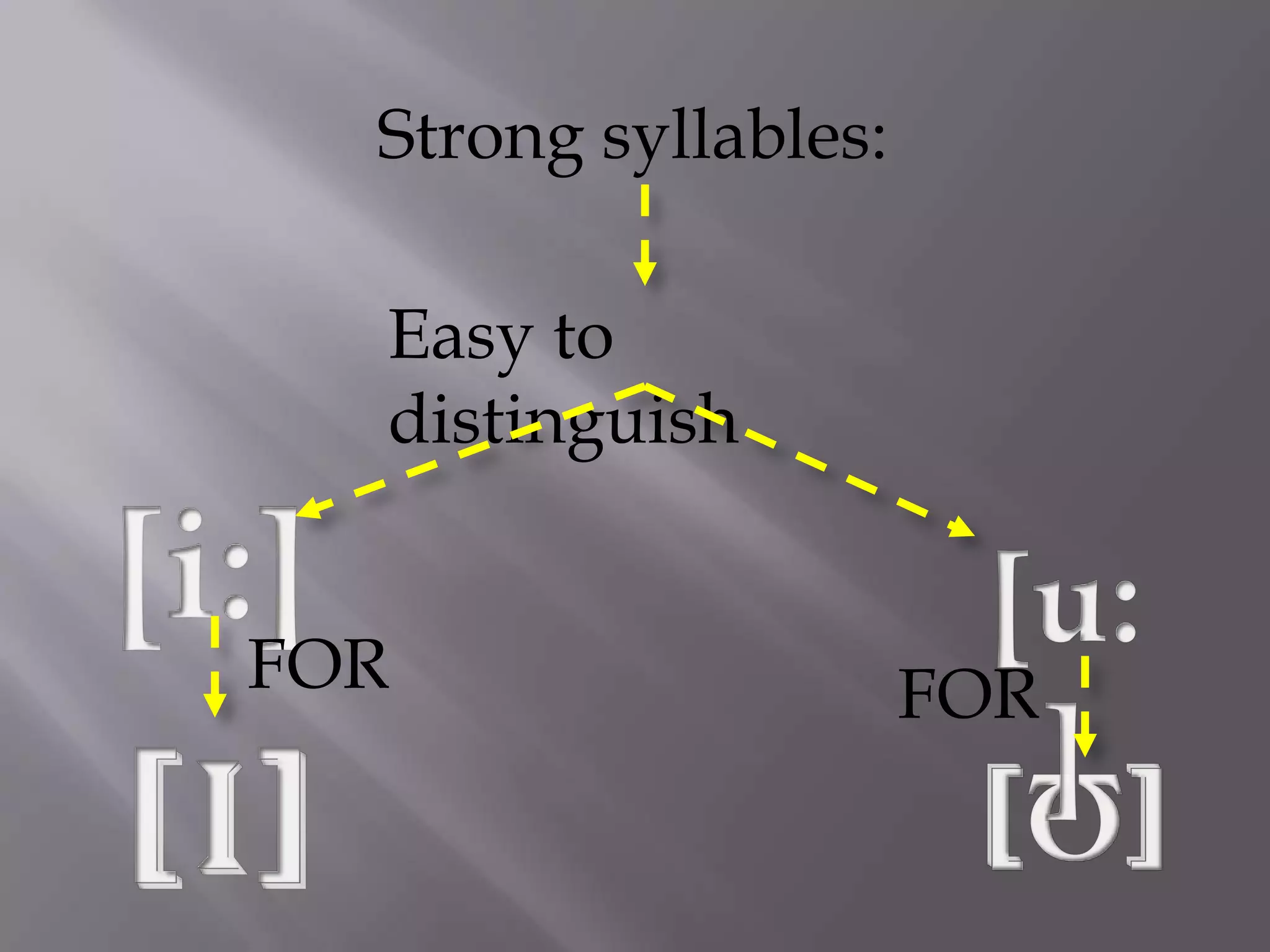
One close front


Weak syllables:

 They are equal

                  Other close back
                  rounded
Strong syllables:

  Easy to
  distinguish


FOR                   FOR
Example:


“beat” [bi:t]
                We can
                distinguis
“bit”   [bIt]   h sounds
“easy” [i:zI]
                 We can´t
                 distinguis
“busy” [bIzi:]   h sounds
Vowels in Questions:


They sound like [i:] and
[u:] when they precede
another vowel.
For BBC
  pronunciation:
Within strong syllables sound
[i:] is NEUTRALIZED in
weak syllables.
Possibilities, using
    our symbols:
“easy”           “busy”

[i:zi:           [bIzi:]
]
[i:zI]           [bIzI]
We find i occuring:
Words in the final
  position “y” or “ey”
  after one or more
  consont letter.

<happy> [hᴂpi
            ]
<valley> [vᴂli
             ]
In morpheme-final position
 when such words have
 suffixes beginning with
 vowels.

<happier> [hᴂpi ]
              ə
<easier>          [i:ziə]
In the prefix such as those
   spelt „re‟, „pre‟, „de‟; if it
   precedes a vowel and is
   untressed.

 <react>               [riᴂkt
                            ]
 <create>             [krieit]
<deodorant>          [diə     dərənt]
In the suffixes :„iate‟, „ious‟,
   when they have two
   syllables

<appreciate> [əpri:ʃieI t]
<hilarious> [hileəriəs]
In the following words
when unstressed:
„he‟, „she‟, „we‟, „me‟, „be‟
and the word „the‟ when it
precedes a vowel.
With [i] the sound is short
  close front unrounded
  vowel.

<enough>           [Inᴧf]
In weak syllables we found
[u:].
      „you‟, „to‟, „into‟, „do‟

When they are untressed
are not immediatly
preciding a consonant,
„through‟ [θru:]
This vowel is also found
   before another vowel
   withing a word.

<evacuation>[ivᴂkjueiʃṇ]

<influenza> [influenzə]
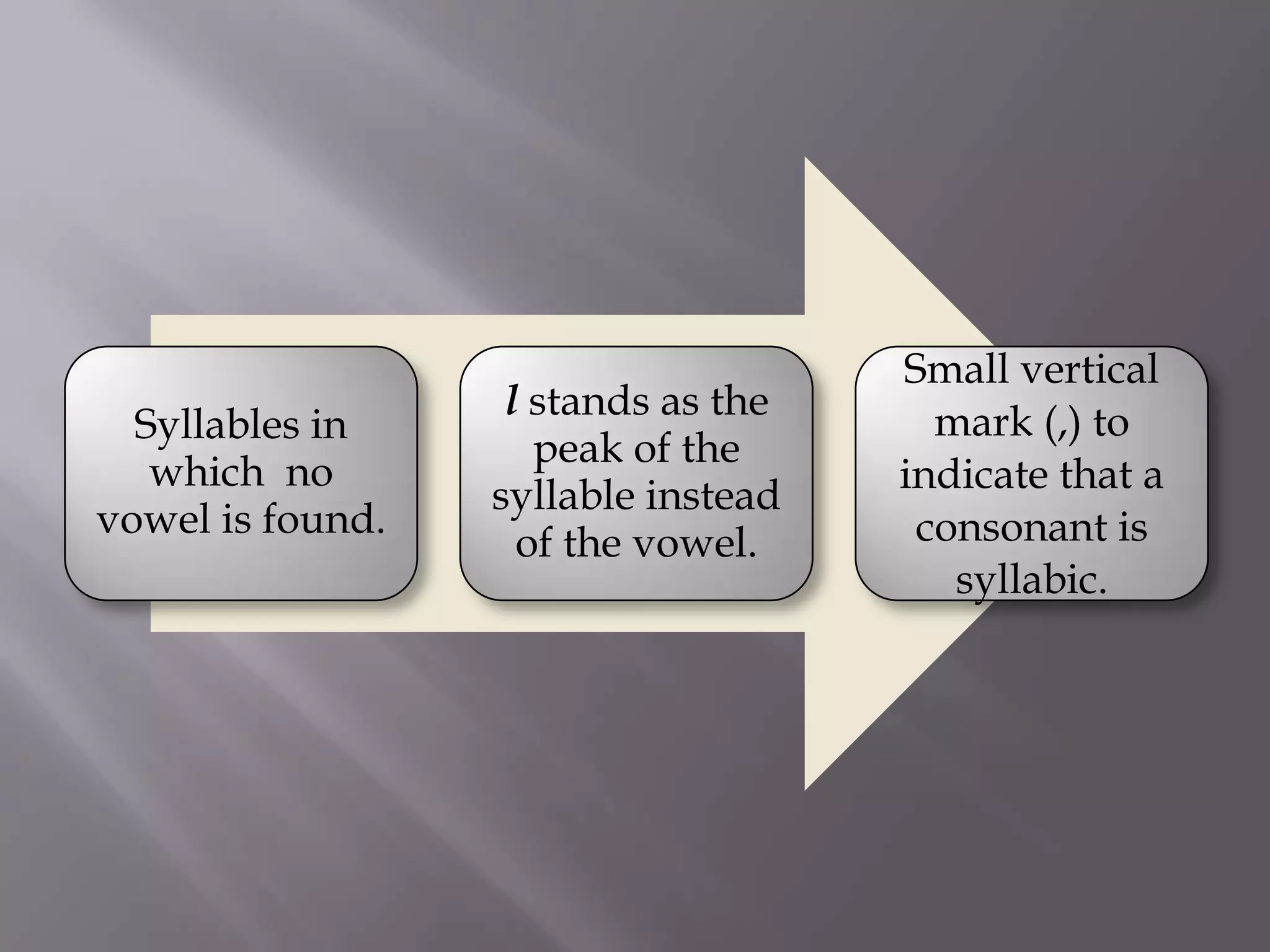
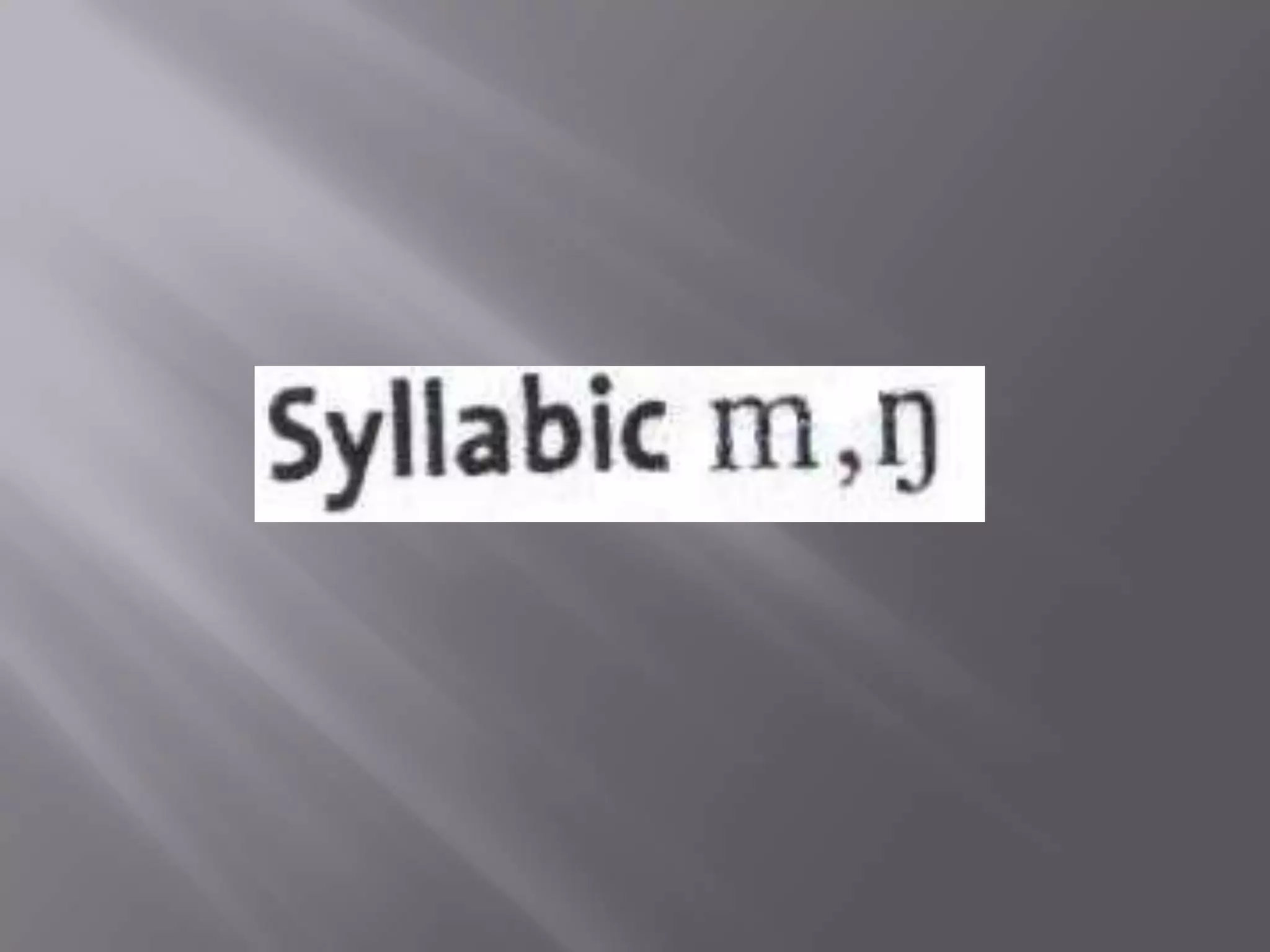
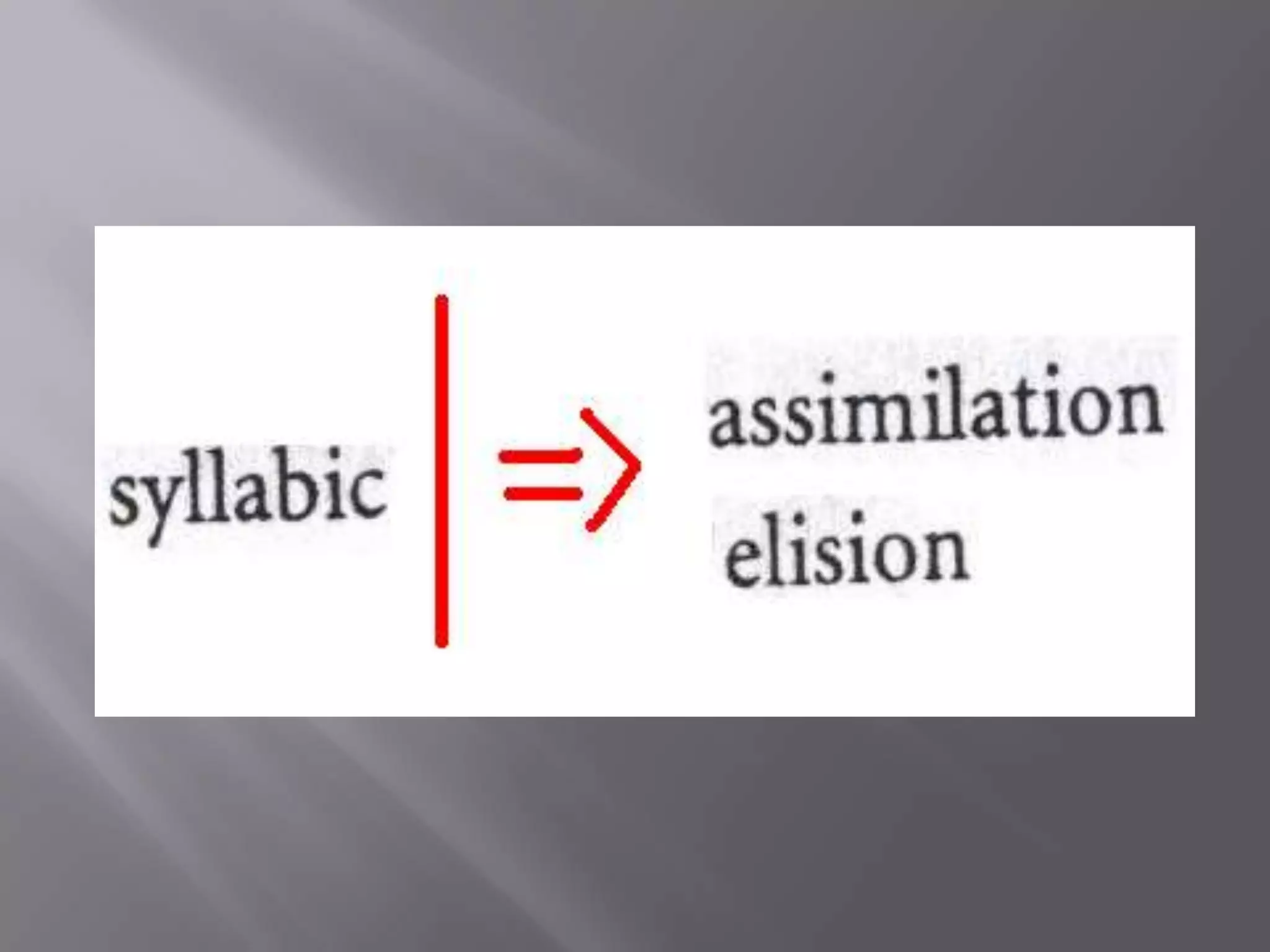
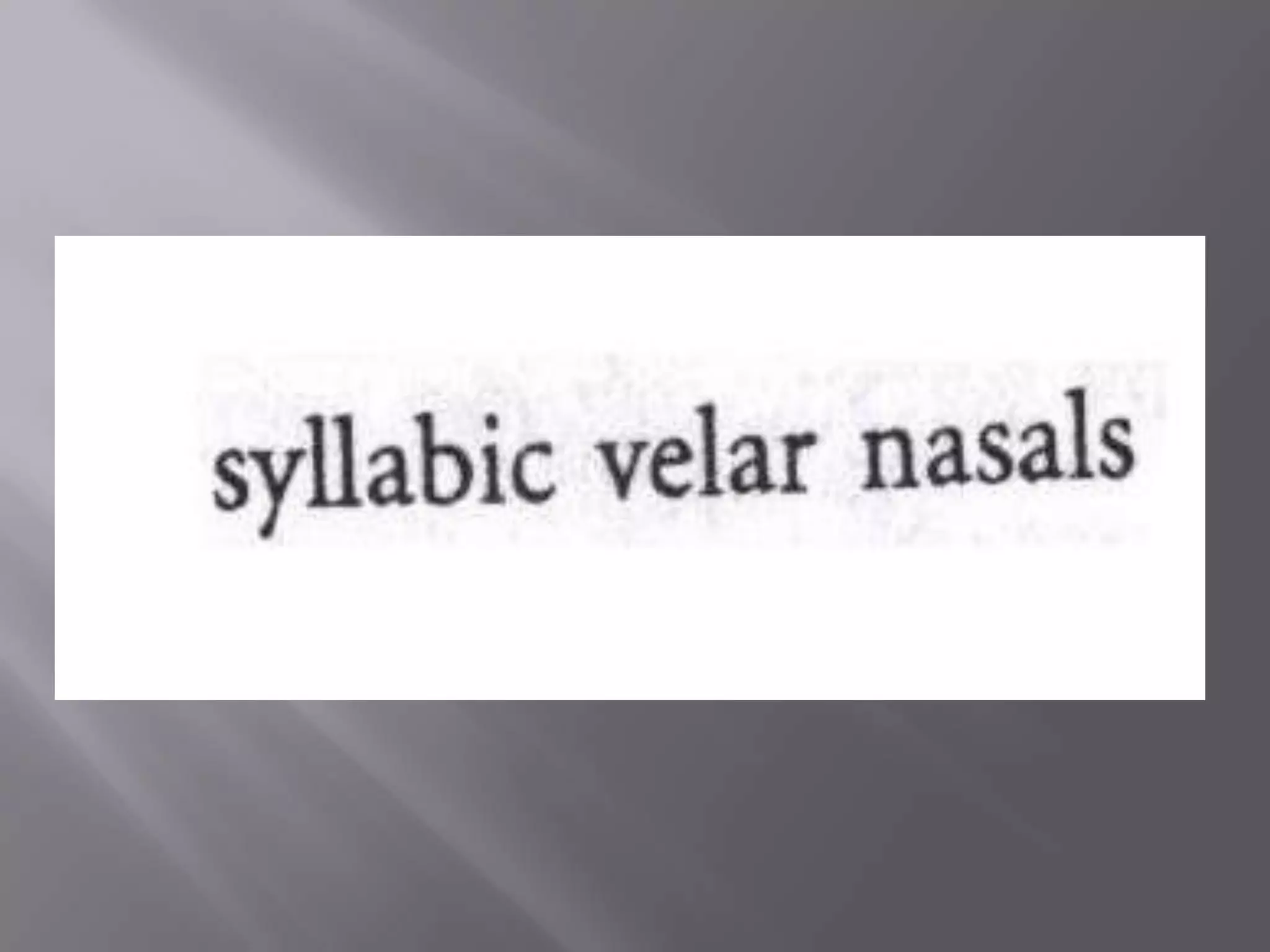
Syllabic l
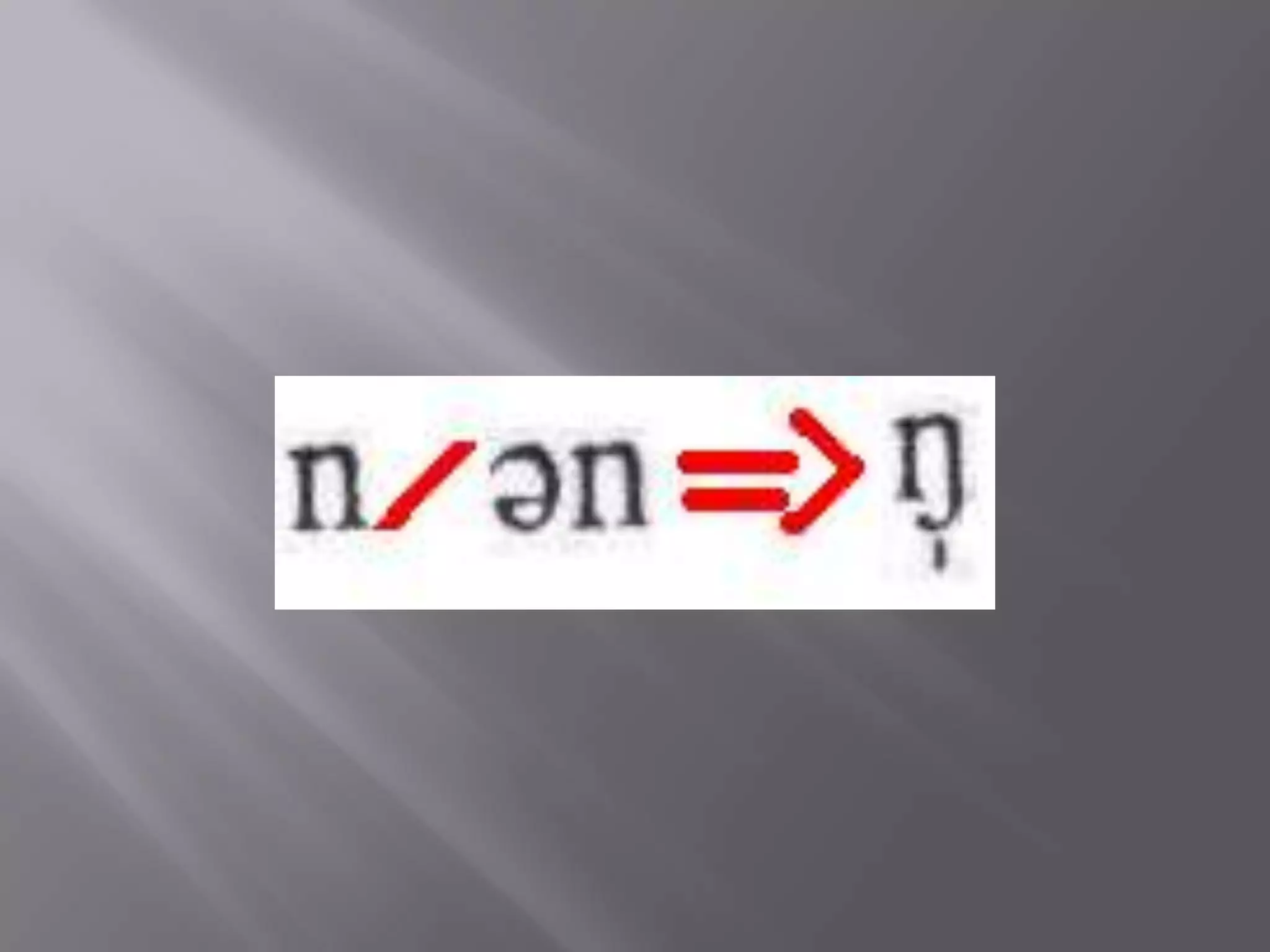
Small vertical
                   l stands as the     mark (,) to
  Syllables in
                     peak of the
   which no                          indicate that a
                  syllable instead
vowel is found.                       consonant is
                    of the vowel.
                                        syllabic.
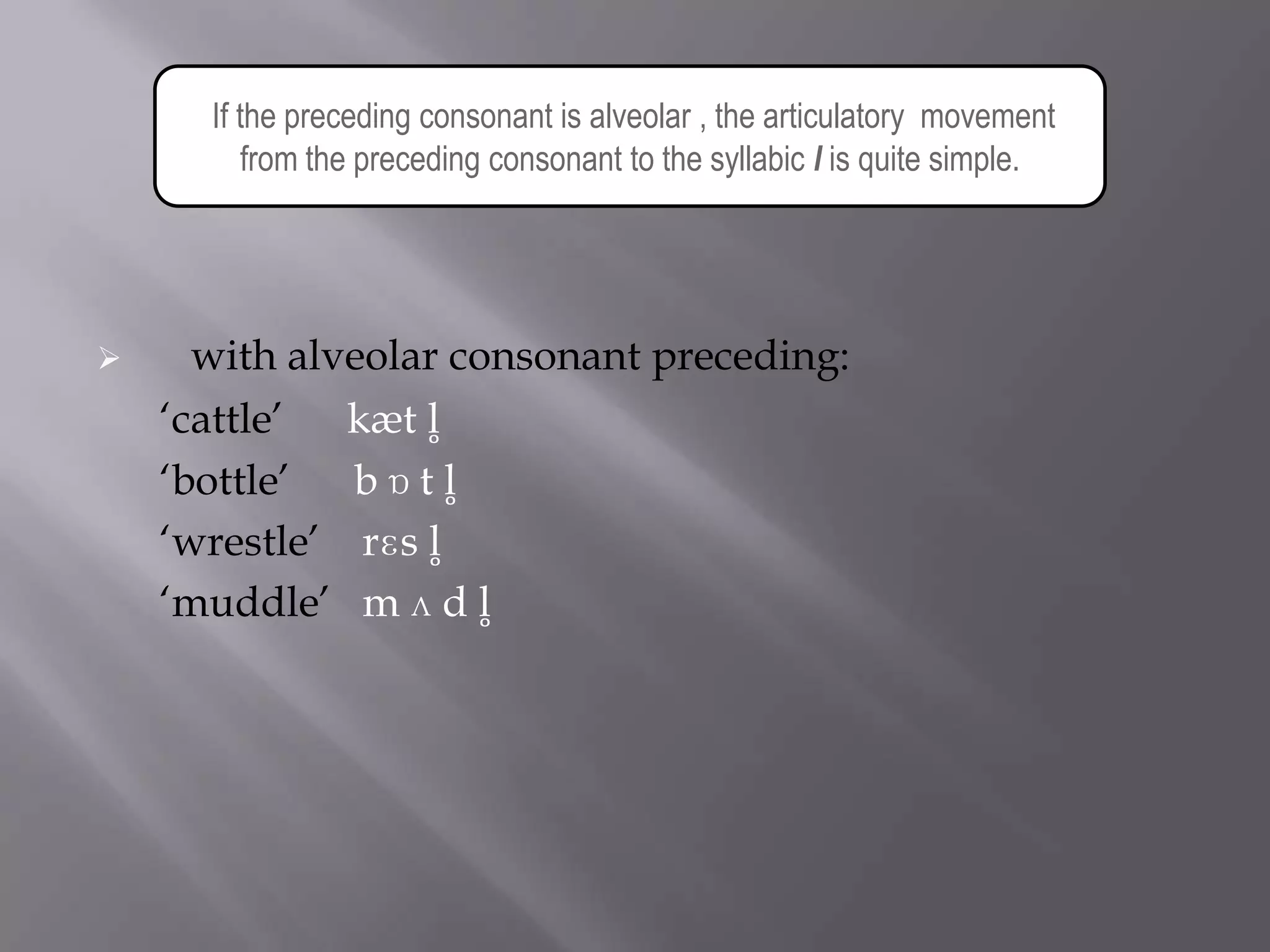
If the preceding consonant is alveolar , the articulatory movement
         from the preceding consonant to the syllabic l is quite simple.


     with alveolar consonant preceding:
    „cattle‟  kæt l̥
    „bottle‟  b ɒ t l̥
    „wrestle‟ rɛs l̥
    „muddle‟ m ʌ d l̥
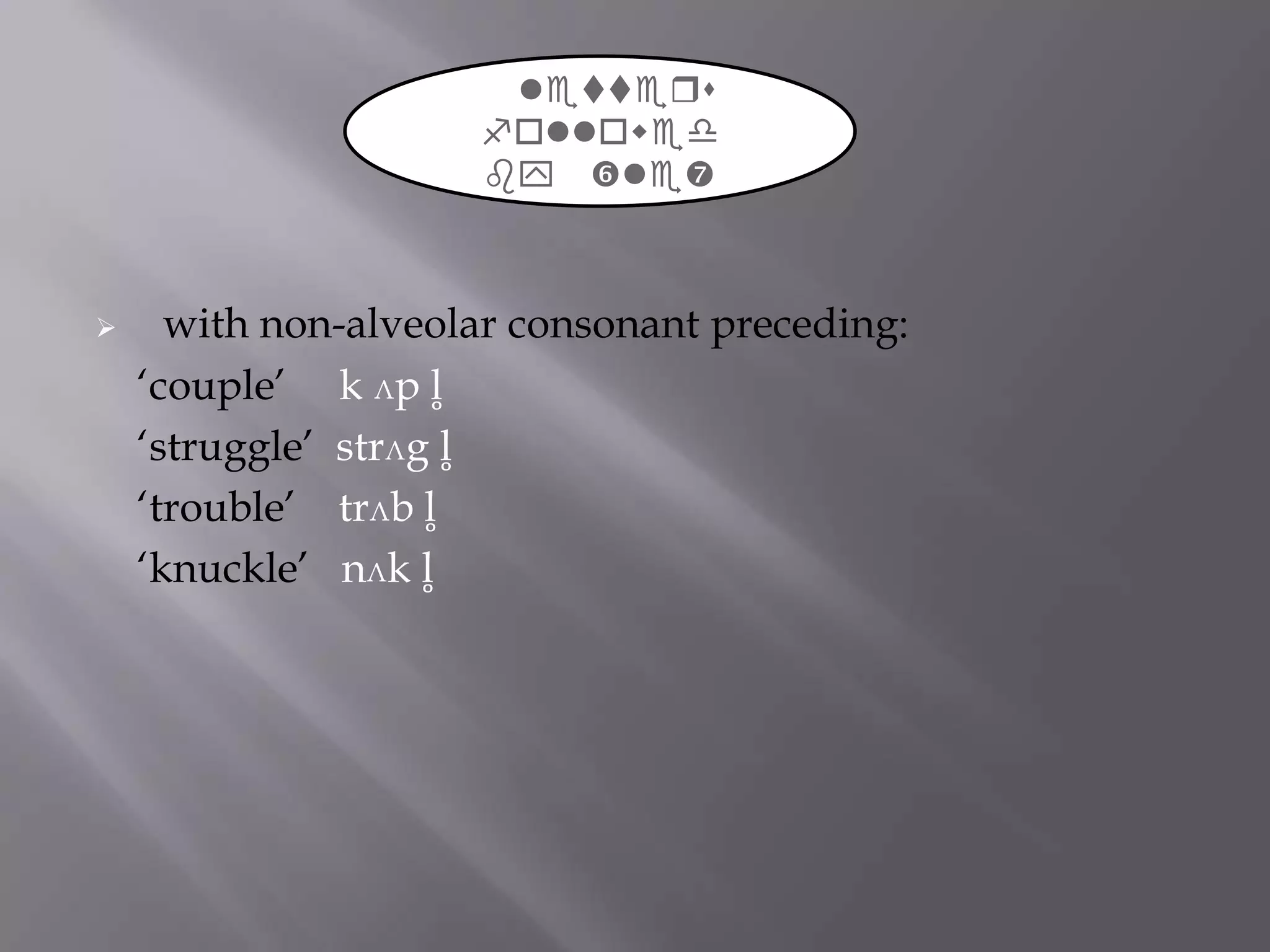
letters
                     followed
                      le


     with non-alveolar consonant preceding:
    „couple‟ k ʌp l̥
    „struggle‟ strʌg l̥
    „trouble‟ trʌb l̥
    „knuckle‟ nʌk l̥
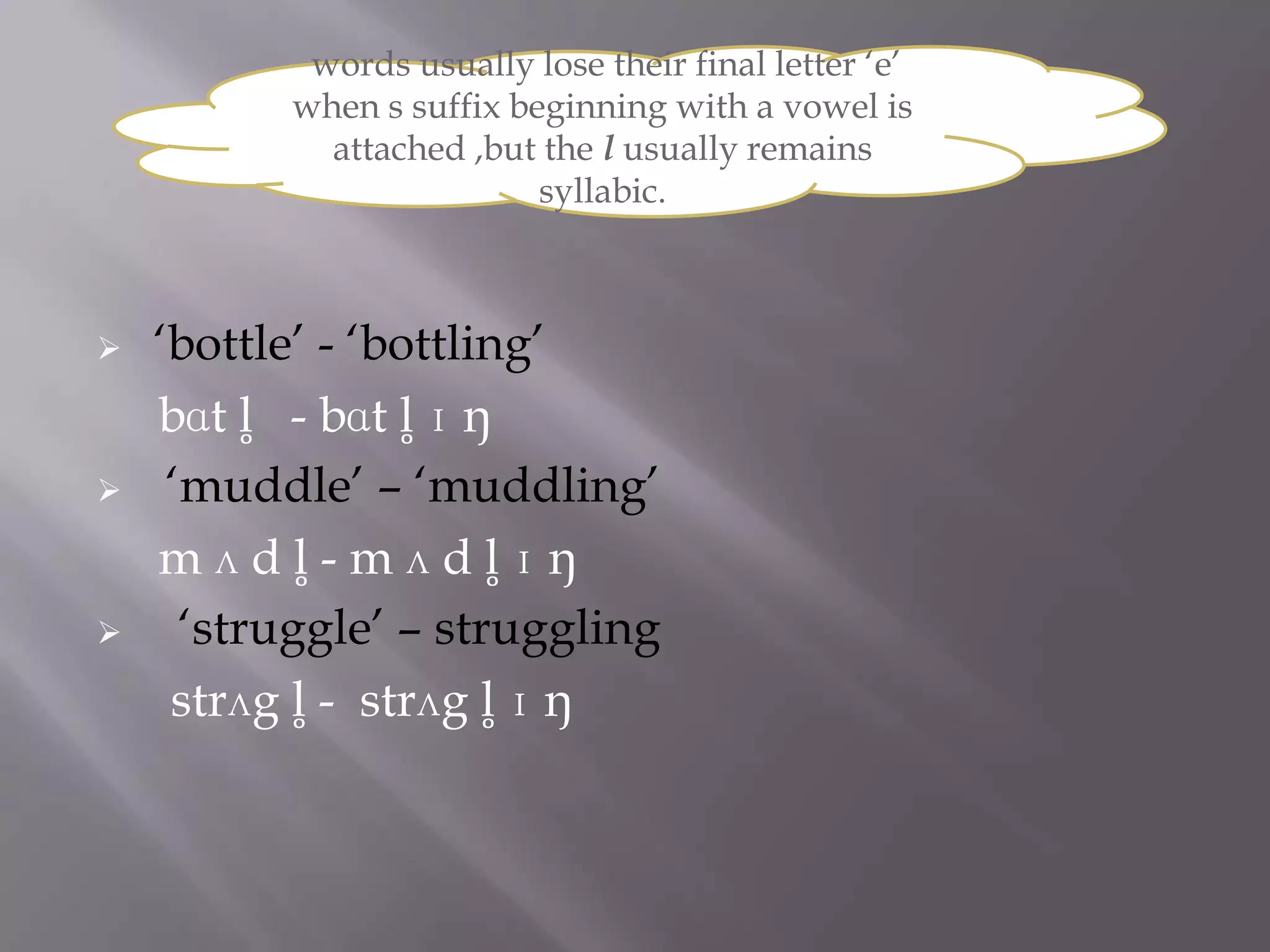
words usually lose their final letter „e‟
          when s suffix beginning with a vowel is
            attached ,but the l usually remains
                          syllabic.


   „bottle‟ - „bottling‟
    bɑt l̥ - bɑt l̥ ɪ ŋ
    „muddle‟ – „muddling‟
    m ʌ d l̥ - m ʌ d l̥ ɪ ŋ
     „struggle‟ – struggling
     strʌg l̥ - strʌg l̥ ɪ ŋ
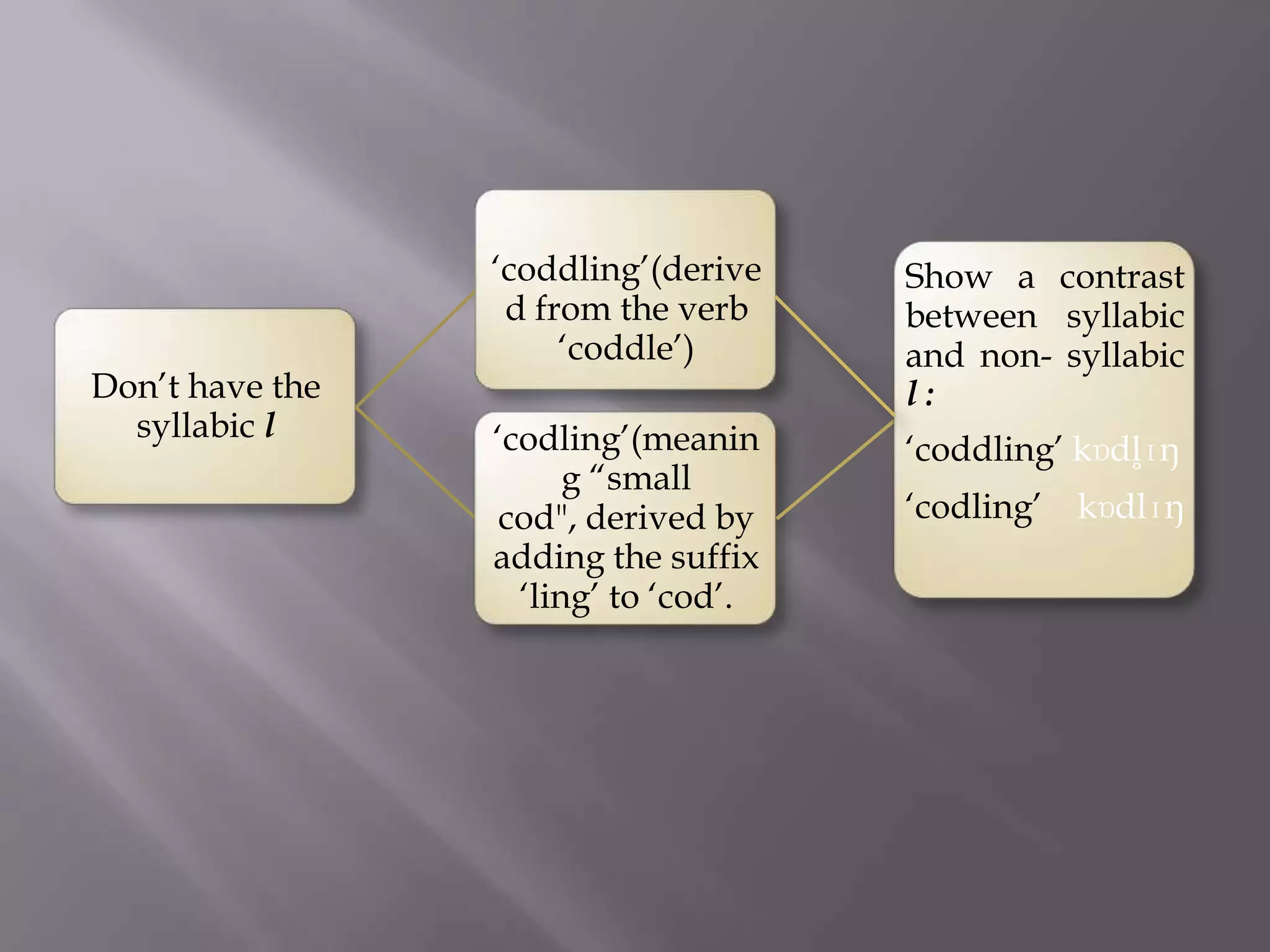
„coddling‟(derive    Show a contrast
                  d from the verb     between syllabic
                      „coddle‟)       and non- syllabic
Don‟t have the                        l:
  syllabic l     „codling‟(meanin     „coddling‟ kɒdl̥ɪŋ
                       g “small
                  cod", derived by    „codling‟ kɒdlɪŋ
                 adding the suffix
                   „ling‟ to „cod‟.
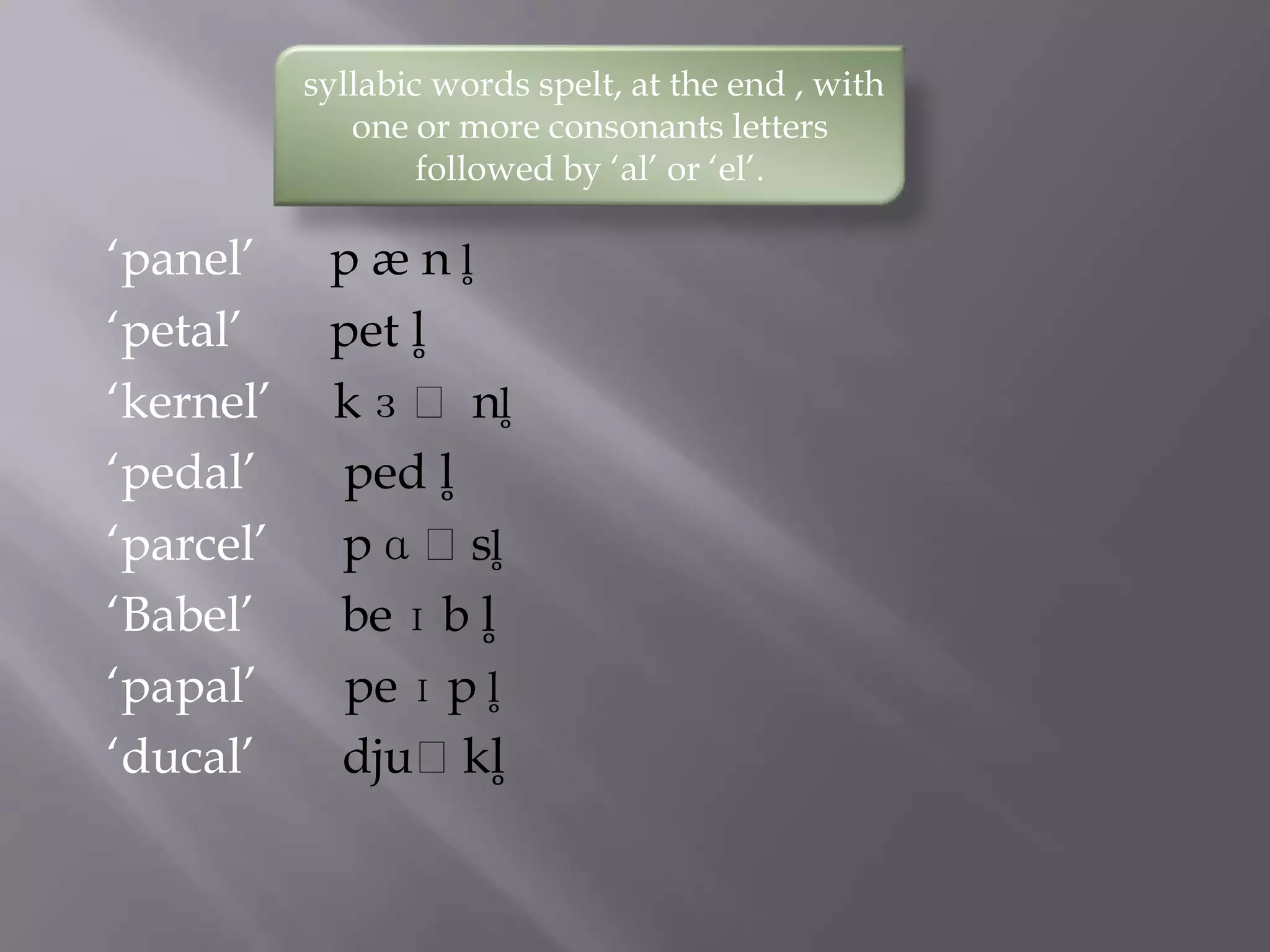
syllabic words spelt, at the end , with
              one or more consonants letters
                   followed by „al‟ or „el‟.

„panel‟     p æ n l̥
„petal‟     pet l̥
„kernel‟    k ɜ ː nl̥
„pedal‟     ped l̥
„parcel‟    p ɑ ːsl̥
„Babel‟     be ɪ b l̥
„papal‟     pe ɪ p l̥
„ducal‟     djuːkl̥
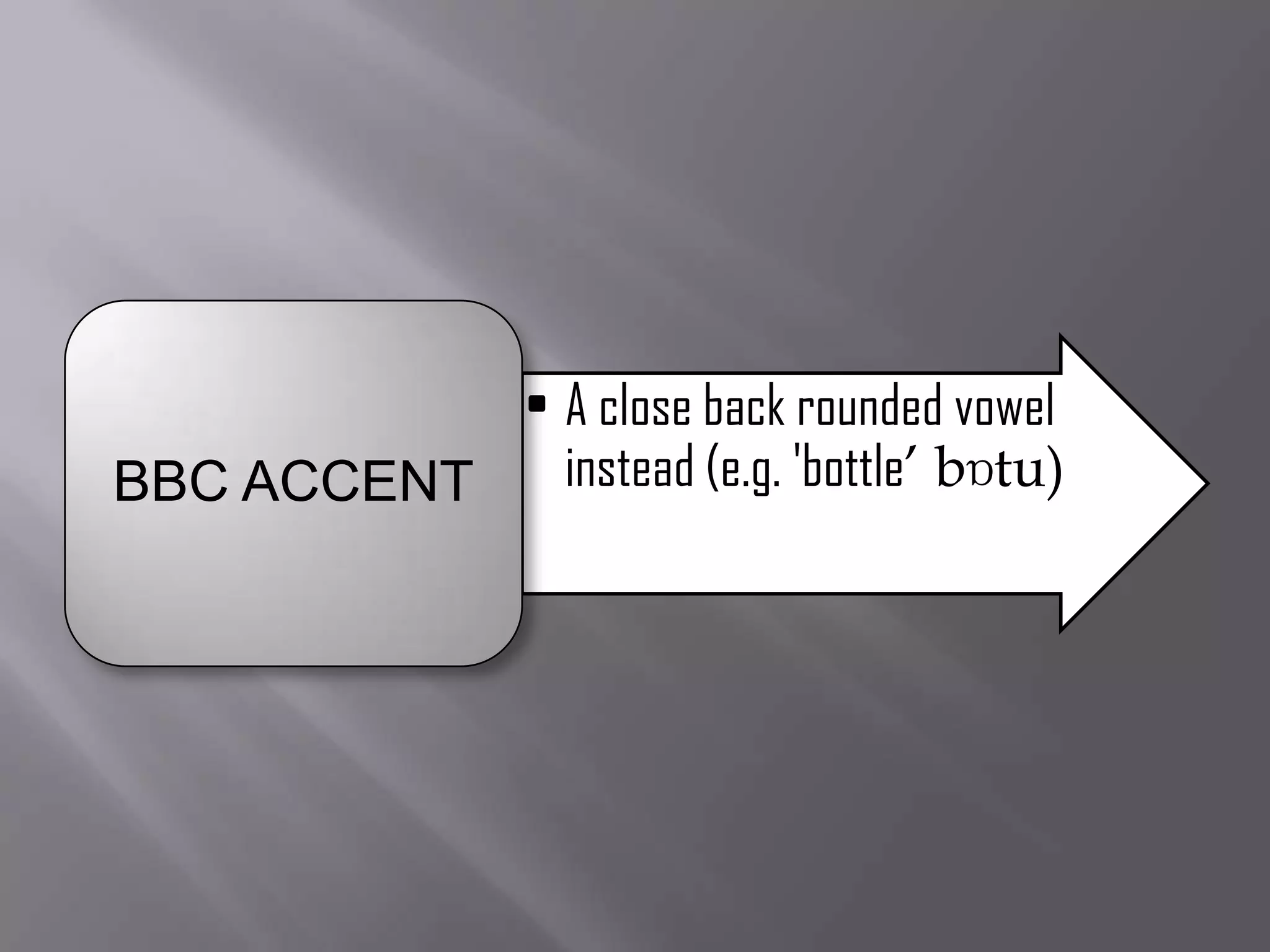
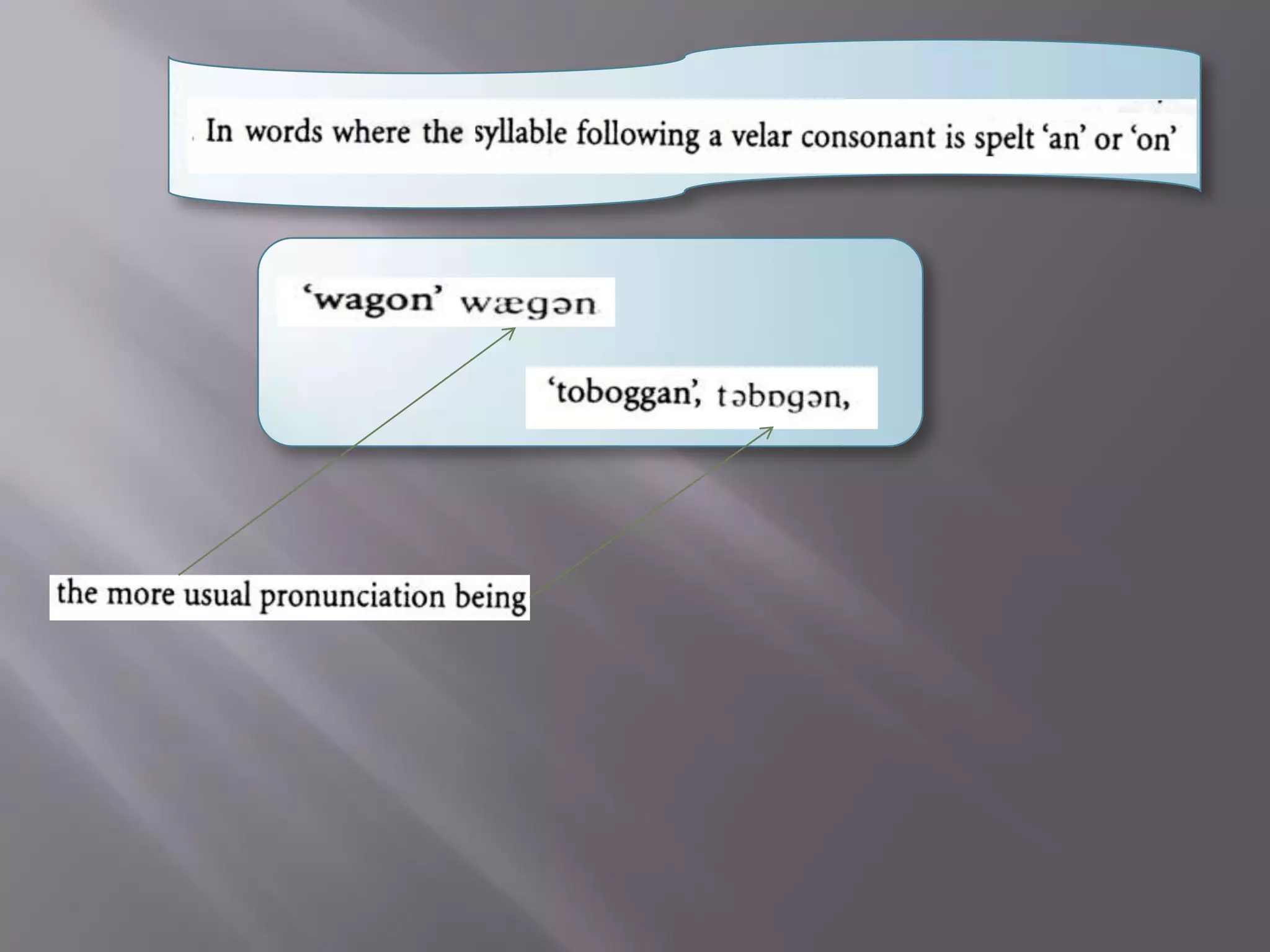
• A close back rounded vowel
BBC ACCENT   instead (e.g. 'bottle‟ bɒtu)
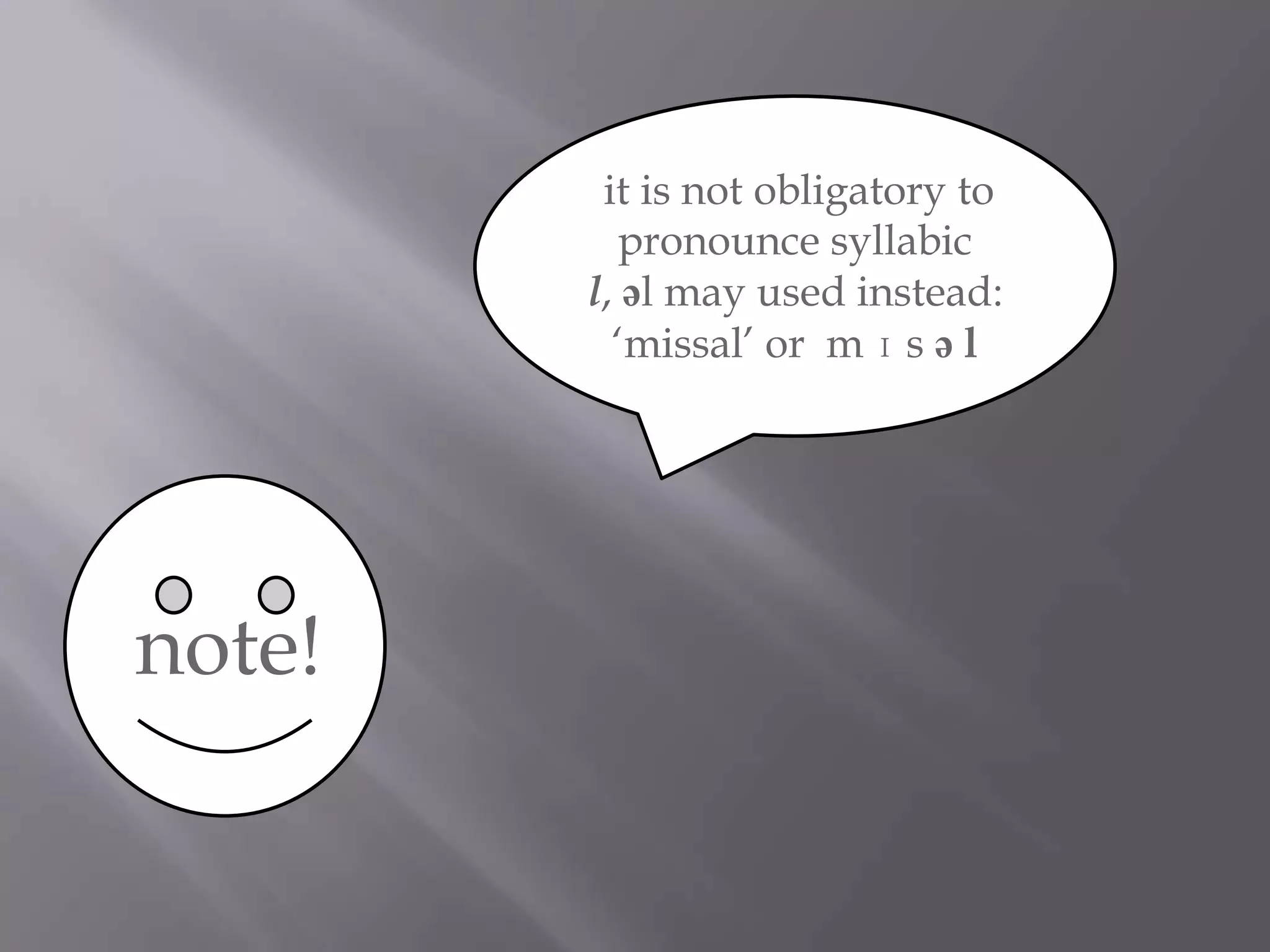
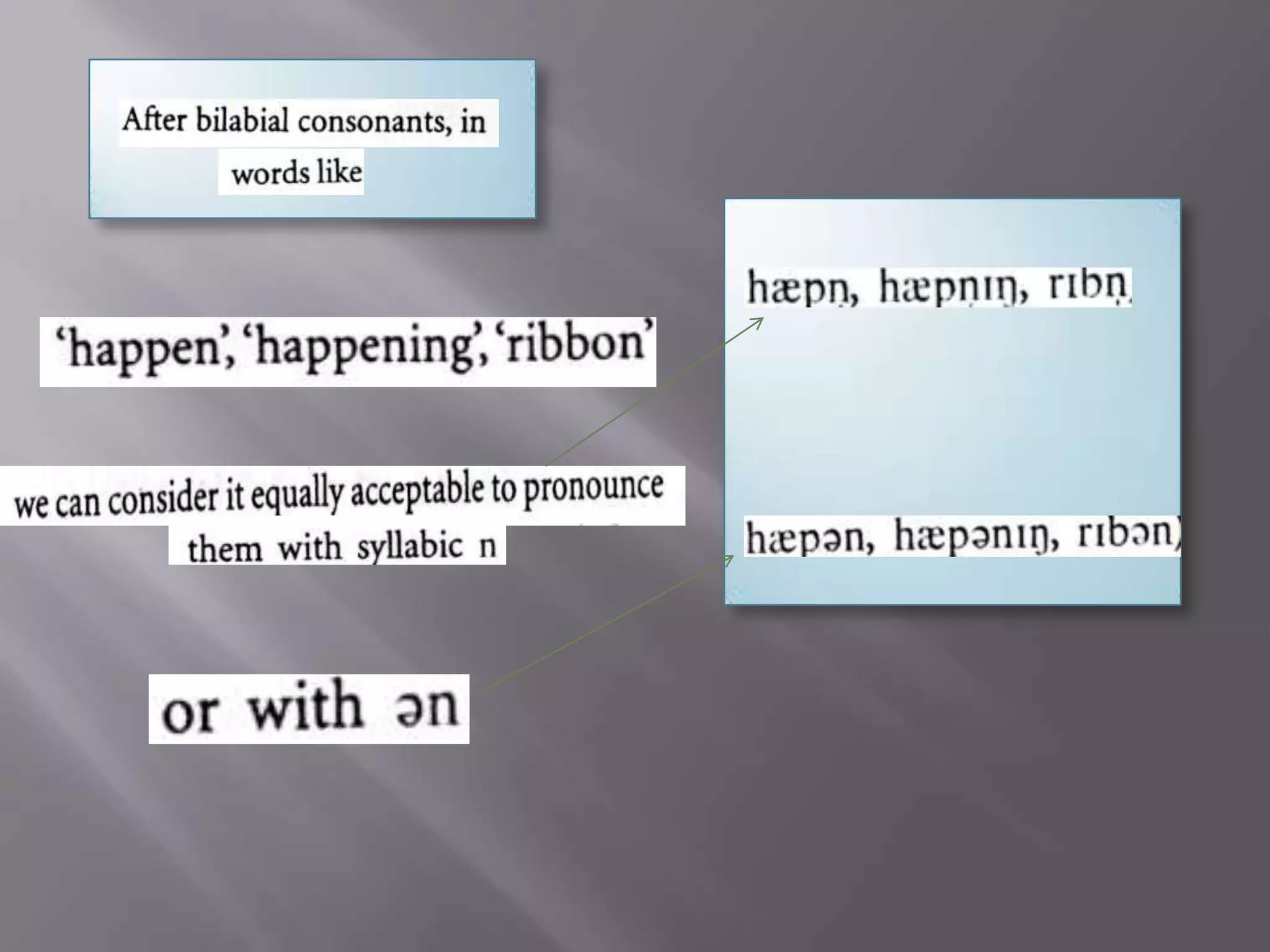
it is not obligatory to
           pronounce syllabic
        l, əl may used instead:
          „missal‟ or m ɪ s ə l


note!
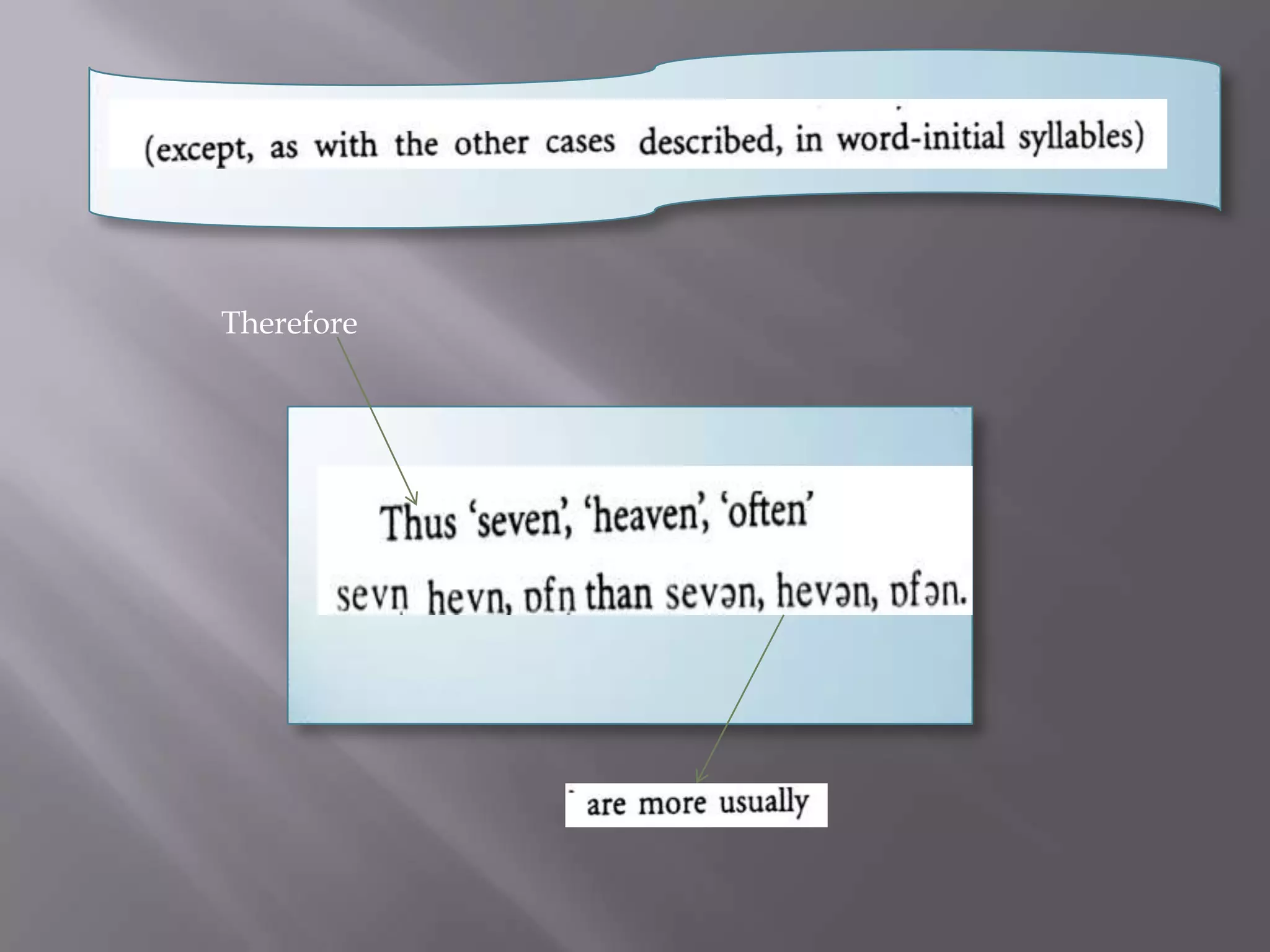
Therefore
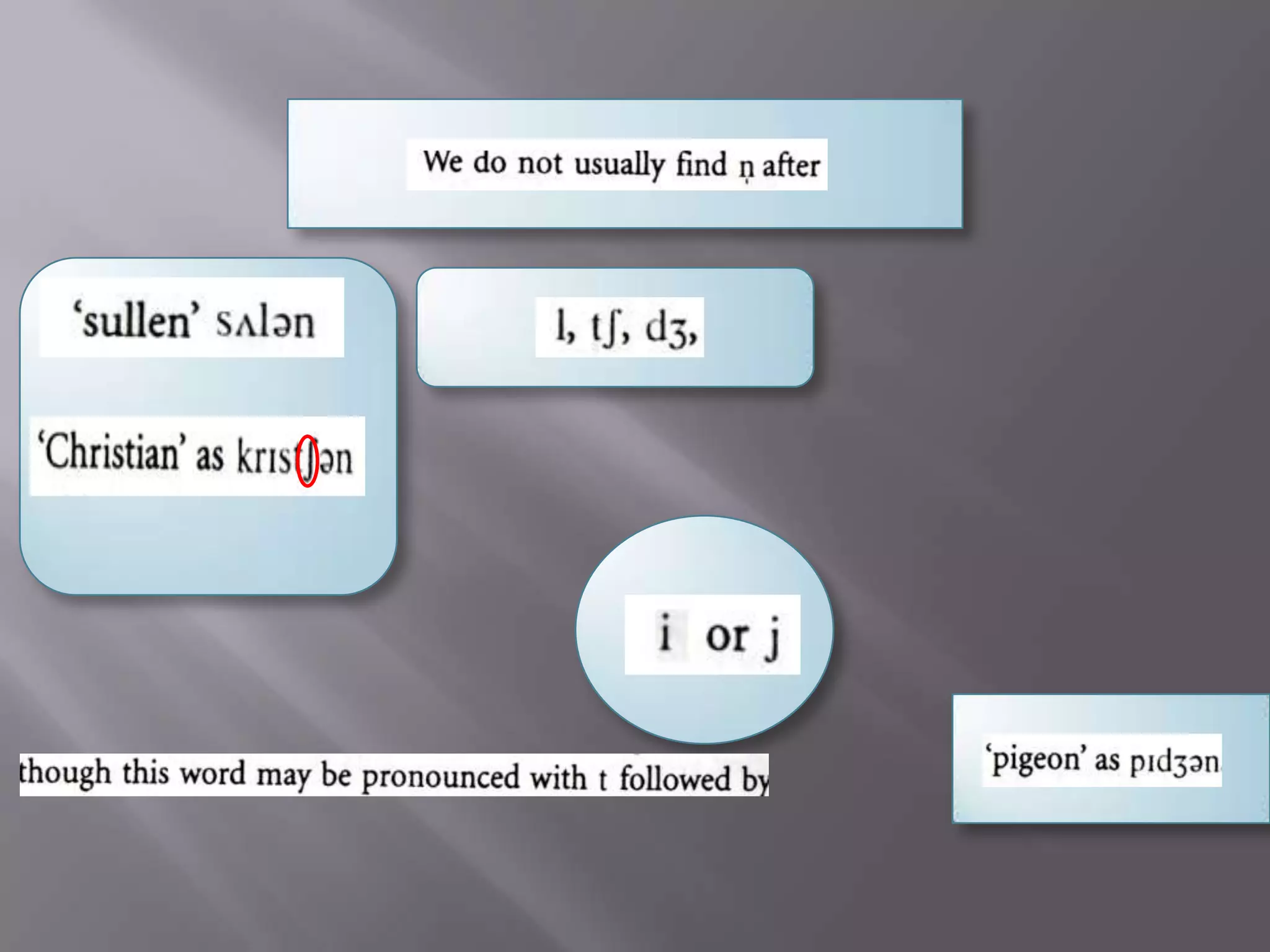
   In many accents of the type called “rhotic”
   In american accents, the syllabic r is very common .
   Examples : the word “particular”
       Americans
       BBC pronunciation
         Future
         Teacher
         Never
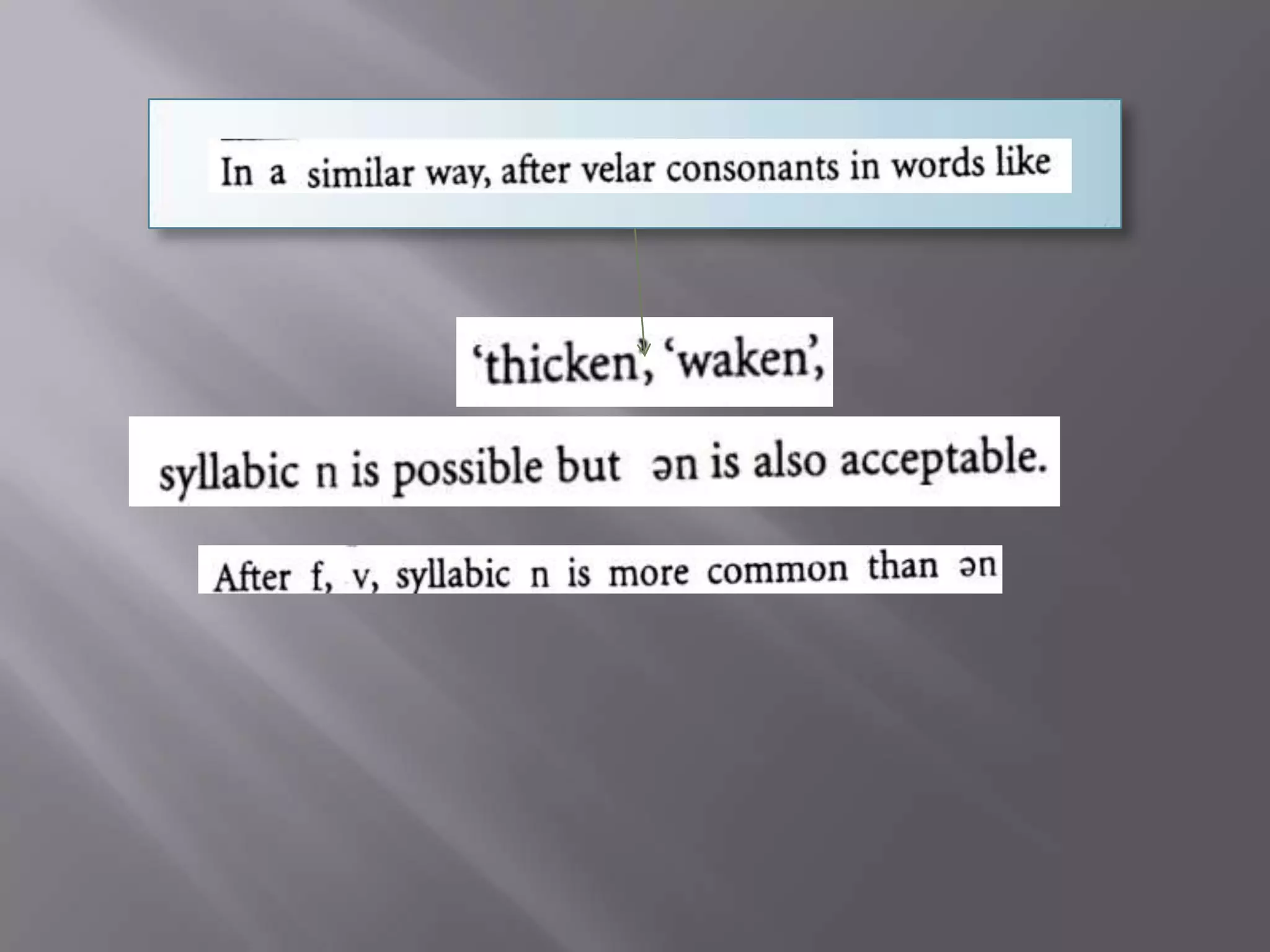
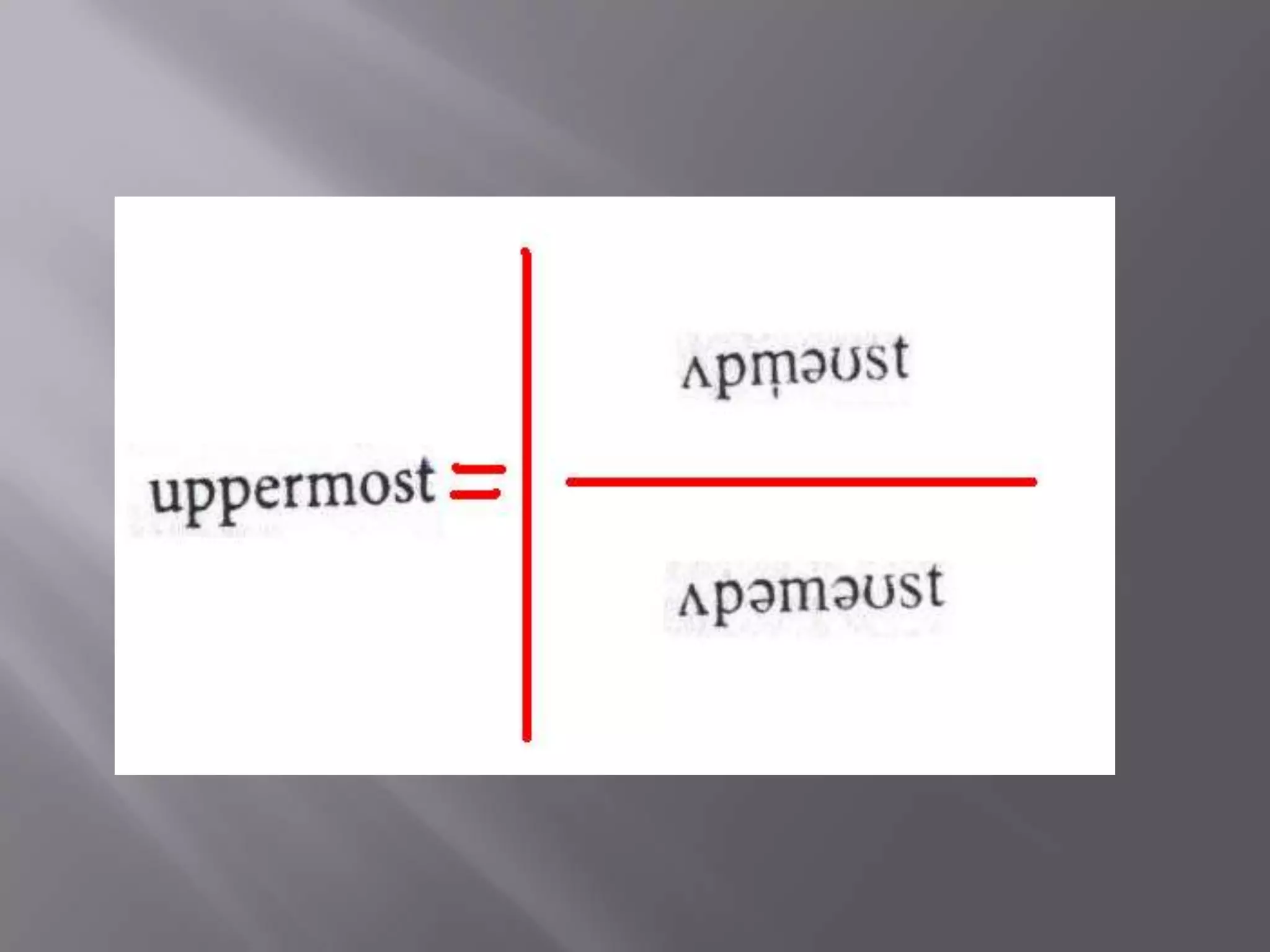
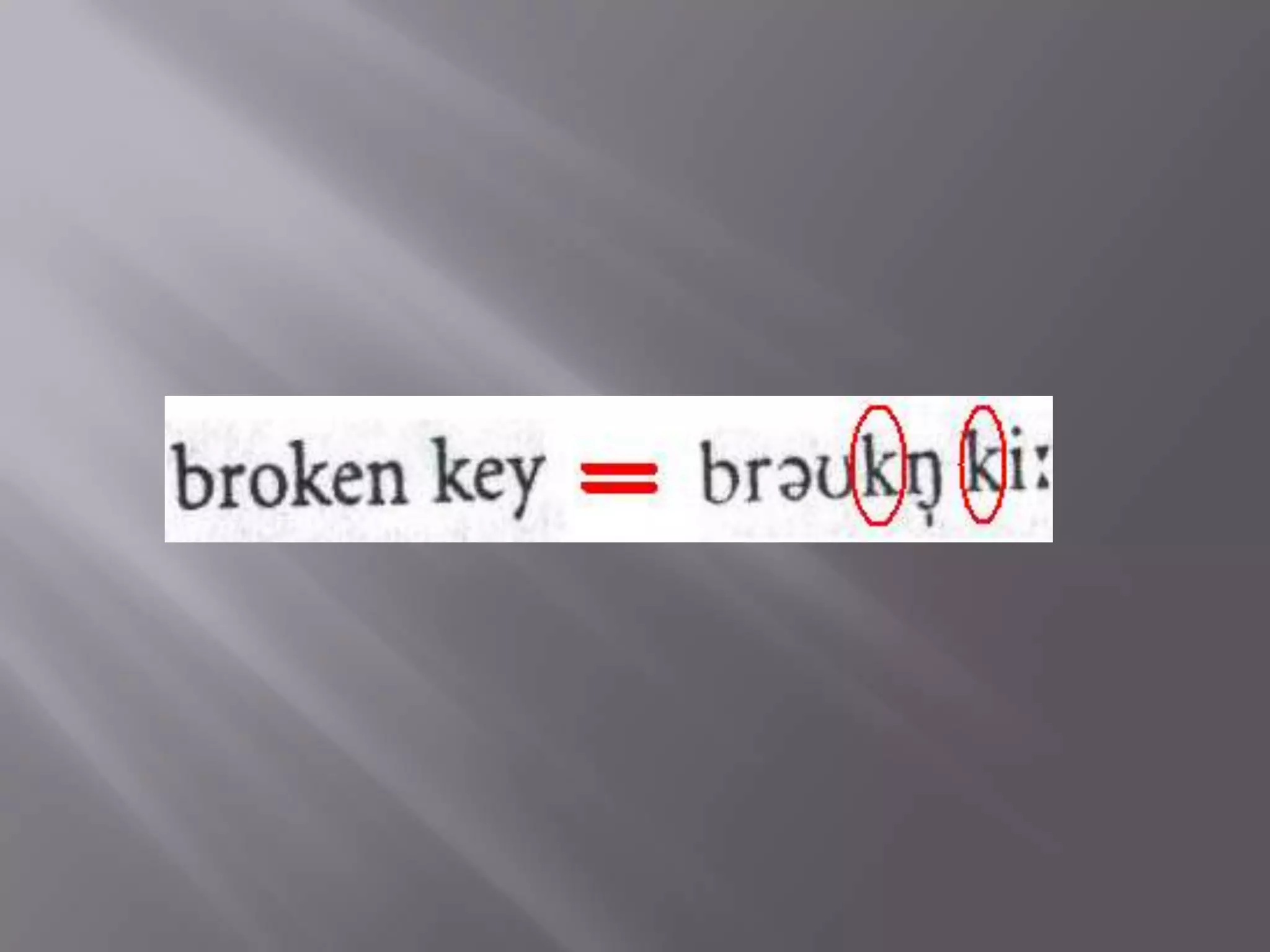
   It isn t unusual to find two syllabic consonants
    together.
       Examples:
         National
         Literal
         Visionary
         Veteran
       In BBC the “schwa” vowel is very very weak.
   This about preliminary notions without a full
    explanation.
   Familiar with the differences between stressed and
    unstressed and nature of the “schwa”
   In the same way with “i” , ”u”
 Logman pronunciation
  dictionary
 The cambrige english
  pronouncing dictionary
Introduction of the “schwa” vowel has been
deliberaty delayed until this chapter, since the
author wanted it to be presented in the context
of weak syllables in general. Since students
sould by now be comporatively well informed
about basic segmental phonetics, it is very
important that their production and recognition
of this vowel should be good before moving on
to the following chapters.
This chapter is in a sense a crucial point in the
 course. Although the segmental material of the
preceding chapters is important as a foundation, the
   strog/weak syllable distinction and the overall
prosodic characteristics of words and sentences are
essential to intelligibility. Most of the remaining
  chapterss of the course are corcened with such
                       matters.
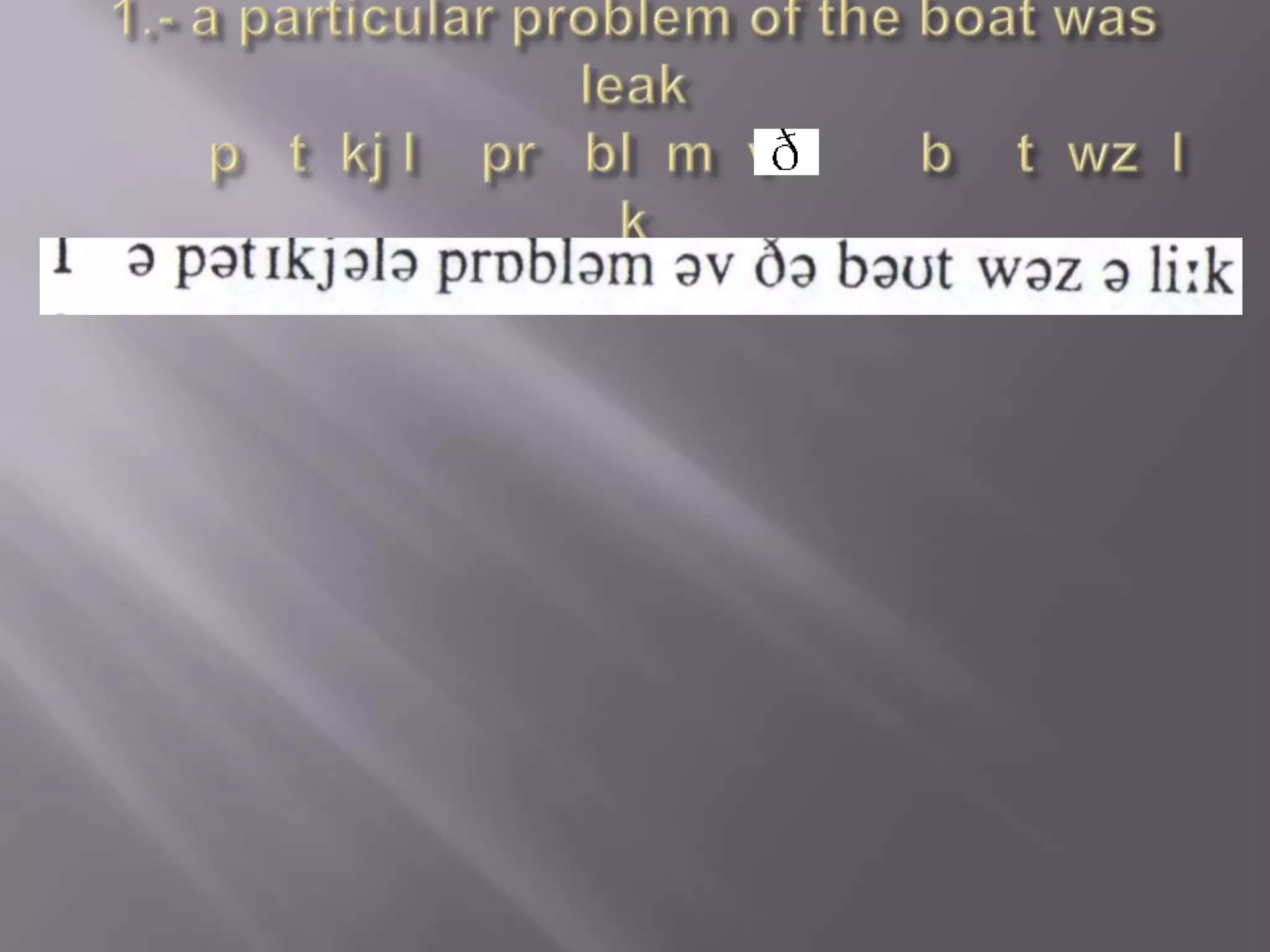
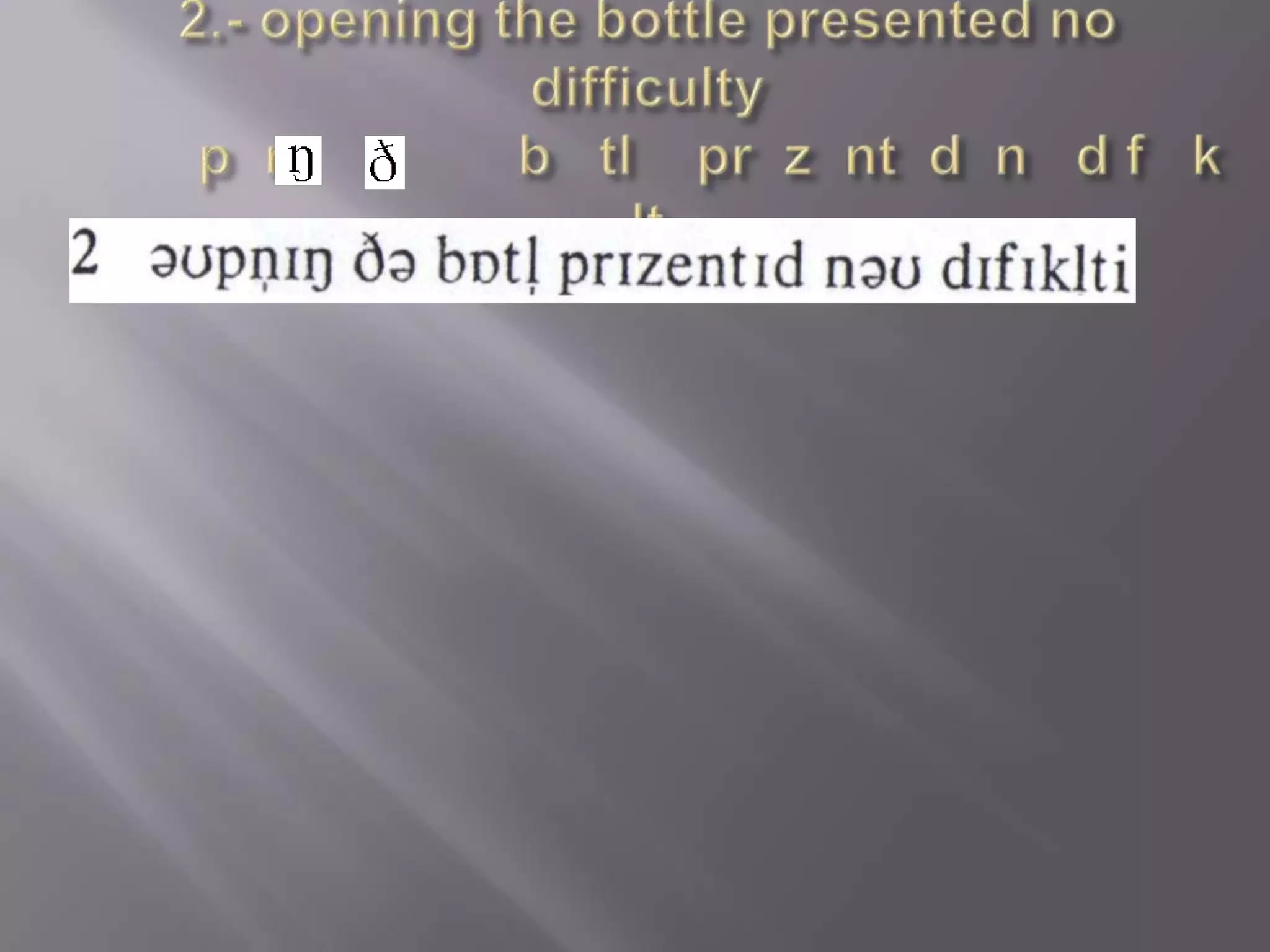
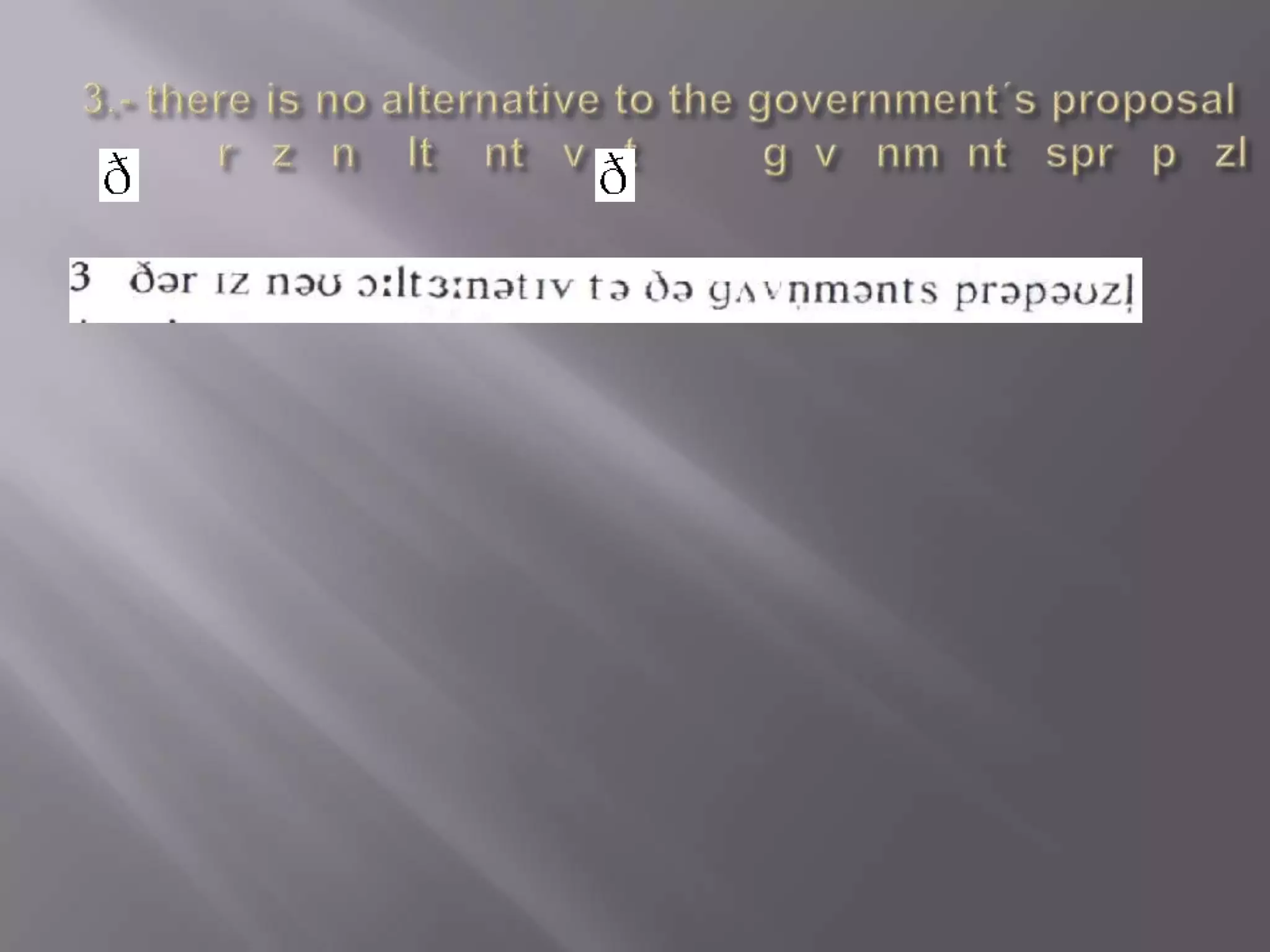
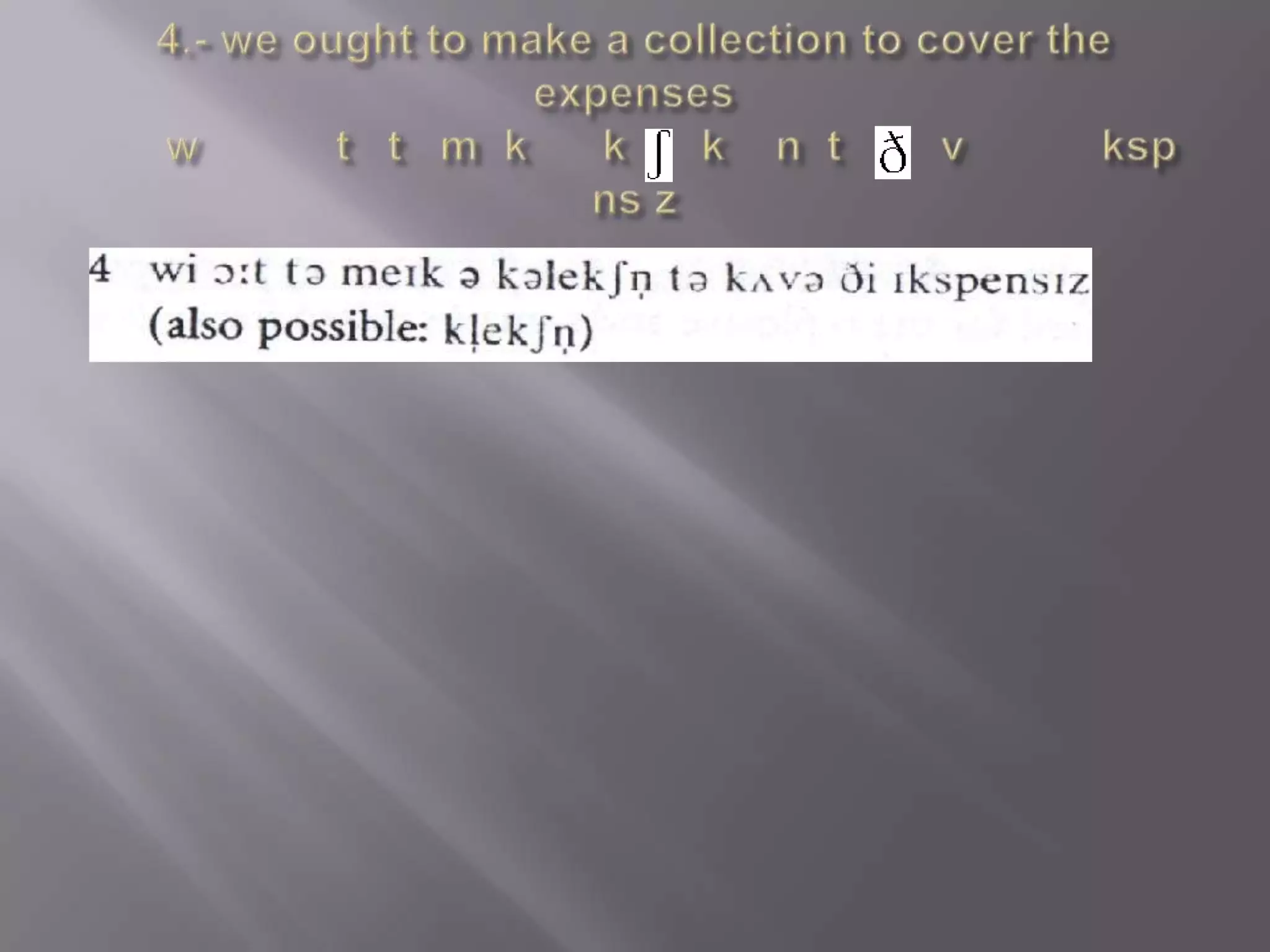
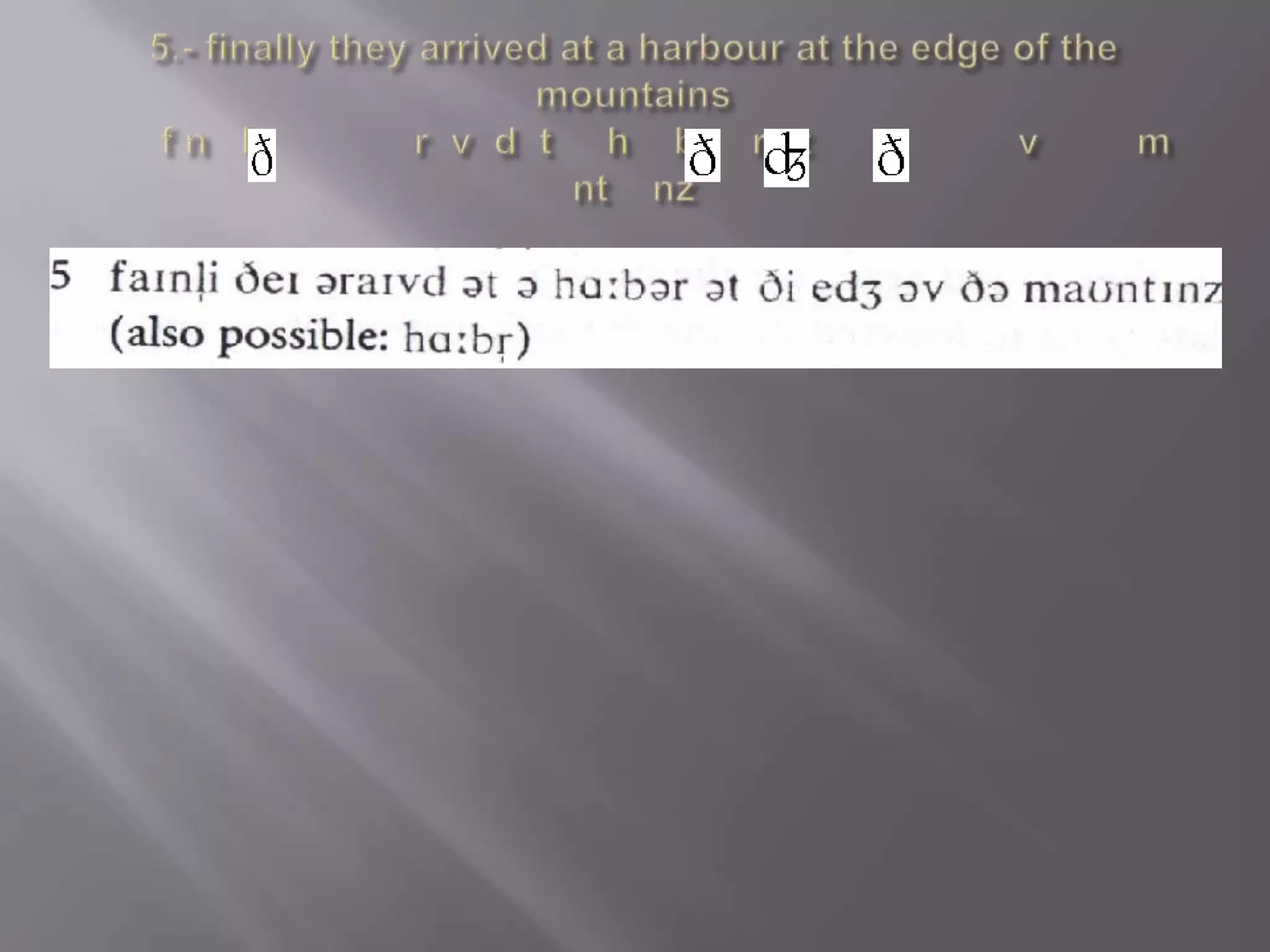
The following sentences have been partially trancribed, but
the vowels have been left blanj. Fill in the vowels, takig care
 to identify wich vowels are weak; put no vowel at all if you
  think a syllabic consonant is appropiate, but put a syllabic
             mark beneath the syllabic consonant.
Strong and weak syllables

Strong and weak syllables

  • 2.
    •Strong English syllables Pronunciation •Weak syllables
  • 3.
    baiSER gaLLEta GUAgua This is also true of many other languages
  • 4.
    It is necessary How these weak sylables are pronounced Where they occur in English
  • 5.
    Which is very important in Stress deciding wheter a syllable is strong or weak
  • 6.
  • 7.
    We find the vowel in a weak “data” syllable tends to be shorter, of /deΙtƏ/ Syllable lower intensity Consonant The weak syllable contains “bottle” /bɒtl/ no vowel at all
  • 8.
    Stress Strong syllables are stressed Weak syllables are unstressed
  • 9.
    The vowel Ə (“schwa”) Aclose front unrounded vowel in the general area of i:, I, symbolised i A close back rounded vowel inthe general area of u:, Ʊ, symbolised u
  • 10.
     happy /betƏ/  Better /hæpi/  thank you /Ɵæɳk ju/
  • 11.
     Open /ƏƱpƏn/  Sharpen /ʃɒ:pƏn/
  • 12.
     “photograph” /fƏƱtƏgrɒ:f/  “radio” /reIdiƏƱ/  “influence” /InfluƏns/
  • 13.
  • 15.
  • 16.
  • 17.
    The most frequently occurring vowel in English It is generally Is always described as associated lax-that is, not whit weak articulated syllables with much energy
  • 18.
    Examples - halfway - between - close - open Note.- Not all weak syllables contain ə, though many do.
  • 19.
    Learners of Englishneed to learn where ə is appropriate and where it is not We have to use information that We must consider traditional phonemic spelling theory.
  • 20.
     Spelt with“ a”; strong pronunciation would have æ
  • 21.
    “ attend” /ətend/ “barracks” /bærəks/ “ character” /kærətə/
  • 22.
    Spelt with «ar»;strong pronunciation would have ɑ:
  • 23.
    “pɑrticular” /pətɪkjələ / “monɑrchy”/mɒnəki / “molɑr” /məʊlə /
  • 24.
    Adjectives endings spelt “ ate”; strong pronunciation would have eɪ
  • 25.
    “ intimɑte” /ɪntɪmət/ “accurɑte” /ækjərət/ “desolɑte” /desələt/ (although there are exceptions to this: “private” is usually /praɪvɪt/)
  • 26.
    Spelt with “o”;strong pronunciation would have ɒ or əʊ
  • 27.
  • 28.
    Spelt with “or”; strong pronunciation would have ɔ:
  • 29.
  • 31.
    “settlement” /setəlmənt / “violet” /vaɪələt/ “postment” /pəʊstmən/
  • 32.
    Spelt with “er”, strong pronunciation would have ɜ:
  • 33.
     “perhaps” /pəhæps/  “stronger” /strɒŋgə/  “superman” /su:pəmæn/
  • 34.
     Spelt with “u”; strong pronunciation would have ʌ
  • 35.
     “autumn” /ɔ:təm/ “support” / səpɔ:t/  “halibut” /hælɪbət/
  • 36.
     Spelt with“ough” ( there are many pronunciations for the letter- sequence “ough”)
  • 37.
     “thorough” /θʌrə/  “borough” /bʌrə/
  • 38.
     Spelt with “ou”; strong pronunciation might have ɑʊ
  • 39.
     “gracious” /greɪʃəs/ “ callous” /kæləs/
  • 43.
    One close front Weaksyllables: They are equal Other close back rounded
  • 44.
    Strong syllables: Easy to distinguish FOR FOR
  • 45.
    Example: “beat” [bi:t] We can distinguis “bit” [bIt] h sounds
  • 46.
    “easy” [i:zI] We can´t distinguis “busy” [bIzi:] h sounds
  • 47.
    Vowels in Questions: Theysound like [i:] and [u:] when they precede another vowel.
  • 48.
    For BBC pronunciation: Within strong syllables sound [i:] is NEUTRALIZED in weak syllables.
  • 49.
    Possibilities, using our symbols: “easy” “busy” [i:zi: [bIzi:] ] [i:zI] [bIzI]
  • 50.
    We find ioccuring:
  • 51.
    Words in thefinal position “y” or “ey” after one or more consont letter. <happy> [hᴂpi ] <valley> [vᴂli ]
  • 52.
    In morpheme-final position when such words have suffixes beginning with vowels. <happier> [hᴂpi ] ə <easier> [i:ziə]
  • 53.
    In the prefixsuch as those spelt „re‟, „pre‟, „de‟; if it precedes a vowel and is untressed. <react> [riᴂkt ] <create> [krieit] <deodorant> [diə dərənt]
  • 54.
    In the suffixes:„iate‟, „ious‟, when they have two syllables <appreciate> [əpri:ʃieI t] <hilarious> [hileəriəs]
  • 55.
    In the followingwords when unstressed: „he‟, „she‟, „we‟, „me‟, „be‟ and the word „the‟ when it precedes a vowel.
  • 56.
    With [i] thesound is short close front unrounded vowel. <enough> [Inᴧf]
  • 57.
    In weak syllableswe found [u:]. „you‟, „to‟, „into‟, „do‟ When they are untressed are not immediatly preciding a consonant, „through‟ [θru:]
  • 58.
    This vowel isalso found before another vowel withing a word. <evacuation>[ivᴂkjueiʃṇ] <influenza> [influenzə]
  • 59.
  • 60.
    Small vertical l stands as the mark (,) to Syllables in peak of the which no indicate that a syllable instead vowel is found. consonant is of the vowel. syllabic.
  • 61.
    If the precedingconsonant is alveolar , the articulatory movement from the preceding consonant to the syllabic l is quite simple.  with alveolar consonant preceding: „cattle‟ kæt l̥ „bottle‟ b ɒ t l̥ „wrestle‟ rɛs l̥ „muddle‟ m ʌ d l̥
  • 62.
    letters followed  le  with non-alveolar consonant preceding: „couple‟ k ʌp l̥ „struggle‟ strʌg l̥ „trouble‟ trʌb l̥ „knuckle‟ nʌk l̥
  • 63.
    words usually losetheir final letter „e‟ when s suffix beginning with a vowel is attached ,but the l usually remains syllabic.  „bottle‟ - „bottling‟ bɑt l̥ - bɑt l̥ ɪ ŋ  „muddle‟ – „muddling‟ m ʌ d l̥ - m ʌ d l̥ ɪ ŋ  „struggle‟ – struggling strʌg l̥ - strʌg l̥ ɪ ŋ
  • 64.
    „coddling‟(derive Show a contrast d from the verb between syllabic „coddle‟) and non- syllabic Don‟t have the l: syllabic l „codling‟(meanin „coddling‟ kɒdl̥ɪŋ g “small cod", derived by „codling‟ kɒdlɪŋ adding the suffix „ling‟ to „cod‟.
  • 65.
    syllabic words spelt,at the end , with one or more consonants letters followed by „al‟ or „el‟. „panel‟ p æ n l̥ „petal‟ pet l̥ „kernel‟ k ɜ ː nl̥ „pedal‟ ped l̥ „parcel‟ p ɑ ːsl̥ „Babel‟ be ɪ b l̥ „papal‟ pe ɪ p l̥ „ducal‟ djuːkl̥
  • 66.
    • A closeback rounded vowel BBC ACCENT instead (e.g. 'bottle‟ bɒtu)
  • 67.
    it is notobligatory to pronounce syllabic l, əl may used instead: „missal‟ or m ɪ s ə l note!
  • 80.
  • 92.
    In many accents of the type called “rhotic”  In american accents, the syllabic r is very common .  Examples : the word “particular”  Americans  BBC pronunciation  Future  Teacher  Never
  • 93.
    It isn t unusual to find two syllabic consonants together.  Examples:  National  Literal  Visionary  Veteran  In BBC the “schwa” vowel is very very weak.
  • 94.
    This about preliminary notions without a full explanation.  Familiar with the differences between stressed and unstressed and nature of the “schwa”  In the same way with “i” , ”u”  Logman pronunciation dictionary  The cambrige english pronouncing dictionary
  • 96.
    Introduction of the“schwa” vowel has been deliberaty delayed until this chapter, since the author wanted it to be presented in the context of weak syllables in general. Since students sould by now be comporatively well informed about basic segmental phonetics, it is very important that their production and recognition of this vowel should be good before moving on to the following chapters.
  • 97.
    This chapter isin a sense a crucial point in the course. Although the segmental material of the preceding chapters is important as a foundation, the strog/weak syllable distinction and the overall prosodic characteristics of words and sentences are essential to intelligibility. Most of the remaining chapterss of the course are corcened with such matters.
  • 98.
    The following sentenceshave been partially trancribed, but the vowels have been left blanj. Fill in the vowels, takig care to identify wich vowels are weak; put no vowel at all if you think a syllabic consonant is appropiate, but put a syllabic mark beneath the syllabic consonant.