First it is necessary for us to have a closer look at the way 
in which vowels differ from consonants. 
Then we need to analyze vowels phonetically, it means 
according to: 
- Tongue position: how high in the mouth is the tongue, 
and which part of the tongue is the highest? 
- Length: are the vowels long or short? 
- Rounding: are the lips rounded or not? 
- Nasality: is there free passage of air through the nose? 
(although in English there aren’t any nasal vowels).
Difference from Consonants 
Even though all the languages of the world contain both vowels and 
consonants, and although almost everybody has some idea of 
whether a given sound is a vowel or a consonant in his language, 
there is actually more than one way to distinguish between the two 
classes of sounds. From a phonetic point of view one way of 
distinguishing is by considering which sounds have the highest 
degree of obstruction. Although vowels have almost no obstruction, 
and some consonants (obstruents, nasals, and the lateral) have a 
high degree of obstruction, there is a group of consonants (the 
approximants) which would be classified as vowels if this criterion 
was used: approximants have no more obstruction than vowels. 
This can be seen by comparing the approximant /j/ in yeast /ji:st/ 
with the vowel /i:/ in east /i:st/.
From a phonological point of view, it is possible to 
distinguish between vowels and consonants by testing 
which sounds may be the nucleus of a syllable, i.e. the part 
of a syllable that cannot be left out. If you consider a 
syllable such as /kart/ cart, the initial /k/ may be left 
out and we still have a syllable, /art] art, the final /t/ may be 
left out and we still have a syllable , /kar/ car. In fact /k/ and 
/t/ may both be left out, and the remainder is still a syllable, 
/ar/ are. If however you try to leave out the vowel, then 
there is no syllable anymore:* /kt/. [a:] is then the sound 
that cannot be left out. Compare with yeast whereas 
/j/ can be left out, giving /i:st/, /i:/ can’t:* /jst/. Syllabicity 
seems to be the criterion to determine whether a sound is a 
vowel or a consonant.
The above discussion would not be complete if we 
didn't mention the problem of so called syllabic 
consonants. This is the case when sounds like 
/r/,/l/,/n/ may function as a separate syllable consisting 
of an only sound, as in /kɒtn/ cotton or /æpl/ apple, 
where English speakers clearly hear two separate 
syllables. 
In these words, the /n/ and /l/ seem to function as the 
nucleus of the second syllable of these words. 
However they cannot be classified as vowels, as they 
can never occur alone as a word.
Tongue Position 
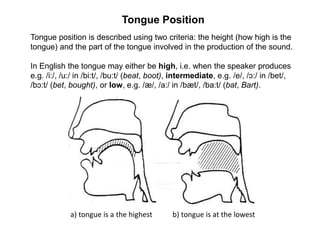
Tongue position is described using two criteria: the height (how high is the 
tongue) and the part of the tongue involved in the production of the sound. 
In English the tongue may either be high, i.e. when the speaker produces 
e.g. /i:/, /u:/ in /bi:t/, /bu:t/ (beat, boot), intermediate, e.g. /e/, /ɔ:/ in /bet/, 
/bɔ:t/ (bet, bought), or low, e.g. /æ/, /a:/ in /bæt/, /ba:t/ (bat, Bart). 
a) tongue is a the highest b) tongue is at the lowest
Depending on the language we can have several 
intermediate tongue heights. English has three heights: 
high, mid and low, whereas French has two intermediate 
tongue heights with a total of four tongue heights: high, mid 
high, mid low and low. 
The part of the tongue involved in the production of a vowel 
can also be illustrated with the examples above. If you say 
/i:/ and then /u:/ just after it, you almost have the feeling 
that you are moving your tongue backwards. This is 
because /i:/ is a front vowel, and /u:/ is a back vowel, or in 
other words, the highest point in the pronunciation of /i:/ is 
the front of the tongue, whereas the highest point in /u:/ is 
the back of the tongue.
The next figure gives you two examples of tongue position: 
a) is an example of the front of the tongue being at the highest. 
b) it is the back of the tongue which is nearest to the palate. 
(a) front and (b) back. (Thomas 1976:56)
For example /ɜ/ is front and /ɔ:/ is back, and /æ/ front, /a:/ back. There are 
also vowels in between front and back, called central, namely /ɜ:/, /ə/, / / 
as in /wɜ:d/, /fɔ:wəd/, /m d/ (word, forward, mud). /ɜ:/ for instance is 
between /e/ and /ɔ:/, as can be seen from /bed,/ /bɜ:d, bɔ:d], (bed, bird, 
board). 
To give an accurate account of tongue position one has to combine height 
of the tongue and part of the tongue involved. 
v 
v 
/i:/ 
/e/ 
/æ/ 
/u:/ 
/ɔ:/ 
/a:/ 
a) height position for front vowels b) height position for back vowels
If you put the previous diagrams together, isolating tongue position, 
you get the following diagram:
With the previous explanation and the previous diagram, we can 
locate vowel production and tongue position in this way: 
Front Central Back 
High 
Mid 
Low
Length 
As you may have seen, there are two types of /i/ sound in English 
placed in two different positions. However for the purpose of 
description, what is relevant is not the difference of position but that of 
the perceived length of the vowel. Thus it is said that /i:/ is a long vowel 
and /I/ is a short one. The same is valid for /u:/ - /ʊ/, /ɜ:/ - /ə/, /ɔ:/ - /ɒ/. 
Remember: Symbols for long vowels all have a colon. 
Phonologically, one can establish the rule such as only long vowels may 
be the last sound of a syllable, whereas short vowels are always 
followed by at least a consonant. If we take away the final /t/ from court, 
/kɔ:/ is a possible syllable (core) whereas /kɒ/ could not possibly occur. 
(Exceptions from this are the three short vowels that occur in 
completely unstressed syllables, /sItI/, /Intʊ/, /swetə/ [city, into, 
sweater]).
Rounding 
Vowels may also be different from each other with respect to rounding. If 
you compare /i:/ in /tʃi:z]/(cheese) with /u:/ in /tʃu:z/ (choose), you will see 
that not only is /i:/ a front vowel and /u:/ a back vowel, but /i:/ is also 
unrounded where /u:/ is rounded. When pronouncing /u:/ your lips are 
rounded, but when pronouncing /i:/ the corners of the mouth are much 
further apart. 
/i/ 
/e/ 
/æ/ 
/u:/ 
/ɔ:/ 
/ɒ/ 
/a:/ 
Lips 
Spread 
Close 
Lip-rounding 
Open 
Lip-rounding 
Neutrally 
Open
We can summarize the description of English 
vowels in the following explanation. However, 
it is very important to accompany this chapter 
simultaneously with what we learned about 
tongue position. Remember that, as usual, we 
are talking about sounds, not letters, and the 
description belongs to how they are expected 
to be produced.
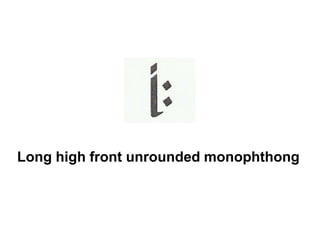
Long high front unrounded monophthong
Short high front unrounded monophthong
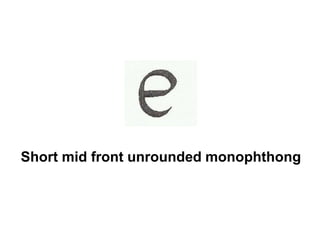
Short mid front unrounded monophthong
Short low front unrounded monophthong
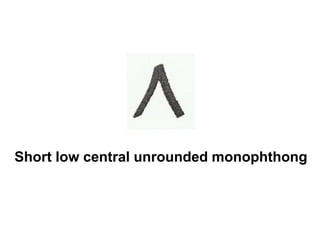
Short low central unrounded monophthong
Long low back unrounded monophthong
Short low back rounded monophthong
Long mid back rounded monophthong
Short high back rounded monophthong
Long high back rounded monophthong
Long mid central unrounded monophthong
Short mid central unrounded monophthong
*Theoretical ground taken from: Forel, A and Puskás, G (2005) 
Phonetics and Phonology: Reader for First Year English 
Linguistics. University of Geneva. 
*Presentation designed by: Manuel R. Medina (2014)

Vowels

  • 1.
    First it isnecessary for us to have a closer look at the way in which vowels differ from consonants. Then we need to analyze vowels phonetically, it means according to: - Tongue position: how high in the mouth is the tongue, and which part of the tongue is the highest? - Length: are the vowels long or short? - Rounding: are the lips rounded or not? - Nasality: is there free passage of air through the nose? (although in English there aren’t any nasal vowels).
  • 2.
    Difference from Consonants Even though all the languages of the world contain both vowels and consonants, and although almost everybody has some idea of whether a given sound is a vowel or a consonant in his language, there is actually more than one way to distinguish between the two classes of sounds. From a phonetic point of view one way of distinguishing is by considering which sounds have the highest degree of obstruction. Although vowels have almost no obstruction, and some consonants (obstruents, nasals, and the lateral) have a high degree of obstruction, there is a group of consonants (the approximants) which would be classified as vowels if this criterion was used: approximants have no more obstruction than vowels. This can be seen by comparing the approximant /j/ in yeast /ji:st/ with the vowel /i:/ in east /i:st/.
  • 3.
    From a phonologicalpoint of view, it is possible to distinguish between vowels and consonants by testing which sounds may be the nucleus of a syllable, i.e. the part of a syllable that cannot be left out. If you consider a syllable such as /kart/ cart, the initial /k/ may be left out and we still have a syllable, /art] art, the final /t/ may be left out and we still have a syllable , /kar/ car. In fact /k/ and /t/ may both be left out, and the remainder is still a syllable, /ar/ are. If however you try to leave out the vowel, then there is no syllable anymore:* /kt/. [a:] is then the sound that cannot be left out. Compare with yeast whereas /j/ can be left out, giving /i:st/, /i:/ can’t:* /jst/. Syllabicity seems to be the criterion to determine whether a sound is a vowel or a consonant.
  • 4.
    The above discussionwould not be complete if we didn't mention the problem of so called syllabic consonants. This is the case when sounds like /r/,/l/,/n/ may function as a separate syllable consisting of an only sound, as in /kɒtn/ cotton or /æpl/ apple, where English speakers clearly hear two separate syllables. In these words, the /n/ and /l/ seem to function as the nucleus of the second syllable of these words. However they cannot be classified as vowels, as they can never occur alone as a word.
  • 5.
    Tongue Position Tongueposition is described using two criteria: the height (how high is the tongue) and the part of the tongue involved in the production of the sound. In English the tongue may either be high, i.e. when the speaker produces e.g. /i:/, /u:/ in /bi:t/, /bu:t/ (beat, boot), intermediate, e.g. /e/, /ɔ:/ in /bet/, /bɔ:t/ (bet, bought), or low, e.g. /æ/, /a:/ in /bæt/, /ba:t/ (bat, Bart). a) tongue is a the highest b) tongue is at the lowest
  • 6.
    Depending on thelanguage we can have several intermediate tongue heights. English has three heights: high, mid and low, whereas French has two intermediate tongue heights with a total of four tongue heights: high, mid high, mid low and low. The part of the tongue involved in the production of a vowel can also be illustrated with the examples above. If you say /i:/ and then /u:/ just after it, you almost have the feeling that you are moving your tongue backwards. This is because /i:/ is a front vowel, and /u:/ is a back vowel, or in other words, the highest point in the pronunciation of /i:/ is the front of the tongue, whereas the highest point in /u:/ is the back of the tongue.
  • 7.
    The next figuregives you two examples of tongue position: a) is an example of the front of the tongue being at the highest. b) it is the back of the tongue which is nearest to the palate. (a) front and (b) back. (Thomas 1976:56)
  • 8.
    For example /ɜ/is front and /ɔ:/ is back, and /æ/ front, /a:/ back. There are also vowels in between front and back, called central, namely /ɜ:/, /ə/, / / as in /wɜ:d/, /fɔ:wəd/, /m d/ (word, forward, mud). /ɜ:/ for instance is between /e/ and /ɔ:/, as can be seen from /bed,/ /bɜ:d, bɔ:d], (bed, bird, board). To give an accurate account of tongue position one has to combine height of the tongue and part of the tongue involved. v v /i:/ /e/ /æ/ /u:/ /ɔ:/ /a:/ a) height position for front vowels b) height position for back vowels
  • 9.
    If you putthe previous diagrams together, isolating tongue position, you get the following diagram:
  • 10.
    With the previousexplanation and the previous diagram, we can locate vowel production and tongue position in this way: Front Central Back High Mid Low
  • 11.
    Length As youmay have seen, there are two types of /i/ sound in English placed in two different positions. However for the purpose of description, what is relevant is not the difference of position but that of the perceived length of the vowel. Thus it is said that /i:/ is a long vowel and /I/ is a short one. The same is valid for /u:/ - /ʊ/, /ɜ:/ - /ə/, /ɔ:/ - /ɒ/. Remember: Symbols for long vowels all have a colon. Phonologically, one can establish the rule such as only long vowels may be the last sound of a syllable, whereas short vowels are always followed by at least a consonant. If we take away the final /t/ from court, /kɔ:/ is a possible syllable (core) whereas /kɒ/ could not possibly occur. (Exceptions from this are the three short vowels that occur in completely unstressed syllables, /sItI/, /Intʊ/, /swetə/ [city, into, sweater]).
  • 12.
    Rounding Vowels mayalso be different from each other with respect to rounding. If you compare /i:/ in /tʃi:z]/(cheese) with /u:/ in /tʃu:z/ (choose), you will see that not only is /i:/ a front vowel and /u:/ a back vowel, but /i:/ is also unrounded where /u:/ is rounded. When pronouncing /u:/ your lips are rounded, but when pronouncing /i:/ the corners of the mouth are much further apart. /i/ /e/ /æ/ /u:/ /ɔ:/ /ɒ/ /a:/ Lips Spread Close Lip-rounding Open Lip-rounding Neutrally Open
  • 13.
    We can summarizethe description of English vowels in the following explanation. However, it is very important to accompany this chapter simultaneously with what we learned about tongue position. Remember that, as usual, we are talking about sounds, not letters, and the description belongs to how they are expected to be produced.
  • 14.
    Long high frontunrounded monophthong
  • 15.
    Short high frontunrounded monophthong
  • 16.
    Short mid frontunrounded monophthong
  • 17.
    Short low frontunrounded monophthong
  • 18.
    Short low centralunrounded monophthong
  • 19.
    Long low backunrounded monophthong
  • 20.
    Short low backrounded monophthong
  • 21.
    Long mid backrounded monophthong
  • 22.
    Short high backrounded monophthong
  • 23.
    Long high backrounded monophthong
  • 24.
    Long mid centralunrounded monophthong
  • 25.
    Short mid centralunrounded monophthong
  • 26.
    *Theoretical ground takenfrom: Forel, A and Puskás, G (2005) Phonetics and Phonology: Reader for First Year English Linguistics. University of Geneva. *Presentation designed by: Manuel R. Medina (2014)