By Ihsan Ibadurrahman (G1025429)
 Production: speaker’s use of a more muscular
  energy used than in unstressed syllable.
 Perception: Stressed syllable are more
  prominence than unstressed one(s), typically
  characterized as having:
    Louder sound
    Longer sound
    Higher pitch
    Different quality
 Unstressed:  having no recognizable amount
  of prominence.
 Primary stress (‘): Stress which has the most
  prominence.
 Secondary stress (,): Stronger than
  unstressed but weaker than the primary
  sterss.
 Identify three of them on the following
  words:
  Pronunciation Photographic
 Which  syllables do we stress?
 Generally, stress rules can depend on:
 The grammatical category
  (abstract, conduct, export, present)
 The number of syllables
 The phonological structure
 Whether it’s a simple or complex word
 Strong syllable
  A rhyme which either has a syllable nucleus
  which is a long vowel or diphthong, or a vowel
  followed by more than one coda. A strong
  syllable is stressed.
 Weak syllable
  A rhyme which has a syllable nucleus which is
  a short vowel and no coda or the syllable
  nucleus is the schwa vowel.
  A weak syllable is not stressed.
 Exception:
  Honest, Perfect.
 Words   composed more than one grammatical
  unit
 Example: carelessness
 Two types of complex words:
  a. words made by basic words (stem)
       by adding affixes (prefix or suffix)
       (prefix) un + (stem) pleasant
       (stem) good + (suffix) nesss
  b. compound words
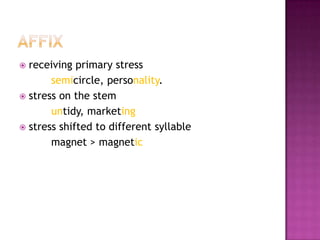
 receiving primary stress
       semicircle, personality.
 stress on the stem
       untidy, marketing
 stress shifted to different syllable
       magnet > magnetic
 -ee : refugee, evacuee
 -eer: mountainer, volunteer
 -ese: Portuguese, journalese, Japanese.
 -able:  comfortable
 -age: anchorage
 -al: refusal
 -ful: wonderful
 -like: birdlike
 -less: powerless
 -ly: hurriedly
 -ness: happiness
 -ous: poisonous
 -fy: glorify
 -ous  : advantageous
 -graphy: photography
 -ial: proverbial
 -ic: climatic
 -ion: perfection
 -ty: tranquility
 -ive: reflexive
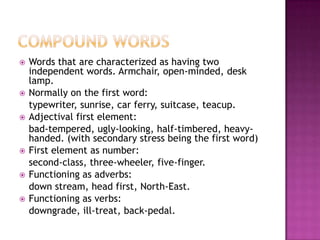
   Words that are characterized as having two
    independent words. Armchair, open-minded, desk
    lamp.
   Normally on the first word:
    typewriter, sunrise, car ferry, suitcase, teacup.
   Adjectival first element:
    bad-tempered, ugly-looking, half-timbered, heavy-
    handed. (with secondary stress being the first word)
   First element as number:
    second-class, three-wheeler, five-finger.
   Functioning as adverbs:
    down stream, head first, North-East.
   Functioning as verbs:
    downgrade, ill-treat, back-pedal.
 Not  all stress pattern is fixed, either because
  of other words occurring next to the word in
  question or because not all speakers agree on
  the placement of stress.
 A final stressed compounds tend to move to
  the preceding syllables:
  bad-tempered and a bad-tempered person
  heavy-handed and a heavy-handed sentece
 Disagreement among speakers:
  Controversy, ice
  cream, kilometer, formidable.
 English, Short, Sleep, Observe.
 Permit, Subject, Eject, Contrast.
 Otherwise, Chinese, Refugee, Volunteer.
 Controversy, kilometer, formidable,
  language.
 Tranquility, perfection, advantageous,
  poisonous.
 Cost-effective, suitcase, teacup, Ill-
  tempered.

Stress in complex words

  • 1.
  • 2.
     Production: speaker’suse of a more muscular energy used than in unstressed syllable.  Perception: Stressed syllable are more prominence than unstressed one(s), typically characterized as having:  Louder sound  Longer sound  Higher pitch  Different quality
  • 3.
     Unstressed: having no recognizable amount of prominence.  Primary stress (‘): Stress which has the most prominence.  Secondary stress (,): Stronger than unstressed but weaker than the primary sterss.  Identify three of them on the following words: Pronunciation Photographic
  • 5.
     Which syllables do we stress?  Generally, stress rules can depend on:  The grammatical category (abstract, conduct, export, present)  The number of syllables  The phonological structure  Whether it’s a simple or complex word
  • 6.
     Strong syllable A rhyme which either has a syllable nucleus which is a long vowel or diphthong, or a vowel followed by more than one coda. A strong syllable is stressed.  Weak syllable A rhyme which has a syllable nucleus which is a short vowel and no coda or the syllable nucleus is the schwa vowel. A weak syllable is not stressed.  Exception: Honest, Perfect.
  • 7.
     Words composed more than one grammatical unit  Example: carelessness  Two types of complex words: a. words made by basic words (stem) by adding affixes (prefix or suffix) (prefix) un + (stem) pleasant (stem) good + (suffix) nesss b. compound words
  • 8.
     receiving primarystress semicircle, personality.  stress on the stem untidy, marketing  stress shifted to different syllable magnet > magnetic
  • 9.
     -ee :refugee, evacuee  -eer: mountainer, volunteer  -ese: Portuguese, journalese, Japanese.
  • 10.
     -able: comfortable  -age: anchorage  -al: refusal  -ful: wonderful  -like: birdlike  -less: powerless  -ly: hurriedly  -ness: happiness  -ous: poisonous  -fy: glorify
  • 11.
     -ous : advantageous  -graphy: photography  -ial: proverbial  -ic: climatic  -ion: perfection  -ty: tranquility  -ive: reflexive
  • 12.
    Words that are characterized as having two independent words. Armchair, open-minded, desk lamp.  Normally on the first word: typewriter, sunrise, car ferry, suitcase, teacup.  Adjectival first element: bad-tempered, ugly-looking, half-timbered, heavy- handed. (with secondary stress being the first word)  First element as number: second-class, three-wheeler, five-finger.  Functioning as adverbs: down stream, head first, North-East.  Functioning as verbs: downgrade, ill-treat, back-pedal.
  • 13.
     Not all stress pattern is fixed, either because of other words occurring next to the word in question or because not all speakers agree on the placement of stress.  A final stressed compounds tend to move to the preceding syllables: bad-tempered and a bad-tempered person heavy-handed and a heavy-handed sentece  Disagreement among speakers: Controversy, ice cream, kilometer, formidable.
  • 14.
     English, Short,Sleep, Observe.  Permit, Subject, Eject, Contrast.  Otherwise, Chinese, Refugee, Volunteer.  Controversy, kilometer, formidable, language.  Tranquility, perfection, advantageous, poisonous.  Cost-effective, suitcase, teacup, Ill- tempered.