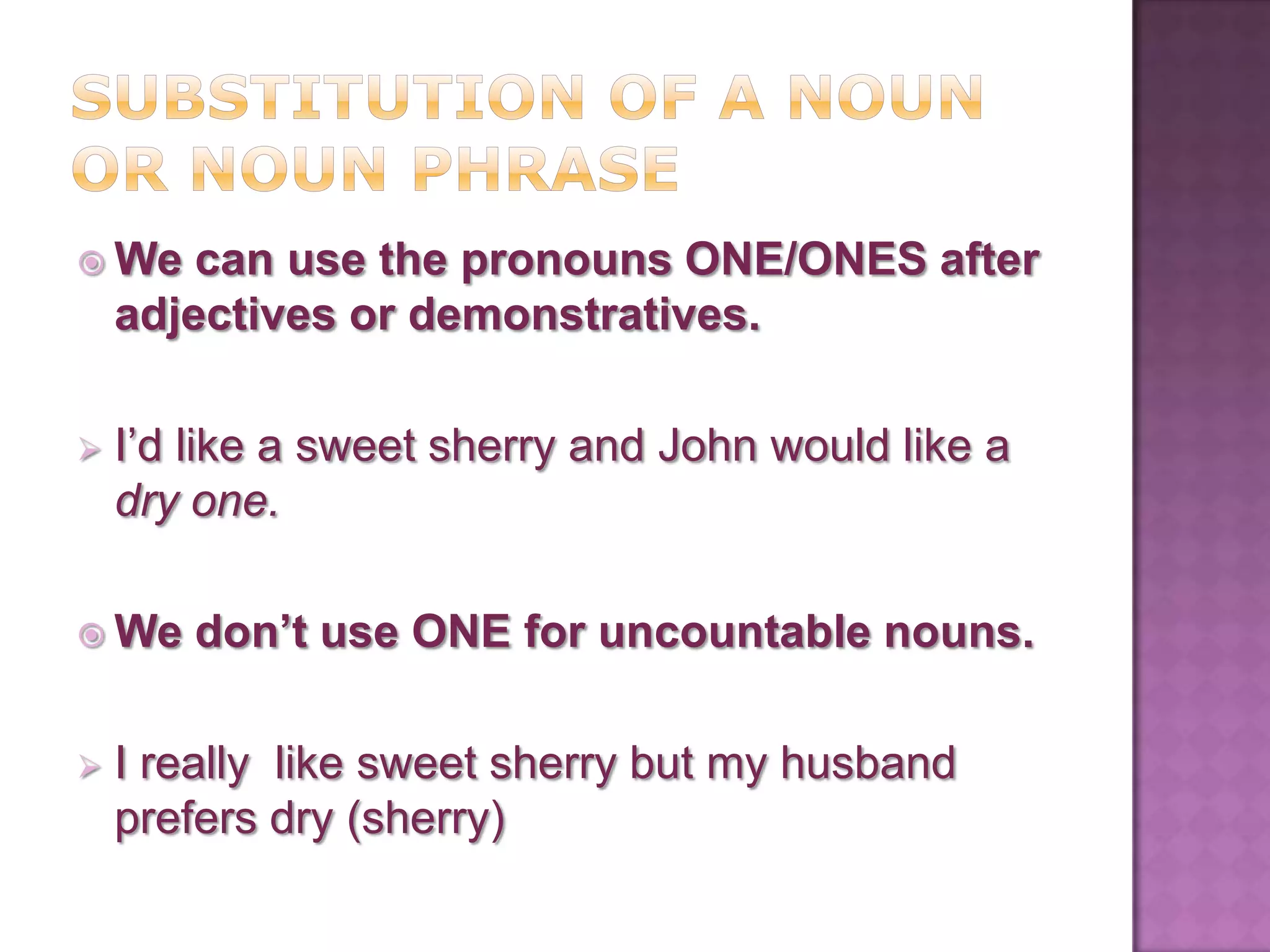
 We    can use the pronouns ONE/ONES after
    adjectives or demonstratives.

   I’d like a sweet sherry and John would like a
    dry one.

 We    don’t use ONE for uncountable nouns.

   I really like sweet sherry but my husband
    prefers dry (sherry)
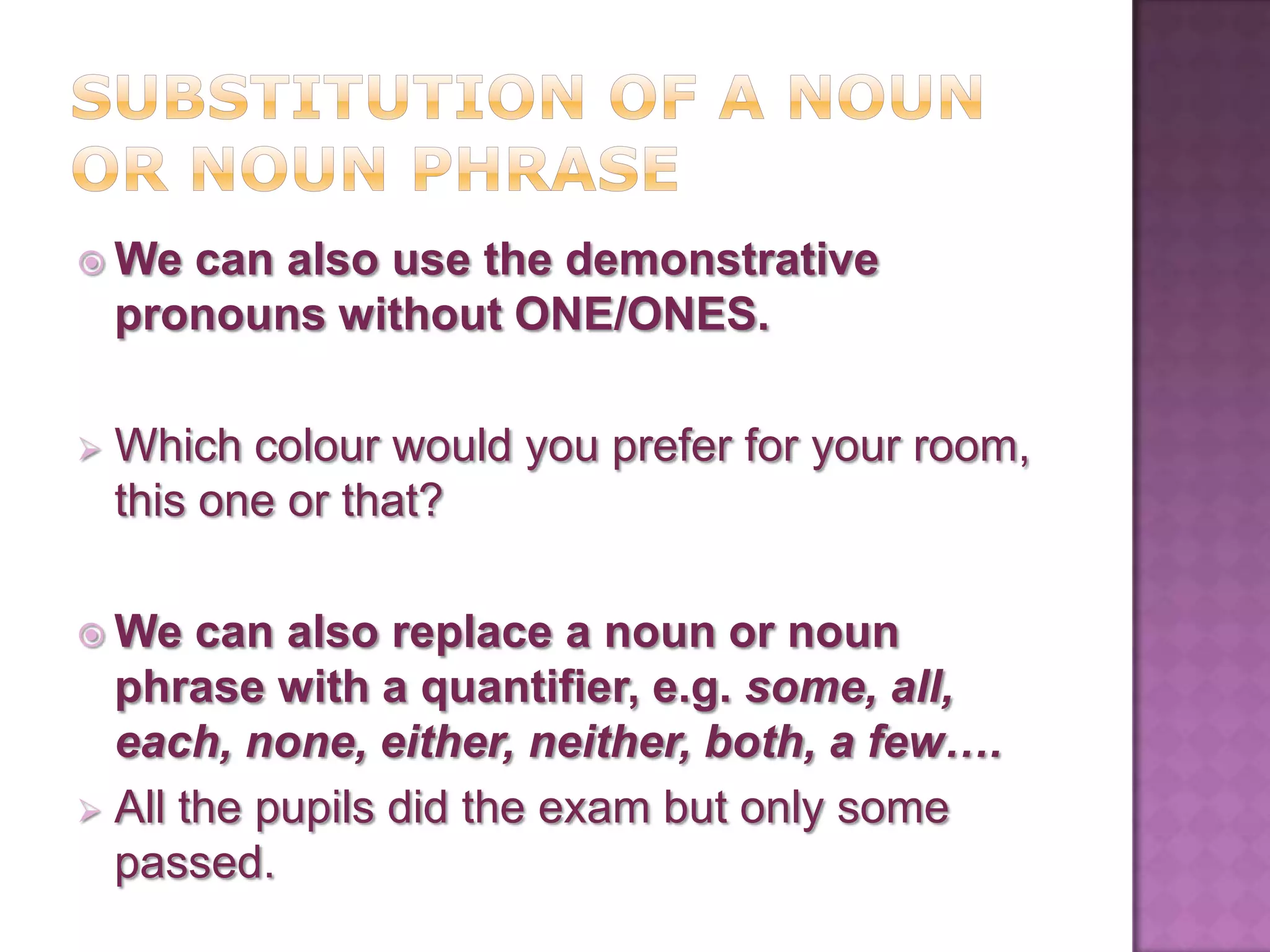
 We   can also use the demonstrative
    pronouns without ONE/ONES.

   Which colour would you prefer for your room,
    this one or that?

 We   can also replace a noun or noun
  phrase with a quantifier, e.g. some, all,
  each, none, either, neither, both, a few….
 All the pupils did the exam but only some
  passed.
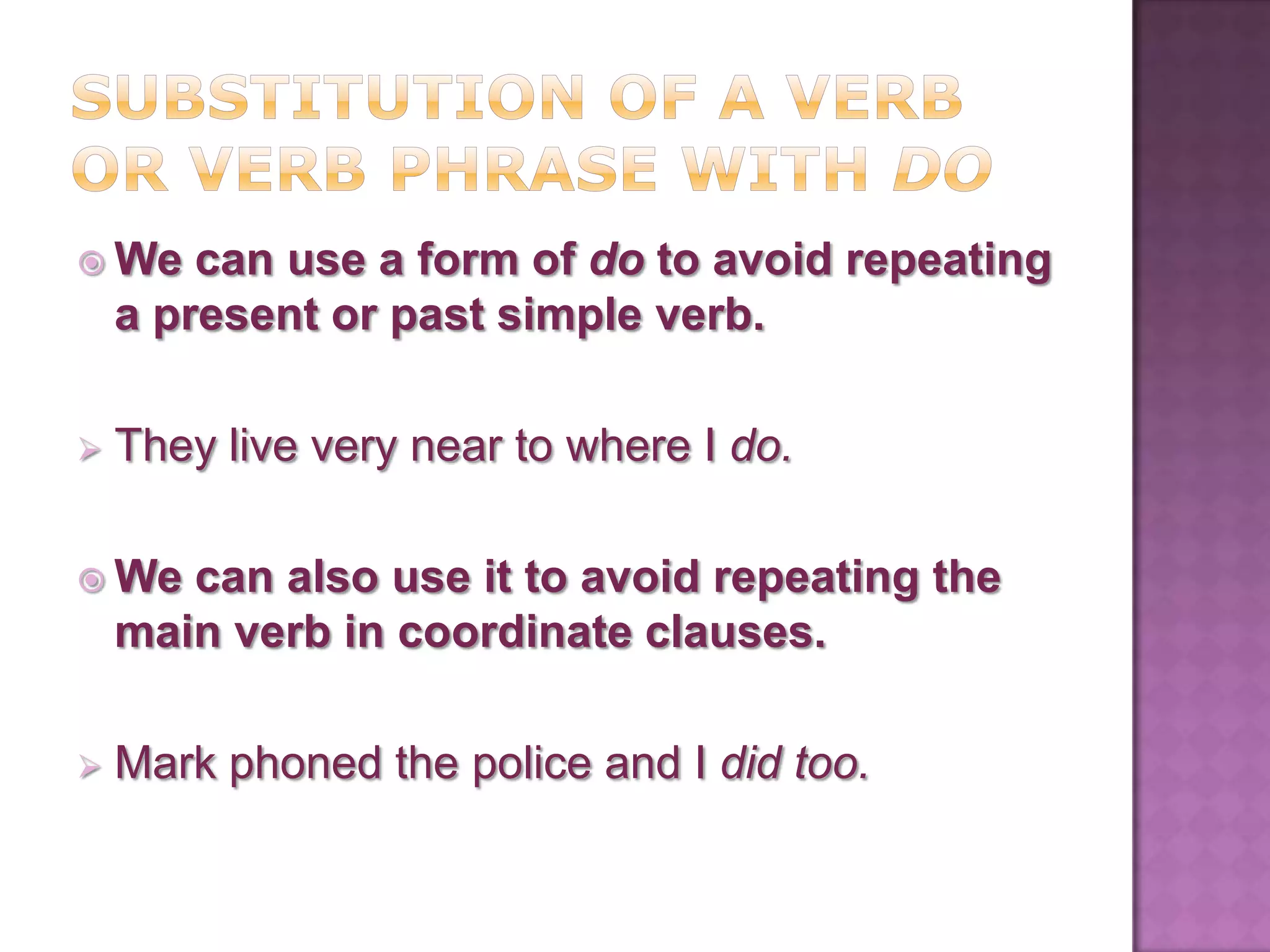
 We    can use a form of do to avoid repeating
    a present or past simple verb.

   They live very near to where I do.

 We   can also use it to avoid repeating the
    main verb in coordinate clauses.

   Mark phoned the police and I did too.
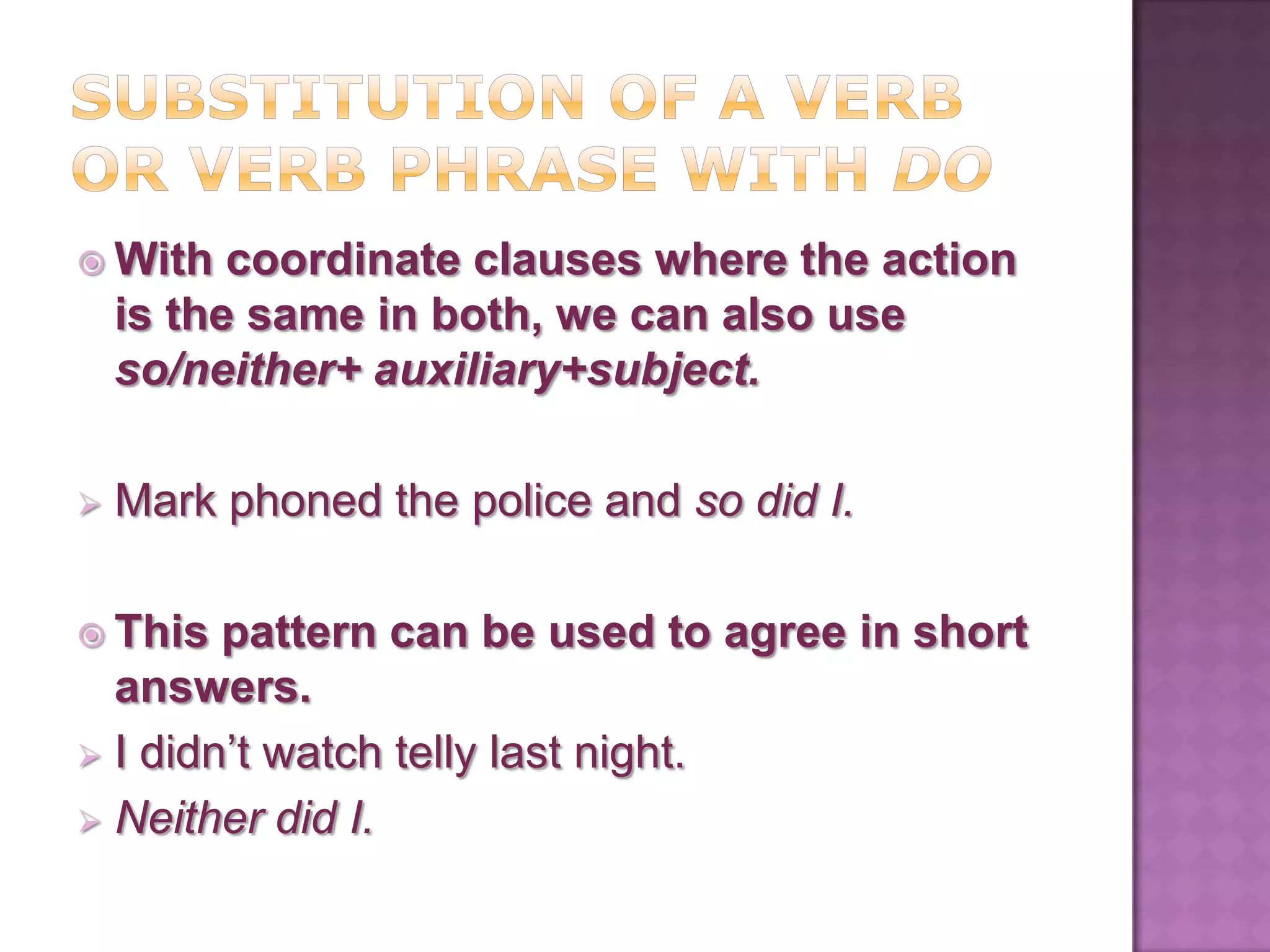
 With    coordinate clauses where the action
    is the same in both, we can also use
    so/neither+ auxiliary+subject.

   Mark phoned the police and so did I.

 This  pattern can be used to agree in short
  answers.
 I didn’t watch telly last night.
 Neither did I.
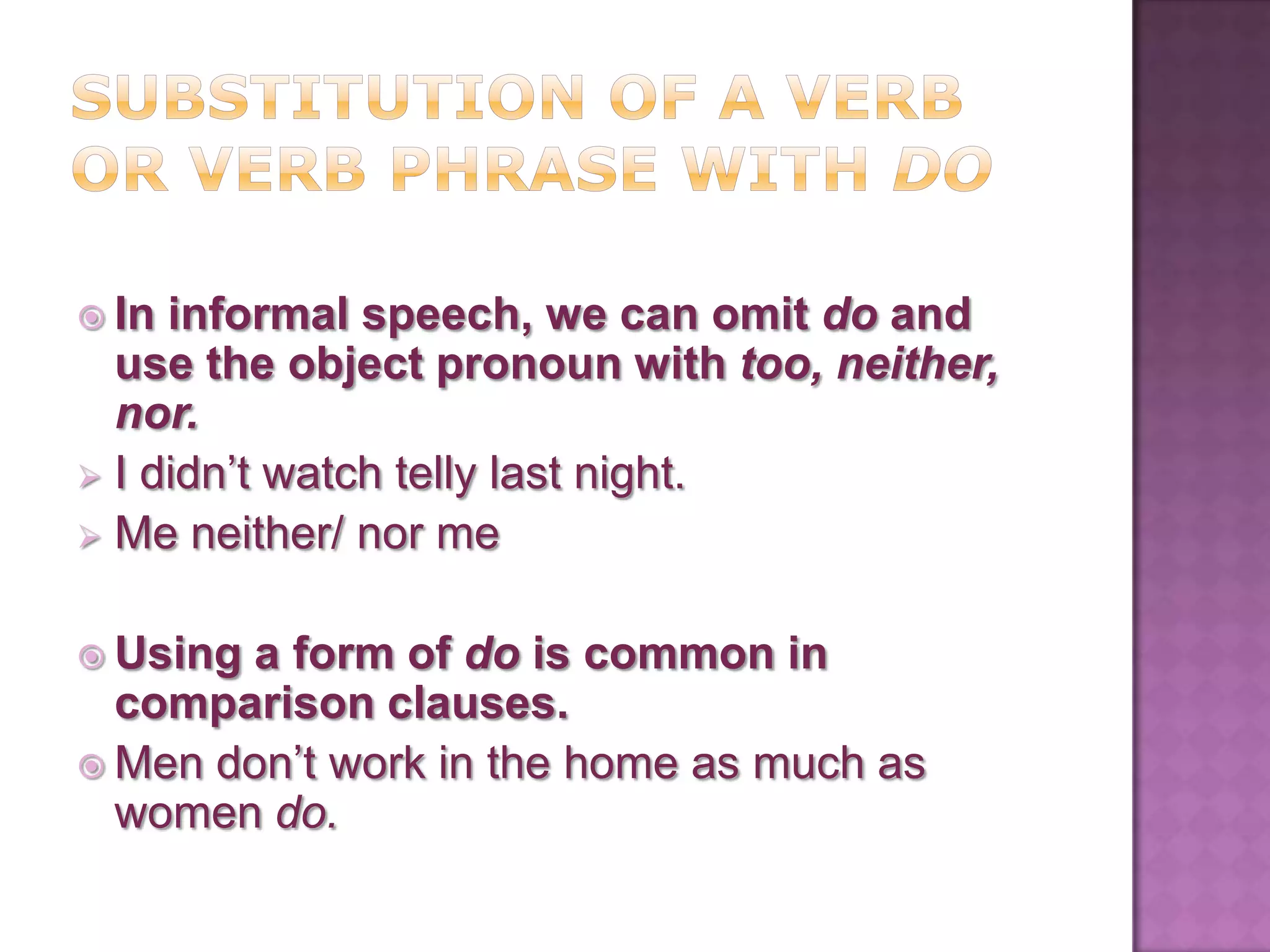
 In informal speech, we can omit do and
  use the object pronoun with too, neither,
  nor.
 I didn’t watch telly last night.
 Me neither/ nor me


 Usinga form of do is common in
  comparison clauses.
 Men don’t work in the home as much as
  women do.
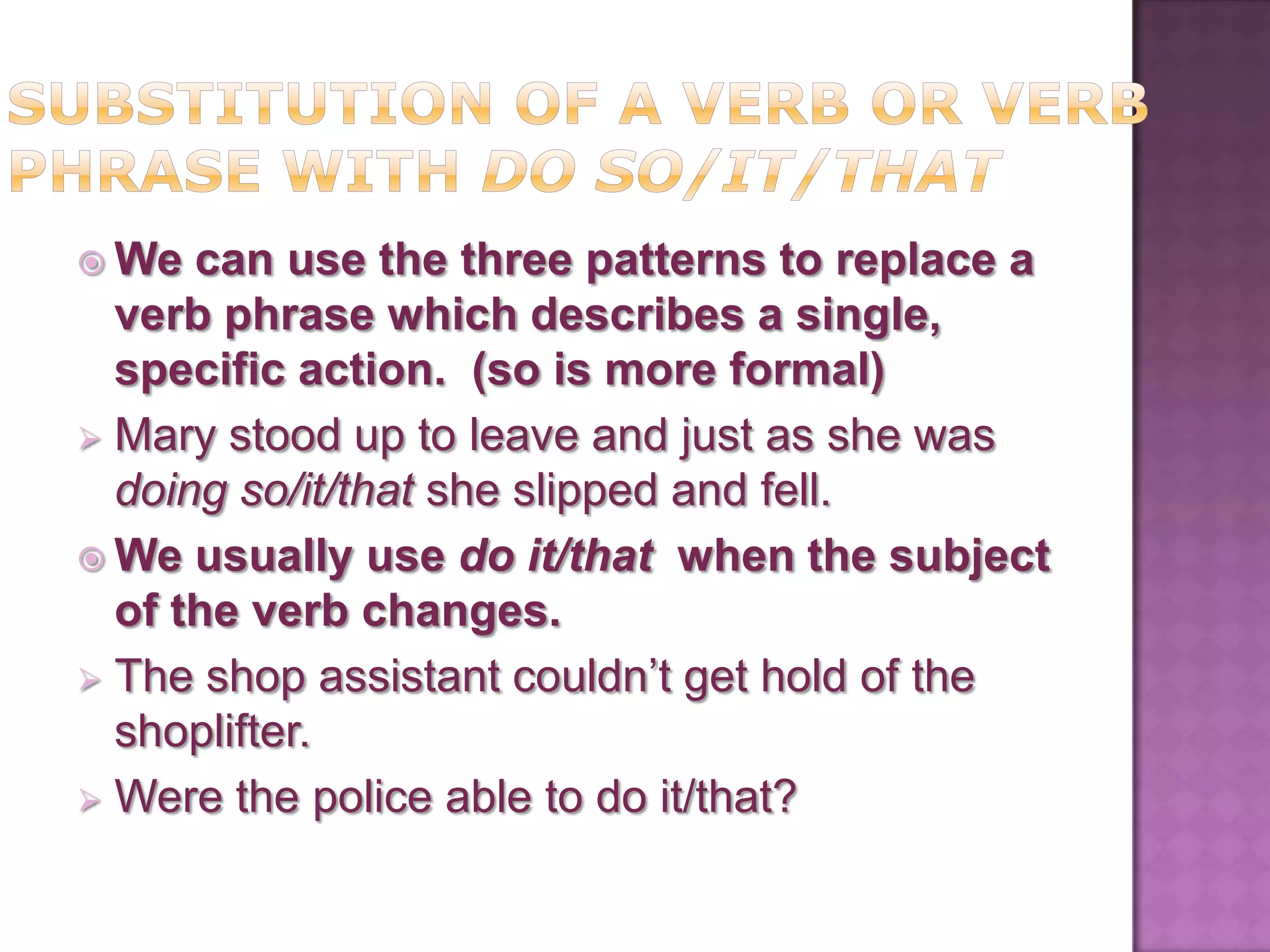
 We  can use the three patterns to replace a
  verb phrase which describes a single,
  specific action. (so is more formal)
 Mary stood up to leave and just as she was
  doing so/it/that she slipped and fell.
 We usually use do it/that when the subject
  of the verb changes.
 The shop assistant couldn’t get hold of the
  shoplifter.
 Were the police able to do it/that?
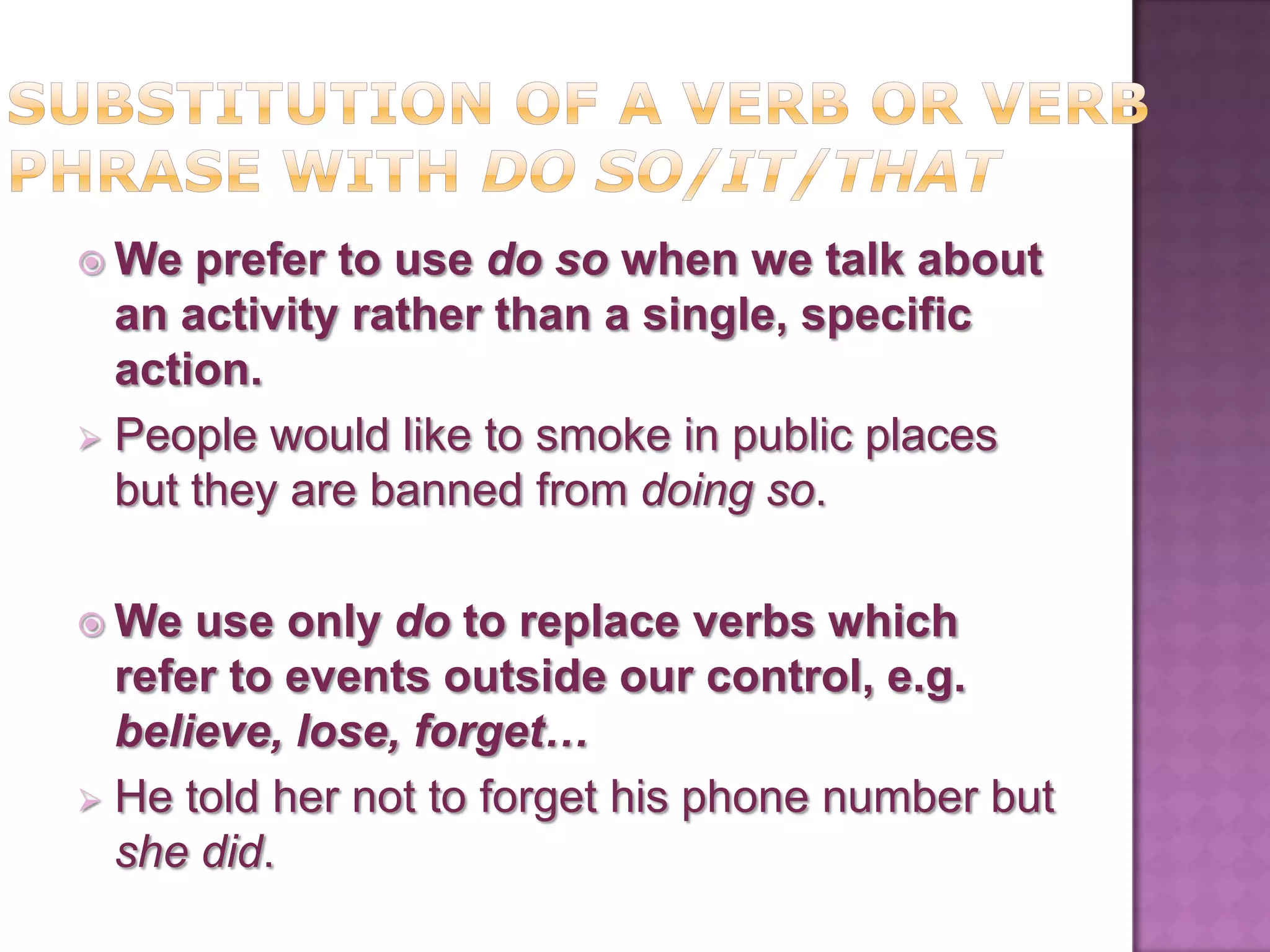
 We  prefer to use do so when we talk about
  an activity rather than a single, specific
  action.
 People would like to smoke in public places
  but they are banned from doing so.

 We  use only do to replace verbs which
  refer to events outside our control, e.g.
  believe, lose, forget…
 He told her not to forget his phone number but
  she did.
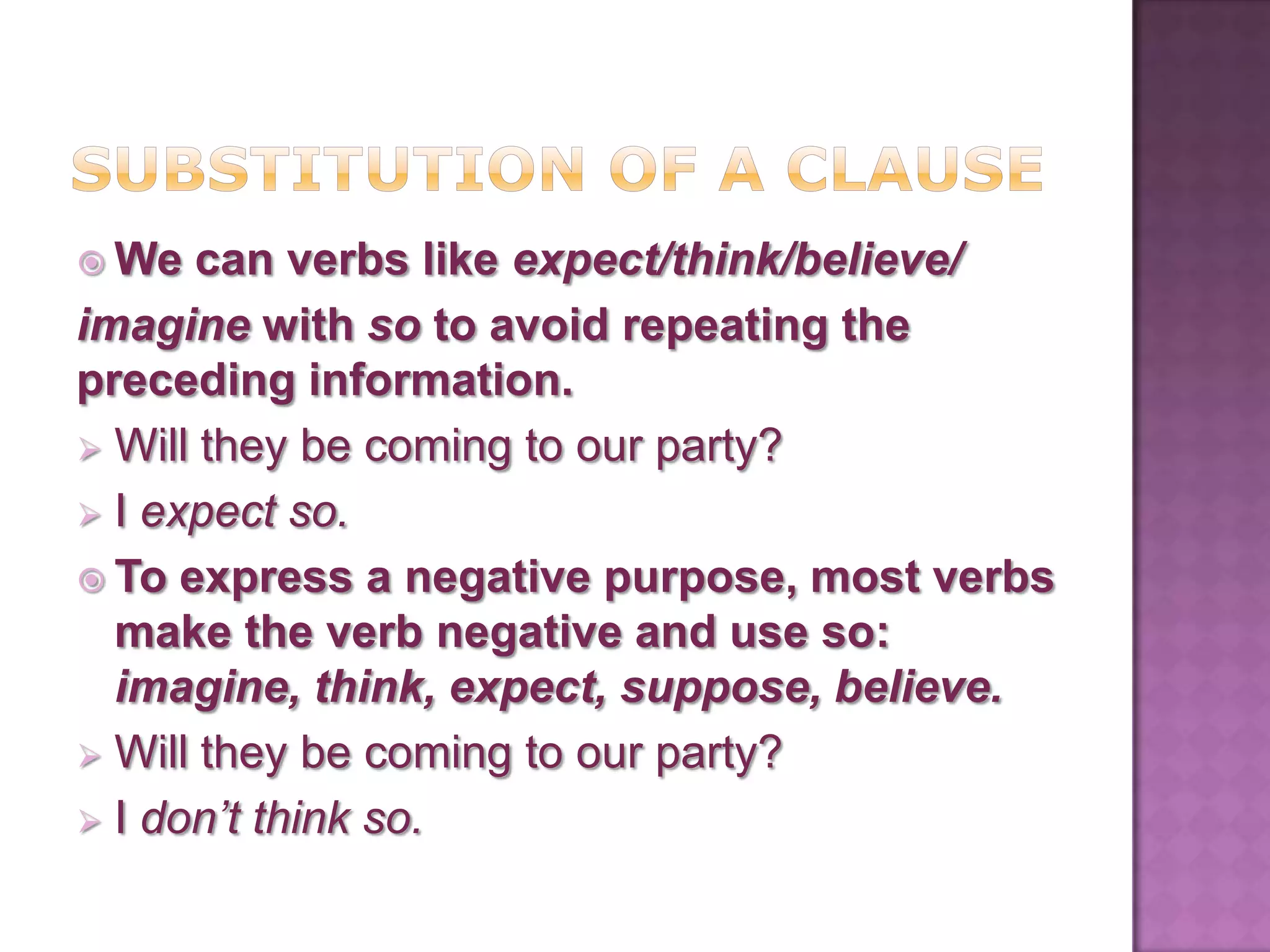
 We   can verbs like expect/think/believe/
imagine with so to avoid repeating the
preceding information.
 Will they be coming to our party?
 I expect so.
 To express a negative purpose, most verbs
  make the verb negative and use so:
  imagine, think, expect, suppose, believe.
 Will they be coming to our party?
 I don’t think so.
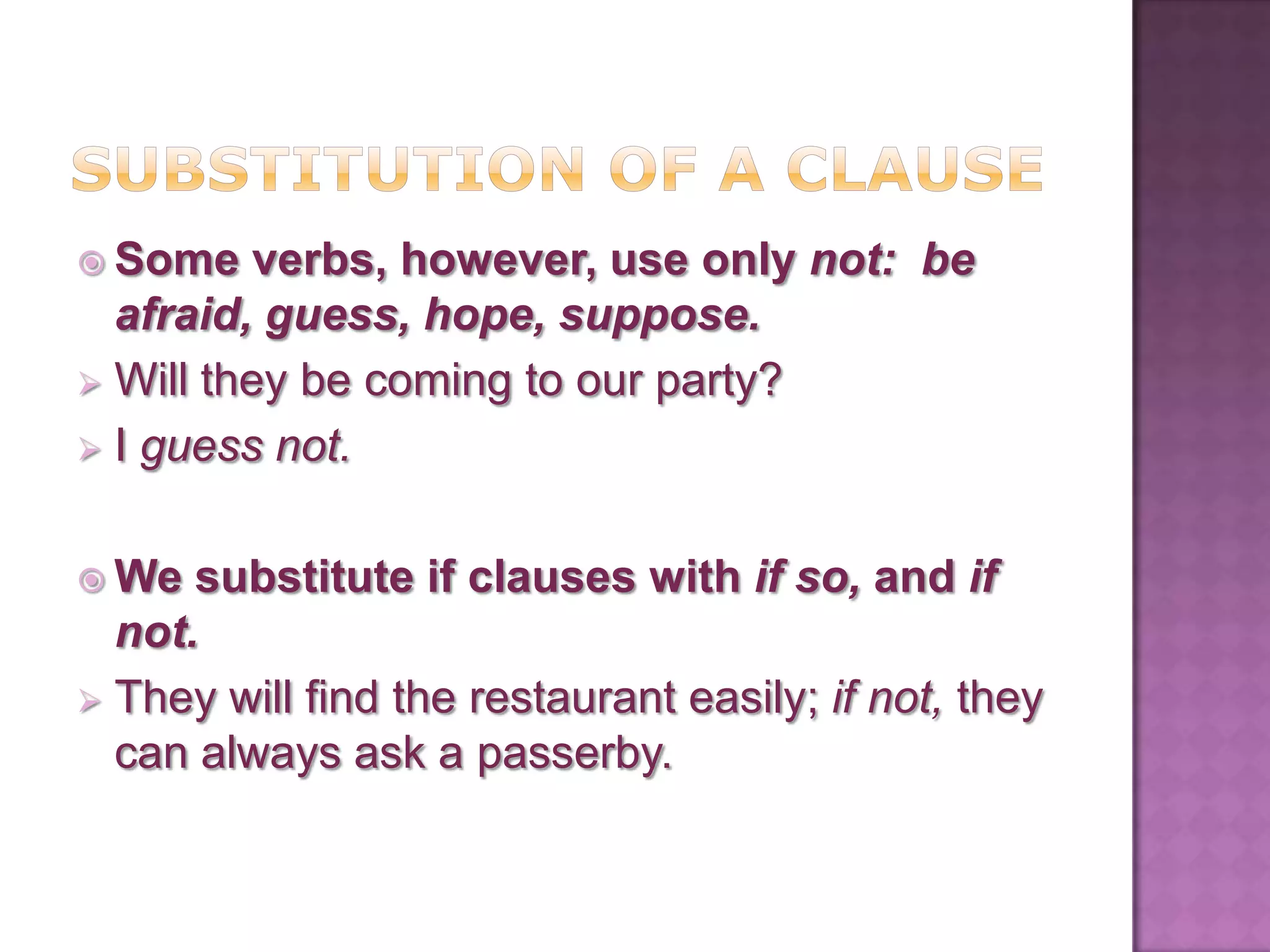
 Some    verbs, however, use only not: be
  afraid, guess, hope, suppose.
 Will they be coming to our party?
 I guess not.


 We  substitute if clauses with if so, and if
  not.
 They will find the restaurant easily; if not, they
  can always ask a passerby.
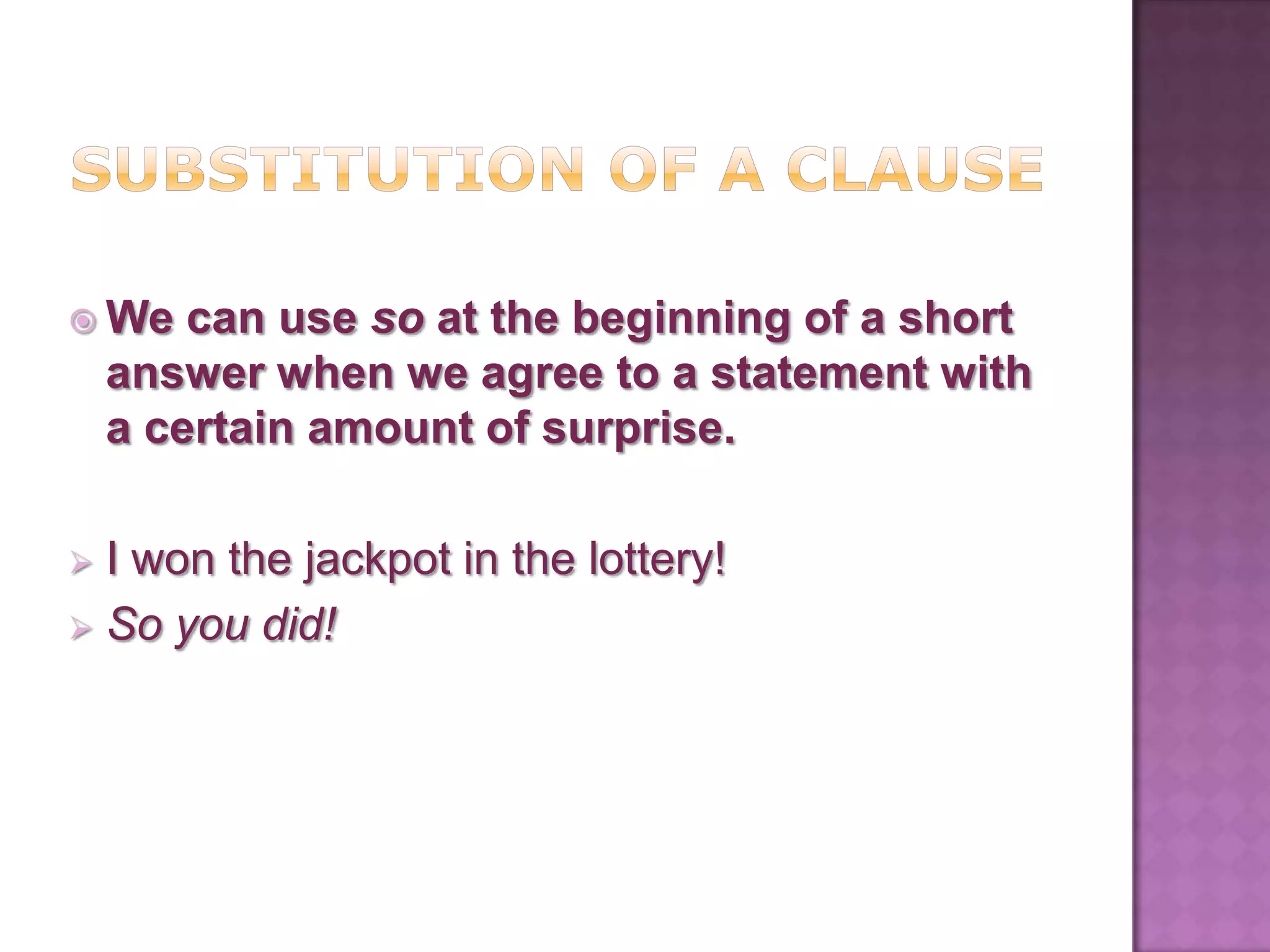
 We    can use so at the beginning of a short
    answer when we agree to a statement with
    a certain amount of surprise.

 I won the jackpot in the lottery!
 So you did!
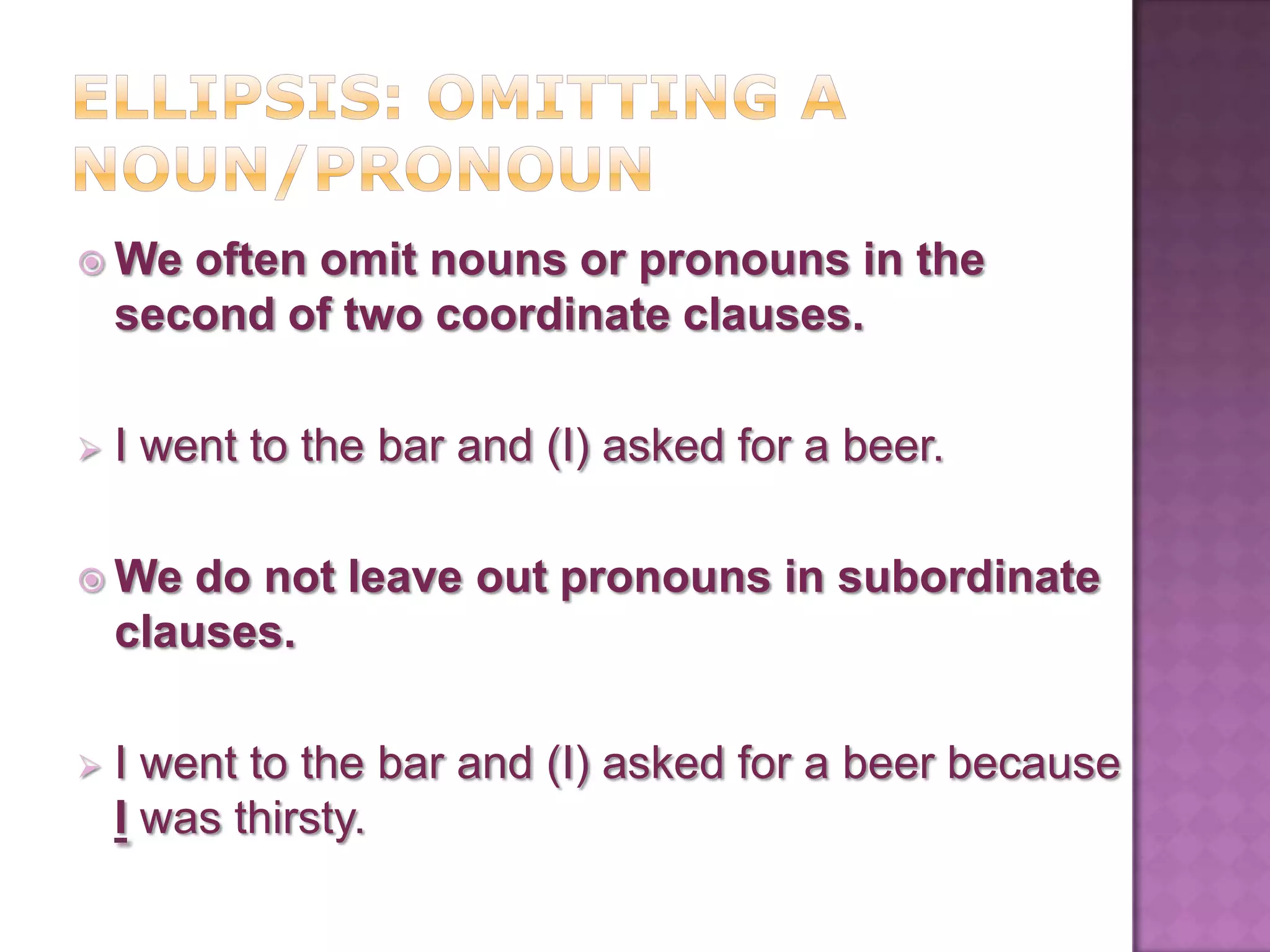
 We   often omit nouns or pronouns in the
    second of two coordinate clauses.

   I went to the bar and (I) asked for a beer.

 We    do not leave out pronouns in subordinate
    clauses.

   I went to the bar and (I) asked for a beer because
    I was thirsty.
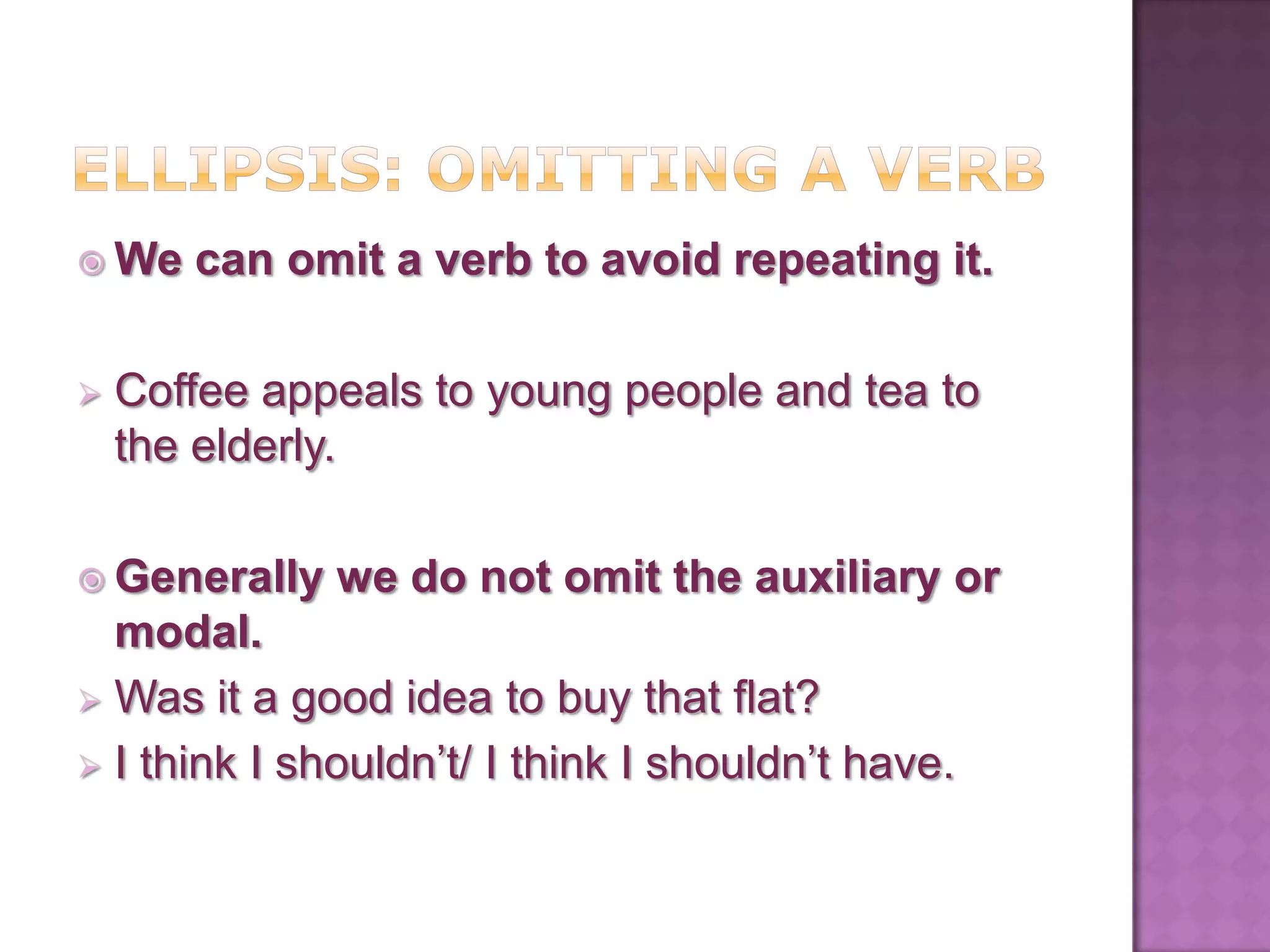
 We   can omit a verb to avoid repeating it.

   Coffee appeals to young people and tea to
    the elderly.

 Generally   we do not omit the auxiliary or
  modal.
 Was it a good idea to buy that flat?
 I think I shouldn’t/ I think I shouldn’t have.
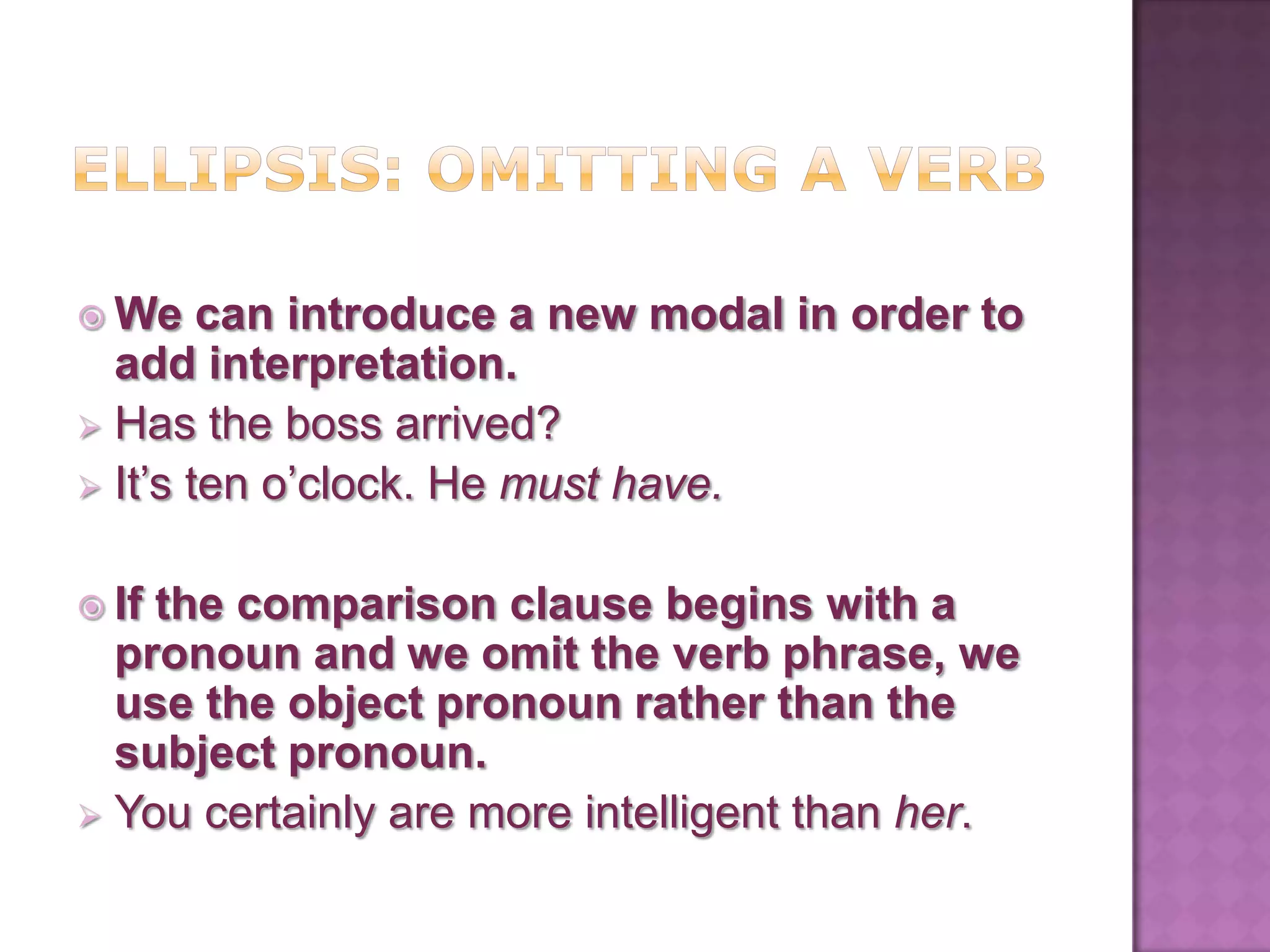
 We    can introduce a new modal in order to
  add interpretation.
 Has the boss arrived?
 It’s ten o’clock. He must have.


 Ifthe comparison clause begins with a
  pronoun and we omit the verb phrase, we
  use the object pronoun rather than the
  subject pronoun.
 You certainly are more intelligent than her.
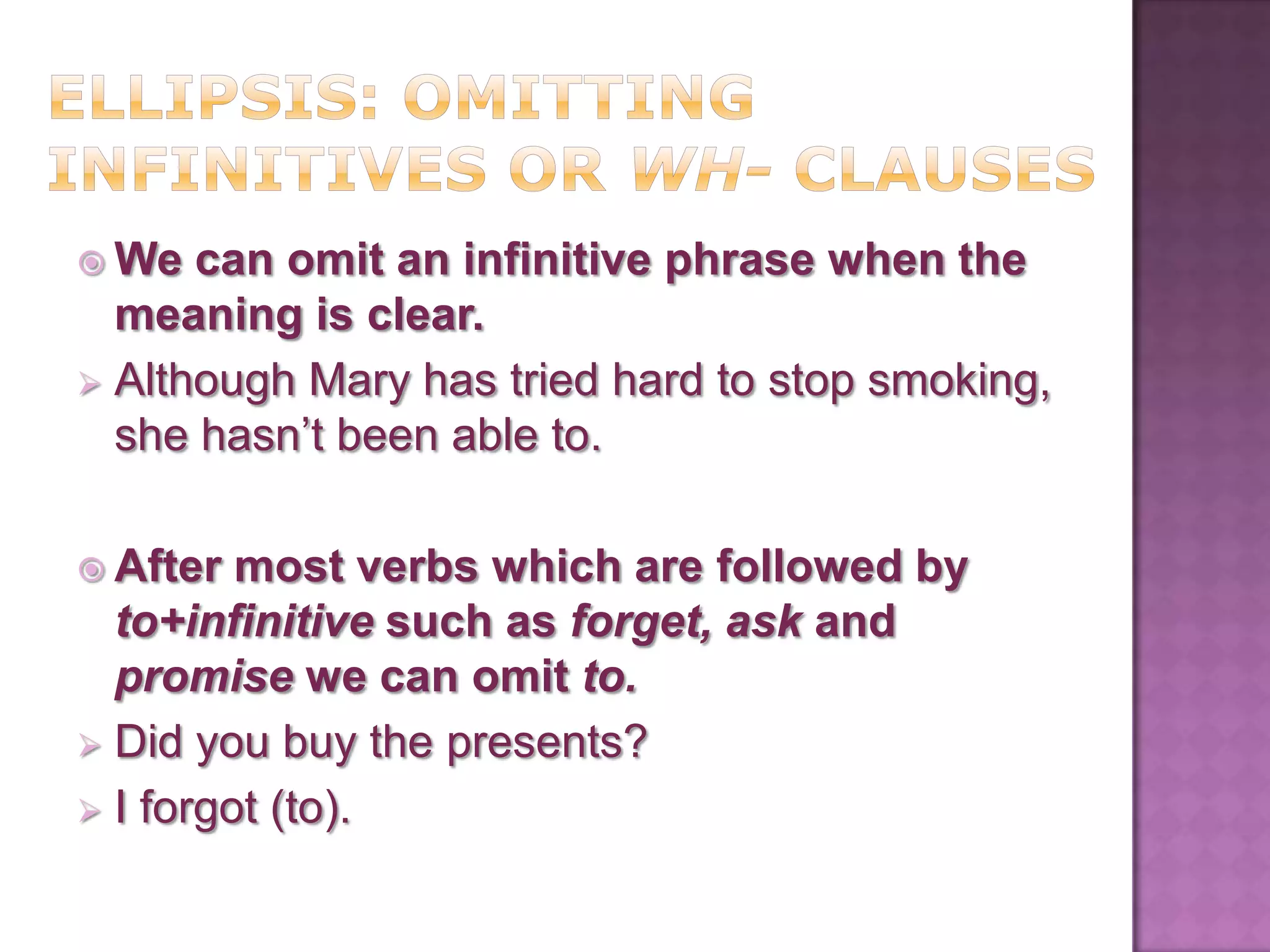
 We  can omit an infinitive phrase when the
  meaning is clear.
 Although Mary has tried hard to stop smoking,
  she hasn’t been able to.

 After  most verbs which are followed by
  to+infinitive such as forget, ask and
  promise we can omit to.
 Did you buy the presents?
 I forgot (to).
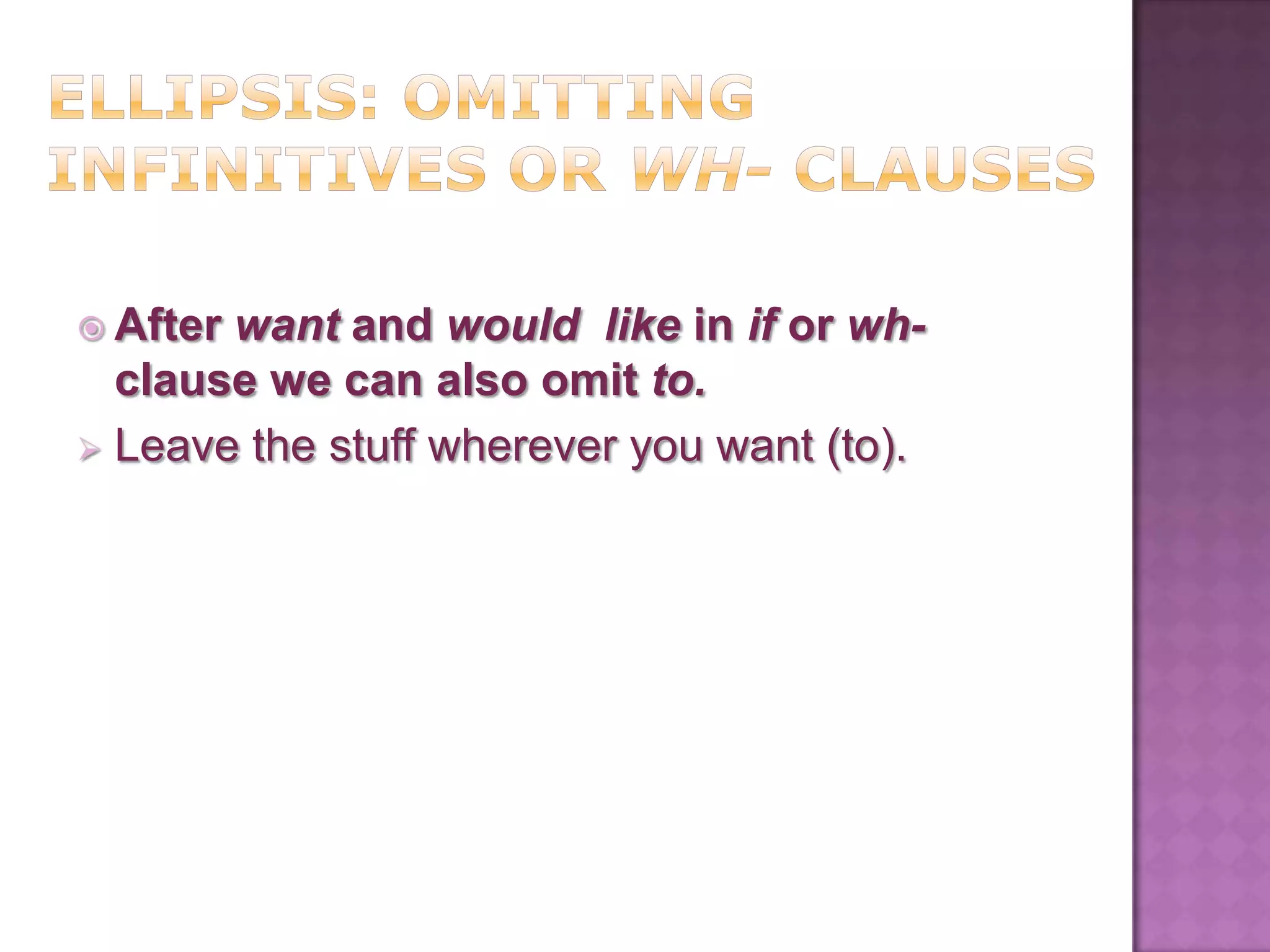
 Afterwant and would like in if or wh-
  clause we can also omit to.
 Leave the stuff wherever you want (to).

Substitution and ellipsis

  • 2.
     We can use the pronouns ONE/ONES after adjectives or demonstratives.  I’d like a sweet sherry and John would like a dry one.  We don’t use ONE for uncountable nouns.  I really like sweet sherry but my husband prefers dry (sherry)
  • 3.
     We can also use the demonstrative pronouns without ONE/ONES.  Which colour would you prefer for your room, this one or that?  We can also replace a noun or noun phrase with a quantifier, e.g. some, all, each, none, either, neither, both, a few….  All the pupils did the exam but only some passed.
  • 4.
     We can use a form of do to avoid repeating a present or past simple verb.  They live very near to where I do.  We can also use it to avoid repeating the main verb in coordinate clauses.  Mark phoned the police and I did too.
  • 5.
     With coordinate clauses where the action is the same in both, we can also use so/neither+ auxiliary+subject.  Mark phoned the police and so did I.  This pattern can be used to agree in short answers.  I didn’t watch telly last night.  Neither did I.
  • 6.
     In informalspeech, we can omit do and use the object pronoun with too, neither, nor.  I didn’t watch telly last night.  Me neither/ nor me  Usinga form of do is common in comparison clauses.  Men don’t work in the home as much as women do.
  • 7.
     We can use the three patterns to replace a verb phrase which describes a single, specific action. (so is more formal)  Mary stood up to leave and just as she was doing so/it/that she slipped and fell.  We usually use do it/that when the subject of the verb changes.  The shop assistant couldn’t get hold of the shoplifter.  Were the police able to do it/that?
  • 8.
     We prefer to use do so when we talk about an activity rather than a single, specific action.  People would like to smoke in public places but they are banned from doing so.  We use only do to replace verbs which refer to events outside our control, e.g. believe, lose, forget…  He told her not to forget his phone number but she did.
  • 9.
     We can verbs like expect/think/believe/ imagine with so to avoid repeating the preceding information.  Will they be coming to our party?  I expect so.  To express a negative purpose, most verbs make the verb negative and use so: imagine, think, expect, suppose, believe.  Will they be coming to our party?  I don’t think so.
  • 10.
     Some verbs, however, use only not: be afraid, guess, hope, suppose.  Will they be coming to our party?  I guess not.  We substitute if clauses with if so, and if not.  They will find the restaurant easily; if not, they can always ask a passerby.
  • 11.
     We can use so at the beginning of a short answer when we agree to a statement with a certain amount of surprise.  I won the jackpot in the lottery!  So you did!
  • 12.
     We often omit nouns or pronouns in the second of two coordinate clauses.  I went to the bar and (I) asked for a beer.  We do not leave out pronouns in subordinate clauses.  I went to the bar and (I) asked for a beer because I was thirsty.
  • 13.
     We can omit a verb to avoid repeating it.  Coffee appeals to young people and tea to the elderly.  Generally we do not omit the auxiliary or modal.  Was it a good idea to buy that flat?  I think I shouldn’t/ I think I shouldn’t have.
  • 14.
     We can introduce a new modal in order to add interpretation.  Has the boss arrived?  It’s ten o’clock. He must have.  Ifthe comparison clause begins with a pronoun and we omit the verb phrase, we use the object pronoun rather than the subject pronoun.  You certainly are more intelligent than her.
  • 15.
     We can omit an infinitive phrase when the meaning is clear.  Although Mary has tried hard to stop smoking, she hasn’t been able to.  After most verbs which are followed by to+infinitive such as forget, ask and promise we can omit to.  Did you buy the presents?  I forgot (to).
  • 16.
     Afterwant andwould like in if or wh- clause we can also omit to.  Leave the stuff wherever you want (to).