Unit 5 : Sentence Structure
ď‚§ Kinds of Sentences
A sentence is a group of words that you
can use to communicate your ideas.
The four basic kinds of sentences in
English are simple, compound, complex,
and compound-complex.
1. Simple Sentences
A simple sentence is one independent clause.
Example: He is playing football.
She does not eat rice this evening.
2. Compound Sentences
A compound sentence is two or more independent
clauses joined together. There are three ways to join
the clauses:
- with a coordinator
- with a conjunctive adverb
- with a semicolon
a. Compound Sentences with Coordinators
A compound sentence can be formed as
follows:
Independent clause,+ coordinator +
independent clause.
Example: -I will go hometown, but I do not
play football.
-Dara left home, and he went library
to read book.
There are seven coordinators, which are also
called coordinating conjunctions. You can
remember them by the phrase FABOYS (For,
And, Nor, But, Or, Yet, So). He following
sentences illustrate the meanings of the seven
FANBOYS coordinators.
b. Compound Sentences with Conjunctive
Adverbs
A second way to form a compound sentence is as
follows:
Independent clause ,+ conjunctive adverb
independent clause
Example: Salt water boils at a higher temperature
than freshwater; therefore, food cooks faster in salt
water.
C. Compound Sentences with Semicolons
A third way to form a compound sentence is
to connect the two independent clauses with a
semicolon alone.
Example: Poland was the first Eastern
European country to turn away from
communism; others soon followed.
3. Complex Sentences
A complex sentence contains one
independent clause and one (or more)
dependent clause(s).In a complex sentence,
one idea is generally more important than
the other one.
There are three kinds of dependent clauses:
adverb, adjective, and noun.
• Complex sentences with Adverb Clauses
An adverb clause acts like an adverb; that
is, it tells where, when, why, and how.
An adverb clause begins with a
subordinator, such as when, while,
because, although, if, so, or that. It can
come before or after an independent
clause.
ď‚§ Complex sentences with Adjective
Clauses
An adjective clauses acts like an adjective;
that is , it describes a noun or pronoun.
An adjective clause begins with a relative
pronoun, such as who, whom, which,
whose. Or that, or with relative adverb,
such as where and when. It follows the
noun or pronoun it describes.
• Complex sentences with Noun Clauses
A noun clause begins with a wh-question
word, that, whether, and sometimes if.
A noun clause acts like a noun; it can be
either he subject of the independent
clauses.
4. Compound-Complex Sentences
A compound-complex sentence has at least
three clauses, at least two of which are
independent.You can use almost any
combination of dependent and independent
clauses. Just be sure that there is at least one
independent clause.
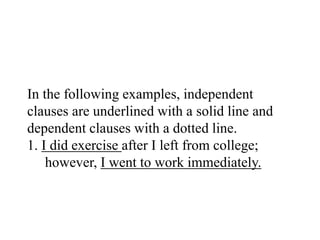
In the following examples, independent
clauses are underlined with a solid line and
dependent clauses with a dotted line.
1. I did exercise after I left from college;
however, I went to work immediately.
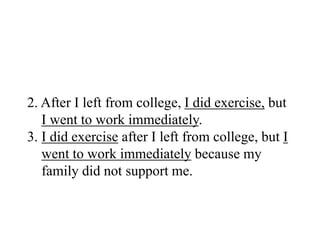
2. After I left from college, I did exercise, but
I went to work immediately.
3. I did exercise after I left from college, but I
went to work immediately because my
family did not support me.

Unit 5

  • 1.
    Unit 5 :Sentence Structure
  • 2.
    ď‚§ Kinds ofSentences A sentence is a group of words that you can use to communicate your ideas. The four basic kinds of sentences in English are simple, compound, complex, and compound-complex.
  • 3.
    1. Simple Sentences Asimple sentence is one independent clause. Example: He is playing football. She does not eat rice this evening.
  • 4.
    2. Compound Sentences Acompound sentence is two or more independent clauses joined together. There are three ways to join the clauses: - with a coordinator - with a conjunctive adverb - with a semicolon
  • 5.
    a. Compound Sentenceswith Coordinators A compound sentence can be formed as follows: Independent clause,+ coordinator + independent clause. Example: -I will go hometown, but I do not play football. -Dara left home, and he went library to read book.
  • 6.
    There are sevencoordinators, which are also called coordinating conjunctions. You can remember them by the phrase FABOYS (For, And, Nor, But, Or, Yet, So). He following sentences illustrate the meanings of the seven FANBOYS coordinators.
  • 7.
    b. Compound Sentenceswith Conjunctive Adverbs A second way to form a compound sentence is as follows: Independent clause ,+ conjunctive adverb independent clause Example: Salt water boils at a higher temperature than freshwater; therefore, food cooks faster in salt water.
  • 8.
    C. Compound Sentenceswith Semicolons A third way to form a compound sentence is to connect the two independent clauses with a semicolon alone. Example: Poland was the first Eastern European country to turn away from communism; others soon followed.
  • 9.
    3. Complex Sentences Acomplex sentence contains one independent clause and one (or more) dependent clause(s).In a complex sentence, one idea is generally more important than the other one. There are three kinds of dependent clauses: adverb, adjective, and noun.
  • 10.
    • Complex sentenceswith Adverb Clauses An adverb clause acts like an adverb; that is, it tells where, when, why, and how. An adverb clause begins with a subordinator, such as when, while, because, although, if, so, or that. It can come before or after an independent clause.
  • 11.
    ď‚§ Complex sentenceswith Adjective Clauses An adjective clauses acts like an adjective; that is , it describes a noun or pronoun. An adjective clause begins with a relative pronoun, such as who, whom, which, whose. Or that, or with relative adverb, such as where and when. It follows the noun or pronoun it describes.
  • 12.
    • Complex sentenceswith Noun Clauses A noun clause begins with a wh-question word, that, whether, and sometimes if. A noun clause acts like a noun; it can be either he subject of the independent clauses.
  • 13.
    4. Compound-Complex Sentences Acompound-complex sentence has at least three clauses, at least two of which are independent.You can use almost any combination of dependent and independent clauses. Just be sure that there is at least one independent clause.
  • 14.
    In the followingexamples, independent clauses are underlined with a solid line and dependent clauses with a dotted line. 1. I did exercise after I left from college; however, I went to work immediately.
  • 15.
    2. After Ileft from college, I did exercise, but I went to work immediately. 3. I did exercise after I left from college, but I went to work immediately because my family did not support me.