វិទ្យាស្ថា នសហប្រតិរតតិការអនតរជាតិ កម្ពុជា
Cambodia International Cooperation Institute
Faculty of Arts, Humanities and Languages
Applied Linguistics
Submitted by: Group III
1.Miss. Chean Loemhun
2.Miss. Ross Socheat
3.Miss. Ly Bunna
4.Miss. Toum MuyEng
5.Miss. Yim Sina
6. Mr. Pouk sary
7. Mr. Phat Utdom
Lecturer Kak Sovanna
1 6/21/2015 1
contents
Syntax
Generative Grammar
Syntactic structures
Deep and surface structure
Structural ambiguity
Recursion
1 6/21/2015 2
Symbols used in syntactic description
Tree Diagrams
Phrase structure rules
Lexical rules
Back to recursion
Complement phrases
Transformational rules
Group 03
6/21/2015 3
SYNTAX
In linguistics , syntax is the set of rule , principle
, and process that govern the structure of
sentences in a give language. The term of syntax
is also used to refer to the study of such
principle and process. The goal of many
syntacticians is to discover the syntax rule
common to all language and in literal means “ a
putting together or arrangement ”
Group 3 6/29/2015
4
Generative Grammar
 Linguists have attempted to produce a particular type
of grammar that have a very explicit system of rules
specifying what combinations of basic elements
would result in well-formed sentences. This very
explicit system of rules . it was proposed , would
have a lot on common with the types of rules found
in mathematics .
1 6/21/2015
5
 In basic algebra , if we have an expression such as 3x +
2y , and we give x and y the value of any whole number
, then that simple algebraic expression can “ generate “
and endless set of values by following the simple rules
of arithmetic. When x = 5 and y = 10 , the result is 35.
When x = 2 and y = 1, the result is 8 . these results will
follow directly and predictably from applying the
explicit rules.
1 6/21/2015 6
Syntactic structures
 A generative grammar defines the syntactic structures
of a language . the grammar will generate all well-
formed syntactic structures ( e.g. sentence ) of the
language and will not generate any ill-formed
structures.
 The grammar will have a finite ( i.e. limited ) number
of rules , 6/21/2015
7
be will be capable of generating an infinite number of
well-formed structures.
 The grammar should also be capable of revealing the
basis of two other phenomena : first, how some
superficially different sentences are closely related and
, second , have some superficially similar sentences are
in fact different.
1 6/21/2015
8
Deep and surface structure
 The distinction between them is a different in their
surface structure , that is the different syntactic forms
they have as individual English sentences .
 This superficial different in form disguises the fact that
the two sentences are very closely related, even
identical at some less superficial level.
 . 1 6/21/2015
9
 This other “ underlying “ level, where the basic
components ( noun phrase + verb + noun phrase )
shared by the two sentences can be represented , is
called their deep structure.
1 6/21/2015
10
Structural ambiguity
 These two different versions of events can actually be
expressed in the same surface structure forms : Annie
whacked a man with an umbrella.
 This sentences provides an example of structural
ambiguity. It have two distinct underling interpretations
that have to be represented differently in deep
structure.1 6/21/2015
11
 Part of the underlying structure would be
something like : ‘I shot an elephant ( which was )
in my pyjamas.
 There are two different underlying structures
with the same surface structure .
 The grammar will have to be capable of showing
the structural distinction between these
underlying representations
1 6/21/2015
12
Recursion
 The rules of grammar will also need the crucial
property of recursion.
 Using different words ( near the window ) , for as long
as the sentence still make sense ( in the bedroom ) .
1 6/21/2015
13
• Recursion (‘repeatable any number of times’) rules have the
capacity to be applied more than once in generating a structure.
• For example, we can have one prepositional phrase describing
location (on the table) in the sentence The gun was on the table.
1 6/21/2015 14
• We can also repeat this type of phrase, using different words (near
the window), for as long a the sentence still makes sense (in the
bedroom).
• So, in order to generate a sentence such as The gun was on the
table near the window in the bedroom, we must be able to repeat
the rule that creates a prepositional phrase over and over again.
1 6/21/2015 15
 In principle , there is no end to the recursion that
would produce ever longer versions of complex
sentences with this structure .
 We should note that recursion of this type is not
only a feature of grammar. But can also be an
essential part of a theory of cosmic structure , as
in the role of turtles in one little old lady’s view
of the universe.1 6/21/2015
16
• We must also be able to put sentences inside other sentences.
• For example, when we produce a sentence such as Cathy knew
that Mary helped George, we do so with the sentence Mary
helped Gorge inside it.
• Those two sentences can be generated inside another sentence
such as
Jonh belived that Cathy knew that Mary helped Gorge.
1 6/21/2015 17
Symbols Used In Syntactic Description
 The way in which syntactic analysis is presented.
 Some symbols in previous sections as abbreviations for syntactic
categories:
‘S’ (= sentence)
‘NP’ (= noun phrase)
‘N’ (= noun)
‘Art’ (= article)
1 6/21/2015
18
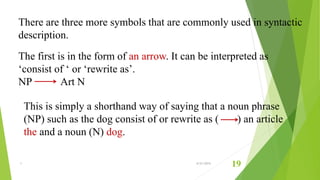
There are three more symbols that are commonly used in syntactic
description.
The first is in the form of an arrow. It can be interpreted as
‘consist of ‘ or ‘rewrite as’.
NP Art N
This is simply a shorthand way of saying that a noun phrase
(NP) such as the dog consist of or rewrite as ( ) an article
the and a noun (N) dog.
1 6/21/2015
19
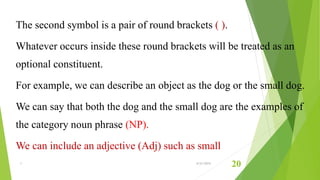
The second symbol is a pair of round brackets ( ).
Whatever occurs inside these round brackets will be treated as an
optional constituent.
For example, we can describe an object as the dog or the small dog.
We can say that both the dog and the small dog are the examples of
the category noun phrase (NP).
We can include an adjective (Adj) such as small
1 6/21/2015
20
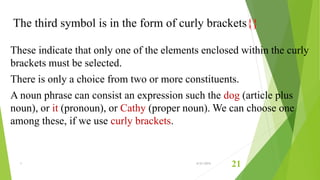
The third symbol is in the form of curly brackets{}
These indicate that only one of the elements enclosed within the curly
brackets must be selected.
There is only a choice from two or more constituents.
A noun phrase can consist an expression such the dog (article plus
noun), or it (pronoun), or Cathy (proper noun). We can choose one
among these, if we use curly brackets.
1 6/21/2015
21
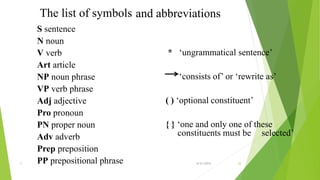
The list of symbols
S sentence
N noun
V verb
Art article
NP noun phrase
VP verb phrase
Adj adjective
Pro pronoun
PN proper noun
Adv adverb
Prep preposition
PP prepositional phrase
* ‘ungrammatical sentence’
‘consists of’ or ‘rewrite as’
( ) ‘optional constituent’
{ } ‘one and only one of these
constituents must be selected’
and abbreviations
1 6/21/2015 22
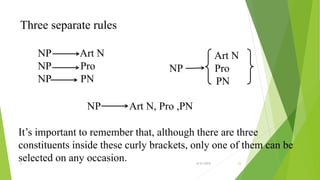
Three separate rules
NP Art N
NP Pro
NP PN
NP Art N, Pro ,PN
Art N
NP Pro
PN
It’s important to remember that, although there are three
constituents inside these curly brackets, only one of them can be
selected on any occasion.1 6/21/2015 23
Tree Diagrams
It’s the way to describe the structure of sentences to create a more
explicit representation of the hierarchical organization of one
structure
NP
Art N
[The] [girl]
NP
Art N
The girl
1 6/21/2015
24
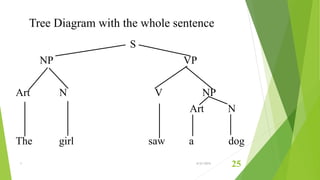
Tree Diagram with the whole sentence
S
NP VP
Art N V NP
Art N
The girl saw a dog
1 6/21/2015
25
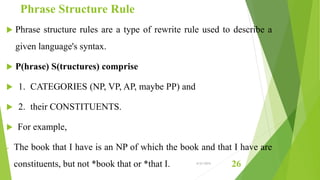
Phrase Structure Rule
 Phrase structure rules are a type of rewrite rule used to describe a
given language's syntax.
 P(hrase) S(tructures) comprise
 1. CATEGORIES (NP, VP, AP, maybe PP) and
 2. their CONSTITUENTS.
 For example,
- The book that I have is an NP of which the book and that I have are
constituents, but not *book that or *that I.1 6/21/2015
26
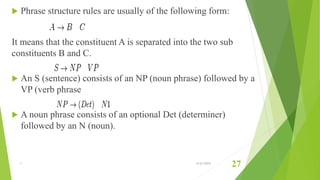
 Phrase structure rules are usually of the following form:
It means that the constituent A is separated into the two sub
constituents B and C.
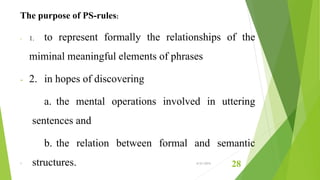
 An S (sentence) consists of an NP (noun phrase) followed by a
VP (verb phrase
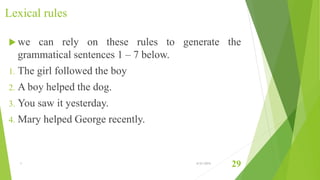
 A noun phrase consists of an optional Det (determiner)
followed by an N (noun).
1 6/21/2015
27
The purpose of PS-rules:
- 1. to represent formally the relationships of the
miminal meaningful elements of phrases
- 2. in hopes of discovering
a. the mental operations involved in uttering
sentences and
b. the relation between formal and semantic
structures.1 6/21/2015
28
Lexical rules
 we can rely on these rules to generate the
grammatical sentences 1 – 7 below.
1. The girl followed the boy
2. A boy helped the dog.
3. You saw it yesterday.
4. Mary helped George recently.
1 6/21/2015
29
5. George saw a dog .
6. A small dog followed Mary.
7. The small boy saw George with a crazy dog
recently .
8. You it saw .
9. Mary helped boy.
10.Followed the dog
1 6/21/2015
30
Lexical rules (2)
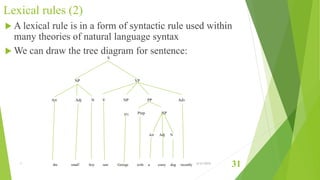
 A lexical rule is in a form of syntactic rule used within
many theories of natural language syntax
 We can draw the tree diagram for sentence:
PN
Art Adj N
the small` boy saw George with a crazy dog recently
S
NP VP
Art Adj N V NP PP Adv
Prep NP
1 6/21/2015
31
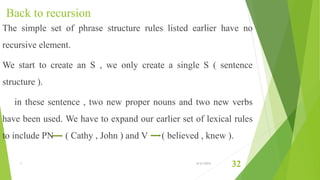
Back to recursion
The simple set of phrase structure rules listed earlier have no
recursive element.
We start to create an S , we only create a single S ( sentence
structure ).
in these sentence , two new proper nouns and two new verbs
have been used. We have to expand our earlier set of lexical rules
to include PN ( Cathy , John ) and V ( believed , knew ).
1 6/21/2015
32
Complement phrases
The role of that as a complementizer is to introduce a
complement phrase (CP). We can identify one CP which
contains that plus Mary helped George. We already
know that Mary helped George is a sentence (S).
We can also see from the same sentence that the
complement phrase (CP) comes after a verb (V) knew.
This means that we are using the CP as part of a verb
phrase (VP) , as in knew that.
1 6/21/2015
33
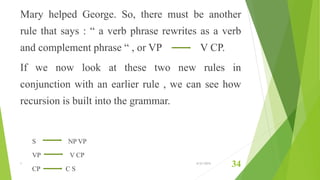
Mary helped George. So, there must be another
rule that says : “ a verb phrase rewrites as a verb
and complement phrase “ , or VP V CP.
If we now look at these two new rules in
conjunction with an earlier rule , we can see how
recursion is built into the grammar.
S NP VP
VP V CP
CP C S
1 6/21/2015
34
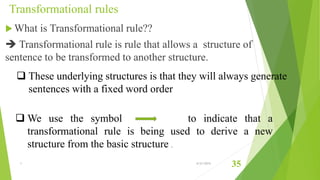
Transformational rules
 What is Transformational rule??
 Transformational rule is rule that allows a structure of
sentence to be transformed to another structure.
 These underlying structures is that they will always generate
sentences with a fixed word order
 We use the symbol to indicate that a
transformational rule is being used to derive a new
structure from the basic structure .
1 6/21/2015
35
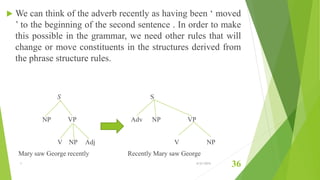
 We can think of the adverb recently as having been ‘ moved
’ to the beginning of the second sentence . In order to make
this possible in the grammar, we need other rules that will
change or move constituents in the structures derived from
the phrase structure rules.
S S
NP VP Adv NP VP
V NP Adj V NP
Mary saw George recently Recently Mary saw George
1 6/21/2015
36
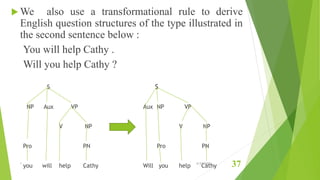
 We also use a transformational rule to derive
English question structures of the type illustrated in
the second sentence below :
You will help Cathy .
Will you help Cathy ?
S S
NP Aux VP Aux NP VP
V NP V NP
Pro PN Pro PN
you will help Cathy Will you help Cathy
1 6/21/2015
37
There are many more rules and concepts in the
analysis of syntax. However , having explored some of
the basic issues and methods of syntactic analysis in
order to talk about ‘ structure ‘ in language , we must
move on to consider how we might incorporate the
analysis of ‘ in the study of language .
1 6/21/2015
38
The end
Thanks you for attention
1 6/21/2015
39

Syntax

  • 1.
    វិទ្យាស្ថា នសហប្រតិរតតិការអនតរជាតិ កម្ពុជា CambodiaInternational Cooperation Institute Faculty of Arts, Humanities and Languages Applied Linguistics Submitted by: Group III 1.Miss. Chean Loemhun 2.Miss. Ross Socheat 3.Miss. Ly Bunna 4.Miss. Toum MuyEng 5.Miss. Yim Sina 6. Mr. Pouk sary 7. Mr. Phat Utdom Lecturer Kak Sovanna 1 6/21/2015 1
  • 2.
    contents Syntax Generative Grammar Syntactic structures Deepand surface structure Structural ambiguity Recursion 1 6/21/2015 2
  • 3.
    Symbols used insyntactic description Tree Diagrams Phrase structure rules Lexical rules Back to recursion Complement phrases Transformational rules Group 03 6/21/2015 3
  • 4.
    SYNTAX In linguistics ,syntax is the set of rule , principle , and process that govern the structure of sentences in a give language. The term of syntax is also used to refer to the study of such principle and process. The goal of many syntacticians is to discover the syntax rule common to all language and in literal means “ a putting together or arrangement ” Group 3 6/29/2015 4
  • 5.
    Generative Grammar  Linguistshave attempted to produce a particular type of grammar that have a very explicit system of rules specifying what combinations of basic elements would result in well-formed sentences. This very explicit system of rules . it was proposed , would have a lot on common with the types of rules found in mathematics . 1 6/21/2015 5
  • 6.
     In basicalgebra , if we have an expression such as 3x + 2y , and we give x and y the value of any whole number , then that simple algebraic expression can “ generate “ and endless set of values by following the simple rules of arithmetic. When x = 5 and y = 10 , the result is 35. When x = 2 and y = 1, the result is 8 . these results will follow directly and predictably from applying the explicit rules. 1 6/21/2015 6
  • 7.
    Syntactic structures  Agenerative grammar defines the syntactic structures of a language . the grammar will generate all well- formed syntactic structures ( e.g. sentence ) of the language and will not generate any ill-formed structures.  The grammar will have a finite ( i.e. limited ) number of rules , 6/21/2015 7
  • 8.
    be will becapable of generating an infinite number of well-formed structures.  The grammar should also be capable of revealing the basis of two other phenomena : first, how some superficially different sentences are closely related and , second , have some superficially similar sentences are in fact different. 1 6/21/2015 8
  • 9.
    Deep and surfacestructure  The distinction between them is a different in their surface structure , that is the different syntactic forms they have as individual English sentences .  This superficial different in form disguises the fact that the two sentences are very closely related, even identical at some less superficial level.  . 1 6/21/2015 9
  • 10.
     This other“ underlying “ level, where the basic components ( noun phrase + verb + noun phrase ) shared by the two sentences can be represented , is called their deep structure. 1 6/21/2015 10
  • 11.
    Structural ambiguity  Thesetwo different versions of events can actually be expressed in the same surface structure forms : Annie whacked a man with an umbrella.  This sentences provides an example of structural ambiguity. It have two distinct underling interpretations that have to be represented differently in deep structure.1 6/21/2015 11
  • 12.
     Part ofthe underlying structure would be something like : ‘I shot an elephant ( which was ) in my pyjamas.  There are two different underlying structures with the same surface structure .  The grammar will have to be capable of showing the structural distinction between these underlying representations 1 6/21/2015 12
  • 13.
    Recursion  The rulesof grammar will also need the crucial property of recursion.  Using different words ( near the window ) , for as long as the sentence still make sense ( in the bedroom ) . 1 6/21/2015 13
  • 14.
    • Recursion (‘repeatableany number of times’) rules have the capacity to be applied more than once in generating a structure. • For example, we can have one prepositional phrase describing location (on the table) in the sentence The gun was on the table. 1 6/21/2015 14
  • 15.
    • We canalso repeat this type of phrase, using different words (near the window), for as long a the sentence still makes sense (in the bedroom). • So, in order to generate a sentence such as The gun was on the table near the window in the bedroom, we must be able to repeat the rule that creates a prepositional phrase over and over again. 1 6/21/2015 15
  • 16.
     In principle, there is no end to the recursion that would produce ever longer versions of complex sentences with this structure .  We should note that recursion of this type is not only a feature of grammar. But can also be an essential part of a theory of cosmic structure , as in the role of turtles in one little old lady’s view of the universe.1 6/21/2015 16
  • 17.
    • We mustalso be able to put sentences inside other sentences. • For example, when we produce a sentence such as Cathy knew that Mary helped George, we do so with the sentence Mary helped Gorge inside it. • Those two sentences can be generated inside another sentence such as Jonh belived that Cathy knew that Mary helped Gorge. 1 6/21/2015 17
  • 18.
    Symbols Used InSyntactic Description  The way in which syntactic analysis is presented.  Some symbols in previous sections as abbreviations for syntactic categories: ‘S’ (= sentence) ‘NP’ (= noun phrase) ‘N’ (= noun) ‘Art’ (= article) 1 6/21/2015 18
  • 19.
    There are threemore symbols that are commonly used in syntactic description. The first is in the form of an arrow. It can be interpreted as ‘consist of ‘ or ‘rewrite as’. NP Art N This is simply a shorthand way of saying that a noun phrase (NP) such as the dog consist of or rewrite as ( ) an article the and a noun (N) dog. 1 6/21/2015 19
  • 20.
    The second symbolis a pair of round brackets ( ). Whatever occurs inside these round brackets will be treated as an optional constituent. For example, we can describe an object as the dog or the small dog. We can say that both the dog and the small dog are the examples of the category noun phrase (NP). We can include an adjective (Adj) such as small 1 6/21/2015 20
  • 21.
    The third symbolis in the form of curly brackets{} These indicate that only one of the elements enclosed within the curly brackets must be selected. There is only a choice from two or more constituents. A noun phrase can consist an expression such the dog (article plus noun), or it (pronoun), or Cathy (proper noun). We can choose one among these, if we use curly brackets. 1 6/21/2015 21
  • 22.
    The list ofsymbols S sentence N noun V verb Art article NP noun phrase VP verb phrase Adj adjective Pro pronoun PN proper noun Adv adverb Prep preposition PP prepositional phrase * ‘ungrammatical sentence’ ‘consists of’ or ‘rewrite as’ ( ) ‘optional constituent’ { } ‘one and only one of these constituents must be selected’ and abbreviations 1 6/21/2015 22
  • 23.
    Three separate rules NPArt N NP Pro NP PN NP Art N, Pro ,PN Art N NP Pro PN It’s important to remember that, although there are three constituents inside these curly brackets, only one of them can be selected on any occasion.1 6/21/2015 23
  • 24.
    Tree Diagrams It’s theway to describe the structure of sentences to create a more explicit representation of the hierarchical organization of one structure NP Art N [The] [girl] NP Art N The girl 1 6/21/2015 24
  • 25.
    Tree Diagram withthe whole sentence S NP VP Art N V NP Art N The girl saw a dog 1 6/21/2015 25
  • 26.
    Phrase Structure Rule Phrase structure rules are a type of rewrite rule used to describe a given language's syntax.  P(hrase) S(tructures) comprise  1. CATEGORIES (NP, VP, AP, maybe PP) and  2. their CONSTITUENTS.  For example, - The book that I have is an NP of which the book and that I have are constituents, but not *book that or *that I.1 6/21/2015 26
  • 27.
     Phrase structurerules are usually of the following form: It means that the constituent A is separated into the two sub constituents B and C.  An S (sentence) consists of an NP (noun phrase) followed by a VP (verb phrase  A noun phrase consists of an optional Det (determiner) followed by an N (noun). 1 6/21/2015 27
  • 28.
    The purpose ofPS-rules: - 1. to represent formally the relationships of the miminal meaningful elements of phrases - 2. in hopes of discovering a. the mental operations involved in uttering sentences and b. the relation between formal and semantic structures.1 6/21/2015 28
  • 29.
    Lexical rules  wecan rely on these rules to generate the grammatical sentences 1 – 7 below. 1. The girl followed the boy 2. A boy helped the dog. 3. You saw it yesterday. 4. Mary helped George recently. 1 6/21/2015 29
  • 30.
    5. George sawa dog . 6. A small dog followed Mary. 7. The small boy saw George with a crazy dog recently . 8. You it saw . 9. Mary helped boy. 10.Followed the dog 1 6/21/2015 30
  • 31.
    Lexical rules (2) A lexical rule is in a form of syntactic rule used within many theories of natural language syntax  We can draw the tree diagram for sentence: PN Art Adj N the small` boy saw George with a crazy dog recently S NP VP Art Adj N V NP PP Adv Prep NP 1 6/21/2015 31
  • 32.
    Back to recursion Thesimple set of phrase structure rules listed earlier have no recursive element. We start to create an S , we only create a single S ( sentence structure ). in these sentence , two new proper nouns and two new verbs have been used. We have to expand our earlier set of lexical rules to include PN ( Cathy , John ) and V ( believed , knew ). 1 6/21/2015 32
  • 33.
    Complement phrases The roleof that as a complementizer is to introduce a complement phrase (CP). We can identify one CP which contains that plus Mary helped George. We already know that Mary helped George is a sentence (S). We can also see from the same sentence that the complement phrase (CP) comes after a verb (V) knew. This means that we are using the CP as part of a verb phrase (VP) , as in knew that. 1 6/21/2015 33
  • 34.
    Mary helped George.So, there must be another rule that says : “ a verb phrase rewrites as a verb and complement phrase “ , or VP V CP. If we now look at these two new rules in conjunction with an earlier rule , we can see how recursion is built into the grammar. S NP VP VP V CP CP C S 1 6/21/2015 34
  • 35.
    Transformational rules  Whatis Transformational rule??  Transformational rule is rule that allows a structure of sentence to be transformed to another structure.  These underlying structures is that they will always generate sentences with a fixed word order  We use the symbol to indicate that a transformational rule is being used to derive a new structure from the basic structure . 1 6/21/2015 35
  • 36.
     We canthink of the adverb recently as having been ‘ moved ’ to the beginning of the second sentence . In order to make this possible in the grammar, we need other rules that will change or move constituents in the structures derived from the phrase structure rules. S S NP VP Adv NP VP V NP Adj V NP Mary saw George recently Recently Mary saw George 1 6/21/2015 36
  • 37.
     We alsouse a transformational rule to derive English question structures of the type illustrated in the second sentence below : You will help Cathy . Will you help Cathy ? S S NP Aux VP Aux NP VP V NP V NP Pro PN Pro PN you will help Cathy Will you help Cathy 1 6/21/2015 37
  • 38.
    There are manymore rules and concepts in the analysis of syntax. However , having explored some of the basic issues and methods of syntactic analysis in order to talk about ‘ structure ‘ in language , we must move on to consider how we might incorporate the analysis of ‘ in the study of language . 1 6/21/2015 38
  • 39.
    The end Thanks youfor attention 1 6/21/2015 39