
Chapter 3: Syntax
Presented by Kak Sovanna
Academic Year: 2014-2015
16/28/2015 Presented by Mr. Kak Sovanna (+85593600021)
6/28/2015 2Presented by Mr. Kak Sovanna (+85593600021)
Read the following sentences and try to
identify various meanings in each sentence.
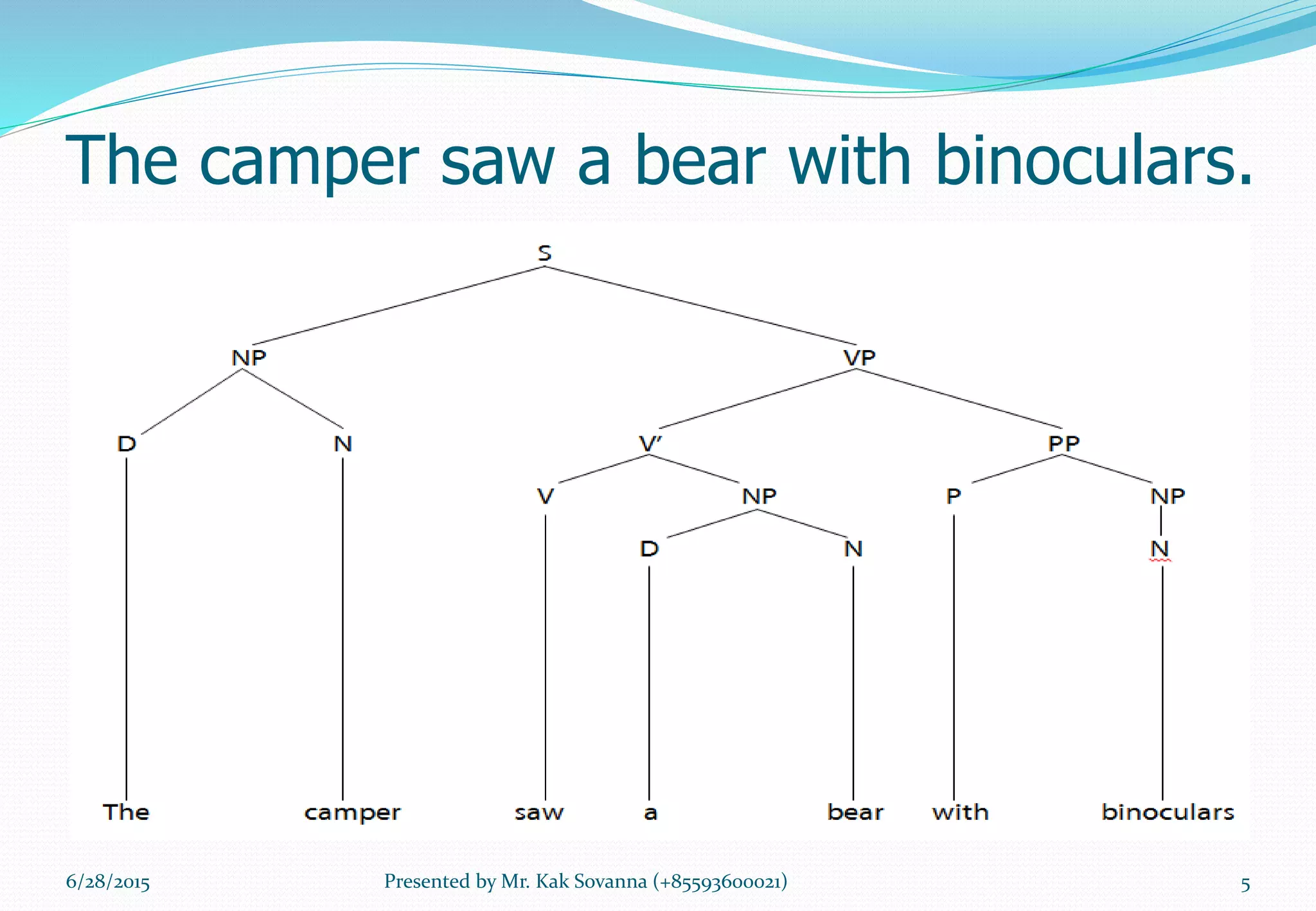
 The camper saw a bear with binoculars.
 I once shot an elephant in my pajamas.
 Flying planes can be dangerous.
 A: I just saw someone carrying a monkey and
an elephant go into the circus.
 B: Wow, that someone must be pretty strong.
6/28/2015 3Presented by Mr. Kak Sovanna (+85593600021)
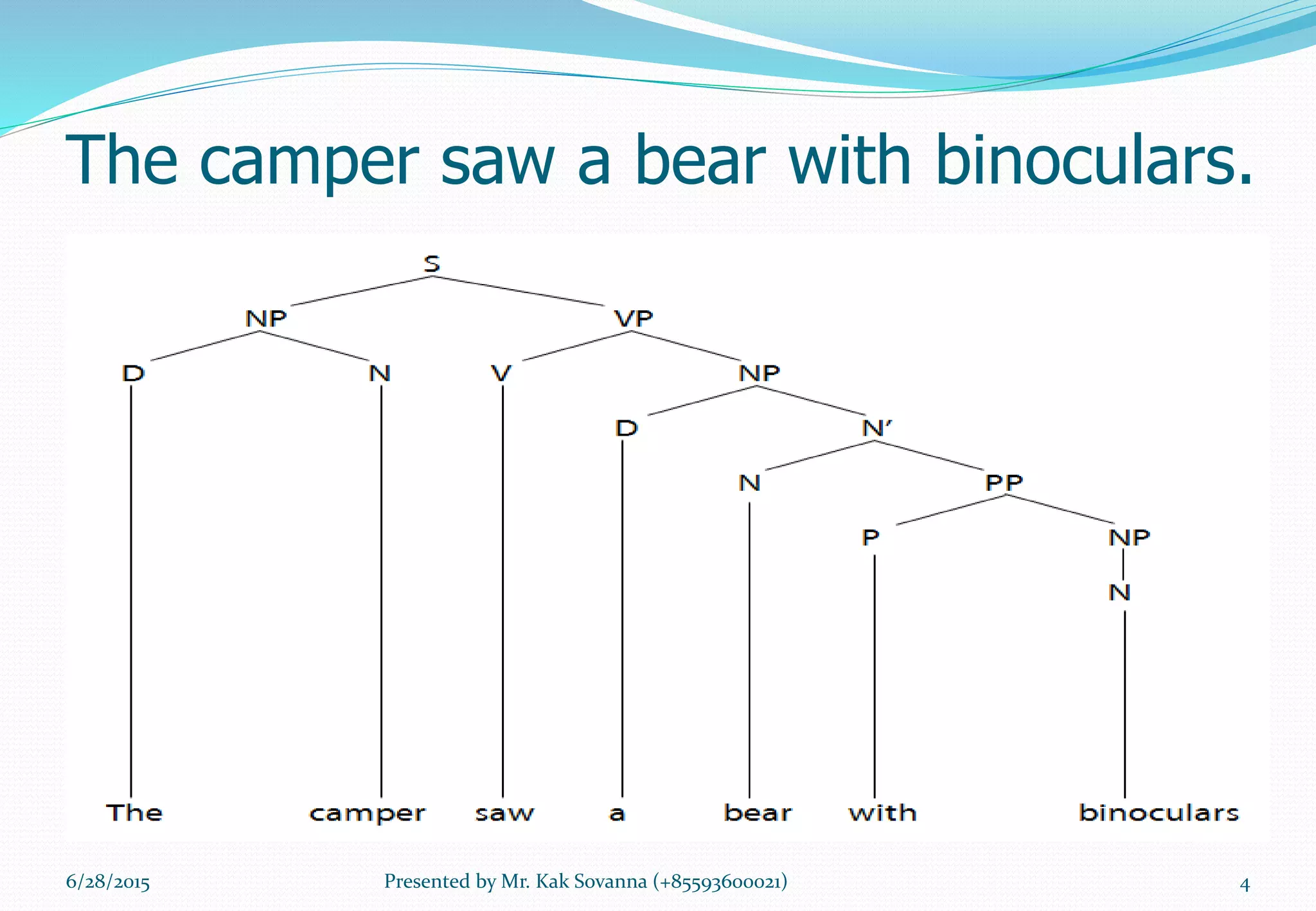
The camper saw a bear with binoculars.
6/28/2015 4Presented by Mr. Kak Sovanna (+85593600021)
The camper saw a bear with binoculars.
6/28/2015 5Presented by Mr. Kak Sovanna (+85593600021)
Content
What is syntax?
Generative Grammar
Syntactic Description
References
6/28/2015 6Presented by Mr. Kak Sovanna (+85593600021)
What is syntax?
It comes from Greek, syntaxis (syn
‘together’ + taxis ‘to arrange’ -> ‘to
arrange together’)
Syntactic is the adjective from
syntax.
6/28/2015 7Presented by Mr. Kak Sovanna (+85593600021)
What is syntax? (1)
Syntax is the study of rules that govern
the ways in which words combine to form
phrases, clauses, and sentences.
(About.com)
It could also refer to the arrangement of
words itself in a sentence. (About.com)
6/28/2015 8Presented by Mr. Kak Sovanna (+85593600021)
What is syntax? (3)
 Linguistically, Syntax is also defined as a major
component of the grammar of a language that
concerns the ways in which words combine to
form sentences and the rules which govern the
formulation of sentences, making some
sentences possible and others not possible
within a particular language. (Dictionary of
Language Teaching and Applied Linguistics,
4th edition)
6/28/2015 9Presented by Mr. Kak Sovanna (+85593600021)
Generative Grammar
A type of grammar, inspired by Noam
Chomsky, that attempts to define and
describe, by a set of rules or principles,
all the grammatical sentences of a
language and no ungrammatical ones.
This type of grammar is said to generate,
or produce, grammatical sentences.
6/28/2015 10Presented by Mr. Kak Sovanna (+85593600021)
Generative Grammar (1)
Language is seen as consisting of a
set of finite numbers of rules, which
enable the production of infinite
numbers of well-formed sentences.
6/28/2015 11Presented by Mr. Kak Sovanna (+85593600021)
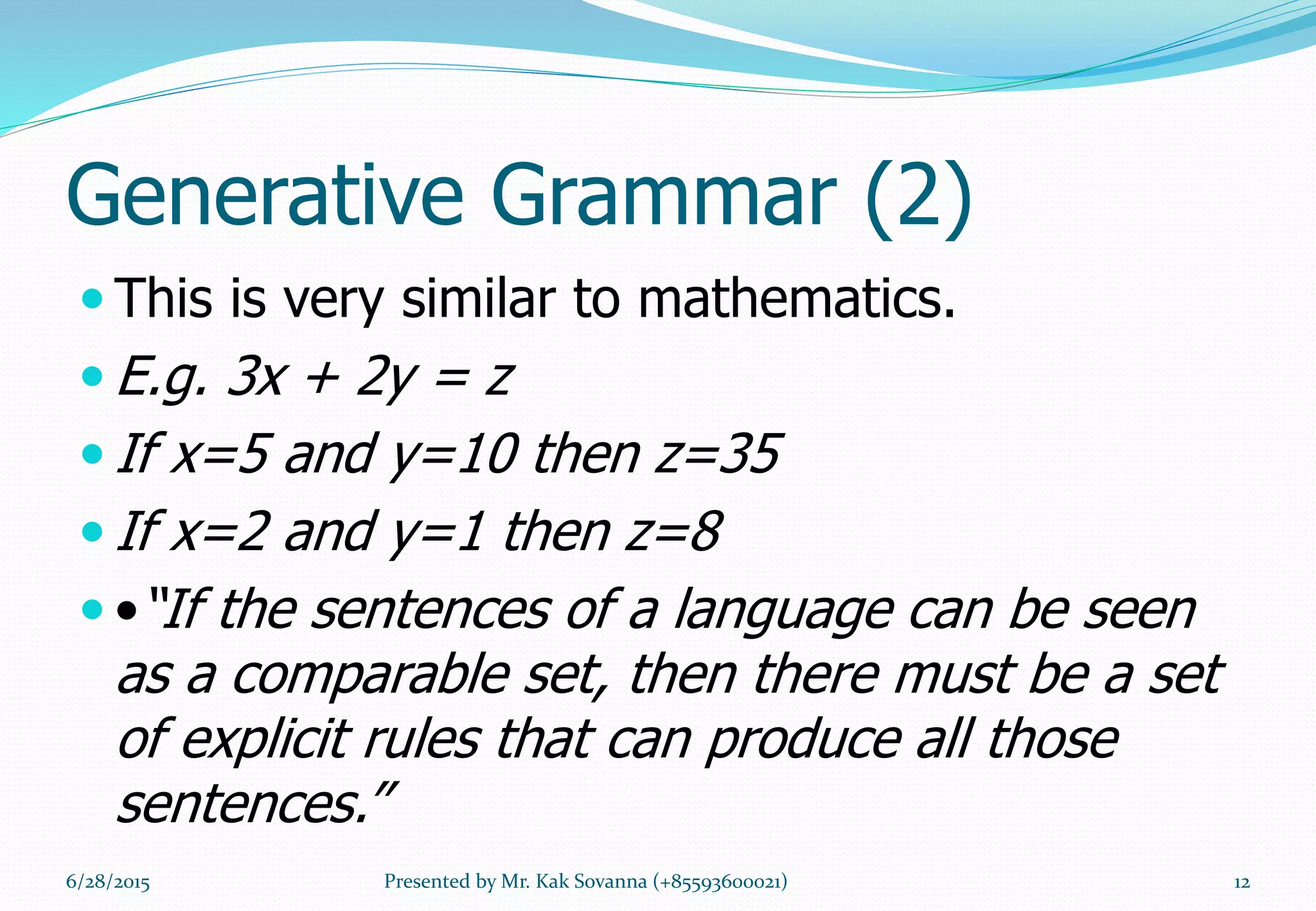
Generative Grammar (2)
 This is very similar to mathematics.
 E.g. 3x + 2y = z
 If x=5 and y=10 then z=35
 If x=2 and y=1 then z=8
 •“If the sentences of a language can be seen
as a comparable set, then there must be a set
of explicit rules that can produce all those
sentences.”
6/28/2015 12Presented by Mr. Kak Sovanna (+85593600021)
Generative Grammar (3)
Deep and Surface Structure
Generative Grammar also attempts to
describe (a) how to 2 different sentences
are closely related, and (b) how to 2
similar sentences are different.
6/28/2015 13Presented by Mr. Kak Sovanna (+85593600021)
Generative Grammar (4)
Charlie broke the window.
The window was broken by Charlie.
6/28/2015 14Presented by Mr. Kak Sovanna (+85593600021)
Generative Grammar (5)
 Deep and Surface Structure (2)
 The first sentence is active, focusing on
Charlie.
 The second is passive, focusing on window.
 The meaning is still the same, and therefore,
what makes them different is just their written
forms. This is called the Surface Structure.
6/28/2015 15Presented by Mr. Kak Sovanna (+85593600021)
Generative Grammar (6)
 Deep and Surface Structure (3)
 In fact, the all the aforementioned examples
derive from a common basic structure, which
consists of the same constituents or
components (Charlie, window, break).
 This is called the Deep Structure.
6/28/2015 16Presented by Mr. Kak Sovanna (+85593600021)
Generative Grammar (7)
Deep Structure is an abstract
underlying level of structural
organization in which all the
elements determining structural
interpretation are represented.
6/28/2015 17Presented by Mr. Kak Sovanna (+85593600021)
Generative Grammar (8)
Deep and Surface Structure (4)
Suppose we have a deep structure:
NP + V + NP
6/28/2015 18Presented by Mr. Kak Sovanna (+85593600021)
Generative Grammar (9)
Deep and Surface Structure (4)
 The following sentences can be derived:
 a)Charlie broke the window.
 b)The window was broken by Charlie.
 c)It was Charlie who broke the window.
 d)Was the window broken by Charlie?
6/28/2015 19Presented by Mr. Kak Sovanna (+85593600021)
Generative Grammar (10)
Deep and Surface Structure (5)
In short,
Deep Structure = Basic Structure
Surface Structure = Transformed Structure
6/28/2015 20Presented by Mr. Kak Sovanna (+85593600021)
Generative Grammar (11)
Deep and Surface Structure (6)
Sometimes, 2 different deep structures
could also be expressed in the same
surface structure.
6/28/2015 21Presented by Mr. Kak Sovanna (+85593600021)
Generative Grammar (12)
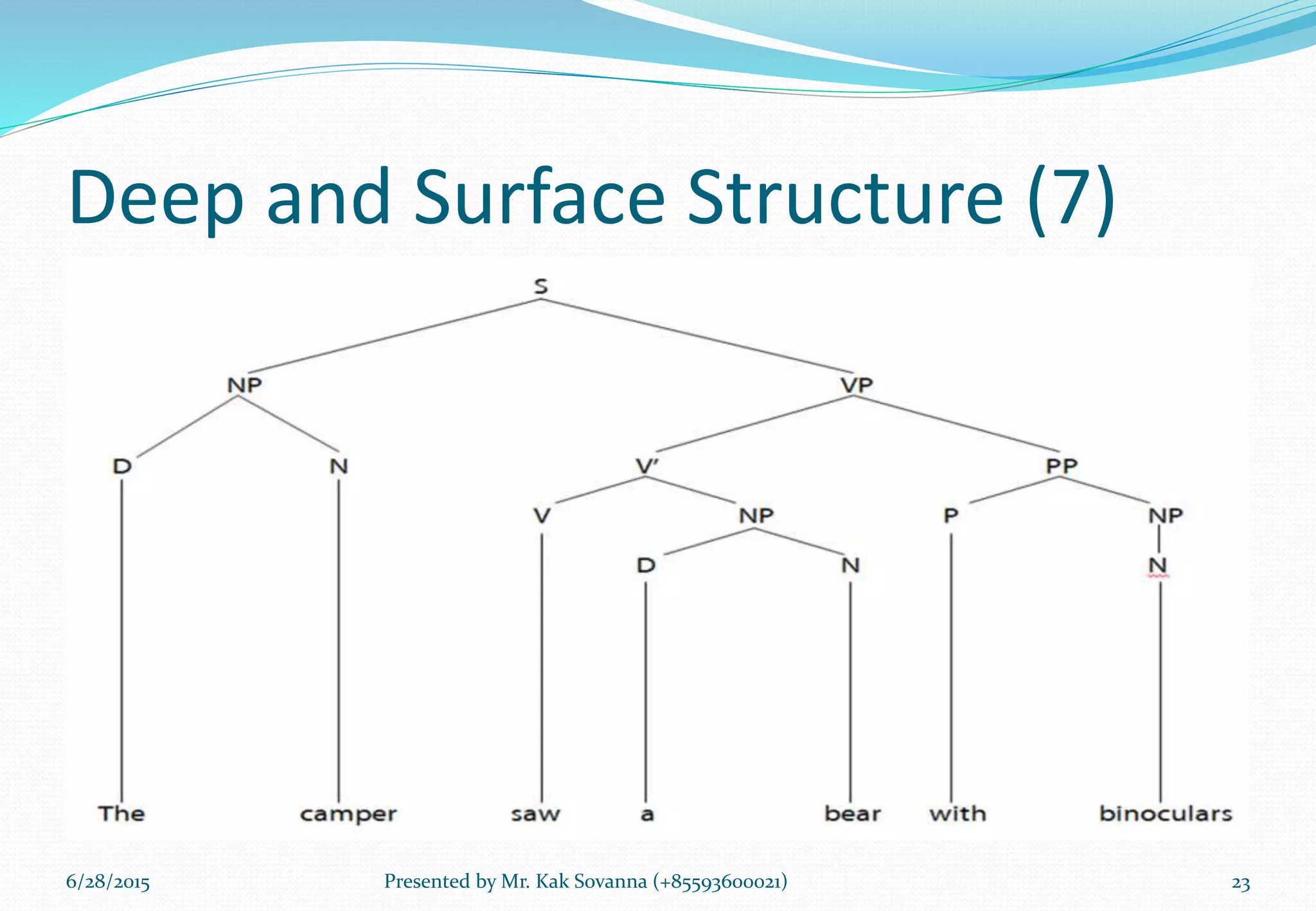
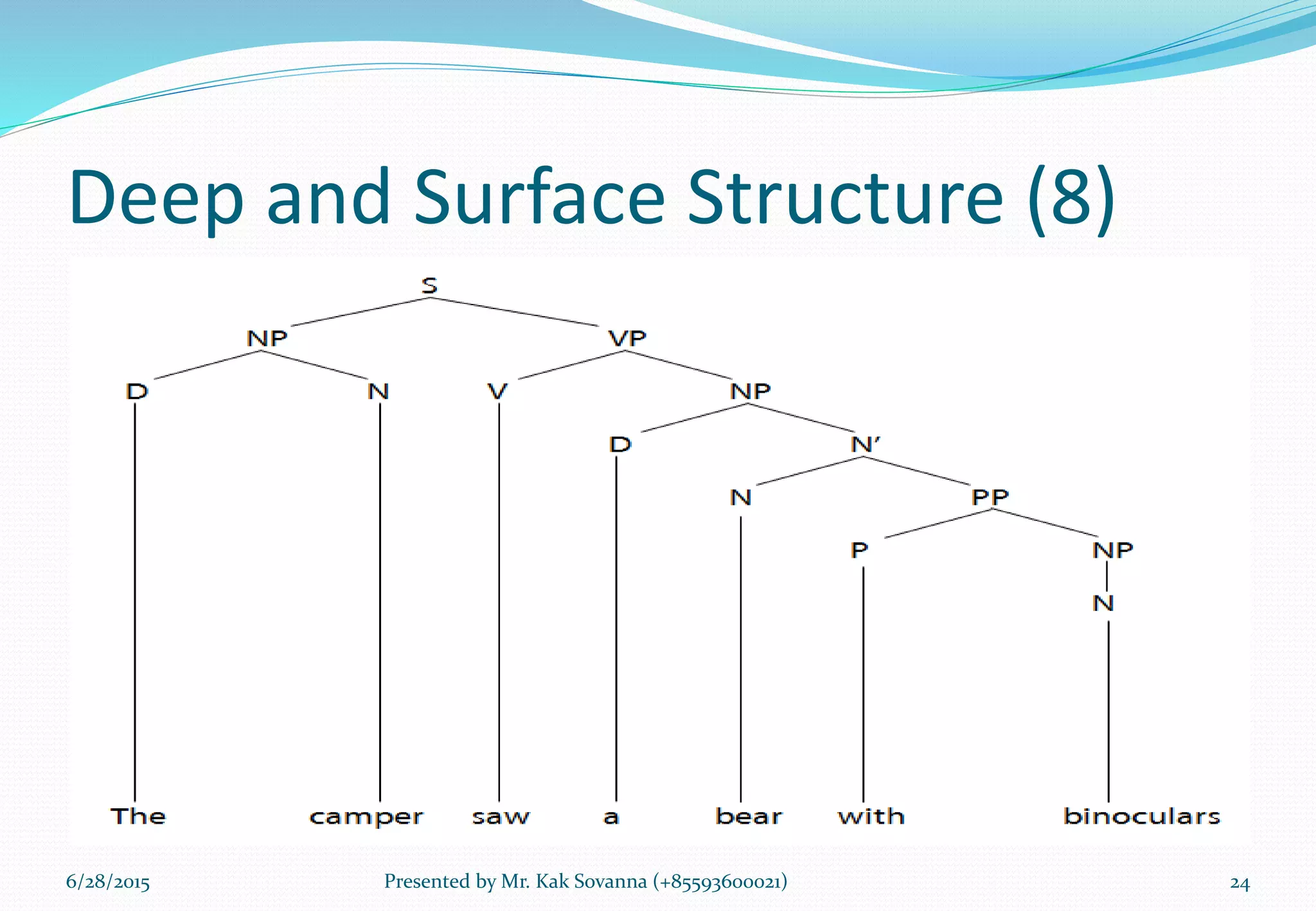
 Eg. The camper saw a bear with binoculars.
 (1) would mean that the camper use
binoculars to see a bear
 (2) would mean that the camper see a bear
who is using a binocular
6/28/2015 22Presented by Mr. Kak Sovanna (+85593600021)
Deep and Surface Structure (7)
6/28/2015 Presented by Mr. Kak Sovanna (+85593600021) 23
Deep and Surface Structure (8)
6/28/2015 Presented by Mr. Kak Sovanna (+85593600021) 24
Generative Grammar (13)
 Deep and Surface Structure (9)
 This is called Structural Ambiguity.
 Structural Ambiguity occurs when a particular
sentence (or structure) could have two or
more underlying interpretations that have to
be represented differently in deep structure.
6/28/2015 Presented by Mr. Kak Sovanna (+85593600021) 25
Generative Grammar (14)
 E.g. Those small boys and girls have been selected
for the contest.
 E.g. Outside of a dog, a book is a man’s best friend;
inside it’s too hard to read.
 Everybody knows dogs are man's best friend, right?
Well, books are, too-in a way. You can read books
and understand them, but dogs aren't easy to
understand. that's what "inside if a dog it's too dark
to read" means.
6/28/2015 Presented by Mr. Kak Sovanna (+85593600021) 26
Generative Grammar (15)
Recursion
Recursive rules have the capacity to
be applied more than once in
generating a structure.
6/28/2015 Presented by Mr. Kak Sovanna (+85593600021) 27
Generative Grammar (16)
Recursion
E.g. The gun was on the table near
the window in the bedroom of the
old house.
E.g. John believed that Cathy knew
that Mary helped George.
6/28/2015 Presented by Mr. Kak Sovanna (+85593600021) 28
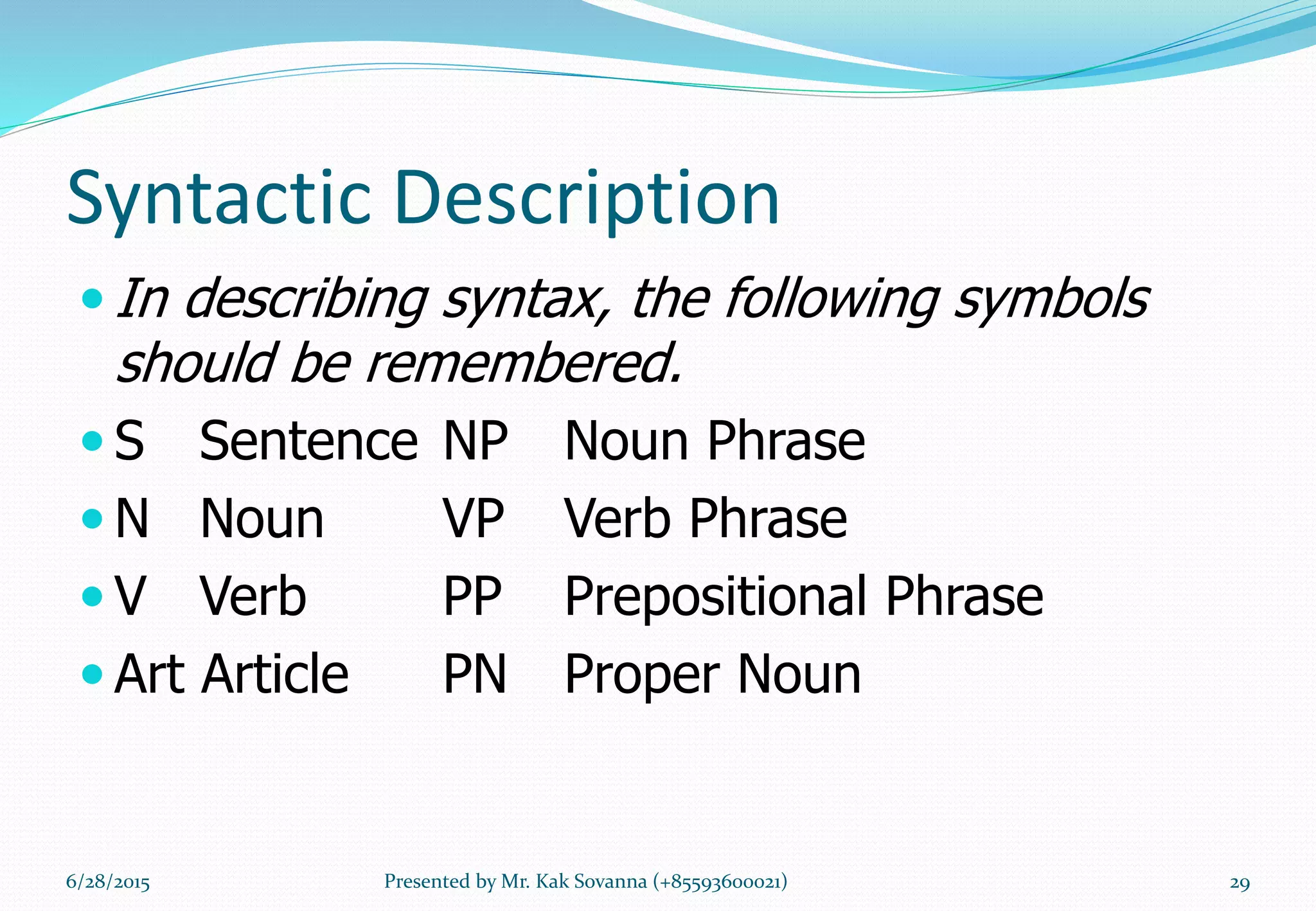
Syntactic Description
 In describing syntax, the following symbols
should be remembered.
 S Sentence NP Noun Phrase
 N Noun VP Verb Phrase
 V Verb PP Prepositional Phrase
 Art Article PN Proper Noun
6/28/2015 Presented by Mr. Kak Sovanna (+85593600021) 29
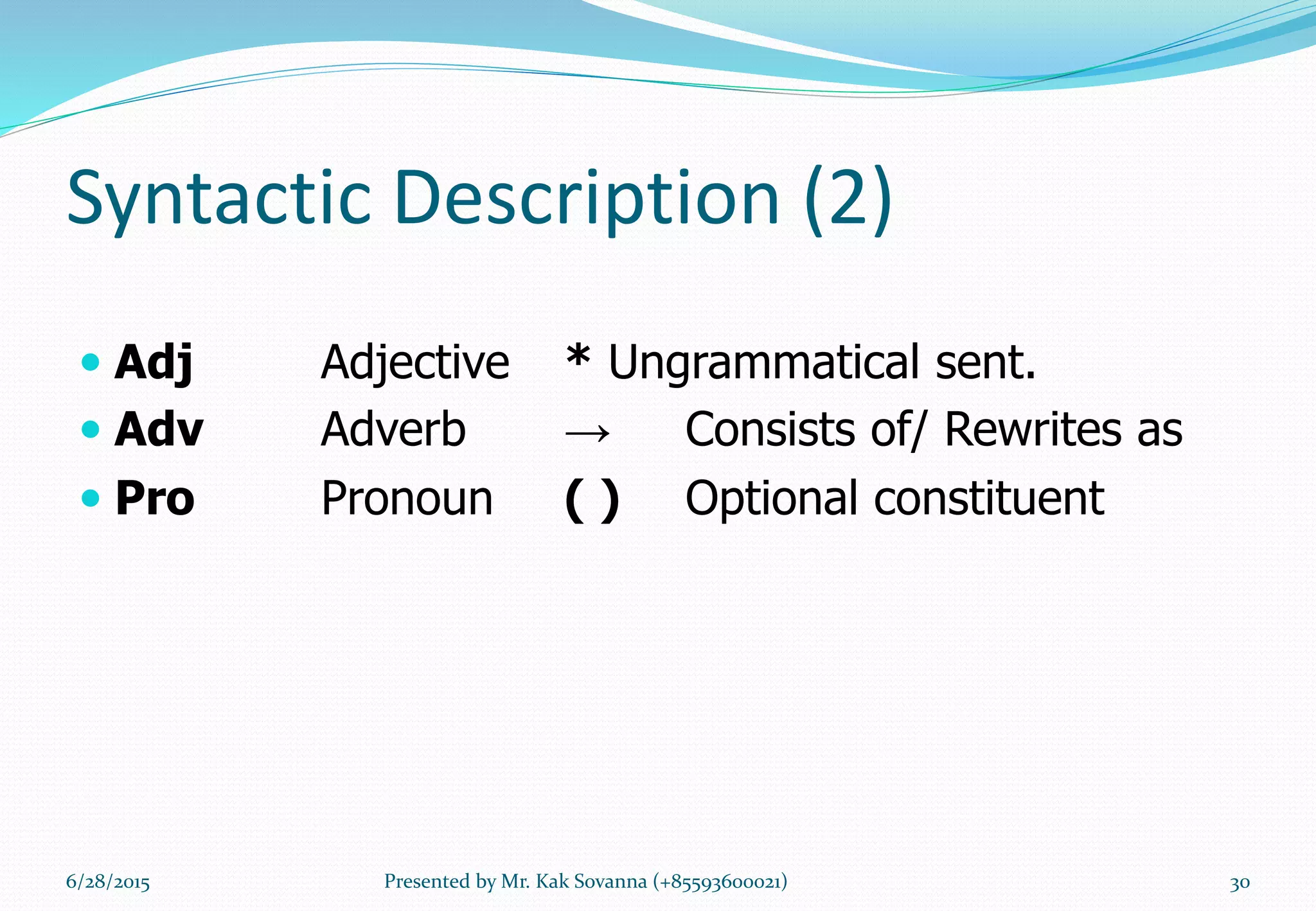
Syntactic Description (2)
 Adj Adjective * Ungrammatical sent.
 Adv Adverb → Consists of/ Rewrites as
 Pro Pronoun ( ) Optional constituent
6/28/2015 Presented by Mr. Kak Sovanna (+85593600021) 30
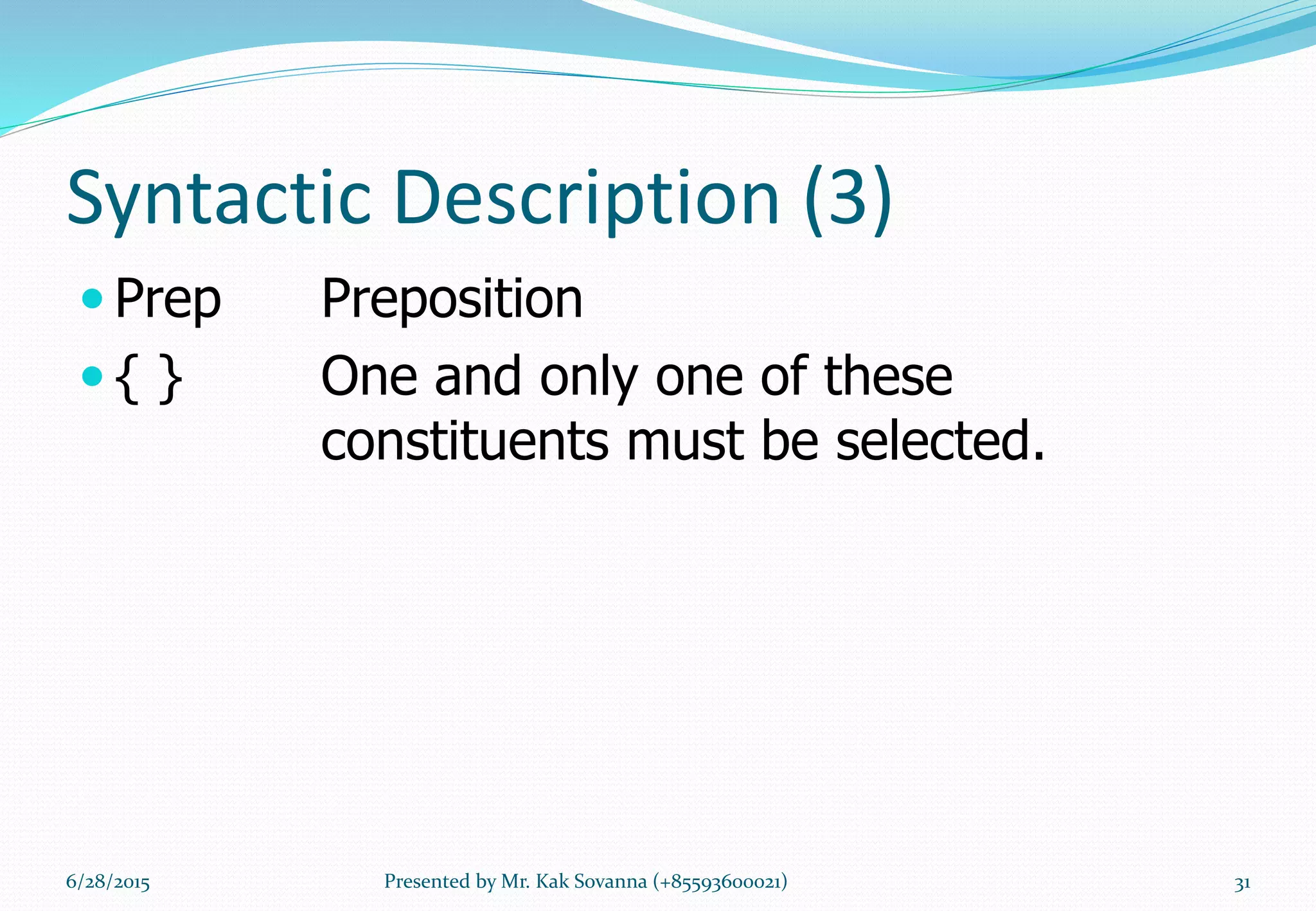
Syntactic Description (3)
 Prep Preposition
 { } One and only one of these
constituents must be selected.
6/28/2015 Presented by Mr. Kak Sovanna (+85593600021) 31
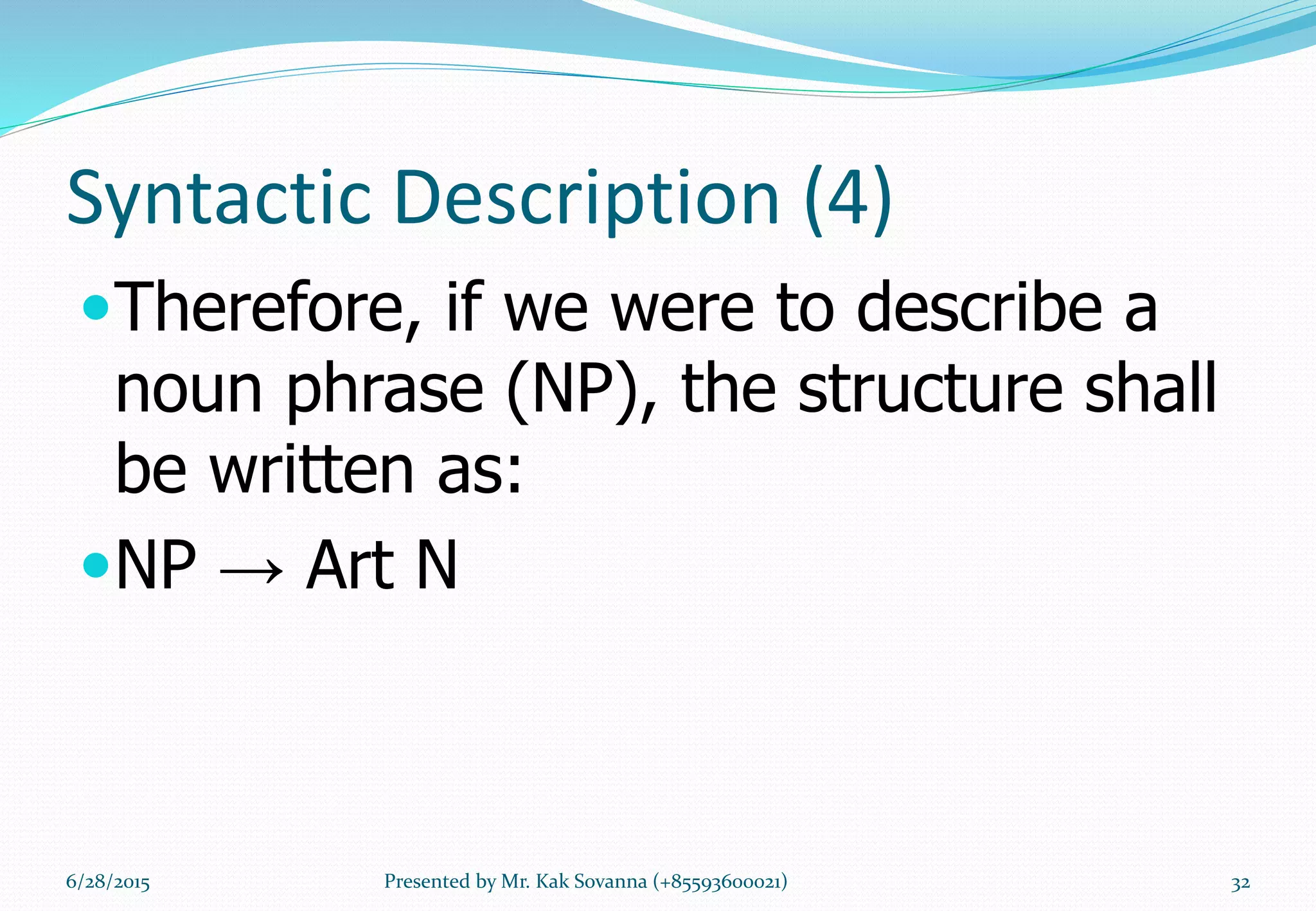
Syntactic Description (4)
Therefore, if we were to describe a
noun phrase (NP), the structure shall
be written as:
NP → Art N
6/28/2015 Presented by Mr. Kak Sovanna (+85593600021) 32
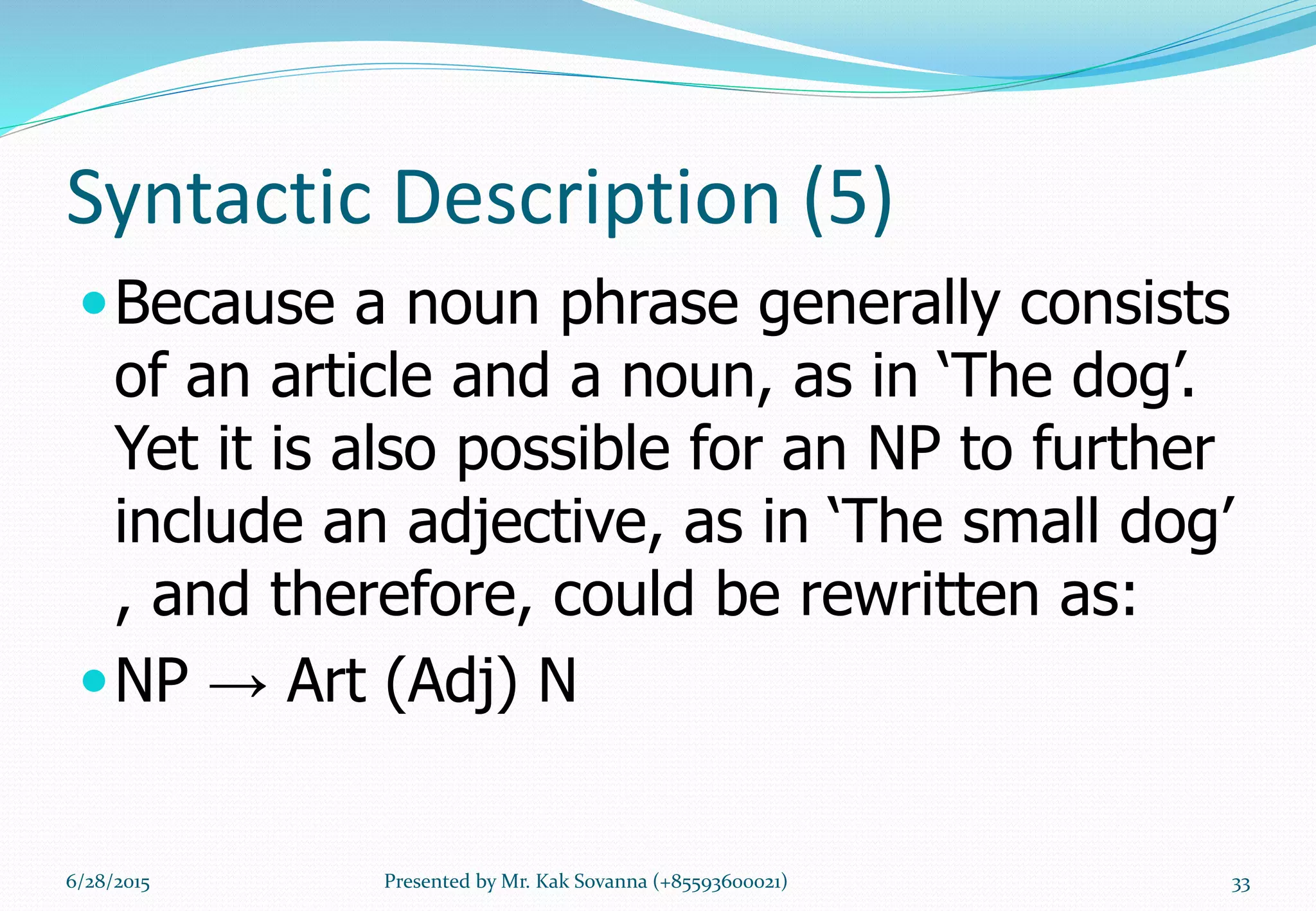
Syntactic Description (5)
Because a noun phrase generally consists
of an article and a noun, as in ‘The dog’.
Yet it is also possible for an NP to further
include an adjective, as in ‘The small dog’
, and therefore, could be rewritten as:
NP → Art (Adj) N
6/28/2015 Presented by Mr. Kak Sovanna (+85593600021) 33
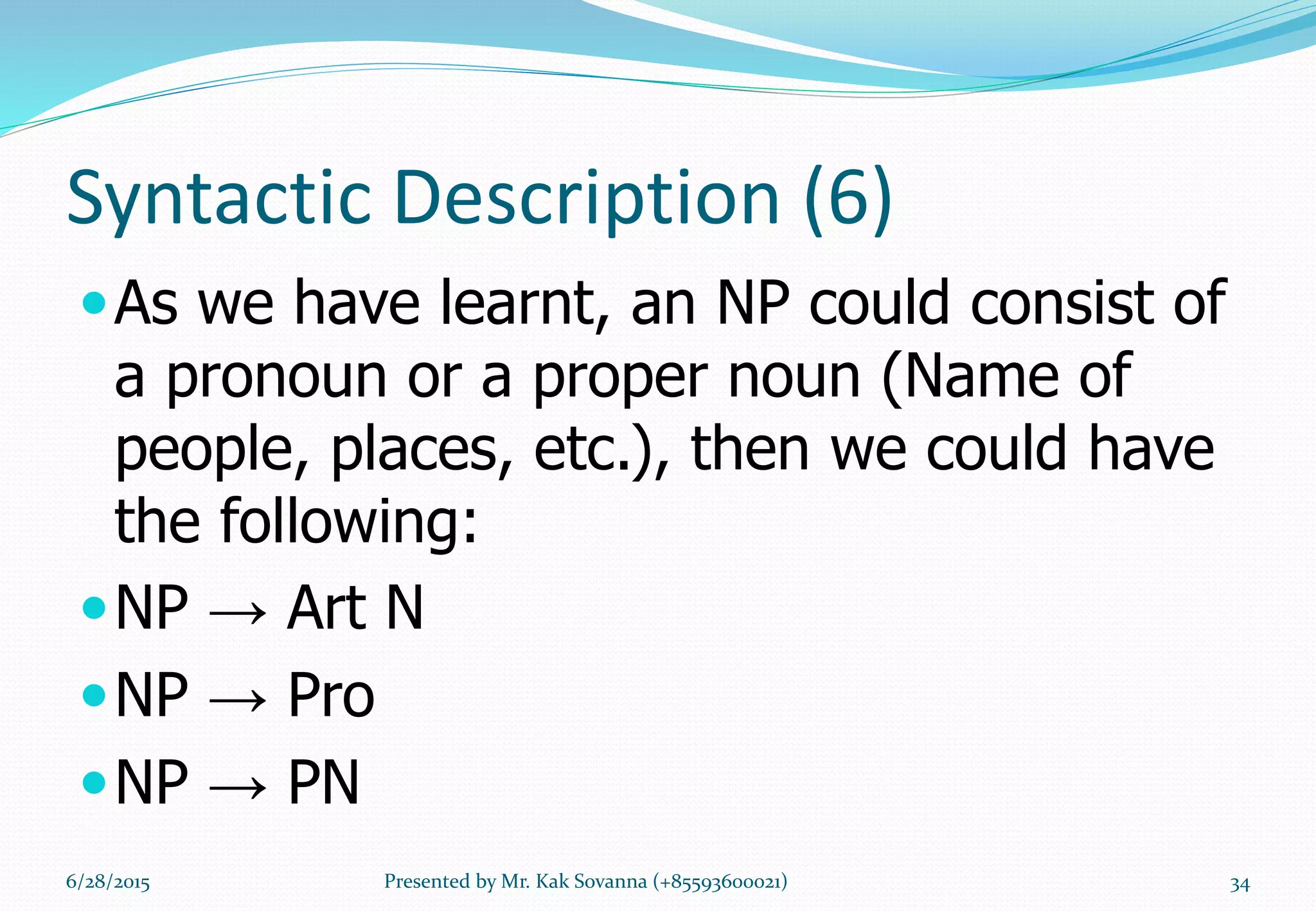
Syntactic Description (6)
As we have learnt, an NP could consist of
a pronoun or a proper noun (Name of
people, places, etc.), then we could have
the following:
NP → Art N
NP → Pro
NP → PN
6/28/2015 Presented by Mr. Kak Sovanna (+85593600021) 34
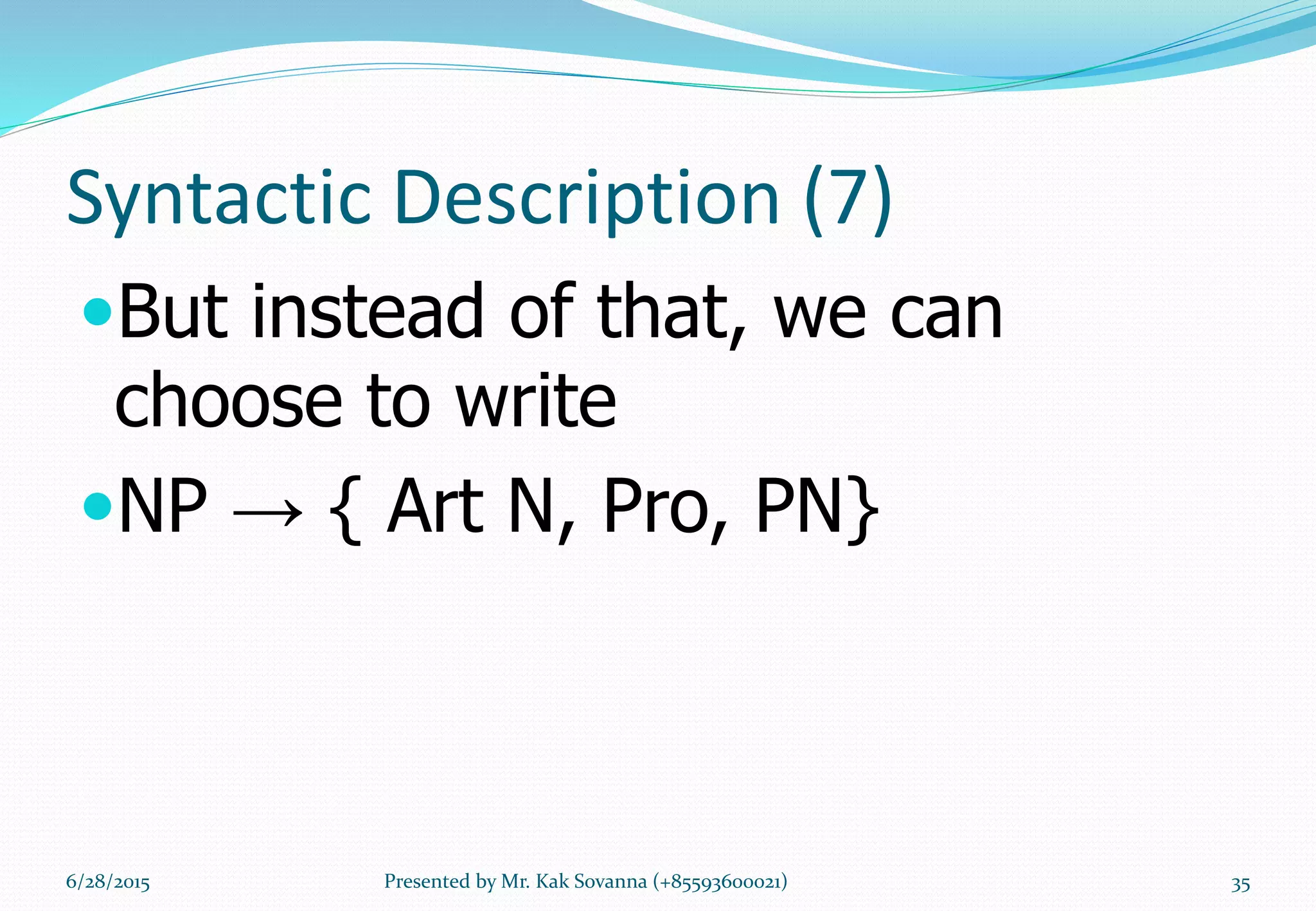
Syntactic Description (7)
But instead of that, we can
choose to write
NP → { Art N, Pro, PN}
6/28/2015 Presented by Mr. Kak Sovanna (+85593600021) 35
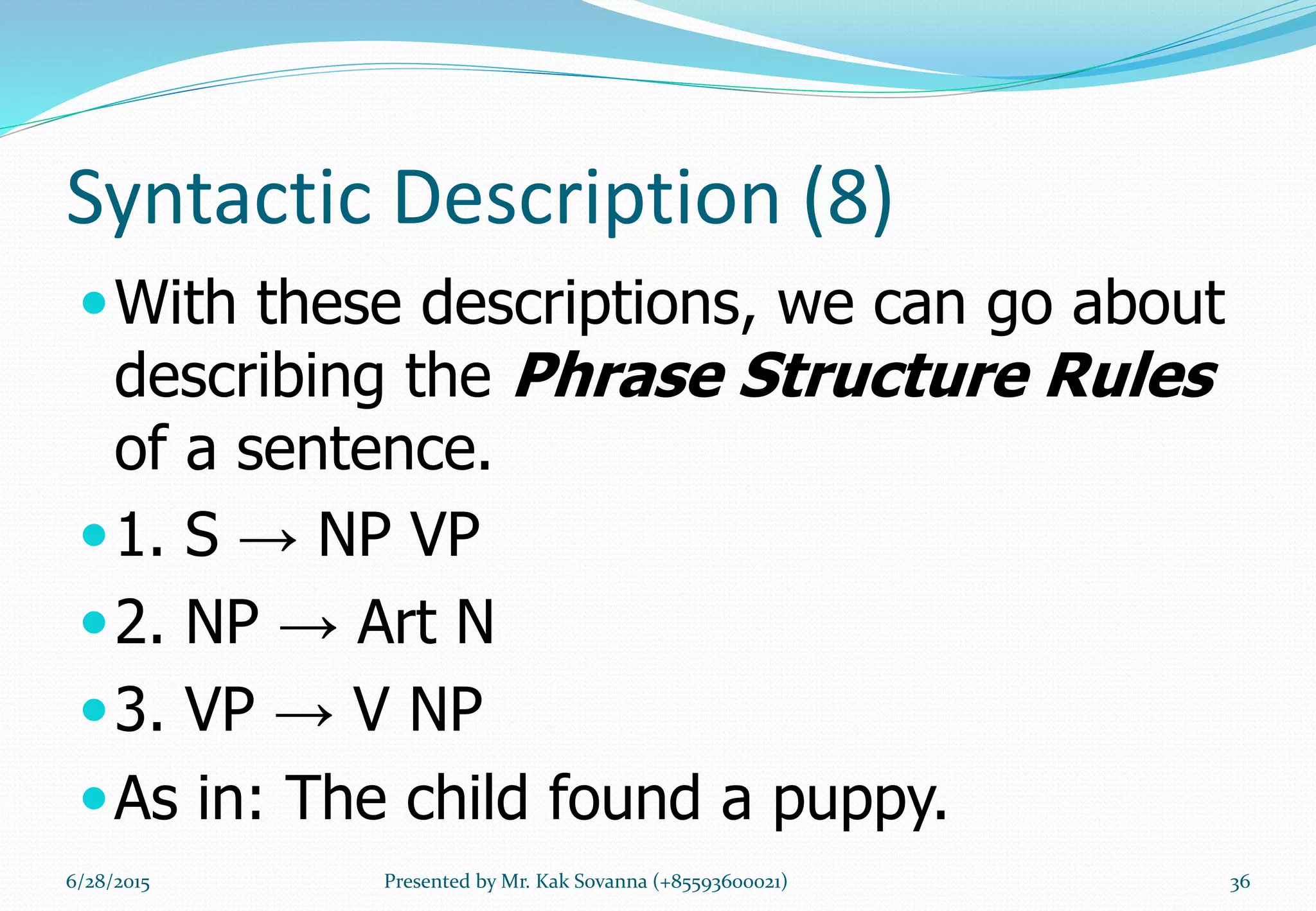
Syntactic Description (8)
With these descriptions, we can go about
describing the Phrase Structure Rules
of a sentence.
1. S → NP VP
2. NP → Art N
3. VP → V NP
As in: The child found a puppy.
6/28/2015 Presented by Mr. Kak Sovanna (+85593600021) 36
Syntactic Description (9)
Sometimes, a VP might also
include a PP. To be more specific,
the structure could be written as:
6/28/2015 Presented by Mr. Kak Sovanna (+85593600021) 37
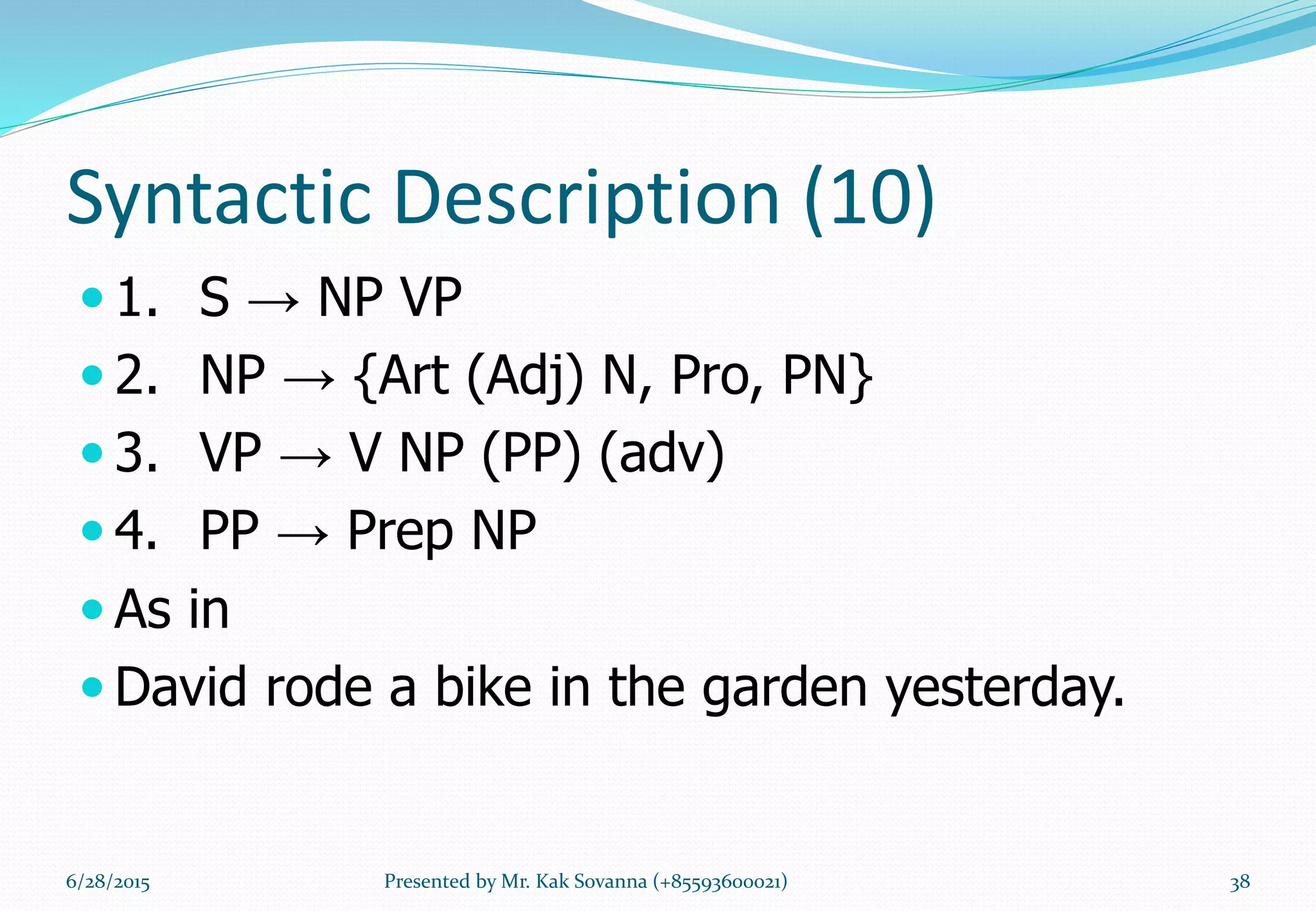
Syntactic Description (10)
 1. S → NP VP
 2. NP → {Art (Adj) N, Pro, PN}
 3. VP → V NP (PP) (adv)
 4. PP → Prep NP
 As in
 David rode a bike in the garden yesterday.
6/28/2015 Presented by Mr. Kak Sovanna (+85593600021) 38
Syntactic Description (11)
Phrase Structure Rules are not enough.
We also need Lexical Rules to specify
which words can be used when rewriting
specific constituents. We might ask ‘What
are examples of a N?’
6/28/2015 Presented by Mr. Kak Sovanna (+85593600021) 39
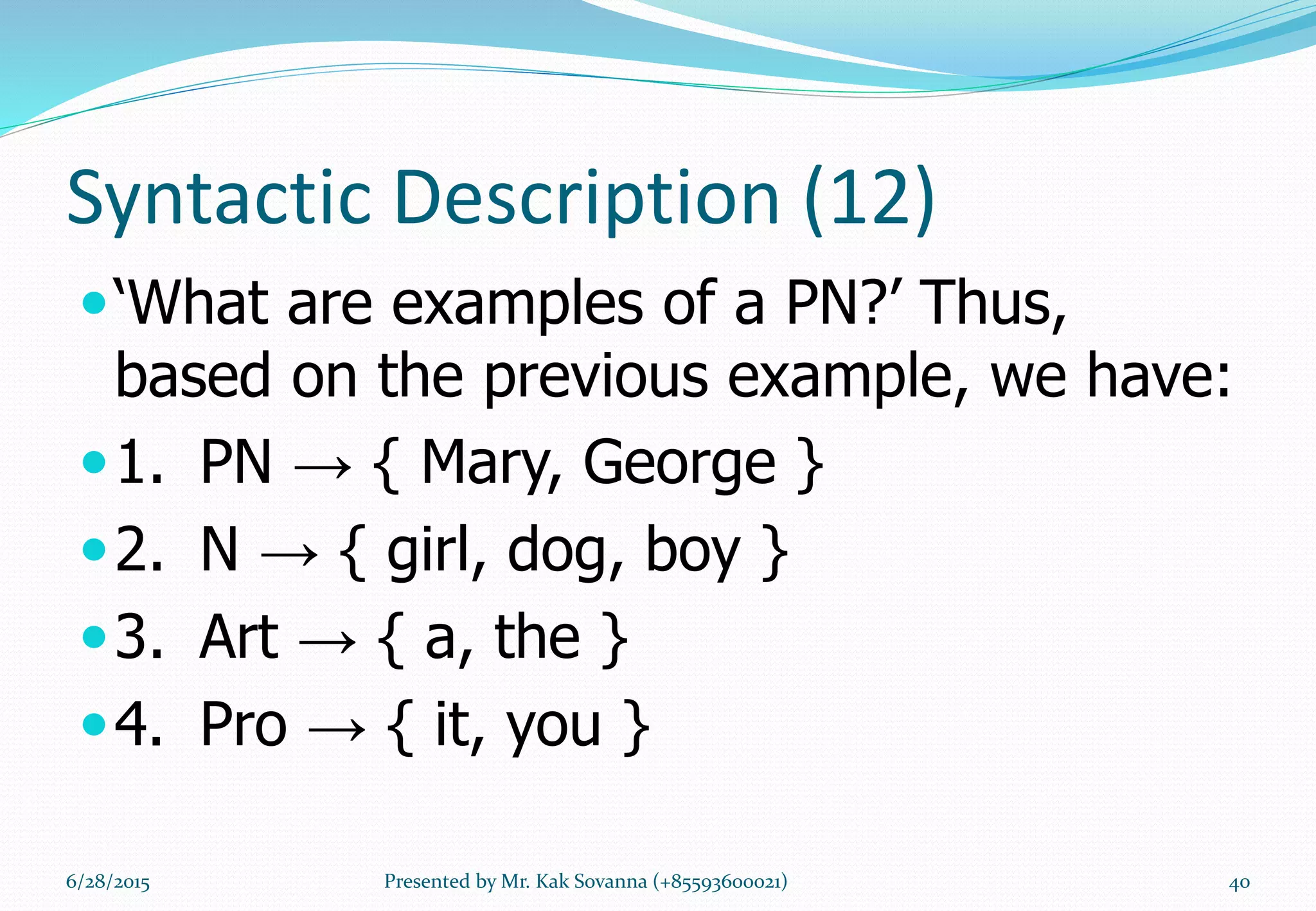
Syntactic Description (12)
‘What are examples of a PN?’ Thus,
based on the previous example, we have:
1. PN → { Mary, George }
2. N → { girl, dog, boy }
3. Art → { a, the }
4. Pro → { it, you }
6/28/2015 Presented by Mr. Kak Sovanna (+85593600021) 40
Syntactic Description (13)
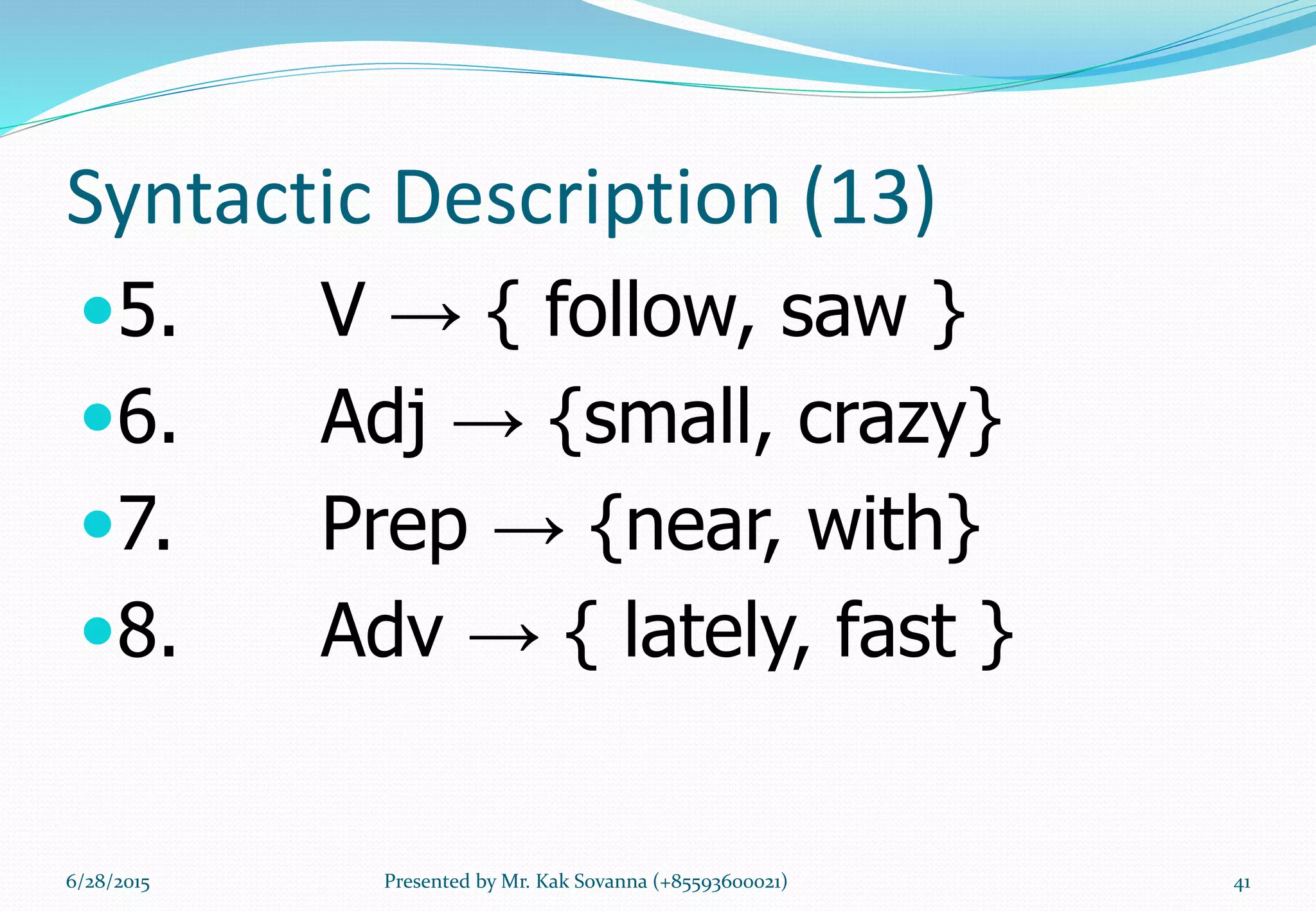
5. V → { follow, saw }
6. Adj → {small, crazy}
7. Prep → {near, with}
8. Adv → { lately, fast }
6/28/2015 Presented by Mr. Kak Sovanna (+85593600021) 41
Syntactic Description (14)
Relying on these rules, we are
able to generate grammatical
sentences, not ungrammatical
ones as in the following.
6/28/2015 Presented by Mr. Kak Sovanna (+85593600021) 42
Syntactic Description (15)
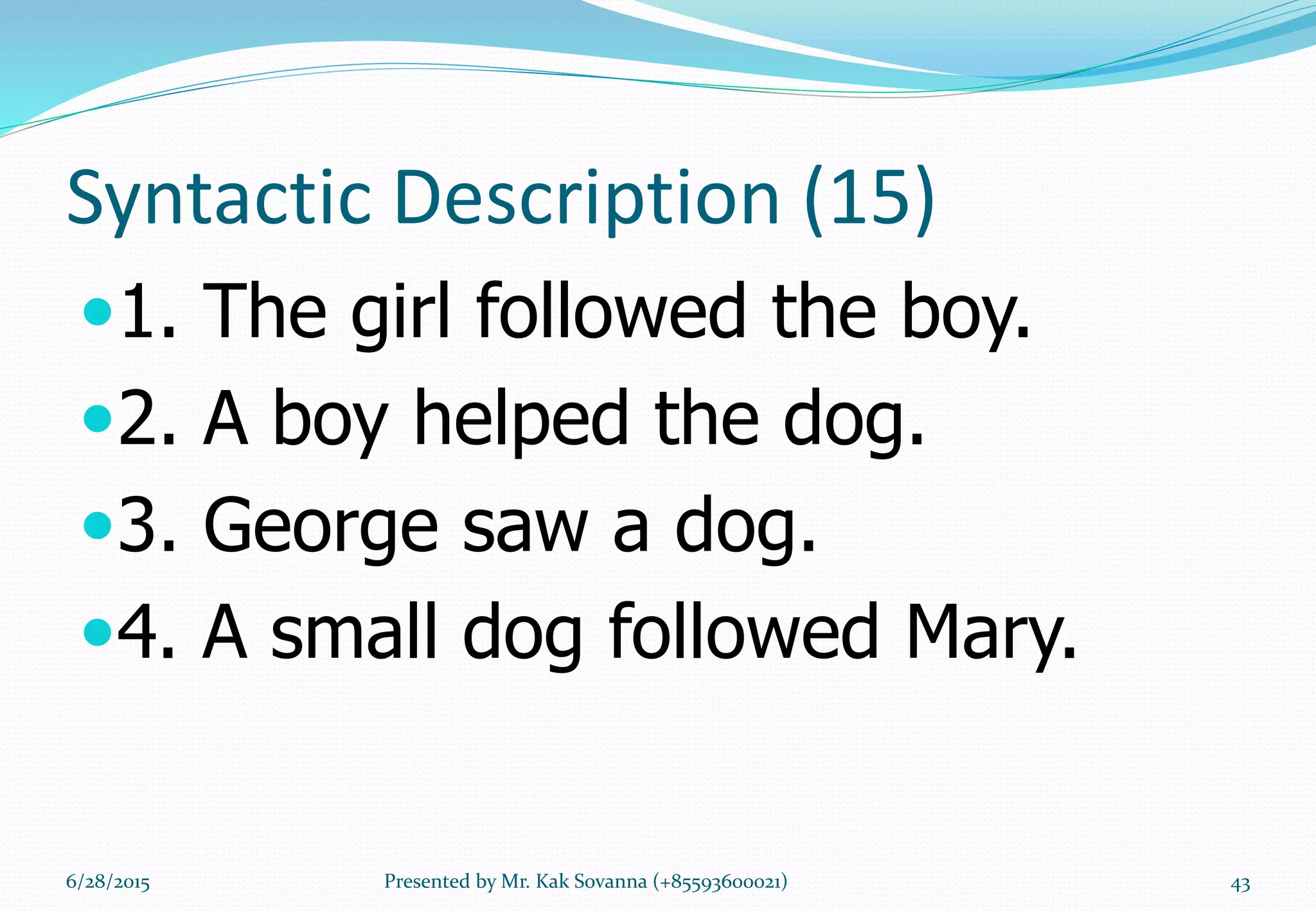
1. The girl followed the boy.
2. A boy helped the dog.
3. George saw a dog.
4. A small dog followed Mary.
6/28/2015 Presented by Mr. Kak Sovanna (+85593600021) 43
Syntactic Description (16)
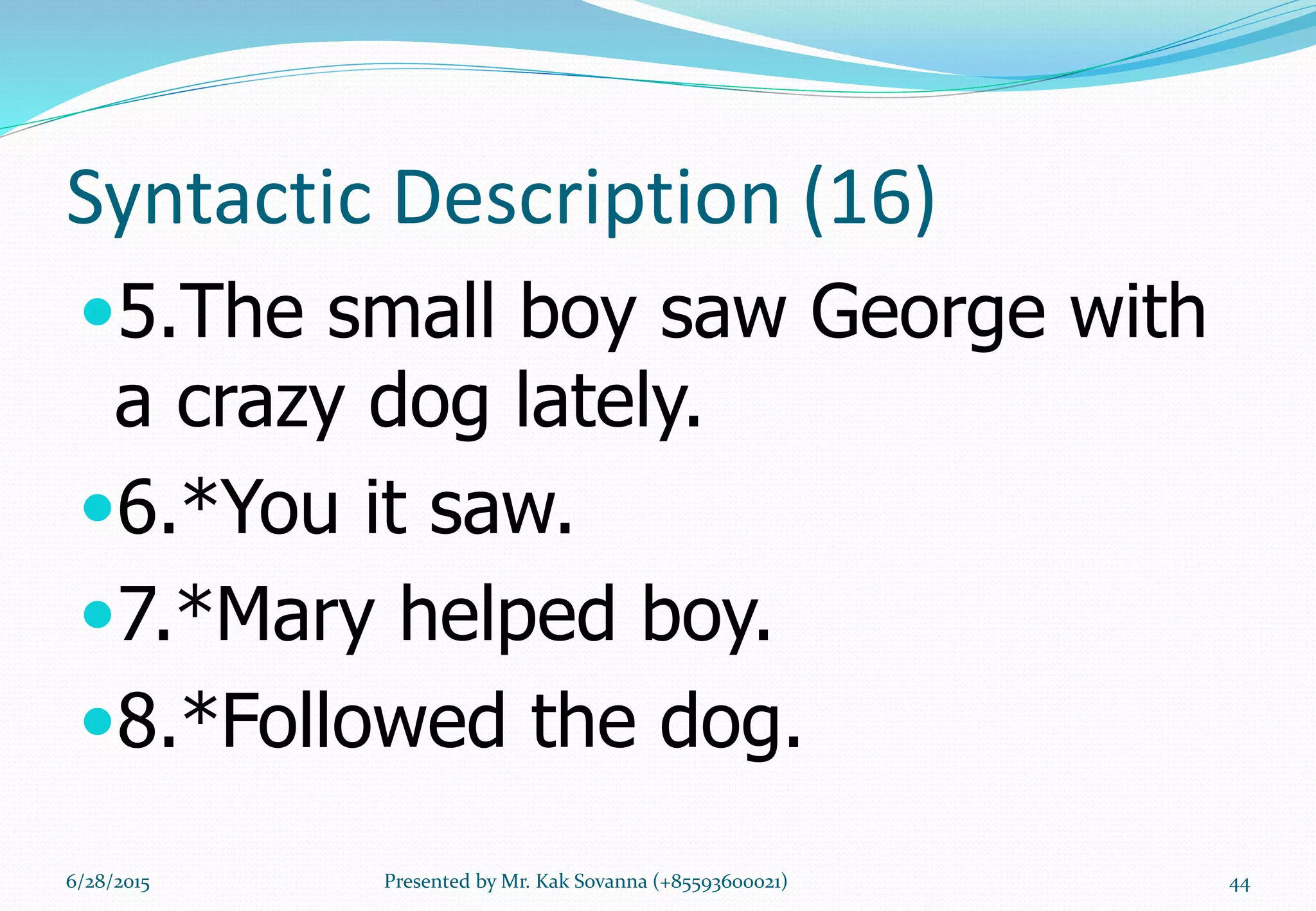
5.The small boy saw George with
a crazy dog lately.
6.*You it saw.
7.*Mary helped boy.
8.*Followed the dog.
6/28/2015 Presented by Mr. Kak Sovanna (+85593600021) 44
Syntactic Description (17)
Although phrase structure and lexical
rules are great in describing syntax,
there also exists Tree Diagram (or
Tree Structure) for description.
6/28/2015 Presented by Mr. Kak Sovanna (+85593600021) 45
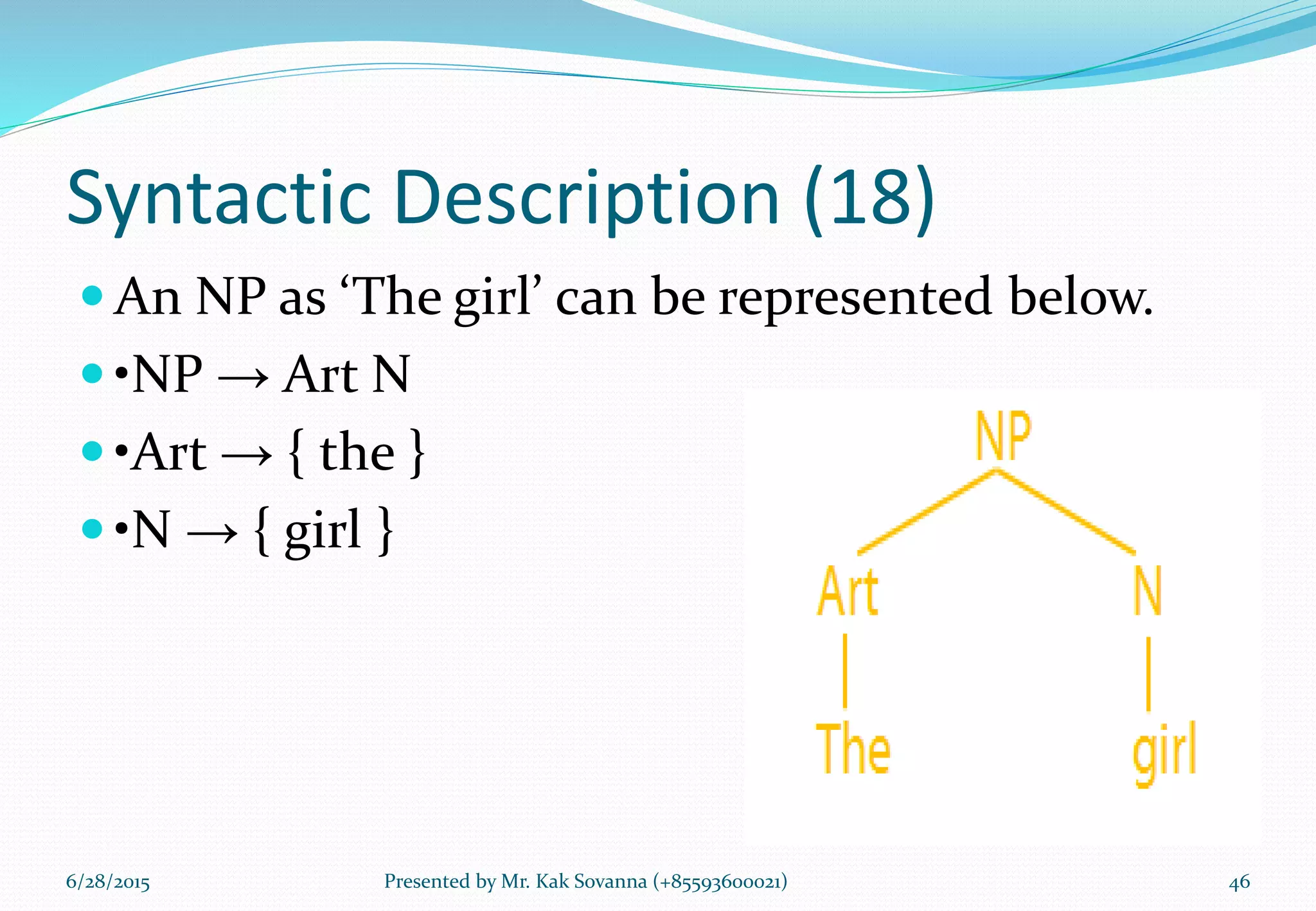
Syntactic Description (18)
 An NP as ‘The girl’ can be represented below.
 •NP → Art N
 •Art → { the }
 •N → { girl }
6/28/2015 Presented by Mr. Kak Sovanna (+85593600021) 46
Syntactic Description (19)
Now, we shall try to draw a tree
diagram of the sentence below.
 The girl saw a dog.
6/28/2015 Presented by Mr. Kak Sovanna (+85593600021) 47
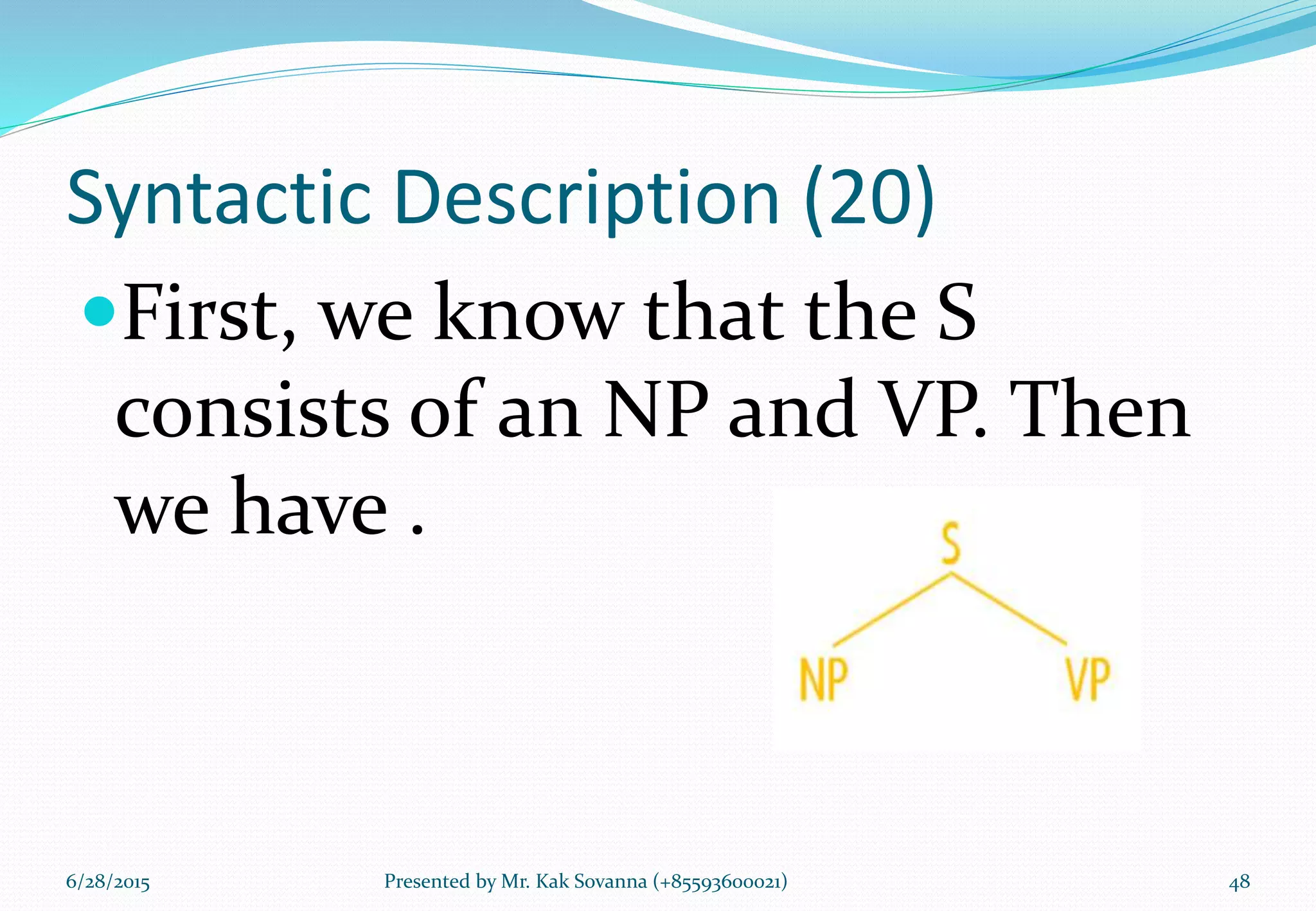
Syntactic Description (20)
First, we know that the S
consists of an NP and VP. Then
we have .
6/28/2015 Presented by Mr. Kak Sovanna (+85593600021) 48
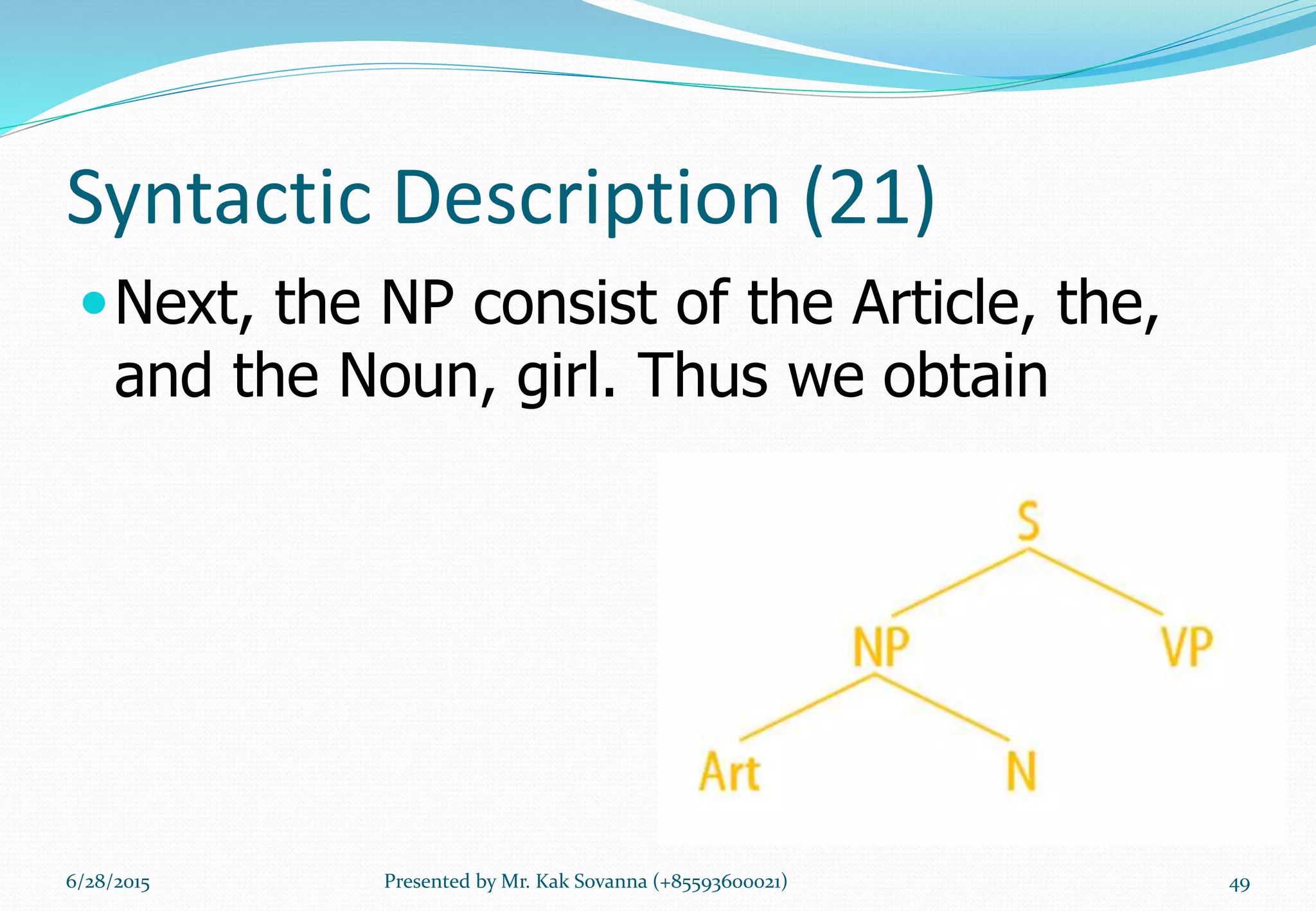
Syntactic Description (21)
Next, the NP consist of the Article, the,
and the Noun, girl. Thus we obtain
6/28/2015 Presented by Mr. Kak Sovanna (+85593600021) 49
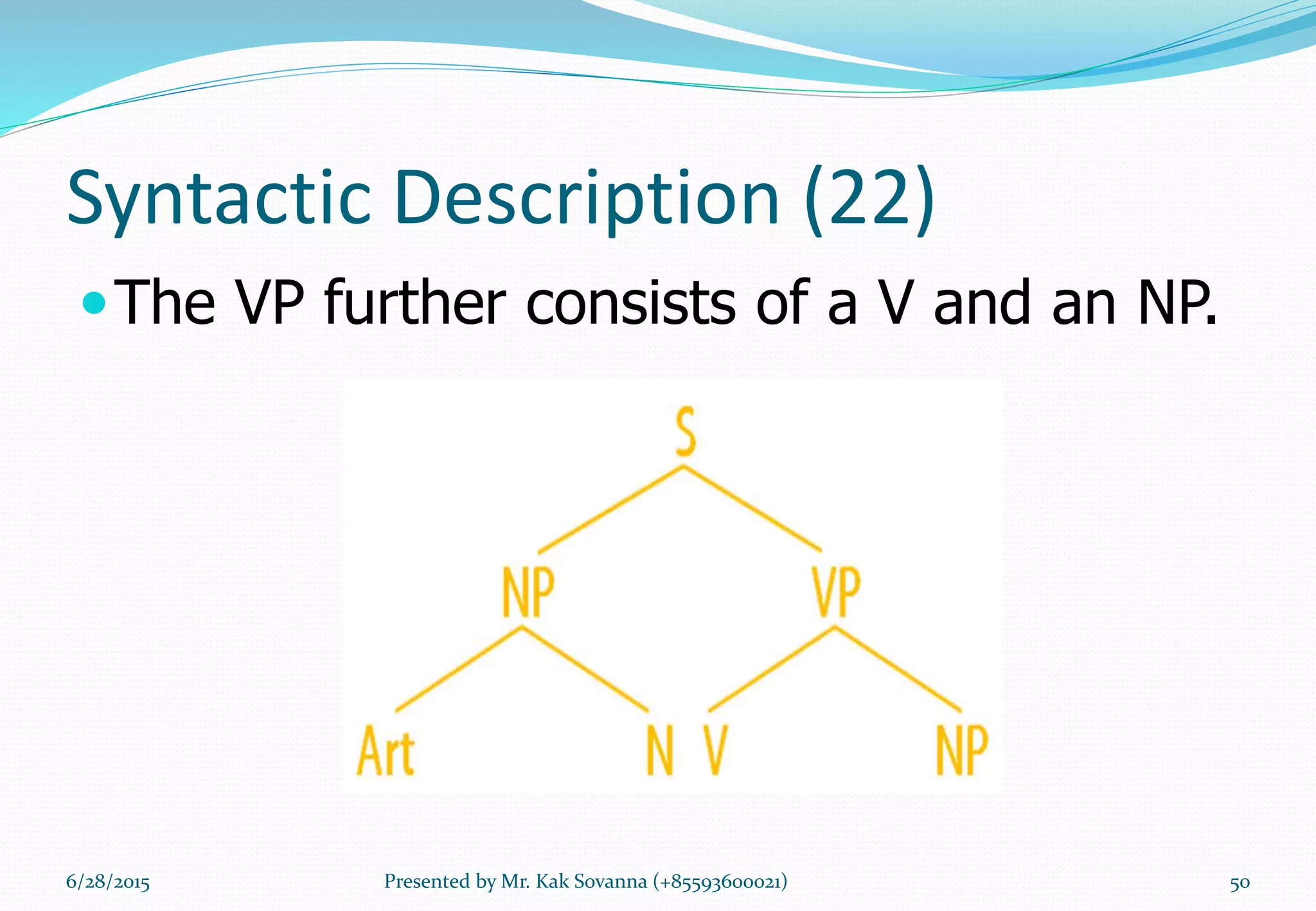
Syntactic Description (22)
The VP further consists of a V and an NP.
6/28/2015 Presented by Mr. Kak Sovanna (+85593600021) 50
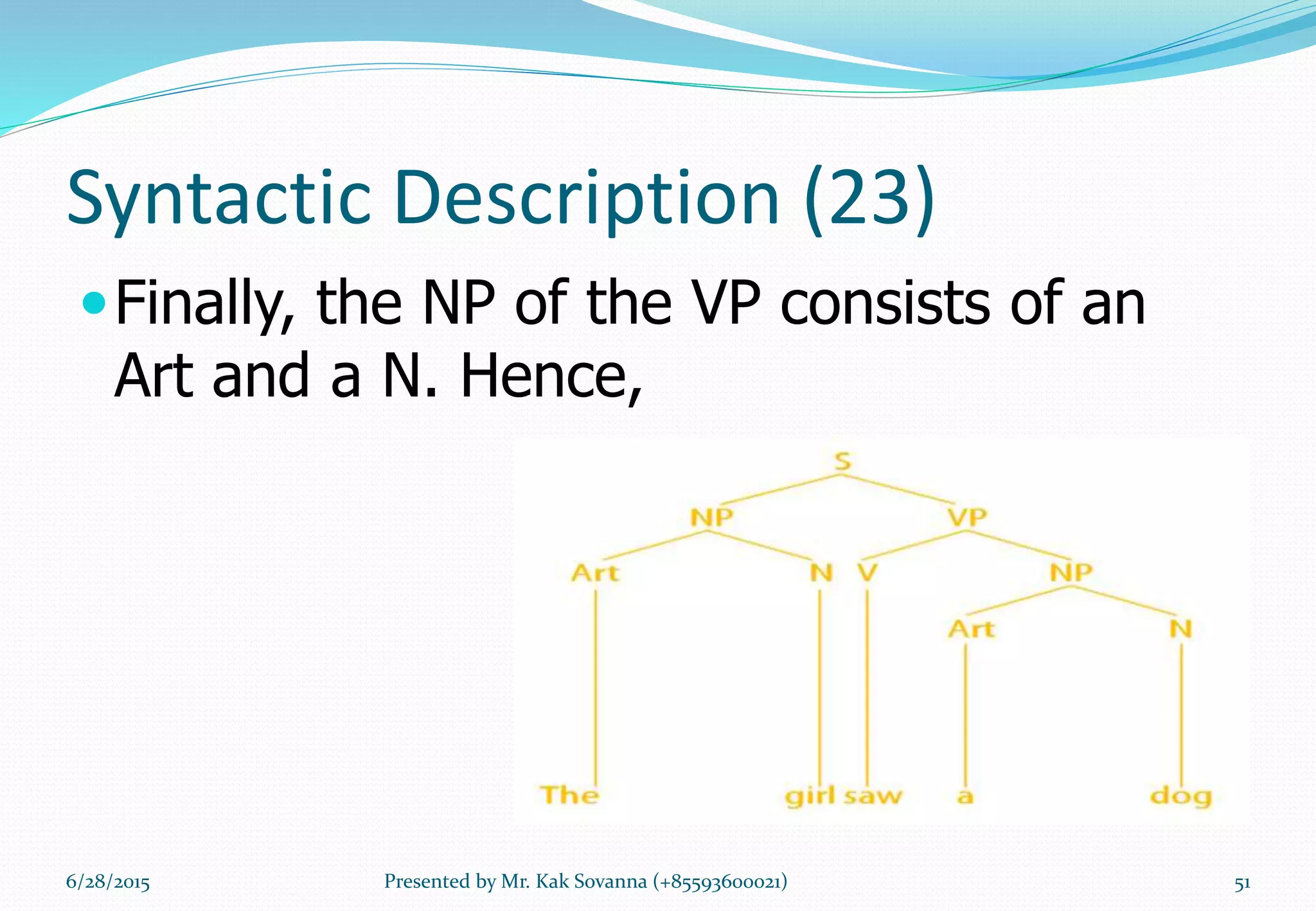
Syntactic Description (23)
Finally, the NP of the VP consists of an
Art and a N. Hence,
6/28/2015 Presented by Mr. Kak Sovanna (+85593600021) 51
Syntactic Description (24)
 Practice drawing tree diagram for the following
sentences.
 1. George bought a car.
 2. The house has a room with air-conditioner.
 3. The children walk to school.
6/28/2015 Presented by Mr. Kak Sovanna (+85593600021) 52
Syntactic Description (25)
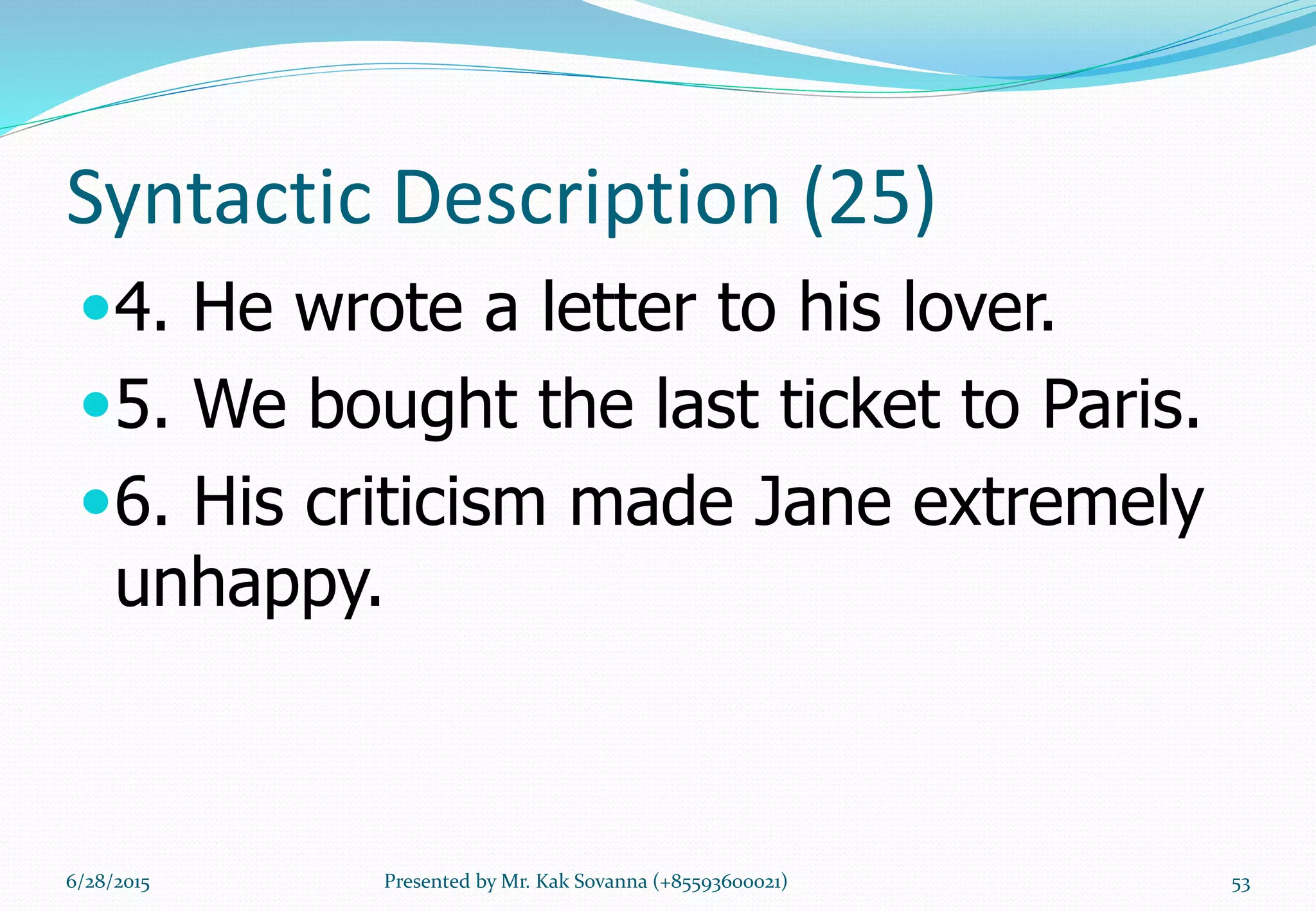
4. He wrote a letter to his lover.
5. We bought the last ticket to Paris.
6. His criticism made Jane extremely
unhappy.
6/28/2015 Presented by Mr. Kak Sovanna (+85593600021) 53
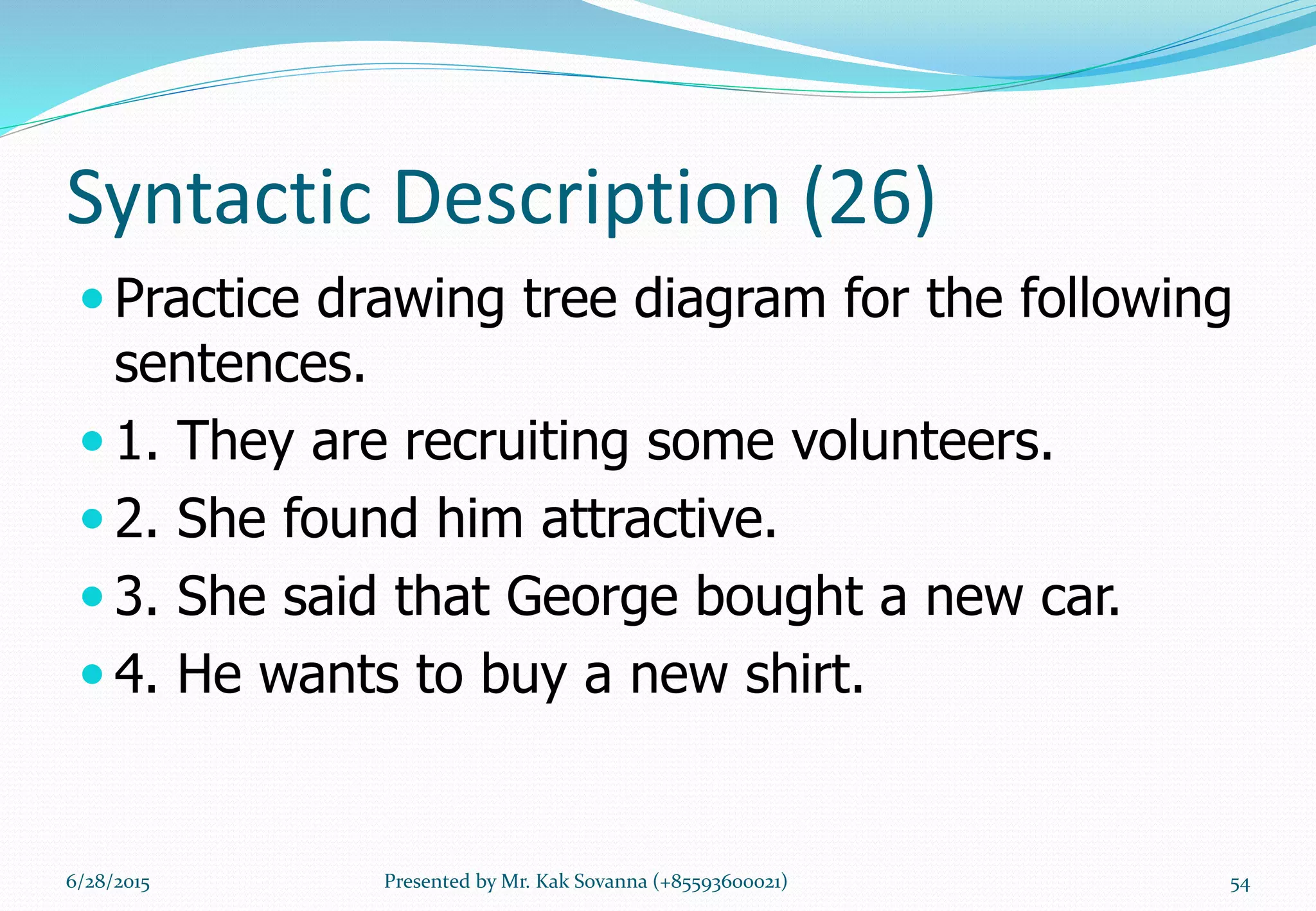
Syntactic Description (26)
 Practice drawing tree diagram for the following
sentences.
 1. They are recruiting some volunteers.
 2. She found him attractive.
 3. She said that George bought a new car.
 4. He wants to buy a new shirt.
6/28/2015 Presented by Mr. Kak Sovanna (+85593600021) 54
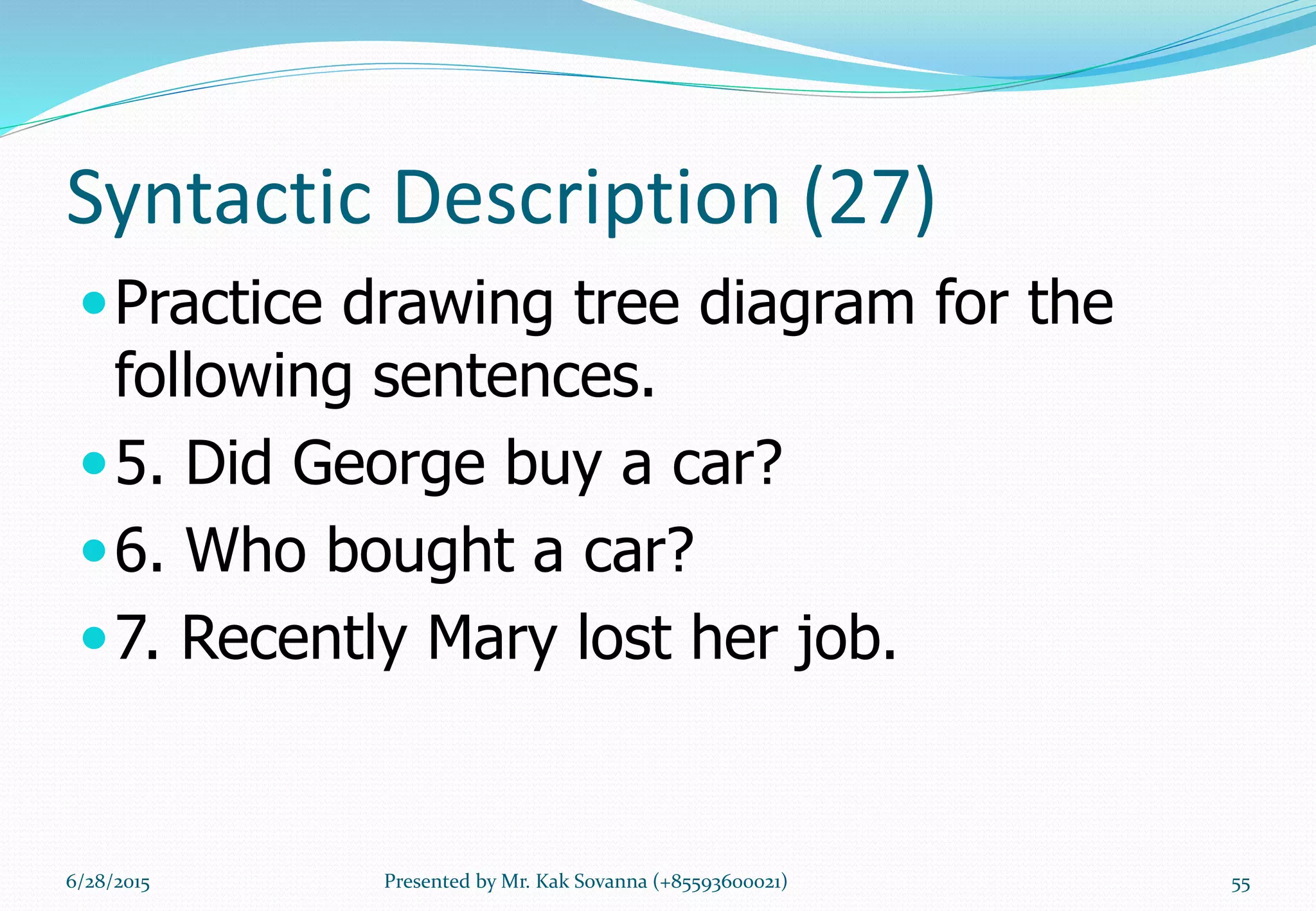
Syntactic Description (27)
Practice drawing tree diagram for the
following sentences.
5. Did George buy a car?
6. Who bought a car?
7. Recently Mary lost her job.
6/28/2015 Presented by Mr. Kak Sovanna (+85593600021) 55
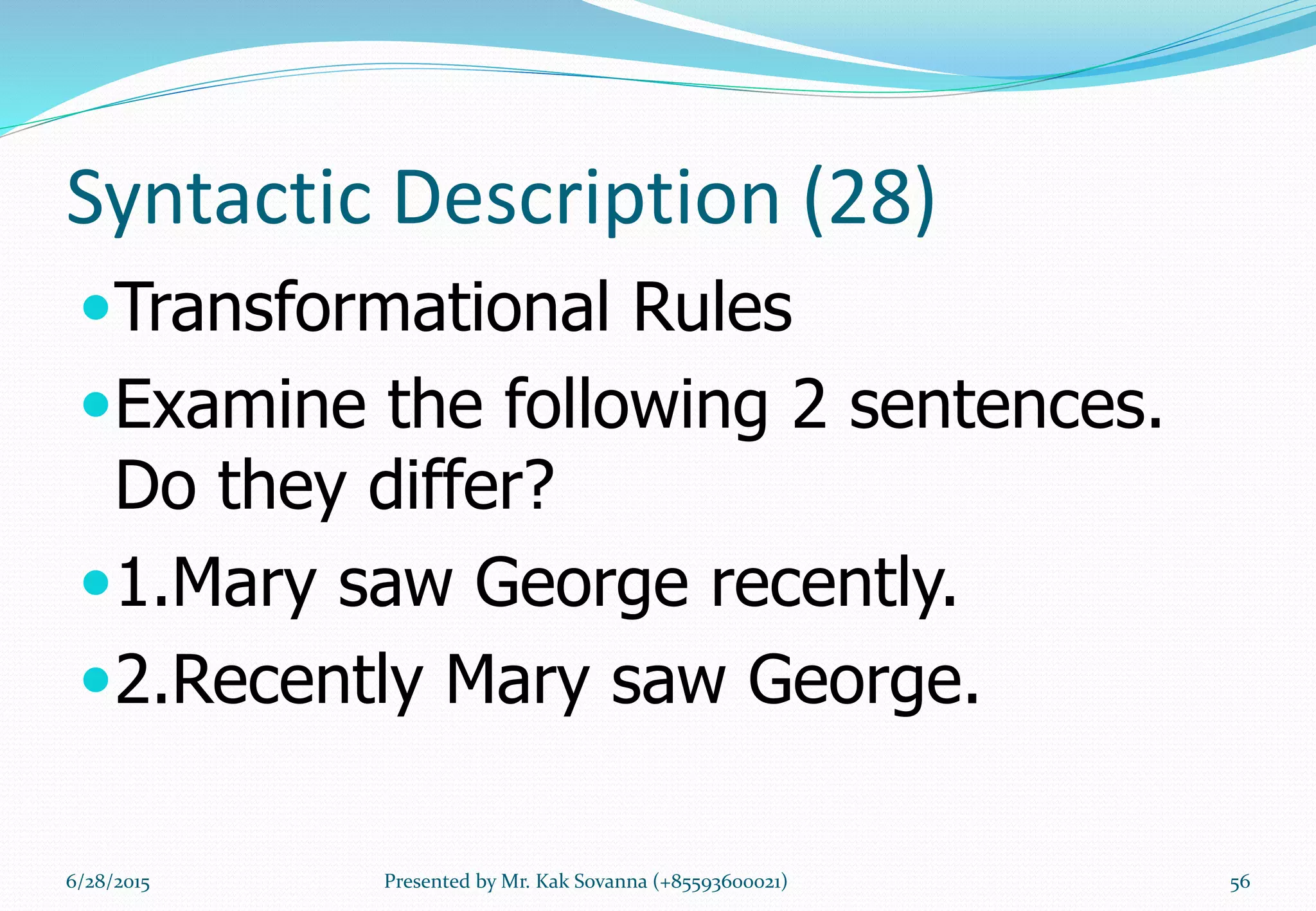
Syntactic Description (28)
Transformational Rules
Examine the following 2 sentences.
Do they differ?
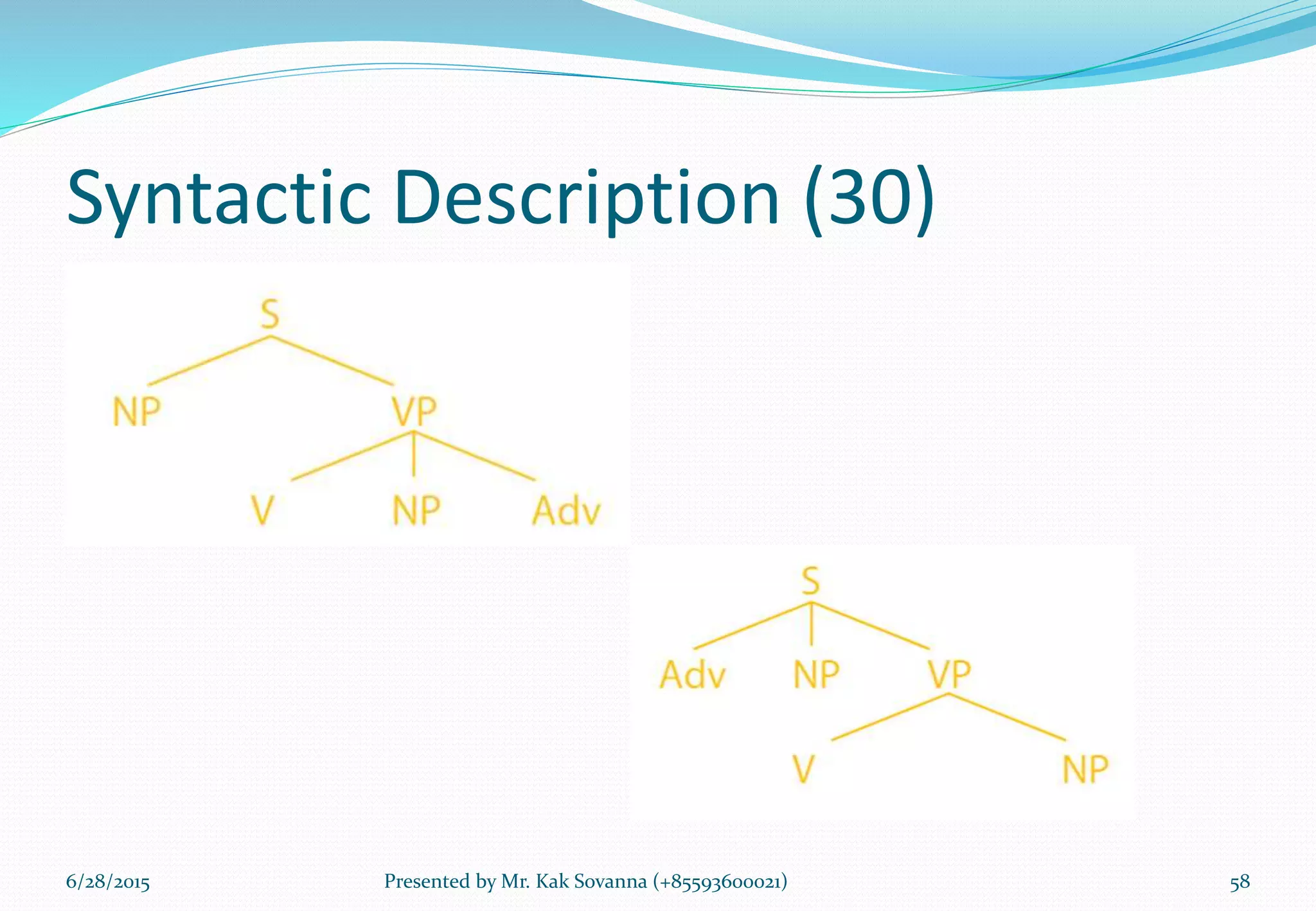
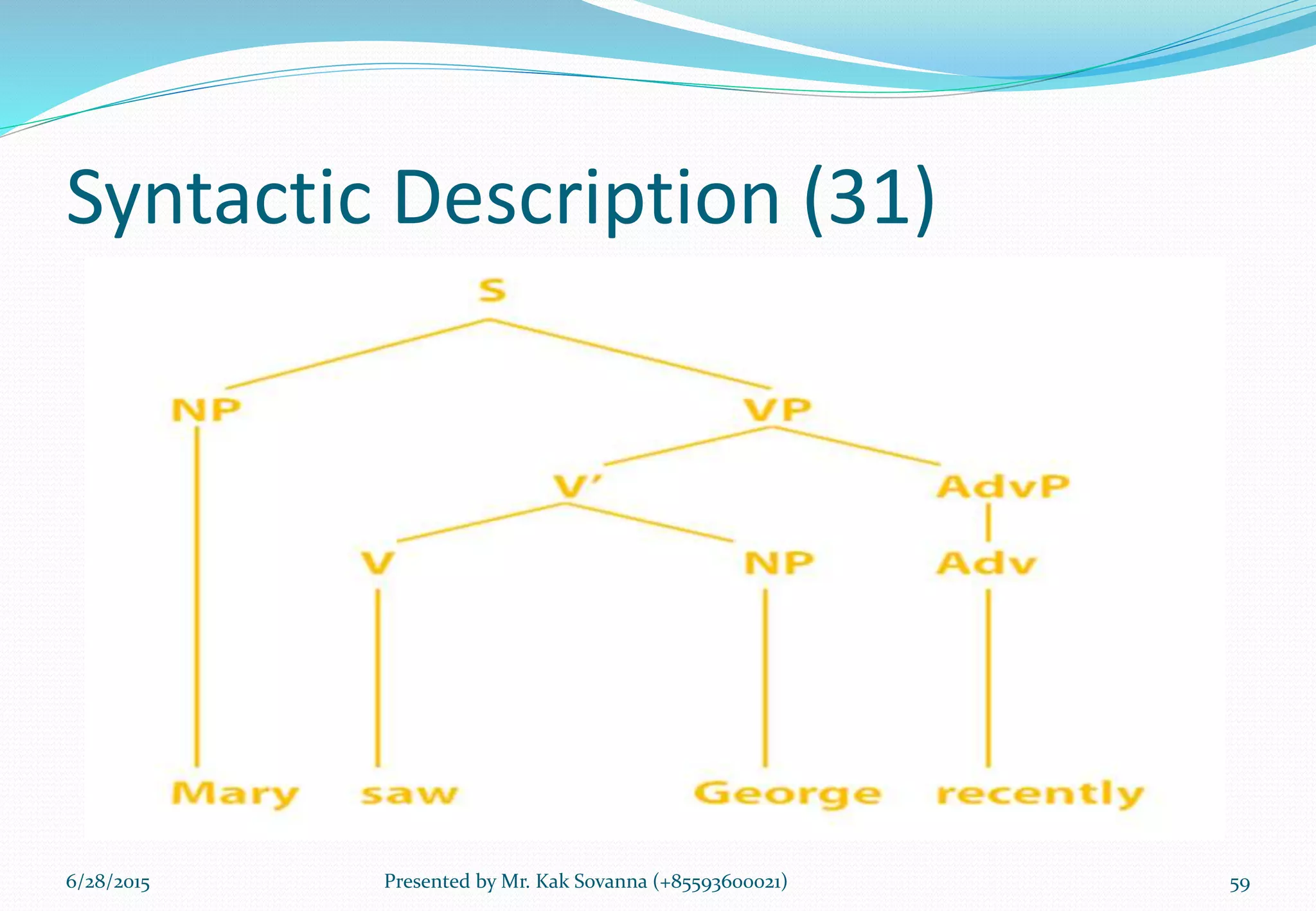
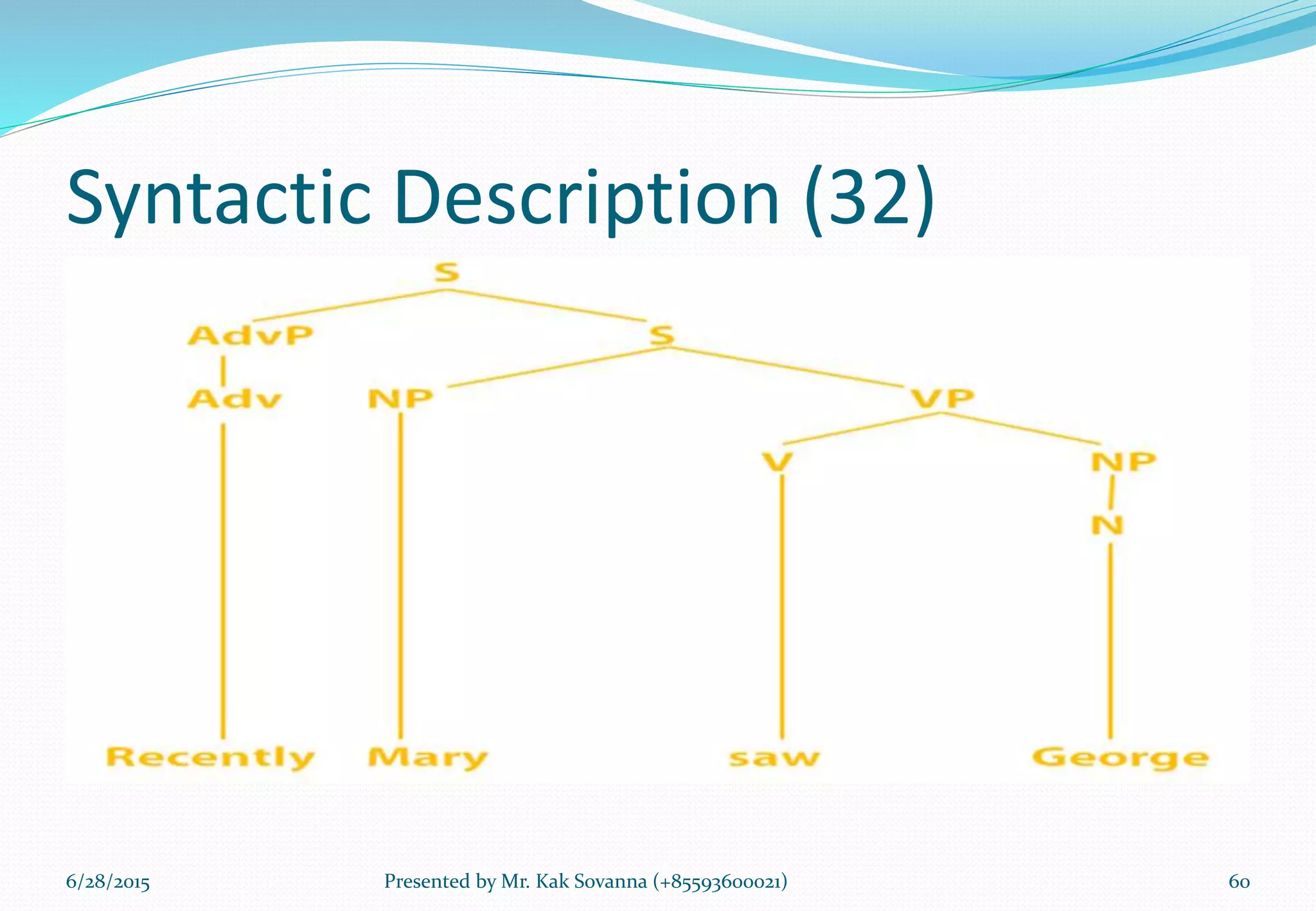
1.Mary saw George recently.
2.Recently Mary saw George.
6/28/2015 Presented by Mr. Kak Sovanna (+85593600021) 56
Syntactic Description (29)
Transformational Rules (2)
• Actually, the structure of the 2nd
sentence is said to be derived from the
1st sentence. It is said that the adverb
‘recently’ has been moved to the
beginning in the 2nd sentence.
6/28/2015 Presented by Mr. Kak Sovanna (+85593600021) 57
Syntactic Description (30)
6/28/2015 Presented by Mr. Kak Sovanna (+85593600021) 58
Syntactic Description (31)
6/28/2015 Presented by Mr. Kak Sovanna (+85593600021) 59
Syntactic Description (32)
6/28/2015 Presented by Mr. Kak Sovanna (+85593600021) 60
References
 Sovannarith, L. (2011). Applied Linguistics. Phnom Penh:
Institute of Foreign Languages.
 Geldren, E. V. (2010). An Introduction to Grammar of
English. Amsterdam: John Benjamins Publishing Co.
 Applied Linguistics. CICI.
6/28/2015 Presented by Mr. Kak Sovanna (+85593600021) 61

Chapter 2 syntax

  • 1.
    Chapter 3: Syntax Presentedby Kak Sovanna Academic Year: 2014-2015 16/28/2015 Presented by Mr. Kak Sovanna (+85593600021)
  • 2.
    6/28/2015 2Presented byMr. Kak Sovanna (+85593600021)
  • 3.
    Read the followingsentences and try to identify various meanings in each sentence.  The camper saw a bear with binoculars.  I once shot an elephant in my pajamas.  Flying planes can be dangerous.  A: I just saw someone carrying a monkey and an elephant go into the circus.  B: Wow, that someone must be pretty strong. 6/28/2015 3Presented by Mr. Kak Sovanna (+85593600021)
  • 4.
    The camper sawa bear with binoculars. 6/28/2015 4Presented by Mr. Kak Sovanna (+85593600021)
  • 5.
    The camper sawa bear with binoculars. 6/28/2015 5Presented by Mr. Kak Sovanna (+85593600021)
  • 6.
    Content What is syntax? GenerativeGrammar Syntactic Description References 6/28/2015 6Presented by Mr. Kak Sovanna (+85593600021)
  • 7.
    What is syntax? Itcomes from Greek, syntaxis (syn ‘together’ + taxis ‘to arrange’ -> ‘to arrange together’) Syntactic is the adjective from syntax. 6/28/2015 7Presented by Mr. Kak Sovanna (+85593600021)
  • 8.
    What is syntax?(1) Syntax is the study of rules that govern the ways in which words combine to form phrases, clauses, and sentences. (About.com) It could also refer to the arrangement of words itself in a sentence. (About.com) 6/28/2015 8Presented by Mr. Kak Sovanna (+85593600021)
  • 9.
    What is syntax?(3)  Linguistically, Syntax is also defined as a major component of the grammar of a language that concerns the ways in which words combine to form sentences and the rules which govern the formulation of sentences, making some sentences possible and others not possible within a particular language. (Dictionary of Language Teaching and Applied Linguistics, 4th edition) 6/28/2015 9Presented by Mr. Kak Sovanna (+85593600021)
  • 10.
    Generative Grammar A typeof grammar, inspired by Noam Chomsky, that attempts to define and describe, by a set of rules or principles, all the grammatical sentences of a language and no ungrammatical ones. This type of grammar is said to generate, or produce, grammatical sentences. 6/28/2015 10Presented by Mr. Kak Sovanna (+85593600021)
  • 11.
    Generative Grammar (1) Languageis seen as consisting of a set of finite numbers of rules, which enable the production of infinite numbers of well-formed sentences. 6/28/2015 11Presented by Mr. Kak Sovanna (+85593600021)
  • 12.
    Generative Grammar (2) This is very similar to mathematics.  E.g. 3x + 2y = z  If x=5 and y=10 then z=35  If x=2 and y=1 then z=8  •“If the sentences of a language can be seen as a comparable set, then there must be a set of explicit rules that can produce all those sentences.” 6/28/2015 12Presented by Mr. Kak Sovanna (+85593600021)
  • 13.
    Generative Grammar (3) Deepand Surface Structure Generative Grammar also attempts to describe (a) how to 2 different sentences are closely related, and (b) how to 2 similar sentences are different. 6/28/2015 13Presented by Mr. Kak Sovanna (+85593600021)
  • 14.
    Generative Grammar (4) Charliebroke the window. The window was broken by Charlie. 6/28/2015 14Presented by Mr. Kak Sovanna (+85593600021)
  • 15.
    Generative Grammar (5) Deep and Surface Structure (2)  The first sentence is active, focusing on Charlie.  The second is passive, focusing on window.  The meaning is still the same, and therefore, what makes them different is just their written forms. This is called the Surface Structure. 6/28/2015 15Presented by Mr. Kak Sovanna (+85593600021)
  • 16.
    Generative Grammar (6) Deep and Surface Structure (3)  In fact, the all the aforementioned examples derive from a common basic structure, which consists of the same constituents or components (Charlie, window, break).  This is called the Deep Structure. 6/28/2015 16Presented by Mr. Kak Sovanna (+85593600021)
  • 17.
    Generative Grammar (7) DeepStructure is an abstract underlying level of structural organization in which all the elements determining structural interpretation are represented. 6/28/2015 17Presented by Mr. Kak Sovanna (+85593600021)
  • 18.
    Generative Grammar (8) Deepand Surface Structure (4) Suppose we have a deep structure: NP + V + NP 6/28/2015 18Presented by Mr. Kak Sovanna (+85593600021)
  • 19.
    Generative Grammar (9) Deepand Surface Structure (4)  The following sentences can be derived:  a)Charlie broke the window.  b)The window was broken by Charlie.  c)It was Charlie who broke the window.  d)Was the window broken by Charlie? 6/28/2015 19Presented by Mr. Kak Sovanna (+85593600021)
  • 20.
    Generative Grammar (10) Deepand Surface Structure (5) In short, Deep Structure = Basic Structure Surface Structure = Transformed Structure 6/28/2015 20Presented by Mr. Kak Sovanna (+85593600021)
  • 21.
    Generative Grammar (11) Deepand Surface Structure (6) Sometimes, 2 different deep structures could also be expressed in the same surface structure. 6/28/2015 21Presented by Mr. Kak Sovanna (+85593600021)
  • 22.
    Generative Grammar (12) Eg. The camper saw a bear with binoculars.  (1) would mean that the camper use binoculars to see a bear  (2) would mean that the camper see a bear who is using a binocular 6/28/2015 22Presented by Mr. Kak Sovanna (+85593600021)
  • 23.
    Deep and SurfaceStructure (7) 6/28/2015 Presented by Mr. Kak Sovanna (+85593600021) 23
  • 24.
    Deep and SurfaceStructure (8) 6/28/2015 Presented by Mr. Kak Sovanna (+85593600021) 24
  • 25.
    Generative Grammar (13) Deep and Surface Structure (9)  This is called Structural Ambiguity.  Structural Ambiguity occurs when a particular sentence (or structure) could have two or more underlying interpretations that have to be represented differently in deep structure. 6/28/2015 Presented by Mr. Kak Sovanna (+85593600021) 25
  • 26.
    Generative Grammar (14) E.g. Those small boys and girls have been selected for the contest.  E.g. Outside of a dog, a book is a man’s best friend; inside it’s too hard to read.  Everybody knows dogs are man's best friend, right? Well, books are, too-in a way. You can read books and understand them, but dogs aren't easy to understand. that's what "inside if a dog it's too dark to read" means. 6/28/2015 Presented by Mr. Kak Sovanna (+85593600021) 26
  • 27.
    Generative Grammar (15) Recursion Recursiverules have the capacity to be applied more than once in generating a structure. 6/28/2015 Presented by Mr. Kak Sovanna (+85593600021) 27
  • 28.
    Generative Grammar (16) Recursion E.g.The gun was on the table near the window in the bedroom of the old house. E.g. John believed that Cathy knew that Mary helped George. 6/28/2015 Presented by Mr. Kak Sovanna (+85593600021) 28
  • 29.
    Syntactic Description  Indescribing syntax, the following symbols should be remembered.  S Sentence NP Noun Phrase  N Noun VP Verb Phrase  V Verb PP Prepositional Phrase  Art Article PN Proper Noun 6/28/2015 Presented by Mr. Kak Sovanna (+85593600021) 29
  • 30.
    Syntactic Description (2) Adj Adjective * Ungrammatical sent.  Adv Adverb → Consists of/ Rewrites as  Pro Pronoun ( ) Optional constituent 6/28/2015 Presented by Mr. Kak Sovanna (+85593600021) 30
  • 31.
    Syntactic Description (3) Prep Preposition  { } One and only one of these constituents must be selected. 6/28/2015 Presented by Mr. Kak Sovanna (+85593600021) 31
  • 32.
    Syntactic Description (4) Therefore,if we were to describe a noun phrase (NP), the structure shall be written as: NP → Art N 6/28/2015 Presented by Mr. Kak Sovanna (+85593600021) 32
  • 33.
    Syntactic Description (5) Becausea noun phrase generally consists of an article and a noun, as in ‘The dog’. Yet it is also possible for an NP to further include an adjective, as in ‘The small dog’ , and therefore, could be rewritten as: NP → Art (Adj) N 6/28/2015 Presented by Mr. Kak Sovanna (+85593600021) 33
  • 34.
    Syntactic Description (6) Aswe have learnt, an NP could consist of a pronoun or a proper noun (Name of people, places, etc.), then we could have the following: NP → Art N NP → Pro NP → PN 6/28/2015 Presented by Mr. Kak Sovanna (+85593600021) 34
  • 35.
    Syntactic Description (7) Butinstead of that, we can choose to write NP → { Art N, Pro, PN} 6/28/2015 Presented by Mr. Kak Sovanna (+85593600021) 35
  • 36.
    Syntactic Description (8) Withthese descriptions, we can go about describing the Phrase Structure Rules of a sentence. 1. S → NP VP 2. NP → Art N 3. VP → V NP As in: The child found a puppy. 6/28/2015 Presented by Mr. Kak Sovanna (+85593600021) 36
  • 37.
    Syntactic Description (9) Sometimes,a VP might also include a PP. To be more specific, the structure could be written as: 6/28/2015 Presented by Mr. Kak Sovanna (+85593600021) 37
  • 38.
    Syntactic Description (10) 1. S → NP VP  2. NP → {Art (Adj) N, Pro, PN}  3. VP → V NP (PP) (adv)  4. PP → Prep NP  As in  David rode a bike in the garden yesterday. 6/28/2015 Presented by Mr. Kak Sovanna (+85593600021) 38
  • 39.
    Syntactic Description (11) PhraseStructure Rules are not enough. We also need Lexical Rules to specify which words can be used when rewriting specific constituents. We might ask ‘What are examples of a N?’ 6/28/2015 Presented by Mr. Kak Sovanna (+85593600021) 39
  • 40.
    Syntactic Description (12) ‘Whatare examples of a PN?’ Thus, based on the previous example, we have: 1. PN → { Mary, George } 2. N → { girl, dog, boy } 3. Art → { a, the } 4. Pro → { it, you } 6/28/2015 Presented by Mr. Kak Sovanna (+85593600021) 40
  • 41.
    Syntactic Description (13) 5.V → { follow, saw } 6. Adj → {small, crazy} 7. Prep → {near, with} 8. Adv → { lately, fast } 6/28/2015 Presented by Mr. Kak Sovanna (+85593600021) 41
  • 42.
    Syntactic Description (14) Relyingon these rules, we are able to generate grammatical sentences, not ungrammatical ones as in the following. 6/28/2015 Presented by Mr. Kak Sovanna (+85593600021) 42
  • 43.
    Syntactic Description (15) 1.The girl followed the boy. 2. A boy helped the dog. 3. George saw a dog. 4. A small dog followed Mary. 6/28/2015 Presented by Mr. Kak Sovanna (+85593600021) 43
  • 44.
    Syntactic Description (16) 5.Thesmall boy saw George with a crazy dog lately. 6.*You it saw. 7.*Mary helped boy. 8.*Followed the dog. 6/28/2015 Presented by Mr. Kak Sovanna (+85593600021) 44
  • 45.
    Syntactic Description (17) Althoughphrase structure and lexical rules are great in describing syntax, there also exists Tree Diagram (or Tree Structure) for description. 6/28/2015 Presented by Mr. Kak Sovanna (+85593600021) 45
  • 46.
    Syntactic Description (18) An NP as ‘The girl’ can be represented below.  •NP → Art N  •Art → { the }  •N → { girl } 6/28/2015 Presented by Mr. Kak Sovanna (+85593600021) 46
  • 47.
    Syntactic Description (19) Now,we shall try to draw a tree diagram of the sentence below.  The girl saw a dog. 6/28/2015 Presented by Mr. Kak Sovanna (+85593600021) 47
  • 48.
    Syntactic Description (20) First,we know that the S consists of an NP and VP. Then we have . 6/28/2015 Presented by Mr. Kak Sovanna (+85593600021) 48
  • 49.
    Syntactic Description (21) Next,the NP consist of the Article, the, and the Noun, girl. Thus we obtain 6/28/2015 Presented by Mr. Kak Sovanna (+85593600021) 49
  • 50.
    Syntactic Description (22) TheVP further consists of a V and an NP. 6/28/2015 Presented by Mr. Kak Sovanna (+85593600021) 50
  • 51.
    Syntactic Description (23) Finally,the NP of the VP consists of an Art and a N. Hence, 6/28/2015 Presented by Mr. Kak Sovanna (+85593600021) 51
  • 52.
    Syntactic Description (24) Practice drawing tree diagram for the following sentences.  1. George bought a car.  2. The house has a room with air-conditioner.  3. The children walk to school. 6/28/2015 Presented by Mr. Kak Sovanna (+85593600021) 52
  • 53.
    Syntactic Description (25) 4.He wrote a letter to his lover. 5. We bought the last ticket to Paris. 6. His criticism made Jane extremely unhappy. 6/28/2015 Presented by Mr. Kak Sovanna (+85593600021) 53
  • 54.
    Syntactic Description (26) Practice drawing tree diagram for the following sentences.  1. They are recruiting some volunteers.  2. She found him attractive.  3. She said that George bought a new car.  4. He wants to buy a new shirt. 6/28/2015 Presented by Mr. Kak Sovanna (+85593600021) 54
  • 55.
    Syntactic Description (27) Practicedrawing tree diagram for the following sentences. 5. Did George buy a car? 6. Who bought a car? 7. Recently Mary lost her job. 6/28/2015 Presented by Mr. Kak Sovanna (+85593600021) 55
  • 56.
    Syntactic Description (28) TransformationalRules Examine the following 2 sentences. Do they differ? 1.Mary saw George recently. 2.Recently Mary saw George. 6/28/2015 Presented by Mr. Kak Sovanna (+85593600021) 56
  • 57.
    Syntactic Description (29) TransformationalRules (2) • Actually, the structure of the 2nd sentence is said to be derived from the 1st sentence. It is said that the adverb ‘recently’ has been moved to the beginning in the 2nd sentence. 6/28/2015 Presented by Mr. Kak Sovanna (+85593600021) 57
  • 58.
    Syntactic Description (30) 6/28/2015Presented by Mr. Kak Sovanna (+85593600021) 58
  • 59.
    Syntactic Description (31) 6/28/2015Presented by Mr. Kak Sovanna (+85593600021) 59
  • 60.
    Syntactic Description (32) 6/28/2015Presented by Mr. Kak Sovanna (+85593600021) 60
  • 61.
    References  Sovannarith, L.(2011). Applied Linguistics. Phnom Penh: Institute of Foreign Languages.  Geldren, E. V. (2010). An Introduction to Grammar of English. Amsterdam: John Benjamins Publishing Co.  Applied Linguistics. CICI. 6/28/2015 Presented by Mr. Kak Sovanna (+85593600021) 61