Definition
Compounding or composition is the process of combining two or
more words (free morphemes) to create a new word (commonly a
noun, verb, or adjective).
Example: black+board=blackboard
 The meaning of a compound word may be very different from the
meanings of its components in isolation.
 In other words a compound word is a union of two or more words
to convey a unit idea or special meaning that is not conveyed as
easily or quickly by separated words.
Compound words may be hyphenated, written open (as separate
words), or written solid (closed).
A hyphenated compound—also called a unit modifier—is simply a
combination of words joined by a hyphen or hyphens.
E.g. Marry-go-round
The hyphen is a mark of punctuation that not only unites but
separates the component words; thus, A hyphen in a compound
word aids understanding and readability and ensures correct
pronunciation.
Words are hyphenated mainly to express the idea of a unit and to
avoid ambiguity.
TheuseofcompoundinginEnglishlanguageisanevolving
process.CompoundsinEnglisharewrittensometimesas;
i)oneword(sunglass)
ii)sometimesastwohyphenatedwords(life-threatening)
iii)sometimesastwoseparatewords(footballstadium)
Compounds have a very important systematic property:
 Their head usually occurs on the right-hand head
 It’s called right-hand head rule
Type of right-hand head:
 If the head is a verb, the compound will be a verb.
e.g. deep-fry
 If the head is a count noun, the compound will a noun.
e.g. beer bottle
Noun Compounds
Verb Compounds
Adjective Compounds
Two or more nouns combined to form a single noun.
Compound nouns are written as:
separate words (orange juice)
linked by a hyphen (sister-in-law)
one word (schoolteacher)
Two or more words that act as a single idea to modify a noun.
part-time: part-time employee
high-speed: high-speed race
As a general rule, the words in a compound adjective are hyphenated when they come before a
noun (a well-known actor) but not when they come after (The actor is well known).
Also, compound adjectives formed with an adverb ending in -ly (such as rapidly changing) are
usually not hyphenated.
Adverbs that do not end in -ly may take the hyphen to form a compound adjective. The reason is
obvious. A fast-moving script suggests a roller coaster plot while a fast moving script might have
pace but it is emotionally charged (i.e., emotionally moving) at the same time.
The process of compounding verbs can be
distinguished into 3 methods.
1- Two or more words combined to form a single
verb. Conventionally, verb compounds are written as
either one word ("to housesit") or two hyphenated
words ("to water-proof").
Example:
"I pretended to window-shop, pausing in front of a little
store jammed with racks of costume jewelry."
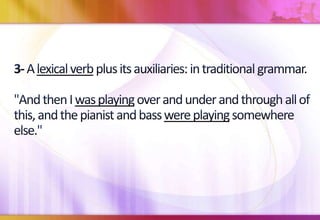
droptheessayoff
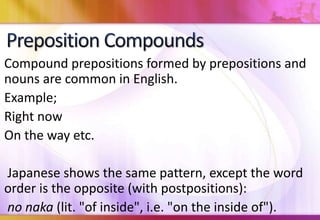
Compound prepositions formed by prepositions and
nouns are common in English.
Example;
Right now
On the way etc.
Japanese shows the same pattern, except the word
order is the opposite (with postpositions):
no naka (lit. "of inside", i.e. "on the inside of").
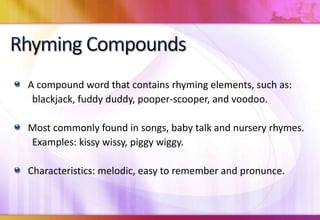
A compound word that contains rhyming elements, such as:
blackjack, fuddy duddy, pooper-scooper, and voodoo.
Most commonly found in songs, baby talk and nursery rhymes.
Examples: kissy wissy, piggy wiggy.
Characteristics: melodic, easy to remember and pronunce.
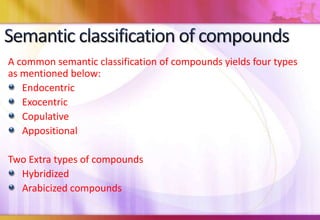
A common semantic classification of compounds yields four types
as mentioned below:
Endocentric
Exocentric
Copulative
Appositional
Two Extra types of compounds
Hybridized
Arabicized compounds
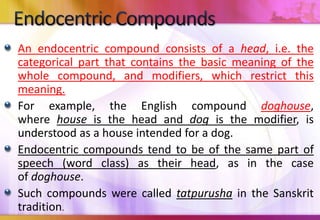
An endocentric compound consists of a head, i.e. the
categorical part that contains the basic meaning of the
whole compound, and modifiers, which restrict this
meaning.
For example, the English compound doghouse,
where house is the head and dog is the modifier, is
understood as a house intended for a dog.
Endocentric compounds tend to be of the same part of
speech (word class) as their head, as in the case
of doghouse.
Such compounds were called tatpurusha in the Sanskrit
tradition.
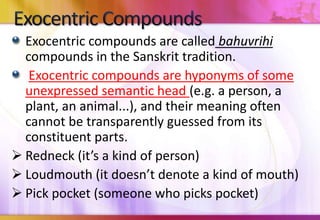
Exocentric compounds are called bahuvrihi
compounds in the Sanskrit tradition.
Exocentric compounds are hyponyms of some
unexpressed semantic head (e.g. a person, a
plant, an animal...), and their meaning often
cannot be transparently guessed from its
constituent parts.
 Redneck (it’s a kind of person)
 Loudmouth (it doesn’t denote a kind of mouth)
 Pick pocket (someone who picks pocket)
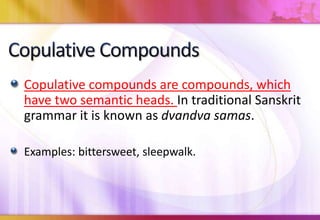
Copulative compounds are compounds, which
have two semantic heads. In traditional Sanskrit
grammar it is known as dvandva samas.
Examples: bittersweet, sleepwalk.
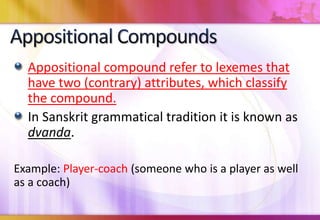
Appositional compound refer to lexemes that
have two (contrary) attributes, which classify
the compound.
In Sanskrit grammatical tradition it is known as
dvanda.
Example: Player-coach (someone who is a player as well
as a coach)
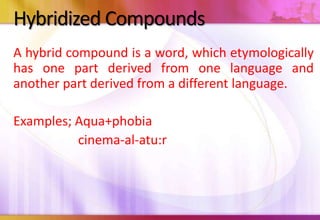
Hybridized Compounds
A hybrid compound is a word, which etymologically
has one part derived from one language and
another part derived from a different language.
Examples; Aqua+phobia
cinema-al-atu:r
Compounding (Linguistics)

Compounding (Linguistics)

  • 2.
    Definition Compounding or compositionis the process of combining two or more words (free morphemes) to create a new word (commonly a noun, verb, or adjective). Example: black+board=blackboard  The meaning of a compound word may be very different from the meanings of its components in isolation.  In other words a compound word is a union of two or more words to convey a unit idea or special meaning that is not conveyed as easily or quickly by separated words.
  • 3.
    Compound words maybe hyphenated, written open (as separate words), or written solid (closed). A hyphenated compound—also called a unit modifier—is simply a combination of words joined by a hyphen or hyphens. E.g. Marry-go-round The hyphen is a mark of punctuation that not only unites but separates the component words; thus, A hyphen in a compound word aids understanding and readability and ensures correct pronunciation. Words are hyphenated mainly to express the idea of a unit and to avoid ambiguity.
  • 4.
  • 5.
    Compounds have avery important systematic property:  Their head usually occurs on the right-hand head  It’s called right-hand head rule Type of right-hand head:  If the head is a verb, the compound will be a verb. e.g. deep-fry  If the head is a count noun, the compound will a noun. e.g. beer bottle
  • 6.
  • 7.
    Two or morenouns combined to form a single noun. Compound nouns are written as: separate words (orange juice) linked by a hyphen (sister-in-law) one word (schoolteacher)
  • 8.
    Two or morewords that act as a single idea to modify a noun. part-time: part-time employee high-speed: high-speed race As a general rule, the words in a compound adjective are hyphenated when they come before a noun (a well-known actor) but not when they come after (The actor is well known). Also, compound adjectives formed with an adverb ending in -ly (such as rapidly changing) are usually not hyphenated. Adverbs that do not end in -ly may take the hyphen to form a compound adjective. The reason is obvious. A fast-moving script suggests a roller coaster plot while a fast moving script might have pace but it is emotionally charged (i.e., emotionally moving) at the same time.
  • 9.
    The process ofcompounding verbs can be distinguished into 3 methods. 1- Two or more words combined to form a single verb. Conventionally, verb compounds are written as either one word ("to housesit") or two hyphenated words ("to water-proof"). Example: "I pretended to window-shop, pausing in front of a little store jammed with racks of costume jewelry."
  • 10.
  • 12.
    Compound prepositions formedby prepositions and nouns are common in English. Example; Right now On the way etc. Japanese shows the same pattern, except the word order is the opposite (with postpositions): no naka (lit. "of inside", i.e. "on the inside of").
  • 13.
    A compound wordthat contains rhyming elements, such as: blackjack, fuddy duddy, pooper-scooper, and voodoo. Most commonly found in songs, baby talk and nursery rhymes. Examples: kissy wissy, piggy wiggy. Characteristics: melodic, easy to remember and pronunce.
  • 14.
    A common semanticclassification of compounds yields four types as mentioned below: Endocentric Exocentric Copulative Appositional Two Extra types of compounds Hybridized Arabicized compounds
  • 15.
    An endocentric compoundconsists of a head, i.e. the categorical part that contains the basic meaning of the whole compound, and modifiers, which restrict this meaning. For example, the English compound doghouse, where house is the head and dog is the modifier, is understood as a house intended for a dog. Endocentric compounds tend to be of the same part of speech (word class) as their head, as in the case of doghouse. Such compounds were called tatpurusha in the Sanskrit tradition.
  • 16.
    Exocentric compounds arecalled bahuvrihi compounds in the Sanskrit tradition. Exocentric compounds are hyponyms of some unexpressed semantic head (e.g. a person, a plant, an animal...), and their meaning often cannot be transparently guessed from its constituent parts.  Redneck (it’s a kind of person)  Loudmouth (it doesn’t denote a kind of mouth)  Pick pocket (someone who picks pocket)
  • 17.
    Copulative compounds arecompounds, which have two semantic heads. In traditional Sanskrit grammar it is known as dvandva samas. Examples: bittersweet, sleepwalk.
  • 18.
    Appositional compound referto lexemes that have two (contrary) attributes, which classify the compound. In Sanskrit grammatical tradition it is known as dvanda. Example: Player-coach (someone who is a player as well as a coach)
  • 19.
    Hybridized Compounds A hybridcompound is a word, which etymologically has one part derived from one language and another part derived from a different language. Examples; Aqua+phobia cinema-al-atu:r