Other aspects of
connected speech
Prof. Ung Kim Srong
By Kak Sovanna, Mr. Soun Ngoun Y, MA in
English
02/08/15 kak Sovanna 093 6000211
contents
 Why “other” aspects of connected speech?
 Assimilation
 Elision
 Linking and intrusion
 Juncture
 Contraction
 Should we teach these aspects of connected
speech?
02/08/15 kak Sovanna 093 6000212
Introduction
 English people speak so fast
 When students see a spoken sentence in
its written form, they have no trouble
comprehending. Why is this?
02/08/15 kak Sovanna 093 6000213
Assimilation
 Describing how sounds modify each other
when they meet, usually across word
boundaries, and within a words is
assimilation.
 Common phonological process by which
one sound becomes more like a nearby
sound.
02/08/15 kak Sovanna 093 6000214
Rules for Assimilation
 The phomens /t/, /d/, and /n/ often
become bilabial before bilabial
consonant /p/, /b/, and /m/.
 He’s a rather fat boy. /t/ to /p/
 He’s very good boy. /t/ to /b/
 There are ten men in the class. /n/ to
/m/
02/08/15 kak Sovanna 093 6000215
Rules for Assimilation 1
 /t/ assimilates to /k/ before /k or /g/.
 /d/ assimilates to /g/ before /k/ of /g/
 Where has that cat been all night?
 Can you see that girl over there?
 It was very good concert.
02/08/15 kak Sovanna 093 6000216
Rules for Assimilation 2
 /n/ assimilates to /ŋ / before /g/ or /k/
 I’ve been going out too much lately.
 He’s bringing his own car.
 /s/ can assimilate to / / before / /ʃ ʃ
 I am really like this shiny one over there.
02/08/15 kak Sovanna 093 6000217
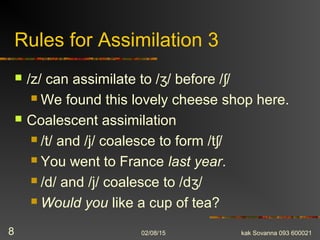
Rules for Assimilation 3
 /z/ can assimilate to / / before / /ʒ ʃ
 We found this lovely cheese shop here.
 Coalescent assimilation
 /t/ and /j/ coalesce to form /t /ʃ
 You went to France last year.
 /d/ and /j/ coalesce to /d /ʒ
 Would you like a cup of tea?
02/08/15 kak Sovanna 093 6000218
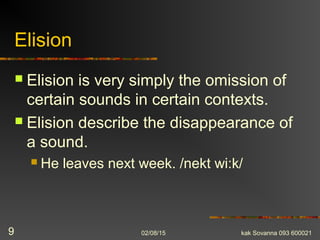
Elision
 Elision is very simply the omission of
certain sounds in certain contexts.
 Elision describe the disappearance of
a sound.
 He leaves next week. /nekt wi:k/
02/08/15 kak Sovanna 093 6000219
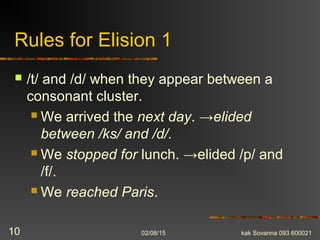
Rules for Elision 1
 /t/ and /d/ when they appear between a
consonant cluster.
 We arrived the next day. →elided
between /ks/ and /d/.
 We stopped for lunch. →elided /p/ and
/f/.
 We reached Paris.
02/08/15 kak Sovanna 093 60002110
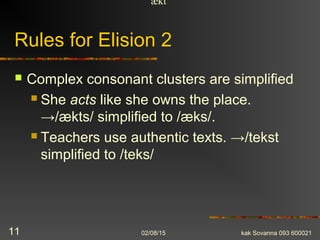
Rules for Elision 2
 Complex consonant clusters are simplified
 She acts like she owns the place.
→/ækts/ simplified to /æks/.
 Teachers use authentic texts. →/tekst
simplified to /teks/
ækt
02/08/15 kak Sovanna 093 60002111
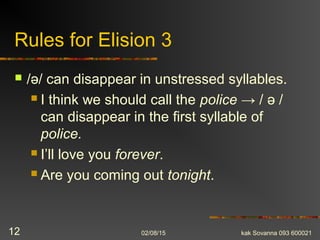
Rules for Elision 3
 /ə/ can disappear in unstressed syllables.
 I think we should call the police → / ə /
can disappear in the first syllable of
police.
 I’ll love you forever.
 Are you coming out tonight.
02/08/15 kak Sovanna 093 60002112
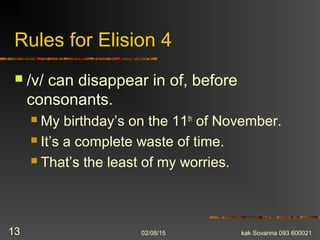
Rules for Elision 4
 /v/ can disappear in of, before
consonants.
 My birthday’s on the 11th
of November.
 It’s a complete waste of time.
 That’s the least of my worries.
02/08/15 kak Sovanna 093 60002113
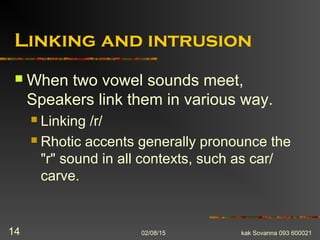
Linking and intrusion
 When two vowel sounds meet,
Speakers link them in various way.
 Linking /r/
 Rhotic accents generally pronounce the
"r" sound in all contexts, such as car/
carve.
02/08/15 kak Sovanna 093 60002114
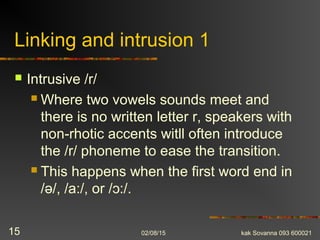
Linking and intrusion 1
 Intrusive /r/
 Where two vowels sounds meet and
there is no written letter r, speakers with
non-rhotic accents witll often introduce
the /r/ phoneme to ease the transition.
 This happens when the first word end in
/ə/, /a:/, or / :/.ɔ
02/08/15 kak Sovanna 093 60002115
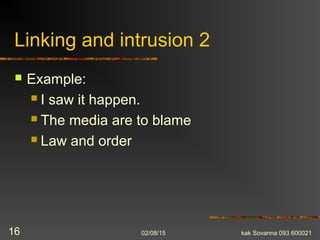
Linking and intrusion 2
 Example:
 I saw it happen.
 The media are to blame
 Law and order
02/08/15 kak Sovanna 093 60002116
Linking and intrusion 3
 Linking /j/
 When a word ends in /i/, or a dipthong
which finishes with [I], speakers often
introduce a /j/ to ease the transition to
the following vowel sound:
02/08/15 kak Sovanna 093 60002117
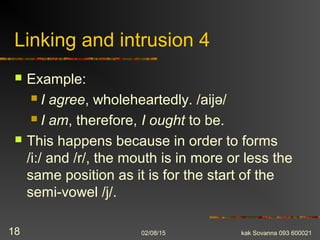
Linking and intrusion 4
 Example:
 I agree, wholeheartedly. /aijə/
 I am, therefore, I ought to be.
 This happens because in order to forms
/i:/ and /r/, the mouth is in more or less the
same position as it is for the start of the
semi-vowel /j/.
02/08/15 kak Sovanna 093 60002118
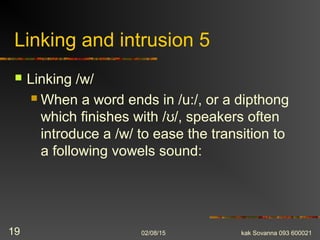
Linking and intrusion 5
 Linking /w/
 When a word ends in /u:/, or a dipthong
which finishes with / /, speakers oftenʊ
introduce a /w/ to ease the transition to
a following vowels sound:
02/08/15 kak Sovanna 093 60002119
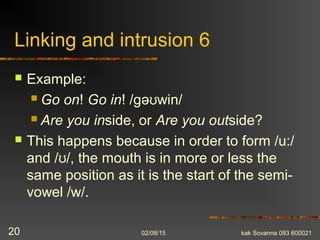
Linking and intrusion 6
 Example:
 Go on! Go in! /gə win/ʊ
 Are you inside, or Are you outside?
 This happens because in order to form /u:/
and / /, the mouth is in more or less theʊ
same position as it is the start of the semi-
vowel /w/.
02/08/15 kak Sovanna 093 60002120
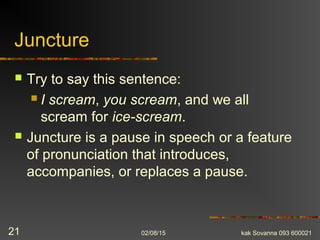
Juncture
 Try to say this sentence:
 I scream, you scream, and we all
scream for ice-scream.
 Juncture is a pause in speech or a feature
of pronunciation that introduces,
accompanies, or replaces a pause.
02/08/15 kak Sovanna 093 60002121
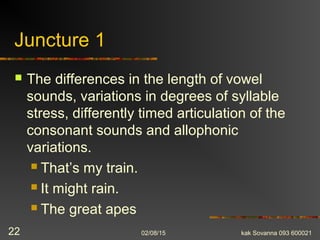
Juncture 1
 The differences in the length of vowel
sounds, variations in degrees of syllable
stress, differently timed articulation of the
consonant sounds and allophonic
variations.
 That’s my train.
 It might rain.
 The great apes
02/08/15 kak Sovanna 093 60002122
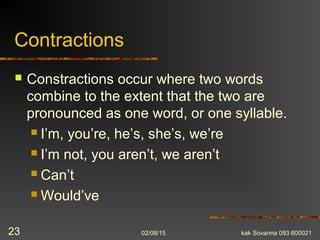
Contractions
 Constractions occur where two words
combine to the extent that the two are
pronounced as one word, or one syllable.
 I’m, you’re, he’s, she’s, we’re
 I’m not, you aren’t, we aren’t
 Can’t
 Would’ve
02/08/15 kak Sovanna 093 60002123
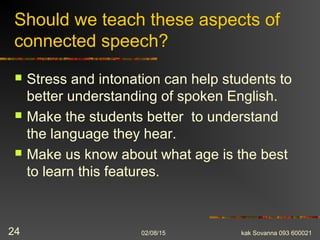
Should we teach these aspects of
connected speech?
 Stress and intonation can help students to
better understanding of spoken English.
 Make the students better to understand
the language they hear.
 Make us know about what age is the best
to learn this features.
02/08/15 kak Sovanna 093 60002124
Thank You!!!
02/08/15 kak Sovanna 093 60002125

Connected speech of sounds

  • 1.
    Other aspects of connectedspeech Prof. Ung Kim Srong By Kak Sovanna, Mr. Soun Ngoun Y, MA in English 02/08/15 kak Sovanna 093 6000211
  • 2.
    contents  Why “other”aspects of connected speech?  Assimilation  Elision  Linking and intrusion  Juncture  Contraction  Should we teach these aspects of connected speech? 02/08/15 kak Sovanna 093 6000212
  • 3.
    Introduction  English peoplespeak so fast  When students see a spoken sentence in its written form, they have no trouble comprehending. Why is this? 02/08/15 kak Sovanna 093 6000213
  • 4.
    Assimilation  Describing howsounds modify each other when they meet, usually across word boundaries, and within a words is assimilation.  Common phonological process by which one sound becomes more like a nearby sound. 02/08/15 kak Sovanna 093 6000214
  • 5.
    Rules for Assimilation The phomens /t/, /d/, and /n/ often become bilabial before bilabial consonant /p/, /b/, and /m/.  He’s a rather fat boy. /t/ to /p/  He’s very good boy. /t/ to /b/  There are ten men in the class. /n/ to /m/ 02/08/15 kak Sovanna 093 6000215
  • 6.
    Rules for Assimilation1  /t/ assimilates to /k/ before /k or /g/.  /d/ assimilates to /g/ before /k/ of /g/  Where has that cat been all night?  Can you see that girl over there?  It was very good concert. 02/08/15 kak Sovanna 093 6000216
  • 7.
    Rules for Assimilation2  /n/ assimilates to /ŋ / before /g/ or /k/  I’ve been going out too much lately.  He’s bringing his own car.  /s/ can assimilate to / / before / /ʃ ʃ  I am really like this shiny one over there. 02/08/15 kak Sovanna 093 6000217
  • 8.
    Rules for Assimilation3  /z/ can assimilate to / / before / /ʒ ʃ  We found this lovely cheese shop here.  Coalescent assimilation  /t/ and /j/ coalesce to form /t /ʃ  You went to France last year.  /d/ and /j/ coalesce to /d /ʒ  Would you like a cup of tea? 02/08/15 kak Sovanna 093 6000218
  • 9.
    Elision  Elision isvery simply the omission of certain sounds in certain contexts.  Elision describe the disappearance of a sound.  He leaves next week. /nekt wi:k/ 02/08/15 kak Sovanna 093 6000219
  • 10.
    Rules for Elision1  /t/ and /d/ when they appear between a consonant cluster.  We arrived the next day. →elided between /ks/ and /d/.  We stopped for lunch. →elided /p/ and /f/.  We reached Paris. 02/08/15 kak Sovanna 093 60002110
  • 11.
    Rules for Elision2  Complex consonant clusters are simplified  She acts like she owns the place. →/ækts/ simplified to /æks/.  Teachers use authentic texts. →/tekst simplified to /teks/ ækt 02/08/15 kak Sovanna 093 60002111
  • 12.
    Rules for Elision3  /ə/ can disappear in unstressed syllables.  I think we should call the police → / ə / can disappear in the first syllable of police.  I’ll love you forever.  Are you coming out tonight. 02/08/15 kak Sovanna 093 60002112
  • 13.
    Rules for Elision4  /v/ can disappear in of, before consonants.  My birthday’s on the 11th of November.  It’s a complete waste of time.  That’s the least of my worries. 02/08/15 kak Sovanna 093 60002113
  • 14.
    Linking and intrusion When two vowel sounds meet, Speakers link them in various way.  Linking /r/  Rhotic accents generally pronounce the "r" sound in all contexts, such as car/ carve. 02/08/15 kak Sovanna 093 60002114
  • 15.
    Linking and intrusion1  Intrusive /r/  Where two vowels sounds meet and there is no written letter r, speakers with non-rhotic accents witll often introduce the /r/ phoneme to ease the transition.  This happens when the first word end in /ə/, /a:/, or / :/.ɔ 02/08/15 kak Sovanna 093 60002115
  • 16.
    Linking and intrusion2  Example:  I saw it happen.  The media are to blame  Law and order 02/08/15 kak Sovanna 093 60002116
  • 17.
    Linking and intrusion3  Linking /j/  When a word ends in /i/, or a dipthong which finishes with [I], speakers often introduce a /j/ to ease the transition to the following vowel sound: 02/08/15 kak Sovanna 093 60002117
  • 18.
    Linking and intrusion4  Example:  I agree, wholeheartedly. /aijə/  I am, therefore, I ought to be.  This happens because in order to forms /i:/ and /r/, the mouth is in more or less the same position as it is for the start of the semi-vowel /j/. 02/08/15 kak Sovanna 093 60002118
  • 19.
    Linking and intrusion5  Linking /w/  When a word ends in /u:/, or a dipthong which finishes with / /, speakers oftenʊ introduce a /w/ to ease the transition to a following vowels sound: 02/08/15 kak Sovanna 093 60002119
  • 20.
    Linking and intrusion6  Example:  Go on! Go in! /gə win/ʊ  Are you inside, or Are you outside?  This happens because in order to form /u:/ and / /, the mouth is in more or less theʊ same position as it is the start of the semi- vowel /w/. 02/08/15 kak Sovanna 093 60002120
  • 21.
    Juncture  Try tosay this sentence:  I scream, you scream, and we all scream for ice-scream.  Juncture is a pause in speech or a feature of pronunciation that introduces, accompanies, or replaces a pause. 02/08/15 kak Sovanna 093 60002121
  • 22.
    Juncture 1  Thedifferences in the length of vowel sounds, variations in degrees of syllable stress, differently timed articulation of the consonant sounds and allophonic variations.  That’s my train.  It might rain.  The great apes 02/08/15 kak Sovanna 093 60002122
  • 23.
    Contractions  Constractions occurwhere two words combine to the extent that the two are pronounced as one word, or one syllable.  I’m, you’re, he’s, she’s, we’re  I’m not, you aren’t, we aren’t  Can’t  Would’ve 02/08/15 kak Sovanna 093 60002123
  • 24.
    Should we teachthese aspects of connected speech?  Stress and intonation can help students to better understanding of spoken English.  Make the students better to understand the language they hear.  Make us know about what age is the best to learn this features. 02/08/15 kak Sovanna 093 60002124
  • 25.
    Thank You!!! 02/08/15 kakSovanna 093 60002125