(Morphological and Syntactic
Analysis)
Centre for Linguistics, School of language,
Literature and Culture Studies
JNU, New Delhi-110067
Gopal Ram
Slides Courtesy: Prof PK Das
How new words are being formed in the
language?
Why the process consists of a combination of
morphemes that are rule-governed (when a
new word is formed)?
Why processes are formed frequently or
commonly in the use of the English language?
Nowadays, the terms ‘word formation’ does not have a clear
cut, universally accepted usage.
It is sometimes referred to all processes connected with
changing the form of the word by, for example, affixation,
which is a matter of morphology.
In its wider sense word formation denotes the processes of
creation of new lexical units.
Although it seems that the difference between morphological
change of a word and creation of a new term is quite easy to
perceive, there is sometimes a dispute as to whether blending
is still a morphological change or making a new word.
There are, of course, numerous word formation processes
that do not arouse any controversies and are very similar in
the majority of languages.
Clipping is the word formation process which
consists in the reduction of a word to one of its
parts (Marchand: 1969). Clippings are, also,
known as "shortenings."Clipping mainly
consists of the following types:
a. Back clipping
b. Fore-clipping
c. Middle clipping
d. Complex clipping
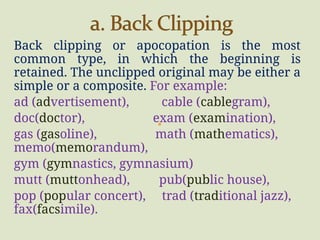
Back clipping or apocopation is the most
common type, in which the beginning is
retained. The unclipped original may be either a
simple or a composite. For example:
ad (advertisement), cable (cablegram),
doc(doctor), exam (examination),
gas (gasoline), math (mathematics),
memo(memorandum),
gym (gymnastics, gymnasium)
mutt (muttonhead), pub(public house),
pop (popular concert), trad (traditional jazz),
fax(facsimile).
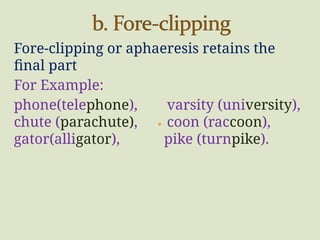
Fore-clipping or aphaeresis retains the
final part.
For Example:
phone(telephone), varsity (university),
chute (parachute), coon (raccoon),
gator(alligator), pike (turnpike).
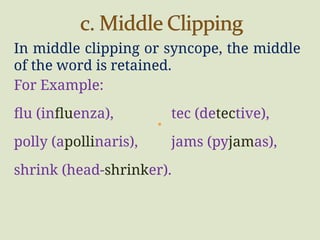
In middle clipping or syncope, the middle
of the word is retained.
For Example:
flu (influenza), tec (detective),
polly (apollinaris), jams (pyjamas),
shrink (head-shrinker).
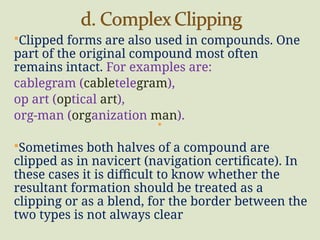
Clipped forms are also used in compounds. One
part of the original compound most often
remains intact. For examples are:
cablegram (cabletelegram),
op art (optical art),
org-man (organization man).
Sometimes both halves of a compound are
clipped as in navicert (navigation certificate). In
these cases it is difficult to know whether the
resultant formation should be treated as a
clipping or as a blend, for the border between the
two types is not always clear
Acronyms and initialisms are
abbreviations, such as NATO, laser, and
IBM, that are formed using the initial
letters of words or word parts in a phrase
or name. Acronyms and initialisms are
usually pronounced in a way that is
distinct from that of the full forms for
which they stand: as the names of the
individual letters (as in IBM), as a word
(as in NATO), or as a combination (as in
IUPAC). Another term, Alphabetism, is
sometimes used to describe abbreviations
pronounced as the names of letters.
A blend is a word formed from parts of two other words. These parts are sometimes,
but not always, morphemes.
A blend is different from a portmanteau word in that a portmanteau refers strictly to
a blending of two function words, similar to a contraction.
3.1 Formation of Blending: Most blends are formed by one of the following methods:
a. The beginning of one word is added to the end of the other. For
Example: brunch (breakfast and lunch).
b. The beginnings of two words are combined. For
Example: cyborg (cybernetic and organism)
c. One complete word is combined with part of another word.
For Example: guesstimate (guess and estimate)
d. Two words are blended around a common sequence of sounds.
For Example: Californication (from a song by the Red Hot Chili
Peppers, is a blend of California and fornication)
e. Multiple sounds from two component words are blended, while mostly
preserving the sounds' order. Poet Lewis Carroll was well known for these
kinds of blends. This method is difficult to achieve and is considered a
sign of Carroll's verbal wit. For Example: slithy (lithe and slimy).
Back-formation refers to the process of creating a new lexeme
(less precisely, a new "word") by removing actual or supposed
affixes. The resulting neologism is called a back-formation.
Back-formations are shortened words created from longer
words, thus back-formations may be viewed as a sub-type of
clipping. For Example:
The noun resurrection was borrowed from Latin, and
the verb resurrect was then back formed hundreds of
years later from it by removing the -ion suffix. This
segmentation of resurrection into resurrect+ ion was
possible because English had many examples of
Latinate words that had verb and verb+-ion pairs —
in these pairs the -ion suffix is added to verb forms in
order to create nouns (such as, insert/insertion,
project/projection, etc.).
Borrowing is just taking a word from another
language. The borrowed words are called loan
words. A loanword (or loan word) is a word
directly taken into one language from another
with little or no translation. By contrast, a
calque or loan translation is a related concept
whereby it is the meaning or idiom that is
borrowed rather than the lexical item itself. The
word loanword is itself a calque of the German
Lehnwort. Loanwords can also be called
"borrowings".
For Example: Sakul/schakul from School
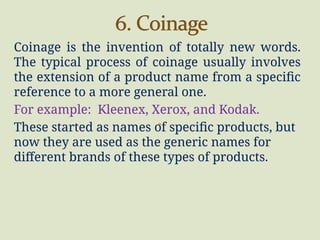
Coinage is the invention of totally new words.
The typical process of coinage usually involves
the extension of a product name from a specific
reference to a more general one.
For example: Kleenex, Xerox, and Kodak.
These started as names of specific products, but
now they are used as the generic names for
different brands of these types of products.
Process of forming new words either by doubling an entire word
(total reduplication) or part of a word (partial reduplication).
English makes use of reduplication very sporadically (rarely). Total
reduplication is extremely rare!
Full and partial reduplication
Full reduplication involves a reduplication of the entire word. For
example, Kham derives reciprocal forms from reflexive forms by
total reduplication:
[ɡin]'ourselves'→[ɡinɡin]'we (to) us'(ɡin-ɡin) [jaː]'themselves'→[jaːjaː]'they (to)
them'(jaː-jaː)(Watters 2002).
Partial reduplication involves a reduplication of only part of the word. For
example, Marshallese forms words meaning 'to wear X' by reduplicating
the last consonant-vowel-consonant (CVC) sequence of a base, i.e. base+CVC:
kagir 'belt'→kagirgir 'to wear a belt‘ (kagir-gir) takin 'sock'→takinkin 'to wear socks
‘(takin-kin)(Moravsik 1978).
English partial reduplication:
Example: Humpty – Dumpty, Hocus -
Pocus,
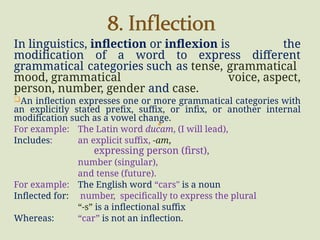
In linguistics, inflection or inflexion is the
modification of a word to express different
grammatical categories such as tense, grammatical
mood, grammatical voice, aspect,
person, number, gender and case.
An inflection expresses one or more grammatical categories with
an explicitly stated prefix, suffix, or infix, or another internal
modification such as a vowel change.
For example: The Latin word ducam, (I will lead),
Includes: an explicit suffix, -am,
expressing person (first),
number (singular),
and tense (future).
For example: The English word “cars" is a noun
Inflected for: number, specifically to express the plural
“-s” is a inflectional suffix
Whereas: “car” is not an inflection.
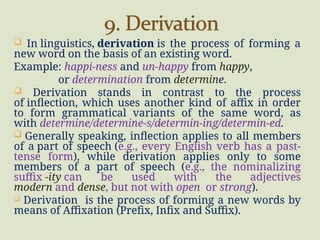
 In linguistics, derivation is the process of forming a
new word on the basis of an existing word.
Example: happi-ness and un-happy from happy,
or determination from determine.
 Derivation stands in contrast to the process
of inflection, which uses another kind of affix in order
to form grammatical variants of the same word, as
with determine/determine-s/determin-ing/determin-ed.
 Generally speaking, inflection applies to all members
of a part of speech (e.g., every English verb has a past-
tense form), while derivation applies only to some
members of a part of speech (e.g., the nominalizing
suffix -ity can be used with the adjectives
modern and dense, but not with open or strong).
 Derivation is the process of forming a new words by
means of Affixation (Prefix, Infix and Suffix).
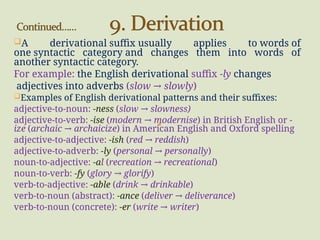
A derivational suffix usually applies to words of
one syntactic category and changes them into words of
another syntactic category.
For example: the English derivational suffix -ly changes
adjectives into adverbs (slow → slowly).
Examples of English derivational patterns and their suffixes:
adjective-to-noun: -ness (slow → slowness)
adjective-to-verb: -ise (modern → modernise) in British English or -
ize (archaic → archaicize) in American English and Oxford spelling
adjective-to-adjective: -ish (red → reddish)
adjective-to-adverb: -ly (personal → personally)
noun-to-adjective: -al (recreation → recreational)
noun-to-verb: -fy (glory → glorify)
verb-to-adjective: -able (drink → drinkable)
verb-to-noun (abstract): -ance (deliver → deliverance)
verb-to-noun (concrete): -er (write → writer)
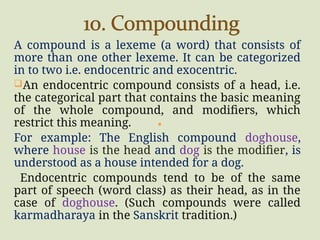
A compound is a lexeme (a word) that consists of
more than one other lexeme. It can be categorized
in to two i.e. endocentric and exocentric.
An endocentric compound consists of a head, i.e.
the categorical part that contains the basic meaning
of the whole compound, and modifiers, which
restrict this meaning.
For example: The English compound doghouse,
where house is the head and dog is the modifier, is
understood as a house intended for a dog.
Endocentric compounds tend to be of the same
part of speech (word class) as their head, as in the
case of doghouse. (Such compounds were called
karmadharaya in the Sanskrit tradition.)
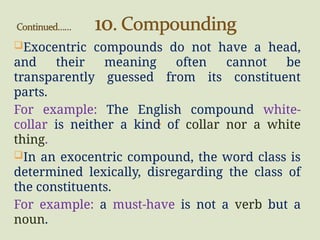
Exocentric compounds do not have a head,
and their meaning often cannot be
transparently guessed from its constituent
parts.
For example: The English compound white-
collar is neither a kind of collar nor a white
thing.
In an exocentric compound, the word class is
determined lexically, disregarding the class of
the constituents.
For example: a must-have is not a verb but a
noun.
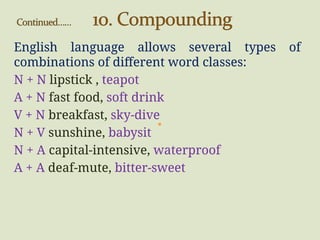
English language allows several types of
combinations of different word classes:
N + N lipstick , teapot
A + N fast food, soft drink
V + N breakfast, sky-dive
N + V sunshine, babysit
N + A capital-intensive, waterproof
A + A deaf-mute, bitter-sweet
Good Day.

Word-formation-process.pptpptpptpptpptpptppt

  • 1.
    (Morphological and Syntactic Analysis) Centrefor Linguistics, School of language, Literature and Culture Studies JNU, New Delhi-110067 Gopal Ram Slides Courtesy: Prof PK Das
  • 2.
    How new wordsare being formed in the language? Why the process consists of a combination of morphemes that are rule-governed (when a new word is formed)? Why processes are formed frequently or commonly in the use of the English language?
  • 3.
    Nowadays, the terms‘word formation’ does not have a clear cut, universally accepted usage. It is sometimes referred to all processes connected with changing the form of the word by, for example, affixation, which is a matter of morphology. In its wider sense word formation denotes the processes of creation of new lexical units. Although it seems that the difference between morphological change of a word and creation of a new term is quite easy to perceive, there is sometimes a dispute as to whether blending is still a morphological change or making a new word. There are, of course, numerous word formation processes that do not arouse any controversies and are very similar in the majority of languages.
  • 4.
    Clipping is theword formation process which consists in the reduction of a word to one of its parts (Marchand: 1969). Clippings are, also, known as "shortenings."Clipping mainly consists of the following types: a. Back clipping b. Fore-clipping c. Middle clipping d. Complex clipping
  • 5.
    Back clipping orapocopation is the most common type, in which the beginning is retained. The unclipped original may be either a simple or a composite. For example: ad (advertisement), cable (cablegram), doc(doctor), exam (examination), gas (gasoline), math (mathematics), memo(memorandum), gym (gymnastics, gymnasium) mutt (muttonhead), pub(public house), pop (popular concert), trad (traditional jazz), fax(facsimile).
  • 6.
    Fore-clipping or aphaeresisretains the final part. For Example: phone(telephone), varsity (university), chute (parachute), coon (raccoon), gator(alligator), pike (turnpike).
  • 7.
    In middle clippingor syncope, the middle of the word is retained. For Example: flu (influenza), tec (detective), polly (apollinaris), jams (pyjamas), shrink (head-shrinker).
  • 8.
    Clipped forms arealso used in compounds. One part of the original compound most often remains intact. For examples are: cablegram (cabletelegram), op art (optical art), org-man (organization man). Sometimes both halves of a compound are clipped as in navicert (navigation certificate). In these cases it is difficult to know whether the resultant formation should be treated as a clipping or as a blend, for the border between the two types is not always clear
  • 9.
    Acronyms and initialismsare abbreviations, such as NATO, laser, and IBM, that are formed using the initial letters of words or word parts in a phrase or name. Acronyms and initialisms are usually pronounced in a way that is distinct from that of the full forms for which they stand: as the names of the individual letters (as in IBM), as a word (as in NATO), or as a combination (as in IUPAC). Another term, Alphabetism, is sometimes used to describe abbreviations pronounced as the names of letters.
  • 10.
    A blend isa word formed from parts of two other words. These parts are sometimes, but not always, morphemes. A blend is different from a portmanteau word in that a portmanteau refers strictly to a blending of two function words, similar to a contraction. 3.1 Formation of Blending: Most blends are formed by one of the following methods: a. The beginning of one word is added to the end of the other. For Example: brunch (breakfast and lunch). b. The beginnings of two words are combined. For Example: cyborg (cybernetic and organism) c. One complete word is combined with part of another word. For Example: guesstimate (guess and estimate) d. Two words are blended around a common sequence of sounds. For Example: Californication (from a song by the Red Hot Chili Peppers, is a blend of California and fornication) e. Multiple sounds from two component words are blended, while mostly preserving the sounds' order. Poet Lewis Carroll was well known for these kinds of blends. This method is difficult to achieve and is considered a sign of Carroll's verbal wit. For Example: slithy (lithe and slimy).
  • 11.
    Back-formation refers tothe process of creating a new lexeme (less precisely, a new "word") by removing actual or supposed affixes. The resulting neologism is called a back-formation. Back-formations are shortened words created from longer words, thus back-formations may be viewed as a sub-type of clipping. For Example: The noun resurrection was borrowed from Latin, and the verb resurrect was then back formed hundreds of years later from it by removing the -ion suffix. This segmentation of resurrection into resurrect+ ion was possible because English had many examples of Latinate words that had verb and verb+-ion pairs — in these pairs the -ion suffix is added to verb forms in order to create nouns (such as, insert/insertion, project/projection, etc.).
  • 12.
    Borrowing is justtaking a word from another language. The borrowed words are called loan words. A loanword (or loan word) is a word directly taken into one language from another with little or no translation. By contrast, a calque or loan translation is a related concept whereby it is the meaning or idiom that is borrowed rather than the lexical item itself. The word loanword is itself a calque of the German Lehnwort. Loanwords can also be called "borrowings". For Example: Sakul/schakul from School
  • 13.
    Coinage is theinvention of totally new words. The typical process of coinage usually involves the extension of a product name from a specific reference to a more general one. For example: Kleenex, Xerox, and Kodak. These started as names of specific products, but now they are used as the generic names for different brands of these types of products.
  • 14.
    Process of formingnew words either by doubling an entire word (total reduplication) or part of a word (partial reduplication). English makes use of reduplication very sporadically (rarely). Total reduplication is extremely rare! Full and partial reduplication Full reduplication involves a reduplication of the entire word. For example, Kham derives reciprocal forms from reflexive forms by total reduplication: [ɡin]'ourselves'→[ɡinɡin]'we (to) us'(ɡin-ɡin) [jaː]'themselves'→[jaːjaː]'they (to) them'(jaː-jaː)(Watters 2002). Partial reduplication involves a reduplication of only part of the word. For example, Marshallese forms words meaning 'to wear X' by reduplicating the last consonant-vowel-consonant (CVC) sequence of a base, i.e. base+CVC: kagir 'belt'→kagirgir 'to wear a belt‘ (kagir-gir) takin 'sock'→takinkin 'to wear socks ‘(takin-kin)(Moravsik 1978). English partial reduplication: Example: Humpty – Dumpty, Hocus - Pocus,
  • 15.
    In linguistics, inflectionor inflexion is the modification of a word to express different grammatical categories such as tense, grammatical mood, grammatical voice, aspect, person, number, gender and case. An inflection expresses one or more grammatical categories with an explicitly stated prefix, suffix, or infix, or another internal modification such as a vowel change. For example: The Latin word ducam, (I will lead), Includes: an explicit suffix, -am, expressing person (first), number (singular), and tense (future). For example: The English word “cars" is a noun Inflected for: number, specifically to express the plural “-s” is a inflectional suffix Whereas: “car” is not an inflection.
  • 16.
     In linguistics,derivation is the process of forming a new word on the basis of an existing word. Example: happi-ness and un-happy from happy, or determination from determine.  Derivation stands in contrast to the process of inflection, which uses another kind of affix in order to form grammatical variants of the same word, as with determine/determine-s/determin-ing/determin-ed.  Generally speaking, inflection applies to all members of a part of speech (e.g., every English verb has a past- tense form), while derivation applies only to some members of a part of speech (e.g., the nominalizing suffix -ity can be used with the adjectives modern and dense, but not with open or strong).  Derivation is the process of forming a new words by means of Affixation (Prefix, Infix and Suffix).
  • 17.
    A derivational suffixusually applies to words of one syntactic category and changes them into words of another syntactic category. For example: the English derivational suffix -ly changes adjectives into adverbs (slow → slowly). Examples of English derivational patterns and their suffixes: adjective-to-noun: -ness (slow → slowness) adjective-to-verb: -ise (modern → modernise) in British English or - ize (archaic → archaicize) in American English and Oxford spelling adjective-to-adjective: -ish (red → reddish) adjective-to-adverb: -ly (personal → personally) noun-to-adjective: -al (recreation → recreational) noun-to-verb: -fy (glory → glorify) verb-to-adjective: -able (drink → drinkable) verb-to-noun (abstract): -ance (deliver → deliverance) verb-to-noun (concrete): -er (write → writer)
  • 18.
    A compound isa lexeme (a word) that consists of more than one other lexeme. It can be categorized in to two i.e. endocentric and exocentric. An endocentric compound consists of a head, i.e. the categorical part that contains the basic meaning of the whole compound, and modifiers, which restrict this meaning. For example: The English compound doghouse, where house is the head and dog is the modifier, is understood as a house intended for a dog. Endocentric compounds tend to be of the same part of speech (word class) as their head, as in the case of doghouse. (Such compounds were called karmadharaya in the Sanskrit tradition.)
  • 19.
    Exocentric compounds donot have a head, and their meaning often cannot be transparently guessed from its constituent parts. For example: The English compound white- collar is neither a kind of collar nor a white thing. In an exocentric compound, the word class is determined lexically, disregarding the class of the constituents. For example: a must-have is not a verb but a noun.
  • 20.
    English language allowsseveral types of combinations of different word classes: N + N lipstick , teapot A + N fast food, soft drink V + N breakfast, sky-dive N + V sunshine, babysit N + A capital-intensive, waterproof A + A deaf-mute, bitter-sweet
  • 21.