
Subject:
Topic: Morphology
Academic Year
2014~2015
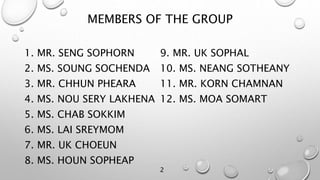
MEMBERS OF THE GROUP
1. MR. SENG SOPHORN
2. MS. SOUNG SOCHENDA
3. MR. CHHUN PHEARA
4. MS. NOU SERY LAKHENA
5. MS. CHAB SOKKIM
6. MS. LAI SREYMOM
7. MR. UK CHOEUN
8. MS. HOUN SOPHEAP
9. MR. UK SOPHAL
10. MS. NEANG SOTHEANY
11. MR. KORN CHAMNAN
12. MS. MOA SOMART
2
MORPHOLOGY
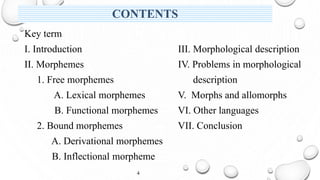
CONTENTS
Key term
I. Introduction
II. Morphemes
1. Free morphemes
A. Lexical morphemes
B. Functional morphemes
2. Bound morphemes
A. Derivational morphemes
B. Inflectional morpheme
4
III. Morphological description
IV. Problems in morphological
description
V. Morphs and allomorphs
VI. Other languages
VII. Conclusion
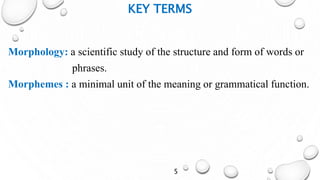
KEY TERMS
Morphology: a scientific study of the structure and form of words or
phrases.
Morphemes : a minimal unit of the meaning or grammatical function.
5
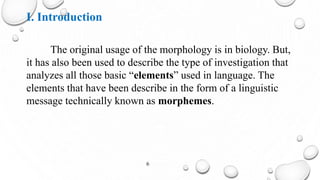
I. Introduction
The original usage of the morphology is in biology. But,
it has also been used to describe the type of investigation that
analyzes all those basic “elements” used in language. The
elements that have been describe in the form of a linguistic
message technically known as morphemes.
6
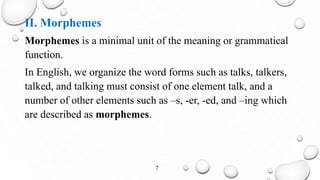
II. Morphemes
Morphemes is a minimal unit of the meaning or grammatical
function.
In English, we organize the word forms such as talks, talkers,
talked, and talking must consist of one element talk, and a
number of other elements such as –s, -er, -ed, and –ing which
are described as morphemes.
7
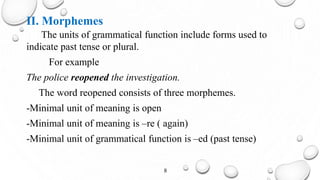
II. Morphemes
The units of grammatical function include forms used to
indicate past tense or plural.
For example
The police reopened the investigation.
The word reopened consists of three morphemes.
-Minimal unit of meaning is open
-Minimal unit of meaning is –re ( again)
-Minimal unit of grammatical function is –ed (past tense)
8
II. Morphemes
Tourists
The word tourists also contains three morphemes.
-Minimal unit of meaning is tour
-Minimal unit of meaning is –ist ( person who does something)
-Minimal unit of grammatical function is –s (plural)
9
1. Free morphemes
Free morphemes is the morphemes that can stand by
themselves as single words.
For example
- Open
- Tour
It can generally be identified as the set of separate
English word forms such as basic nouns, adjectives,
verbs. 10
A. Lexical morphemes
The words like: girl, man, house, tiger, sad, long, yellow,
sincere, open, ect. Are known as free morphemes, but these free
morphemes are called lexical morphemes. They are the set of
ordinary nouns, adjectives, and verbs.
We can add new lexical morphemes to the language easily.
So they are treated as “open” class of words.
11
B. Functional morphemes
The words like: and, but, because, etc. are known as
free morphemes, but these free morphemes are called
lexical morphemes. They are the set of functional words
such as conjunctions, prepositions, articled, and
pronouns.
We never add new functional morphemes to the
language, so they are described as a “closed” class of
words.
12
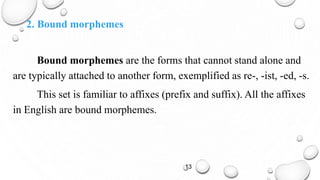
2. Bound morphemes
Bound morphemes are the forms that cannot stand alone and
are typically attached to another form, exemplified as re-, -ist, -ed, -s.
This set is familiar to affixes (prefix and suffix). All the affixes
in English are bound morphemes.
13
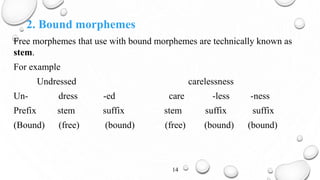
2. Bound morphemes
Free morphemes that use with bound morphemes are technically known as
stem.
For example
Undressed carelessness
Un- dress -ed care -less -ness
Prefix stem suffix stem suffix suffix
(Bound) (free) (bound) (free) (bound) (bound)
14
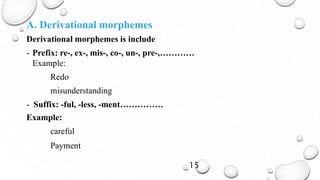
A. Derivational morphemes
Derivational morphemes is include
- Prefix: re-, ex-, mis-, co-, un-, pre-,…………
Example:
Redo
misunderstanding
- Suffix: -ful, -less, -ment……………
Example:
careful
Payment
15
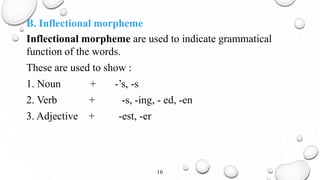
B. Inflectional morpheme
Inflectional morpheme are used to indicate grammatical
function of the words.
These are used to show :
1. Noun + -’s, -s
2. Verb + -s, -ing, - ed, -en
3. Adjective + -est, -er
16
III. Morphological description
Inflectional morpheme never changes the grammatical
function of the words.
Example:
older, cuter
Derivational morpheme can changes the grammatical
function of the words.
Example:
leader, driver
17
Summary
Morphemes
1. Free morphemes
A. Lexical morphemes (child, teach)
B. Functional morphemes ( and, the)
2. Bound morphemes
A. Derivational morphemes (re-, -ness)
B. Inflectional morpheme (-’s, -ed)
18
IV. Problems in morphological description
In the analysis of different languages, there are
problematic cases. But the solution of the
problem are clear.
19
For example
The relationship between law and legal
- law (noun)
- legal (adjective)
+ Law is the result of borrowing into old English (lagu)
from a Scandinavian source over 1000 years ago.
+ Legal was borrowed from the Latin from (legalis = of
the law) about 500 years.
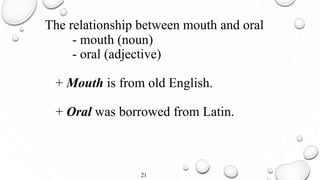
The relationship between mouth and oral
- mouth (noun)
- oral (adjective)
+ Mouth is from old English.
+ Oral was borrowed from Latin.
21
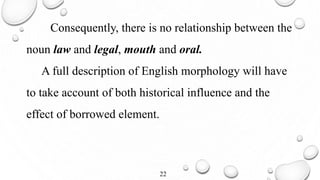
Consequently, there is no relationship between the
noun law and legal, mouth and oral.
A full description of English morphology will have
to take account of both historical influence and the
effect of borrowed element.
22
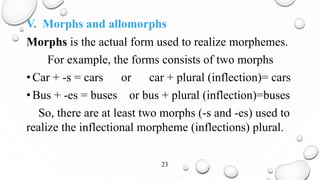
V. Morphs and allomorphs
Morphs is the actual form used to realize morphemes.
For example, the forms consists of two morphs
•Car + -s = cars or car + plural (inflection)= cars
•Bus + -es = buses or bus + plural (inflection)=buses
So, there are at least two morphs (-s and -es) used to
realize the inflectional morpheme (inflections) plural.
23
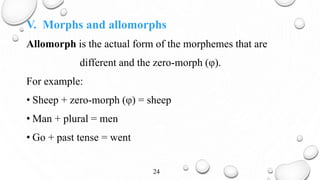
V. Morphs and allomorphs
Allomorph is the actual form of the morphemes that are
different and the zero-morph (φ).
For example:
• Sheep + zero-morph (φ) = sheep
• Man + plural = men
• Go + past tense = went
24
VI. Other Languages (1)
We can find other form and patterns realize the
basic types of morphemes we have identified.
For examples, we attach a derivation morphemes
to a stem, then add an inflectional morpheme.
25
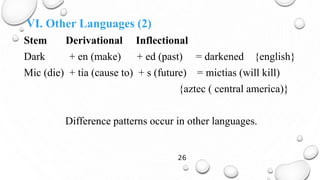
VI. Other Languages (2)
Stem Derivational Inflectional
Dark + en (make) + ed (past) = darkened {english}
Mic (die) + tia (cause to) + s (future) = mictias (will kill)
{aztec ( central america)}
Difference patterns occur in other languages.
26
VI. Conclusion
In conclusion, studying the morphology is very
important for the learner. Although it is the small unit,
it is the grammatical function in the linguistics. The
learners of linguistics should understand the usage of
the morphology and have to be careful the forms that
are different. In other languages also have morphology.
27
Thank you

Morphology ch 2, group 1

  • 1.
  • 2.
    MEMBERS OF THEGROUP 1. MR. SENG SOPHORN 2. MS. SOUNG SOCHENDA 3. MR. CHHUN PHEARA 4. MS. NOU SERY LAKHENA 5. MS. CHAB SOKKIM 6. MS. LAI SREYMOM 7. MR. UK CHOEUN 8. MS. HOUN SOPHEAP 9. MR. UK SOPHAL 10. MS. NEANG SOTHEANY 11. MR. KORN CHAMNAN 12. MS. MOA SOMART 2
  • 3.
  • 4.
    CONTENTS Key term I. Introduction II.Morphemes 1. Free morphemes A. Lexical morphemes B. Functional morphemes 2. Bound morphemes A. Derivational morphemes B. Inflectional morpheme 4 III. Morphological description IV. Problems in morphological description V. Morphs and allomorphs VI. Other languages VII. Conclusion
  • 5.
    KEY TERMS Morphology: ascientific study of the structure and form of words or phrases. Morphemes : a minimal unit of the meaning or grammatical function. 5
  • 6.
    I. Introduction The originalusage of the morphology is in biology. But, it has also been used to describe the type of investigation that analyzes all those basic “elements” used in language. The elements that have been describe in the form of a linguistic message technically known as morphemes. 6
  • 7.
    II. Morphemes Morphemes isa minimal unit of the meaning or grammatical function. In English, we organize the word forms such as talks, talkers, talked, and talking must consist of one element talk, and a number of other elements such as –s, -er, -ed, and –ing which are described as morphemes. 7
  • 8.
    II. Morphemes The unitsof grammatical function include forms used to indicate past tense or plural. For example The police reopened the investigation. The word reopened consists of three morphemes. -Minimal unit of meaning is open -Minimal unit of meaning is –re ( again) -Minimal unit of grammatical function is –ed (past tense) 8
  • 9.
    II. Morphemes Tourists The wordtourists also contains three morphemes. -Minimal unit of meaning is tour -Minimal unit of meaning is –ist ( person who does something) -Minimal unit of grammatical function is –s (plural) 9
  • 10.
    1. Free morphemes Freemorphemes is the morphemes that can stand by themselves as single words. For example - Open - Tour It can generally be identified as the set of separate English word forms such as basic nouns, adjectives, verbs. 10
  • 11.
    A. Lexical morphemes Thewords like: girl, man, house, tiger, sad, long, yellow, sincere, open, ect. Are known as free morphemes, but these free morphemes are called lexical morphemes. They are the set of ordinary nouns, adjectives, and verbs. We can add new lexical morphemes to the language easily. So they are treated as “open” class of words. 11
  • 12.
    B. Functional morphemes Thewords like: and, but, because, etc. are known as free morphemes, but these free morphemes are called lexical morphemes. They are the set of functional words such as conjunctions, prepositions, articled, and pronouns. We never add new functional morphemes to the language, so they are described as a “closed” class of words. 12
  • 13.
    2. Bound morphemes Boundmorphemes are the forms that cannot stand alone and are typically attached to another form, exemplified as re-, -ist, -ed, -s. This set is familiar to affixes (prefix and suffix). All the affixes in English are bound morphemes. 13
  • 14.
    2. Bound morphemes Freemorphemes that use with bound morphemes are technically known as stem. For example Undressed carelessness Un- dress -ed care -less -ness Prefix stem suffix stem suffix suffix (Bound) (free) (bound) (free) (bound) (bound) 14
  • 15.
    A. Derivational morphemes Derivationalmorphemes is include - Prefix: re-, ex-, mis-, co-, un-, pre-,………… Example: Redo misunderstanding - Suffix: -ful, -less, -ment…………… Example: careful Payment 15
  • 16.
    B. Inflectional morpheme Inflectionalmorpheme are used to indicate grammatical function of the words. These are used to show : 1. Noun + -’s, -s 2. Verb + -s, -ing, - ed, -en 3. Adjective + -est, -er 16
  • 17.
    III. Morphological description Inflectionalmorpheme never changes the grammatical function of the words. Example: older, cuter Derivational morpheme can changes the grammatical function of the words. Example: leader, driver 17
  • 18.
    Summary Morphemes 1. Free morphemes A.Lexical morphemes (child, teach) B. Functional morphemes ( and, the) 2. Bound morphemes A. Derivational morphemes (re-, -ness) B. Inflectional morpheme (-’s, -ed) 18
  • 19.
    IV. Problems inmorphological description In the analysis of different languages, there are problematic cases. But the solution of the problem are clear. 19
  • 20.
    For example The relationshipbetween law and legal - law (noun) - legal (adjective) + Law is the result of borrowing into old English (lagu) from a Scandinavian source over 1000 years ago. + Legal was borrowed from the Latin from (legalis = of the law) about 500 years.
  • 21.
    The relationship betweenmouth and oral - mouth (noun) - oral (adjective) + Mouth is from old English. + Oral was borrowed from Latin. 21
  • 22.
    Consequently, there isno relationship between the noun law and legal, mouth and oral. A full description of English morphology will have to take account of both historical influence and the effect of borrowed element. 22
  • 23.
    V. Morphs andallomorphs Morphs is the actual form used to realize morphemes. For example, the forms consists of two morphs •Car + -s = cars or car + plural (inflection)= cars •Bus + -es = buses or bus + plural (inflection)=buses So, there are at least two morphs (-s and -es) used to realize the inflectional morpheme (inflections) plural. 23
  • 24.
    V. Morphs andallomorphs Allomorph is the actual form of the morphemes that are different and the zero-morph (φ). For example: • Sheep + zero-morph (φ) = sheep • Man + plural = men • Go + past tense = went 24
  • 25.
    VI. Other Languages(1) We can find other form and patterns realize the basic types of morphemes we have identified. For examples, we attach a derivation morphemes to a stem, then add an inflectional morpheme. 25
  • 26.
    VI. Other Languages(2) Stem Derivational Inflectional Dark + en (make) + ed (past) = darkened {english} Mic (die) + tia (cause to) + s (future) = mictias (will kill) {aztec ( central america)} Difference patterns occur in other languages. 26
  • 27.
    VI. Conclusion In conclusion,studying the morphology is very important for the learner. Although it is the small unit, it is the grammatical function in the linguistics. The learners of linguistics should understand the usage of the morphology and have to be careful the forms that are different. In other languages also have morphology. 27
  • 28.