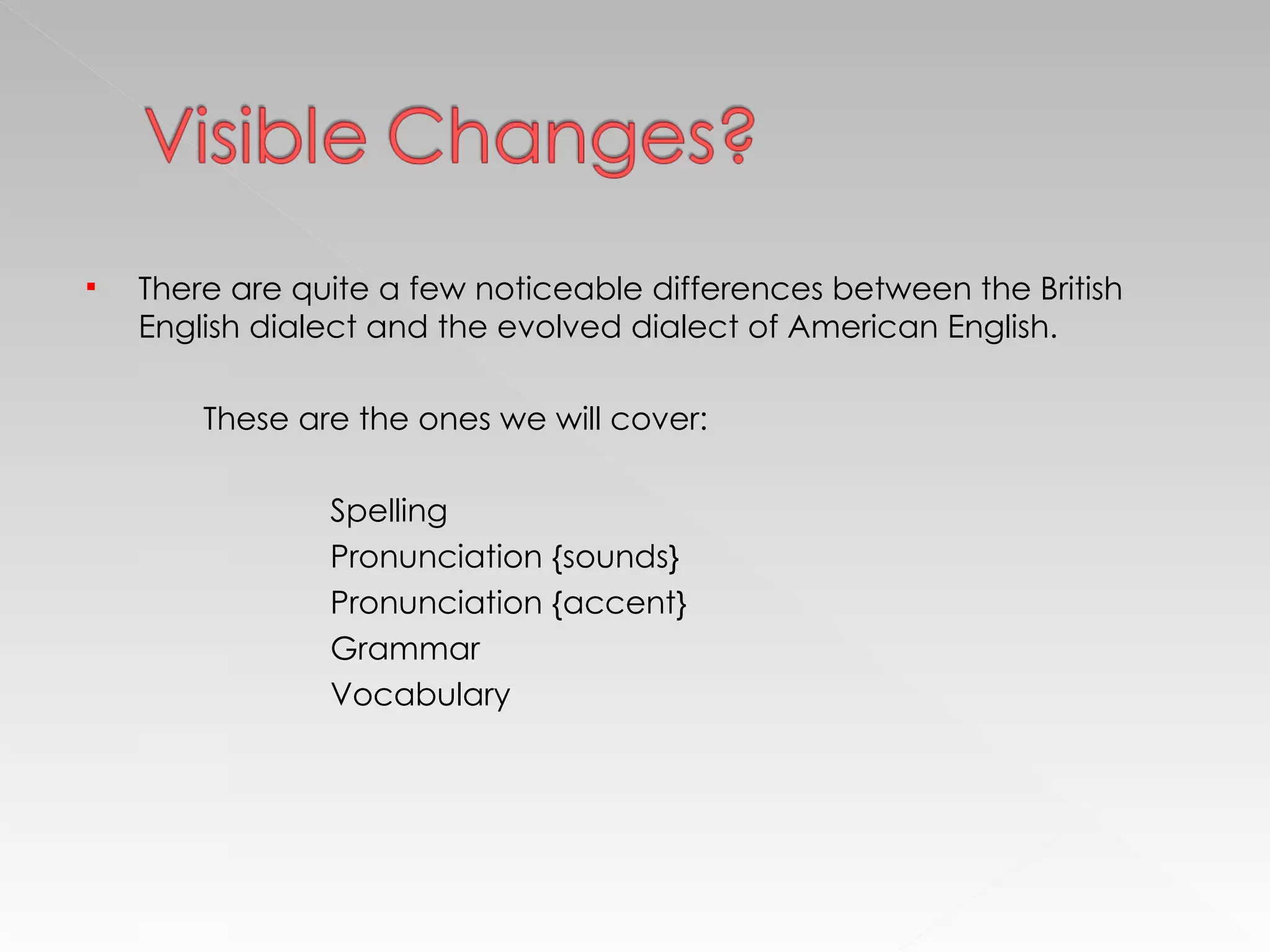
There are quite a few noticeable differences between the British English dialect and the evolved dialect of American English. These are the ones we will cover: Spelling Pronunciation {sounds} Pronunciation {accent} Grammar Vocabulary
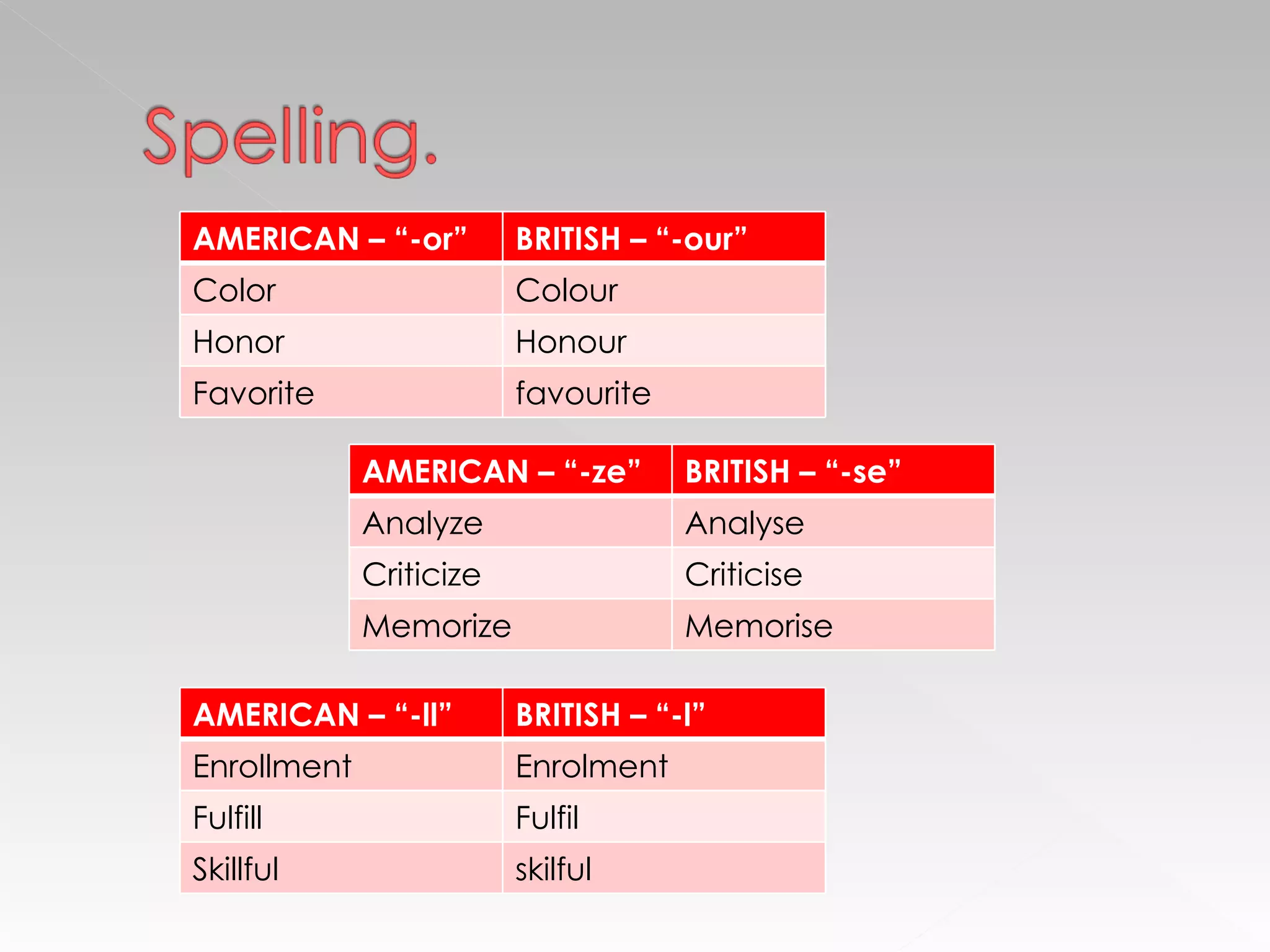
AMERICAN – “-or” BRITISH – “-our” Color Colour Honor Honour Favorite favourite AMERICAN – “-ll” BRITISH – “-l” Enrollment Enrolment Fulfill Fulfil Skillful skilful AMERICAN – “-ze” BRITISH – “-se” Analyze Analyse Criticize Criticise Memorize Memorise
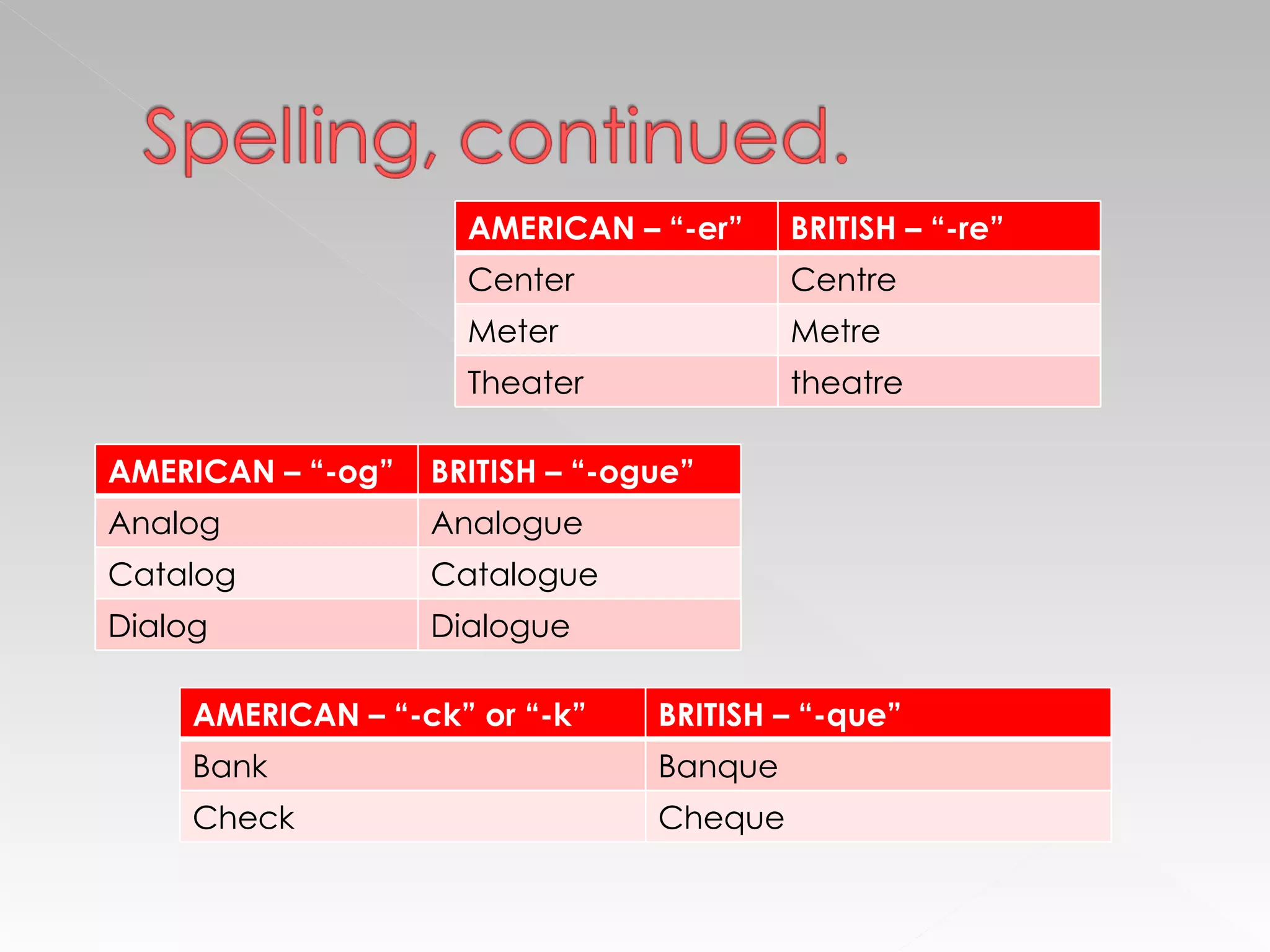
AMERICAN – “-er” BRITISH – “-re” Center Centre Meter Metre Theater theatre AMERICAN – “-og” BRITISH – “-ogue” Analog Analogue Catalog Catalogue Dialog Dialogue AMERICAN – “-ck” or “-k” BRITISH – “-que” Bank Banque Check Cheque
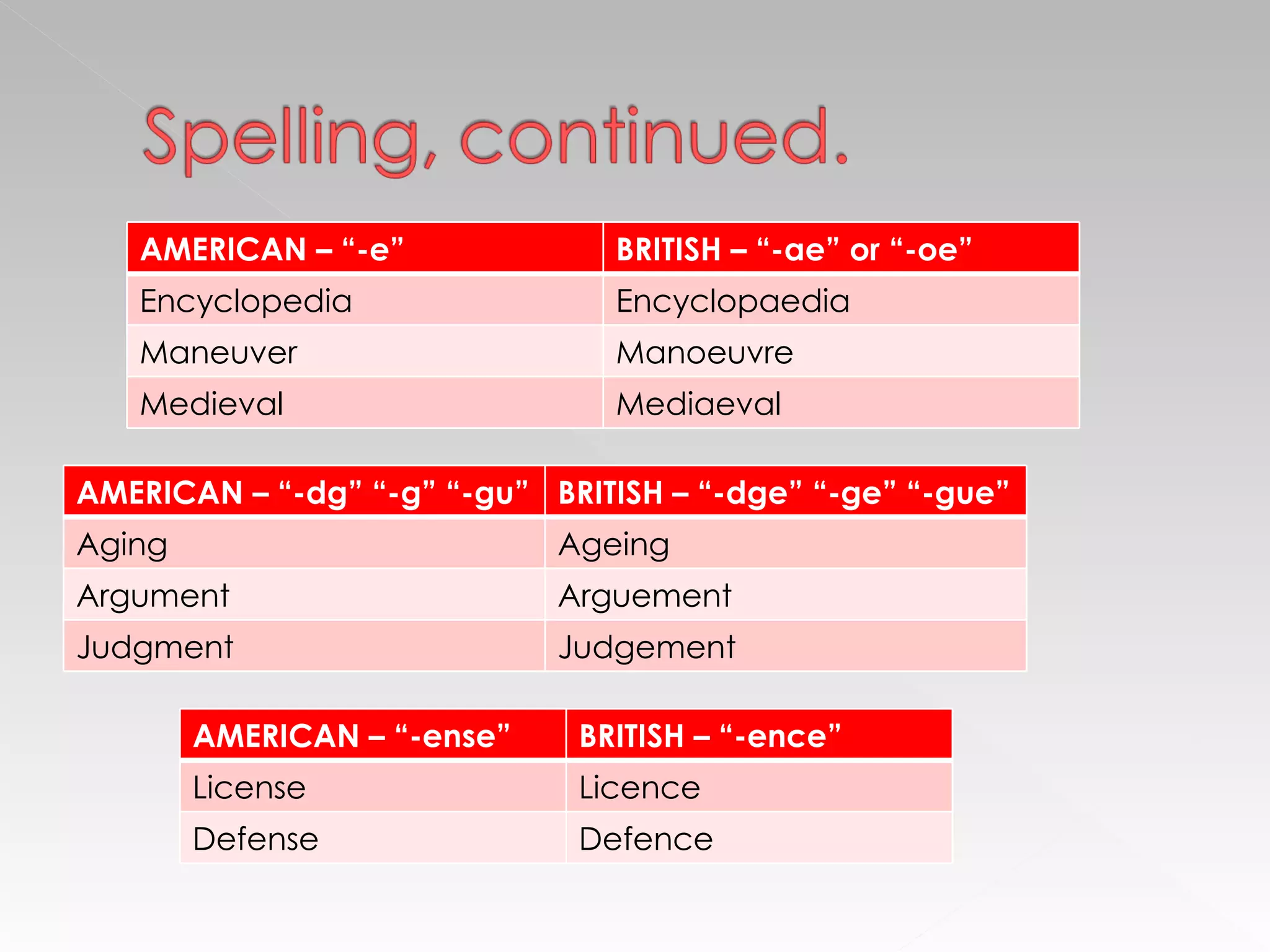
AMERICAN – “-e” BRITISH – “-ae” or “-oe” Encyclopedia Encyclopaedia Maneuver Manoeuvre Medieval Mediaeval AMERICAN – “-dg” “-g” “-gu” BRITISH – “-dge” “-ge” “-gue” Aging Ageing Argument Arguement Judgment Judgement AMERICAN – “-ense” BRITISH – “-ence” License Licence Defense Defence
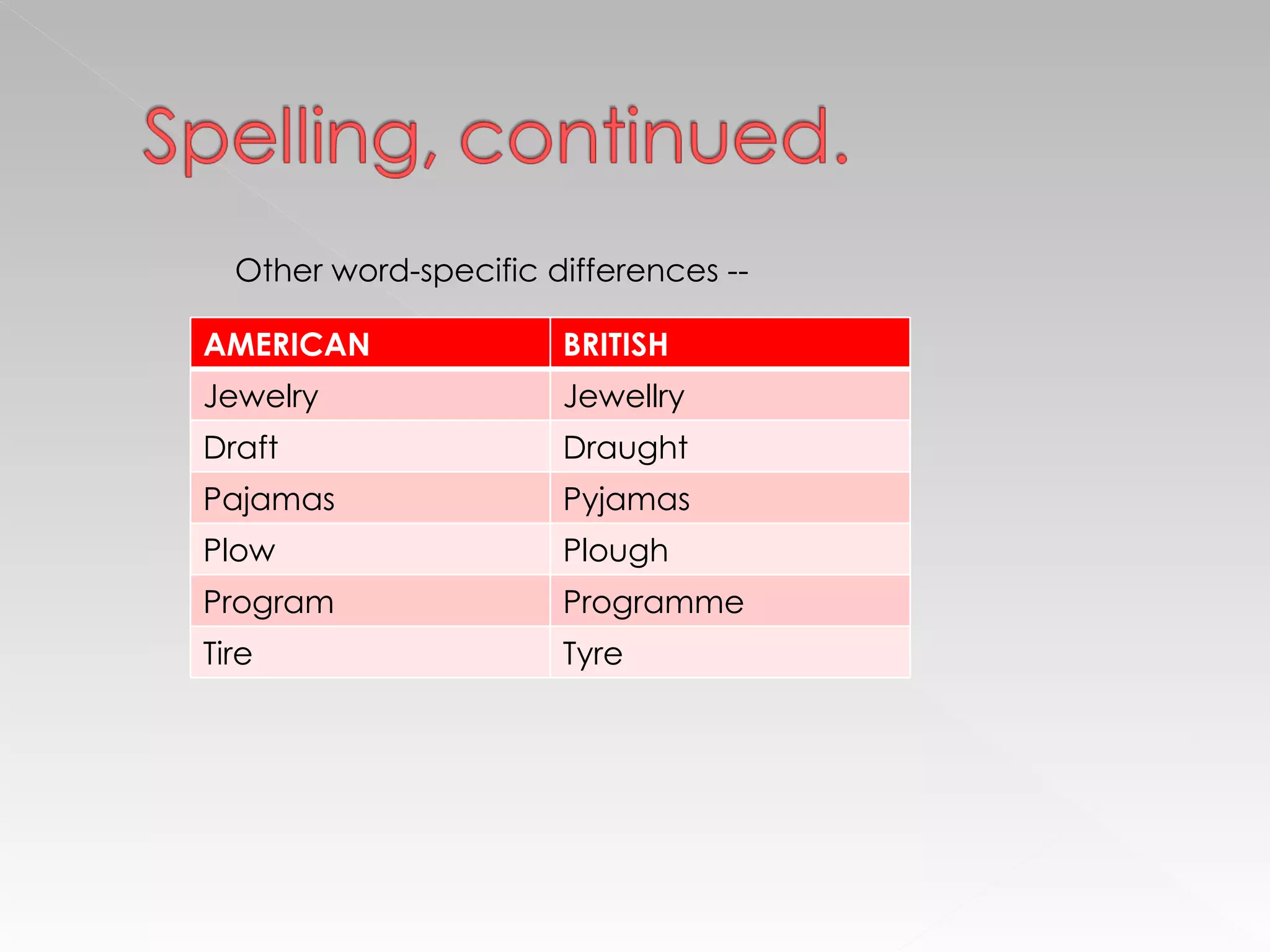
Other word-specific differences -- AMERICAN BRITISH Jewelry Jewellry Draft Draught Pajamas Pyjamas Plow Plough Program Programme Tire Tyre
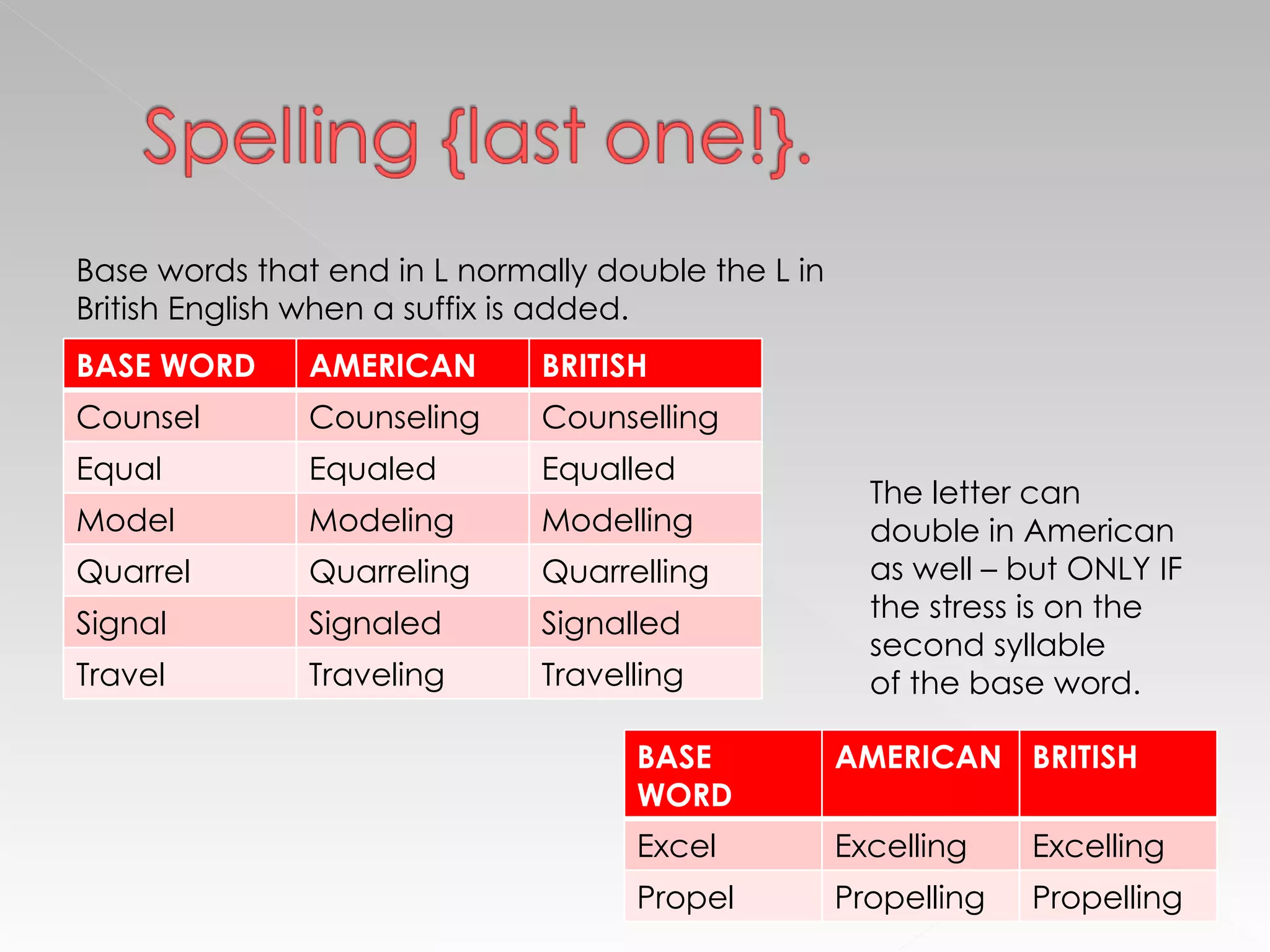
Base words that end in L normally double the L in  British English when a suffix is added. The letter can double in American as well – but ONLY IF the stress is on the second syllable of the base word. BASE WORD AMERICAN BRITISH Counsel Counseling Counselling Equal Equaled Equalled Model Modeling Modelling Quarrel Quarreling Quarrelling Signal Signaled Signalled Travel Traveling Travelling BASE WORD AMERICAN BRITISH Excel Excelling Excelling Propel Propelling Propelling
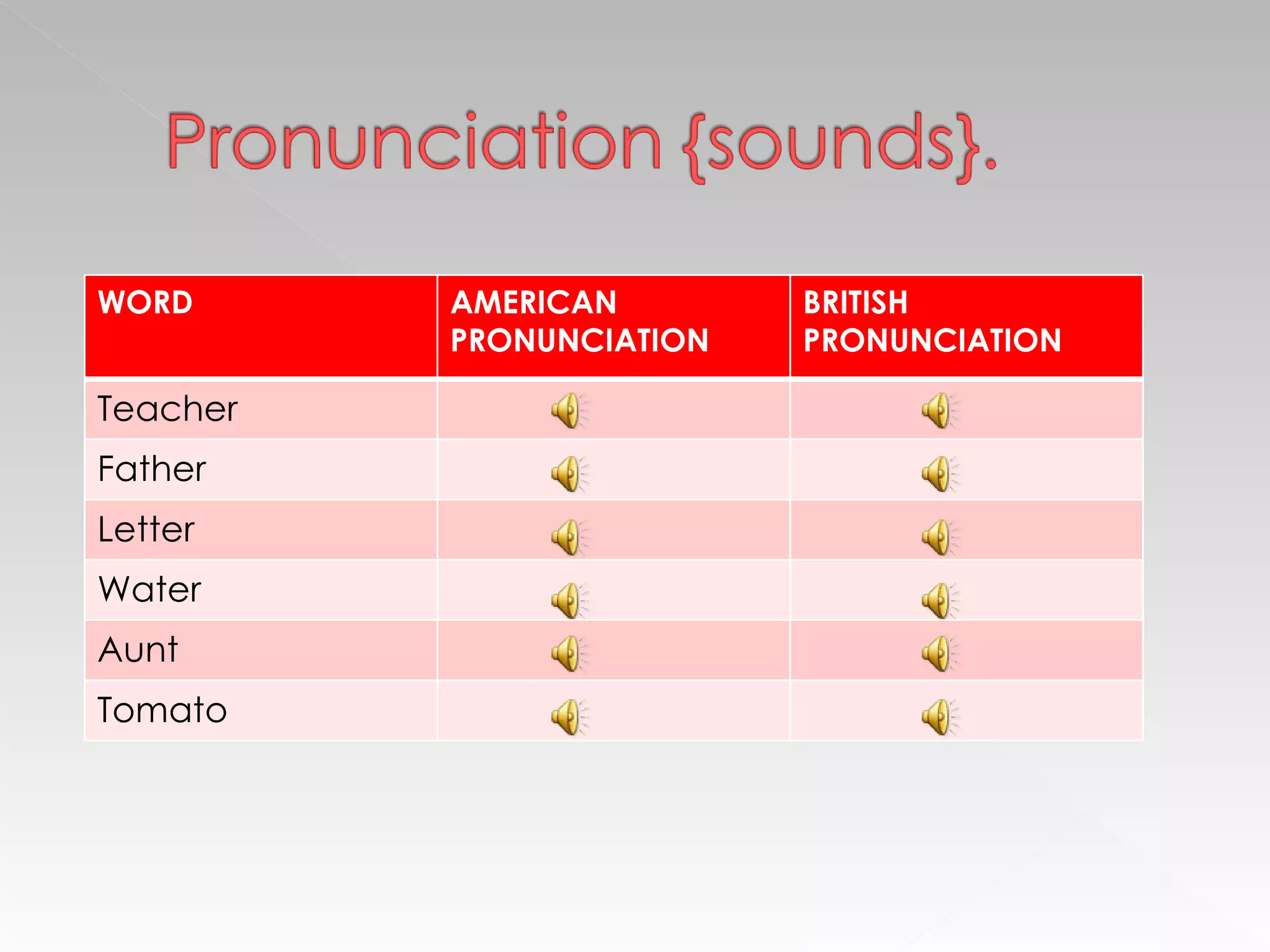
WORD AMERICAN PRONUNCIATION BRITISH PRONUNCIATION Teacher Father Letter Water Aunt Tomato
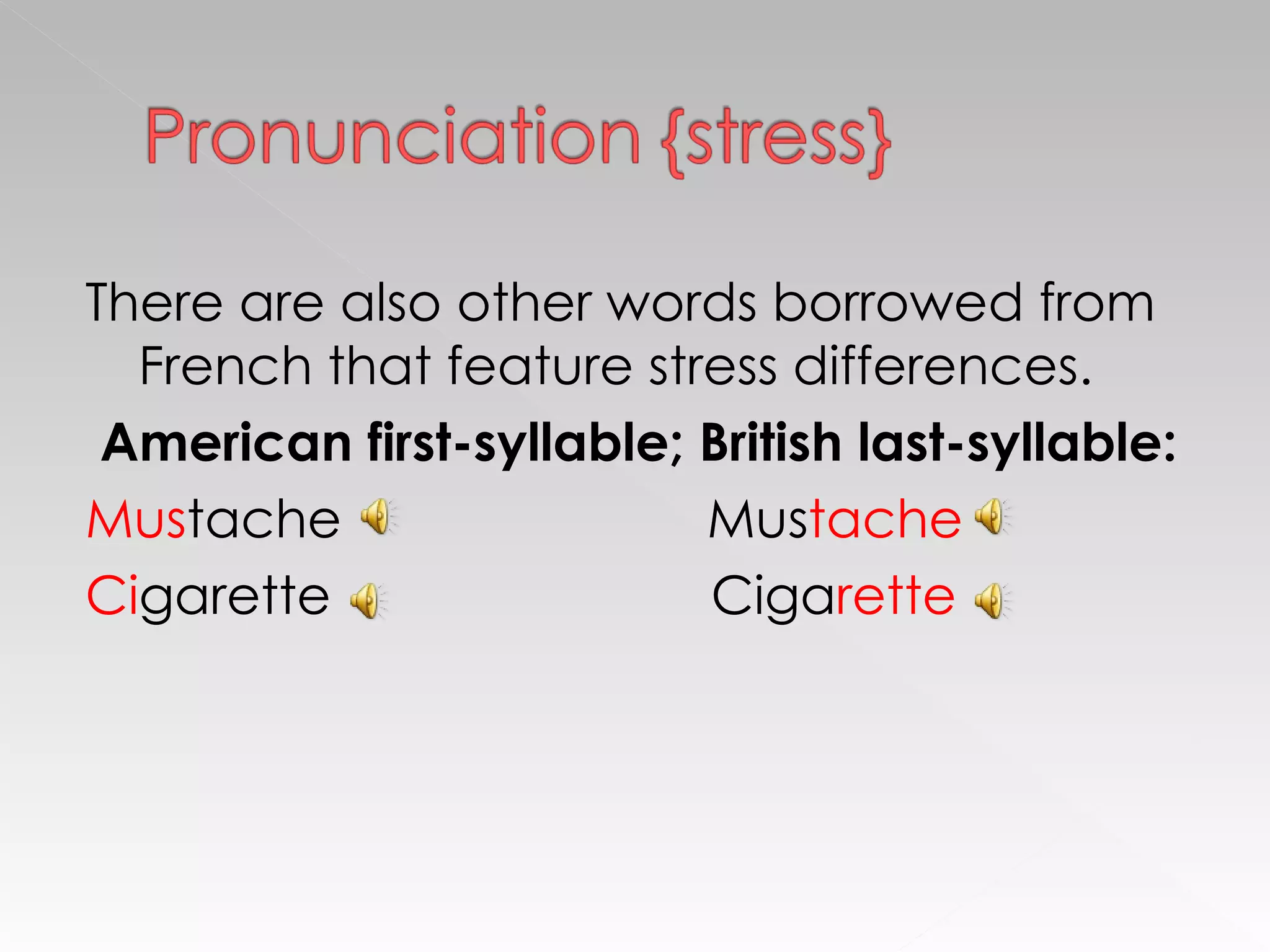
There are also other words borrowed from French that feature stress differences. American first-syllable; British last-syllable: Mus tache  Mus tache Ci garette  Ciga rette
The next 2 videos show a teacher saying the same text first with the American accent and then with the British accent
 
American accent
 
British accent
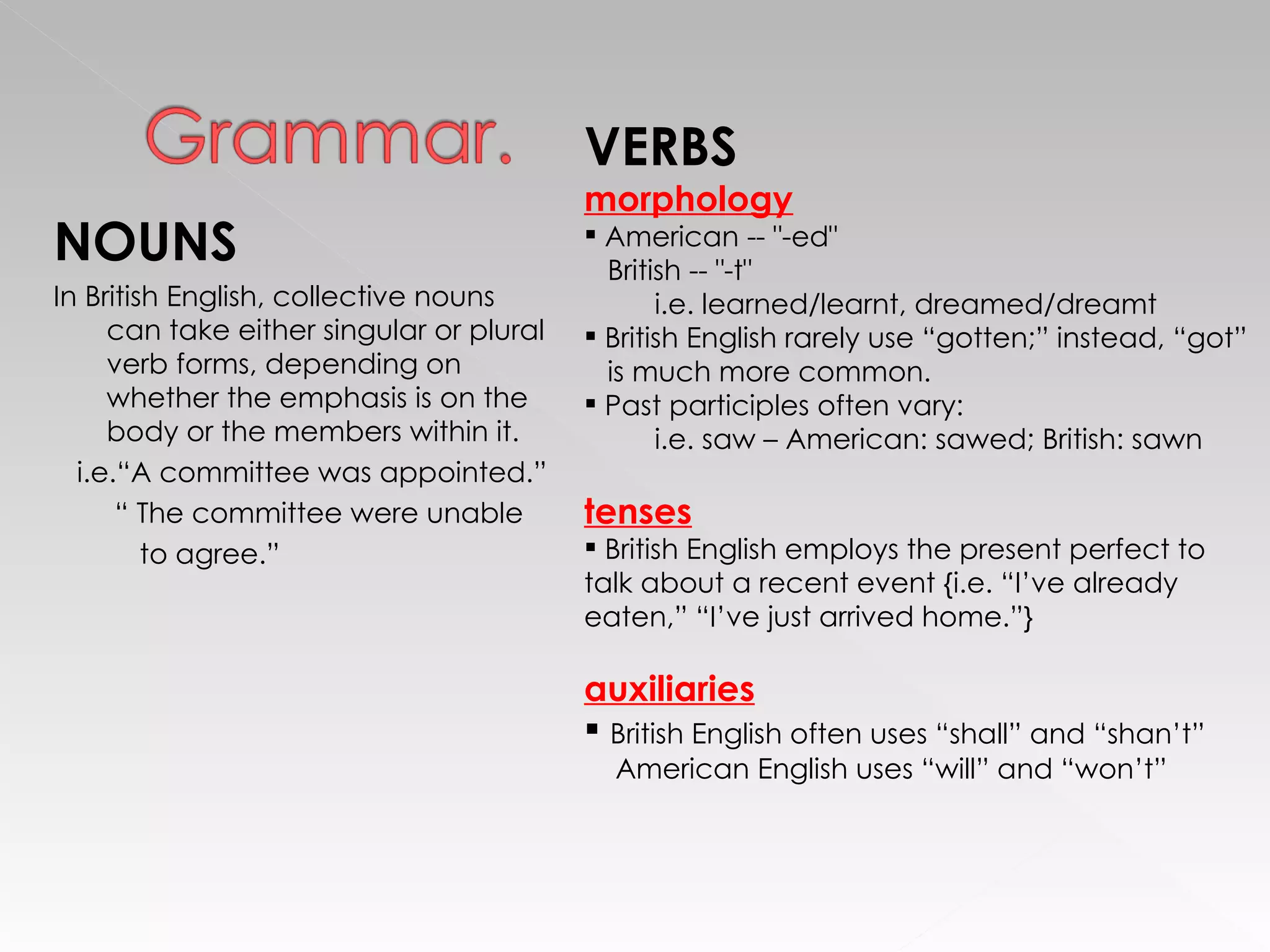
NOUNS In British English, collective nouns can take either singular or plural verb forms, depending on whether the emphasis is on the body or the members within it. i.e.“A committee was appointed.”  “  The committee were unable  to agree.” VERBS morphology American -- "-ed" British -- "-t" i.e. learned/learnt, dreamed/dreamt British English rarely use “gotten;” instead, “got”  is much more common. Past participles often vary: i.e. saw – American: sawed; British: sawn tenses British English employs the present perfect to talk about a recent event {i.e. “I’ve already eaten,” “I’ve just arrived home.”} auxiliaries British English often uses “shall” and “shan’t” American English uses “will” and “won’t”
American & British English sometimes have different words for the same things -- AMERICAN BRITISH Apartment Flat Argument Row Carriage/coach Pram Bathroom Loo Can Tin Cookie Biscuit Diaper Nappy Elevator Lift Eraser Rubber Flashlight Torch Fries Chips Gas Petrol Guy Bloke/chap
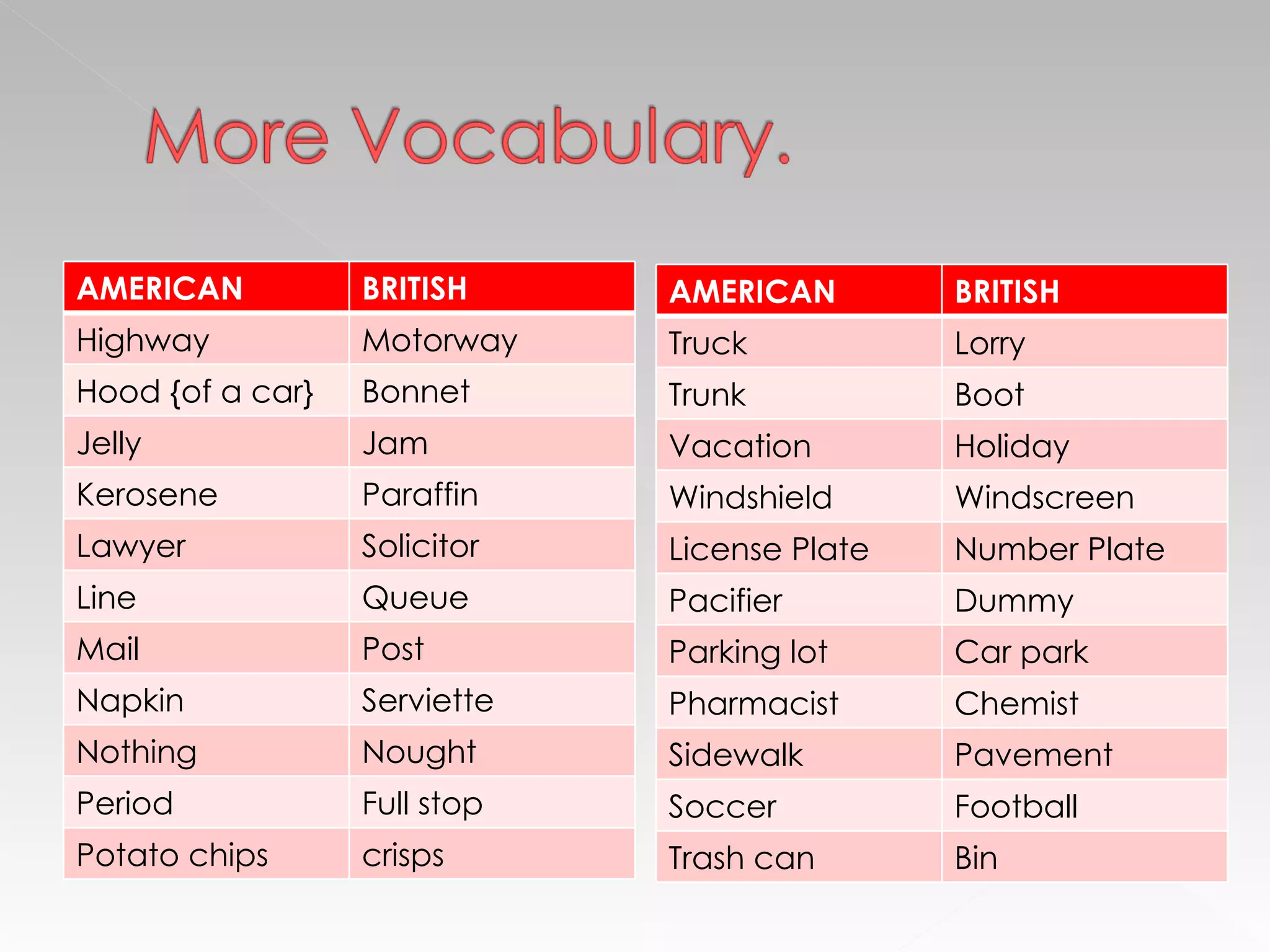
AMERICAN BRITISH Highway Motorway Hood {of a car} Bonnet Jelly Jam Kerosene Paraffin Lawyer Solicitor Line Queue Mail Post Napkin Serviette Nothing Nought Period Full stop Potato chips crisps AMERICAN BRITISH Truck Lorry Trunk Boot Vacation Holiday Windshield Windscreen License Plate Number Plate Pacifier Dummy Parking lot Car park Pharmacist Chemist Sidewalk Pavement Soccer Football Trash can Bin
American and British English speakers often use the same words but intend very different meaning with them: http://en.wikipedia.org/wiki/List_of_words_having_different_meanings_in_British_and_American_English  {for more examples!} WORD AMERICAN BRITISH Biscuit Dinner roll Cookie Brew Beer Tea Bureau Chest of drawers Writing table/desk Casket Coffin Jewelry Box First Floor Ground Floor “ Second” Floor To hire To employ To rent
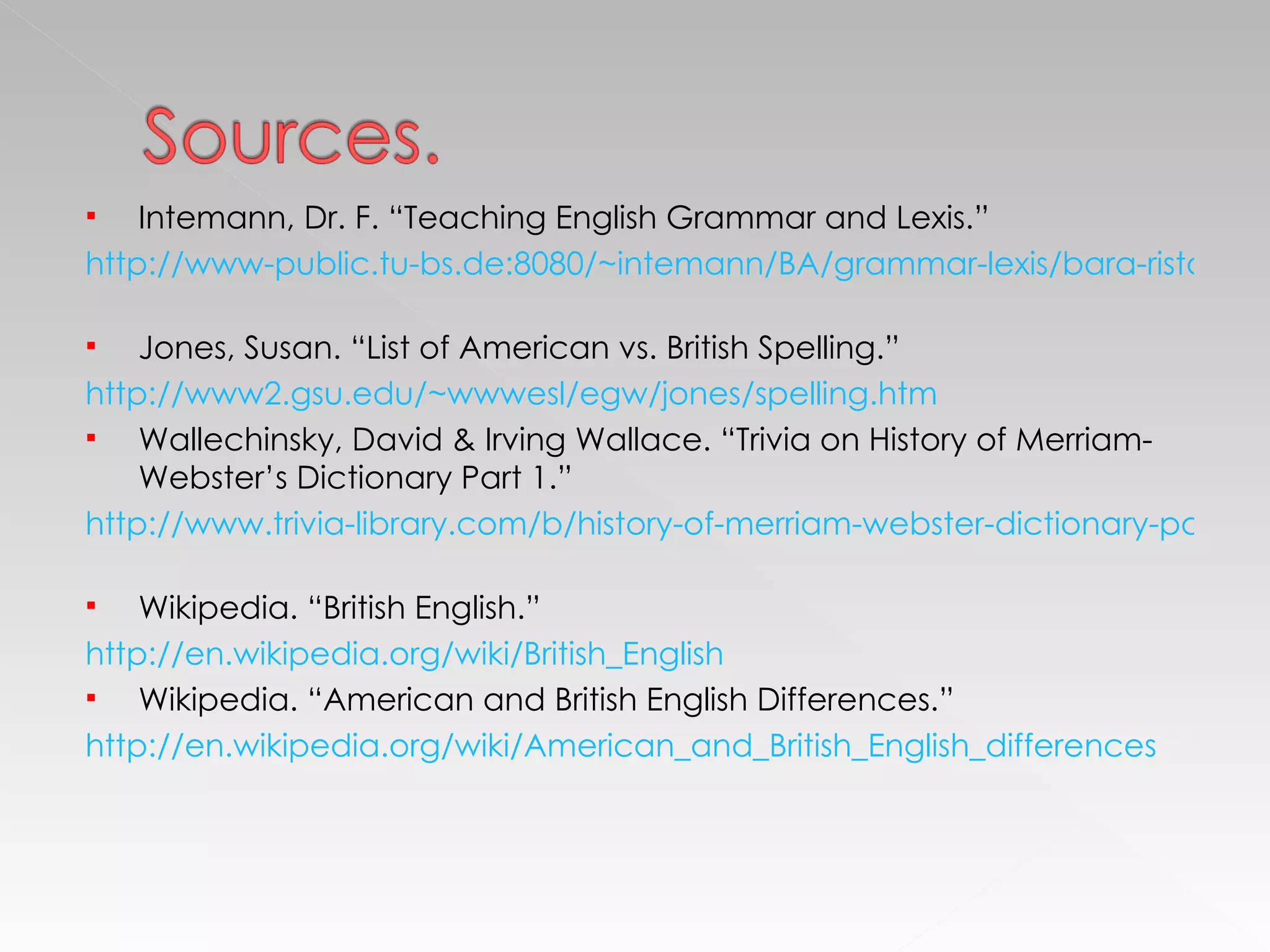
Intemann, Dr. F. “Teaching English Grammar and Lexis.” http://www-public.tu-bs.de:8080/~intemann/BA/grammar-lexis/bara-ristau-schubert.pdf   Jones, Susan. “List of American vs. British Spelling.” http://www2.gsu.edu/~wwwesl/egw/jones/spelling.htm Wallechinsky, David & Irving Wallace. “Trivia on History of Merriam-Webster’s Dictionary Part 1.” http://www.trivia-library.com/b/history-of-merriam-webster-dictionary-part-1.htm   Wikipedia. “British English.” http://en.wikipedia.org/wiki/British_English   Wikipedia. “American and British English Differences.” http://en.wikipedia.org/wiki/American_and_British_English_differences

Differences between British English and American English

  • 1.
  • 2.
    There are quitea few noticeable differences between the British English dialect and the evolved dialect of American English. These are the ones we will cover: Spelling Pronunciation {sounds} Pronunciation {accent} Grammar Vocabulary
  • 3.
    AMERICAN – “-or”BRITISH – “-our” Color Colour Honor Honour Favorite favourite AMERICAN – “-ll” BRITISH – “-l” Enrollment Enrolment Fulfill Fulfil Skillful skilful AMERICAN – “-ze” BRITISH – “-se” Analyze Analyse Criticize Criticise Memorize Memorise
  • 4.
    AMERICAN – “-er”BRITISH – “-re” Center Centre Meter Metre Theater theatre AMERICAN – “-og” BRITISH – “-ogue” Analog Analogue Catalog Catalogue Dialog Dialogue AMERICAN – “-ck” or “-k” BRITISH – “-que” Bank Banque Check Cheque
  • 5.
    AMERICAN – “-e”BRITISH – “-ae” or “-oe” Encyclopedia Encyclopaedia Maneuver Manoeuvre Medieval Mediaeval AMERICAN – “-dg” “-g” “-gu” BRITISH – “-dge” “-ge” “-gue” Aging Ageing Argument Arguement Judgment Judgement AMERICAN – “-ense” BRITISH – “-ence” License Licence Defense Defence
  • 6.
    Other word-specific differences-- AMERICAN BRITISH Jewelry Jewellry Draft Draught Pajamas Pyjamas Plow Plough Program Programme Tire Tyre
  • 7.
    Base words thatend in L normally double the L in British English when a suffix is added. The letter can double in American as well – but ONLY IF the stress is on the second syllable of the base word. BASE WORD AMERICAN BRITISH Counsel Counseling Counselling Equal Equaled Equalled Model Modeling Modelling Quarrel Quarreling Quarrelling Signal Signaled Signalled Travel Traveling Travelling BASE WORD AMERICAN BRITISH Excel Excelling Excelling Propel Propelling Propelling
  • 8.
    WORD AMERICAN PRONUNCIATIONBRITISH PRONUNCIATION Teacher Father Letter Water Aunt Tomato
  • 9.
    There are alsoother words borrowed from French that feature stress differences. American first-syllable; British last-syllable: Mus tache Mus tache Ci garette Ciga rette
  • 10.
    The next 2videos show a teacher saying the same text first with the American accent and then with the British accent
  • 11.
  • 12.
  • 13.
  • 14.
  • 15.
    NOUNS In BritishEnglish, collective nouns can take either singular or plural verb forms, depending on whether the emphasis is on the body or the members within it. i.e.“A committee was appointed.” “ The committee were unable to agree.” VERBS morphology American -- "-ed" British -- "-t" i.e. learned/learnt, dreamed/dreamt British English rarely use “gotten;” instead, “got” is much more common. Past participles often vary: i.e. saw – American: sawed; British: sawn tenses British English employs the present perfect to talk about a recent event {i.e. “I’ve already eaten,” “I’ve just arrived home.”} auxiliaries British English often uses “shall” and “shan’t” American English uses “will” and “won’t”
  • 16.
    American & BritishEnglish sometimes have different words for the same things -- AMERICAN BRITISH Apartment Flat Argument Row Carriage/coach Pram Bathroom Loo Can Tin Cookie Biscuit Diaper Nappy Elevator Lift Eraser Rubber Flashlight Torch Fries Chips Gas Petrol Guy Bloke/chap
  • 17.
    AMERICAN BRITISH HighwayMotorway Hood {of a car} Bonnet Jelly Jam Kerosene Paraffin Lawyer Solicitor Line Queue Mail Post Napkin Serviette Nothing Nought Period Full stop Potato chips crisps AMERICAN BRITISH Truck Lorry Trunk Boot Vacation Holiday Windshield Windscreen License Plate Number Plate Pacifier Dummy Parking lot Car park Pharmacist Chemist Sidewalk Pavement Soccer Football Trash can Bin
  • 18.
    American and BritishEnglish speakers often use the same words but intend very different meaning with them: http://en.wikipedia.org/wiki/List_of_words_having_different_meanings_in_British_and_American_English {for more examples!} WORD AMERICAN BRITISH Biscuit Dinner roll Cookie Brew Beer Tea Bureau Chest of drawers Writing table/desk Casket Coffin Jewelry Box First Floor Ground Floor “ Second” Floor To hire To employ To rent
  • 19.
    Intemann, Dr. F.“Teaching English Grammar and Lexis.” http://www-public.tu-bs.de:8080/~intemann/BA/grammar-lexis/bara-ristau-schubert.pdf Jones, Susan. “List of American vs. British Spelling.” http://www2.gsu.edu/~wwwesl/egw/jones/spelling.htm Wallechinsky, David & Irving Wallace. “Trivia on History of Merriam-Webster’s Dictionary Part 1.” http://www.trivia-library.com/b/history-of-merriam-webster-dictionary-part-1.htm Wikipedia. “British English.” http://en.wikipedia.org/wiki/British_English Wikipedia. “American and British English Differences.” http://en.wikipedia.org/wiki/American_and_British_English_differences