Assessment in Schools Developing Learning Objectives
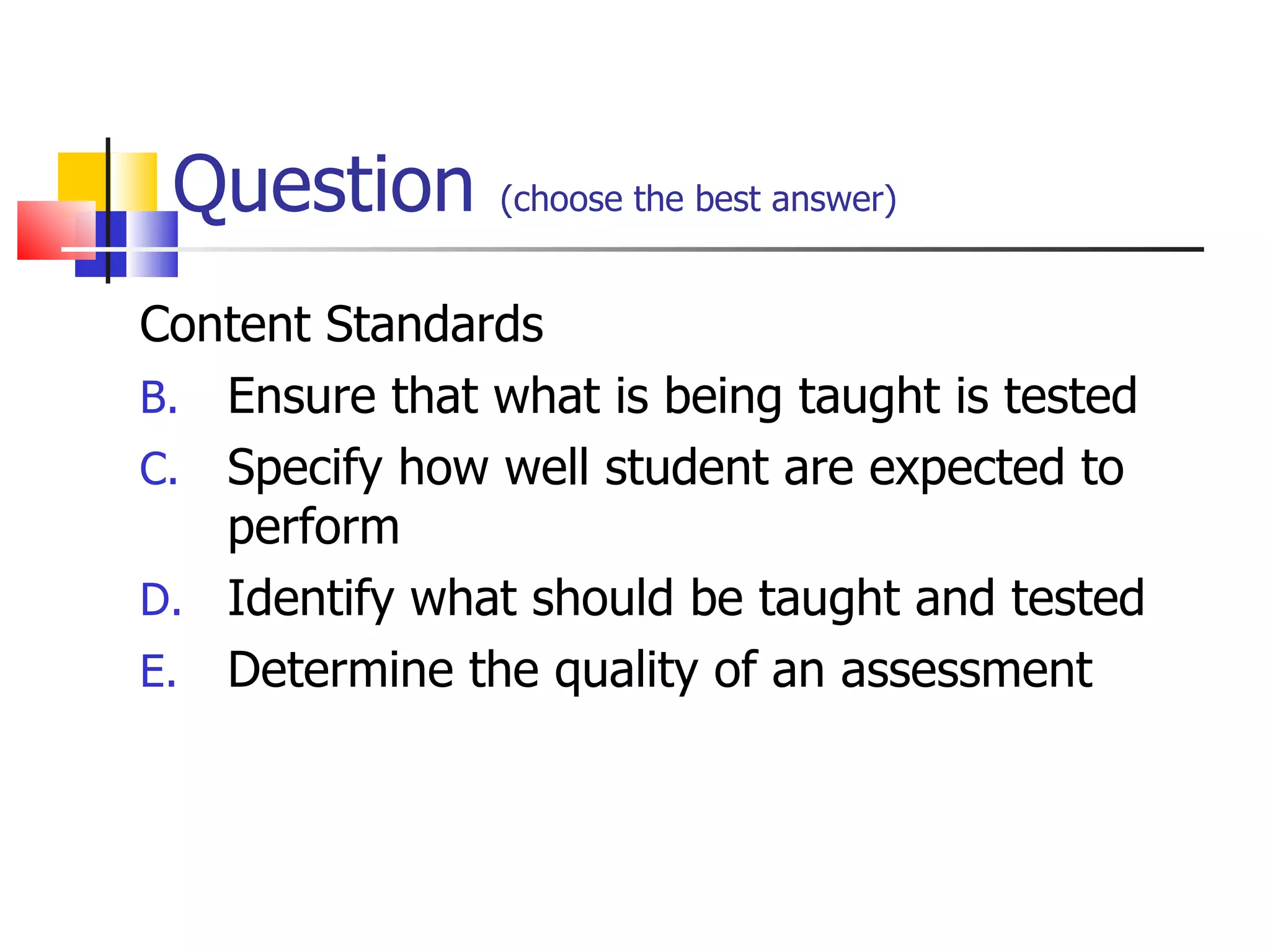
Question  (choose the best answer)   Content Standards Ensure that what is being taught is tested Specify how well student are expected to perform Identify what should be taught and tested Determine the quality of an assessment
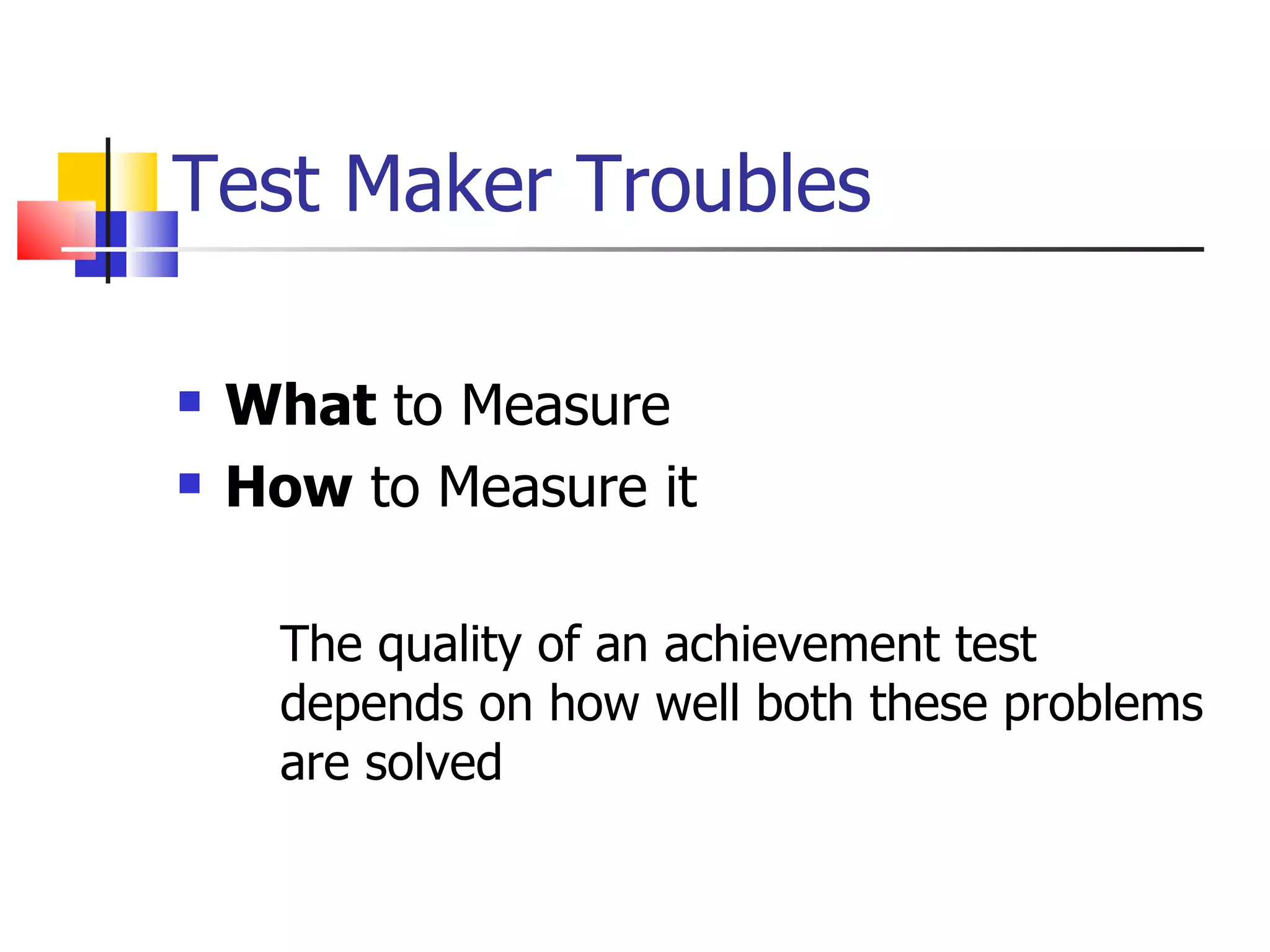
Test Maker Troubles What  to Measure How  to Measure it The quality of an achievement test depends on how well both these problems are solved
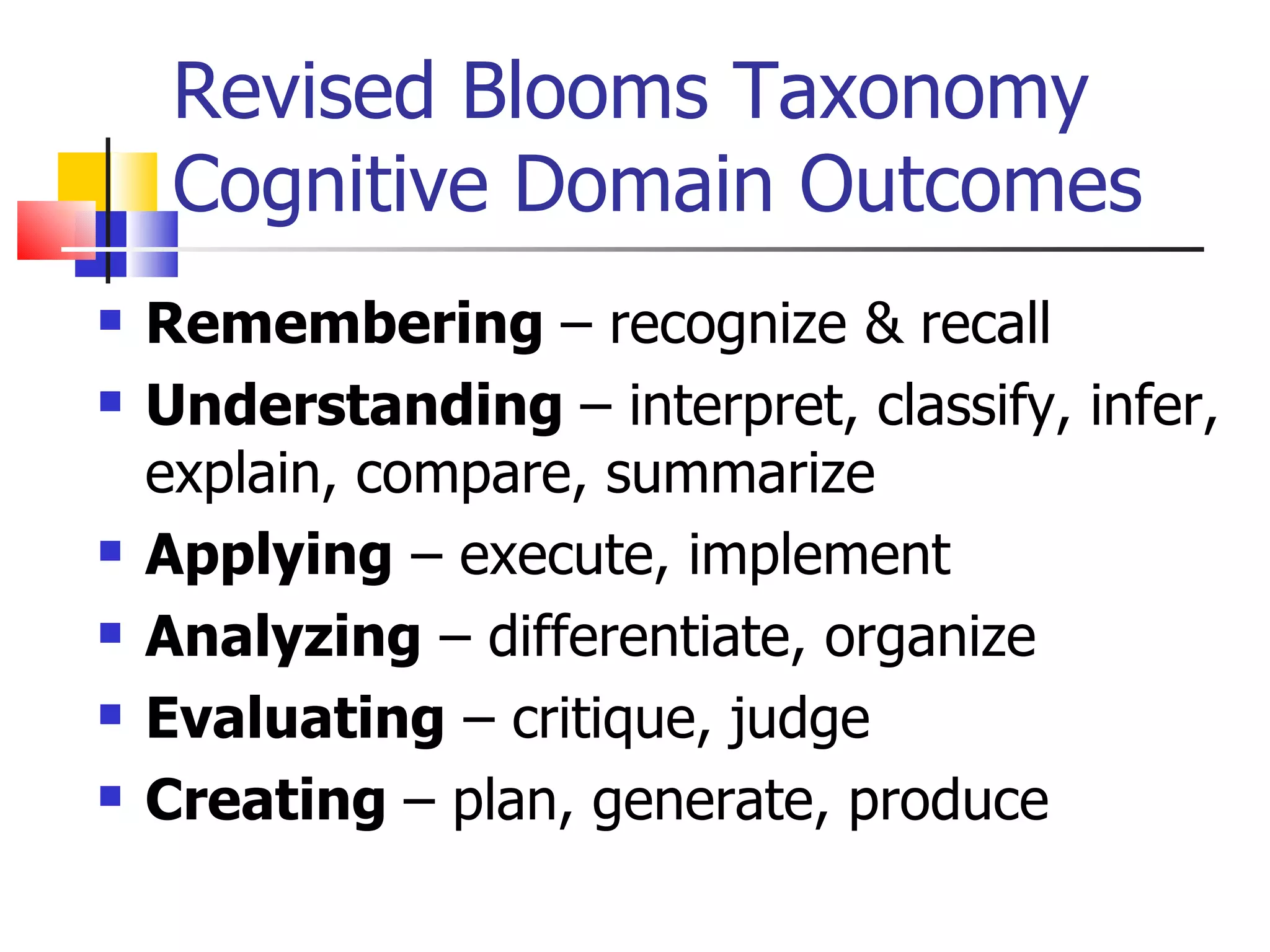
Revised Blooms Taxonomy Cognitive Domain Outcomes Remembering  – recognize & recall Understanding  – interpret, classify, infer, explain, compare, summarize Applying  – execute, implement Analyzing  – differentiate, organize Evaluating  – critique, judge Creating  – plan, generate, produce
Test Planning There should be a direct relationship/alignment between Instructional Goals/Objectives of the course and the planned assessment of students’ learning.
Instructional/Learning Objectives When should they be written? What might happen if you don’t? [2-3]
Selecting Objectives Complete and Comprehensive :  Are all important objectives covered? Is each important? Appropriate:  Are they in harmony with school goals and societal values? Pedagogically Sound :  Considering Age, interests, needs of students. Feasible : (Practical Utility) Are they realistic (ability, time, facilities)?  [pg. 58-59; 2-25]
Behavioral Objectives Focus is on observable action  (Mager) Behavior – what the student will do Conditions – of the performance  Criteria – the standard of performance What difficulties do you see with these?
Instructional Objectives Gronlund’s instructional objectives defined in terms of intended learning outcomes GIO – General Instructional Objective Specific Learner Outcomes (SLO) - examples of what the student might do to provide evidence that GIO has been accomplished satisfactorily [pg. 62-63; 2-4]
GIOs and SLOs GIOs –  Describe intended learning outcome SLOs describe the intended outcomes in terms of explicitly stated, observable performances or behavioral patterns which provide evidence that the instructional goal has been accomplished.
GIOs and SLOs GIOs –  Provide context (significance & relevance) for the accompanying SLOs Separately, none of the SLOs are ends in and of themselves. They are only a sample of the behaviors, skills, ability, or dispositions that a students is likely to demonstrate.
GIOs and SLOs GIOs –  Need  not  be stated in terms of observable behaviors (e.g., understands). They can be somewhat vague (general). SLOs clarify the meaning of the GIO. They provide the operational definition of the GIO and make it measurable.
GIOs and SLOs GIOs –  Used to communicate main intent SLOs define what we are willing to accept as evidence that the main goal has been achieved. They provide a sample of specific indicators of the main goal.  There may be others.
General Guidelines for Objectives Objectives should Begin with an action verb Be stated in terms of observable changes in behavior or actions Stated in unambiguous terms Context free Relate to only one process
Objectives & Verbs  (see Appendix G2) Objectives should begin with a verb Cognitive Domain :   Knows, understands, applies, recognizes, formulates, judges  Affective Domain:   Listens, enjoys, appreciates, accepts, displays Psychomotor Domain: Relates, demonstrates, performs, operates, creates, develops
Question  (choose the best answer)   Learning Outcomes should be stated in terms of  what and how the teacher should teach the learning process students will employ the specific content students will learn None of the above [pg. 60; 2-5]
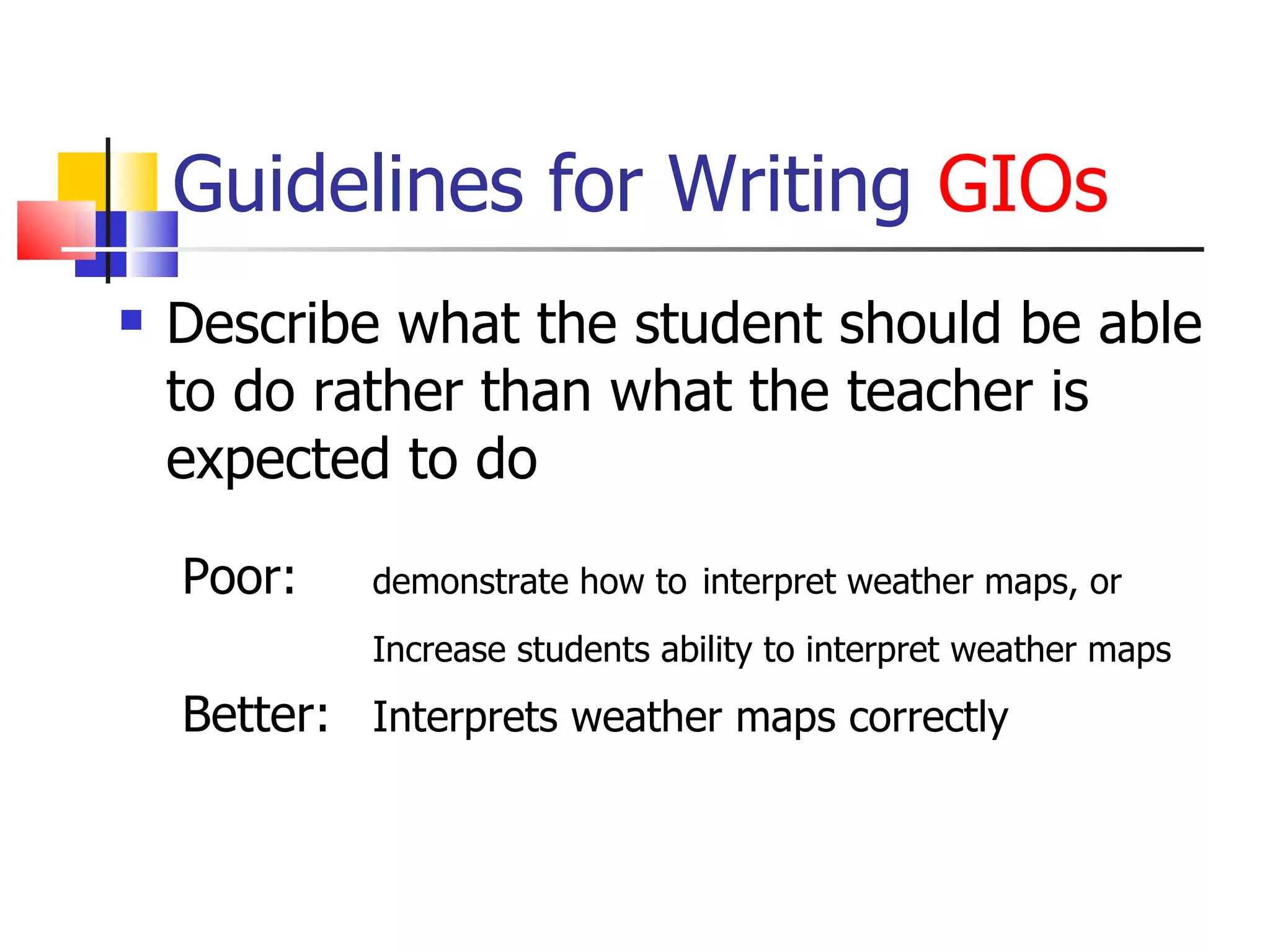
Guidelines for Writing  GIOs Describe what the student should be able to do rather than what the teacher is expected to do Poor:  demonstrate how to   interpret weather maps, or Increase students ability to interpret weather maps Better:  Interprets weather maps correctly
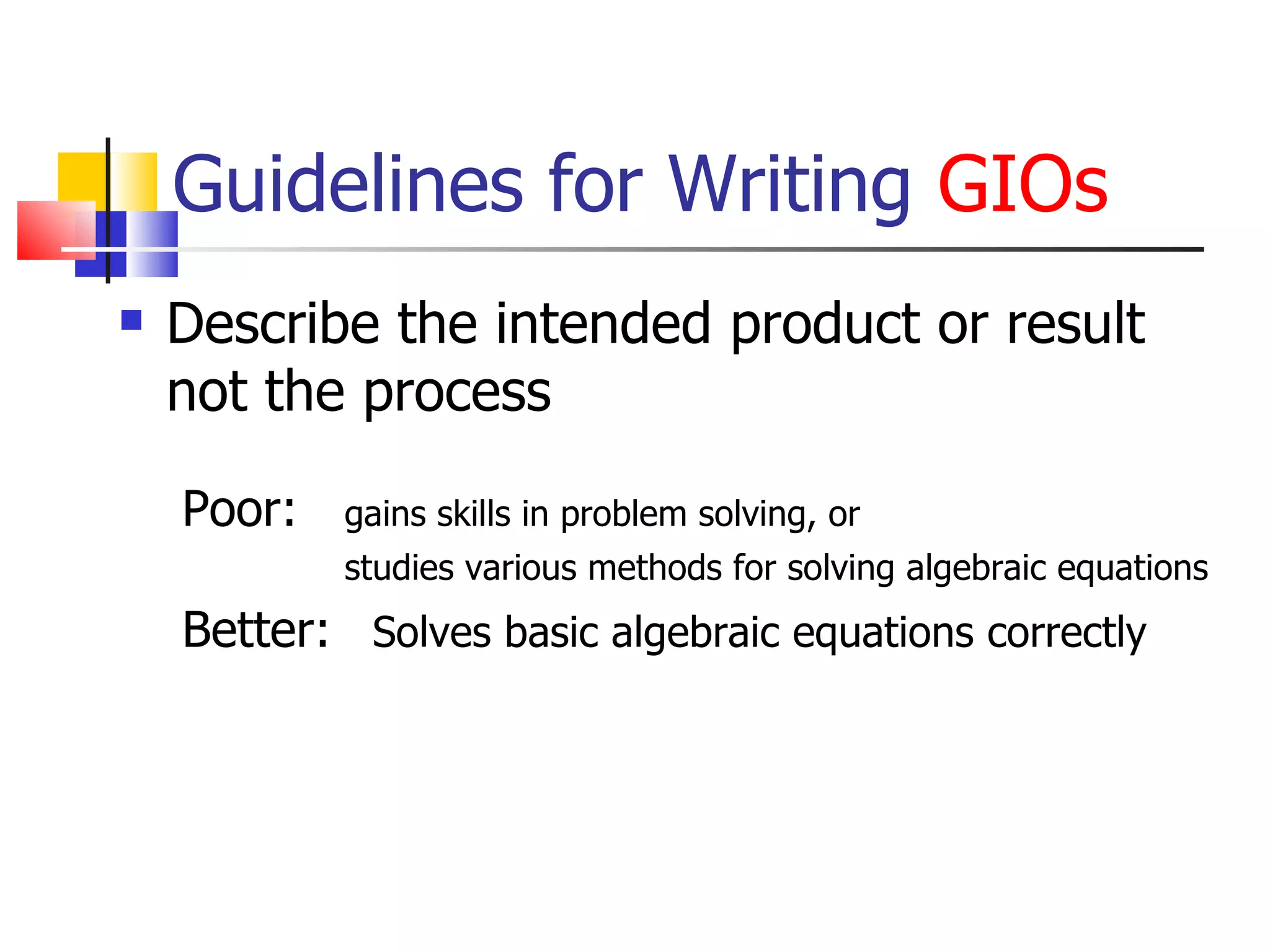
Guidelines for Writing  GIOs Describe the intended product or result not the process Poor:  gains skills in problem solving, or    studies various methods for solving algebraic equations Better:  Solves basic algebraic equations correctly
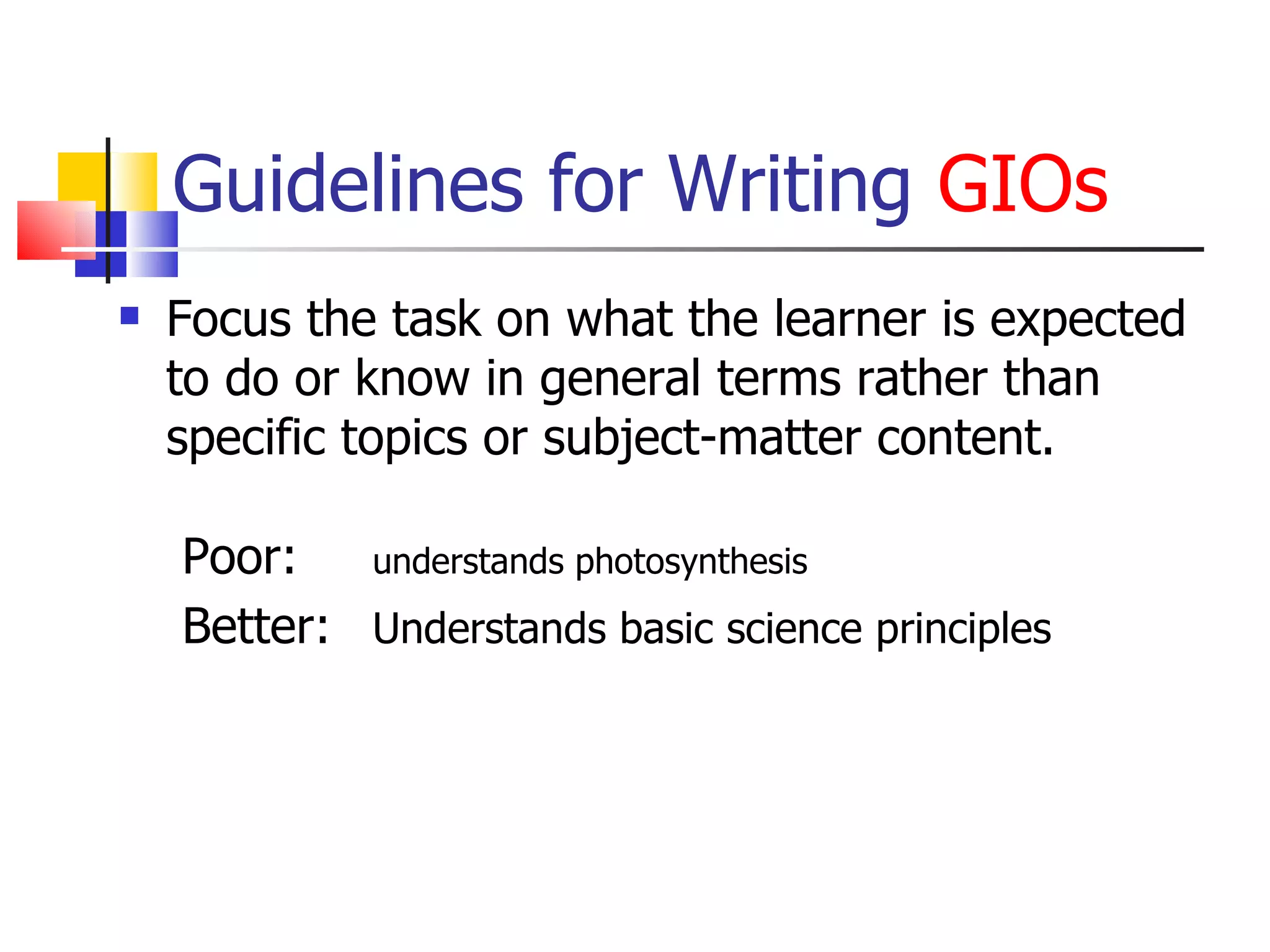
Guidelines for Writing  GIOs Focus the task on what the learner is expected to do or know in general terms rather than specific topics or subject-matter content. Poor:  understands photosynthesis Better:  Understands basic science principles
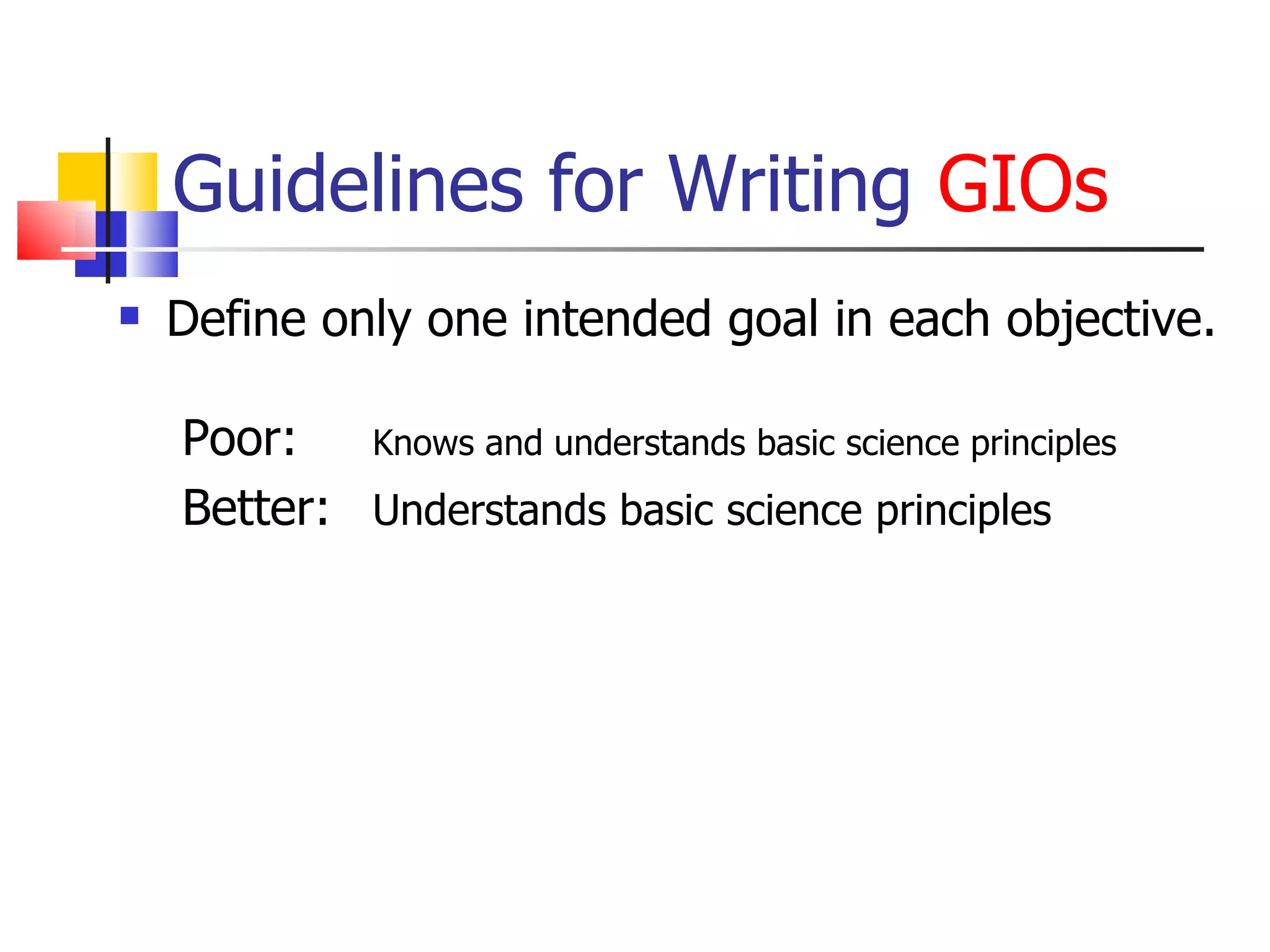
Guidelines for Writing  GIOs Define only one intended goal in each objective. Poor:  Knows and understands basic science principles Better:  Understands basic science principles
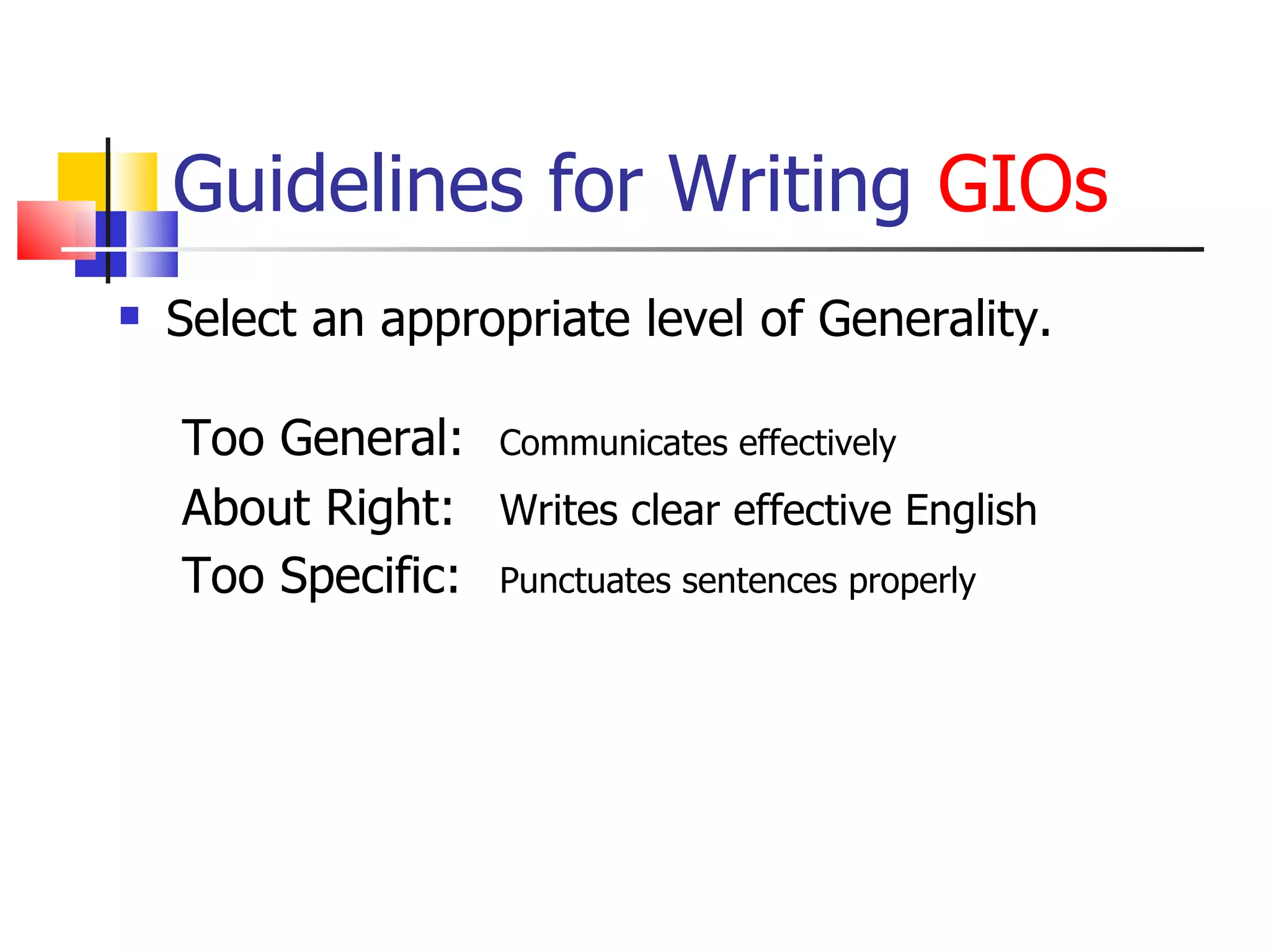
Guidelines for Writing  GIOs Select an appropriate level of Generality. Too General:  Communicates effectively About Right:  Writes clear effective English Too Specific:  Punctuates sentences properly
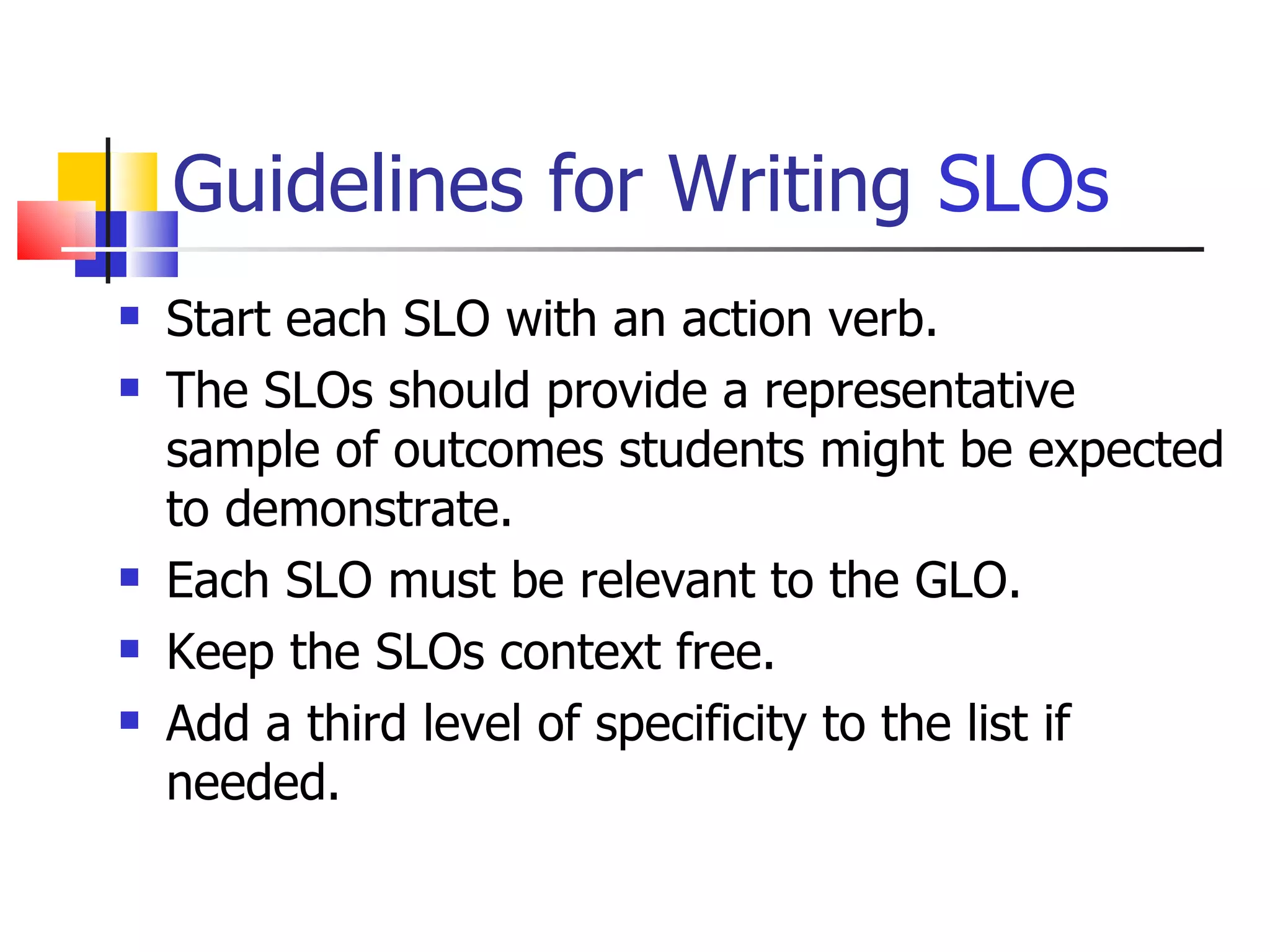
Guidelines for Writing  SLOs Start each SLO with an action verb. The SLOs should provide a representative sample of outcomes students might be expected to demonstrate. Each SLO must be relevant to the GLO. Keep the SLOs context free. Add a third level of specificity to the list if needed.
Practice Exercise 1  [handout 18-11]
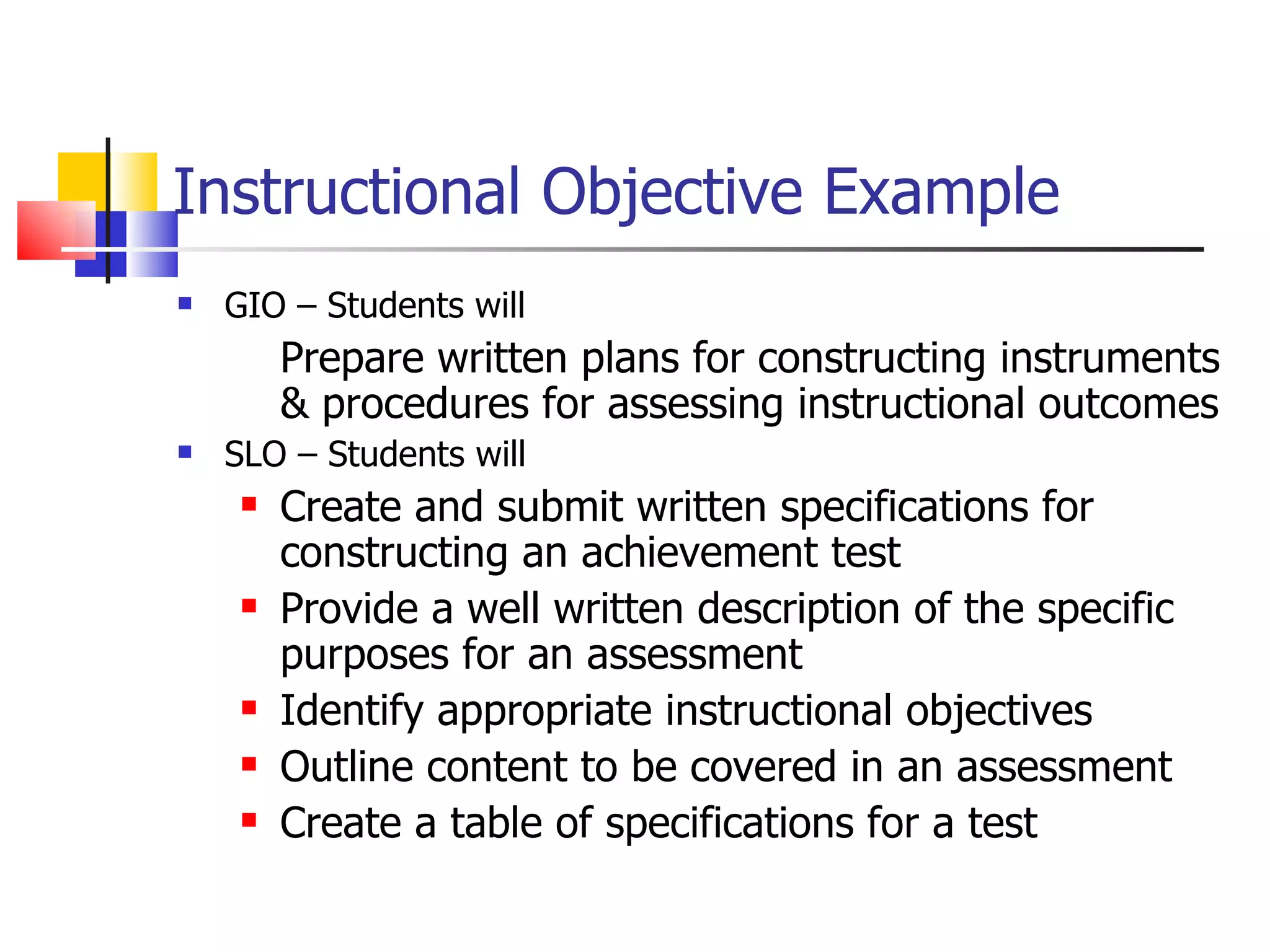
Instructional Objective Example GIO – Students will Prepare written plans for constructing instruments & procedures for assessing instructional outcomes SLO – Students will Create and submit written specifications for constructing an achievement test Provide a well written description of the specific purposes for an assessment  Identify appropriate instructional objectives  Outline content to be covered in an assessment Create a table of specifications for a test
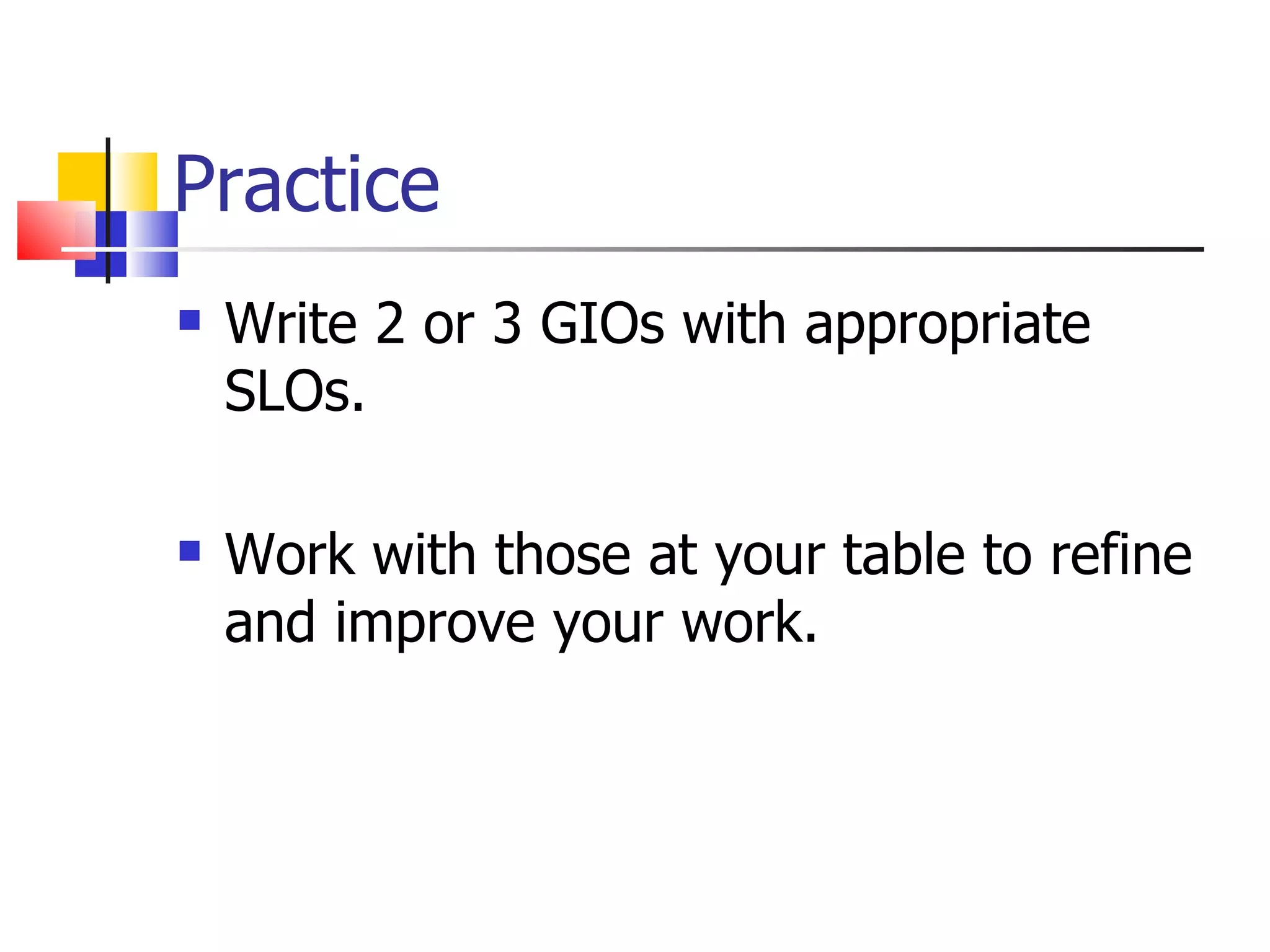
Practice Write 2 or 3 GIOs with appropriate SLOs.  Work with those at your table to refine and improve your work.

Week2b Chpt 3 Learning Objectives

  • 1.
    Assessment in SchoolsDeveloping Learning Objectives
  • 2.
    Question (choosethe best answer) Content Standards Ensure that what is being taught is tested Specify how well student are expected to perform Identify what should be taught and tested Determine the quality of an assessment
  • 3.
    Test Maker TroublesWhat to Measure How to Measure it The quality of an achievement test depends on how well both these problems are solved
  • 4.
    Revised Blooms TaxonomyCognitive Domain Outcomes Remembering – recognize & recall Understanding – interpret, classify, infer, explain, compare, summarize Applying – execute, implement Analyzing – differentiate, organize Evaluating – critique, judge Creating – plan, generate, produce
  • 5.
    Test Planning Thereshould be a direct relationship/alignment between Instructional Goals/Objectives of the course and the planned assessment of students’ learning.
  • 6.
    Instructional/Learning Objectives Whenshould they be written? What might happen if you don’t? [2-3]
  • 7.
    Selecting Objectives Completeand Comprehensive : Are all important objectives covered? Is each important? Appropriate: Are they in harmony with school goals and societal values? Pedagogically Sound : Considering Age, interests, needs of students. Feasible : (Practical Utility) Are they realistic (ability, time, facilities)? [pg. 58-59; 2-25]
  • 8.
    Behavioral Objectives Focusis on observable action (Mager) Behavior – what the student will do Conditions – of the performance Criteria – the standard of performance What difficulties do you see with these?
  • 9.
    Instructional Objectives Gronlund’sinstructional objectives defined in terms of intended learning outcomes GIO – General Instructional Objective Specific Learner Outcomes (SLO) - examples of what the student might do to provide evidence that GIO has been accomplished satisfactorily [pg. 62-63; 2-4]
  • 10.
    GIOs and SLOsGIOs – Describe intended learning outcome SLOs describe the intended outcomes in terms of explicitly stated, observable performances or behavioral patterns which provide evidence that the instructional goal has been accomplished.
  • 11.
    GIOs and SLOsGIOs – Provide context (significance & relevance) for the accompanying SLOs Separately, none of the SLOs are ends in and of themselves. They are only a sample of the behaviors, skills, ability, or dispositions that a students is likely to demonstrate.
  • 12.
    GIOs and SLOsGIOs – Need not be stated in terms of observable behaviors (e.g., understands). They can be somewhat vague (general). SLOs clarify the meaning of the GIO. They provide the operational definition of the GIO and make it measurable.
  • 13.
    GIOs and SLOsGIOs – Used to communicate main intent SLOs define what we are willing to accept as evidence that the main goal has been achieved. They provide a sample of specific indicators of the main goal. There may be others.
  • 14.
    General Guidelines forObjectives Objectives should Begin with an action verb Be stated in terms of observable changes in behavior or actions Stated in unambiguous terms Context free Relate to only one process
  • 15.
    Objectives & Verbs (see Appendix G2) Objectives should begin with a verb Cognitive Domain : Knows, understands, applies, recognizes, formulates, judges Affective Domain: Listens, enjoys, appreciates, accepts, displays Psychomotor Domain: Relates, demonstrates, performs, operates, creates, develops
  • 16.
    Question (choosethe best answer) Learning Outcomes should be stated in terms of what and how the teacher should teach the learning process students will employ the specific content students will learn None of the above [pg. 60; 2-5]
  • 17.
    Guidelines for Writing GIOs Describe what the student should be able to do rather than what the teacher is expected to do Poor: demonstrate how to interpret weather maps, or Increase students ability to interpret weather maps Better: Interprets weather maps correctly
  • 18.
    Guidelines for Writing GIOs Describe the intended product or result not the process Poor: gains skills in problem solving, or studies various methods for solving algebraic equations Better: Solves basic algebraic equations correctly
  • 19.
    Guidelines for Writing GIOs Focus the task on what the learner is expected to do or know in general terms rather than specific topics or subject-matter content. Poor: understands photosynthesis Better: Understands basic science principles
  • 20.
    Guidelines for Writing GIOs Define only one intended goal in each objective. Poor: Knows and understands basic science principles Better: Understands basic science principles
  • 21.
    Guidelines for Writing GIOs Select an appropriate level of Generality. Too General: Communicates effectively About Right: Writes clear effective English Too Specific: Punctuates sentences properly
  • 22.
    Guidelines for Writing SLOs Start each SLO with an action verb. The SLOs should provide a representative sample of outcomes students might be expected to demonstrate. Each SLO must be relevant to the GLO. Keep the SLOs context free. Add a third level of specificity to the list if needed.
  • 23.
    Practice Exercise 1 [handout 18-11]
  • 24.
    Instructional Objective ExampleGIO – Students will Prepare written plans for constructing instruments & procedures for assessing instructional outcomes SLO – Students will Create and submit written specifications for constructing an achievement test Provide a well written description of the specific purposes for an assessment Identify appropriate instructional objectives Outline content to be covered in an assessment Create a table of specifications for a test
  • 25.
    Practice Write 2or 3 GIOs with appropriate SLOs. Work with those at your table to refine and improve your work.