Rigor and 21st Century Skills
Feedback for Student Success
Jonathan P. Costa, Sr.
March 28th, 2019
costa@edadvance.org
Jonathan P. Costa
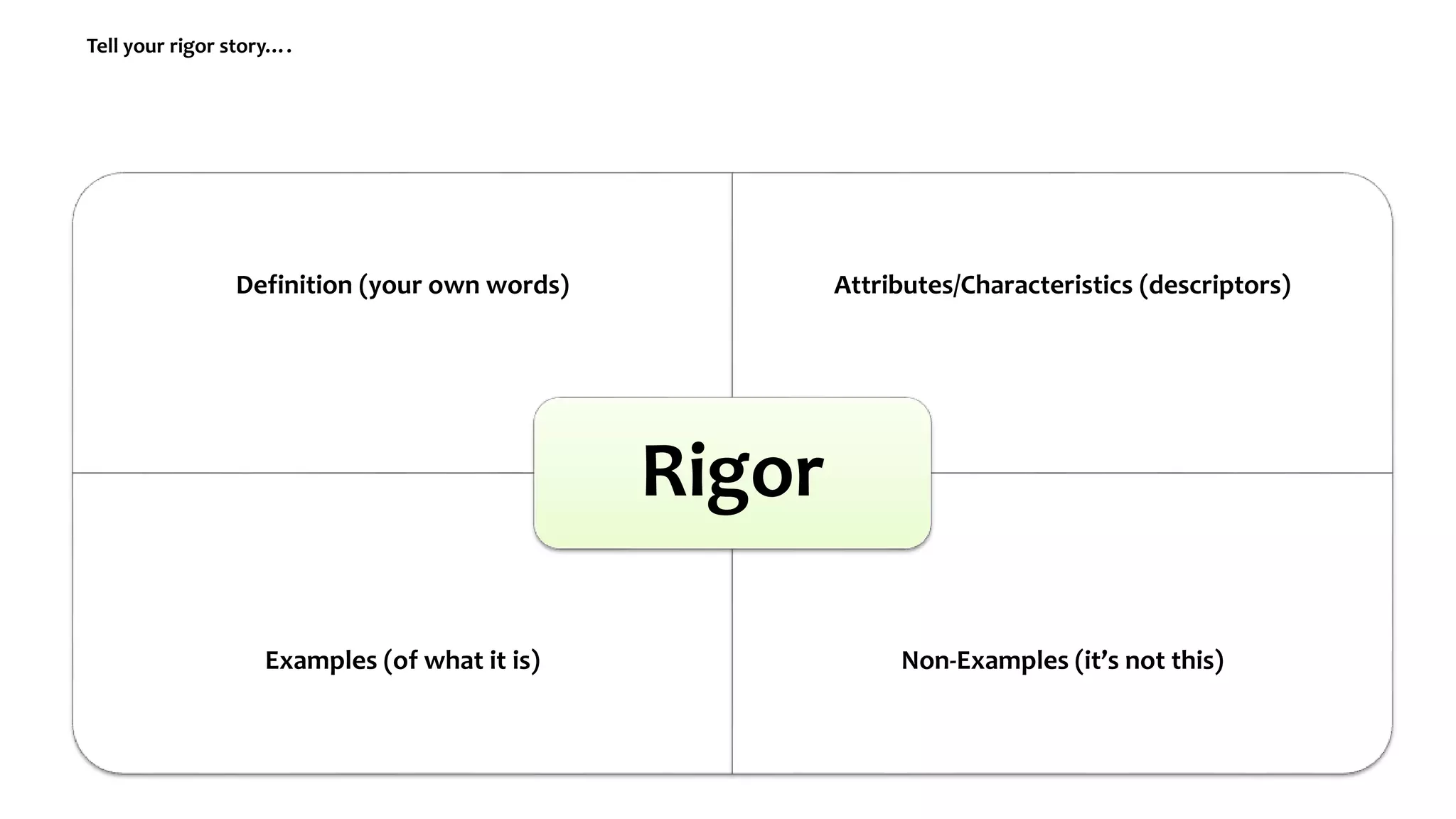
Definition (your own words) Attributes/Characteristics (descriptors)
Examples (of what it is) Non-Examples (it’s not this)
Rigor
Tell your rigor story….
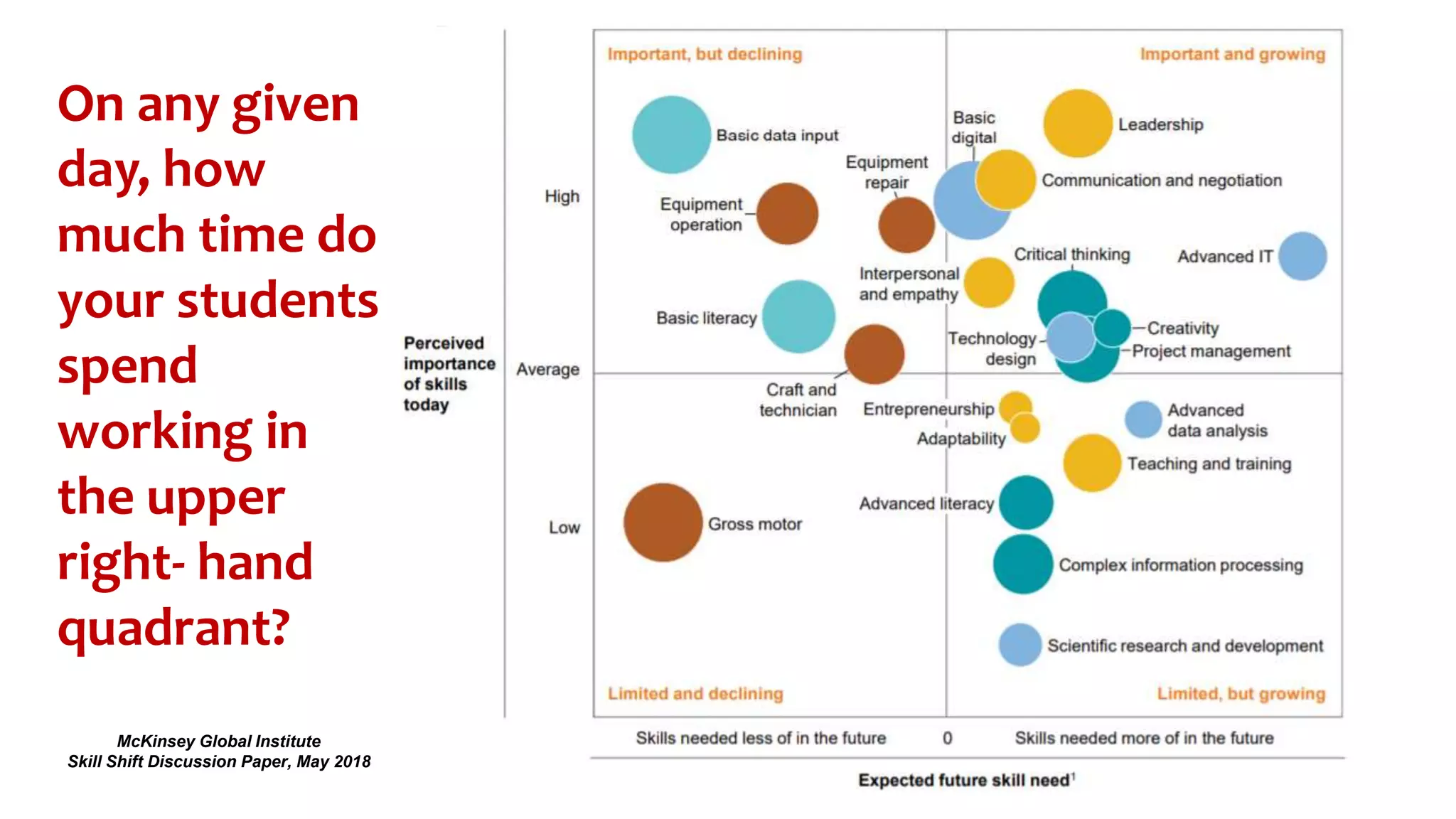
On any given
day, how
much time do
your students
spend
working in
the upper
right- hand
quadrant?
McKinsey Global Institute
Skill Shift Discussion Paper, May 2018
Value
Reliability
Difficult, but
not
impossible.
Critical Thinking
Assessment Test
Tennessee
Tech University
Elements
of rigor…
Content
Sophistication
Problem
Complexity
Performance
Standard
…for 21st
Century
Skills.
EdAdvance, 2019
Lexile, Variety,
Sophistication
Depth of Knowledge, BloomStandards of Quality/Quantity
EdAdvance, 2016
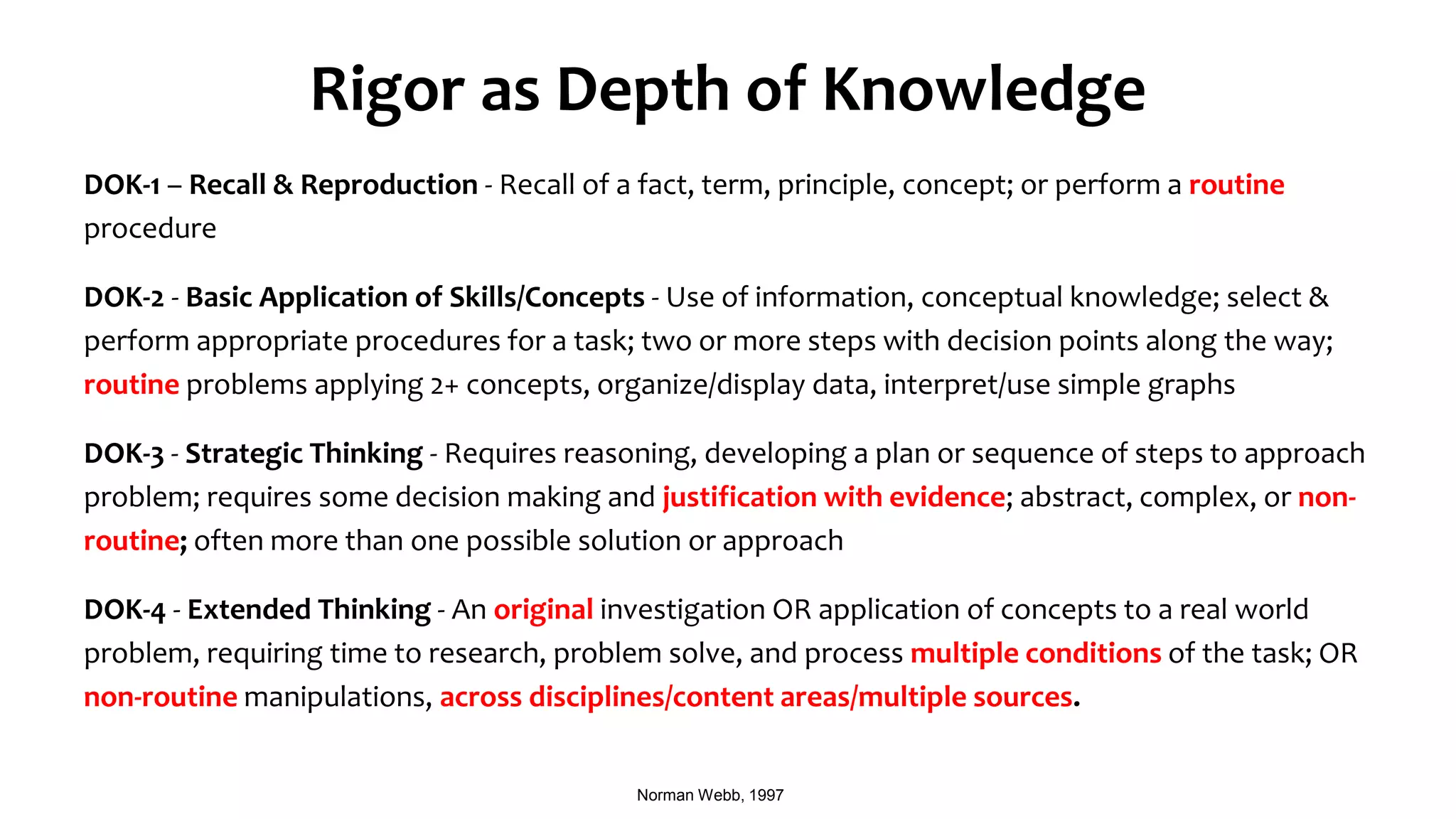
Rigor as Depth of Knowledge
DOK-1 – Recall & Reproduction - Recall of a fact, term, principle, concept; or perform a routine
procedure
DOK-2 - Basic Application of Skills/Concepts - Use of information, conceptual knowledge; select &
perform appropriate procedures for a task; two or more steps with decision points along the way;
routine problems applying 2+ concepts, organize/display data, interpret/use simple graphs
DOK-3 - Strategic Thinking - Requires reasoning, developing a plan or sequence of steps to approach
problem; requires some decision making and justification with evidence; abstract, complex, or non-
routine; often more than one possible solution or approach
DOK-4 - Extended Thinking - An original investigation OR application of concepts to a real world
problem, requiring time to research, problem solve, and process multiple conditions of the task; OR
non-routine manipulations, across disciplines/content areas/multiple sources.
Norman Webb, 1997
EdAdvance, 2019
Evidence Collection Modalities
Observation
Example –
• Listening to
student
interactions
What would
you see?
Student Work
Example –
• Examine written
argument for
credible
evidence to
support claim
What would
students produce?
Conversation
Example -
• Ask questions
about student’s
understanding
of the problem
What would
you hear?
EdAdvance, 2019
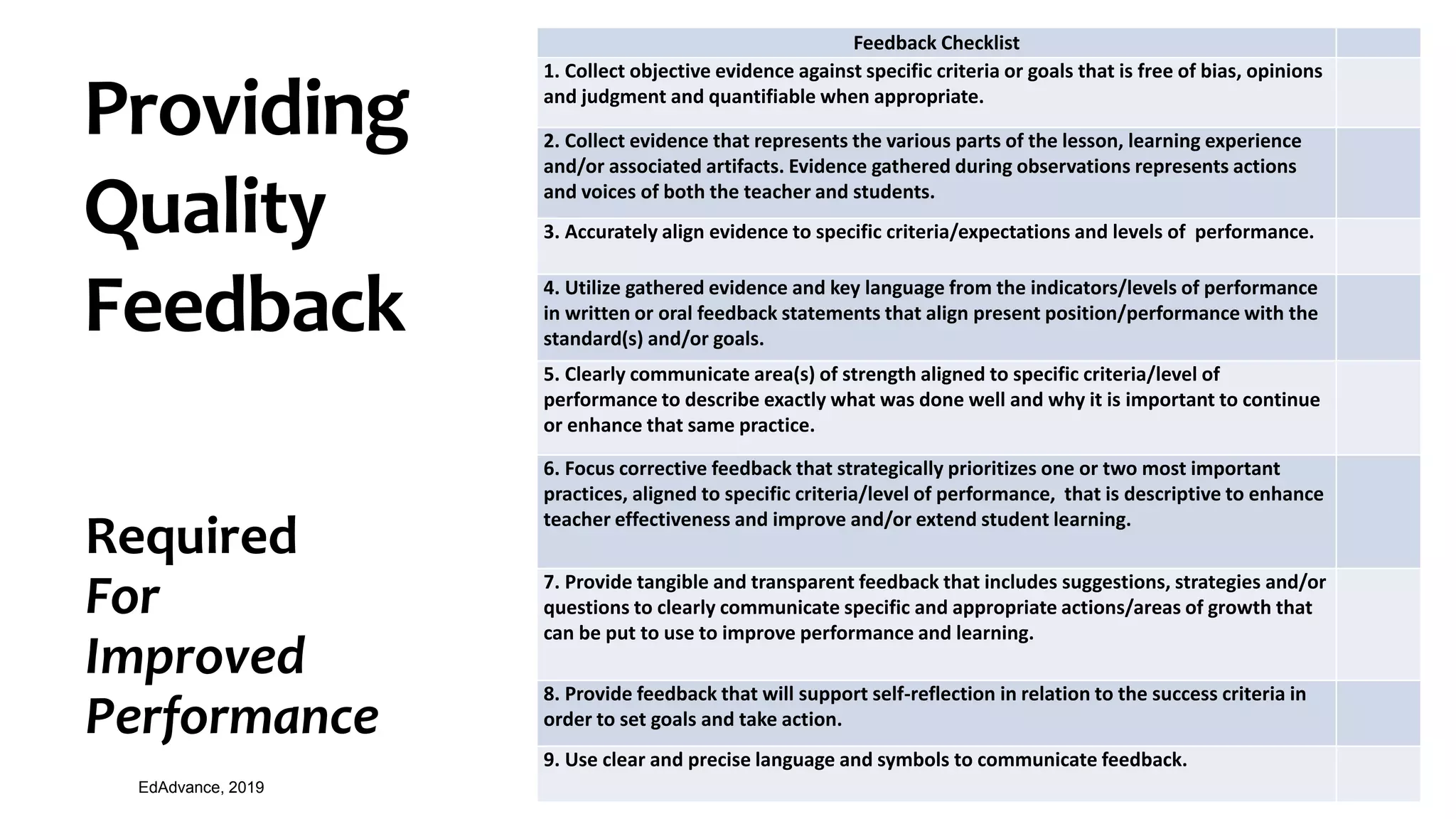
Providing
Quality
Feedback
Required
For
Improved
Performance
Feedback Checklist
1. Collect objective evidence against specific criteria or goals that is free of bias, opinions
and judgment and quantifiable when appropriate.
2. Collect evidence that represents the various parts of the lesson, learning experience
and/or associated artifacts. Evidence gathered during observations represents actions
and voices of both the teacher and students.
3. Accurately align evidence to specific criteria/expectations and levels of performance.
4. Utilize gathered evidence and key language from the indicators/levels of performance
in written or oral feedback statements that align present position/performance with the
standard(s) and/or goals.
5. Clearly communicate area(s) of strength aligned to specific criteria/level of
performance to describe exactly what was done well and why it is important to continue
or enhance that same practice.
6. Focus corrective feedback that strategically prioritizes one or two most important
practices, aligned to specific criteria/level of performance, that is descriptive to enhance
teacher effectiveness and improve and/or extend student learning.
7. Provide tangible and transparent feedback that includes suggestions, strategies and/or
questions to clearly communicate specific and appropriate actions/areas of growth that
can be put to use to improve performance and learning.
8. Provide feedback that will support self-reflection in relation to the success criteria in
order to set goals and take action.
9. Use clear and precise language and symbols to communicate feedback.
EdAdvance, 2019
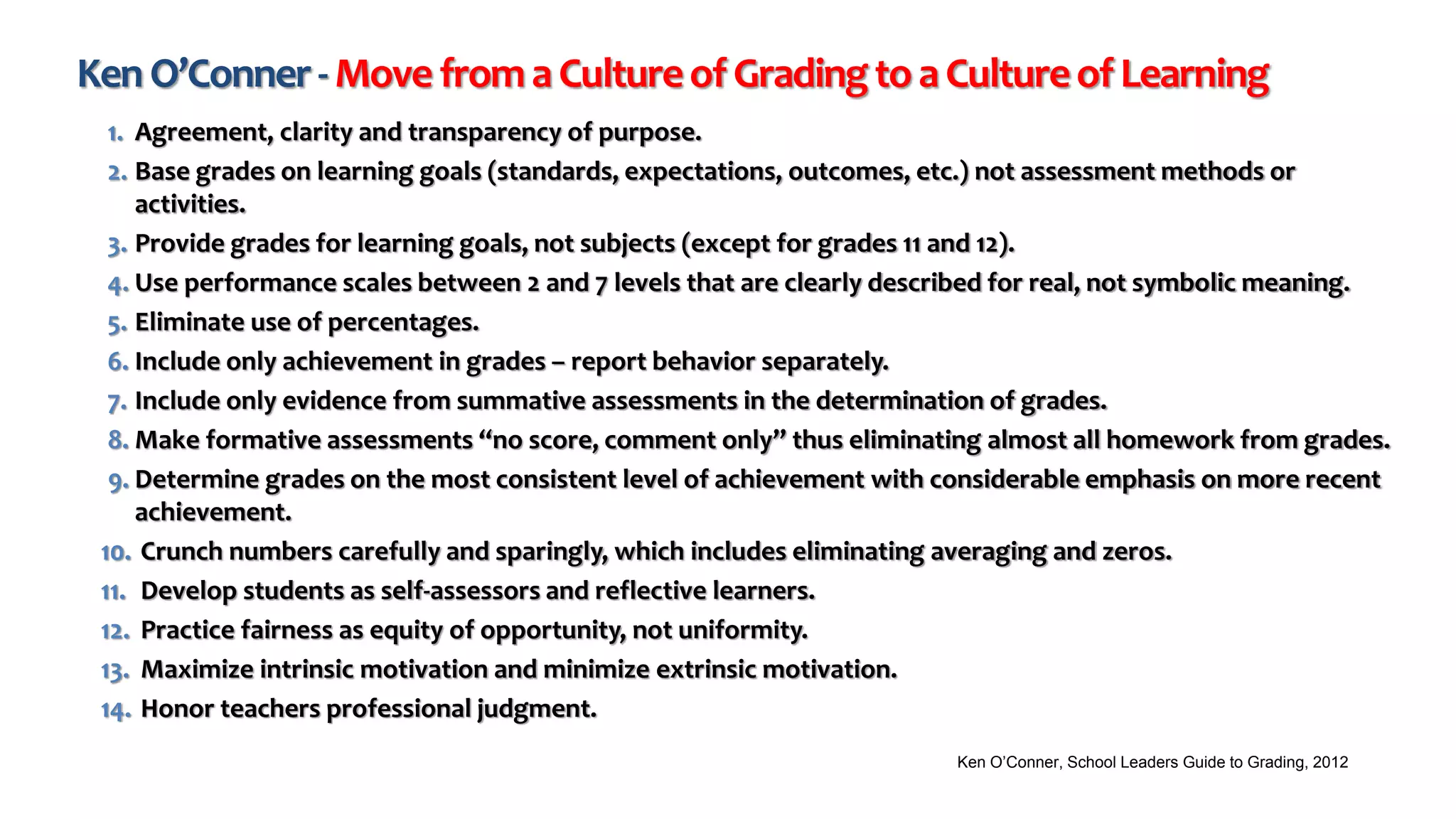
KenO’Conner-MovefromaCultureofGradingtoaCultureofLearning
1. Agreement, clarity and transparency of purpose.
2. Base grades on learning goals (standards, expectations, outcomes, etc.) not assessment methods or
activities.
3. Provide grades for learning goals, not subjects (except for grades 11 and 12).
4. Use performance scales between 2 and 7 levels that are clearly described for real, not symbolic meaning.
5. Eliminate use of percentages.
6. Include only achievement in grades – report behavior separately.
7. Include only evidence from summative assessments in the determination of grades.
8. Make formative assessments “no score, comment only” thus eliminating almost all homework from grades.
9. Determine grades on the most consistent level of achievement with considerable emphasis on more recent
achievement.
10. Crunch numbers carefully and sparingly, which includes eliminating averaging and zeros.
11. Develop students as self-assessors and reflective learners.
12. Practice fairness as equity of opportunity, not uniformity.
13. Maximize intrinsic motivation and minimize extrinsic motivation.
14. Honor teachers professional judgment.
Ken O’Conner, School Leaders Guide to Grading, 2012
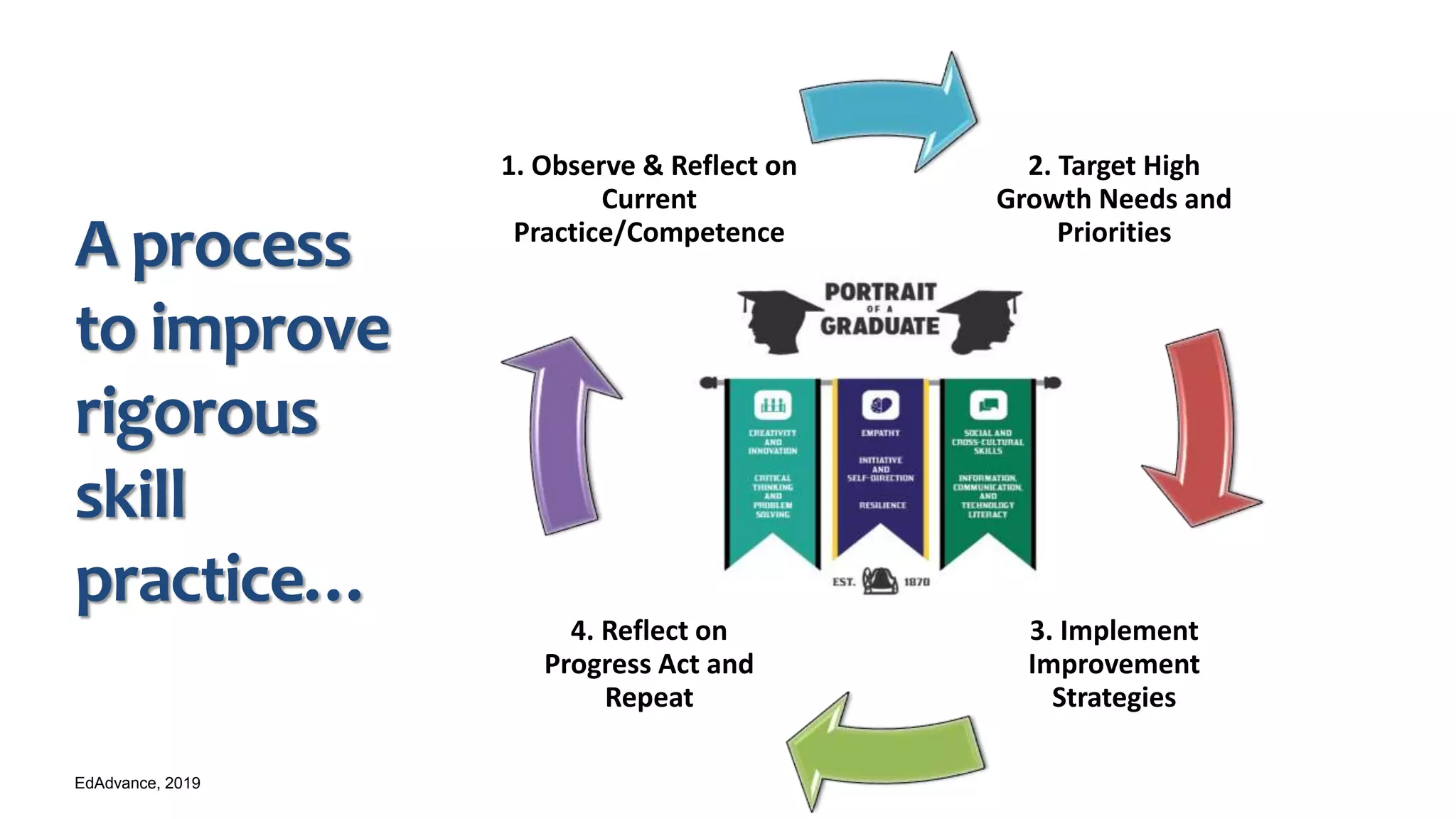
A process
to improve
rigorous
skill
practice…
2. Target High
Growth Needs and
Priorities
3. Implement
Improvement
Strategies
4. Reflect on
Progress Act and
Repeat
1. Observe & Reflect on
Current
Practice/Competence
EdAdvance, 2019
Align Your Systems With Your Goals for Learning
Measures
Subject Area
Responsibilities
Everyone’s
Responsibility
Content
(Declarative)
Facts
Content Skills
(Procedural)
Discrete Skills
Portrait of a Graduate
(Contextual)
Skills and Attributes
Goals
Practices
Lecture, video,
films, assigned
readings and
memory activities.
Classroom or textbook
problems, experiments,
discussions, practice and
repetition.
Complex projects,
real time explorations,
authentic and relevant
skill applications.
Time
Discrete units,
spiraled and
predictable.
Ongoing, systemic and
without a finite
or predictable end.
Discrete units,
spiraled and
predictable.
Recall & recognition
based quizzes, tests,
and activities. Multiple
choice, matching, etc.
(SAT/AP/Exams)
Checklists,
analytic rubrics,
or other agreed upon
skill standards
(AP/SB/CAPT/Exams)
Holistic and,
analytic rubrics,
or other agreed upon
standards of rigor
(Portfolios, Exhibitions, SB)
EdAdvance, 2019

CCER Rigor and 21st Century Skills Slides - Jonathan Costa

  • 1.
    Rigor and 21stCentury Skills Feedback for Student Success Jonathan P. Costa, Sr. March 28th, 2019 costa@edadvance.org Jonathan P. Costa
  • 2.
    Definition (your ownwords) Attributes/Characteristics (descriptors) Examples (of what it is) Non-Examples (it’s not this) Rigor Tell your rigor story….
  • 3.
    On any given day,how much time do your students spend working in the upper right- hand quadrant? McKinsey Global Institute Skill Shift Discussion Paper, May 2018
  • 4.
  • 5.
  • 6.
    Elements of rigor… Content Sophistication Problem Complexity Performance Standard …for 21st Century Skills. EdAdvance,2019 Lexile, Variety, Sophistication Depth of Knowledge, BloomStandards of Quality/Quantity
  • 7.
  • 8.
    Rigor as Depthof Knowledge DOK-1 – Recall & Reproduction - Recall of a fact, term, principle, concept; or perform a routine procedure DOK-2 - Basic Application of Skills/Concepts - Use of information, conceptual knowledge; select & perform appropriate procedures for a task; two or more steps with decision points along the way; routine problems applying 2+ concepts, organize/display data, interpret/use simple graphs DOK-3 - Strategic Thinking - Requires reasoning, developing a plan or sequence of steps to approach problem; requires some decision making and justification with evidence; abstract, complex, or non- routine; often more than one possible solution or approach DOK-4 - Extended Thinking - An original investigation OR application of concepts to a real world problem, requiring time to research, problem solve, and process multiple conditions of the task; OR non-routine manipulations, across disciplines/content areas/multiple sources. Norman Webb, 1997
  • 9.
  • 10.
    Evidence Collection Modalities Observation Example– • Listening to student interactions What would you see? Student Work Example – • Examine written argument for credible evidence to support claim What would students produce? Conversation Example - • Ask questions about student’s understanding of the problem What would you hear? EdAdvance, 2019
  • 11.
    Providing Quality Feedback Required For Improved Performance Feedback Checklist 1. Collectobjective evidence against specific criteria or goals that is free of bias, opinions and judgment and quantifiable when appropriate. 2. Collect evidence that represents the various parts of the lesson, learning experience and/or associated artifacts. Evidence gathered during observations represents actions and voices of both the teacher and students. 3. Accurately align evidence to specific criteria/expectations and levels of performance. 4. Utilize gathered evidence and key language from the indicators/levels of performance in written or oral feedback statements that align present position/performance with the standard(s) and/or goals. 5. Clearly communicate area(s) of strength aligned to specific criteria/level of performance to describe exactly what was done well and why it is important to continue or enhance that same practice. 6. Focus corrective feedback that strategically prioritizes one or two most important practices, aligned to specific criteria/level of performance, that is descriptive to enhance teacher effectiveness and improve and/or extend student learning. 7. Provide tangible and transparent feedback that includes suggestions, strategies and/or questions to clearly communicate specific and appropriate actions/areas of growth that can be put to use to improve performance and learning. 8. Provide feedback that will support self-reflection in relation to the success criteria in order to set goals and take action. 9. Use clear and precise language and symbols to communicate feedback. EdAdvance, 2019
  • 12.
    KenO’Conner-MovefromaCultureofGradingtoaCultureofLearning 1. Agreement, clarityand transparency of purpose. 2. Base grades on learning goals (standards, expectations, outcomes, etc.) not assessment methods or activities. 3. Provide grades for learning goals, not subjects (except for grades 11 and 12). 4. Use performance scales between 2 and 7 levels that are clearly described for real, not symbolic meaning. 5. Eliminate use of percentages. 6. Include only achievement in grades – report behavior separately. 7. Include only evidence from summative assessments in the determination of grades. 8. Make formative assessments “no score, comment only” thus eliminating almost all homework from grades. 9. Determine grades on the most consistent level of achievement with considerable emphasis on more recent achievement. 10. Crunch numbers carefully and sparingly, which includes eliminating averaging and zeros. 11. Develop students as self-assessors and reflective learners. 12. Practice fairness as equity of opportunity, not uniformity. 13. Maximize intrinsic motivation and minimize extrinsic motivation. 14. Honor teachers professional judgment. Ken O’Conner, School Leaders Guide to Grading, 2012
  • 13.
    A process to improve rigorous skill practice… 2.Target High Growth Needs and Priorities 3. Implement Improvement Strategies 4. Reflect on Progress Act and Repeat 1. Observe & Reflect on Current Practice/Competence EdAdvance, 2019
  • 14.
    Align Your SystemsWith Your Goals for Learning Measures Subject Area Responsibilities Everyone’s Responsibility Content (Declarative) Facts Content Skills (Procedural) Discrete Skills Portrait of a Graduate (Contextual) Skills and Attributes Goals Practices Lecture, video, films, assigned readings and memory activities. Classroom or textbook problems, experiments, discussions, practice and repetition. Complex projects, real time explorations, authentic and relevant skill applications. Time Discrete units, spiraled and predictable. Ongoing, systemic and without a finite or predictable end. Discrete units, spiraled and predictable. Recall & recognition based quizzes, tests, and activities. Multiple choice, matching, etc. (SAT/AP/Exams) Checklists, analytic rubrics, or other agreed upon skill standards (AP/SB/CAPT/Exams) Holistic and, analytic rubrics, or other agreed upon standards of rigor (Portfolios, Exhibitions, SB) EdAdvance, 2019