Writing Effective Learning
Objectives
March 31, 2014
Cynthia Tysick
cat2@buffalo.edu
Associate Librarian
University at Buffalo
What we’ll cover
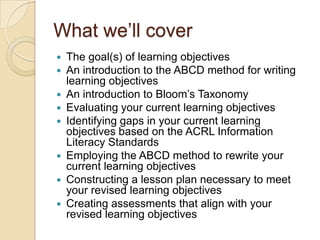
 The goal(s) of learning objectives
 An introduction to the ABCD method for writing
learning objectives
 An introduction to Bloom’s Taxonomy
 Evaluating your current learning objectives
 Identifying gaps in your current learning
objectives based on the ACRL Information
Literacy Standards
 Employing the ABCD method to rewrite your
current learning objectives
 Constructing a lesson plan necessary to meet
your revised learning objectives
 Creating assessments that align with your
revised learning objectives
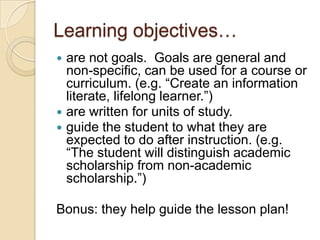
Learning objectives…
 are not goals. Goals are general and
non-specific, can be used for a course or
curriculum. (e.g. “Create an information
literate, lifelong learner.”)
 are written for units of study.
 guide the student to what they are
expected to do after instruction. (e.g.
“The student will distinguish academic
scholarship from non-academic
scholarship.”)
Bonus: they help guide the lesson plan!
ABCD Method
 4 components of a learning objective:
◦ A is the Audience (always the student)
◦ B is the behavior or action verb
◦ C is the condition for the objectives
◦ D is the degree of achievement or criteria
The action verb is the key!
 Action verb can’t be omitted
◦ Tells the student what they will do after
instruction. (e.g. distinguish academic
scholarship from non-academic
scholarship)
 Benjamin Bloom and his colleague,
David Krathwohl, created a taxonomy
of verbs used to write effective and
measureable learning objectives.
Bloom’s Taxonomy…
 describes and classifies observable
knowledge, skills, attitudes, behaviors
and abilities.
 runs under the assumption that there
is cognitive activity happening in the
brain.
◦ Levels of observable action
◦ Three domains: cognitive (thinking),
affective (attitudes), and psychomotor
(doing)
 is commonly in the cognitive domain.
Cognitive Domain
 Level 1: remember (knowledge) &
understand (comprehension)
 Level II: apply (application) & analyze
(analysis)
 Level III: evaluate (evaluation) and
create (synthesis)
Each level demonstrates a progression
of critical thinking skills.
See the handouts
 Critical thinking is developed as you
go up the levels.
 Creating has replaced synthesizing.
 Creating new knowledge is the
ultimate objective.
Putting it all together
After the lecture the student will distinguish
academic scholarship from non-academic
scholarship.
Lesson: PowerPoint defining academic
scholarship, identifying authors of
academic scholarship, and going over the
sections of an academic article.
Assessment: Show the covers and
citations to a popular magazine piece and
a journal article. Students distinguish one
from the other using clicker or clicker app.
Evaluating your current learning
objectives
Group exercise
Evaluating your current learning
objectives
The student will be able to understand
the information cycle.
Evaluating your current learning
objectives
The student will be able to understand
the information cycle.
What’s the verb here?
Using the two handouts can you come
up with a more descriptive verb?
Evaluating your current learning
objectives
Work on finding a good verb for your
learning objective.
ACRL Info. Lit. Standards
 Determine the extent of information needed
 Access the needed information effectively
and efficiently
 Evaluate information and its sources critically
 Incorporate selected information into one’s
knowledge base
 Use information effectively to accomplish a
specific purpose
 Understand the economic, legal, and social
issues surrounding the use of information,
and access and use information ethically and
legally
ACRL Info. Lit. Standards
Group Exercise
ACRL Info. Lit. Standards
The student will create a search
strategy.
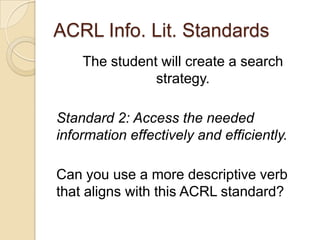
ACRL Info. Lit. Standards
The student will create a search
strategy.
Standard 2: Access the needed
information effectively and efficiently.
Can you use a more descriptive verb
that aligns with this ACRL standard?
ACRL Info. Lit. Standards
Can you identify a learning objective
that needs work aligning with ACRL
Info. Lit. Standards?
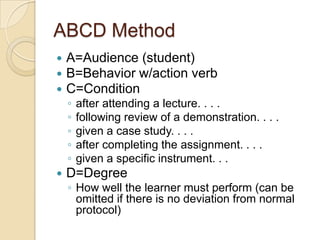
ABCD Method
 A=Audience (student)
 B=Behavior w/action verb
 C=Condition
◦ after attending a lecture. . . .
◦ following review of a demonstration. . . .
◦ given a case study. . . .
◦ after completing the assignment. . . .
◦ given a specific instrument. . .
 D=Degree
◦ How well the learner must perform (can be
omitted if there is no deviation from normal
protocol)
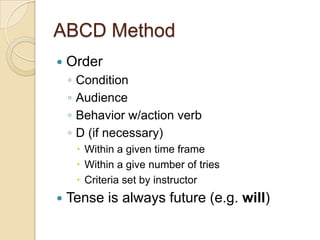
ABCD Method
 Order
◦ Condition
◦ Audience
◦ Behavior w/action verb
◦ D (if necessary)
 Within a given time frame
 Within a give number of tries
 Criteria set by instructor
 Tense is always future (e.g. will)
ABCD Method
Group Exercise
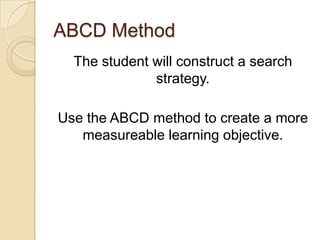
ABCD Method
The student will construct a search
strategy.
ABCD Method
The student will construct a search
strategy.
Use the ABCD method to create a more
measureable learning objective.
ABCD Method
Use the ABCD method to make your
learning objective more measureable.
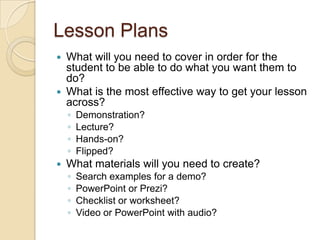
Lesson Plans
 What will you need to cover in order for the
student to be able to do what you want them to
do?
 What is the most effective way to get your lesson
across?
◦ Demonstration?
◦ Lecture?
◦ Hands-on?
◦ Flipped?
 What materials will you need to create?
◦ Search examples for a demo?
◦ PowerPoint or Prezi?
◦ Checklist or worksheet?
◦ Video or PowerPoint with audio?
Lesson Plans
Create an outline for a lesson that
meets your learning objective?
 Delivery method
 Resources needed
Assessment
Some of the more common
assessments are:
◦ Completed handout
◦ Post-survey
◦ Quiz
◦ Response paper
◦ Presentation/demonstration
◦ Bibliography
◦ Faculty feedback
Assessment
How will you assess the learning
objective has been met?
Resources
 Writing Instruction Objectives by Kathy
Waller,
http://www.naacls.org/docs/announcement/wr
iting-objectives.pdf
 Bloom’s Taxonomy of Measureable Verbs by
Jerry Dugan, http://www.taasa.org/wp-
content/uploads/2012/04/Working-on-the-
Wow-Side-Handout-31.pdf
 ASSURE model for designing instruction by
Jerry Dugan, http://taasa.org/wp-
content/uploads/2012/04/Working-on-the-
Wow-Side-Handout-11.pdf
 Bloomin’ Apps by Kathy Schrock,
http://www.schrockguide.net/bloomin-
apps.html

Writing effective learning objectives

  • 1.
    Writing Effective Learning Objectives March31, 2014 Cynthia Tysick cat2@buffalo.edu Associate Librarian University at Buffalo
  • 2.
    What we’ll cover The goal(s) of learning objectives  An introduction to the ABCD method for writing learning objectives  An introduction to Bloom’s Taxonomy  Evaluating your current learning objectives  Identifying gaps in your current learning objectives based on the ACRL Information Literacy Standards  Employing the ABCD method to rewrite your current learning objectives  Constructing a lesson plan necessary to meet your revised learning objectives  Creating assessments that align with your revised learning objectives
  • 3.
    Learning objectives…  arenot goals. Goals are general and non-specific, can be used for a course or curriculum. (e.g. “Create an information literate, lifelong learner.”)  are written for units of study.  guide the student to what they are expected to do after instruction. (e.g. “The student will distinguish academic scholarship from non-academic scholarship.”) Bonus: they help guide the lesson plan!
  • 4.
    ABCD Method  4components of a learning objective: ◦ A is the Audience (always the student) ◦ B is the behavior or action verb ◦ C is the condition for the objectives ◦ D is the degree of achievement or criteria
  • 5.
    The action verbis the key!  Action verb can’t be omitted ◦ Tells the student what they will do after instruction. (e.g. distinguish academic scholarship from non-academic scholarship)  Benjamin Bloom and his colleague, David Krathwohl, created a taxonomy of verbs used to write effective and measureable learning objectives.
  • 6.
    Bloom’s Taxonomy…  describesand classifies observable knowledge, skills, attitudes, behaviors and abilities.  runs under the assumption that there is cognitive activity happening in the brain. ◦ Levels of observable action ◦ Three domains: cognitive (thinking), affective (attitudes), and psychomotor (doing)  is commonly in the cognitive domain.
  • 7.
    Cognitive Domain  Level1: remember (knowledge) & understand (comprehension)  Level II: apply (application) & analyze (analysis)  Level III: evaluate (evaluation) and create (synthesis) Each level demonstrates a progression of critical thinking skills.
  • 9.
    See the handouts Critical thinking is developed as you go up the levels.  Creating has replaced synthesizing.  Creating new knowledge is the ultimate objective.
  • 10.
    Putting it alltogether After the lecture the student will distinguish academic scholarship from non-academic scholarship. Lesson: PowerPoint defining academic scholarship, identifying authors of academic scholarship, and going over the sections of an academic article. Assessment: Show the covers and citations to a popular magazine piece and a journal article. Students distinguish one from the other using clicker or clicker app.
  • 11.
    Evaluating your currentlearning objectives Group exercise
  • 12.
    Evaluating your currentlearning objectives The student will be able to understand the information cycle.
  • 13.
    Evaluating your currentlearning objectives The student will be able to understand the information cycle. What’s the verb here? Using the two handouts can you come up with a more descriptive verb?
  • 14.
    Evaluating your currentlearning objectives Work on finding a good verb for your learning objective.
  • 15.
    ACRL Info. Lit.Standards  Determine the extent of information needed  Access the needed information effectively and efficiently  Evaluate information and its sources critically  Incorporate selected information into one’s knowledge base  Use information effectively to accomplish a specific purpose  Understand the economic, legal, and social issues surrounding the use of information, and access and use information ethically and legally
  • 16.
    ACRL Info. Lit.Standards Group Exercise
  • 17.
    ACRL Info. Lit.Standards The student will create a search strategy.
  • 18.
    ACRL Info. Lit.Standards The student will create a search strategy. Standard 2: Access the needed information effectively and efficiently. Can you use a more descriptive verb that aligns with this ACRL standard?
  • 19.
    ACRL Info. Lit.Standards Can you identify a learning objective that needs work aligning with ACRL Info. Lit. Standards?
  • 20.
    ABCD Method  A=Audience(student)  B=Behavior w/action verb  C=Condition ◦ after attending a lecture. . . . ◦ following review of a demonstration. . . . ◦ given a case study. . . . ◦ after completing the assignment. . . . ◦ given a specific instrument. . .  D=Degree ◦ How well the learner must perform (can be omitted if there is no deviation from normal protocol)
  • 21.
    ABCD Method  Order ◦Condition ◦ Audience ◦ Behavior w/action verb ◦ D (if necessary)  Within a given time frame  Within a give number of tries  Criteria set by instructor  Tense is always future (e.g. will)
  • 22.
  • 23.
    ABCD Method The studentwill construct a search strategy.
  • 24.
    ABCD Method The studentwill construct a search strategy. Use the ABCD method to create a more measureable learning objective.
  • 25.
    ABCD Method Use theABCD method to make your learning objective more measureable.
  • 26.
    Lesson Plans  Whatwill you need to cover in order for the student to be able to do what you want them to do?  What is the most effective way to get your lesson across? ◦ Demonstration? ◦ Lecture? ◦ Hands-on? ◦ Flipped?  What materials will you need to create? ◦ Search examples for a demo? ◦ PowerPoint or Prezi? ◦ Checklist or worksheet? ◦ Video or PowerPoint with audio?
  • 27.
    Lesson Plans Create anoutline for a lesson that meets your learning objective?  Delivery method  Resources needed
  • 28.
    Assessment Some of themore common assessments are: ◦ Completed handout ◦ Post-survey ◦ Quiz ◦ Response paper ◦ Presentation/demonstration ◦ Bibliography ◦ Faculty feedback
  • 29.
    Assessment How will youassess the learning objective has been met?
  • 30.
    Resources  Writing InstructionObjectives by Kathy Waller, http://www.naacls.org/docs/announcement/wr iting-objectives.pdf  Bloom’s Taxonomy of Measureable Verbs by Jerry Dugan, http://www.taasa.org/wp- content/uploads/2012/04/Working-on-the- Wow-Side-Handout-31.pdf  ASSURE model for designing instruction by Jerry Dugan, http://taasa.org/wp- content/uploads/2012/04/Working-on-the- Wow-Side-Handout-11.pdf  Bloomin’ Apps by Kathy Schrock, http://www.schrockguide.net/bloomin- apps.html