WRITING OBJECTIVES


Ines A. de Guzman, PhD
GENERAL
  Long
  Term


            TYPES OF
           OBJECTIVES

SPECIFIC
 Short
 Term
OBJECTIVES
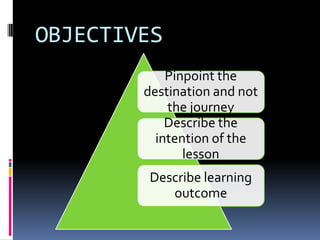
            Pinpoint the
        destination and not
            the journey
            Describe the
          intention of the
               lesson
         Describe learning
            outcome
General Objectives
 A statement, in more or less precise terms, that
  shows the trend of the learning activity.

 A statement, which defines the outcome of the
  learning activity and represents a particular
  point in the general orientation of a curriculum.

 The general objective is the first level of
  specification of the aim from which it was
  derived from.
General Objectives: Examples
 At the end of the semester, the students should
  be able to develop a home economics curriculum
  for public secondary high schools.
 At the end of the semester, the students should
  be able to evaluate a secondary home economics
  curriculum based on a curriculum standard model.
 At the end of the semester, the students should
  be able to appreciate the importance of home
  economics in everyday living.
Specific Objectives
 A statement which describes the trend of the learning
  activity.
 It is formulated in terms of observable behaviour.
 It is an interpretation of the general objective from
  which it was derived from.
Examples:
  General Objective:
    At the end of the semester, the students should be able to
    develop a home economics curriculum for public secondary
    high school students.
  Specific Objective:
    At the end of the lesson, the students should be able to
    identify the various areas of home economics.
PURPOSE


•Help teachers to clarify precisely what they want their
students to learn.
•Help provide lesson focus and direction.
•Help guide the selection of appropriate practice
activities.
•Help teachers evaluate if the students have learned
what they are supposed to learn.
•Provide means of measuring the teacher’s teaching
effectiveness.
Characteristics of a Specific
            Objective
1. It is always expressed in terms of the student.
2. It is unequivocal/clear. It is precise and supports
   only one interpretation.
3. It describes an observable behaviour on the part
   of the subject.
4. It specifies, where appropriate, the special
   conditions in which this behaviour is manifested
   and the criteria which will make it possible to
   judge whether the objective has been attained.
It is always expressed in terms
of the student.
 Emphasis is placed on the student's learning
  rather than on the teaching given by the teacher.
  It is not enough for the teacher to have provided
  the teaching but it is also necessary for his
  students to have learnt.
 Encourage thinking about the link between
  teaching and learning. The teacher should try to
  specify his objectives by concentrating not on
  what she teaches but on the changes she wishes
  to bring about in the students.
It is unequivocal-precise and supports
only one interpretation.
 The following objectives are open to various
  interpretations:
  1. At the end of the lesson, the students will be able
  to display awareness of the home economics
  curriculum for secondary schools.
  2. At the end of the lesson, the students will be able
  to know the content of home economics 1.
 In order to make these objectives unequivocal, it is
  necessary to consider what the student will do to
  demonstrate her awareness of the HE curriculum
  for secondary schools.
 General terms such as to know, to realize, to
  understand, to familiarize oneself with, to
  become aware of, to appreciate, and so forth,
  lend themselves to different interpretations.

 What is expected of a person who knows, realizes
  or understands must be specified if one is to infer
  that that person knows, realizes, or understands.

 Terms as vague as these are an indication rather
  of aims or of general objectives.
 To clarify the general objective, one derives from it a
  series of specific objectives choosing from among
  various possibilities the objectives which, given the
  context, seem to be the most relevant to the
  attainment of the general objective from which they
  are derived from.
 For example, the general objective,
 “To understand the meaning of nutrients,” may give
  rise to the following objectives:
   to define a term in one's own words,
   to identify the meaning of a term when it is used in a
    context,
   to distinguish between terms which are similar in meaning.
  Users must, therefore, reach an understanding on the
    terminology used and thus make the objective unequivocal.
The specific objective
describes observable behaviour
 The objective must describe an ability which the
  subject must have acquired at the end of the learning
  process.
 It is a question of specifying an observable ability and
  not a category of modes of behaviour such as those
  suggested by the words 'to understand' and 'to
  realize'.
 One must be able to grasp the reality of this ability
  by means of a concrete and observable action.
 Thus, an objective such as 'to see the value of home
  economics' is not specific.
 A distinction must be made between the process
  and the outcome, between the means and what
  one wishes to attain.

Example of a learning process:
 To discover a home economics curriculum model
  as a standard for proposing a new curriculum.
 To experiment three best mixing methods.

Example of an activity or a task to be accomplished:
 To mix the ingredients of fat-less longanisa.
 To beat the egg whites until foamy and thick.
 A distinction must also be made between the
  objectives in a list of contents.
 An objective comprises at least three parts:
   a subject (the student),
   a verb of action (the observable behaviour which is
    expected)
   a content (the complement).

  Thus, in the specific objective, ‘the student must be able to list
    different types of mixing techniques',

    the subject is the student, the verb 'to list' refers to
    observable behaviour, and the content is mixing techniques.

    Thus, there can be no confusion between the objective and
    list of content. The verb and the complement must be
    precise if the objective is to be specific.
The specific objective states the special
conditions in which the behaviour is
manifested.
  The objective must, where appropriate, mention the
   conditions in which the behaviour must be manifested
   and the criteria that will be used to determine whether
   the objective has been attained or not.
  The special conditions relating to the display of the
   behaviour are all those conditions which may make the
   difficulty of the objective variable and which make it
   possible to imagine a concrete situation in which the
   behaviour must be manifested.
  Although it is not necessary for all objectives to
   mention such special conditions, certain objectives
   demand that they should be mentioned.
For example, the objectives:

 ‘to explain how to measure ingredients properly
  and accurately.’
 ‘to demonstrate the proper way of handling
  ingredients.’
 ‘to discuss the importance of food safety and
  kitchen sanitation.’

could not be sufficiently precise to be specific if the
  time requirements in relation to the behaviour
  were not indicated.
Writing Specific Objectives

  The objective of any lesson
   is to change a behavior.
  Thus, objectives must be
   expressed in performance
   terms.
Questions to ask:
1. What is the minimum acceptable level of
  performance?
2. How will you test the achievement of that
  level of performance?
3. What criterion or standard of performance
  will you accept?
4. Is the new terminal behaviour defined in
  terms that are measurable?
5. Under what conditions is the new
  behaviour expected to occur?
6. Is the new terminal behaviour
  observable?
7. Are the learning objectives
  categorized into three different areas
  or levels of domain?

    A. Knowledge (Cognitive )
    B. Attitude (Affective)
    C. Skills (Psychomotor)
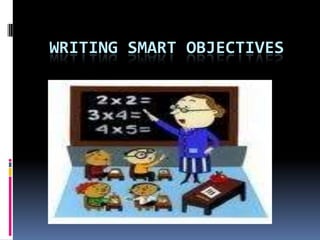
WRITING SMART OBJECTIVES
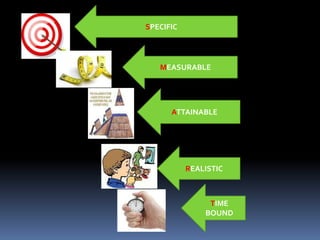
SPECIFIC


   MEASURABLE


      ATTAINABLE


           REALISTIC


                TIME
               BOUND
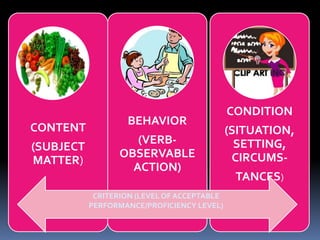
CONDITION
                   BEHAVIOR
CONTENT                                      (SITUATION,
                     (VERB-                    SETTING,
(SUBJECT
                  OBSERVABLE                  CIRCUMS-
MATTER)
                    ACTION)
                                              TANCES)
            CRITERION (LEVEL OF ACCEPTABLE
           PERFORMANCE/PROFICIENCY LEVEL)
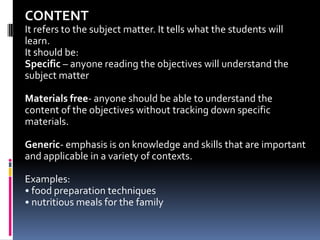
CONTENT
It refers to the subject matter. It tells what the students will
learn.
It should be:
Specific – anyone reading the objectives will understand the
subject matter

Materials free- anyone should be able to understand the
content of the objectives without tracking down specific
materials.

Generic- emphasis is on knowledge and skills that are important
and applicable in a variety of contexts.

Examples:
• food preparation techniques
• nutritious meals for the family
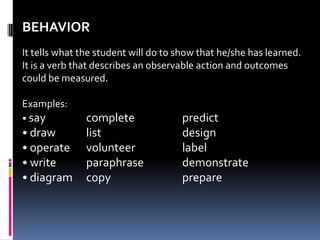
BEHAVIOR
It tells what the student will do to show that he/she has learned.
It is a verb that describes an observable action and outcomes
could be measured.

Examples:
• say          complete              predict
• draw         list                  design
• operate      volunteer             label
• write        paraphrase            demonstrate
• diagram      copy                  prepare
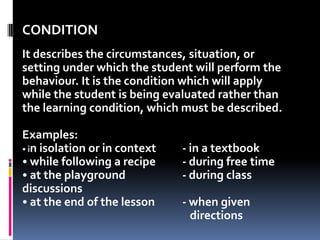
CONDITION
It describes the circumstances, situation, or
setting under which the student will perform the
behaviour. It is the condition which will apply
while the student is being evaluated rather than
the learning condition, which must be described.

Examples:
• in isolation or in context   - in a textbook
• while following a recipe     - during free time
• at the playground            - during class
discussions
• at the end of the lesson     - when given
                                 directions
CRITERION

It refers to the level of acceptable performance, the
standard of mastery, or the proficiency level
expected.
Examples:
• with 90% accuracy
• within ten minutes
• at least three of the steps
• with no errors
• following baking standards
• fully/correctly/precisely
PRACTICE MAKES
PERFECT
1. At the end of the lesson, the students will
   be able to explain fully the rationale
   behind the K-12 and its impact in the EPP
   curriculum.

  Content:
  Behavior:
  Condition:
  Criterion:

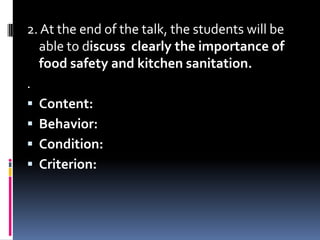
2. At the end of the talk, the students will be
  able to discuss clearly the importance of
  food safety and kitchen sanitation.
.
 Content:
 Behavior:
 Condition:
 Criterion:
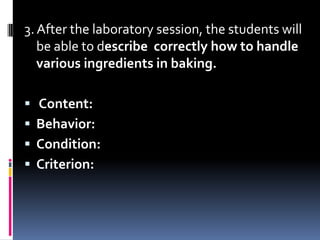
3. After the laboratory session, the students will
   be able to describe correctly how to handle
   various ingredients in baking.

   Content:
   Behavior:
   Condition:
   Criterion:
5. At the end of the demonstration, the students will
   be able to compute the selling price of the product
   with no errors.


   Content:
   Behavior:
   Condition:
   Criterion:
References

 Blooms Taxonomy of Objectives
 Internet Materials
 http://www.unesco.org/webworld/ramp/html/
  r8810e/r8810e07.htm

Writing objectives

  • 1.
  • 2.
    GENERAL Long Term TYPES OF OBJECTIVES SPECIFIC Short Term
  • 3.
    OBJECTIVES Pinpoint the destination and not the journey Describe the intention of the lesson Describe learning outcome
  • 4.
    General Objectives  Astatement, in more or less precise terms, that shows the trend of the learning activity.  A statement, which defines the outcome of the learning activity and represents a particular point in the general orientation of a curriculum.  The general objective is the first level of specification of the aim from which it was derived from.
  • 5.
    General Objectives: Examples At the end of the semester, the students should be able to develop a home economics curriculum for public secondary high schools.  At the end of the semester, the students should be able to evaluate a secondary home economics curriculum based on a curriculum standard model.  At the end of the semester, the students should be able to appreciate the importance of home economics in everyday living.
  • 6.
    Specific Objectives  Astatement which describes the trend of the learning activity.  It is formulated in terms of observable behaviour.  It is an interpretation of the general objective from which it was derived from. Examples: General Objective: At the end of the semester, the students should be able to develop a home economics curriculum for public secondary high school students. Specific Objective: At the end of the lesson, the students should be able to identify the various areas of home economics.
  • 7.
    PURPOSE •Help teachers toclarify precisely what they want their students to learn. •Help provide lesson focus and direction. •Help guide the selection of appropriate practice activities. •Help teachers evaluate if the students have learned what they are supposed to learn. •Provide means of measuring the teacher’s teaching effectiveness.
  • 8.
    Characteristics of aSpecific Objective 1. It is always expressed in terms of the student. 2. It is unequivocal/clear. It is precise and supports only one interpretation. 3. It describes an observable behaviour on the part of the subject. 4. It specifies, where appropriate, the special conditions in which this behaviour is manifested and the criteria which will make it possible to judge whether the objective has been attained.
  • 9.
    It is alwaysexpressed in terms of the student.  Emphasis is placed on the student's learning rather than on the teaching given by the teacher. It is not enough for the teacher to have provided the teaching but it is also necessary for his students to have learnt.  Encourage thinking about the link between teaching and learning. The teacher should try to specify his objectives by concentrating not on what she teaches but on the changes she wishes to bring about in the students.
  • 10.
    It is unequivocal-preciseand supports only one interpretation.  The following objectives are open to various interpretations: 1. At the end of the lesson, the students will be able to display awareness of the home economics curriculum for secondary schools. 2. At the end of the lesson, the students will be able to know the content of home economics 1.  In order to make these objectives unequivocal, it is necessary to consider what the student will do to demonstrate her awareness of the HE curriculum for secondary schools.
  • 11.
     General termssuch as to know, to realize, to understand, to familiarize oneself with, to become aware of, to appreciate, and so forth, lend themselves to different interpretations.  What is expected of a person who knows, realizes or understands must be specified if one is to infer that that person knows, realizes, or understands.  Terms as vague as these are an indication rather of aims or of general objectives.
  • 12.
     To clarifythe general objective, one derives from it a series of specific objectives choosing from among various possibilities the objectives which, given the context, seem to be the most relevant to the attainment of the general objective from which they are derived from.  For example, the general objective,  “To understand the meaning of nutrients,” may give rise to the following objectives:  to define a term in one's own words,  to identify the meaning of a term when it is used in a context,  to distinguish between terms which are similar in meaning. Users must, therefore, reach an understanding on the terminology used and thus make the objective unequivocal.
  • 13.
    The specific objective describesobservable behaviour  The objective must describe an ability which the subject must have acquired at the end of the learning process.  It is a question of specifying an observable ability and not a category of modes of behaviour such as those suggested by the words 'to understand' and 'to realize'.  One must be able to grasp the reality of this ability by means of a concrete and observable action.  Thus, an objective such as 'to see the value of home economics' is not specific.
  • 14.
     A distinctionmust be made between the process and the outcome, between the means and what one wishes to attain. Example of a learning process:  To discover a home economics curriculum model as a standard for proposing a new curriculum.  To experiment three best mixing methods. Example of an activity or a task to be accomplished:  To mix the ingredients of fat-less longanisa.  To beat the egg whites until foamy and thick.
  • 15.
     A distinctionmust also be made between the objectives in a list of contents.  An objective comprises at least three parts:  a subject (the student),  a verb of action (the observable behaviour which is expected)  a content (the complement). Thus, in the specific objective, ‘the student must be able to list different types of mixing techniques', the subject is the student, the verb 'to list' refers to observable behaviour, and the content is mixing techniques. Thus, there can be no confusion between the objective and list of content. The verb and the complement must be precise if the objective is to be specific.
  • 16.
    The specific objectivestates the special conditions in which the behaviour is manifested.  The objective must, where appropriate, mention the conditions in which the behaviour must be manifested and the criteria that will be used to determine whether the objective has been attained or not.  The special conditions relating to the display of the behaviour are all those conditions which may make the difficulty of the objective variable and which make it possible to imagine a concrete situation in which the behaviour must be manifested.  Although it is not necessary for all objectives to mention such special conditions, certain objectives demand that they should be mentioned.
  • 17.
    For example, theobjectives:  ‘to explain how to measure ingredients properly and accurately.’  ‘to demonstrate the proper way of handling ingredients.’  ‘to discuss the importance of food safety and kitchen sanitation.’ could not be sufficiently precise to be specific if the time requirements in relation to the behaviour were not indicated.
  • 18.
    Writing Specific Objectives  The objective of any lesson is to change a behavior.  Thus, objectives must be expressed in performance terms.
  • 19.
    Questions to ask: 1.What is the minimum acceptable level of performance? 2. How will you test the achievement of that level of performance? 3. What criterion or standard of performance will you accept? 4. Is the new terminal behaviour defined in terms that are measurable? 5. Under what conditions is the new behaviour expected to occur?
  • 20.
    6. Is thenew terminal behaviour observable? 7. Are the learning objectives categorized into three different areas or levels of domain? A. Knowledge (Cognitive ) B. Attitude (Affective) C. Skills (Psychomotor)
  • 21.
  • 22.
    SPECIFIC MEASURABLE ATTAINABLE REALISTIC TIME BOUND
  • 23.
    CONDITION BEHAVIOR CONTENT (SITUATION, (VERB- SETTING, (SUBJECT OBSERVABLE CIRCUMS- MATTER) ACTION) TANCES) CRITERION (LEVEL OF ACCEPTABLE PERFORMANCE/PROFICIENCY LEVEL)
  • 24.
    CONTENT It refers tothe subject matter. It tells what the students will learn. It should be: Specific – anyone reading the objectives will understand the subject matter Materials free- anyone should be able to understand the content of the objectives without tracking down specific materials. Generic- emphasis is on knowledge and skills that are important and applicable in a variety of contexts. Examples: • food preparation techniques • nutritious meals for the family
  • 25.
    BEHAVIOR It tells whatthe student will do to show that he/she has learned. It is a verb that describes an observable action and outcomes could be measured. Examples: • say complete predict • draw list design • operate volunteer label • write paraphrase demonstrate • diagram copy prepare
  • 26.
    CONDITION It describes thecircumstances, situation, or setting under which the student will perform the behaviour. It is the condition which will apply while the student is being evaluated rather than the learning condition, which must be described. Examples: • in isolation or in context - in a textbook • while following a recipe - during free time • at the playground - during class discussions • at the end of the lesson - when given directions
  • 27.
    CRITERION It refers tothe level of acceptable performance, the standard of mastery, or the proficiency level expected. Examples: • with 90% accuracy • within ten minutes • at least three of the steps • with no errors • following baking standards • fully/correctly/precisely
  • 28.
  • 29.
    1. At theend of the lesson, the students will be able to explain fully the rationale behind the K-12 and its impact in the EPP curriculum. Content: Behavior: Condition: Criterion:
  • 30.
    2. At theend of the talk, the students will be able to discuss clearly the importance of food safety and kitchen sanitation. .  Content:  Behavior:  Condition:  Criterion:
  • 31.
    3. After thelaboratory session, the students will be able to describe correctly how to handle various ingredients in baking.  Content:  Behavior:  Condition:  Criterion:
  • 32.
    5. At theend of the demonstration, the students will be able to compute the selling price of the product with no errors.  Content:  Behavior:  Condition:  Criterion:
  • 33.
    References  Blooms Taxonomyof Objectives  Internet Materials  http://www.unesco.org/webworld/ramp/html/ r8810e/r8810e07.htm