Professionalism & Work Ethic
TIPS FOR SUCCESS IN THE WORKPLACE
Sponsored in part by the Workforce Development Agency, State of Michigan, Michigan Works!, through your local Workforce Development Board and Muskegon County
Board of Commissioners. Auxiliary aids and services are available upon request to individuals with disabilities EEO/ADA/Employer/Programs - TTY# - 711.
Professionalism
is a determined effort by
everyone in the workplace to give
their best each and every day.
“Businesses of all
sizes rely on credibility,
confidence and reputation
to survive, and their people are
part of that impression.”
Professionalism & Workplace Savvy
by Erica Feigenbaum, Demand Media
Path to Professionalism
 Punctuality and Attendance
 Communication
 Presentation and Appearance
 Competence and Initiative
 Respect
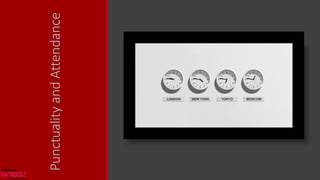
PunctualityandAttendance
“80% of success in life is just showing up.”
- Woody Allen
 One of the most important qualities an employee
can display is dependability
 The main factor in being dependable is attendance
 Attendance is usually the top priority when it
comes to an employee's performance and is
necessary for continued professional growth
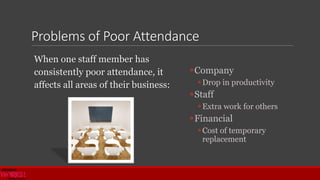
Problems of Poor Attendance
Company
Drop in productivity
Staff
Extra work for others
Financial
Cost of temporary
replacement
When one staff member has
consistently poor attendance, it
affects all areas of their business:
Punctuality
If you arrive 5 minutes late and
leave 5 minutes early every day, you
have stolen 30 hours of work time
from your employer in one year.
Punctuality Tips
 Be at your workstation when the
business day starts.
 Be clear on time allotted for
lunch and breaks.
 Don’t pack up until the work day
is over.
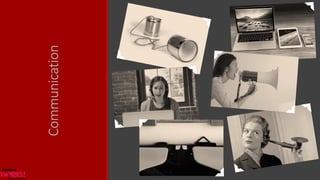
Communication
Oral Communication
 Be clear and concise
 Think before you speak
 Be positive instead of negative
 Reflect on your conversations
 Ask open ended questions:
 How, what, why
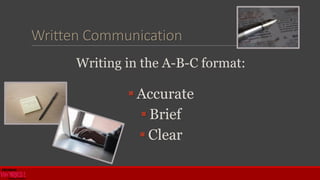
Written Communication
Writing in the A-B-C format:
 Accurate
 Brief
 Clear
21st Century Communication
 Use proper grammar
 Carefully proofread, edit, spell-check
 Rethink your response before you send
 Don’t use email if the subject needs a
face-to-face conversation
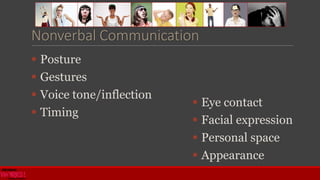
Nonverbal Communication
 Eye contact
 Facial expression
 Personal space
 Appearance
 Posture
 Gestures
 Voice tone/inflection
 Timing
Communication Don’ts
 Gossip
 Flirt
 Discuss politics, religion, or
personal problems
 Complain about your job,
coworkers, or supervisor
 Criticize or insult your coworkers
or supervisor
“Attitude is a little thing that
makes a big difference.”
Winston Churchill
Attitude
Attitude
 Be positive
 Show enthusiasm
 Pick your battles
 Be in charge
PresentationandAppearance
Presentation
 Perception matters
 Presentation is equally important as
attendance and punctuality
 You are only given a very short time
to make a first impression
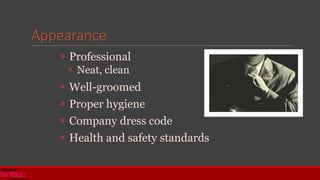
Appearance
 Professional
 Neat, clean
 Well-groomed
 Proper hygiene
 Company dress code
 Health and safety standards
Your appearance is a
reflection of the company or
organization you work for.
Appearance
CompetenceandInitiative
Competence
 Perform job duties in an efficient and
proficient manner
 Possess the skills and knowledge to do
the job well
 Be a “paid expert”
 Keep skills current
Initiative
 Do what needs to be done without
being told
 Complete all job duties promptly and
professionally
 Take action and ownership
 Help others or take on extra projects
when possible
Initiative
Use critical thinking and problem solving skills:
 Ask what the problem is
 Analyze it
 Explore all possible solutions
 List solutions from best to
worst
 Select the best solution
 Evaluate the solution
Rewards of taking Initiative
 Knowledge of your company and the
market it serves
 Increased value as an employee
 Enhanced independence
 More career advancement opportunities
 A more meaningful and fulfilling work
experience
Respect
Respect
is the foundation of workplace success with managers,
coworkers, and customers
 Consideration for self and
others
 Value of people’s differences
 Understanding conflicting
points of view
Respectful Workplace Behaviors
 Get to know your coworkers
 Be courteous
 Encourage coworkers to
express opinions and ideas
 Listen to other’s viewpoints
 Ask for advice and help
 Be honest
 Use integrity
 Steer clear of gossip
 Avoid getting into fights and
arguments
 Follow workplace standards
 Be a source of positivity and
encouragement
 Share credit when deserved
WorkEthics
Work Ethics
RESPONSIBILITY
 How you work
 Amount of work done
 Punctuality
 Best effort
 Responsibility for results
QUALITY
 More than the bare minimum
 Produce great work
Work Ethics
DISCIPLINE
 Commitment
 Dedication
TEAMWORK
 Work together
 Respect each other
 Collaborate
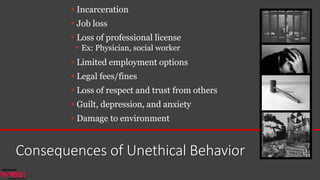
Consequences of Unethical Behavior
 Incarceration
 Job loss
 Loss of professional license
 Ex: Physician, social worker
 Limited employment options
 Legal fees/fines
 Loss of respect and trust from others
 Guilt, depression, and anxiety
 Damage to environment
“Individuals do not become professionals
because of some sudden leap that they make
into the stratosphere. Individuals become
professionals because of their lifetime
dedication and commitment to higher
standards and ideals, honorable values,
and continuous self-improvement.”
Jim Ball, Professionalism is for Everyone
We hope you found this information helpful.
Check us out at www.miworksmo.org.
 Give us any
questions/comments/concerns
 See our workshop schedule
 Learn more about Michigan Works!
Muskegon-Oceana
Like what
you saw?
 Professionalism in the Workplace 2012
 Speedupcareer.com; Professionalism at Work
 “Professionalism in the Workplace”; Centennial College
 “10 Ways to Be Professional at Work”; The Monster Career Coach, career-advice.monster.com
 “What Are Good Work Ethics?”; Roslyn Frenz, eHow Contributor, eHow.com
 “Professionalism & Workplace Savvy”; Eric Feigenbaum, Demand Media, Small Business – Chron. Com
 “Topics of Professionalism in the Workplace”; Rose Johnson, Demand Media, Small Business – Chron.com
 “Tips for Professionalism in the Workplace”; Mary Beth Magee, eHow Contributor, eHow.com
 Job Retention Instructor Guide: Goodwill Works Curriculum. Goodwill Industries International, 2009.
 Job Retention Participant Guide: Goodwill Works Curriculum. Goodwill Industries International, 2009.
 “Job Retention Workshop.” Careerlinkhighvalley.org.
 “Job Success: Time Management.” GCFlearnfree.org. 1998-2011. Goodwill Community
Foundation. MARO
 “Time Management.” Cpehr.com. 2011. California Human Resources HR Outsourcing. CPEhr.
 “Tips for Professional Success: Developing Professionalism Through Your AmeriCorps Experience.”
America Reads – Mississippi. Team Leader Training. 22 Feb. 2006.
 Whitmore, Amanda. From Temp to Hire. Muskegon, MI: GoodTemps Temporary Staffing Agency
(A Wholly Owned Subsidiary of Goodwill Industries of West Michigan), 2011.
Sources

Professionalism & Work Ethic

  • 1.
    Professionalism & WorkEthic TIPS FOR SUCCESS IN THE WORKPLACE Sponsored in part by the Workforce Development Agency, State of Michigan, Michigan Works!, through your local Workforce Development Board and Muskegon County Board of Commissioners. Auxiliary aids and services are available upon request to individuals with disabilities EEO/ADA/Employer/Programs - TTY# - 711.
  • 2.
    Professionalism is a determinedeffort by everyone in the workplace to give their best each and every day.
  • 3.
    “Businesses of all sizesrely on credibility, confidence and reputation to survive, and their people are part of that impression.” Professionalism & Workplace Savvy by Erica Feigenbaum, Demand Media
  • 4.
    Path to Professionalism Punctuality and Attendance  Communication  Presentation and Appearance  Competence and Initiative  Respect
  • 5.
  • 6.
    “80% of successin life is just showing up.” - Woody Allen  One of the most important qualities an employee can display is dependability  The main factor in being dependable is attendance  Attendance is usually the top priority when it comes to an employee's performance and is necessary for continued professional growth
  • 7.
    Problems of PoorAttendance Company Drop in productivity Staff Extra work for others Financial Cost of temporary replacement When one staff member has consistently poor attendance, it affects all areas of their business:
  • 8.
    Punctuality If you arrive5 minutes late and leave 5 minutes early every day, you have stolen 30 hours of work time from your employer in one year.
  • 9.
    Punctuality Tips  Beat your workstation when the business day starts.  Be clear on time allotted for lunch and breaks.  Don’t pack up until the work day is over.
  • 10.
  • 11.
    Oral Communication  Beclear and concise  Think before you speak  Be positive instead of negative  Reflect on your conversations  Ask open ended questions:  How, what, why
  • 12.
    Written Communication Writing inthe A-B-C format:  Accurate  Brief  Clear
  • 13.
    21st Century Communication Use proper grammar  Carefully proofread, edit, spell-check  Rethink your response before you send  Don’t use email if the subject needs a face-to-face conversation
  • 14.
    Nonverbal Communication  Eyecontact  Facial expression  Personal space  Appearance  Posture  Gestures  Voice tone/inflection  Timing
  • 15.
    Communication Don’ts  Gossip Flirt  Discuss politics, religion, or personal problems  Complain about your job, coworkers, or supervisor  Criticize or insult your coworkers or supervisor
  • 16.
    “Attitude is alittle thing that makes a big difference.” Winston Churchill Attitude
  • 17.
    Attitude  Be positive Show enthusiasm  Pick your battles  Be in charge
  • 18.
  • 19.
    Presentation  Perception matters Presentation is equally important as attendance and punctuality  You are only given a very short time to make a first impression
  • 20.
    Appearance  Professional  Neat,clean  Well-groomed  Proper hygiene  Company dress code  Health and safety standards
  • 21.
    Your appearance isa reflection of the company or organization you work for. Appearance
  • 22.
  • 23.
    Competence  Perform jobduties in an efficient and proficient manner  Possess the skills and knowledge to do the job well  Be a “paid expert”  Keep skills current
  • 24.
    Initiative  Do whatneeds to be done without being told  Complete all job duties promptly and professionally  Take action and ownership  Help others or take on extra projects when possible
  • 25.
    Initiative Use critical thinkingand problem solving skills:  Ask what the problem is  Analyze it  Explore all possible solutions  List solutions from best to worst  Select the best solution  Evaluate the solution
  • 26.
    Rewards of takingInitiative  Knowledge of your company and the market it serves  Increased value as an employee  Enhanced independence  More career advancement opportunities  A more meaningful and fulfilling work experience
  • 27.
  • 28.
    Respect is the foundationof workplace success with managers, coworkers, and customers  Consideration for self and others  Value of people’s differences  Understanding conflicting points of view
  • 29.
    Respectful Workplace Behaviors Get to know your coworkers  Be courteous  Encourage coworkers to express opinions and ideas  Listen to other’s viewpoints  Ask for advice and help  Be honest  Use integrity  Steer clear of gossip  Avoid getting into fights and arguments  Follow workplace standards  Be a source of positivity and encouragement  Share credit when deserved
  • 30.
  • 31.
    Work Ethics RESPONSIBILITY  Howyou work  Amount of work done  Punctuality  Best effort  Responsibility for results QUALITY  More than the bare minimum  Produce great work
  • 32.
    Work Ethics DISCIPLINE  Commitment Dedication TEAMWORK  Work together  Respect each other  Collaborate
  • 33.
    Consequences of UnethicalBehavior  Incarceration  Job loss  Loss of professional license  Ex: Physician, social worker  Limited employment options  Legal fees/fines  Loss of respect and trust from others  Guilt, depression, and anxiety  Damage to environment
  • 34.
    “Individuals do notbecome professionals because of some sudden leap that they make into the stratosphere. Individuals become professionals because of their lifetime dedication and commitment to higher standards and ideals, honorable values, and continuous self-improvement.” Jim Ball, Professionalism is for Everyone
  • 35.
    We hope youfound this information helpful. Check us out at www.miworksmo.org.  Give us any questions/comments/concerns  See our workshop schedule  Learn more about Michigan Works! Muskegon-Oceana Like what you saw?
  • 36.
     Professionalism inthe Workplace 2012  Speedupcareer.com; Professionalism at Work  “Professionalism in the Workplace”; Centennial College  “10 Ways to Be Professional at Work”; The Monster Career Coach, career-advice.monster.com  “What Are Good Work Ethics?”; Roslyn Frenz, eHow Contributor, eHow.com  “Professionalism & Workplace Savvy”; Eric Feigenbaum, Demand Media, Small Business – Chron. Com  “Topics of Professionalism in the Workplace”; Rose Johnson, Demand Media, Small Business – Chron.com  “Tips for Professionalism in the Workplace”; Mary Beth Magee, eHow Contributor, eHow.com  Job Retention Instructor Guide: Goodwill Works Curriculum. Goodwill Industries International, 2009.  Job Retention Participant Guide: Goodwill Works Curriculum. Goodwill Industries International, 2009.  “Job Retention Workshop.” Careerlinkhighvalley.org.  “Job Success: Time Management.” GCFlearnfree.org. 1998-2011. Goodwill Community Foundation. MARO  “Time Management.” Cpehr.com. 2011. California Human Resources HR Outsourcing. CPEhr.  “Tips for Professional Success: Developing Professionalism Through Your AmeriCorps Experience.” America Reads – Mississippi. Team Leader Training. 22 Feb. 2006.  Whitmore, Amanda. From Temp to Hire. Muskegon, MI: GoodTemps Temporary Staffing Agency (A Wholly Owned Subsidiary of Goodwill Industries of West Michigan), 2011. Sources