Matching Exercise Jered Borup & Ben McMurry January 28, 2010
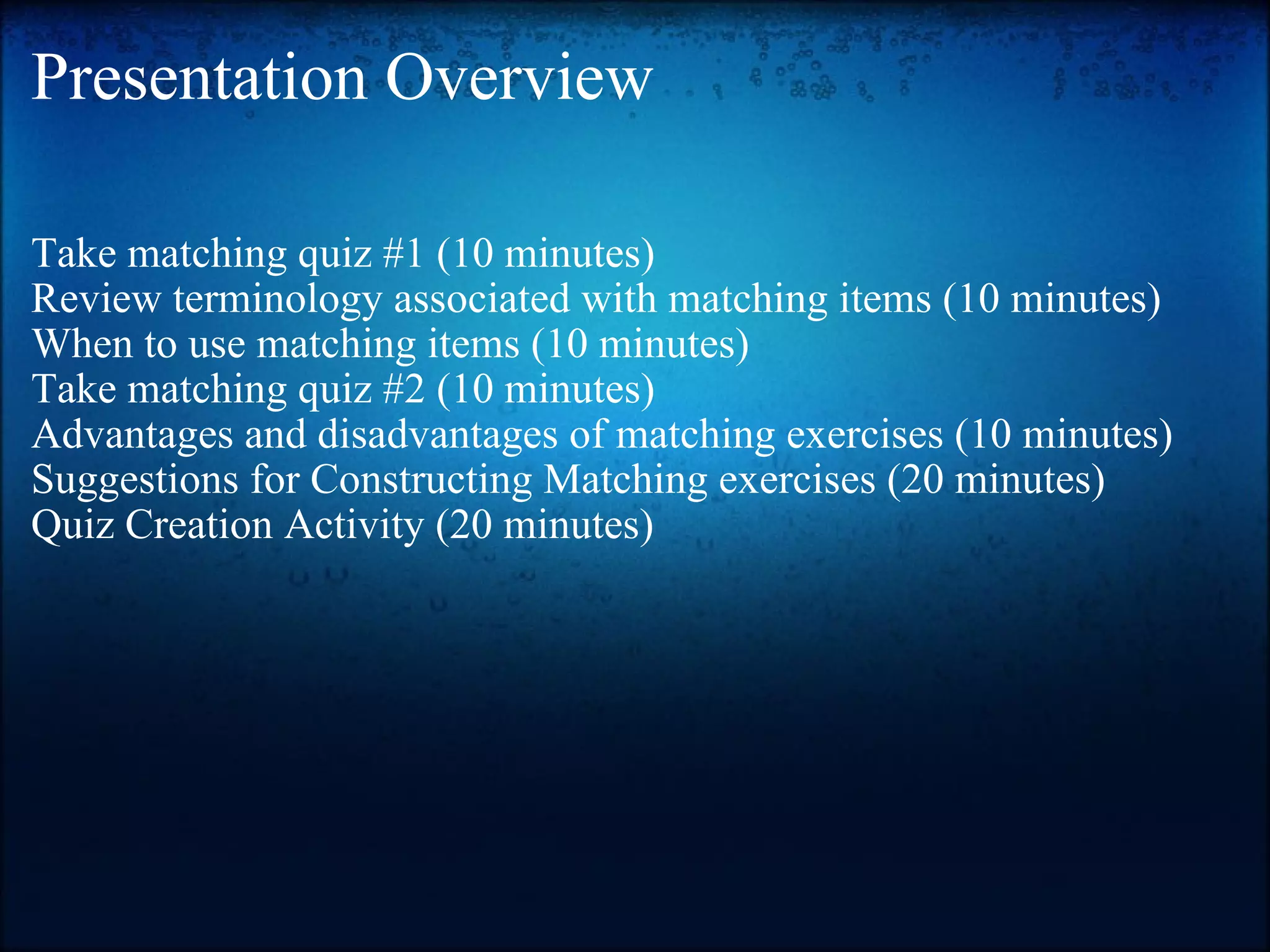
Presentation Overview Take matching quiz #1 (10 minutes) Review terminology associated with matching items (10 minutes) When to use matching items (10 minutes) Take matching quiz #2 (10 minutes) Advantages and disadvantages of matching exercises (10 minutes) Suggestions for Constructing Matching exercises (20 minutes) Quiz Creation Activity (20 minutes)
Sample Matching Exercise 10 minutes
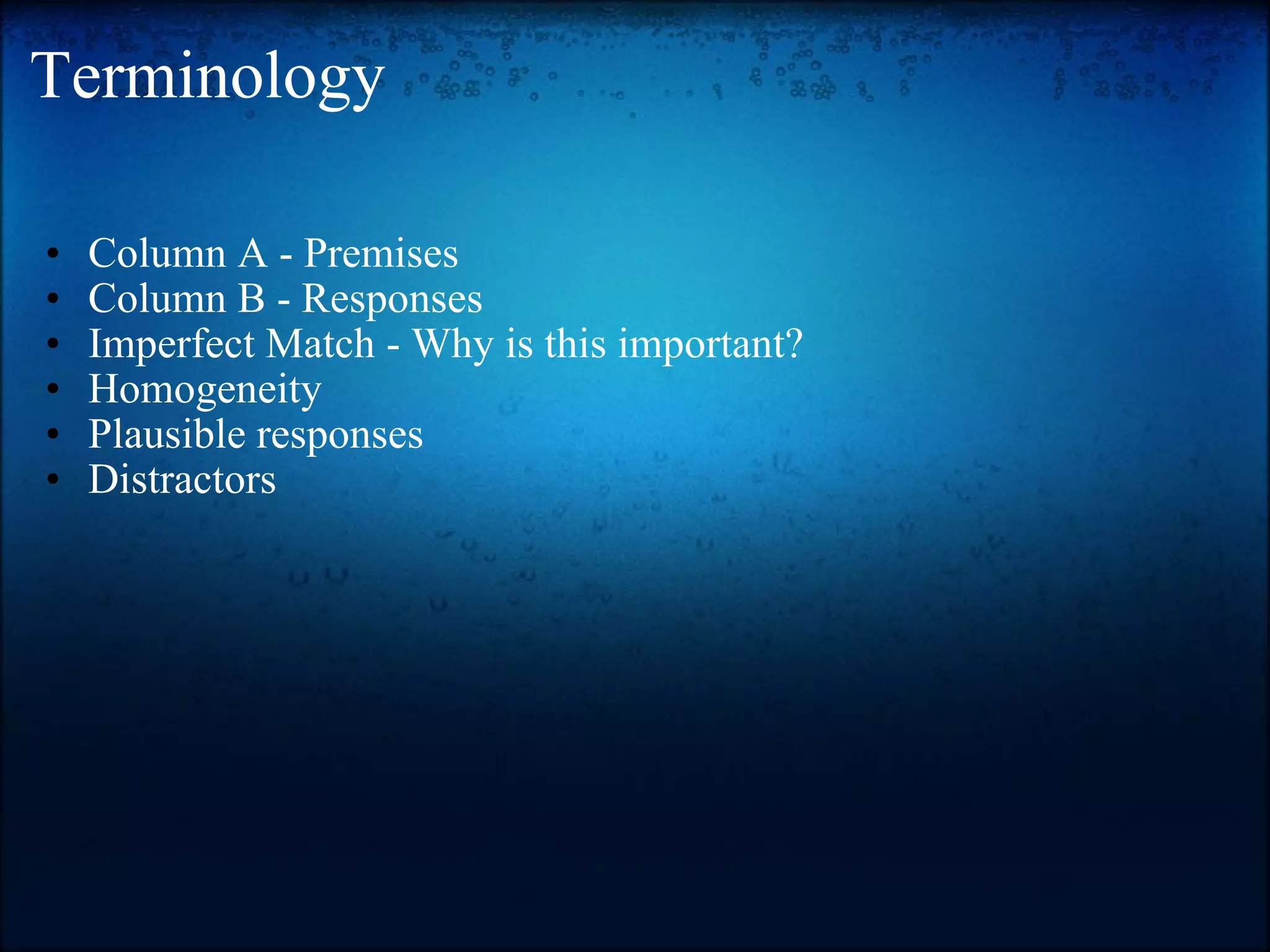
Terminology Column A - Premises Column B - Responses Imperfect Match - Why is this important? Homogeneity Plausible responses Distractors
When to use matching exercises In small groups, make a list of possible relationships that may be tested with matching exercises. (2 minutes) Persons Dates Terms Rules Symbols Authors Foreign Words Machines Plants or Animals Objects Parts
When to use matching exercises Persons Dates Terms Rules Symbols Authors Foreign Words Machines Plants or Animals Objects Parts Achievements Historical Events Definitions Examples Concepts Titles of Books English Equivalents Uses Classification Names of Objects Functions
What part of Bloom's Revised Taxonomy do these assess?   
Advantages & Limitations In small groups, make a list of advantages and one of limitations for matching exercises. (2 minutes) Advantages compact form possible to measure a large amount in a short time Ease of construction high degree of skill for quality items Limitations overuse focus on memorization poor-items rapidly constructed more irrelevant clues difficulty in finding homogenous materials less significant items are added to the test
Suggestions for Constructing Matching Exercises In small groups, review the section in the textbook regarding your assigned suggestion. (5 minutes) Be prepared to explain your suggestion to the class. (pgs. 189-191) Use only homogeneous material in a single matching exercise. Include an unequal number of responses and premises and instruct the students that response may be used one, more than once, or not at all. Keep the list of items to be matched brief and place the shorter responses on the right Arrange the list of responses in logical order, place words in alphabetical order, and numbers in sequence. Indicate in the directions the basis for matching the responses and premises. Place all the items for one matching exercise on the same page.
Application . . . . In your group, create a short matching exercise following the suggestions in the book. (5 minutes) In your group, review your quiz using the checklist on page 191. (2 minutes) Give your quiz to Jered (jeredborup@gmail.com) As a class, discuss the experience of making the matching exercise (5 minutes) In your group, take the quizes of your classmates (10 minutes) In your group, critique the matching exercises. (10 minutes) Discuss as a class what you have learned.
www.manythings.org/mq/ /

Ip T 652 Matching Exercise

  • 1.
    Matching Exercise JeredBorup & Ben McMurry January 28, 2010
  • 2.
    Presentation Overview Takematching quiz #1 (10 minutes) Review terminology associated with matching items (10 minutes) When to use matching items (10 minutes) Take matching quiz #2 (10 minutes) Advantages and disadvantages of matching exercises (10 minutes) Suggestions for Constructing Matching exercises (20 minutes) Quiz Creation Activity (20 minutes)
  • 3.
  • 4.
    Terminology Column A- Premises Column B - Responses Imperfect Match - Why is this important? Homogeneity Plausible responses Distractors
  • 5.
    When to usematching exercises In small groups, make a list of possible relationships that may be tested with matching exercises. (2 minutes) Persons Dates Terms Rules Symbols Authors Foreign Words Machines Plants or Animals Objects Parts
  • 6.
    When to usematching exercises Persons Dates Terms Rules Symbols Authors Foreign Words Machines Plants or Animals Objects Parts Achievements Historical Events Definitions Examples Concepts Titles of Books English Equivalents Uses Classification Names of Objects Functions
  • 7.
    What part ofBloom's Revised Taxonomy do these assess?   
  • 8.
    Advantages & LimitationsIn small groups, make a list of advantages and one of limitations for matching exercises. (2 minutes) Advantages compact form possible to measure a large amount in a short time Ease of construction high degree of skill for quality items Limitations overuse focus on memorization poor-items rapidly constructed more irrelevant clues difficulty in finding homogenous materials less significant items are added to the test
  • 9.
    Suggestions for ConstructingMatching Exercises In small groups, review the section in the textbook regarding your assigned suggestion. (5 minutes) Be prepared to explain your suggestion to the class. (pgs. 189-191) Use only homogeneous material in a single matching exercise. Include an unequal number of responses and premises and instruct the students that response may be used one, more than once, or not at all. Keep the list of items to be matched brief and place the shorter responses on the right Arrange the list of responses in logical order, place words in alphabetical order, and numbers in sequence. Indicate in the directions the basis for matching the responses and premises. Place all the items for one matching exercise on the same page.
  • 10.
    Application . .. . In your group, create a short matching exercise following the suggestions in the book. (5 minutes) In your group, review your quiz using the checklist on page 191. (2 minutes) Give your quiz to Jered (jeredborup@gmail.com) As a class, discuss the experience of making the matching exercise (5 minutes) In your group, take the quizes of your classmates (10 minutes) In your group, critique the matching exercises. (10 minutes) Discuss as a class what you have learned.
  • 11.