Assessing Learning Outcomes Week 1B: Role of Assessment Course Number:  IPT 652 Meeting time:  T&TH 2:00 -3:50 pm
Topics For Today  (this week) Role of Assessment More Terms
Purpose of Assessment Why Assess?
Education and Assessment A general purpose of education is to help students achieve a set of intended learning goals Assessment can be an integral part of the educational process
Some Reasons for Assessment The specific purpose of assessment varies  [p.38 ] Placement – Pre-instructional assessment  Diagnostic – assess learner’s needs Formative – during the educational process to help guide instructional activities Summative – determine the extent to which learning objectives were achieved by students. Accountability – for students, teachers and schools Proper use of assessment data can be used to improve the educational process. Improper use ….?
Assessment Adjectives Valid  -  Measures what it is suppose to measure and is used and interpreted properly. Reliable  – consistently measures what it measures. Note the assessment results are reliable not the assessment instrument.
Additional Assessment Terms It is difficult to communicate about Assessment if we don’t have a correct and shared understanding of terms.
Assessment Types (format)  [see 1-8] Standardized  [1-9]   and Performance Standardized test – Professionally made, administered, scored and interpreted in a standard manner. Goal is to make the conditions similar for all those taking the test. Performance Assessments – Authentic situations in which students must perform or accomplish some task which will be assessed.  [1-12]
Question  (choose the best answer)   The best way to get good test results is to  Use tests that are objectively scored to maximize agreement Use subjectively scored assessments to maximize flexibility and completeness. No one really knows
Assessment Issues  (format and scoring) Objective vs Subjective Objective – Fixed choice Cost effective, high reliability, efficient Overemphasize facts and low-level skills, test drive instruction limiting what we teach Subjective – Complex-performance  (authentic) time consuming, less reliable, require expertise/training Test important real-world skills, whole person capability Represent two ends of the testing continuum, best to mix carefully to obtain best results
Assessment Purpose (nature) Maximum vs Typical performance  [1-13] Maximum performance – the best the person can achieve when motivated to obtain highest score possible  (predicts what students is capable of) Typical performance – how the person normally performs or typical behavior.  (concerned with what student will do,  not what they are capable of)
Question  (choose the best answer)   What type of assessment is a portfolio Maximum performance Typical performance
Assessment Purpose (format) Speed vs Power Speed – how well a student performs in a set amount of time.  Power – how the person performs given ample time to accomplish the task  Why would you do this?
Assessment Purpose (interpretation) Norm Referenced vs Criterion Referenced tests Norm Reference – compares result to all others taking the test. (wants to discriminate, compare to others) Criterion Reference – compares performance to a specific expected level. (wants to measure proficiency against a set standard) Look similar but are constructed differently.  [pg 42, 1-10]
Question  (choose the best answer)   NCLB legislation requires states to align test with standards. Which best describes the type of standards use by most states Content standards Performance standards Federal Education Standards All the above
Standards and Testing http://www.education.com/reference/article/Ref_U_Pass_Tests/ http://www.uen.org/core/
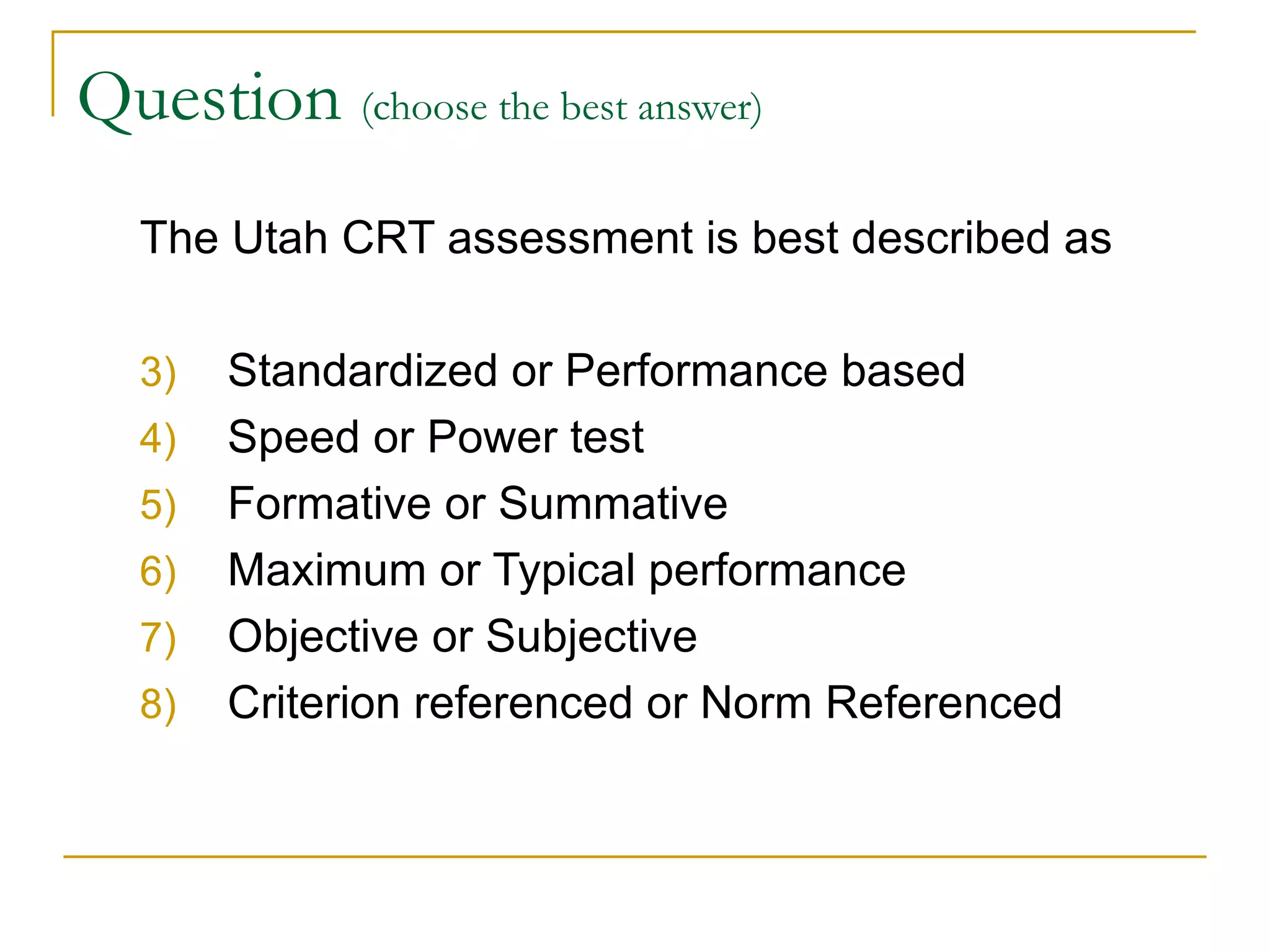
Question  (choose the best answer)   The Utah CRT assessment is best described as Standardized or Performance based Speed or Power test Formative or Summative Maximum or Typical performance Objective or Subjective Criterion referenced or Norm Referenced
Review and Summary Assessment Terms need to be understood Trend for Increased Assessment Reasons for Assessment Vary Assessment is a means to an end not and end in itself.
Summary Measurement and Assessment play an important role in education Used properly, assessment will improve the teaching and learning process Teachers (and others) need to understand both measurement and assessment concepts, benefits, and limitations
Next Week Bloom’s Revised Appendix G 2-7 to 2-22 Chapter 3

Week1 B Assessment Overview

  • 1.
    Assessing Learning OutcomesWeek 1B: Role of Assessment Course Number: IPT 652 Meeting time: T&TH 2:00 -3:50 pm
  • 2.
    Topics For Today (this week) Role of Assessment More Terms
  • 3.
  • 4.
    Education and AssessmentA general purpose of education is to help students achieve a set of intended learning goals Assessment can be an integral part of the educational process
  • 5.
    Some Reasons forAssessment The specific purpose of assessment varies [p.38 ] Placement – Pre-instructional assessment Diagnostic – assess learner’s needs Formative – during the educational process to help guide instructional activities Summative – determine the extent to which learning objectives were achieved by students. Accountability – for students, teachers and schools Proper use of assessment data can be used to improve the educational process. Improper use ….?
  • 6.
    Assessment Adjectives Valid - Measures what it is suppose to measure and is used and interpreted properly. Reliable – consistently measures what it measures. Note the assessment results are reliable not the assessment instrument.
  • 7.
    Additional Assessment TermsIt is difficult to communicate about Assessment if we don’t have a correct and shared understanding of terms.
  • 8.
    Assessment Types (format) [see 1-8] Standardized [1-9] and Performance Standardized test – Professionally made, administered, scored and interpreted in a standard manner. Goal is to make the conditions similar for all those taking the test. Performance Assessments – Authentic situations in which students must perform or accomplish some task which will be assessed. [1-12]
  • 9.
    Question (choosethe best answer) The best way to get good test results is to Use tests that are objectively scored to maximize agreement Use subjectively scored assessments to maximize flexibility and completeness. No one really knows
  • 10.
    Assessment Issues (format and scoring) Objective vs Subjective Objective – Fixed choice Cost effective, high reliability, efficient Overemphasize facts and low-level skills, test drive instruction limiting what we teach Subjective – Complex-performance (authentic) time consuming, less reliable, require expertise/training Test important real-world skills, whole person capability Represent two ends of the testing continuum, best to mix carefully to obtain best results
  • 11.
    Assessment Purpose (nature)Maximum vs Typical performance [1-13] Maximum performance – the best the person can achieve when motivated to obtain highest score possible (predicts what students is capable of) Typical performance – how the person normally performs or typical behavior. (concerned with what student will do, not what they are capable of)
  • 12.
    Question (choosethe best answer) What type of assessment is a portfolio Maximum performance Typical performance
  • 13.
    Assessment Purpose (format)Speed vs Power Speed – how well a student performs in a set amount of time. Power – how the person performs given ample time to accomplish the task Why would you do this?
  • 14.
    Assessment Purpose (interpretation)Norm Referenced vs Criterion Referenced tests Norm Reference – compares result to all others taking the test. (wants to discriminate, compare to others) Criterion Reference – compares performance to a specific expected level. (wants to measure proficiency against a set standard) Look similar but are constructed differently. [pg 42, 1-10]
  • 15.
    Question (choosethe best answer) NCLB legislation requires states to align test with standards. Which best describes the type of standards use by most states Content standards Performance standards Federal Education Standards All the above
  • 16.
    Standards and Testinghttp://www.education.com/reference/article/Ref_U_Pass_Tests/ http://www.uen.org/core/
  • 17.
    Question (choosethe best answer) The Utah CRT assessment is best described as Standardized or Performance based Speed or Power test Formative or Summative Maximum or Typical performance Objective or Subjective Criterion referenced or Norm Referenced
  • 18.
    Review and SummaryAssessment Terms need to be understood Trend for Increased Assessment Reasons for Assessment Vary Assessment is a means to an end not and end in itself.
  • 19.
    Summary Measurement andAssessment play an important role in education Used properly, assessment will improve the teaching and learning process Teachers (and others) need to understand both measurement and assessment concepts, benefits, and limitations
  • 20.
    Next Week Bloom’sRevised Appendix G 2-7 to 2-22 Chapter 3