



Extension and Engagement for the21stCentury Land Grant InstitutionThe Logic Model and the Scholarship of Engagement Steven E. Newman, Ph.D., A.A.F.Greenhouse Crops Extension Specialistand Professor of Floriculture
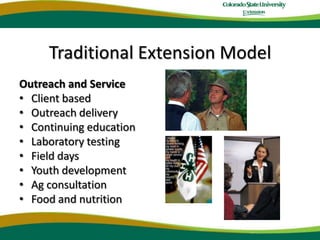
Traditional Extension ModelOutreach and ServiceClient basedOutreach deliveryContinuing educationLaboratory testingField daysYouth developmentAg consultationFood and nutrition
The Scholarship of EngagementWhat is the scholarship of engagement?Is it service?Service is often seen as somehow outside the "real" work of scholars.
The Scholarship of EngagementWhat is the scholarship of engagement?Is it service?Service is often seen as somehow outside the "real" work of scholars. Faculty members can extend their intellectual curiosity into their service activities bringing together their teaching, research, and service in a synergistic way, to the benefit of each aspect of their work and the benefit of those with whom they work.
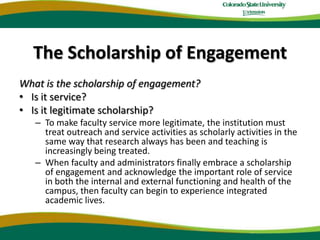
The Scholarship of EngagementWhat is the scholarship of engagement?Is it service?Is it legitimate scholarship?
The Scholarship of EngagementWhat is the scholarship of engagement?Is it service?Is it legitimate scholarship?To make faculty service more legitimate, the institution must treat outreach and service activities as scholarly activities in the same way that research always has been and teaching is increasingly being treated. When faculty and administrators finally embrace a scholarship of engagement and acknowledge the important role of service in both the internal and external functioning and health of the campus, then faculty can begin to experience integrated academic lives.
The Scholarship of EngagementEngagement provides a conduit of information to flow from units not normally considered part of the outreach mission of an institution.This must include:StakeholdersConsumersAll facultyStudents
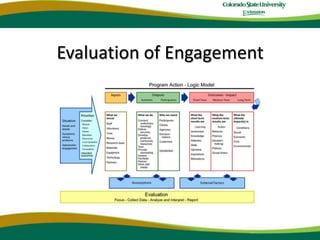
Evaluation of Engagement
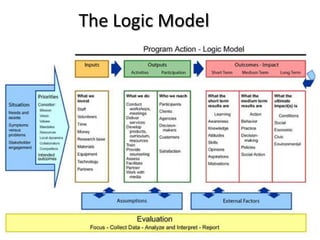
The Logic Model
The Logic ModelFive Components:Resources or inputsProgram activitiesOutputsOutcomesImpacts
A logic model is…A depiction of a program showing what the program will do and what it is to accomplish.A series of “if-then” relationships that, if implemented as intended, lead to the desired outcomes The core of program planning and evaluationUniversity of Wisconsin-Extension, Program Development and Evaluation
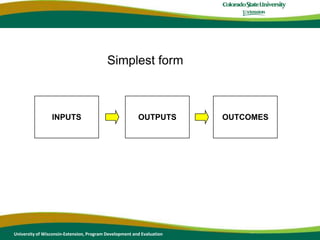
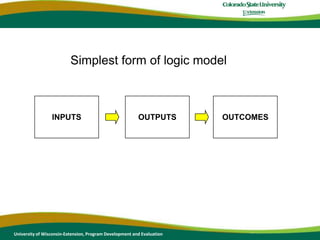
Simplest formINPUTSOUTPUTSOUTCOMESUniversity of Wisconsin-Extension, Program Development and Evaluation
Logic models can be applied to: a small program, a process (i.e. a team working together), a large, multi-component program, or even to an organization or business. University of Wisconsin-Extension, Program Development and Evaluation
LOGICthe principles of reasoningreasonablethe relationship of elements to each other and a wholeMODELsmall object representing another, often larger object (represents reality, isn’t reality) preliminary pattern serving as a plantentative description of a system or theory that accounts for all its known propertiesThe American Heritage Dictionary, 2nd EdUniversity of Wisconsin-Extension, Program Development and Evaluation
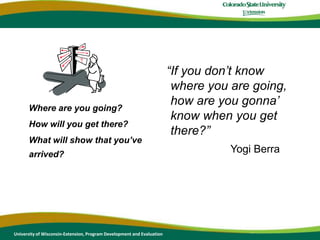
“If you don’t know where you are going, how are you gonna’ know when you get there?”Yogi BerraWhere are you going? How will you get there?What will show that you’ve arrived?University of Wisconsin-Extension, Program Development and Evaluation
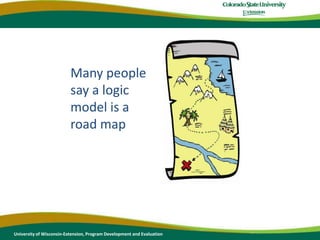
Many people say a logic model is a road mapUniversity of Wisconsin-Extension, Program Development and Evaluation
Logic model may also be called…Theory of changeProgram actionModel of changeConceptual mapOutcome mapProgram logicUniversity of Wisconsin-Extension, Program Development and Evaluation
What gets measured gets doneIf you don’t measure results, you can’t tell success from failureIf you can’t see success, you can’t reward itIf you can’t reward success, you’re probably rewarding failureIf you can’t see success, you can’t learn from itIf you can’t recognize failure, you can’t correct it.If you can demonstrate results, you can win public support.Reinventing Government, Osborne and Gaebler, 1992Accountability eraUniversity of Wisconsin-Extension, Program Development and Evaluation
What logic model is not…A theoryRealityAn evaluation model or methodIt is a framework for describing the relationships between investments, activities, and results.  It provides a common approach for integrating planning, implementation, evaluation and reporting.University of Wisconsin-Extension, Program Development and Evaluation
A bit of historyDates to late 1960’sCurrent accountability demands; logic model in widespread usePublic Sector - GPRANon-Profit Sector Private SectorInternational Agencies EvaluationUniversity of Wisconsin-Extension, Program Development and Evaluation
Why the hype?  What’s the benefit?    Focus on and be accountable for what matters – OUTCOMESProvides common languageMakes assumptions EXPLICITSupports continuous improvement Promotes communicationsUniversity of Wisconsin-Extension, Program Development and Evaluation
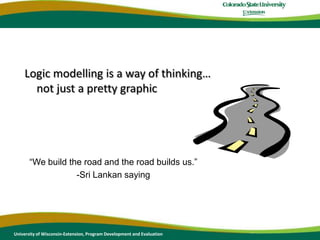
Logic modelling is a way of thinking…not just a pretty graphic“We build the road and the road builds us.”-Sri Lankan sayingUniversity of Wisconsin-Extension, Program Development and Evaluation
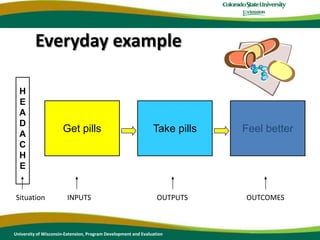
Everyday exampleHEADACHEFeel betterGetpillsTakepillsSituationINPUTSOUTPUTSOUTCOMESUniversity of Wisconsin-Extension, Program Development and Evaluation
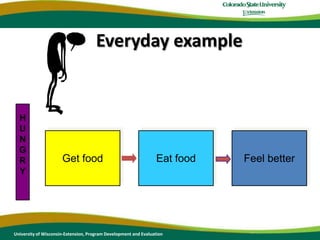
Everyday exampleHUNGRYFeel betterGetfoodEat food University of Wisconsin-Extension, Program Development and Evaluation
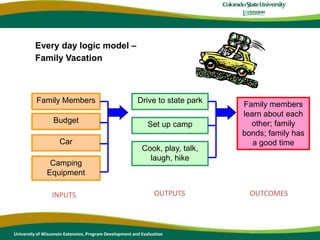
Every day logic model –Family VacationFamily MembersDrive to state parkFamily members learn about each other; family bonds; family has a good timeBudgetSet up campCarCook, play, talk, laugh, hikeCamping EquipmentOUTPUTSOUTCOMESINPUTSUniversity of Wisconsin-Extension, Program Development and Evaluation
AssumptionsAssumptions underlie much of what we do.  It is often these underlying assumptions that hinder success or produce less-than-expected results. One benefit of logic modeling is that it helps us make our assumptions explicit.University of Wisconsin-Extension, Program Development and Evaluation
AssumptionsThe beliefs we have about the program, the participants, and how the program will work. Includes ideas about:the problem or existing situationprogram operationsexpected outcomes and benefitsthe participants and how they learn, behave, their motivationsresourcesstaff external environment: influencesthe knowledge baseetc.University of Wisconsin-Extension, Program Development and Evaluation
AssumptionsAs you left the house today and came to this workshop, what were some of your assumptions about the day? Why is it important that we think about assumptions?University of Wisconsin-Extension, Program Development and Evaluation
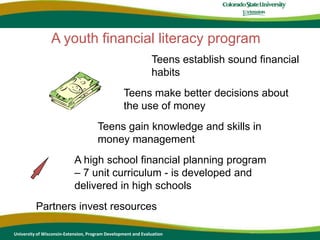
A youth financial literacy program Teens establish sound financial habits Teens make better decisions about the use of moneyTeens gain knowledge and skills in money managementA high school financial planning program – 7 unit curriculum - is developed and delivered in high schools Partners invest resources University of Wisconsin-Extension, Program Development and Evaluation
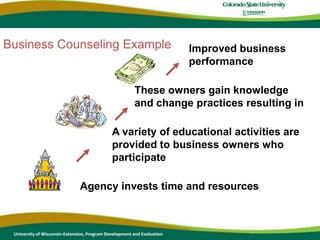
Business Counseling ExampleImproved business performanceThese owners gain knowledge and change practices resulting in A variety of educational activities are provided to business owners who participateAgency invests time and resourcesUniversity of Wisconsin-Extension, Program Development and Evaluation
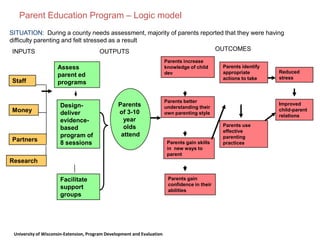
Parent Education Program – Logic modelSITUATION:  During a county needs assessment, majority of parents reported that they were having difficulty parenting and felt stressed as a resultOUTCOMESINPUTSOUTPUTSParents increase knowledge of child devAssess parent ed programsParents identify appropriate actions to takeReduced stressStaffParents of 3-10 year olds attendParents better understanding their own parenting style Improved child-parent relationsDesign- deliver evidence-based program of 8 sessionsMoneyParents use effective parenting practicesPartnersParents gain skills in  new ways to parentResearchFacilitate support groupsParents gain confidence in their abilities University of Wisconsin-Extension, Program Development and Evaluation
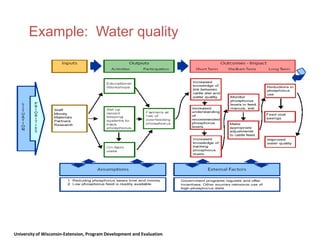
Example:  Water qualityUniversity of Wisconsin-Extension, Program Development and Evaluation
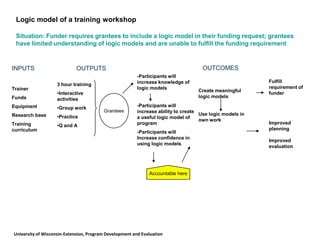
Logic model of a training workshopSituation: Funder requires grantees to include a logic model in their funding request; grantees have limited understanding of logic models and are unable to fulfill the funding requirement  OUTCOMES-Participants will increase knowledge of logic models-Participants will increase ability to create a useful logic model of program -Participants will Increase confidence in using logic modelsINPUTSOUTPUTSFulfill requirement of funderCreate meaningful logic modelsUse logic models in own work3 hour trainingInteractive activities
Group work
Practice
Q and ATrainerFundsEquipmentResearch baseTraining curriculumGranteesImproved planning Improved evaluationAccountable hereUniversity of Wisconsin-Extension, Program Development and Evaluation
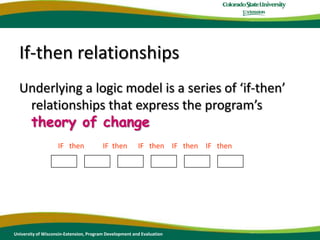
If-then relationshipsUnderlying a logic model is a series of ‘if-then’ relationships that express the program’s theory of changeIF   thenIF  thenIF   thenIF   thenIF   thenUniversity of Wisconsin-Extension, Program Development and Evaluation
Theory of change“A theory of change is a description of how and why a set of activities – be they part of a highly focused program or a comprehensive initiative – are expected to lead to early, intermediate, and long-term outcomes over a specified period.”					(Anderson, 2000)University of Wisconsin-Extension, Program Development and Evaluation
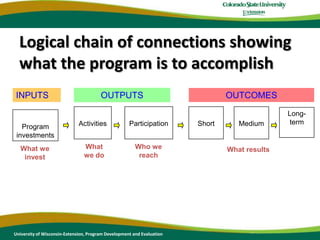
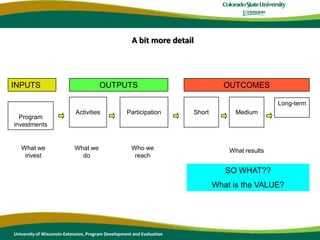
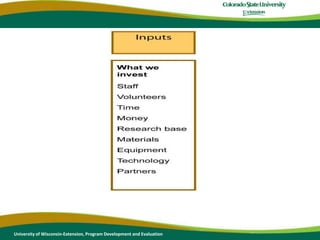
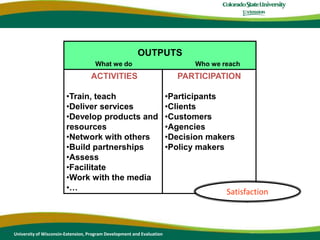
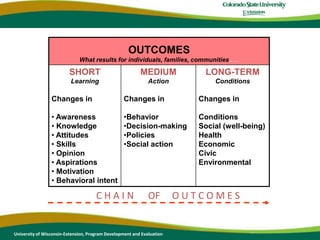
Logical chain of connections showing what the program is to accomplishINPUTSOUTPUTSOUTCOMESActivitiesParticipationShortMediumLong-termProgram investmentsWhat we doWho we reachWhat we investWhat resultsUniversity of Wisconsin-Extension, Program Development and Evaluation
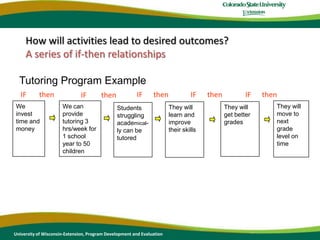
How will activities lead to desired outcomes? A series of if-then relationships Tutoring Program ExampleIF       thenIF      thenIF      thenIF      thenIF        thenThey will move to next grade level on timeWe invest time and moneyWe can provide tutoring 3 hrs/week for 1 school year to 50 childrenThey will get better gradesThey will learn and improve their skillsStudents struggling academical-ly can be tutoredUniversity of Wisconsin-Extension, Program Development and Evaluation
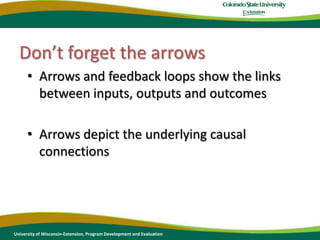
Don’t forget the arrowsArrows and feedback loops show the links between inputs, outputs and outcomesArrows depict the underlying causal connectionsUniversity of Wisconsin-Extension, Program Development and Evaluation
Simplest form of logic modelINPUTSOUTPUTSOUTCOMESUniversity of Wisconsin-Extension, Program Development and Evaluation
A bit more detailINPUTSOUTPUTSOUTCOMESActivitiesParticipationShortMediumLong-termProgram investmentsWhat we investWhat we doWho we reachWhat resultsSO WHAT??What is the VALUE?University of Wisconsin-Extension, Program Development and Evaluation
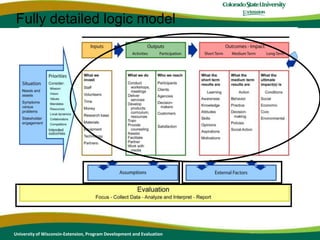
Fully detailed logic modelUniversity of Wisconsin-Extension, Program Development and Evaluation
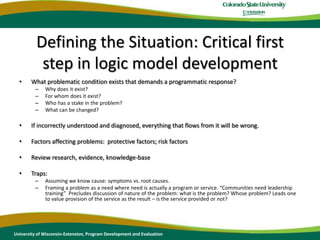
Defining the Situation: Critical first step in logic model developmentWhat problematic condition exists that demands a programmatic response?Why does it exist? For whom does it exist? Who has a stake in the problem?  What can be changed?If incorrectly understood and diagnosed, everything that flows from it will be wrong. Factors affecting problems:  protective factors; risk factorsReview research, evidence, knowledge-baseTraps:  Assuming we know cause: symptoms vs. root causes.Framing a problem as a need where need is actually a program or service. “Communities need leadership training”  Precludes discussion of nature of the problem: what is the problem? Whose problem? Leads one to value provision of the service as the result – is the service provided or not?University of Wisconsin-Extension, Program Development and Evaluation
University of Wisconsin-Extension, Program Development and Evaluation
SatisfactionUniversity of Wisconsin-Extension, Program Development and Evaluation
C H A I N      OF     O U T C O M E S University of Wisconsin-Extension, Program Development and Evaluation
Tend not be included in a logic model graphic:Situational statementPrioritiesList of assumptionsList of external factorsEvaluation methodsUniversity of Wisconsin-Extension, Program Development and Evaluation
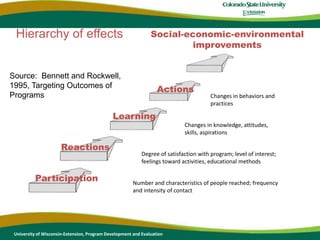
ActionsChanges in behaviors and practicesLearningChanges in knowledge, attitudes, skills, aspirationsReactionsDegree of satisfaction with program; level of interest; feelings toward activities, educational methods ParticipationNumber and characteristics of people reached; frequency and intensity of contactHierarchy of effectsSocial-economic-environmental improvementsSource:  Bennett and Rockwell, 1995, Targeting Outcomes of ProgramsUniversity of Wisconsin-Extension, Program Development and Evaluation
Language:  What do you mean by…Goal = ImpactImpact = Long-term outcomeObjectives (participant focused) = OutcomesActivities = OutputsOutputs may signify “tangible” accomplishments as a result of activities; productsUniversity of Wisconsin-Extension, Program Development and Evaluation
Goal – outcome definitionGoal represents a general, big-picture statement of desired results.  “We find that it is useful to think of goals as the answer to the question ‘What are issues that you would like the program to address?’ (e.g., the goal of the program is to address existing community laws and norms about ATOD use) and outcomes as the answer to: ‘What changes do you want to occur because of your program?’ (e.g., the outcome of the program will be to increase the number of community residents who believe teenaged smoking is dangerous).”					(Western CAPT)University of Wisconsin-Extension, Program Development and Evaluation
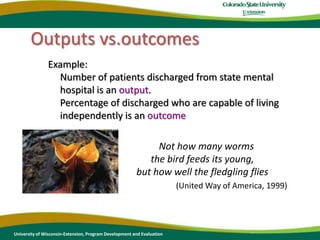
Outputs vs.outcomesExample:  Number of patients discharged from state mental hospital is an output.  Percentage of discharged who are capable of living independently is an outcome		Not how many worms the bird feeds its young, but how well the fledgling flies			(United Way of America, 1999)University of Wisconsin-Extension, Program Development and Evaluation
Logic Model…Represents intention, is not realityFocuses on expected outcomesChallenge of causal attributionMany factors influence process and outcomesDoesn’t address:  Are we doing the right thing?LimitationsUniversity of Wisconsin-Extension, Program Development and Evaluation
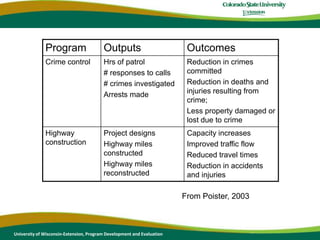
From Poister, 2003University of Wisconsin-Extension, Program Development and Evaluation
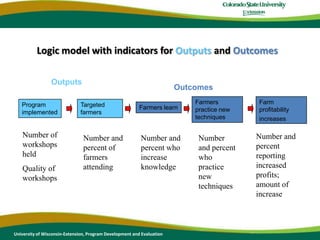
Logic model with indicators for Outputs and OutcomesOutputsOutcomesFarmers practice new techniquesFarm profitability increasesProgram implementedTargeted farmersFarmers learnNumber of workshops heldQuality of workshopsNumber and percent reporting increased profits; amount of increase Number and percent of farmers attendingNumber and percent who increase knowledgeNumber and percent who practice new techniquesUniversity of Wisconsin-Extension, Program Development and Evaluation
Typical activity indicators to trackAmount of products, services delivered#/type of customers/clients servedTimeliness of service provisionAccessibility and convenience of serviceLocation;  hours of operation; staff availabilityAccuracy, adequacy, relevance of assistanceCourteousnessCustomer satisfaction# of clients served# of consultations# of workshops held# of attendees# of referralsQuality of serviceUniversity of Wisconsin-Extension, Program Development and Evaluation
Methods of data collection SOURCES OF INFORMATIONExisting dataProgram records, attendance logs, etcPictures, charts, maps, pictorial recordsProgram participantsOthers:  key informants, nonparticipants, proponents, critics, staff, collaborators, funders, etc.DATA COLLECTION METHODSSurveyInterviewTestObservationGroup techniquesCase studyPhotographyDocument reviewExpert or peer reviewUniversity of Wisconsin-Extension, Program Development and Evaluation
EngagementEngagement is the partnership of university knowledge and resources with those of the public and private sectors to enrich scholarship, research, and creative activity; enhance curriculum, teaching and learning; prepare educated, engaged citizens; strengthen democratic values and civic responsibility; address critical societal issues; and contribute to the public good.
Benchmarks of EngagementEvidence of Institutional Commitment to EngagementEvidence of Institutional Resource Commitments to EngagementEvidence that Students are Involved in Engagement and Outreach ActivitiesEvidence that Faculty and Staff are Engaged with External Constituents
Benchmarks of EngagementEvidence that Institutions are Engaged with their CommunitiesEvidence of Assessing the Impact and Outcomes of EngagementEvidence of Resource/Revenue Opportunities Generated through Engagement
Assessment of EngagementFaculty EvaluationClear goals
Assessment of EngagementFaculty EvaluationClear goalsAdequate preparation
Assessment of EngagementFaculty EvaluationClear goalsAdequate preparationAppropriate methods
Assessment of EngagementFaculty EvaluationClear goalsAdequate preparationAppropriate methodsSignificant results
Assessment of EngagementFaculty EvaluationClear goalsAdequate preparationAppropriate methodsSignificant resultsEffective presentation
Assessment of EngagementFaculty EvaluationClear goalsAdequate preparationAppropriate methodsSignificant resultsEffective presentationReflective critique
What is required of you?Background of significant scholarship
What is required of you?Background of significant scholarshipDiagnostic skills

CSU Extension, Engagement and the Logic model

  • 1.
    Extension and Engagementfor the21stCentury Land Grant InstitutionThe Logic Model and the Scholarship of Engagement Steven E. Newman, Ph.D., A.A.F.Greenhouse Crops Extension Specialistand Professor of Floriculture
  • 2.
    Traditional Extension ModelOutreachand ServiceClient basedOutreach deliveryContinuing educationLaboratory testingField daysYouth developmentAg consultationFood and nutrition
  • 3.
    The Scholarship ofEngagementWhat is the scholarship of engagement?Is it service?Service is often seen as somehow outside the "real" work of scholars.
  • 4.
    The Scholarship ofEngagementWhat is the scholarship of engagement?Is it service?Service is often seen as somehow outside the "real" work of scholars. Faculty members can extend their intellectual curiosity into their service activities bringing together their teaching, research, and service in a synergistic way, to the benefit of each aspect of their work and the benefit of those with whom they work.
  • 5.
    The Scholarship ofEngagementWhat is the scholarship of engagement?Is it service?Is it legitimate scholarship?
  • 6.
    The Scholarship ofEngagementWhat is the scholarship of engagement?Is it service?Is it legitimate scholarship?To make faculty service more legitimate, the institution must treat outreach and service activities as scholarly activities in the same way that research always has been and teaching is increasingly being treated. When faculty and administrators finally embrace a scholarship of engagement and acknowledge the important role of service in both the internal and external functioning and health of the campus, then faculty can begin to experience integrated academic lives.
  • 7.
    The Scholarship ofEngagementEngagement provides a conduit of information to flow from units not normally considered part of the outreach mission of an institution.This must include:StakeholdersConsumersAll facultyStudents
  • 8.
  • 9.
  • 10.
    The Logic ModelFiveComponents:Resources or inputsProgram activitiesOutputsOutcomesImpacts
  • 11.
    A logic modelis…A depiction of a program showing what the program will do and what it is to accomplish.A series of “if-then” relationships that, if implemented as intended, lead to the desired outcomes The core of program planning and evaluationUniversity of Wisconsin-Extension, Program Development and Evaluation
  • 12.
    Simplest formINPUTSOUTPUTSOUTCOMESUniversity ofWisconsin-Extension, Program Development and Evaluation
  • 13.
    Logic models canbe applied to: a small program, a process (i.e. a team working together), a large, multi-component program, or even to an organization or business. University of Wisconsin-Extension, Program Development and Evaluation
  • 14.
    LOGICthe principles ofreasoningreasonablethe relationship of elements to each other and a wholeMODELsmall object representing another, often larger object (represents reality, isn’t reality) preliminary pattern serving as a plantentative description of a system or theory that accounts for all its known propertiesThe American Heritage Dictionary, 2nd EdUniversity of Wisconsin-Extension, Program Development and Evaluation
  • 15.
    “If you don’tknow where you are going, how are you gonna’ know when you get there?”Yogi BerraWhere are you going? How will you get there?What will show that you’ve arrived?University of Wisconsin-Extension, Program Development and Evaluation
  • 16.
    Many people saya logic model is a road mapUniversity of Wisconsin-Extension, Program Development and Evaluation
  • 17.
    Logic model mayalso be called…Theory of changeProgram actionModel of changeConceptual mapOutcome mapProgram logicUniversity of Wisconsin-Extension, Program Development and Evaluation
  • 18.
    What gets measuredgets doneIf you don’t measure results, you can’t tell success from failureIf you can’t see success, you can’t reward itIf you can’t reward success, you’re probably rewarding failureIf you can’t see success, you can’t learn from itIf you can’t recognize failure, you can’t correct it.If you can demonstrate results, you can win public support.Reinventing Government, Osborne and Gaebler, 1992Accountability eraUniversity of Wisconsin-Extension, Program Development and Evaluation
  • 19.
    What logic modelis not…A theoryRealityAn evaluation model or methodIt is a framework for describing the relationships between investments, activities, and results. It provides a common approach for integrating planning, implementation, evaluation and reporting.University of Wisconsin-Extension, Program Development and Evaluation
  • 20.
    A bit ofhistoryDates to late 1960’sCurrent accountability demands; logic model in widespread usePublic Sector - GPRANon-Profit Sector Private SectorInternational Agencies EvaluationUniversity of Wisconsin-Extension, Program Development and Evaluation
  • 21.
    Why the hype? What’s the benefit? Focus on and be accountable for what matters – OUTCOMESProvides common languageMakes assumptions EXPLICITSupports continuous improvement Promotes communicationsUniversity of Wisconsin-Extension, Program Development and Evaluation
  • 22.
    Logic modelling isa way of thinking…not just a pretty graphic“We build the road and the road builds us.”-Sri Lankan sayingUniversity of Wisconsin-Extension, Program Development and Evaluation
  • 23.
  • 24.
    Everyday exampleHUNGRYFeel betterGetfoodEatfood University of Wisconsin-Extension, Program Development and Evaluation
  • 25.
    Every day logicmodel –Family VacationFamily MembersDrive to state parkFamily members learn about each other; family bonds; family has a good timeBudgetSet up campCarCook, play, talk, laugh, hikeCamping EquipmentOUTPUTSOUTCOMESINPUTSUniversity of Wisconsin-Extension, Program Development and Evaluation
  • 26.
    AssumptionsAssumptions underlie muchof what we do. It is often these underlying assumptions that hinder success or produce less-than-expected results. One benefit of logic modeling is that it helps us make our assumptions explicit.University of Wisconsin-Extension, Program Development and Evaluation
  • 27.
    AssumptionsThe beliefs wehave about the program, the participants, and how the program will work. Includes ideas about:the problem or existing situationprogram operationsexpected outcomes and benefitsthe participants and how they learn, behave, their motivationsresourcesstaff external environment: influencesthe knowledge baseetc.University of Wisconsin-Extension, Program Development and Evaluation
  • 28.
    AssumptionsAs you leftthe house today and came to this workshop, what were some of your assumptions about the day? Why is it important that we think about assumptions?University of Wisconsin-Extension, Program Development and Evaluation
  • 29.
    A youth financialliteracy program Teens establish sound financial habits Teens make better decisions about the use of moneyTeens gain knowledge and skills in money managementA high school financial planning program – 7 unit curriculum - is developed and delivered in high schools Partners invest resources University of Wisconsin-Extension, Program Development and Evaluation
  • 30.
    Business Counseling ExampleImprovedbusiness performanceThese owners gain knowledge and change practices resulting in A variety of educational activities are provided to business owners who participateAgency invests time and resourcesUniversity of Wisconsin-Extension, Program Development and Evaluation
  • 31.
    Parent Education Program– Logic modelSITUATION: During a county needs assessment, majority of parents reported that they were having difficulty parenting and felt stressed as a resultOUTCOMESINPUTSOUTPUTSParents increase knowledge of child devAssess parent ed programsParents identify appropriate actions to takeReduced stressStaffParents of 3-10 year olds attendParents better understanding their own parenting style Improved child-parent relationsDesign- deliver evidence-based program of 8 sessionsMoneyParents use effective parenting practicesPartnersParents gain skills in new ways to parentResearchFacilitate support groupsParents gain confidence in their abilities University of Wisconsin-Extension, Program Development and Evaluation
  • 32.
    Example: WaterqualityUniversity of Wisconsin-Extension, Program Development and Evaluation
  • 33.
    Logic model ofa training workshopSituation: Funder requires grantees to include a logic model in their funding request; grantees have limited understanding of logic models and are unable to fulfill the funding requirement OUTCOMES-Participants will increase knowledge of logic models-Participants will increase ability to create a useful logic model of program -Participants will Increase confidence in using logic modelsINPUTSOUTPUTSFulfill requirement of funderCreate meaningful logic modelsUse logic models in own work3 hour trainingInteractive activities
  • 34.
  • 35.
  • 36.
    Q and ATrainerFundsEquipmentResearchbaseTraining curriculumGranteesImproved planning Improved evaluationAccountable hereUniversity of Wisconsin-Extension, Program Development and Evaluation
  • 37.
    If-then relationshipsUnderlying alogic model is a series of ‘if-then’ relationships that express the program’s theory of changeIF thenIF thenIF thenIF thenIF thenUniversity of Wisconsin-Extension, Program Development and Evaluation
  • 38.
    Theory of change“Atheory of change is a description of how and why a set of activities – be they part of a highly focused program or a comprehensive initiative – are expected to lead to early, intermediate, and long-term outcomes over a specified period.” (Anderson, 2000)University of Wisconsin-Extension, Program Development and Evaluation
  • 39.
    Logical chain ofconnections showing what the program is to accomplishINPUTSOUTPUTSOUTCOMESActivitiesParticipationShortMediumLong-termProgram investmentsWhat we doWho we reachWhat we investWhat resultsUniversity of Wisconsin-Extension, Program Development and Evaluation
  • 40.
    How will activitieslead to desired outcomes? A series of if-then relationships Tutoring Program ExampleIF thenIF thenIF thenIF thenIF thenThey will move to next grade level on timeWe invest time and moneyWe can provide tutoring 3 hrs/week for 1 school year to 50 childrenThey will get better gradesThey will learn and improve their skillsStudents struggling academical-ly can be tutoredUniversity of Wisconsin-Extension, Program Development and Evaluation
  • 41.
    Don’t forget thearrowsArrows and feedback loops show the links between inputs, outputs and outcomesArrows depict the underlying causal connectionsUniversity of Wisconsin-Extension, Program Development and Evaluation
  • 42.
    Simplest form oflogic modelINPUTSOUTPUTSOUTCOMESUniversity of Wisconsin-Extension, Program Development and Evaluation
  • 43.
    A bit moredetailINPUTSOUTPUTSOUTCOMESActivitiesParticipationShortMediumLong-termProgram investmentsWhat we investWhat we doWho we reachWhat resultsSO WHAT??What is the VALUE?University of Wisconsin-Extension, Program Development and Evaluation
  • 44.
    Fully detailed logicmodelUniversity of Wisconsin-Extension, Program Development and Evaluation
  • 45.
    Defining the Situation:Critical first step in logic model developmentWhat problematic condition exists that demands a programmatic response?Why does it exist? For whom does it exist? Who has a stake in the problem? What can be changed?If incorrectly understood and diagnosed, everything that flows from it will be wrong. Factors affecting problems: protective factors; risk factorsReview research, evidence, knowledge-baseTraps: Assuming we know cause: symptoms vs. root causes.Framing a problem as a need where need is actually a program or service. “Communities need leadership training” Precludes discussion of nature of the problem: what is the problem? Whose problem? Leads one to value provision of the service as the result – is the service provided or not?University of Wisconsin-Extension, Program Development and Evaluation
  • 46.
    University of Wisconsin-Extension,Program Development and Evaluation
  • 47.
    SatisfactionUniversity of Wisconsin-Extension,Program Development and Evaluation
  • 48.
    C H AI N OF O U T C O M E S University of Wisconsin-Extension, Program Development and Evaluation
  • 49.
    Tend not beincluded in a logic model graphic:Situational statementPrioritiesList of assumptionsList of external factorsEvaluation methodsUniversity of Wisconsin-Extension, Program Development and Evaluation
  • 50.
    ActionsChanges in behaviorsand practicesLearningChanges in knowledge, attitudes, skills, aspirationsReactionsDegree of satisfaction with program; level of interest; feelings toward activities, educational methods ParticipationNumber and characteristics of people reached; frequency and intensity of contactHierarchy of effectsSocial-economic-environmental improvementsSource: Bennett and Rockwell, 1995, Targeting Outcomes of ProgramsUniversity of Wisconsin-Extension, Program Development and Evaluation
  • 51.
    Language: Whatdo you mean by…Goal = ImpactImpact = Long-term outcomeObjectives (participant focused) = OutcomesActivities = OutputsOutputs may signify “tangible” accomplishments as a result of activities; productsUniversity of Wisconsin-Extension, Program Development and Evaluation
  • 52.
    Goal – outcomedefinitionGoal represents a general, big-picture statement of desired results. “We find that it is useful to think of goals as the answer to the question ‘What are issues that you would like the program to address?’ (e.g., the goal of the program is to address existing community laws and norms about ATOD use) and outcomes as the answer to: ‘What changes do you want to occur because of your program?’ (e.g., the outcome of the program will be to increase the number of community residents who believe teenaged smoking is dangerous).” (Western CAPT)University of Wisconsin-Extension, Program Development and Evaluation
  • 53.
    Outputs vs.outcomesExample: Number of patients discharged from state mental hospital is an output. Percentage of discharged who are capable of living independently is an outcome Not how many worms the bird feeds its young, but how well the fledgling flies (United Way of America, 1999)University of Wisconsin-Extension, Program Development and Evaluation
  • 54.
    Logic Model…Represents intention,is not realityFocuses on expected outcomesChallenge of causal attributionMany factors influence process and outcomesDoesn’t address: Are we doing the right thing?LimitationsUniversity of Wisconsin-Extension, Program Development and Evaluation
  • 55.
    From Poister, 2003Universityof Wisconsin-Extension, Program Development and Evaluation
  • 56.
    Logic model withindicators for Outputs and OutcomesOutputsOutcomesFarmers practice new techniquesFarm profitability increasesProgram implementedTargeted farmersFarmers learnNumber of workshops heldQuality of workshopsNumber and percent reporting increased profits; amount of increase Number and percent of farmers attendingNumber and percent who increase knowledgeNumber and percent who practice new techniquesUniversity of Wisconsin-Extension, Program Development and Evaluation
  • 57.
    Typical activity indicatorsto trackAmount of products, services delivered#/type of customers/clients servedTimeliness of service provisionAccessibility and convenience of serviceLocation; hours of operation; staff availabilityAccuracy, adequacy, relevance of assistanceCourteousnessCustomer satisfaction# of clients served# of consultations# of workshops held# of attendees# of referralsQuality of serviceUniversity of Wisconsin-Extension, Program Development and Evaluation
  • 58.
    Methods of datacollection SOURCES OF INFORMATIONExisting dataProgram records, attendance logs, etcPictures, charts, maps, pictorial recordsProgram participantsOthers: key informants, nonparticipants, proponents, critics, staff, collaborators, funders, etc.DATA COLLECTION METHODSSurveyInterviewTestObservationGroup techniquesCase studyPhotographyDocument reviewExpert or peer reviewUniversity of Wisconsin-Extension, Program Development and Evaluation
  • 59.
    EngagementEngagement is thepartnership of university knowledge and resources with those of the public and private sectors to enrich scholarship, research, and creative activity; enhance curriculum, teaching and learning; prepare educated, engaged citizens; strengthen democratic values and civic responsibility; address critical societal issues; and contribute to the public good.
  • 60.
    Benchmarks of EngagementEvidenceof Institutional Commitment to EngagementEvidence of Institutional Resource Commitments to EngagementEvidence that Students are Involved in Engagement and Outreach ActivitiesEvidence that Faculty and Staff are Engaged with External Constituents
  • 61.
    Benchmarks of EngagementEvidencethat Institutions are Engaged with their CommunitiesEvidence of Assessing the Impact and Outcomes of EngagementEvidence of Resource/Revenue Opportunities Generated through Engagement
  • 62.
    Assessment of EngagementFacultyEvaluationClear goals
  • 63.
    Assessment of EngagementFacultyEvaluationClear goalsAdequate preparation
  • 64.
    Assessment of EngagementFacultyEvaluationClear goalsAdequate preparationAppropriate methods
  • 65.
    Assessment of EngagementFacultyEvaluationClear goalsAdequate preparationAppropriate methodsSignificant results
  • 66.
    Assessment of EngagementFacultyEvaluationClear goalsAdequate preparationAppropriate methodsSignificant resultsEffective presentation
  • 67.
    Assessment of EngagementFacultyEvaluationClear goalsAdequate preparationAppropriate methodsSignificant resultsEffective presentationReflective critique
  • 68.
    What is requiredof you?Background of significant scholarship
  • 69.
    What is requiredof you?Background of significant scholarshipDiagnostic skills