Assessing Learning Outcomes Week 1: Issues & Trends Course Number:  IPT 652 Meeting time:  T&TH 2:00 -3:50 pm
Topics For Today  (this week) Course Syllabus Language of Assessment Basic Concepts Review of Policy and Politics  Issues and Trends
Language of Assessment Important to have a Shared Understanding of Terms  Measurement,  Assessment,  Evaluation
What is Measurement? Measurement is the process of assigning numbers that estimate the degree to which a person or object possesses some specified property, attribute or characteristic.
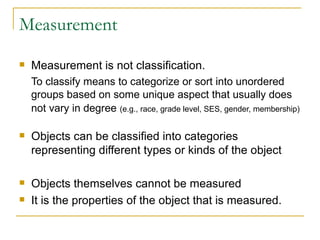
Measurement Measurement is not classification. To classify means to categorize or sort into unordered groups based on some unique aspect that usually does not vary in degree   (e.g., race, grade level, SES, gender, membership) Objects can be classified into categories representing different types or kinds of the object Objects themselves cannot be measured It is the properties of the object that is measured.
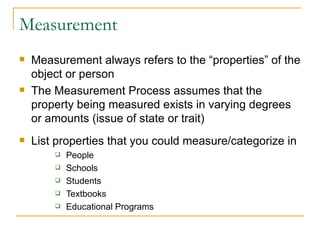
Measurement Measurement always refers to the “properties” of the object or person The Measurement Process assumes that the property being measured exists in varying degrees or amounts (issue of state or trait) List properties that you could measure/categorize in People Schools Students Textbooks Educational Programs
Measurement Procedures for measuring human characteristics are often indirect (observation of behavior, self report, tests) Measurement is a human activity Measures ALWAYS contain some error. The amount of error is a matter of degree. Some measures are better than others.  [1-5]
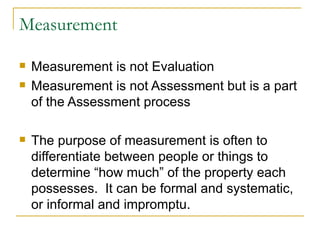
Measurement Measurement is not Evaluation Measurement is not Assessment but is a part of the Assessment process The purpose of measurement is often to differentiate between people or things to determine “how much” of the property each possesses.  It can be formal and systematic, or informal and impromptu.
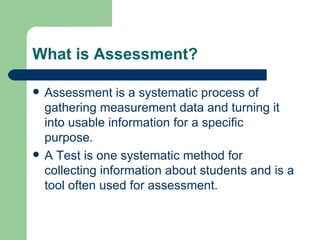
What is Assessment? Assessment is a systematic process of gathering measurement data and turning it into usable information for a specific purpose. A Test is one systematic method for collecting information about students and is a tool often used for assessment.
Assessment (in schools) Assessment is a process involving measurement.  A Test is a particular type of assessment.  [1-6, 1-9] A comprehensive assessment involves a set of planned measurements  (i.e., tests, observations, ratings)  designed to provide evidence or information about a specific person or thing. An Assessment may also be used to form a value judgment (evaluation).
What is Evaluation? Evaluation is the process of making a value judgment about the about a person or object based on some set of assessment data.
Evaluation  Evaluation involves Judgment of merit and worth. It is by nature somewhat subjective. Usually based on a set of criteria  (what we value),  individuals judge the goodness/quality of a thing. For consistency, evaluation criteria used should be clearly defined and generally agreed upon  (e.g., Who should receive an A)
Policy Trends and Assessment How did we get where we are?
Question  (choose the best answer)   Over the past 20 year, how many high school student performed above average on state standardized test?  Approximately 65-70 % Approximately 50% Approximately 25-30 % No one really knows
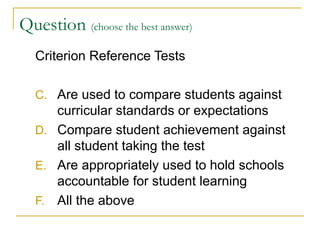
Question  (choose the best answer)   Criterion Reference Tests Are used to compare students against curricular standards or expectations Compare student achievement against all student taking the test Are appropriately used to hold schools accountable for student learning All the above
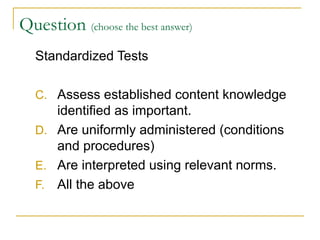
Question  (choose the best answer)   Standardized Tests Assess established content knowledge identified as important. Are uniformly administered (conditions and procedures) Are interpreted using relevant norms. All the above
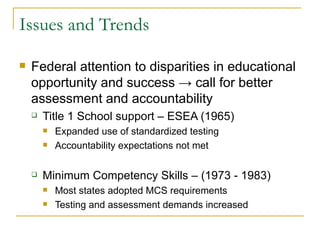
Issues and Trends Federal attention to disparities in educational opportunity and success  ->  call for better assessment and accountability  Title 1 School support – ESEA (1965) Expanded use of standardized testing Accountability expectations not met  Minimum Competency Skills – (1973 - 1983) Most states adopted MCS requirements Testing and assessment demands increased
Issues and Trends Increased Reliance on Testing and Assessment A Nation at Risk (1983) – call for test based reform. (getting test scores up) Teachers focused on skills tested, taught test-taking skills, used standard formats for practice.  [see 1-15, p.11] Cannell(1987) Lake Wobegon effect – all states and districts report that the majority of their students were above national average.  [p.6]
Issues and Trends Standards Based Reform (1990) – Standards based assessment at acceptable  (more substantial)  levels  [p.7] Content standards – what students are expected to learn in each subject area Performance standards – how well students are expected to perform / achieve given contend standards. GQE and high stakes accountability Students & educators, diploma type, grade promotion Push to have all students included Exclusion policy revised (accommodations) Results in new approaches to assessment  (alternative, authentic, direct, performance-based, real-world)
Performance Based Assessment  Belief Base What you test is what you get  Tendency to teach to the test  (also to teach the test) You do not get what you do not assess Student learn what they are held accountable for Conclusion Make tests worth Teaching to Resnick & Resnick (1992)  [p.8]
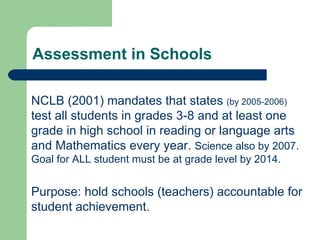
Assessment in Schools NCLB (2001) mandates that states  (by 2005-2006)  test all students in grades 3-8 and at least one grade in high school in reading or language arts and Mathematics every year.  Science also by 2007. Goal for ALL student must be at grade level by 2014. Purpose: hold schools (teachers) accountable for student achievement.
Issues and Trends NCLB (2001) – Increased Reliance on Testing and Assessment Reinforces role of challenging content and performance standards Holds schools, districts and states accountable for student achievement (AYP) Requires 95% inclusion of eligible students Expects that all students will be “proficient”  by 2014
Assessment in Schools The new ESEA program called Race to the Top   http://www.ed.gov/programs/racetothetop/index.html
Issues and Trends Race to Top Program (2009) –  Enhanced standards and high-quality assessments Rewards schools, districts for Increasing student achievement , Decreasing achievement gaps, Increasing high school graduation rates, and Increasing college enrollment  Longitudinal data systems to track individual student growth (data driven decisions) Improve instruction, identify need for PD, determine the effectiveness of instructional materials, strategies, and approaches for educating different types of students  Improving teacher and principal effectiveness based on performance
Issues and Trends Race to Top (2009) – Controversial aspects Link student growth to individual students’ teachers and principals, and link this information to the in-State programs where those teachers and principals were prepared for credentialing. Evaluation of teachers and principals that take into account student achievement as a significant factor  Alternative routes to certification.  Distribute effective teachers to underperforming schools. Compensating, promoting, tenure, full certification, and retaining teachers and principals based on student test results Removing ineffective tenured and untenured teachers and principals  Charter schools
Issues and Trends Race to Top (2009) – Definitions High-quality assessment  means an assessment designed to measure a student’s knowledge, understanding of, and ability to apply, critical concepts through the use of a variety of item types and formats ( e.g., open-ended responses, performance-based tasks). Such assessments should enable measurement of student achievement and student growth; be of high technical quality (e.g., be valid, reliable, fair, and aligned to standards); incorporate technology where appropriate; include the assessment of students with disabilities and English language learners; and to the extent feasible, use universal design principles in development and administration.
Computerized Testing Trend Technology enhanced testing Adaptive test more efficient, more accurate Require large test bank with variety of items Results immediately available Cost less (no paper or scoring cost) Question types broader (i.e., simulations) can go  beyond factual recall questions overemphasized by paper and pencil tests. Computers in schools needed
Assessment in Schools Proponents of Standardized testing Testing is relatively inexpensive and provides an objective “visible” outcome indicator. Can be externally mandated, Rapidly implemented Better off with than without assessment Focusing teachers on important objectives has improve schools  (especially for previously exempt students) Believe test scores are up as a result of policy and student are thus more capable
Assessment in Schools Critics argue Important objectives ignored (narrow focus) Score improvement misleading because teachers teach only that which is tested (pressure to cheat) It is difficult to measure many important aspect of the student (test sample easily measured items) Testing is subject to error and predictions fallible Spending too much time & money testing - little value (students tested out, stressed out) GQE- high stakes testing is unfair, (minorities, gender)  Used inappropriately to judge students and schools (labels). Read too much into result
Assessment in Schools Something you will need to decide What are schools for?  and What purpose should testing have in schools?
Next Class Thursday Review and be prepared to discuss  pgs 15-20 of text Also Chapter 2 topics – role of assessment

Week1 Assessment Overview

  • 1.
    Assessing Learning OutcomesWeek 1: Issues & Trends Course Number: IPT 652 Meeting time: T&TH 2:00 -3:50 pm
  • 2.
    Topics For Today (this week) Course Syllabus Language of Assessment Basic Concepts Review of Policy and Politics Issues and Trends
  • 3.
    Language of AssessmentImportant to have a Shared Understanding of Terms Measurement, Assessment, Evaluation
  • 4.
    What is Measurement?Measurement is the process of assigning numbers that estimate the degree to which a person or object possesses some specified property, attribute or characteristic.
  • 5.
    Measurement Measurement isnot classification. To classify means to categorize or sort into unordered groups based on some unique aspect that usually does not vary in degree (e.g., race, grade level, SES, gender, membership) Objects can be classified into categories representing different types or kinds of the object Objects themselves cannot be measured It is the properties of the object that is measured.
  • 6.
    Measurement Measurement alwaysrefers to the “properties” of the object or person The Measurement Process assumes that the property being measured exists in varying degrees or amounts (issue of state or trait) List properties that you could measure/categorize in People Schools Students Textbooks Educational Programs
  • 7.
    Measurement Procedures formeasuring human characteristics are often indirect (observation of behavior, self report, tests) Measurement is a human activity Measures ALWAYS contain some error. The amount of error is a matter of degree. Some measures are better than others. [1-5]
  • 8.
    Measurement Measurement isnot Evaluation Measurement is not Assessment but is a part of the Assessment process The purpose of measurement is often to differentiate between people or things to determine “how much” of the property each possesses. It can be formal and systematic, or informal and impromptu.
  • 9.
    What is Assessment?Assessment is a systematic process of gathering measurement data and turning it into usable information for a specific purpose. A Test is one systematic method for collecting information about students and is a tool often used for assessment.
  • 10.
    Assessment (in schools)Assessment is a process involving measurement. A Test is a particular type of assessment. [1-6, 1-9] A comprehensive assessment involves a set of planned measurements (i.e., tests, observations, ratings) designed to provide evidence or information about a specific person or thing. An Assessment may also be used to form a value judgment (evaluation).
  • 11.
    What is Evaluation?Evaluation is the process of making a value judgment about the about a person or object based on some set of assessment data.
  • 12.
    Evaluation Evaluationinvolves Judgment of merit and worth. It is by nature somewhat subjective. Usually based on a set of criteria (what we value), individuals judge the goodness/quality of a thing. For consistency, evaluation criteria used should be clearly defined and generally agreed upon (e.g., Who should receive an A)
  • 13.
    Policy Trends andAssessment How did we get where we are?
  • 14.
    Question (choosethe best answer) Over the past 20 year, how many high school student performed above average on state standardized test? Approximately 65-70 % Approximately 50% Approximately 25-30 % No one really knows
  • 15.
    Question (choosethe best answer) Criterion Reference Tests Are used to compare students against curricular standards or expectations Compare student achievement against all student taking the test Are appropriately used to hold schools accountable for student learning All the above
  • 16.
    Question (choosethe best answer) Standardized Tests Assess established content knowledge identified as important. Are uniformly administered (conditions and procedures) Are interpreted using relevant norms. All the above
  • 17.
    Issues and TrendsFederal attention to disparities in educational opportunity and success -> call for better assessment and accountability Title 1 School support – ESEA (1965) Expanded use of standardized testing Accountability expectations not met Minimum Competency Skills – (1973 - 1983) Most states adopted MCS requirements Testing and assessment demands increased
  • 18.
    Issues and TrendsIncreased Reliance on Testing and Assessment A Nation at Risk (1983) – call for test based reform. (getting test scores up) Teachers focused on skills tested, taught test-taking skills, used standard formats for practice. [see 1-15, p.11] Cannell(1987) Lake Wobegon effect – all states and districts report that the majority of their students were above national average. [p.6]
  • 19.
    Issues and TrendsStandards Based Reform (1990) – Standards based assessment at acceptable (more substantial) levels [p.7] Content standards – what students are expected to learn in each subject area Performance standards – how well students are expected to perform / achieve given contend standards. GQE and high stakes accountability Students & educators, diploma type, grade promotion Push to have all students included Exclusion policy revised (accommodations) Results in new approaches to assessment (alternative, authentic, direct, performance-based, real-world)
  • 20.
    Performance Based Assessment Belief Base What you test is what you get Tendency to teach to the test (also to teach the test) You do not get what you do not assess Student learn what they are held accountable for Conclusion Make tests worth Teaching to Resnick & Resnick (1992) [p.8]
  • 21.
    Assessment in SchoolsNCLB (2001) mandates that states (by 2005-2006) test all students in grades 3-8 and at least one grade in high school in reading or language arts and Mathematics every year. Science also by 2007. Goal for ALL student must be at grade level by 2014. Purpose: hold schools (teachers) accountable for student achievement.
  • 22.
    Issues and TrendsNCLB (2001) – Increased Reliance on Testing and Assessment Reinforces role of challenging content and performance standards Holds schools, districts and states accountable for student achievement (AYP) Requires 95% inclusion of eligible students Expects that all students will be “proficient” by 2014
  • 23.
    Assessment in SchoolsThe new ESEA program called Race to the Top http://www.ed.gov/programs/racetothetop/index.html
  • 24.
    Issues and TrendsRace to Top Program (2009) – Enhanced standards and high-quality assessments Rewards schools, districts for Increasing student achievement , Decreasing achievement gaps, Increasing high school graduation rates, and Increasing college enrollment Longitudinal data systems to track individual student growth (data driven decisions) Improve instruction, identify need for PD, determine the effectiveness of instructional materials, strategies, and approaches for educating different types of students Improving teacher and principal effectiveness based on performance
  • 25.
    Issues and TrendsRace to Top (2009) – Controversial aspects Link student growth to individual students’ teachers and principals, and link this information to the in-State programs where those teachers and principals were prepared for credentialing. Evaluation of teachers and principals that take into account student achievement as a significant factor Alternative routes to certification. Distribute effective teachers to underperforming schools. Compensating, promoting, tenure, full certification, and retaining teachers and principals based on student test results Removing ineffective tenured and untenured teachers and principals Charter schools
  • 26.
    Issues and TrendsRace to Top (2009) – Definitions High-quality assessment means an assessment designed to measure a student’s knowledge, understanding of, and ability to apply, critical concepts through the use of a variety of item types and formats ( e.g., open-ended responses, performance-based tasks). Such assessments should enable measurement of student achievement and student growth; be of high technical quality (e.g., be valid, reliable, fair, and aligned to standards); incorporate technology where appropriate; include the assessment of students with disabilities and English language learners; and to the extent feasible, use universal design principles in development and administration.
  • 27.
    Computerized Testing TrendTechnology enhanced testing Adaptive test more efficient, more accurate Require large test bank with variety of items Results immediately available Cost less (no paper or scoring cost) Question types broader (i.e., simulations) can go beyond factual recall questions overemphasized by paper and pencil tests. Computers in schools needed
  • 28.
    Assessment in SchoolsProponents of Standardized testing Testing is relatively inexpensive and provides an objective “visible” outcome indicator. Can be externally mandated, Rapidly implemented Better off with than without assessment Focusing teachers on important objectives has improve schools (especially for previously exempt students) Believe test scores are up as a result of policy and student are thus more capable
  • 29.
    Assessment in SchoolsCritics argue Important objectives ignored (narrow focus) Score improvement misleading because teachers teach only that which is tested (pressure to cheat) It is difficult to measure many important aspect of the student (test sample easily measured items) Testing is subject to error and predictions fallible Spending too much time & money testing - little value (students tested out, stressed out) GQE- high stakes testing is unfair, (minorities, gender) Used inappropriately to judge students and schools (labels). Read too much into result
  • 30.
    Assessment in SchoolsSomething you will need to decide What are schools for? and What purpose should testing have in schools?
  • 31.
    Next Class ThursdayReview and be prepared to discuss pgs 15-20 of text Also Chapter 2 topics – role of assessment