Preparing 
Table of Specification 
(TOS) 
ROXETTE U. LAYOSA 
BSEd GenSci - 3
As a student have you ever 
felt that the test you 
studied for was completely 
or partially unrelated to the 
class activities you 
experienced????
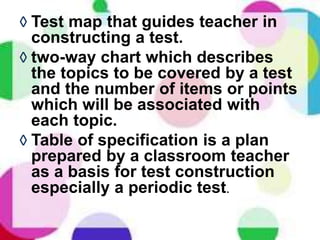
◊ Test map that guides teacher in 
constructing a test. 
◊ two-way chart which describes 
the topics to be covered by a test 
and the number of items or points 
which will be associated with 
each topic. 
◊ Table of specification is a plan 
prepared by a classroom teacher 
as a basis for test construction 
especially a periodic test.
What is the 
importance 
of TOS ?
• Help teachers frame the decision 
making process of test 
construction and improve the 
validity of teachers’ evaluations 
based on tests constructed. 
• Helping teachers to identify the 
types of items they need to 
include on their tests.
• Identify the achievement domains 
being measured and to ensure 
that a fair and representative 
sample of questions appear on 
the test. 
• provides the teacher with 
evidence that a test has content 
validity, that it covers 
what should be covered.
Higher thinking skills 
Lower thinking skills
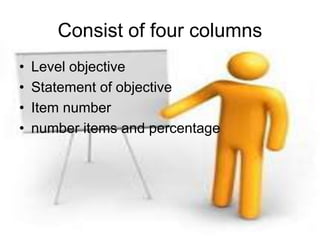
Consist of four columns 
• Level objective 
• Statement of objective 
• Item number 
• number items and percentage
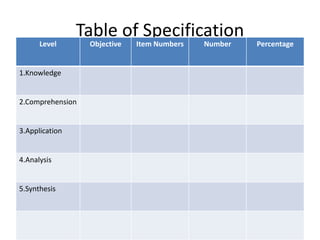
Table of Specification 
Level Objective Item Numbers Number Percentage 
1.Knowledge 
2.Comprehension 
3.Application 
4.Analysis 
5.Synthesis
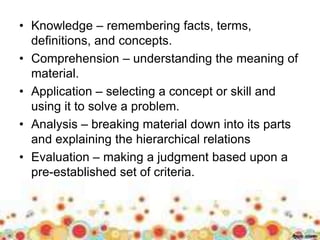
• Knowledge – remembering facts, terms, 
definitions, and concepts. 
• Comprehension – understanding the meaning of 
material. 
• Application – selecting a concept or skill and 
using it to solve a problem. 
• Analysis – breaking material down into its parts 
and explaining the hierarchical relations 
• Evaluation – making a judgment based upon a 
pre-established set of criteria.
Steps in Preparing 
Table of Specification
1. List down the topics 
covered for inclusion in 
the test. 
2. Determine the objectives 
to be assessed by the 
test. 
3. Specify the number of 
days/hours spent for 
teaching a particular 
topic.
4. determine percentage allocation of the 
test items for each of the topics covered. 
The formula applied is as follows: % for a 
topic = Total Number Of Days/ Hours 
Spent
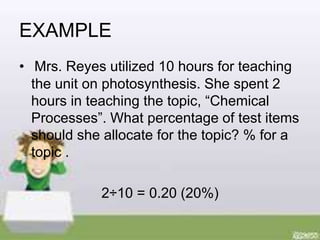
EXAMPLE 
• Mrs. Reyes utilized 10 hours for teaching 
the unit on photosynthesis. She spent 2 
hours in teaching the topic, “Chemical 
Processes”. What percentage of test items 
should she allocate for the topic? % for a 
topic . 
2÷10 = 0.20 (20%)
5. Determine the number of the items for 
each topic. This can be done by 
multiplying the percentage allocation for 
each topic by the total number of items to 
be constructed.
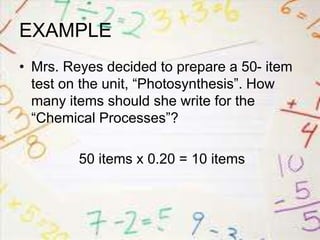
EXAMPLE 
• Mrs. Reyes decided to prepare a 50- item 
test on the unit, “Photosynthesis”. How 
many items should she write for the 
“Chemical Processes”? 
50 items x 0.20 = 10 items
• 6. Distribute the numbers to the objectives. 
The number of items allocated for each 
objective depends on the degree of 
importance attached by the teacher to it.
OTHER REFERENCES 
• http://www.eajournals.org/wp-content/ 
uploads/Table-of-Specification-and-its- 
Relevance-in-educational-development- 
Assessment.pdf 
• http://pareonline.net/pdf/v18n3.pdf 
• http://www.slideshare.net/MarcianoMelchor/ 
table-of-specifications-2013-copy-18908380 
• http://www.slideshare.net/daenice/preparing 
-the-table-of-specification
THANK YOU !!! 
  

preparing a TOS

  • 1.
    Preparing Table ofSpecification (TOS) ROXETTE U. LAYOSA BSEd GenSci - 3
  • 2.
    As a studenthave you ever felt that the test you studied for was completely or partially unrelated to the class activities you experienced????
  • 4.
    ◊ Test mapthat guides teacher in constructing a test. ◊ two-way chart which describes the topics to be covered by a test and the number of items or points which will be associated with each topic. ◊ Table of specification is a plan prepared by a classroom teacher as a basis for test construction especially a periodic test.
  • 5.
    What is the importance of TOS ?
  • 6.
    • Help teachersframe the decision making process of test construction and improve the validity of teachers’ evaluations based on tests constructed. • Helping teachers to identify the types of items they need to include on their tests.
  • 7.
    • Identify theachievement domains being measured and to ensure that a fair and representative sample of questions appear on the test. • provides the teacher with evidence that a test has content validity, that it covers what should be covered.
  • 8.
    Higher thinking skills Lower thinking skills
  • 9.
    Consist of fourcolumns • Level objective • Statement of objective • Item number • number items and percentage
  • 10.
    Table of Specification Level Objective Item Numbers Number Percentage 1.Knowledge 2.Comprehension 3.Application 4.Analysis 5.Synthesis
  • 11.
    • Knowledge –remembering facts, terms, definitions, and concepts. • Comprehension – understanding the meaning of material. • Application – selecting a concept or skill and using it to solve a problem. • Analysis – breaking material down into its parts and explaining the hierarchical relations • Evaluation – making a judgment based upon a pre-established set of criteria.
  • 12.
    Steps in Preparing Table of Specification
  • 13.
    1. List downthe topics covered for inclusion in the test. 2. Determine the objectives to be assessed by the test. 3. Specify the number of days/hours spent for teaching a particular topic.
  • 14.
    4. determine percentageallocation of the test items for each of the topics covered. The formula applied is as follows: % for a topic = Total Number Of Days/ Hours Spent
  • 15.
    EXAMPLE • Mrs.Reyes utilized 10 hours for teaching the unit on photosynthesis. She spent 2 hours in teaching the topic, “Chemical Processes”. What percentage of test items should she allocate for the topic? % for a topic . 2÷10 = 0.20 (20%)
  • 16.
    5. Determine thenumber of the items for each topic. This can be done by multiplying the percentage allocation for each topic by the total number of items to be constructed.
  • 17.
    EXAMPLE • Mrs.Reyes decided to prepare a 50- item test on the unit, “Photosynthesis”. How many items should she write for the “Chemical Processes”? 50 items x 0.20 = 10 items
  • 18.
    • 6. Distributethe numbers to the objectives. The number of items allocated for each objective depends on the degree of importance attached by the teacher to it.
  • 19.
    OTHER REFERENCES •http://www.eajournals.org/wp-content/ uploads/Table-of-Specification-and-its- Relevance-in-educational-development- Assessment.pdf • http://pareonline.net/pdf/v18n3.pdf • http://www.slideshare.net/MarcianoMelchor/ table-of-specifications-2013-copy-18908380 • http://www.slideshare.net/daenice/preparing -the-table-of-specification
  • 20.
    THANK YOU !!!   

Editor's Notes