Assessment in Schools Instructional Objectives & Learning Outcomes
Intelligence Are  you  brainless?  Jar Jar Binks : I speck! Qui-Gon Jinn: The ability to speak does not make  you  intelligent. What is Intelligence?  [2-8 to 2-15]
Gospel Foundations Abr. 3:19 And the Lord said unto me: These two facts do exist, that there are two spirits, one being more intelligent than the other; there shall be another more intelligent than they; I am the Lord thy God, I am more intelligent than they all.  D&C 93:36 The glory of God is intelligence, or, in other words, light and truth.
Gospel Foundation D&C 130:18-19 Whatever principle of intelligence we attain unto in this life, it will rise with us in the resurrection.  And if a person gains more knowledge and intelligence in this life through his diligence and obedience than another, he will have so much the advantage in the world to come.
Educational Achievement What is learning? Relatively permanent changes in behavior, ability, knowledge/understanding that occur as the result of experience or instruction. How will you know Learning has occurred? When we see changes in behavior or evidence of understanding.
Educational Achievement What does achievement mean  [see 2-7] Being able to recall important facts and information on demand. Being able to perform discrete skill like reading, writing, speaking, or computing. view from behavior psychology
Educational Achievement What does achievement mean  [see 2-7] Understanding concepts & principles. Ability to think independently, formulate questions, inquire, solve problems, create new processes, evaluate ones thinking & that of others Exercise discernment and judgment in matters of taste and preference view from Philosophy & Cognitive Science
Taxonomy of Educational Objectives Cognitive Domain :  Knowledge outcomes, intellectual ability & skills Affective Domain:  Attitudes, Interests, Values, Emotions, Social norms Psychomotor Domain :  (motor skills) Physical Performance, Ability & Behaviors   [pg. 55;  Appendix G ]
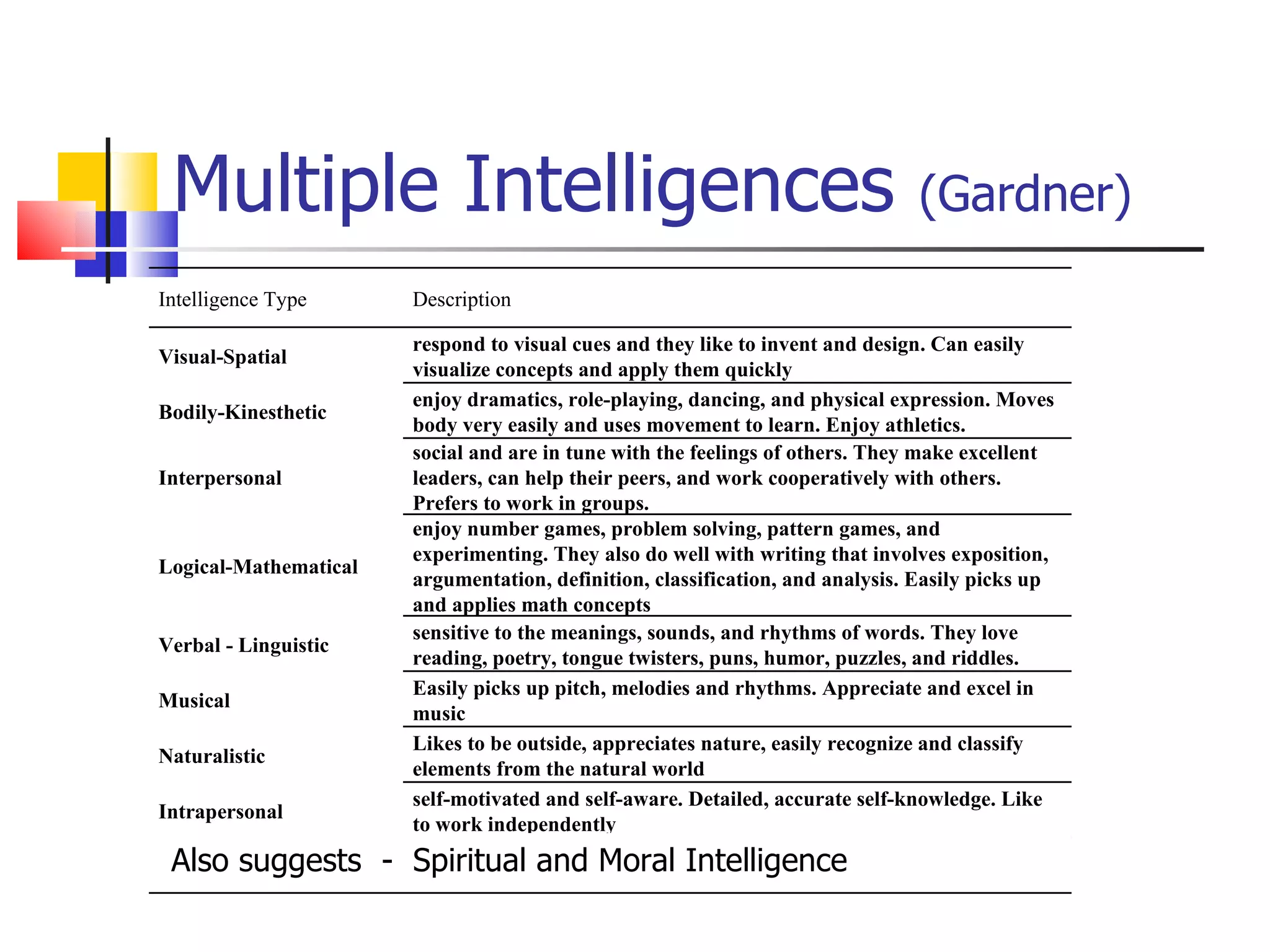
Multiple Intelligences  (Gardner) Also suggests  -  Spiritual and Moral Intelligence Intelligence Type Description Visual-Spatial respond to visual cues and they like to invent and design. Can easily visualize concepts and apply them quickly Bodily-Kinesthetic enjoy dramatics, role-playing, dancing, and physical expression. Moves body very easily and uses movement to learn. Enjoy athletics. Interpersonal social and are in tune with the feelings of others. They make excellent leaders, can help their peers, and work cooperatively with others. Prefers to work in groups. Logical-Mathematical enjoy number games, problem solving, pattern games, and experimenting. They also do well with writing that involves exposition, argumentation, definition, classification, and analysis. Easily picks up and applies math concepts Verbal - Linguistic sensitive to the meanings, sounds, and rhythms of words. They love reading, poetry, tongue twisters, puns, humor, puzzles, and riddles. Musical Easily picks up pitch, melodies and rhythms. Appreciate and excel in music Naturalistic Likes to be outside, appreciates nature, easily recognize and classify elements from the natural world Intrapersonal self-motivated and self-aware. Detailed, accurate self-knowledge. Like to work independently Spiritual recognition of the spiritual (D&C 46:11-33)
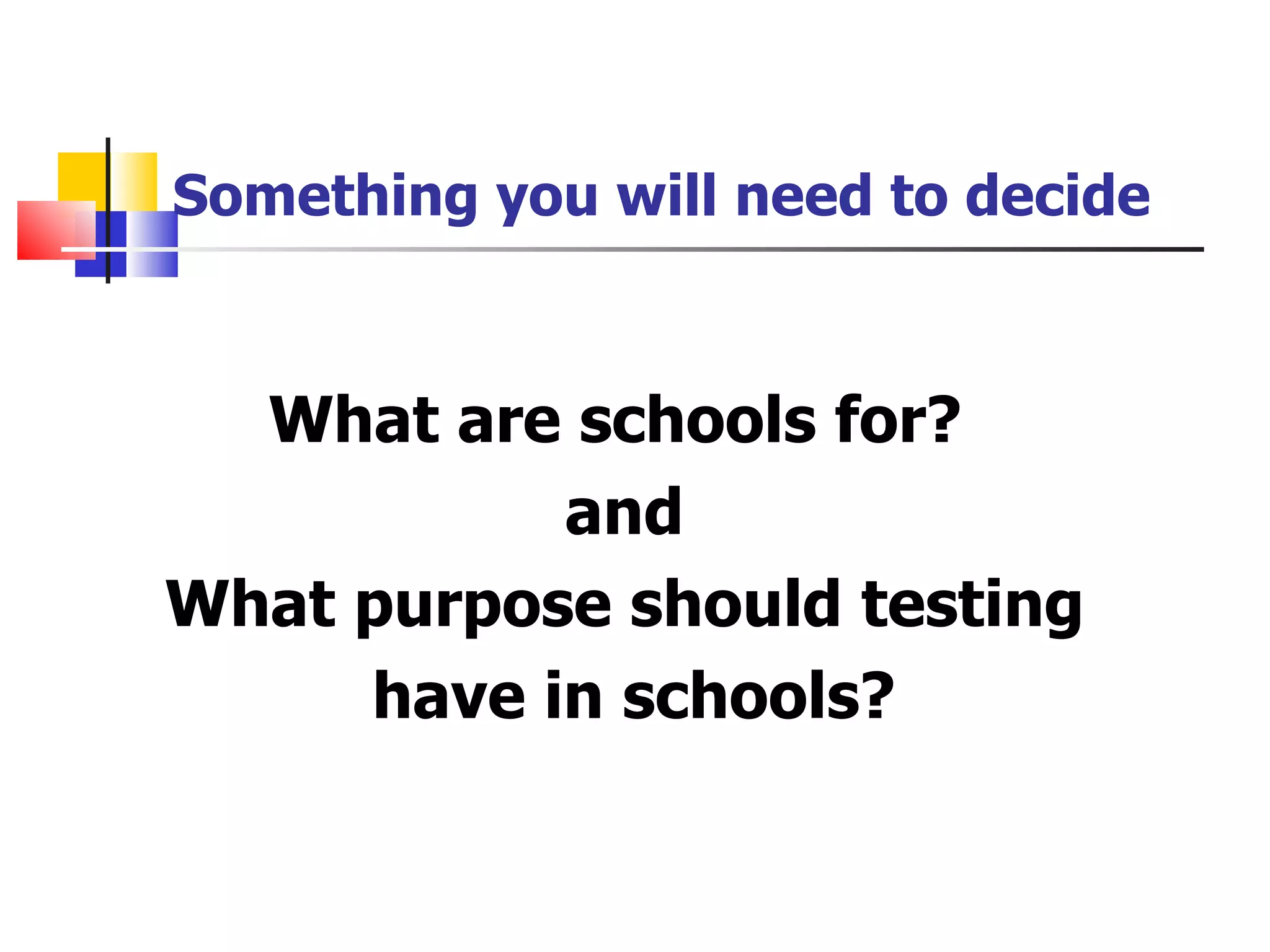
Something you will need to decide What are schools for?  and What purpose should testing have in schools?
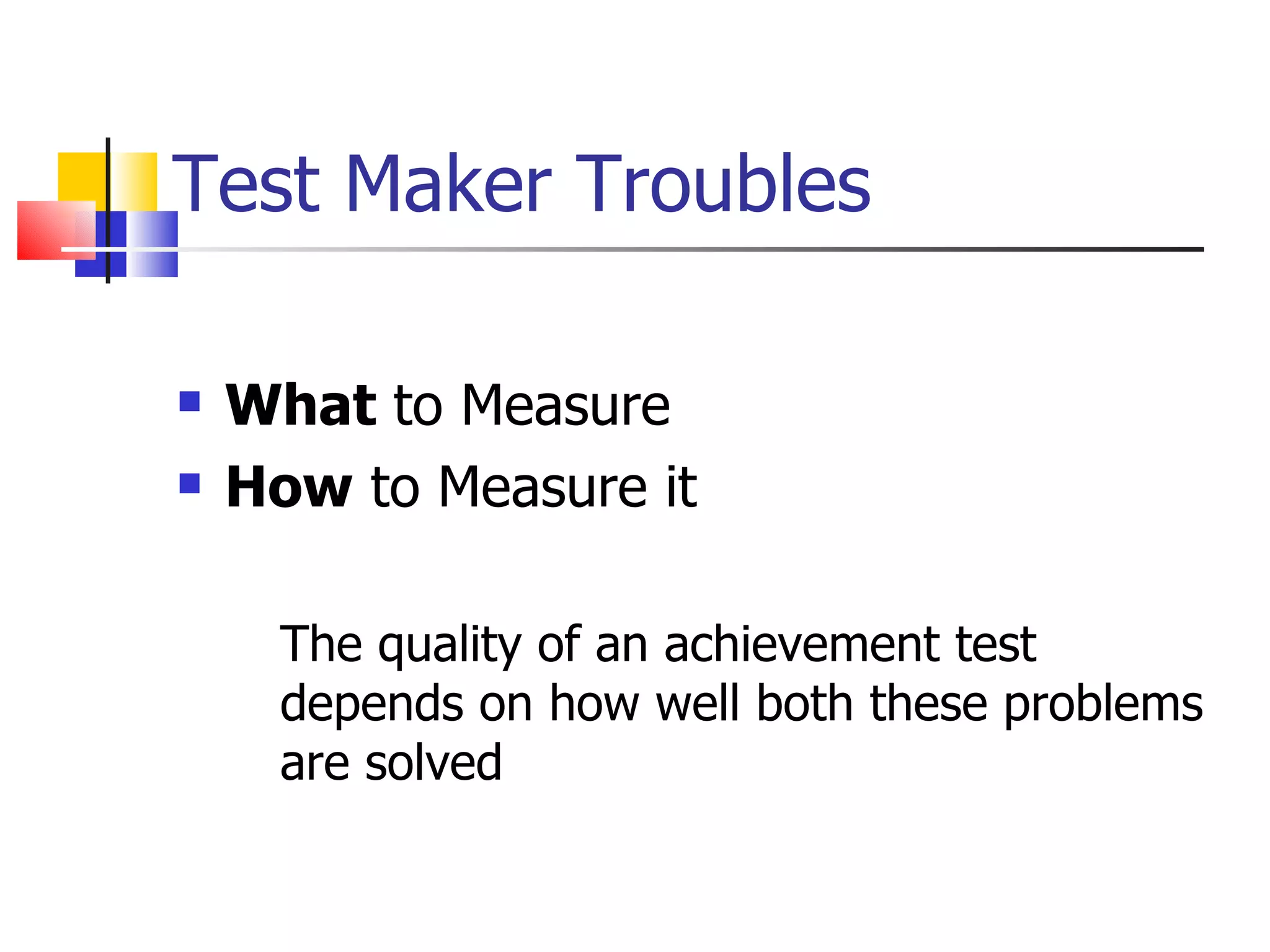
Test Maker Troubles What  to Measure How  to Measure it The quality of an achievement test depends on how well both these problems are solved
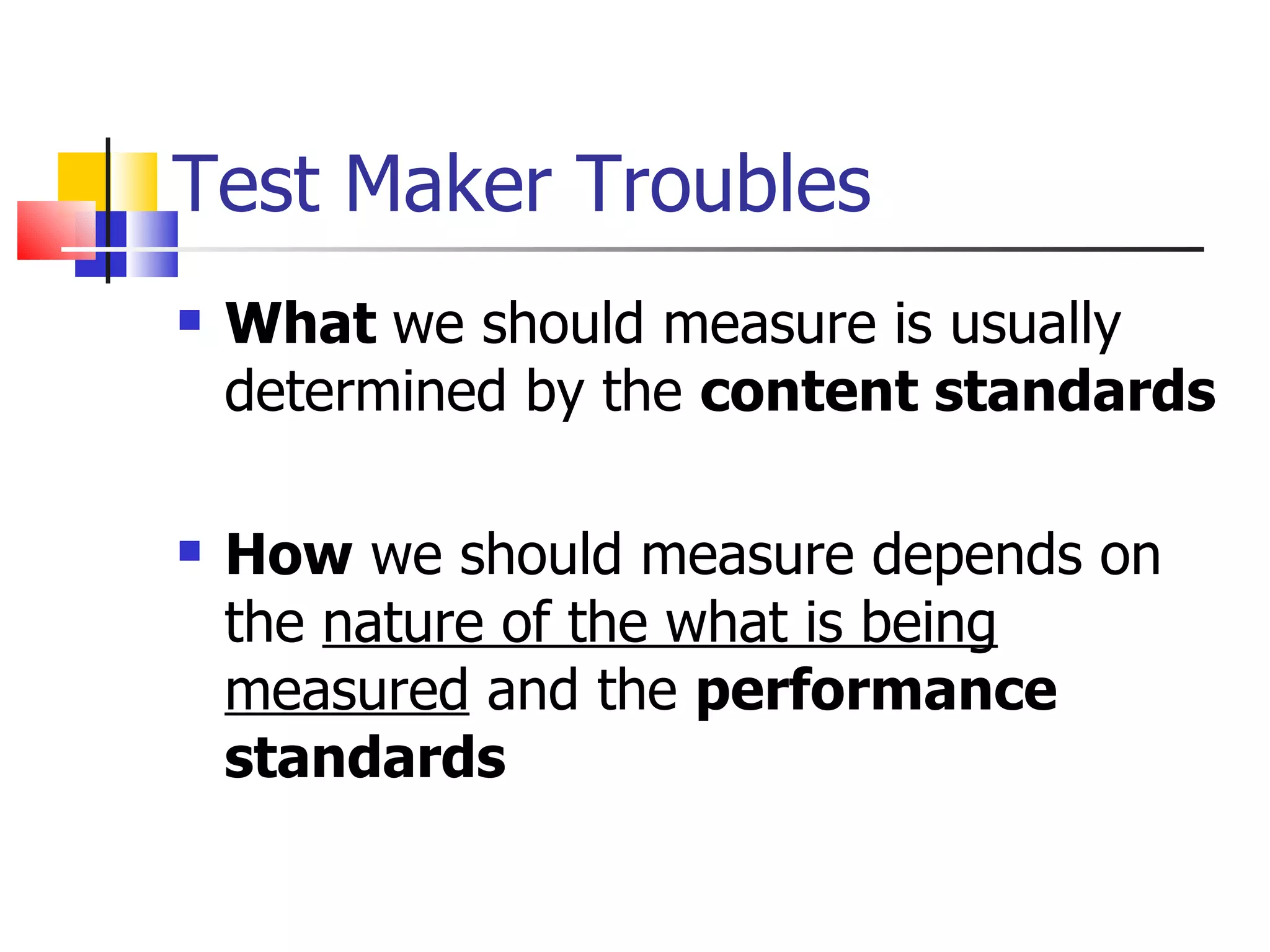
Test Maker Troubles What  we should measure is usually determined by the  content standards How  we should measure depends on the  nature of the what is being measured  and the  performance standards
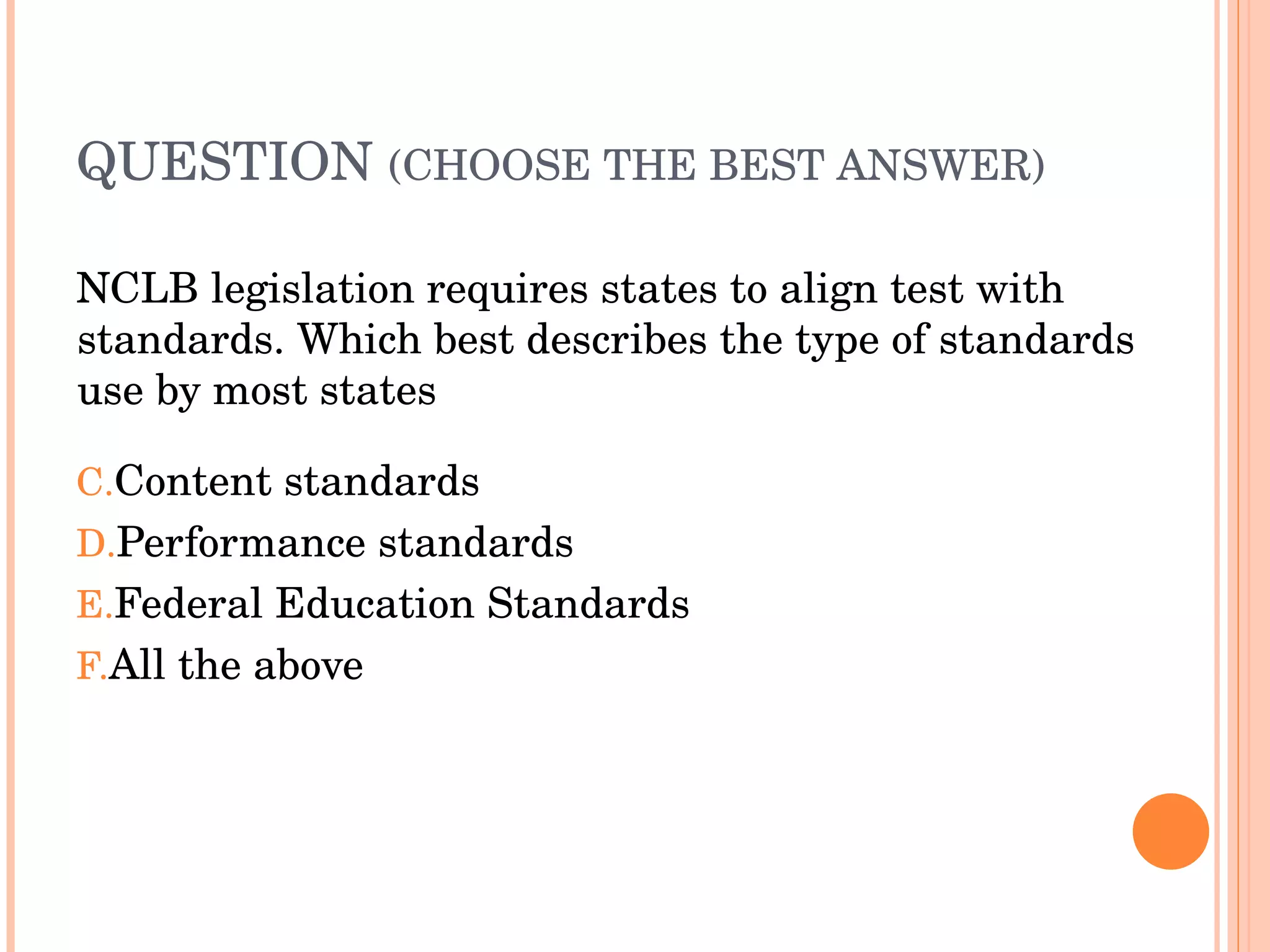
QUESTION  (CHOOSE THE BEST ANSWER)   NCLB legislation requires states to align test with standards. Which best describes the type of standards use by most states Content standards Performance standards Federal Education Standards All the above
Utah Core Curriculum http://www.uen.org/core/ http://www.education.com/reference/article/Ref_U_Pass_Tests/
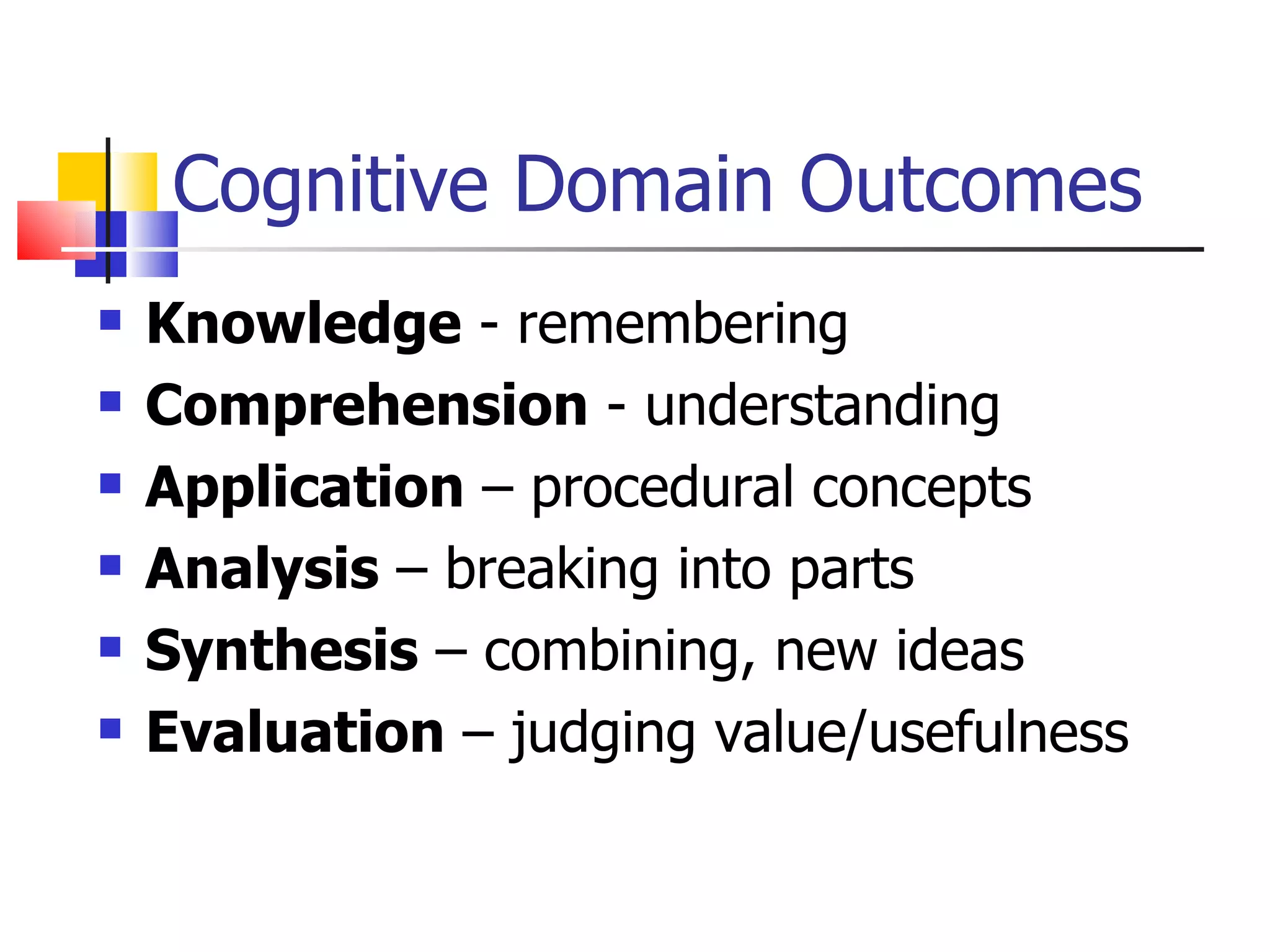
Cognitive Domain Outcomes Knowledge  - remembering Comprehension  - understanding Application  – procedural concepts Analysis  – breaking into parts Synthesis  – combining, new ideas Evaluation  – judging value/usefulness
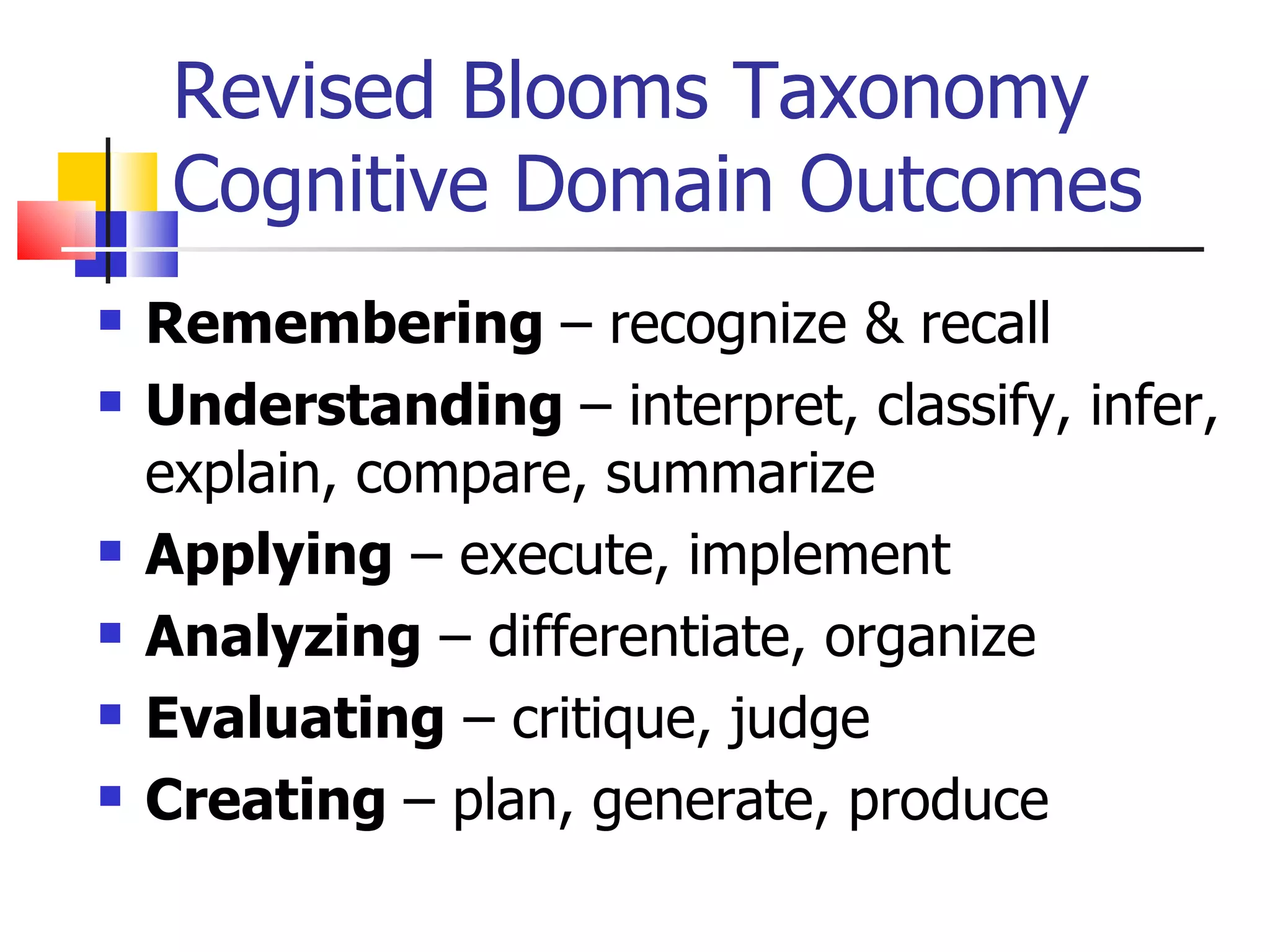
Revised Blooms Taxonomy Cognitive Domain Outcomes Remembering  – recognize & recall Understanding  – interpret, classify, infer, explain, compare, summarize Applying  – execute, implement Analyzing  – differentiate, organize Evaluating  – critique, judge Creating  – plan, generate, produce
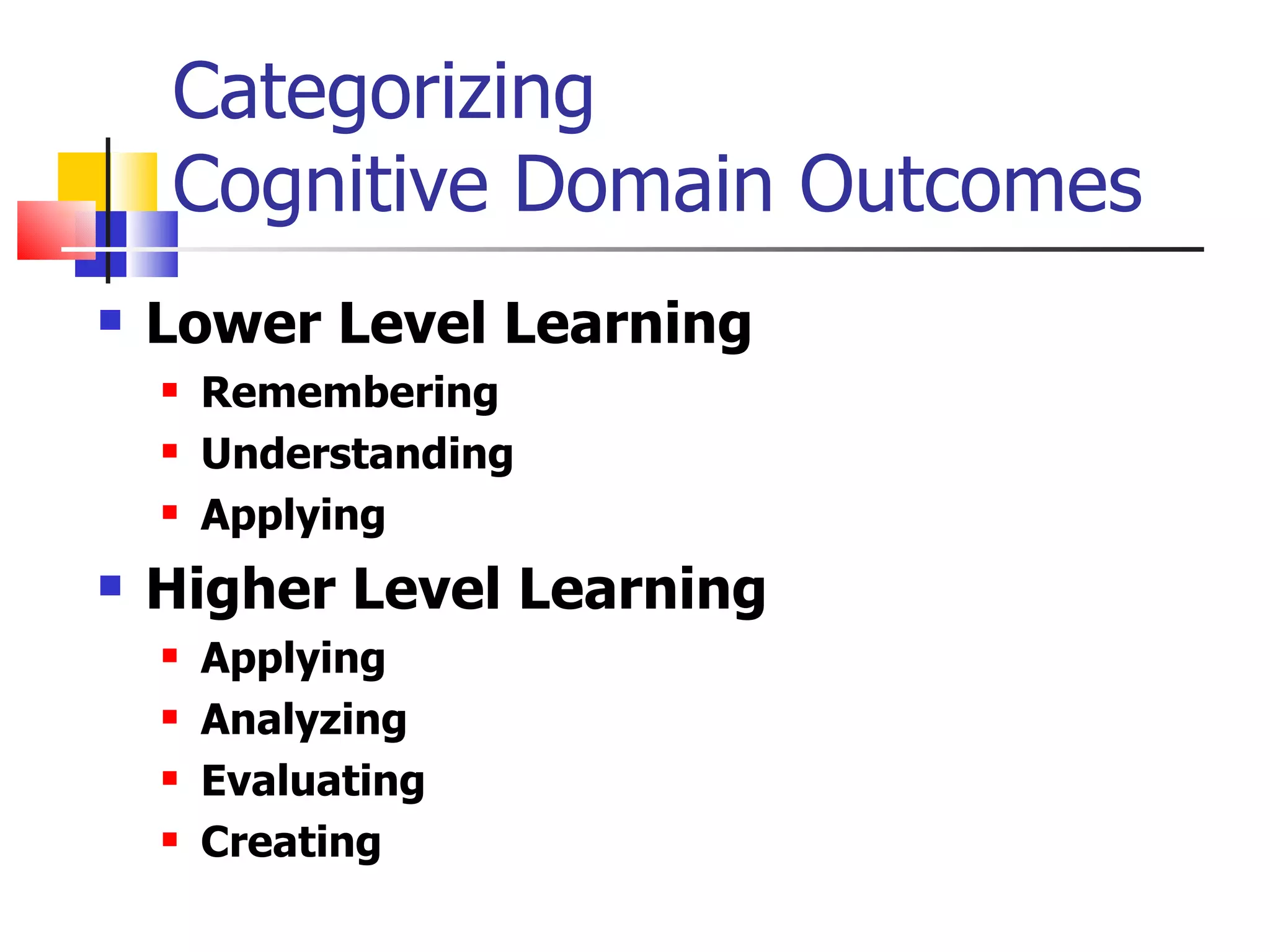
Categorizing Cognitive Domain Outcomes Lower Level Learning Remembering  Understanding  Applying Higher Level Learning Applying   Analyzing   Evaluating   Creating
Types of Knowledge  [2-21] Factual  – terms, details Conceptual  – classifications, principles Procedural  – skills, techniques, method MetaCognitive  – strategies, self-knowledge
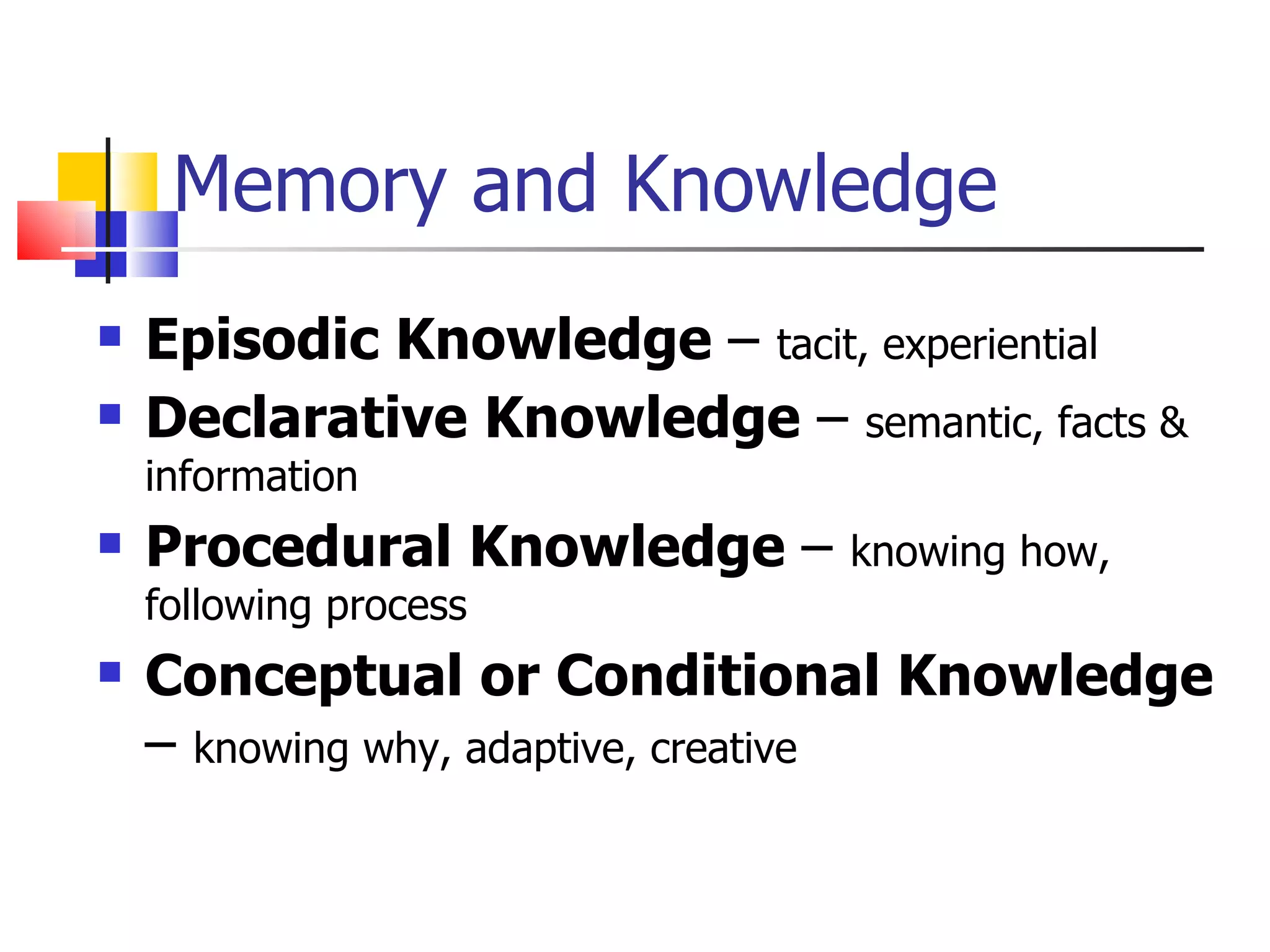
Memory and Knowledge Episodic Knowledge  –  tacit, experiential Declarative Knowledge  –  semantic, facts & information Procedural Knowledge  –  knowing how, following process Conceptual or Conditional Knowledge  –  knowing why, adaptive, creative
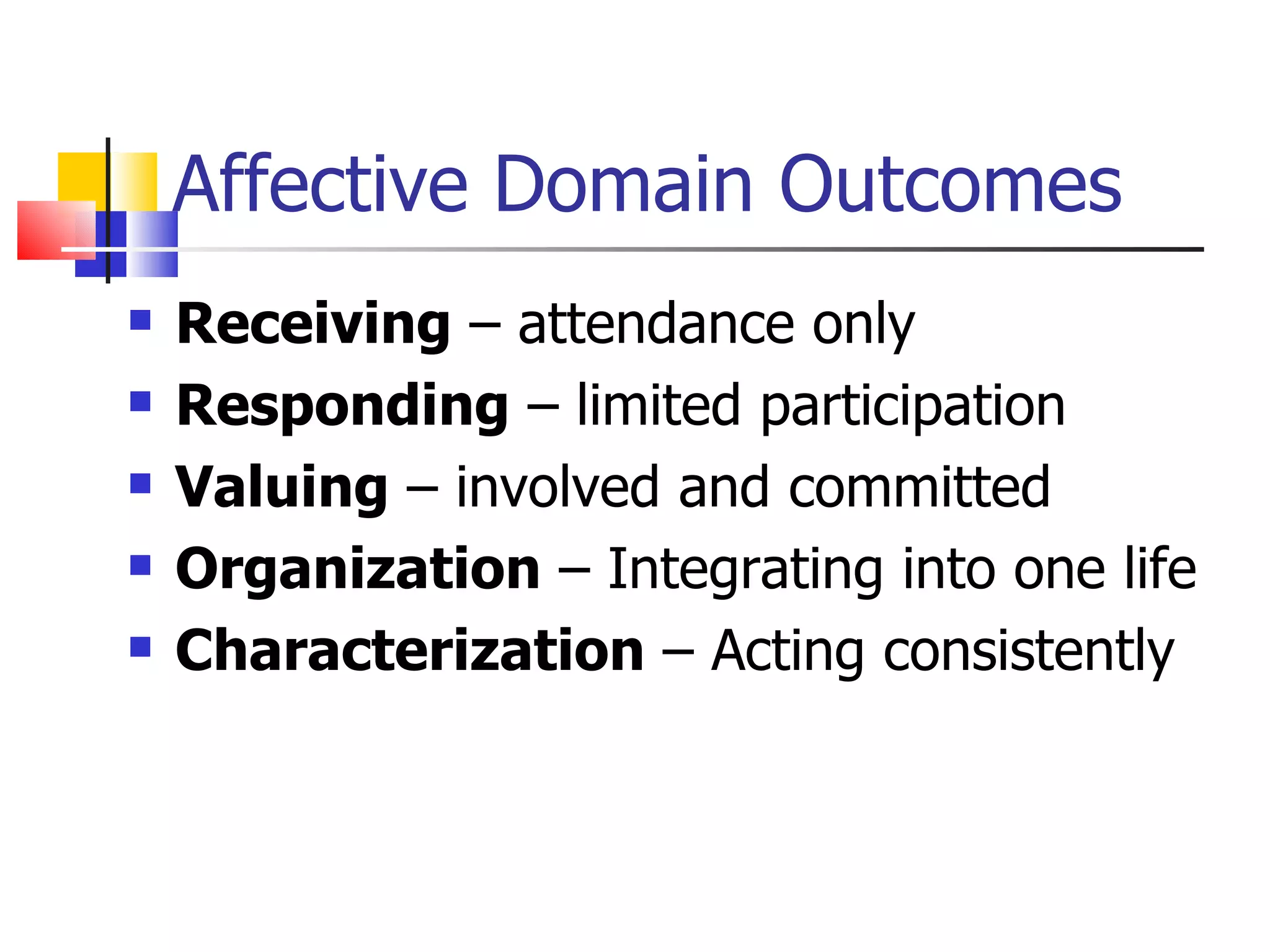
Affective Domain Outcomes Receiving  – attendance only Responding  – limited participation Valuing  – involved and committed Organization  – Integrating into one life Characterization  – Acting consistently
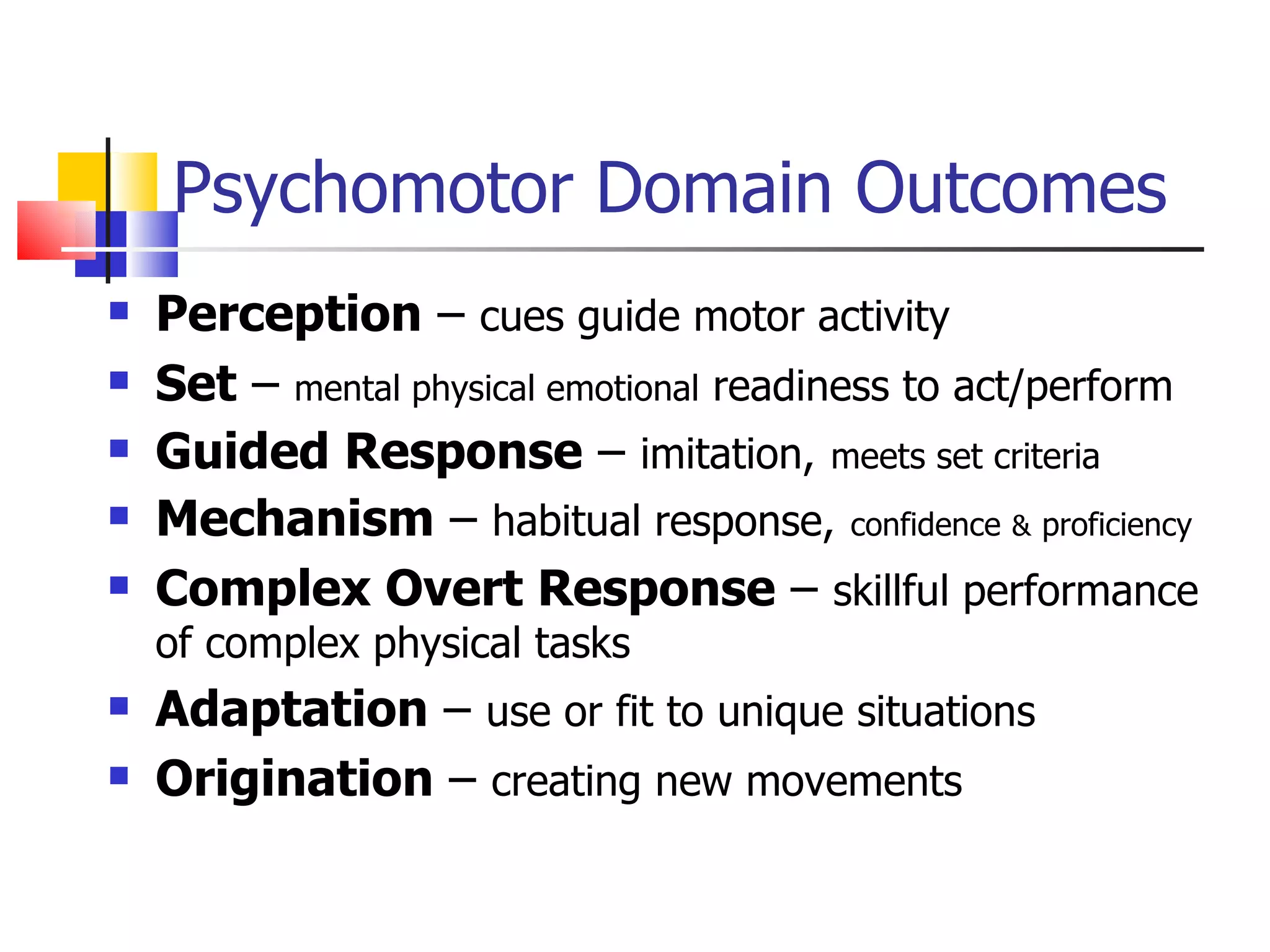
Psychomotor Domain Outcomes Perception  –  cues guide motor activity Set  –  mental physical emotional  readiness to act/perform Guided Response  –  imitation,   meets set criteria Mechanism  –  habitual response,   confidence   &   proficiency Complex Overt Response  –  skillful performance of complex physical tasks Adaptation  –  use or fit to unique situations Origination  –  creating new movements
Practice Exercise 2 handout
Next Class Chapter 3 Learning Objectives

Week2 Learning Objectives

  • 1.
    Assessment in SchoolsInstructional Objectives & Learning Outcomes
  • 2.
    Intelligence Are you brainless? Jar Jar Binks : I speck! Qui-Gon Jinn: The ability to speak does not make you intelligent. What is Intelligence? [2-8 to 2-15]
  • 3.
    Gospel Foundations Abr.3:19 And the Lord said unto me: These two facts do exist, that there are two spirits, one being more intelligent than the other; there shall be another more intelligent than they; I am the Lord thy God, I am more intelligent than they all. D&C 93:36 The glory of God is intelligence, or, in other words, light and truth.
  • 4.
    Gospel Foundation D&C130:18-19 Whatever principle of intelligence we attain unto in this life, it will rise with us in the resurrection. And if a person gains more knowledge and intelligence in this life through his diligence and obedience than another, he will have so much the advantage in the world to come.
  • 5.
    Educational Achievement Whatis learning? Relatively permanent changes in behavior, ability, knowledge/understanding that occur as the result of experience or instruction. How will you know Learning has occurred? When we see changes in behavior or evidence of understanding.
  • 6.
    Educational Achievement Whatdoes achievement mean [see 2-7] Being able to recall important facts and information on demand. Being able to perform discrete skill like reading, writing, speaking, or computing. view from behavior psychology
  • 7.
    Educational Achievement Whatdoes achievement mean [see 2-7] Understanding concepts & principles. Ability to think independently, formulate questions, inquire, solve problems, create new processes, evaluate ones thinking & that of others Exercise discernment and judgment in matters of taste and preference view from Philosophy & Cognitive Science
  • 8.
    Taxonomy of EducationalObjectives Cognitive Domain : Knowledge outcomes, intellectual ability & skills Affective Domain: Attitudes, Interests, Values, Emotions, Social norms Psychomotor Domain : (motor skills) Physical Performance, Ability & Behaviors [pg. 55; Appendix G ]
  • 9.
    Multiple Intelligences (Gardner) Also suggests - Spiritual and Moral Intelligence Intelligence Type Description Visual-Spatial respond to visual cues and they like to invent and design. Can easily visualize concepts and apply them quickly Bodily-Kinesthetic enjoy dramatics, role-playing, dancing, and physical expression. Moves body very easily and uses movement to learn. Enjoy athletics. Interpersonal social and are in tune with the feelings of others. They make excellent leaders, can help their peers, and work cooperatively with others. Prefers to work in groups. Logical-Mathematical enjoy number games, problem solving, pattern games, and experimenting. They also do well with writing that involves exposition, argumentation, definition, classification, and analysis. Easily picks up and applies math concepts Verbal - Linguistic sensitive to the meanings, sounds, and rhythms of words. They love reading, poetry, tongue twisters, puns, humor, puzzles, and riddles. Musical Easily picks up pitch, melodies and rhythms. Appreciate and excel in music Naturalistic Likes to be outside, appreciates nature, easily recognize and classify elements from the natural world Intrapersonal self-motivated and self-aware. Detailed, accurate self-knowledge. Like to work independently Spiritual recognition of the spiritual (D&C 46:11-33)
  • 10.
    Something you willneed to decide What are schools for? and What purpose should testing have in schools?
  • 11.
    Test Maker TroublesWhat to Measure How to Measure it The quality of an achievement test depends on how well both these problems are solved
  • 12.
    Test Maker TroublesWhat we should measure is usually determined by the content standards How we should measure depends on the nature of the what is being measured and the performance standards
  • 13.
    QUESTION (CHOOSETHE BEST ANSWER) NCLB legislation requires states to align test with standards. Which best describes the type of standards use by most states Content standards Performance standards Federal Education Standards All the above
  • 14.
    Utah Core Curriculumhttp://www.uen.org/core/ http://www.education.com/reference/article/Ref_U_Pass_Tests/
  • 15.
    Cognitive Domain OutcomesKnowledge - remembering Comprehension - understanding Application – procedural concepts Analysis – breaking into parts Synthesis – combining, new ideas Evaluation – judging value/usefulness
  • 16.
    Revised Blooms TaxonomyCognitive Domain Outcomes Remembering – recognize & recall Understanding – interpret, classify, infer, explain, compare, summarize Applying – execute, implement Analyzing – differentiate, organize Evaluating – critique, judge Creating – plan, generate, produce
  • 17.
    Categorizing Cognitive DomainOutcomes Lower Level Learning Remembering Understanding Applying Higher Level Learning Applying Analyzing Evaluating Creating
  • 18.
    Types of Knowledge [2-21] Factual – terms, details Conceptual – classifications, principles Procedural – skills, techniques, method MetaCognitive – strategies, self-knowledge
  • 19.
    Memory and KnowledgeEpisodic Knowledge – tacit, experiential Declarative Knowledge – semantic, facts & information Procedural Knowledge – knowing how, following process Conceptual or Conditional Knowledge – knowing why, adaptive, creative
  • 20.
    Affective Domain OutcomesReceiving – attendance only Responding – limited participation Valuing – involved and committed Organization – Integrating into one life Characterization – Acting consistently
  • 21.
    Psychomotor Domain OutcomesPerception – cues guide motor activity Set – mental physical emotional readiness to act/perform Guided Response – imitation, meets set criteria Mechanism – habitual response, confidence & proficiency Complex Overt Response – skillful performance of complex physical tasks Adaptation – use or fit to unique situations Origination – creating new movements
  • 22.
  • 23.
    Next Class Chapter3 Learning Objectives