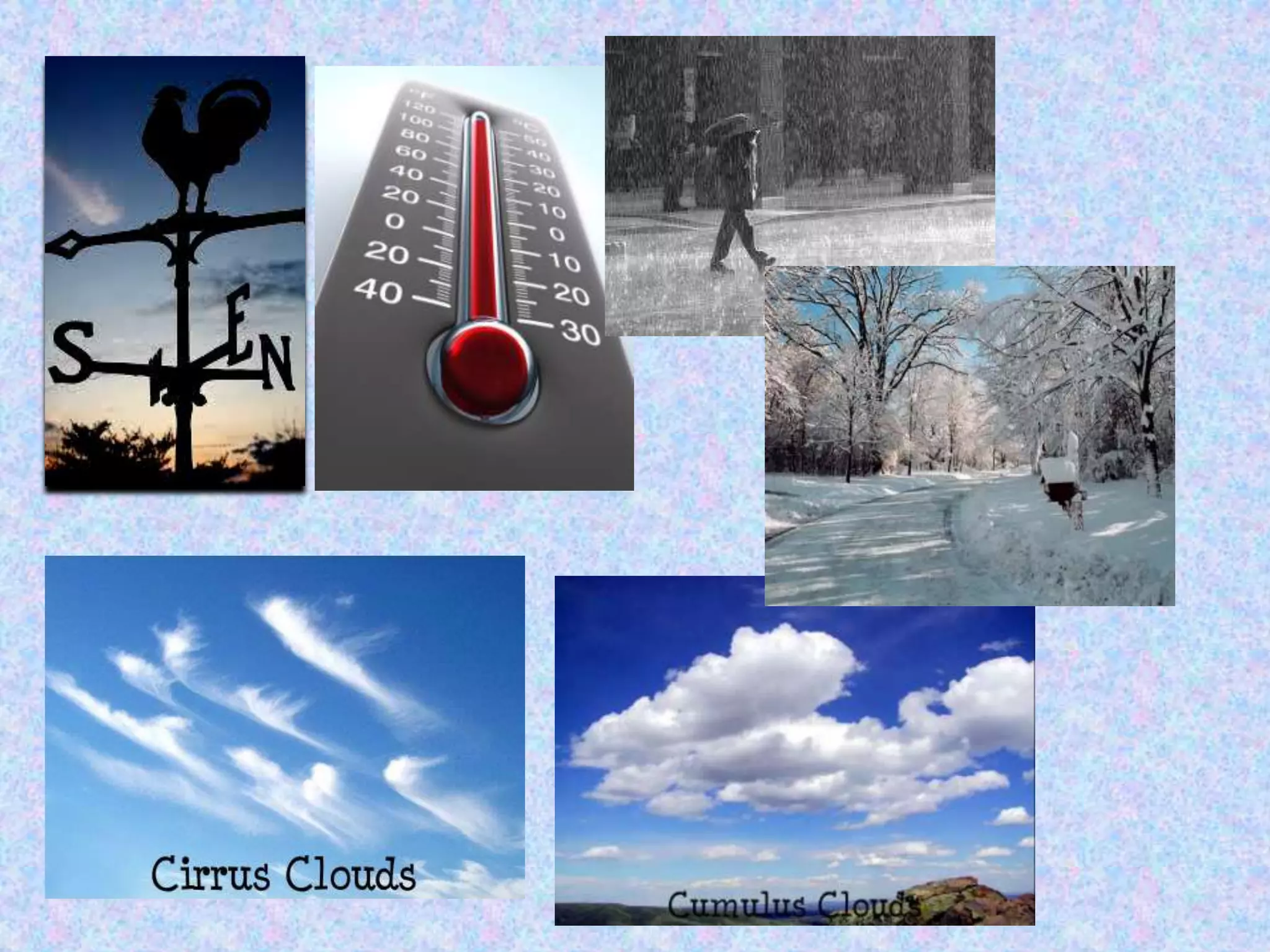
Weather & Climate

   Geography project
       April 2012
 Matthew Ben Hamed 3.2
Observing & Recording the Weather
• Weather is the condition of the air around us
  over a short period of time ex. Rainy or cloudy.
• Meteorology is the study of the atmospheric
  conditions & air circulation.
      A meteorologist is a person who studies the weather
      & works at the meteorological (met) office.
      The met station is the place where they forecast the
      weather.
     There are a number of instruments which help in the
      forecast of the weather.
Weather & Measurements
Description of weather         Measurements used
1. Temperature - how hot or    1. Thermometer (⁰C)
   cold it is.
2. Precipitation - how water   2. Rain Gauge (mm)
   from the air falls to the
   ground.
                               3. Beaufort Scale (force)
3. Wind Speed – How strong
   the wind is blowing.
4. Wind Direction – From       4. Wind Vane
   where the wind is blowing
Weather & Measurements(cont)
5. Cloud Cover - The           5. Octa (Factors of eight)
   amount of sky covered
   by clouds.
6. Cloud type - this is        6. Cumulonimbus,
   based on the shape,            cumulus, stratus &
   size & height of the           cirrus
   cloud.
                               7. Meters
7. Visibility - the distance
   that can be seen.
8. General weather –           8.Sunny, rainy, cloudy, etc.
   Description in words of
   the weather.
Weather Map
Features affecting
            Temperature & Wind
• Microclimate is the climate conditions of a
  small area which is different from the general
  surrounding.
• What causes Microclimate?
     Physical features - Forest, Hills, Lakes & Seas
     Shelter - Walls, Trees, Hedges, Buildings
     Surfaces - The color of the ground surface
     Buildings - Provide shade from sun & shelter from wind
     Aspect – The direction in which a place is facing
Places facing the sun will be warmer
                                 than those in the shadow

     Hilltops are usually cool
            and windy


Water areas such as lakes have
a cooling effect and my also
produce light winds
How does it rain?
The water cycle (hydrological cycle) begins by
Evaporation & Evapotranspiration (water
changes from liquid to gas). As the moist air rises
it cools & water droplets form. Then
condensation occurs & cloud forms. As the water
droplets grow larger they become too heavy &
fall to the ground - precipitation which usually
happens in the form of rain. Then the surface
runoff goes back to sea.
Types of rainfall
• Frontal rainfall happens when a mass of warm
  air meets a mass of cooler air.
• Warm air is lighter then cooler air & is forced
  to rise.
Types of rainfall(cont)
• In Relief rainfall the warm moist air is forced
  to rise over mountains.
• When the air rises, it cools, condensate & rain
  falls.
Types of rainfall(cont)
• In Convectional rainfall the sun warms up the
  ground, which warms up the air above it.
• The warm air rises, it cools, condensates &
  rain falls.
Anticyclones
• Anticyclones are high pressure weather
  system, which usually gives good weather.
• The air sinks, clouds do not form and
  therefore no rain occurs.
• In summer, anticyclones bring hot and sunny
  weather, whilst in winter they bring clear
  skies, low temperatures with a risk of fog or
  frost.
Depressions
• Depressions are low pressure weather systems
  that produce cloudy and rainy weather.
• Depressions develop when warm air meets
  cold air and bring a sequence of weather
  changes as they pass overhead.
• Due to the rising of air caused by the
  movement of the fronts and interaction
  between the warm and cold air there are lots
  of clouds and precipitation.
Thank you for
  your time

         The end

Weather & climate project by Matthew Ben Hamed 3.02

  • 1.
    Weather & Climate Geography project April 2012 Matthew Ben Hamed 3.2
  • 2.
    Observing & Recordingthe Weather • Weather is the condition of the air around us over a short period of time ex. Rainy or cloudy. • Meteorology is the study of the atmospheric conditions & air circulation.  A meteorologist is a person who studies the weather & works at the meteorological (met) office.  The met station is the place where they forecast the weather. There are a number of instruments which help in the forecast of the weather.
  • 3.
    Weather & Measurements Descriptionof weather Measurements used 1. Temperature - how hot or 1. Thermometer (⁰C) cold it is. 2. Precipitation - how water 2. Rain Gauge (mm) from the air falls to the ground. 3. Beaufort Scale (force) 3. Wind Speed – How strong the wind is blowing. 4. Wind Direction – From 4. Wind Vane where the wind is blowing
  • 4.
    Weather & Measurements(cont) 5.Cloud Cover - The 5. Octa (Factors of eight) amount of sky covered by clouds. 6. Cloud type - this is 6. Cumulonimbus, based on the shape, cumulus, stratus & size & height of the cirrus cloud. 7. Meters 7. Visibility - the distance that can be seen. 8. General weather – 8.Sunny, rainy, cloudy, etc. Description in words of the weather.
  • 6.
  • 7.
    Features affecting Temperature & Wind • Microclimate is the climate conditions of a small area which is different from the general surrounding. • What causes Microclimate? Physical features - Forest, Hills, Lakes & Seas Shelter - Walls, Trees, Hedges, Buildings Surfaces - The color of the ground surface Buildings - Provide shade from sun & shelter from wind Aspect – The direction in which a place is facing
  • 8.
    Places facing thesun will be warmer than those in the shadow Hilltops are usually cool and windy Water areas such as lakes have a cooling effect and my also produce light winds
  • 9.
    How does itrain? The water cycle (hydrological cycle) begins by Evaporation & Evapotranspiration (water changes from liquid to gas). As the moist air rises it cools & water droplets form. Then condensation occurs & cloud forms. As the water droplets grow larger they become too heavy & fall to the ground - precipitation which usually happens in the form of rain. Then the surface runoff goes back to sea.
  • 11.
    Types of rainfall •Frontal rainfall happens when a mass of warm air meets a mass of cooler air. • Warm air is lighter then cooler air & is forced to rise.
  • 12.
    Types of rainfall(cont) •In Relief rainfall the warm moist air is forced to rise over mountains. • When the air rises, it cools, condensate & rain falls.
  • 13.
    Types of rainfall(cont) •In Convectional rainfall the sun warms up the ground, which warms up the air above it. • The warm air rises, it cools, condensates & rain falls.
  • 14.
    Anticyclones • Anticyclones arehigh pressure weather system, which usually gives good weather. • The air sinks, clouds do not form and therefore no rain occurs. • In summer, anticyclones bring hot and sunny weather, whilst in winter they bring clear skies, low temperatures with a risk of fog or frost.
  • 16.
    Depressions • Depressions arelow pressure weather systems that produce cloudy and rainy weather. • Depressions develop when warm air meets cold air and bring a sequence of weather changes as they pass overhead. • Due to the rising of air caused by the movement of the fronts and interaction between the warm and cold air there are lots of clouds and precipitation.
  • 18.
    Thank you for your time The end

Editor's Notes

  • #9 Places facing the sun will be warmer than those in the shadow