Powers  and Exponents
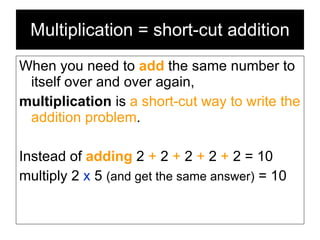
Multiplication = short-cut addition When you need to  add  the same number to itself over and over again, multiplication  is  a short-cut way to write the addition problem . Instead of  adding  2  +  2  +  2  +  2  +  2 = 10 multiply 2  x  5  (and get the same answer)  = 10
Powers = short-cut multiplication When you need to  multiply  the same number by itself over and over again, powers  are  a short-cut way to write the multiplication problem . Instead of  multiplying  2  x  2  x  2  x  2  x  2 =  32 Use the power  2 5  (and get the same answer)  = 32
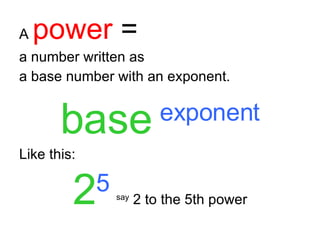
A  power  =   a number written as a base number with an exponent. base   exponent Like this: 2 5   say  2 to the 5th power
The  base (big number on the bottom) = the  repeated   factor  in a multiplication problem. base   exponent  =  power factor  x  factor  x  factor  x  factor  x  factor  =  product 2  x  2   x  2   x  2   x  2   =  32
The   exponent   (little number on the top right of base)  =  the  number of times  the base is multiplied   by itself. 2 5 2 (1 st  time)  x  2 (2 nd  time)  x  2 (3 rd  time)  x  2 (4 th  time)  x  2 (5 th   time)  =  32
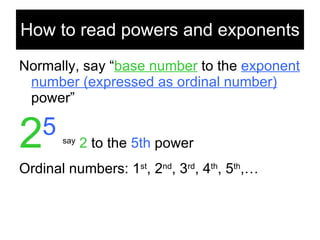
How to read powers and exponents Normally, say “ base number  to the  exponent number (expressed as ordinal number)  power” 2 5   say   2  to the  5th  power Ordinal numbers: 1 st , 2 nd , 3 rd , 4 th , 5 th ,…
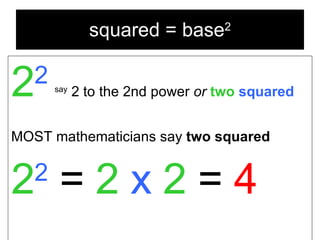
squared = base 2 2 2   say  2 to the 2nd power  or  two   squared MOST mathematicians say  two squared 2 2   =   2  x  2   =   4
cubed = base 3 2 3   say  2 to the 3rd power  or  two   cubed MOST mathematicians say  two cubed 2 3   =   2  x  2  x  2   =   8
Common Mistake 2 5  ≠ (does not equal)   2 x 5 2 5  ≠ (does not equal) 10 2 5  = 2  x  2  x  2  x  2  x  2 =  32
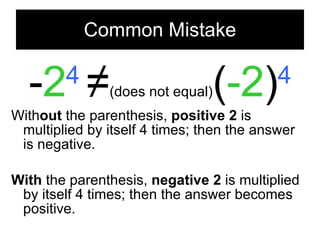
Common Mistake - 2 4  ≠ (does not equal) ( - 2 ) 4 With out  the parenthesis,  positive 2  is multiplied by itself 4 times; then the answer is negative. With  the parenthesis,  negative 2  is multiplied by itself 4 times; then the answer becomes positive.
Common mistake - 2 4  = (- 1 )x (x means times)   + 2 4  = - 1  x  + 2  x  + 2  x  + 2  x  + 2   = - 16 Why?   The  1  and the  positive sign  are invisible.  Anything x 1=anything, so  1 x 2 x 2 x 2 x 2 = 16;  and negative x positive = negative
Common Mistake ( - 2 ) 4 =   - 2  x  -2  x  -2  x  -2   =  +16 Why?   Multiply the numbers: 2 x 2 x 2 x 2 = 16 and then multiply the signs:  1 st  negative x 2 nd  negative = positive;  that positive x 3 rd  negative = negative;  that negative x 4 th  negative = positive;  so answer =  positive 16
When the  exponent  is  0 , and the base is any number  but  0,  the answer is 1 . 2 0   =   1    4,638 0   =  1 Any   number (except the number 0) 0  =  1 0 0  =  undefined
When the  exponent  is  1 , the answer is the same number as the base number . 2 1   =   2    4,638 1   =  4,638 any   number 1  = the  same  base “any number” 0 1  =  0
The exponent   1   is  usually   invisible .
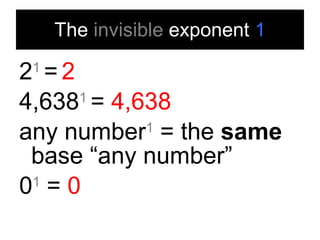
The   invisible   exponent  1 2 1   =   2    4,638 1   =  4,638 any   number 1  = the  same  base “any number” 0 1  =  0
2   =   2    4,638   =  4,638 any   number = the  same  “any number” as the base 0  =  0 The exponent  1  is here. Can you see it? It’s  invisible.  Or. It’s  understood. The  invisible   exponent  1
“Write a power as a product…” power = write the short-cut way means  2 5  =   2  x  2  x  2  x  2  x  2 product = write the long way = answer
“Find the value of the product…” means     answer 2 5  =  2  x  2  x  2  x  2  x  2  =  32 power =  product =  value of the product   (and value of the power)
“ Write prime factorization using exponents…” 125 = product  5   x   5   x   5   so   125 = power  5 3  = answer using exponents product  5 x 5 x 5 = power 5 3 Same exact answer written two different ways.
Congratulations! Now you know how to write a multiplication problem as a product using factors, or as a power using exponents (this can be called  exponential form ). You know how to (evaluate) find the value (answer) of a power.
Notes for teachers Correlates with Glencoe Mathematics (Florida Edition) texts:  Mathematics: Applications and Concepts Course 1: (red book) Chapter 1 Lesson 4 Powers and Exponents Mathematics: Applications and Concepts Course 2: (blue book) Chapter 1 Lesson 2: Powers and Exponents Pre-Algebra: (green book) Chapter 4 Lesson 2: Powers and Exponents For more information on my math class see  http:// walsh.edublogs.org

Powers and Exponents

  • 1.
    Powers andExponents
  • 2.
    Multiplication = short-cutaddition When you need to add the same number to itself over and over again, multiplication is a short-cut way to write the addition problem . Instead of adding 2 + 2 + 2 + 2 + 2 = 10 multiply 2 x 5 (and get the same answer) = 10
  • 3.
    Powers = short-cutmultiplication When you need to multiply the same number by itself over and over again, powers are a short-cut way to write the multiplication problem . Instead of multiplying 2 x 2 x 2 x 2 x 2 = 32 Use the power 2 5 (and get the same answer) = 32
  • 4.
    A power = a number written as a base number with an exponent. base exponent Like this: 2 5 say 2 to the 5th power
  • 5.
    The base(big number on the bottom) = the repeated factor in a multiplication problem. base exponent = power factor x factor x factor x factor x factor = product 2 x 2 x 2 x 2 x 2 = 32
  • 6.
    The exponent (little number on the top right of base) = the number of times the base is multiplied by itself. 2 5 2 (1 st time) x 2 (2 nd time) x 2 (3 rd time) x 2 (4 th time) x 2 (5 th time) = 32
  • 7.
    How to readpowers and exponents Normally, say “ base number to the exponent number (expressed as ordinal number) power” 2 5 say 2 to the 5th power Ordinal numbers: 1 st , 2 nd , 3 rd , 4 th , 5 th ,…
  • 8.
    squared = base2 2 2 say 2 to the 2nd power or two squared MOST mathematicians say two squared 2 2 = 2 x 2 = 4
  • 9.
    cubed = base3 2 3 say 2 to the 3rd power or two cubed MOST mathematicians say two cubed 2 3 = 2 x 2 x 2 = 8
  • 10.
    Common Mistake 25 ≠ (does not equal) 2 x 5 2 5 ≠ (does not equal) 10 2 5 = 2 x 2 x 2 x 2 x 2 = 32
  • 11.
    Common Mistake -2 4 ≠ (does not equal) ( - 2 ) 4 With out the parenthesis, positive 2 is multiplied by itself 4 times; then the answer is negative. With the parenthesis, negative 2 is multiplied by itself 4 times; then the answer becomes positive.
  • 12.
    Common mistake -2 4 = (- 1 )x (x means times) + 2 4 = - 1 x + 2 x + 2 x + 2 x + 2 = - 16 Why? The 1 and the positive sign are invisible. Anything x 1=anything, so 1 x 2 x 2 x 2 x 2 = 16; and negative x positive = negative
  • 13.
    Common Mistake (- 2 ) 4 = - 2 x -2 x -2 x -2 = +16 Why? Multiply the numbers: 2 x 2 x 2 x 2 = 16 and then multiply the signs: 1 st negative x 2 nd negative = positive; that positive x 3 rd negative = negative; that negative x 4 th negative = positive; so answer = positive 16
  • 14.
    When the exponent is 0 , and the base is any number but 0, the answer is 1 . 2 0 = 1 4,638 0 = 1 Any number (except the number 0) 0 = 1 0 0 = undefined
  • 15.
    When the exponent is 1 , the answer is the same number as the base number . 2 1 = 2 4,638 1 = 4,638 any number 1 = the same base “any number” 0 1 = 0
  • 16.
    The exponent 1 is usually invisible .
  • 17.
    The invisible exponent 1 2 1 = 2 4,638 1 = 4,638 any number 1 = the same base “any number” 0 1 = 0
  • 18.
    2 = 2 4,638 = 4,638 any number = the same “any number” as the base 0 = 0 The exponent 1 is here. Can you see it? It’s invisible. Or. It’s understood. The invisible exponent 1
  • 19.
    “Write a poweras a product…” power = write the short-cut way means 2 5 = 2 x 2 x 2 x 2 x 2 product = write the long way = answer
  • 20.
    “Find the valueof the product…” means answer 2 5 = 2 x 2 x 2 x 2 x 2 = 32 power = product = value of the product (and value of the power)
  • 21.
    “ Write primefactorization using exponents…” 125 = product 5 x 5 x 5 so 125 = power 5 3 = answer using exponents product 5 x 5 x 5 = power 5 3 Same exact answer written two different ways.
  • 22.
    Congratulations! Now youknow how to write a multiplication problem as a product using factors, or as a power using exponents (this can be called exponential form ). You know how to (evaluate) find the value (answer) of a power.
  • 23.
    Notes for teachersCorrelates with Glencoe Mathematics (Florida Edition) texts: Mathematics: Applications and Concepts Course 1: (red book) Chapter 1 Lesson 4 Powers and Exponents Mathematics: Applications and Concepts Course 2: (blue book) Chapter 1 Lesson 2: Powers and Exponents Pre-Algebra: (green book) Chapter 4 Lesson 2: Powers and Exponents For more information on my math class see http:// walsh.edublogs.org