GENERAL SCIENCE
WEATHER AND
CLIMATE
What is weather?
• Weather – is the
daily conditions in
the atmosphere in
a particular place
at a particular
time.
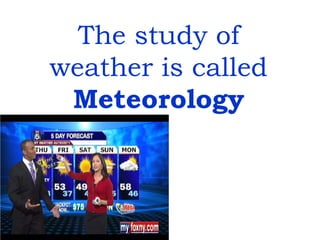
The study of
weather is called
Meteorology
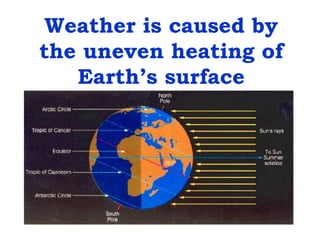
Weather is caused by
the uneven heating of
Earth’s surface
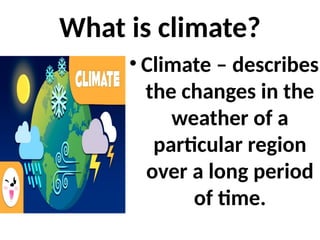
What is climate?
• Climate – describes
the changes in the
weather of a
particular region
over a long period
of time.
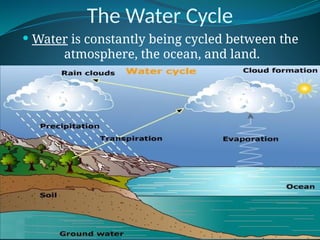
The Water Cycle
 Water is constantly being cycled between the
atmosphere, the ocean, and land.
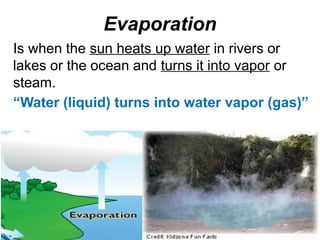
Evaporation
Is when the sun heats up water in rivers or
lakes or the ocean and turns it into vapor or
steam.
“Water (liquid) turns into water vapor (gas)”
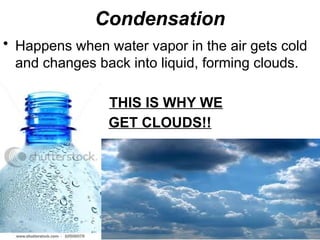
Condensation
• Happens when water vapor in the air gets cold
and changes back into liquid, forming clouds.
• THIS IS WHY WE
GET CLOUDS!!
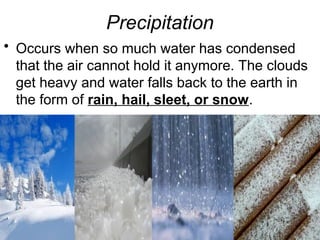
Precipitation
• Occurs when so much water has condensed
that the air cannot hold it anymore. The clouds
get heavy and water falls back to the earth in
the form of rain, hail, sleet, or snow.
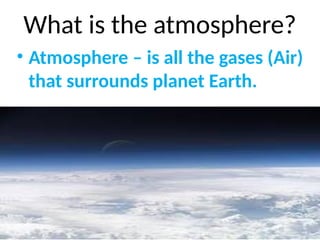
What is the atmosphere?
• Atmosphere – is all the gases (Air)
that surrounds planet Earth.
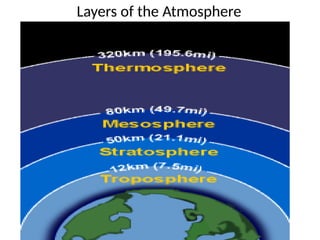
Layers of the Atmosphere
Troposphere
•Closest to the ground
•All weather happens here
•This is air you breathe
•Temperature decrease
•Pressure decreases
Layers of the Atmosphere
Stratosphere
•Ozone is inside this layer
•Ozone – layer of oxygen gas that absorbs
the suns radiation
•Temperature increases
•Pressure decreases
Layers of the Atmosphere
Mesosphere
•Meteors burn up in this layer
•Temperature decreases
•Pressure decreases
Layers of the Atmosphere
Thermosphere
• Last layer of air before entering space
• Temperature increases
• Pressure decreases
The Atmosphere
• As you increase your altitude
(Height off the ground /
distance above sea level):
•AIR PRESSURE DECREASES
•AIR TEMPERATURE DECREASES in
the Troposphere
The Atmosphere
• Air Pressure – the amount of force the
atmosphere is pushing down on you. Air
pressure decreases as altitude increases.
• Temperature – the amount of heat in the
atmosphere. The troposphere is heated from
the ground, so temperature decreases with
altitude.
HEAT TRANSFER
Heat can move from one object to another in
3 different ways.
1. CONDUCTION
2. CONVECTION
3. RADIATION
HEAT TRANSFER
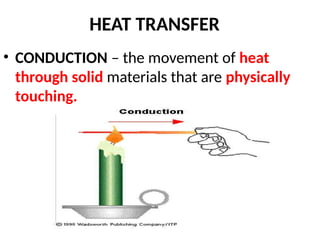
• CONDUCTION – the movement of heat
through solid materials that are physically
touching.
HEAT TRANSFER
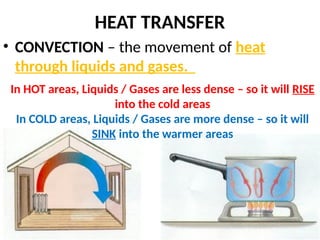
• CONVECTION – the movement of heat
through liquids and gases.
In HOT areas, Liquids / Gases are less dense – so it will RISE
into the cold areas
In COLD areas, Liquids / Gases are more dense – so it will
SINK into the warmer areas
HEAT TRANSFER
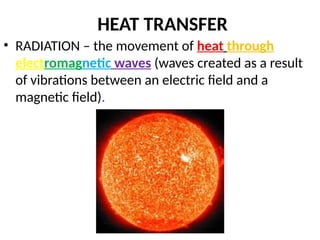
• RADIATION – the movement of heat through
electromagnetic waves (waves created as a result
of vibrations between an electric field and a
magnetic field).
What is wind?
• The movement of air caused by differences in
air pressure
• Differences in AIR PRESSURE are caused by
differences in air TEMPERATURE
Two types of Winds
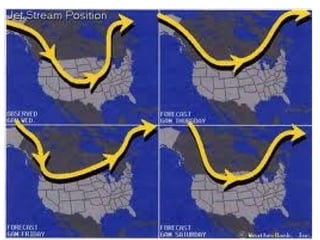
• GLOBAL Wind: Wind that is constantly blowing
in certain directions on different parts of the
earth
Ex. The Jet stream always moves across the
United States from West to East and determines
a lot of New York’s weather patterns.
• In the US, all weather moves towards the
Northeast
Local Winds
• LOCAL wind: wind that moves short distances
and can blow from any direction. They are
caused by the geography of the area.
• Ex. Land Breezes and Sea Breezes
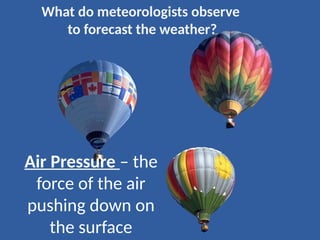
Air Pressure – the
force of the air
pushing down on
the surface
What do meteorologists observe
to forecast the weather?
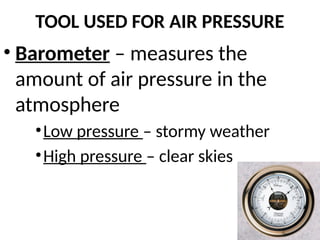
TOOL USED FOR AIR PRESSURE
• Barometer – measures the
amount of air pressure in the
atmosphere
•Low pressure – stormy weather
•High pressure – clear skies
• Humidity – amount of water vapor
the air is holding.
What do Meteorologists observe
to forecast the weather?
What do Meteorologists observe
to forecast the weather?
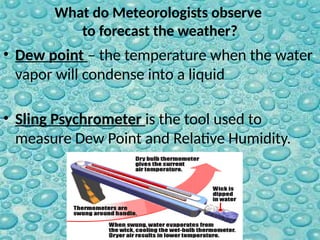
• Dew point – the temperature when the water
vapor will condense into a liquid
• Sling Psychrometer is the tool used to
measure Dew Point and Relative Humidity.
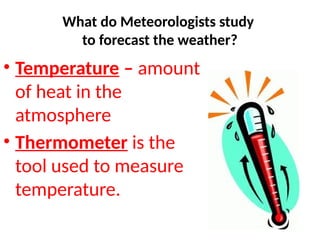
• Temperature – amount
of heat in the
atmosphere
• Thermometer is the
tool used to measure
temperature.
What do Meteorologists study
to forecast the weather?
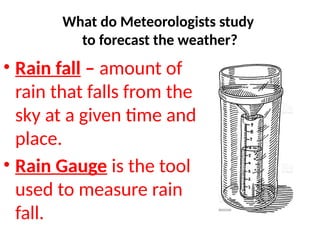
• Rain fall – amount of
rain that falls from the
sky at a given time and
place.
• Rain Gauge is the tool
used to measure rain
fall.
What do Meteorologists study
to forecast the weather?
What do meteorologists observe
to forecast the weather?
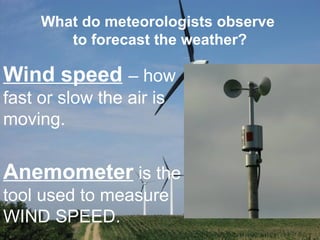
Wind speed – how
fast or slow the air is
moving.
Anemometer is the
tool used to measure
WIND SPEED.
What do meteorologists observe
to forecast the weather?
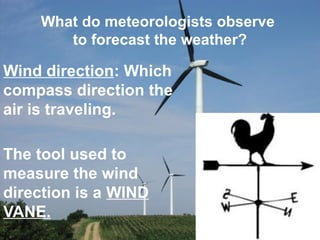
Wind direction: Which
compass direction the
air is traveling.
The tool used to
measure the wind
direction is a WIND
VANE.
MEMORIZE
THIS:
Clouds form when warm air
rises, expands and cools
below its dewpoint temp.
That is why clouds are
usually so high in the
Types of Clouds:
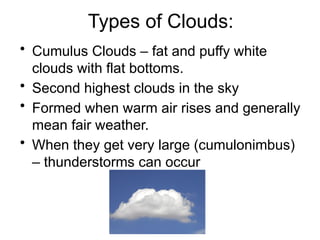
• Cumulus Clouds – fat and puffy white
clouds with flat bottoms.
• Second highest clouds in the sky
• Formed when warm air rises and generally
mean fair weather.
• When they get very large (cumulonimbus)
– thunderstorms can occur
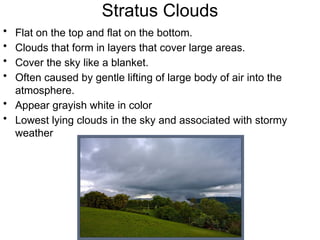
Stratus Clouds
• Flat on the top and flat on the bottom.
• Clouds that form in layers that cover large areas.
• Cover the sky like a blanket.
• Often caused by gentle lifting of large body of air into the
atmosphere.
• Appear grayish white in color
• Lowest lying clouds in the sky and associated with stormy
weather
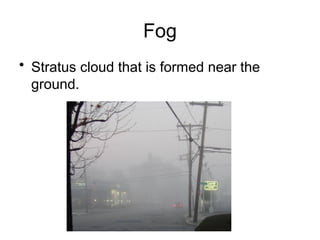
Fog
• Stratus cloud that is formed near the
ground.
Cirrus Clouds
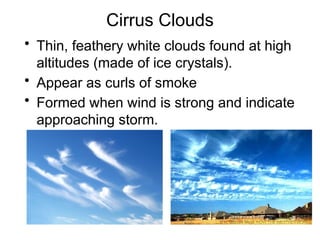
• Thin, feathery white clouds found at high
altitudes (made of ice crystals).
• Appear as curls of smoke
• Formed when wind is strong and indicate
approaching storm.
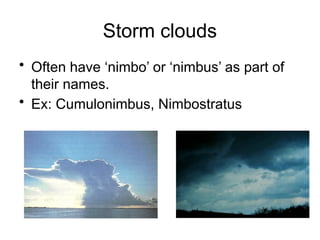
Storm clouds
• Often have ‘nimbo’ or ‘nimbus’ as part of
their names.
• Ex: Cumulonimbus, Nimbostratus
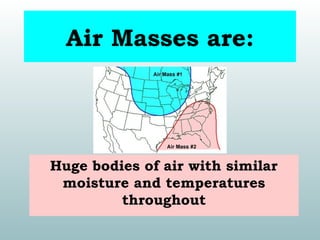
Air Masses are:
Huge bodies of air with similar
moisture and temperatures
throughout
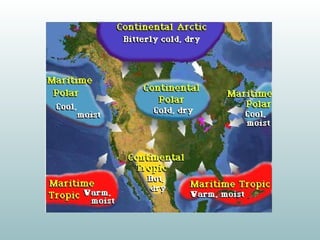
The characteristics of air masses
come from their source region
(where they form)
• If they develop over water
(maritime) = MOIST
• If they develop over land
(continental) = DRY
• If they develop over cold areas
(polar) = COOL
• If they develop over warm areas
(tropical) = WARM
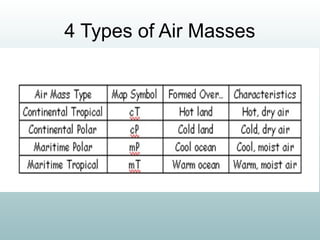
4 Types of Air Masses
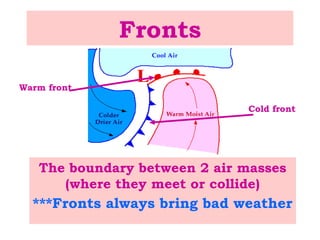
Fronts
The boundary between 2 air masses
(where they meet or collide)
***Fronts always bring bad weather
Warm front
Cold front
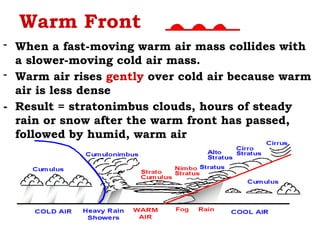
Warm Front
- When a fast-moving warm air mass collides with
a slower-moving cold air mass.
- Warm air rises gently over cold air because warm
air is less dense
- Result = stratonimbus clouds, hours of steady
rain or snow after the warm front has passed,
followed by humid, warm air
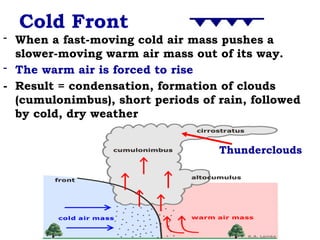
Cold Front
- When a fast-moving cold air mass pushes a
slower-moving warm air mass out of its way.
- The warm air is forced to rise
- Result = condensation, formation of clouds
(cumulonimbus), short periods of rain, followed
by cold, dry weather
Thunderclouds
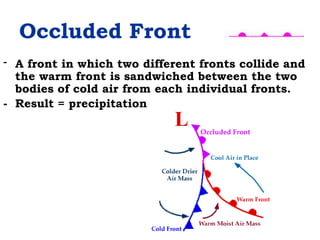
Occluded Front
- A front in which two different fronts collide and
the warm front is sandwiched between the two
bodies of cold air from each individual fronts.
- Result = precipitation
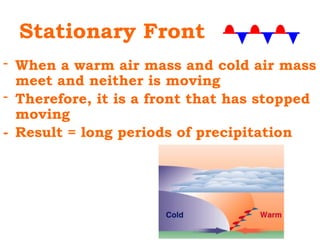
Stationary Front
- When a warm air mass and cold air mass
meet and neither is moving
- Therefore, it is a front that has stopped
moving
- Result = long periods of precipitation
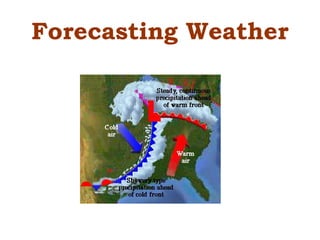
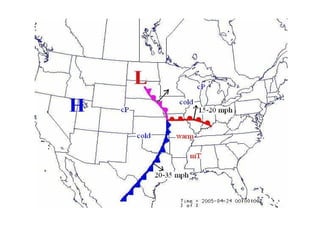
Forecasting Weather
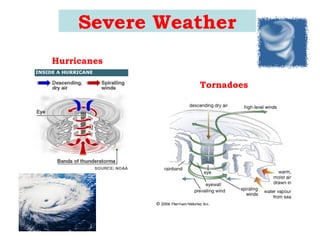
Severe Weather
Hurricanes
Tornadoes
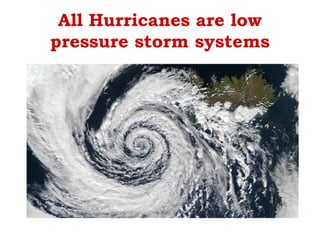
All Hurricanes are low
pressure storm systems
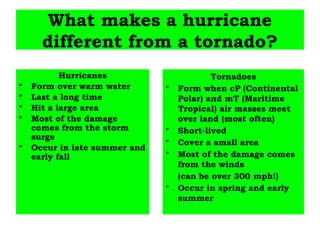
What makes a hurricane
different from a tornado?
Hurricanes
• Form over warm water
• Last a long time
• Hit a large area
• Most of the damage
comes from the storm
surge
• Occur in late summer and
early fall
Tornadoes
• Form when cP (Continental
Polar) and mT (Maritime
Tropical) air masses meet
over land (most often)
• Short-lived
• Cover a small area
• Most of the damage comes
from the winds
(can be over 300 mph!)
• Occur in spring and early
summer
Destructive Weather
• Weather can become a very
destructive force of nature.
• It can threaten life and
property.
• Bad weather can also be a
very expensive
phenomenon.
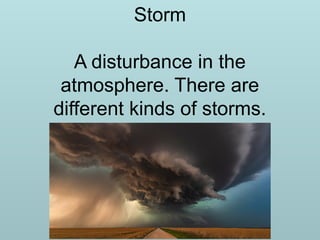
Storm
A disturbance in the
atmosphere. There are
different kinds of storms.
Thunderstorms
• Forms over a small area
• Intense weather systems that produce:
1. Strong winds
2. Heavy rain
3. Lightning and thunder
• Can accompany a weather front
• Known by large cumulonimbus or
thunder head clouds that are formed
When do Thunderstorms occur?
• Two atmospheric conditions required for
thunderstorms
1- Moist warm air near the Earth’s surface
2- Unstable atmosphere (cold air
surrounding a rising air mass)
Lightning
• Movement of thunder clouds in the sky
generates lightning. An electric discharge
that occurs between a positively charged
area and a negatively charged area
Can occur:
1. Cloud to cloud
2. Cloud to earth
3. In the same cloud
• https://
www.youtube.com/watch?v=EM_sN_YH
Now
Thunder
• The sound that results from rapid
movement of air along a lightning strike
• As lightning flashes through the sky, it
causes the air to expand suddenly. With
this sudden expansion comes the loud
rumble we call thunder
• Occurs during Thunderstorms
• Lightning first – then thunder because light
travels faster than sound.
Tornado
• A violent, cyclonic (spinning) thunderstorm.
• Usually develops during severe thunderstorms
• Has high wind speed with low pressure that touches the
ground
Formation-
http://dsc.discovery.com/tv/storm-chasers/
• Wind moving in 2 directions cause the air to spin with
cloud, creating a funnel
• When funnel cloud touches the surface, it is now a
tornado
• Winds – 120+ km/hr (up to 300 MPH)
• Tornados do not last long
Hurricanes
• A large rotating, tropical weather system that bring terrestrial
rains, high wind speeds of at least 120 km/h, and widespread
destruction due to flooding and gusting winds
• Most powerful storms on earth and most destructive weather
phenomenon
• Form over warm, tropical oceans
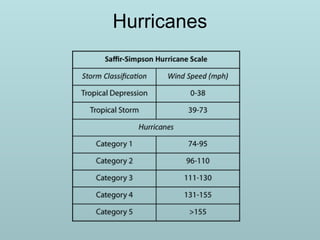
• Category 1-5
• Storm surge and flooding in coastal areas
• Center of the hurricane is known as the “eye”. It is very calm
in the “eye” of the hurricane
• Around the edges of the “eye” of the hurricane, the strongest
winds are found
• The winds determine the strength and power behind the
storm
• http://dsc.discovery.com/news/video/hurricanegallery.html
Hurricanes
Hurricane formation
• Forms over Tropical seas in the warm summer
months
• In the Bahamas, hurricane season extends
from June 1st
to November 30th
• Spin counter clockwise in Northern Hemisphere
and clockwise in the southern due to the
Coriolus Effect (Spin of earth)
• Warm moist air fuels hurricanes
• Must have LOW pressure
• Hurricanes die once they move over colder
water or land
Blizzards
• Huge winter storms with high winds, heavy
snow, and sometimes lightning and
thunder.
• Ice storms can occur as rainfall begins to
freeze and can disrupt electric and phone
service.
• Can cause power outages and dangerous
travel conditions. Frostbite and
hypothermia can result.
Severe Weather Safety
• Listen to the radio/TV during storm for
information
• Lightning is attracted to tall objects if
outside stay away from trees or lay down if
in the open
• Stay out of bodies of water during a storm
Climate Change
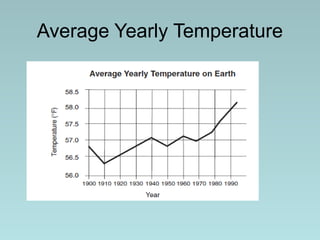
• Scientists around the world believe that
the Earth’s temperature is gradually
increasing.
• Global warming – is the name for the
gradual increase of average temperatures
worldwide.
• Scientists believe that an increase in CO2
emissions is causing the temperature to
rise.
Average Yearly Temperature
What causes Global Warming?
• When Carbon Dioxide CO2 is trapped in
the atmosphere, it causes the
GREENHOUSE EFFECT
• Water Vapor and Carbon Dioxide in the
atmosphere trap heat and don’t let it
escape into space.
“These greenhouse gases act like a blanket”
What human activities cause
excess CO2 (Global Warming)
• Breathing
• Burning Fossil Fuels
– such as coal, oil, gas
• Deforestation (cutting down trees that use
up CO2 when they photosynthesize)
What effect does Global
Warming have on the earth?
• Melting Ice Caps in the Arctic and Antarctic
which cause rising sea levels
• Plants/trees growing season is affected
• Animals like polar bears have to relocate
due to loss of ice (habitat)
• Ocean waters are warmer causing large
cylconic (hurricanes) storms and death to
some sea life.
How can we reduce CO2 emissions?
• Burn less fossil fuels (NON-RENEWABLE)
– Use less electricity (shut off lights, unplug
appliances, buy energy efficient appliances)
– Use less fuel (gas for cars) by carpooling,
taking public transportation, smaller cars
• Use Renewable sources of energy
– Use solar energy to produce electricity
– Use wind energy to produce electricity
– Use water energy (dams) to produce electricity
– Use geothermal energy to heat our homes

Weather and Climate PowerPoint Presentation

  • 1.
  • 2.
    What is weather? •Weather – is the daily conditions in the atmosphere in a particular place at a particular time.
  • 3.
    The study of weatheris called Meteorology
  • 4.
    Weather is causedby the uneven heating of Earth’s surface
  • 5.
    What is climate? •Climate – describes the changes in the weather of a particular region over a long period of time.
  • 6.
    The Water Cycle Water is constantly being cycled between the atmosphere, the ocean, and land.
  • 7.
    Evaporation Is when thesun heats up water in rivers or lakes or the ocean and turns it into vapor or steam. “Water (liquid) turns into water vapor (gas)”
  • 8.
    Condensation • Happens whenwater vapor in the air gets cold and changes back into liquid, forming clouds. • THIS IS WHY WE GET CLOUDS!!
  • 9.
    Precipitation • Occurs whenso much water has condensed that the air cannot hold it anymore. The clouds get heavy and water falls back to the earth in the form of rain, hail, sleet, or snow.
  • 10.
    What is theatmosphere? • Atmosphere – is all the gases (Air) that surrounds planet Earth.
  • 11.
    Layers of theAtmosphere
  • 12.
    Layers of theAtmosphere Troposphere •Closest to the ground •All weather happens here •This is air you breathe •Temperature decrease •Pressure decreases
  • 13.
    Layers of theAtmosphere Stratosphere •Ozone is inside this layer •Ozone – layer of oxygen gas that absorbs the suns radiation •Temperature increases •Pressure decreases
  • 14.
    Layers of theAtmosphere Mesosphere •Meteors burn up in this layer •Temperature decreases •Pressure decreases
  • 15.
    Layers of theAtmosphere Thermosphere • Last layer of air before entering space • Temperature increases • Pressure decreases
  • 16.
    The Atmosphere • Asyou increase your altitude (Height off the ground / distance above sea level): •AIR PRESSURE DECREASES •AIR TEMPERATURE DECREASES in the Troposphere
  • 17.
    The Atmosphere • AirPressure – the amount of force the atmosphere is pushing down on you. Air pressure decreases as altitude increases. • Temperature – the amount of heat in the atmosphere. The troposphere is heated from the ground, so temperature decreases with altitude.
  • 18.
    HEAT TRANSFER Heat canmove from one object to another in 3 different ways. 1. CONDUCTION 2. CONVECTION 3. RADIATION
  • 19.
    HEAT TRANSFER • CONDUCTION– the movement of heat through solid materials that are physically touching.
  • 20.
    HEAT TRANSFER • CONVECTION– the movement of heat through liquids and gases. In HOT areas, Liquids / Gases are less dense – so it will RISE into the cold areas In COLD areas, Liquids / Gases are more dense – so it will SINK into the warmer areas
  • 21.
    HEAT TRANSFER • RADIATION– the movement of heat through electromagnetic waves (waves created as a result of vibrations between an electric field and a magnetic field).
  • 22.
    What is wind? •The movement of air caused by differences in air pressure • Differences in AIR PRESSURE are caused by differences in air TEMPERATURE
  • 23.
    Two types ofWinds • GLOBAL Wind: Wind that is constantly blowing in certain directions on different parts of the earth Ex. The Jet stream always moves across the United States from West to East and determines a lot of New York’s weather patterns. • In the US, all weather moves towards the Northeast
  • 25.
    Local Winds • LOCALwind: wind that moves short distances and can blow from any direction. They are caused by the geography of the area. • Ex. Land Breezes and Sea Breezes
  • 26.
    Air Pressure –the force of the air pushing down on the surface What do meteorologists observe to forecast the weather?
  • 27.
    TOOL USED FORAIR PRESSURE • Barometer – measures the amount of air pressure in the atmosphere •Low pressure – stormy weather •High pressure – clear skies
  • 28.
    • Humidity –amount of water vapor the air is holding. What do Meteorologists observe to forecast the weather?
  • 29.
    What do Meteorologistsobserve to forecast the weather? • Dew point – the temperature when the water vapor will condense into a liquid • Sling Psychrometer is the tool used to measure Dew Point and Relative Humidity.
  • 30.
    • Temperature –amount of heat in the atmosphere • Thermometer is the tool used to measure temperature. What do Meteorologists study to forecast the weather?
  • 31.
    • Rain fall– amount of rain that falls from the sky at a given time and place. • Rain Gauge is the tool used to measure rain fall. What do Meteorologists study to forecast the weather?
  • 32.
    What do meteorologistsobserve to forecast the weather? Wind speed – how fast or slow the air is moving. Anemometer is the tool used to measure WIND SPEED.
  • 33.
    What do meteorologistsobserve to forecast the weather? Wind direction: Which compass direction the air is traveling. The tool used to measure the wind direction is a WIND VANE.
  • 34.
    MEMORIZE THIS: Clouds form whenwarm air rises, expands and cools below its dewpoint temp. That is why clouds are usually so high in the
  • 35.
    Types of Clouds: •Cumulus Clouds – fat and puffy white clouds with flat bottoms. • Second highest clouds in the sky • Formed when warm air rises and generally mean fair weather. • When they get very large (cumulonimbus) – thunderstorms can occur
  • 36.
    Stratus Clouds • Flaton the top and flat on the bottom. • Clouds that form in layers that cover large areas. • Cover the sky like a blanket. • Often caused by gentle lifting of large body of air into the atmosphere. • Appear grayish white in color • Lowest lying clouds in the sky and associated with stormy weather
  • 37.
    Fog • Stratus cloudthat is formed near the ground.
  • 38.
    Cirrus Clouds • Thin,feathery white clouds found at high altitudes (made of ice crystals). • Appear as curls of smoke • Formed when wind is strong and indicate approaching storm.
  • 39.
    Storm clouds • Oftenhave ‘nimbo’ or ‘nimbus’ as part of their names. • Ex: Cumulonimbus, Nimbostratus
  • 40.
    Air Masses are: Hugebodies of air with similar moisture and temperatures throughout
  • 41.
    The characteristics ofair masses come from their source region (where they form) • If they develop over water (maritime) = MOIST • If they develop over land (continental) = DRY • If they develop over cold areas (polar) = COOL • If they develop over warm areas (tropical) = WARM
  • 43.
    4 Types ofAir Masses
  • 44.
    Fronts The boundary between2 air masses (where they meet or collide) ***Fronts always bring bad weather Warm front Cold front
  • 45.
    Warm Front - Whena fast-moving warm air mass collides with a slower-moving cold air mass. - Warm air rises gently over cold air because warm air is less dense - Result = stratonimbus clouds, hours of steady rain or snow after the warm front has passed, followed by humid, warm air
  • 46.
    Cold Front - Whena fast-moving cold air mass pushes a slower-moving warm air mass out of its way. - The warm air is forced to rise - Result = condensation, formation of clouds (cumulonimbus), short periods of rain, followed by cold, dry weather Thunderclouds
  • 47.
    Occluded Front - Afront in which two different fronts collide and the warm front is sandwiched between the two bodies of cold air from each individual fronts. - Result = precipitation
  • 48.
    Stationary Front - Whena warm air mass and cold air mass meet and neither is moving - Therefore, it is a front that has stopped moving - Result = long periods of precipitation
  • 49.
  • 51.
  • 52.
    All Hurricanes arelow pressure storm systems
  • 53.
    What makes ahurricane different from a tornado? Hurricanes • Form over warm water • Last a long time • Hit a large area • Most of the damage comes from the storm surge • Occur in late summer and early fall Tornadoes • Form when cP (Continental Polar) and mT (Maritime Tropical) air masses meet over land (most often) • Short-lived • Cover a small area • Most of the damage comes from the winds (can be over 300 mph!) • Occur in spring and early summer
  • 54.
  • 55.
    • Weather canbecome a very destructive force of nature. • It can threaten life and property. • Bad weather can also be a very expensive phenomenon.
  • 56.
    Storm A disturbance inthe atmosphere. There are different kinds of storms.
  • 57.
    Thunderstorms • Forms overa small area • Intense weather systems that produce: 1. Strong winds 2. Heavy rain 3. Lightning and thunder • Can accompany a weather front • Known by large cumulonimbus or thunder head clouds that are formed
  • 58.
    When do Thunderstormsoccur? • Two atmospheric conditions required for thunderstorms 1- Moist warm air near the Earth’s surface 2- Unstable atmosphere (cold air surrounding a rising air mass)
  • 59.
    Lightning • Movement ofthunder clouds in the sky generates lightning. An electric discharge that occurs between a positively charged area and a negatively charged area Can occur: 1. Cloud to cloud 2. Cloud to earth 3. In the same cloud • https:// www.youtube.com/watch?v=EM_sN_YH Now
  • 60.
    Thunder • The soundthat results from rapid movement of air along a lightning strike • As lightning flashes through the sky, it causes the air to expand suddenly. With this sudden expansion comes the loud rumble we call thunder • Occurs during Thunderstorms • Lightning first – then thunder because light travels faster than sound.
  • 61.
    Tornado • A violent,cyclonic (spinning) thunderstorm. • Usually develops during severe thunderstorms • Has high wind speed with low pressure that touches the ground Formation- http://dsc.discovery.com/tv/storm-chasers/ • Wind moving in 2 directions cause the air to spin with cloud, creating a funnel • When funnel cloud touches the surface, it is now a tornado • Winds – 120+ km/hr (up to 300 MPH) • Tornados do not last long
  • 62.
    Hurricanes • A largerotating, tropical weather system that bring terrestrial rains, high wind speeds of at least 120 km/h, and widespread destruction due to flooding and gusting winds • Most powerful storms on earth and most destructive weather phenomenon • Form over warm, tropical oceans • Category 1-5 • Storm surge and flooding in coastal areas • Center of the hurricane is known as the “eye”. It is very calm in the “eye” of the hurricane • Around the edges of the “eye” of the hurricane, the strongest winds are found • The winds determine the strength and power behind the storm • http://dsc.discovery.com/news/video/hurricanegallery.html
  • 63.
  • 64.
    Hurricane formation • Formsover Tropical seas in the warm summer months • In the Bahamas, hurricane season extends from June 1st to November 30th • Spin counter clockwise in Northern Hemisphere and clockwise in the southern due to the Coriolus Effect (Spin of earth) • Warm moist air fuels hurricanes • Must have LOW pressure • Hurricanes die once they move over colder water or land
  • 65.
    Blizzards • Huge winterstorms with high winds, heavy snow, and sometimes lightning and thunder. • Ice storms can occur as rainfall begins to freeze and can disrupt electric and phone service. • Can cause power outages and dangerous travel conditions. Frostbite and hypothermia can result.
  • 66.
    Severe Weather Safety •Listen to the radio/TV during storm for information • Lightning is attracted to tall objects if outside stay away from trees or lay down if in the open • Stay out of bodies of water during a storm
  • 67.
    Climate Change • Scientistsaround the world believe that the Earth’s temperature is gradually increasing. • Global warming – is the name for the gradual increase of average temperatures worldwide. • Scientists believe that an increase in CO2 emissions is causing the temperature to rise.
  • 68.
  • 69.
    What causes GlobalWarming? • When Carbon Dioxide CO2 is trapped in the atmosphere, it causes the GREENHOUSE EFFECT • Water Vapor and Carbon Dioxide in the atmosphere trap heat and don’t let it escape into space. “These greenhouse gases act like a blanket”
  • 70.
    What human activitiescause excess CO2 (Global Warming) • Breathing • Burning Fossil Fuels – such as coal, oil, gas • Deforestation (cutting down trees that use up CO2 when they photosynthesize)
  • 71.
    What effect doesGlobal Warming have on the earth? • Melting Ice Caps in the Arctic and Antarctic which cause rising sea levels • Plants/trees growing season is affected • Animals like polar bears have to relocate due to loss of ice (habitat) • Ocean waters are warmer causing large cylconic (hurricanes) storms and death to some sea life.
  • 72.
    How can wereduce CO2 emissions? • Burn less fossil fuels (NON-RENEWABLE) – Use less electricity (shut off lights, unplug appliances, buy energy efficient appliances) – Use less fuel (gas for cars) by carpooling, taking public transportation, smaller cars • Use Renewable sources of energy – Use solar energy to produce electricity – Use wind energy to produce electricity – Use water energy (dams) to produce electricity – Use geothermal energy to heat our homes

Editor's Notes

  • #19 Other examples of conduction: Warming you back muscles with a heating pad, the heat from a hot liquid makes the cup itself hot, metal spoon propped up in a pot will become hot from the boiling water in the pot, etc.
  • #43 Continental Tropical – American Deserts, Continental Polar – Over Canada, Maritime Polar – North Atlantic Ocean, and Maritime Tropical – Caribbean Sea.