Physical Resources - ForestryPresented by Mr. D. Gooden
PHYSICALRESOURCESFORESTRY
Revision ExerciseOk students, tell me, what 		do you remember 			“resources” to be?
How about physical resources?Very good! What two categories are 		physical resources classified into?
Good! Tell me now, what is the 			difference between renewable and 		non-renewable resources? Very Good!
FORESTToday we will look at a very precious but delicate resource – the forest.	This resource regulates the world’s temperature.The forest is said to be the “lungs of the earth”. What do you think this means?The world’s environment owes much of its  state of health to the presence of forests. So too does human survival and welfare.
A forest is a community of trees, shrubs, herbs, and associated plants and organisms that cover a considerable area that use oxygen, water and soil nutrients as the community attains maturity and reproduces itself. WHAT IS A FOREST?
TYPES OF FORESTThere are different types of forests which can be seen in different parts of the world.
TYPES OF FORESTThough they may be different, they generallyperform the same ecological functions. These types of forests are:
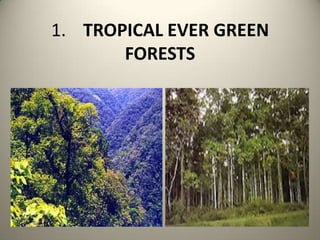
1.	TROPICAL EVER GREEN FORESTS
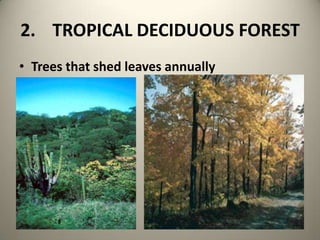
2.	TROPICAL DECIDUOUS FORESTTrees that shed leaves annually
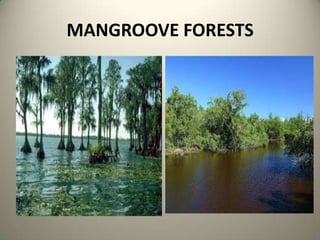
MANGROOVE FORESTS
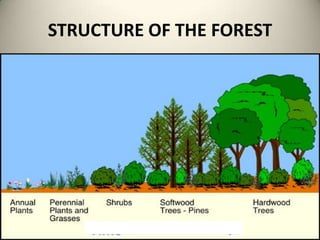
STRUCTURE OF THE FOREST
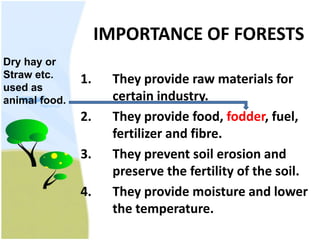
IMPORTANCE OF FORESTSDry hay orStraw etc. used as animal food.1.They provide raw materials for 	certain industry. 	2.		They provide food, fodder, fuel, 	fertilizer and fibre.3.		They prevent soil erosion and 	preserve the fertility of the soil.4.		They provide moisture and lower 	the temperature.
IMPORTANCE OF FORESTSThey are the home for many 	animals and birds, thus , they preserve the biodiversity.They maintain the ecological balance. They provide medicinal value resulting in the making of many medicinal drugs.Forests also help to alleviate psychological stress arising from the trials of modern society.
IMPORTANCE OF FORESTS9.	They provide the opportunity for relaxation and meditation – can lead to the development of eco-tourism.
Habitats of the ForestsThere are many creatures that depend on the forest for their survival. Should this precious habitat be destroyed, they will become extinct for they will not be able to survive anywhere else.
Habitats of the ForestsWILD LIFE - means the native animals of a regionENDANGERED SPECIES -These are the species, which are in danger of extinction and which may not survive if the adverse factors continue to rotate.VULNERABLE SPECIES - The species likely to move into the endangered category in the near future if the causal adverse factors continue to operate.
Habitats of the ForestsRARE SPECIES - These are the species with small population in the world and are at risk.THREATENED SPECIES - These are Species, which are in any one of the Endangered, Vulnerable, Rare Species categories.
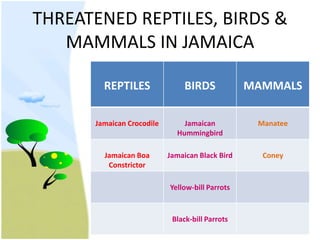
THREATENED REPTILES, BIRDS & MAMMALS IN JAMAICA
REASONS FOR DEPLETION OF WILDLIFEAbsence of shelter to wild animals.DeforestationDestruction of wild plants which affects the survival of wild  animalsPollution
Why is it necessary to conserve Wild Life?The wild life helps us in maintaining balance of nature. It can increase our foreign exchange if linked       with tourism.  The preservation of wild life helps to make their study easy.The wild life of the Caribbean is our cultural asset and had deep rooted effect on Caribbean art, sculpture and religion.
Wow! What a mouthful!Let’s now look at theROLE OF THE FOREST
   Promotes rainfall
   Prevents soil erosion
   Prevents flooding
   Maintains the composition of the atmosphere
   Reduces noise pollution   Acts as a wind barrier from heavy winds
   Provides medicinal remedies
   Recreation
   Lumber for the construction industryAll these benefits will be of no effect if we do not care for the trees in the forests.To care for the forests, we must identify what are the causes of its destruction.

Forest

  • 1.
    Physical Resources -ForestryPresented by Mr. D. Gooden
  • 2.
  • 3.
    Revision ExerciseOk students,tell me, what do you remember “resources” to be?
  • 4.
    How about physicalresources?Very good! What two categories are physical resources classified into?
  • 5.
    Good! Tell menow, what is the difference between renewable and non-renewable resources? Very Good!
  • 6.
    FORESTToday we willlook at a very precious but delicate resource – the forest. This resource regulates the world’s temperature.The forest is said to be the “lungs of the earth”. What do you think this means?The world’s environment owes much of its state of health to the presence of forests. So too does human survival and welfare.
  • 7.
    A forest isa community of trees, shrubs, herbs, and associated plants and organisms that cover a considerable area that use oxygen, water and soil nutrients as the community attains maturity and reproduces itself. WHAT IS A FOREST?
  • 8.
    TYPES OF FORESTThereare different types of forests which can be seen in different parts of the world.
  • 9.
    TYPES OF FORESTThoughthey may be different, they generallyperform the same ecological functions. These types of forests are:
  • 10.
  • 11.
    2. TROPICAL DECIDUOUS FORESTTreesthat shed leaves annually
  • 13.
  • 14.
  • 15.
    IMPORTANCE OF FORESTSDryhay orStraw etc. used as animal food.1.They provide raw materials for certain industry. 2. They provide food, fodder, fuel, fertilizer and fibre.3. They prevent soil erosion and preserve the fertility of the soil.4. They provide moisture and lower the temperature.
  • 16.
    IMPORTANCE OF FORESTSTheyare the home for many animals and birds, thus , they preserve the biodiversity.They maintain the ecological balance. They provide medicinal value resulting in the making of many medicinal drugs.Forests also help to alleviate psychological stress arising from the trials of modern society.
  • 17.
    IMPORTANCE OF FORESTS9. Theyprovide the opportunity for relaxation and meditation – can lead to the development of eco-tourism.
  • 18.
    Habitats of theForestsThere are many creatures that depend on the forest for their survival. Should this precious habitat be destroyed, they will become extinct for they will not be able to survive anywhere else.
  • 19.
    Habitats of theForestsWILD LIFE - means the native animals of a regionENDANGERED SPECIES -These are the species, which are in danger of extinction and which may not survive if the adverse factors continue to rotate.VULNERABLE SPECIES - The species likely to move into the endangered category in the near future if the causal adverse factors continue to operate.
  • 20.
    Habitats of theForestsRARE SPECIES - These are the species with small population in the world and are at risk.THREATENED SPECIES - These are Species, which are in any one of the Endangered, Vulnerable, Rare Species categories.
  • 21.
    THREATENED REPTILES, BIRDS& MAMMALS IN JAMAICA
  • 22.
    REASONS FOR DEPLETIONOF WILDLIFEAbsence of shelter to wild animals.DeforestationDestruction of wild plants which affects the survival of wild animalsPollution
  • 23.
    Why is itnecessary to conserve Wild Life?The wild life helps us in maintaining balance of nature. It can increase our foreign exchange if linked with tourism. The preservation of wild life helps to make their study easy.The wild life of the Caribbean is our cultural asset and had deep rooted effect on Caribbean art, sculpture and religion.
  • 25.
    Wow! What amouthful!Let’s now look at theROLE OF THE FOREST
  • 26.
    Promotes rainfall
  • 27.
    Prevents soil erosion
  • 28.
    Prevents flooding
  • 29.
    Maintains the composition of the atmosphere
  • 30.
    Reduces noise pollution Acts as a wind barrier from heavy winds
  • 31.
    Provides medicinal remedies
  • 32.
    Recreation
  • 33.
    Lumber for the construction industryAll these benefits will be of no effect if we do not care for the trees in the forests.To care for the forests, we must identify what are the causes of its destruction.