The meaning of a river.
 A river is a natural stream of freshwater flowing towards
  an ocean, a lake, a sea, or another river. In a few cases, a
  river simply flows into the ground or dries up completely
  before reaching another source of water. Small rivers may
  also be called by several other names, including stream,
  creek, brook, rivulet, tributary and rill. There are no official
  definitions for generic terms, such as river, as applied to
  geographic features, although in some countries or
  communities a stream may be defined by its size. Many
  names for small rivers are specific to geographic location;
  one example is "burn" in Scotland and northeast England.
  Sometimes a river is said to be larger than a creek, but this
  is not always the case, because of the difference in the
  language.
How do Rivers form?
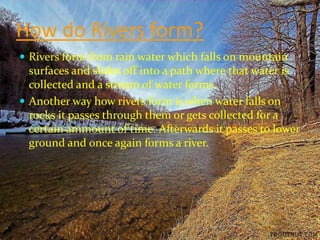
 Rivers form from rain water which falls on mountain
  surfaces and slides off into a path where that water is
  collected and a stream of water forms.
 Another way how rivers form is when water falls on
  rocks it passes through them or gets collected for a
  certain ammount of time. Afterwards it passes to lower
  ground and once again forms a river.
River Basins
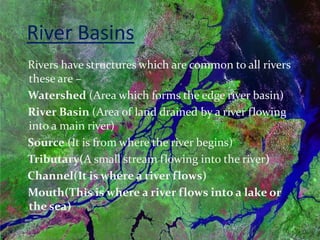
Rivers have structures which are common to all rivers
these are –
Watershed (Area which forms the edge river basin)
River Basin (Area of land drained by a river flowing
into a main river)
Source (It is from where the river begins)
Tributary(A small stream flowing into the river)
Channel(It is where a river flows)
Mouth(This is where a river flows into a lake or
the sea)
The biggest!
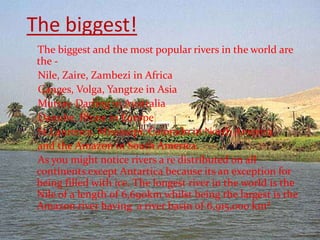
 The biggest and the most popular rivers in the world are
 the -
 Nile, Zaire, Zambezi in Africa
 Ganges, Volga, Yangtze in Asia
 Murray-Darling in Australia
 Danube, Rhine in Europe
 St.Laurence, Mississipi, Colorado in North America
 and the Amazon in South America.
 As you might notice rivers a re distributed on all
 continents except Antartica because its an exception for
 being filled with ice. The longest river in the world is the
 Nile of a length of 6,690km whilst being the largest is the
 Amazon river having a river basin of 6,915,000 km²
Flooding
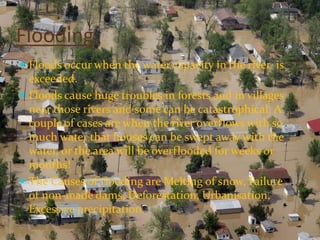
 Floods occur when the water capacity in the river is
  exceeded.
 Floods cause huge troubles in forests and in villages
  near those rivers and some can be catastrophical. A
  couple of cases are when the river overflows with so
  much water that houses can be swept away with the
  water, or the area will be overflooded for weeks or
  months!
 The Causes of flooding are Melting of snow, Failure
  of non-made dams, Deforestation, Urbanisation,
  Excessive precipitation.
Preventing, Helping and supporting
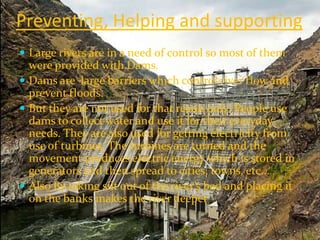
 Large rivers are in a need of control so most of them
  were provided with Dams.
 Dams are large barriers which control river flow and
  prevent floods.
 But they are not used for that reaon only! People use
  dams to collect water and use it for their everyday
  needs. They are also used for getting electricity from
  use of turbines. The turbines are turned and the
  movement produces electric energy which is stored in
  generators and then spread to cities, towns, etc...
 Also By taking silt out of the river’s bed and placing it
  on the banks makes the river deeper
Waterfalls.
 There are many types of rivers which have different types
  of structures.
 Most rivers start forming in the mountains and continue
  slowly to descend to sea level while some descend to only
  a few meters and then end up becoming a waterfall.
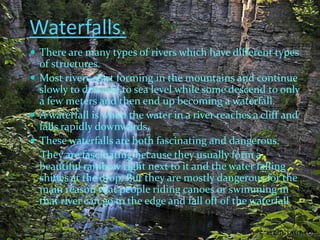
 A waterfall is when the water in a river reaches a cliff and
  falls rapidly downwards.
 These waterfalls are both fascinating and dangerous.
  They are fascinating because they usually form a
  beautiful rainbow right next to it and the water falling
  shines at the drop. But they are mostly dangerous for the
  main reason that people riding canoes or swimming in
  that river can go to the edge and fall off of the waterfall!
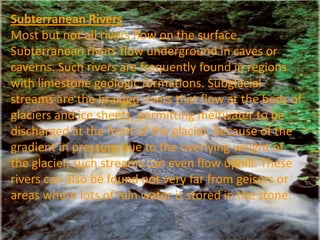
Subterranean Rivers
Most but not all rivers flow on the surface.
Subterranean rivers flow underground in caves or
caverns. Such rivers are frequently found in regions
with limestone geologic formations. Subglacial
streams are the braided rivers that flow at the beds of
glaciers and ice sheets, permitting meltwater to be
discharged at the front of the glacier. Because of the
gradient in pressure due to the overlying weight of
the glacier, such streams can even flow uphill. These
rivers can also be found not very far from geisers or
areas where lots of rain water is stored in the stone.
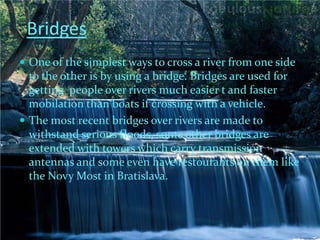
Bridges
 One of the simplest ways to cross a river from one side
  to the other is by using a bridge. Bridges are used for
  getting people over rivers much easier t and faster
  mobilation than boats if crossing with a vehicle.
 The most recent bridges over rivers are made to
  withstand serious floods, some other bridges are
  extended with towers which carry transmission
  antennas and some even have restourants on them like
  the Novy Most in Bratislava.
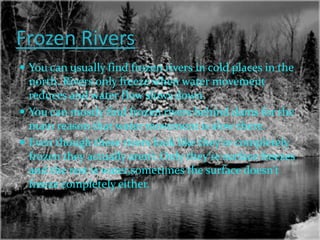
Frozen Rivers
 You can usually find frozen rivers in cold places in the
  north. Rivers only freeze when water movement
  reduces and water flow slows down.
 You can mostly find frozen rivers behind dams for the
  main reason that water movement is slow there.
 Even though these rivers look like they’re completely
  frozen they actually aren’t.Only they’re surface freezes
  and the rest is water,sometimes the surface doesn’t
  freeze completely either.
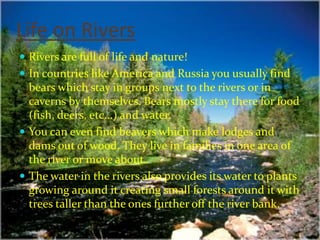
Life on Rivers
 Rivers are full of life and nature!
 In countries like America and Russia you usually find
  bears which stay in groups next to the rivers or in
  caverns by themselves. Bears mostly stay there for food
  (fish, deers, etc...) and water.
 You can even find beavers which make lodges and
  dams out of wood. They live in families in one area of
  the river or move about.
 The water in the rivers also provides its water to plants
  growing around it creating small forests around it with
  trees taller than the ones further off the river bank.
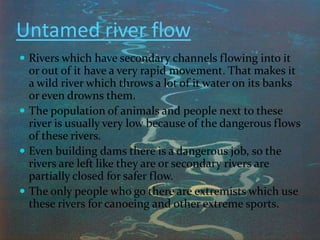
Untamed river flow
 Rivers which have secondary channels flowing into it
  or out of it have a very rapid movement. That makes it
  a wild river which throws a lot of it water on its banks
  or even drowns them.
 The population of animals and people next to these
  river is usually very low because of the dangerous flows
  of these rivers.
 Even building dams there is a dangerous job, so the
  rivers are left like they are or secondary rivers are
  partially closed for safer flow.
 The only people who go there are extremists which use
  these rivers for canoeing and other extreme sports.
Flow rate
Volumetric flow rate, also called discharge, volume flow rate,
and rate of water flow, is the volume of water which passes
through a given cross-section of the river channel per unit time.
It is typically measured in cubic meters per second (cumec) or
cubic feet per second (cfs), where 1 m3/s = 35.51 ft3/s; it is
sometimes also measured in litres or gallons per second.
Volumetric flow rate can be thought of as the mean velocity of
the flow through a given cross-section, times that cross-sectional
area. Mean velocity can be approximated through the use of the
Law of the Wall. In general, velocity increases with the depth (or
hydraulic radius) and slope of the river channel, while the cross-
sectional area scales with the depth and the width: the double-
counting of depth shows the importance of this variable in
determining the discharge through the channel.
Chemistry of rivers
 The chemistry of rivers is complex and depends on
 inputs from the atmosphere, the geology through
 which it travels and the inputs from man's activities.
 The chemistry of the water has a large impact on the
 ecology of that water for both plants and animals and
 it also affects the uses that may be made of the river
 water. Understanding and characterising river water
 chemistry requires a well designed and managed
 sampling and analysis.

Rivers by Dmitry Charkviani 3.01

  • 2.
    The meaning ofa river.  A river is a natural stream of freshwater flowing towards an ocean, a lake, a sea, or another river. In a few cases, a river simply flows into the ground or dries up completely before reaching another source of water. Small rivers may also be called by several other names, including stream, creek, brook, rivulet, tributary and rill. There are no official definitions for generic terms, such as river, as applied to geographic features, although in some countries or communities a stream may be defined by its size. Many names for small rivers are specific to geographic location; one example is "burn" in Scotland and northeast England. Sometimes a river is said to be larger than a creek, but this is not always the case, because of the difference in the language.
  • 3.
    How do Riversform?  Rivers form from rain water which falls on mountain surfaces and slides off into a path where that water is collected and a stream of water forms.  Another way how rivers form is when water falls on rocks it passes through them or gets collected for a certain ammount of time. Afterwards it passes to lower ground and once again forms a river.
  • 4.
    River Basins Rivers havestructures which are common to all rivers these are – Watershed (Area which forms the edge river basin) River Basin (Area of land drained by a river flowing into a main river) Source (It is from where the river begins) Tributary(A small stream flowing into the river) Channel(It is where a river flows) Mouth(This is where a river flows into a lake or the sea)
  • 5.
    The biggest! Thebiggest and the most popular rivers in the world are the - Nile, Zaire, Zambezi in Africa Ganges, Volga, Yangtze in Asia Murray-Darling in Australia Danube, Rhine in Europe St.Laurence, Mississipi, Colorado in North America and the Amazon in South America. As you might notice rivers a re distributed on all continents except Antartica because its an exception for being filled with ice. The longest river in the world is the Nile of a length of 6,690km whilst being the largest is the Amazon river having a river basin of 6,915,000 km²
  • 6.
    Flooding  Floods occurwhen the water capacity in the river is exceeded.  Floods cause huge troubles in forests and in villages near those rivers and some can be catastrophical. A couple of cases are when the river overflows with so much water that houses can be swept away with the water, or the area will be overflooded for weeks or months!  The Causes of flooding are Melting of snow, Failure of non-made dams, Deforestation, Urbanisation, Excessive precipitation.
  • 7.
    Preventing, Helping andsupporting  Large rivers are in a need of control so most of them were provided with Dams.  Dams are large barriers which control river flow and prevent floods.  But they are not used for that reaon only! People use dams to collect water and use it for their everyday needs. They are also used for getting electricity from use of turbines. The turbines are turned and the movement produces electric energy which is stored in generators and then spread to cities, towns, etc...  Also By taking silt out of the river’s bed and placing it on the banks makes the river deeper
  • 8.
    Waterfalls.  There aremany types of rivers which have different types of structures.  Most rivers start forming in the mountains and continue slowly to descend to sea level while some descend to only a few meters and then end up becoming a waterfall.  A waterfall is when the water in a river reaches a cliff and falls rapidly downwards.  These waterfalls are both fascinating and dangerous. They are fascinating because they usually form a beautiful rainbow right next to it and the water falling shines at the drop. But they are mostly dangerous for the main reason that people riding canoes or swimming in that river can go to the edge and fall off of the waterfall!
  • 9.
    Subterranean Rivers Most butnot all rivers flow on the surface. Subterranean rivers flow underground in caves or caverns. Such rivers are frequently found in regions with limestone geologic formations. Subglacial streams are the braided rivers that flow at the beds of glaciers and ice sheets, permitting meltwater to be discharged at the front of the glacier. Because of the gradient in pressure due to the overlying weight of the glacier, such streams can even flow uphill. These rivers can also be found not very far from geisers or areas where lots of rain water is stored in the stone.
  • 10.
    Bridges  One ofthe simplest ways to cross a river from one side to the other is by using a bridge. Bridges are used for getting people over rivers much easier t and faster mobilation than boats if crossing with a vehicle.  The most recent bridges over rivers are made to withstand serious floods, some other bridges are extended with towers which carry transmission antennas and some even have restourants on them like the Novy Most in Bratislava.
  • 11.
    Frozen Rivers  Youcan usually find frozen rivers in cold places in the north. Rivers only freeze when water movement reduces and water flow slows down.  You can mostly find frozen rivers behind dams for the main reason that water movement is slow there.  Even though these rivers look like they’re completely frozen they actually aren’t.Only they’re surface freezes and the rest is water,sometimes the surface doesn’t freeze completely either.
  • 12.
    Life on Rivers Rivers are full of life and nature!  In countries like America and Russia you usually find bears which stay in groups next to the rivers or in caverns by themselves. Bears mostly stay there for food (fish, deers, etc...) and water.  You can even find beavers which make lodges and dams out of wood. They live in families in one area of the river or move about.  The water in the rivers also provides its water to plants growing around it creating small forests around it with trees taller than the ones further off the river bank.
  • 13.
    Untamed river flow Rivers which have secondary channels flowing into it or out of it have a very rapid movement. That makes it a wild river which throws a lot of it water on its banks or even drowns them.  The population of animals and people next to these river is usually very low because of the dangerous flows of these rivers.  Even building dams there is a dangerous job, so the rivers are left like they are or secondary rivers are partially closed for safer flow.  The only people who go there are extremists which use these rivers for canoeing and other extreme sports.
  • 14.
    Flow rate Volumetric flowrate, also called discharge, volume flow rate, and rate of water flow, is the volume of water which passes through a given cross-section of the river channel per unit time. It is typically measured in cubic meters per second (cumec) or cubic feet per second (cfs), where 1 m3/s = 35.51 ft3/s; it is sometimes also measured in litres or gallons per second. Volumetric flow rate can be thought of as the mean velocity of the flow through a given cross-section, times that cross-sectional area. Mean velocity can be approximated through the use of the Law of the Wall. In general, velocity increases with the depth (or hydraulic radius) and slope of the river channel, while the cross- sectional area scales with the depth and the width: the double- counting of depth shows the importance of this variable in determining the discharge through the channel.
  • 15.
    Chemistry of rivers The chemistry of rivers is complex and depends on inputs from the atmosphere, the geology through which it travels and the inputs from man's activities. The chemistry of the water has a large impact on the ecology of that water for both plants and animals and it also affects the uses that may be made of the river water. Understanding and characterising river water chemistry requires a well designed and managed sampling and analysis.