
VARIABLE WEATHER & CHANGING
CLIMATE
1. Why do different places experience different weather and climate?
2. What is happening to the Earth’s climate?
Copy when you see:
IMPORTANT NOTE
• For unit 2, Weather
–Please bring your text book, we are using
the exercises inside.
THINK ABOUT THIS…
GATEWAY 1: Why do different places experience
different weather and climate?
• Why does Singapore not have any snow?
• How does knowing the weather the next day
help you to plan your activities?
• Why does it always feel so warm in the evening
despite the temperature falling?
• Why does it rain so often in Nov/Dec?
• More questions from you?
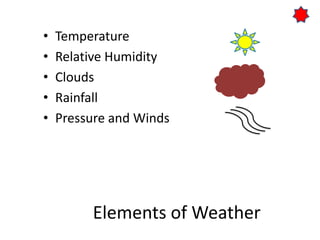
Elements of Weather
• Temperature
• Relative Humidity
• Clouds
• Rainfall
• Pressure and Winds
TEMPERATURE
• Measures the degree of hotness or coldness
• Energy of sun -> Travels through atmosphere ->
Absorbed by earth’s surface -> Surface warms
up -> Heats up atmosphere
• Temperature measurement = oC
• Maximum and minimum temperature
• Diurnal temperature range
• Mean daily/monthly/annual temperature
• Annual temperature range
Maximum and minimum temperature
• The highest and lowest temperatures
recorded within a day.
• Normally affected most by the
presence or absence of sunlight (key
heatsource)
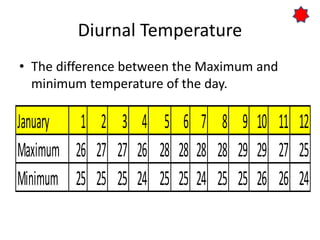
Diurnal Temperature
• The difference between the Maximum and
minimum temperature of the day.
January 1 2 3 4 5 6 7 8 9 10 11 12
Maximum 26 27 27 26 28 28 28 28 29 29 27 25
Minimum 25 25 25 24 25 25 24 25 25 26 26 24
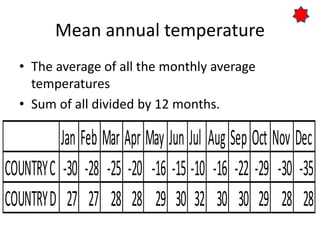
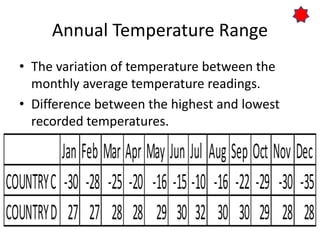
Mean annual temperature
• The average of all the monthly average
temperatures
• Sum of all divided by 12 months.
Jan Feb Mar Apr May Jun Jul Aug Sep Oct Nov Dec
COUNTRYC -30 -28 -25 -20 -16 -15 -10 -16 -22 -29 -30 -35
COUNTRYD 27 27 28 28 29 30 32 30 30 29 28 28
Annual Temperature Range
• The variation of temperature between the
monthly average temperature readings.
• Difference between the highest and lowest
recorded temperatures.
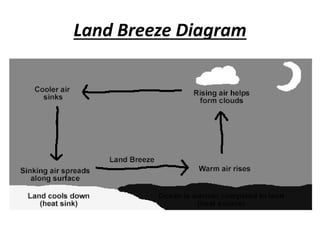
Land Breeze
• Coastal effect experienced at night
• Sea retains heat better at night, air parcel
above the sea is warmer.
• Warmer air rises up, leaving a vacuum.
• The cooler air above the land rushes out to
the sea.
• This movement of air from land to sea forms
the land breeze
Land Breeze Diagram
Sea Breeze
• Coastal effect experienced in the day
• The air above the land heats up faster than
the air above the water.
• Warmer air rises up, leaving a vacuum.
• The cooler air above the sea rushes into the
land.
• This movement of air from sea to land forms
the sea breeze
Sea Breeze Diagram
TEMPERATURE
• Temperature can be affected by:
– Latitude – textbook page 75
– Altitude – textbook page 76
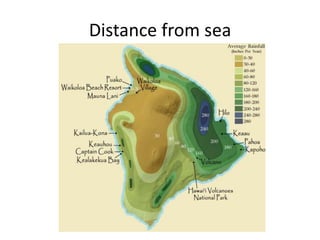
– Distance from the sea – textbook page
77
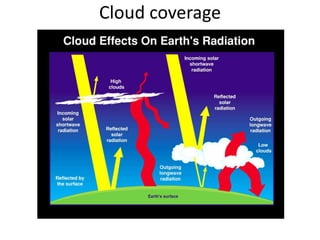
– Cloud cover – textbook page 77
Latitude
Altitude
Distance from sea
Cloud coverage
FACTORS AFFECTING TEMPERATURE
• Maritime Effect
– The effect of large ocean bodies on climate of
coastal areas
– During summer the air over the sea remains cooler
than the land as it heats up slower
– During winter the air over the sea remains warmer
than the land as it loses heat slower
– This causes coastal areas to have cooler summers
and warmer winters
– The annual temperature range is thus smaller
FACTORS AFFECTING TEMPERATURE
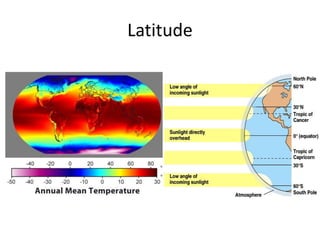
• Latitude
– Imaginary horizontal lines running east to west
– Equator = 0o
– North / South Pole = 90oN / 90oS
– Angle of incidence: refers to the sun’s rays hitting
the earth surface at an angle
– A higher angle of incidence means more
concentrated sunlight
FACTORS AFFECTING TEMPERATURE
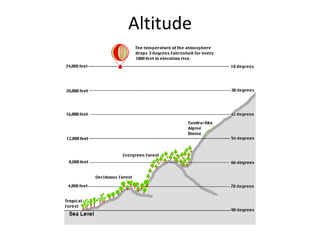
• Altitude
– Refers to the height of a location in relation to the
sea level
– Temperature decreases with altitude
– The higher the altitude, the lower the temperature
– Earth’s atmosphere is mostly heated by the surface
– Shortwave radiation: sun’s solar energy reaching
the earth’s surface
– Longwave radiation: Earth’s surface emitting heat
to heat up the atmosphere
FACTORS AFFECTING TEMPERATURE
• Altitude
– Density of air becomes lower as altitude becomes
higher
– Dense air absorbs more longwave radiation
– Air that is less dense at higher altitudes absorb less
heat and thus temperature is lower
– Qn: Name some gases that would absorb heat.
FACTORS AFFECTING TEMPERATURE
• Distance from the sea
– The sea always heats up and cools down more
slowly than land
– This creates differences in rate of heating between
coastal and inland areas
– Places that are located along the coasts experience
Maritime effect
– Places that are located further inland experience
Continental effect
FACTORS AFFECTING TEMPERATURE
• Continental Effect
– The effect of continental surfaces on climate of
inland areas
– Inland areas are further from the sea and oceans
– These areas are not influenced by the
temperatures over the sea
– Inland areas tend to have warmer summers and
colder winters
– The annual temperature range is thus larger
FACTORS AFFECTING TEMPERATURE
• Cloud cover
– Refers to the extent of sky that is covered by
clouds
– More cloud cover results in a smaller diurnal range
– Less cloud cover results in a larger diurnal range
– This is due to the effect of clouds absorbing and
reflecting the sun’s rays and heat energy from the
earth’s surface (pg 77, fig 2.9)
TEMPERATURE
• DISCUSS
– Qn: Why do different places along the same
latitude have different temperatures?
• EXERCISE
– Textbook page 79
– Questions 1, 3 and 6 Group Work
Groups of 5
please
RELATIVE HUMIDITY
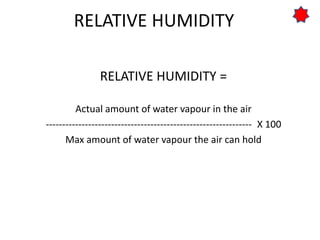
RELATIVE HUMIDITY =
Actual amount of water vapour in the air
--------------------------------------------------------------- X 100
Max amount of water vapour the air can hold
RELATIVE HUMIDITY
• Relative humidity is the ratio between
the actual amount of water vapour and
the maximum amount of water vapour
that the air can hold at a given
temperature
• Warmer air can hold more water vapour
• If temperature rises and the actual
amount of water vapour remains, then
relative humidity will decrease
RELATIVE HUMIDITY
• Saturation is when relative
humidity = 100%
• Dew point temperature:
temperature at which saturation
occurs
• Condensation occurs during dew
point temperature
CLOUDS
• Clouds refer to visible masses of water droplets or ice
crystals suspended in the atmosphere
• Evaporation: water becoming water vapour
• When water vapour rises, it cools to dew point
temperature
• Condensation: water vapour changes to liquid form
• To condense, water vapour needs to find condensation
nuclei
• Coalescence: water droplets bumping into each other to
become larger in size
Cloud making experiment
• We’ll do an experiment now to make clouds
• Let’s recap the key elements of a cloud.
– Water vapour
– Rapid condensation
– Pressure loss
Let’s watch the clip first
Let’s do it ‘live’
• Equipment check
1. Plastic bottle
2. Rubbing alcohol
3. Bicycle pump
Recap
• Sudden condensation leads to formation of
clouds by water vapour.
• Clouds are liquid form of water that have
condensed.
• If there is added pressure, the water vapour
reverts to it’s gaseous form.
RAINFALL
• Precipitation: water falling from the atmosphere
to the earth surface in any form
• E.g. Hail, Snow, Sleet, Rain…
• In tropics, the precipitation is mainly rain
• Air stability: a parcel of air that is cooler than its
surrounding air and tends to sink and remain in
its original position
• Air instability: a parcel of air that is warmer than
its surrounding air and tends to rise and expand
• 2 types of rainfall: Convectional and Relief
RAINFALL
• Convectional Rain
– Occurs due to intense heating of earth’s
surface
– Warm surface heats the air above it
– Instability causes air to rise and expand
– As air rises, it cools to dew point temperature
– Condensation occurs and clouds are formed
– When water droplets become large enough,
they fall as rain
– Convectional rain is often associated with
lightning and thunder
– Intense rain over a short amount of time
RAINFALL
• Relief Rain
– Also known as Orographic rain
– As air passes over the sea, it picks up moisture
– When it arrives at the coast, moist air is forced to
rise along the windward side of the mountain
– Air is forced to cool and condensation occurs at
dew point temperature
– When water droplets in the clouds become heavy
enough they fall to the ground on the windward
side
– On the other side of the mountain, leeward side, it
is dry as most of the moisture is lost on the
windward side (rain shadow)
RELATIVE HUMIDITY, CLOUDS &
RAINFALL
• DISCUSS
– What is the most common type of
rainfall in Singapore? Why do you say
so?
• EXERCISE
– Textbook page 82
– Questions 1, 2, 3 and 5
PRESSURE & WINDS
• Air pressure: the forced exerted by the weight
a column of air on a unit area of the earth’s
surface
• Measured in millibars (mb) by a barometer
• Air is less dense at higher altitudes
• Thus air pressure tends to be lower as altitude
increases
• The average value of air pressure at sea level is
1,013mb
PRESSURE & WINDS
• Wind: The movement of air from high
pressure area to low pressure area
• Pressure gradient: The difference in air
pressure between two places
• The greater the pressure gradient, the
higher the wind speed
• Wind can be described by its speed,
direction and frequency.
PRESSURE & WINDS
• Wind speed: The rate at which air is moving
• Wind speed is measured in kilometres per hour,
using an anemometer
• Wind speed may also be represented by the
Beaufort Scale (pg 85, figure 2.23)
PRESSURE & WINDS
• Wind direction: The direction which the wind
blows from
• Wind direction is measured by a wind vane
• Wind frequency: The percentage of time the
wind blows from a particular direction
• Prevailing winds: Winds that blows most
frequently from a specific direction
• Information of wind direction and frequency can
be recorded using wind roses
PRESSURE & WINDS
• Wind systems is a way of categorising prevailing
winds
• Localised wind systems
– Land breeze
– Sea breeze
• Regional wind systems
– Monsoon Winds
– Mid-latitude Westerlies
– Polar Easterlies
PRESSURE & WINDS
Land and Sea Breezes
• Local wind systems that occur along coastal
areas due to different rates of heating between
the land and sea
• Recall how temperature is affected by distance
from the sea
• In the night
– Land loses heat faster than the sea
– Warm air above the sea rises, creating
low pressure
– Air from the land moves towards the
sea as land breeze
PRESSURE & WINDS
Land and Sea Breezes
• In the day
– Land heats up faster than the sea
– Warm air above the land rises,
creating low pressure
– Air from the sea moves towards the
land as sea breeze
PRESSURE & WINDS
Monsoon Winds
• A regional wind pattern
• Brings seasonal changes in precipitation
• Affected by Coriolis effect
• Northern hemisphere -> deflects to the right
• Southern hemisphere -> deflects to the left
• Coriolis effect is stronger nearer the poles and
weaker near the equator
PRESSURE & WINDS
Monsoon Winds
• For purposes of study, we will use the monsoon winds
blowing between Asia and Australia as an example
• You should keep the following background knowledge that
you ALREADY HAVE…
– Summer = Higher Temp, Winter = Lower Temp
– High Temp = Low pressure, Low Temp = High
pressure
– Concept of relief rain and rain shadow
– Coriolis Effect: North = Right and South = Left
• Are you ready?
PRESSURE & WINDS
Southwest Monsoon (pg 88, figure 2.26)
• June to September
• Summer in northern hemisphere, winter in southern
hemisphere
• Winds move from Australia (south) to Asia (north)
• From Australia, wind moves as southeast monsoon
• As it crosses the equator, it deflects to become
southwest monsoon
• The air picks up moisture over Indian Ocean and
brings heavy rain to India
PRESSURE & WINDS
Northeast Monsoon (pg 88, figure 2.27)
• October to February
• Summer in southern hemisphere, winter in northern
hemisphere
• Winds move from Asia (north) to Australia (south)
• From Asia, wind moves as northeast monsoon
• As it crosses the equator, it deflects to become
northwest monsoon
• The air picks up moisture over Indian Ocean and
brings heavy rain to Australia
PRESSURE & WINDS
• DISCUSS
– How does the NE and SW monsoon
winds affect Singapore in terms of
rainfall?
• EXERCISE
– Textbook page 89
– Questions 2 and 4
CLIMATIC SYSTEMS
• Blah blah
THINK ABOUT THIS…
GATEWAY 2: What is happening to the earth’s
climate?
• Why are we so concerned about carbon
footprints?
• blahblah
• More questions from you?

Variable weather n changing climate (1)

  • 1.
    VARIABLE WEATHER &CHANGING CLIMATE 1. Why do different places experience different weather and climate? 2. What is happening to the Earth’s climate? Copy when you see:
  • 2.
    IMPORTANT NOTE • Forunit 2, Weather –Please bring your text book, we are using the exercises inside.
  • 3.
    THINK ABOUT THIS… GATEWAY1: Why do different places experience different weather and climate? • Why does Singapore not have any snow? • How does knowing the weather the next day help you to plan your activities? • Why does it always feel so warm in the evening despite the temperature falling? • Why does it rain so often in Nov/Dec? • More questions from you?
  • 4.
    Elements of Weather •Temperature • Relative Humidity • Clouds • Rainfall • Pressure and Winds
  • 5.
    TEMPERATURE • Measures thedegree of hotness or coldness • Energy of sun -> Travels through atmosphere -> Absorbed by earth’s surface -> Surface warms up -> Heats up atmosphere • Temperature measurement = oC • Maximum and minimum temperature • Diurnal temperature range • Mean daily/monthly/annual temperature • Annual temperature range
  • 6.
    Maximum and minimumtemperature • The highest and lowest temperatures recorded within a day. • Normally affected most by the presence or absence of sunlight (key heatsource)
  • 7.
    Diurnal Temperature • Thedifference between the Maximum and minimum temperature of the day. January 1 2 3 4 5 6 7 8 9 10 11 12 Maximum 26 27 27 26 28 28 28 28 29 29 27 25 Minimum 25 25 25 24 25 25 24 25 25 26 26 24
  • 8.
    Mean annual temperature •The average of all the monthly average temperatures • Sum of all divided by 12 months. Jan Feb Mar Apr May Jun Jul Aug Sep Oct Nov Dec COUNTRYC -30 -28 -25 -20 -16 -15 -10 -16 -22 -29 -30 -35 COUNTRYD 27 27 28 28 29 30 32 30 30 29 28 28
  • 9.
    Annual Temperature Range •The variation of temperature between the monthly average temperature readings. • Difference between the highest and lowest recorded temperatures.
  • 10.
    Land Breeze • Coastaleffect experienced at night • Sea retains heat better at night, air parcel above the sea is warmer. • Warmer air rises up, leaving a vacuum. • The cooler air above the land rushes out to the sea. • This movement of air from land to sea forms the land breeze
  • 11.
  • 12.
    Sea Breeze • Coastaleffect experienced in the day • The air above the land heats up faster than the air above the water. • Warmer air rises up, leaving a vacuum. • The cooler air above the sea rushes into the land. • This movement of air from sea to land forms the sea breeze
  • 13.
  • 14.
    TEMPERATURE • Temperature canbe affected by: – Latitude – textbook page 75 – Altitude – textbook page 76 – Distance from the sea – textbook page 77 – Cloud cover – textbook page 77
  • 15.
  • 16.
  • 17.
  • 18.
  • 19.
    FACTORS AFFECTING TEMPERATURE •Maritime Effect – The effect of large ocean bodies on climate of coastal areas – During summer the air over the sea remains cooler than the land as it heats up slower – During winter the air over the sea remains warmer than the land as it loses heat slower – This causes coastal areas to have cooler summers and warmer winters – The annual temperature range is thus smaller
  • 20.
    FACTORS AFFECTING TEMPERATURE •Latitude – Imaginary horizontal lines running east to west – Equator = 0o – North / South Pole = 90oN / 90oS – Angle of incidence: refers to the sun’s rays hitting the earth surface at an angle – A higher angle of incidence means more concentrated sunlight
  • 21.
    FACTORS AFFECTING TEMPERATURE •Altitude – Refers to the height of a location in relation to the sea level – Temperature decreases with altitude – The higher the altitude, the lower the temperature – Earth’s atmosphere is mostly heated by the surface – Shortwave radiation: sun’s solar energy reaching the earth’s surface – Longwave radiation: Earth’s surface emitting heat to heat up the atmosphere
  • 22.
    FACTORS AFFECTING TEMPERATURE •Altitude – Density of air becomes lower as altitude becomes higher – Dense air absorbs more longwave radiation – Air that is less dense at higher altitudes absorb less heat and thus temperature is lower – Qn: Name some gases that would absorb heat.
  • 23.
    FACTORS AFFECTING TEMPERATURE •Distance from the sea – The sea always heats up and cools down more slowly than land – This creates differences in rate of heating between coastal and inland areas – Places that are located along the coasts experience Maritime effect – Places that are located further inland experience Continental effect
  • 24.
    FACTORS AFFECTING TEMPERATURE •Continental Effect – The effect of continental surfaces on climate of inland areas – Inland areas are further from the sea and oceans – These areas are not influenced by the temperatures over the sea – Inland areas tend to have warmer summers and colder winters – The annual temperature range is thus larger
  • 25.
    FACTORS AFFECTING TEMPERATURE •Cloud cover – Refers to the extent of sky that is covered by clouds – More cloud cover results in a smaller diurnal range – Less cloud cover results in a larger diurnal range – This is due to the effect of clouds absorbing and reflecting the sun’s rays and heat energy from the earth’s surface (pg 77, fig 2.9)
  • 26.
    TEMPERATURE • DISCUSS – Qn:Why do different places along the same latitude have different temperatures? • EXERCISE – Textbook page 79 – Questions 1, 3 and 6 Group Work Groups of 5 please
  • 27.
    RELATIVE HUMIDITY RELATIVE HUMIDITY= Actual amount of water vapour in the air --------------------------------------------------------------- X 100 Max amount of water vapour the air can hold
  • 28.
    RELATIVE HUMIDITY • Relativehumidity is the ratio between the actual amount of water vapour and the maximum amount of water vapour that the air can hold at a given temperature • Warmer air can hold more water vapour • If temperature rises and the actual amount of water vapour remains, then relative humidity will decrease
  • 29.
    RELATIVE HUMIDITY • Saturationis when relative humidity = 100% • Dew point temperature: temperature at which saturation occurs • Condensation occurs during dew point temperature
  • 30.
    CLOUDS • Clouds referto visible masses of water droplets or ice crystals suspended in the atmosphere • Evaporation: water becoming water vapour • When water vapour rises, it cools to dew point temperature • Condensation: water vapour changes to liquid form • To condense, water vapour needs to find condensation nuclei • Coalescence: water droplets bumping into each other to become larger in size
  • 31.
    Cloud making experiment •We’ll do an experiment now to make clouds • Let’s recap the key elements of a cloud. – Water vapour – Rapid condensation – Pressure loss
  • 32.
  • 33.
    Let’s do it‘live’ • Equipment check 1. Plastic bottle 2. Rubbing alcohol 3. Bicycle pump
  • 34.
    Recap • Sudden condensationleads to formation of clouds by water vapour. • Clouds are liquid form of water that have condensed. • If there is added pressure, the water vapour reverts to it’s gaseous form.
  • 35.
    RAINFALL • Precipitation: waterfalling from the atmosphere to the earth surface in any form • E.g. Hail, Snow, Sleet, Rain… • In tropics, the precipitation is mainly rain • Air stability: a parcel of air that is cooler than its surrounding air and tends to sink and remain in its original position • Air instability: a parcel of air that is warmer than its surrounding air and tends to rise and expand • 2 types of rainfall: Convectional and Relief
  • 36.
    RAINFALL • Convectional Rain –Occurs due to intense heating of earth’s surface – Warm surface heats the air above it – Instability causes air to rise and expand – As air rises, it cools to dew point temperature – Condensation occurs and clouds are formed – When water droplets become large enough, they fall as rain – Convectional rain is often associated with lightning and thunder – Intense rain over a short amount of time
  • 37.
    RAINFALL • Relief Rain –Also known as Orographic rain – As air passes over the sea, it picks up moisture – When it arrives at the coast, moist air is forced to rise along the windward side of the mountain – Air is forced to cool and condensation occurs at dew point temperature – When water droplets in the clouds become heavy enough they fall to the ground on the windward side – On the other side of the mountain, leeward side, it is dry as most of the moisture is lost on the windward side (rain shadow)
  • 38.
    RELATIVE HUMIDITY, CLOUDS& RAINFALL • DISCUSS – What is the most common type of rainfall in Singapore? Why do you say so? • EXERCISE – Textbook page 82 – Questions 1, 2, 3 and 5
  • 39.
    PRESSURE & WINDS •Air pressure: the forced exerted by the weight a column of air on a unit area of the earth’s surface • Measured in millibars (mb) by a barometer • Air is less dense at higher altitudes • Thus air pressure tends to be lower as altitude increases • The average value of air pressure at sea level is 1,013mb
  • 40.
    PRESSURE & WINDS •Wind: The movement of air from high pressure area to low pressure area • Pressure gradient: The difference in air pressure between two places • The greater the pressure gradient, the higher the wind speed • Wind can be described by its speed, direction and frequency.
  • 41.
    PRESSURE & WINDS •Wind speed: The rate at which air is moving • Wind speed is measured in kilometres per hour, using an anemometer • Wind speed may also be represented by the Beaufort Scale (pg 85, figure 2.23)
  • 42.
    PRESSURE & WINDS •Wind direction: The direction which the wind blows from • Wind direction is measured by a wind vane • Wind frequency: The percentage of time the wind blows from a particular direction • Prevailing winds: Winds that blows most frequently from a specific direction • Information of wind direction and frequency can be recorded using wind roses
  • 43.
    PRESSURE & WINDS •Wind systems is a way of categorising prevailing winds • Localised wind systems – Land breeze – Sea breeze • Regional wind systems – Monsoon Winds – Mid-latitude Westerlies – Polar Easterlies
  • 44.
    PRESSURE & WINDS Landand Sea Breezes • Local wind systems that occur along coastal areas due to different rates of heating between the land and sea • Recall how temperature is affected by distance from the sea • In the night – Land loses heat faster than the sea – Warm air above the sea rises, creating low pressure – Air from the land moves towards the sea as land breeze
  • 45.
    PRESSURE & WINDS Landand Sea Breezes • In the day – Land heats up faster than the sea – Warm air above the land rises, creating low pressure – Air from the sea moves towards the land as sea breeze
  • 46.
    PRESSURE & WINDS MonsoonWinds • A regional wind pattern • Brings seasonal changes in precipitation • Affected by Coriolis effect • Northern hemisphere -> deflects to the right • Southern hemisphere -> deflects to the left • Coriolis effect is stronger nearer the poles and weaker near the equator
  • 47.
    PRESSURE & WINDS MonsoonWinds • For purposes of study, we will use the monsoon winds blowing between Asia and Australia as an example • You should keep the following background knowledge that you ALREADY HAVE… – Summer = Higher Temp, Winter = Lower Temp – High Temp = Low pressure, Low Temp = High pressure – Concept of relief rain and rain shadow – Coriolis Effect: North = Right and South = Left • Are you ready?
  • 48.
    PRESSURE & WINDS SouthwestMonsoon (pg 88, figure 2.26) • June to September • Summer in northern hemisphere, winter in southern hemisphere • Winds move from Australia (south) to Asia (north) • From Australia, wind moves as southeast monsoon • As it crosses the equator, it deflects to become southwest monsoon • The air picks up moisture over Indian Ocean and brings heavy rain to India
  • 49.
    PRESSURE & WINDS NortheastMonsoon (pg 88, figure 2.27) • October to February • Summer in southern hemisphere, winter in northern hemisphere • Winds move from Asia (north) to Australia (south) • From Asia, wind moves as northeast monsoon • As it crosses the equator, it deflects to become northwest monsoon • The air picks up moisture over Indian Ocean and brings heavy rain to Australia
  • 50.
    PRESSURE & WINDS •DISCUSS – How does the NE and SW monsoon winds affect Singapore in terms of rainfall? • EXERCISE – Textbook page 89 – Questions 2 and 4
  • 51.
  • 52.
    THINK ABOUT THIS… GATEWAY2: What is happening to the earth’s climate? • Why are we so concerned about carbon footprints? • blahblah • More questions from you?

Editor's Notes

  • #15 Run through the key elements in the textbook on Latitude, Altitude, Distance from sea and Cloud cover.
  • #18 Tendency for more rainfall around areas near sea. Coupled with relief factors, distance from sea can affect temperature.
  • #21 Talk about polar regions where there are periods of no sunlight 30days of night trailer
  • #22 Show random mountain climbing videos up snowcapped mountains. http://www.youtube.com/watch?v=Du54zAXM3Eg Watch clip on climbing everest Think about the presence of snow and the implications on temperature
  • #23 Link to video: http://www.youtube.com/watch?v=nNzDXXUiqRs
  • #24 East Coast vs AMK…why is it more desirable to live in East Coast? http://www.propertyguru.com.sg/listing/hdb-for-sale-180-ang-mo-kio-avenue-5-14142377 AMK http://www.propertyguru.com.sg/listing/hdb-for-sale-27-marine-crescent-13952694 Marine Terrace
  • #27 Write on A4/A3 paper, pin on exterior / interior classroom walls for reference and peer learning.
  • #31 Link to http://www.youtube.com/watch?v=E8AvfXar9zs&list=PLDA6466A452C9053B Link to http://www.youtube.com/watch?v=NiCSk1zxMEs&list=PLDA6466A452C9053B
  • #36 Link to http://www.youtube.com/watch?v=bHHHRSBvo9o&list=PLDA6466A452C9053B
  • #37 Link to
  • #38 Link to http://www.youtube.com/watch?v=bHHHRSBvo9o&list=PLDA6466A452C9053B