Mid-latitude Cyclone

Temperate / Mid-latitude Cyclone
Click here for playlist
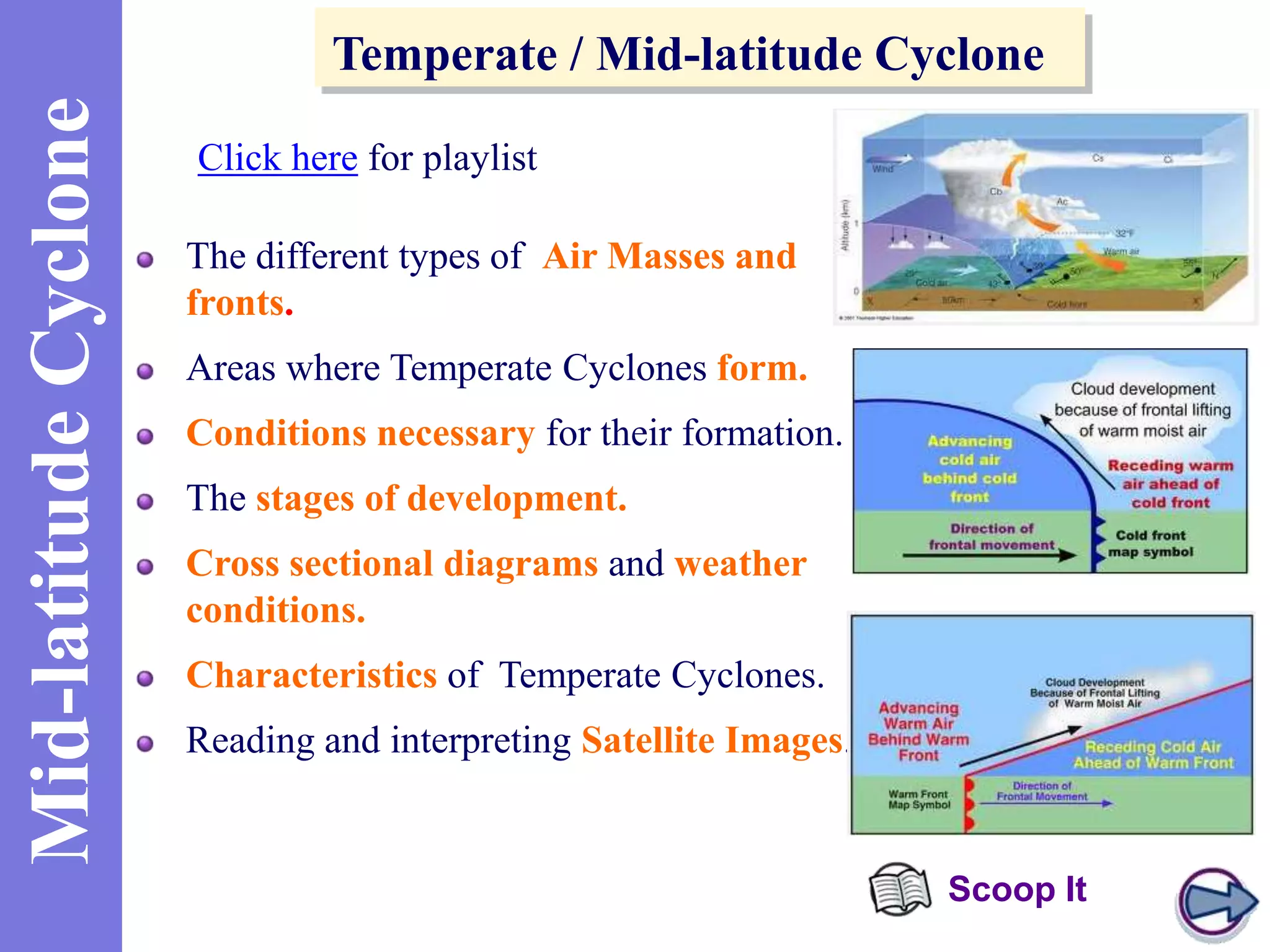
The different types of Air Masses and
fronts.
Areas where Temperate Cyclones form.
Conditions necessary for their formation.
The stages of development.
Cross sectional diagrams and weather
conditions.
Characteristics of Temperate Cyclones.
Reading and interpreting Satellite Images.

Scoop It
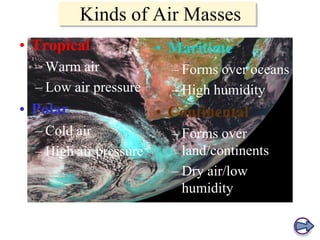
Kinds of Air Masses
• Tropical
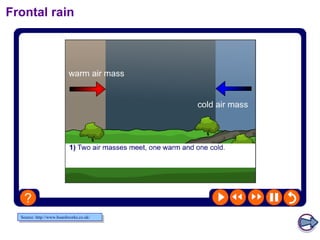
– Warm air
– Low air pressure

• Polar
– Cold air
– High air pressure

• Maritime
– Forms over oceans
– High humidity

• Continental
– Forms over
land/continents
– Dry air/low
humidity
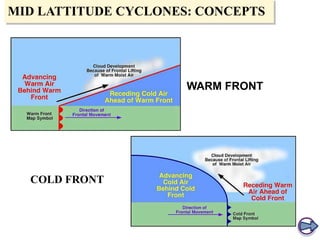
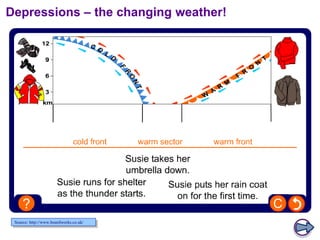
MID LATTITUDE CYCLONES: CONCEPTS

WARM FRONT

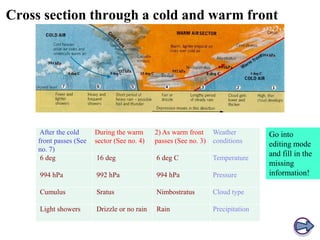
COLD FRONT
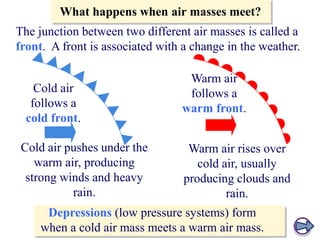
What happens when air masses meet?
The junction between two different air masses is called a
front. A front is associated with a change in the weather.

Cold air
follows a
cold front.
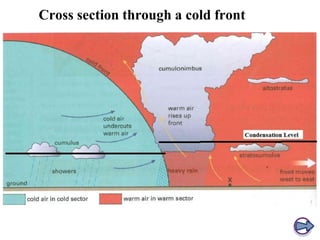
Cold air pushes under the
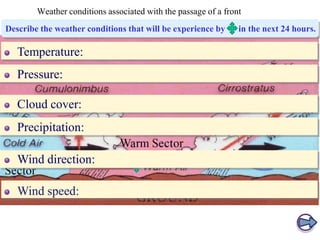
warm air, producing
strong winds and heavy
rain.

Warm air
follows a
warm front.
Warm air rises over
cold air, usually
producing clouds and
rain.

Depressions (low pressure systems) form
when a cold air mass meets a warm air mass.
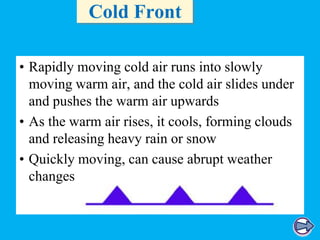
Cold Front
• Rapidly moving cold air runs into slowly
moving warm air, and the cold air slides under
and pushes the warm air upwards
• As the warm air rises, it cools, forming clouds
and releasing heavy rain or snow
• Quickly moving, can cause abrupt weather
changes
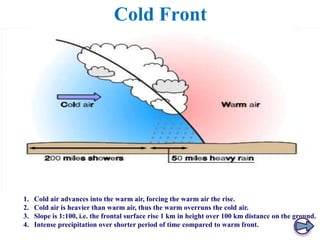
Cold Front

1.
2.
3.
4.

Cold air advances into the warm air, forcing the warm air the rise.
Cold air is heavier than warm air, thus the warm overruns the cold air.
Slope is 1:100, i.e. the frontal surface rise 1 km in height over 100 km distance on the ground.
Intense precipitation over shorter period of time compared to warm front.
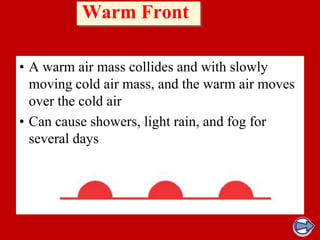
Warm Front
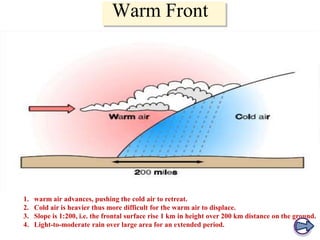
• A warm air mass collides and with slowly
moving cold air mass, and the warm air moves
over the cold air
• Can cause showers, light rain, and fog for
several days
Warm Front

1.
2.
3.
4.

warm air advances, pushing the cold air to retreat.
Cold air is heavier thus more difficult for the warm air to displace.
Slope is 1:200, i.e. the frontal surface rise 1 km in height over 200 km distance on the ground.
Light-to-moderate rain over large area for an extended period.
Cold Front
and Squall Line
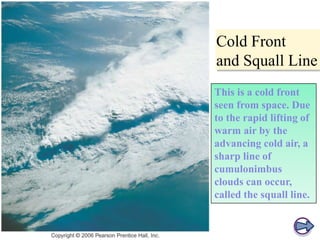
This is a cold front
seen from space. Due
to the rapid lifting of
warm air by the
advancing cold air, a
sharp line of
cumulonimbus
clouds can occur,
called the squall line.
Stationary Front
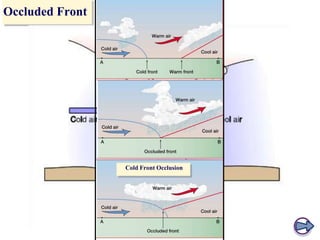
Occluded Front
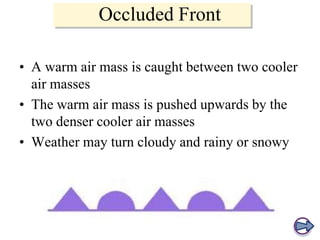
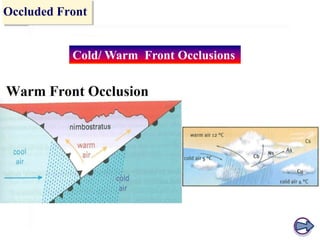
• A warm air mass is caught between two cooler
air masses
• The warm air mass is pushed upwards by the
two denser cooler air masses
• Weather may turn cloudy and rainy or snowy
Occluded Front

Cold Front Occlusion

Cold Front Occlusion
Occluded Front

Cold/ Warm Front Occlusions
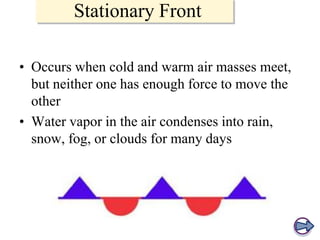
Stationary Front
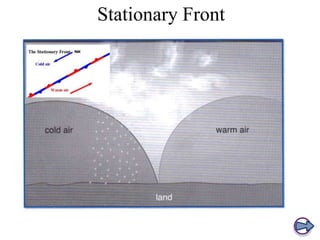
• Occurs when cold and warm air masses meet,
but neither one has enough force to move the
other
• Water vapor in the air condenses into rain,
snow, fog, or clouds for many days
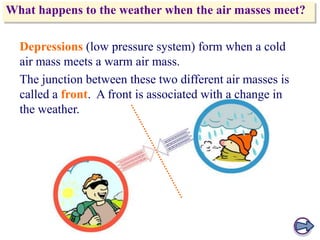
What happens to the weather when the air masses meet?
Depressions (low pressure system) form when a cold
air mass meets a warm air mass.
The junction between these two different air masses is
called a front. A front is associated with a change in
the weather.
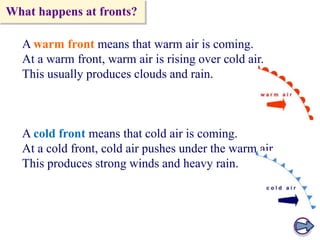
What happens at fronts?

A warm front means that warm air is coming.
At a warm front, warm air is rising over cold air.
This usually produces clouds and rain.

A cold front means that cold air is coming.
At a cold front, cold air pushes under the warm air.
This produces strong winds and heavy rain.
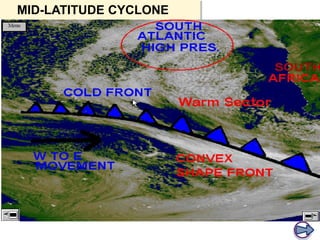
MID-LATITUDE CYCLONE

Cold
front

Isobar

Warm
sector

L

Cold
sector

Wind
rotation
clockwise
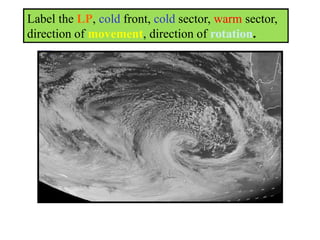
Label the LP, cold front, cold sector, warm sector,
direction of movement, direction of rotation.
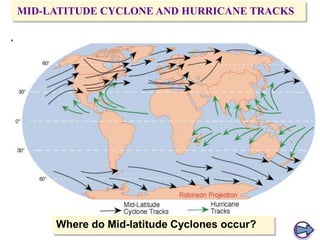
MID-LATITUDE CYCLONE AND HURRICANE TRACKS

Where do Mid-latitude Cyclones occur?
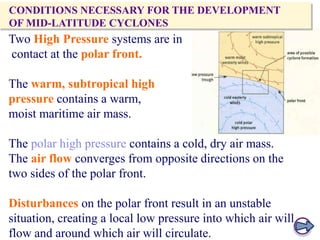
CONDITIONS NECESSARY FOR THE DEVELOPMENT
OF MID-LATITUDE CYCLONES

Two High Pressure systems are in
contact at the polar front.
The warm, subtropical high
pressure contains a warm,
moist maritime air mass.
The polar high pressure contains a cold, dry air mass.
The air flow converges from opposite directions on the
two sides of the polar front.
Disturbances on the polar front result in an unstable
situation, creating a local low pressure into which air will
flow and around which air will circulate.
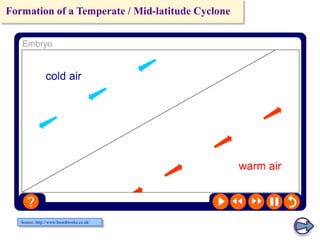
Formation of a Temperate / Mid-latitude Cyclone
Click on the red labels find out more!

Source: http://www.boardworks.co.uk/
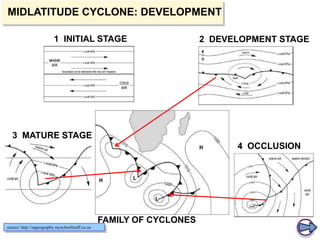
MIDLATITUDE CYCLONE: DEVELOPMENT
1 INITIAL STAGE

2 DEVELOPMENT STAGE

3 MATURE STAGE
4 OCCLUSION

FAMILY OF CYCLONES
source: http://sageography.myschoolstuff.co.za
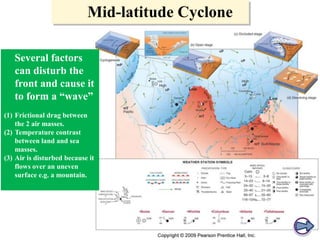
Mid-latitude Cyclone
Several factors
can disturb the
front and cause it
to form a “wave”
(1) Frictional drag between
the 2 air masses.
(2) Temperature contrast
between land and sea
masses.
(3) Air is disturbed because it
flows over an uneven
surface e.g. a mountain.

Figure 8.14
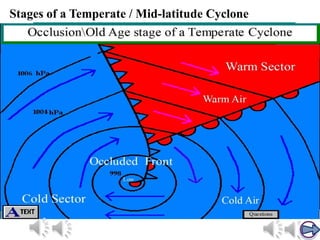
Stages of a Temperate / Mid-latitude Cyclone
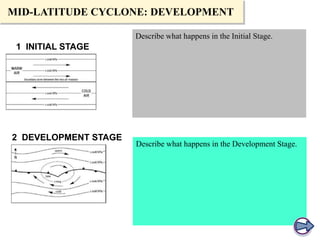
MID-LATITUDE CYCLONE: DEVELOPMENT
Describe what happens in the Initial Stage.

1 INITIAL STAGE

2 DEVELOPMENT STAGE

Describe what happens in the Development Stage.
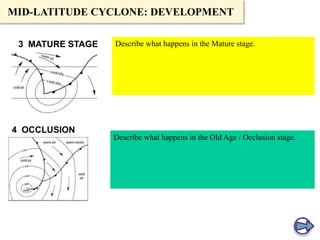
MID-LATITUDE CYCLONE: DEVELOPMENT
3 MATURE STAGE

4 OCCLUSION

Describe what happens in the Mature stage.

Describe what happens in the Old Age / Occlusion stage.
Passage of a Temperate / Mid-latitude Cyclone

Source: http://www.boardworks.co.uk/
Depressions – the changing weather!

Source: http://www.boardworks.co.uk/
Passage of a depression

Source: http://www.boardworks.co.uk/
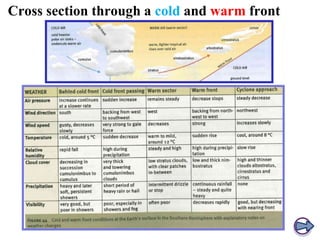
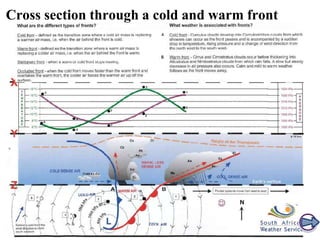
Cross section through a cold and warm front

After the cold
front passes (See
no. 7)
6 deg

During the warm
sector (See no. 4)

2) As warm front Weather
passes (See no. 3) conditions

16 deg

6 deg C

Temperature

994 hPa

992 hPa

994 hPa

Pressure

Cumulus

Sratus

Nimbostratus

Cloud type

Light showers

Drizzle or no rain

Rain

Precipitation

Go into
editing mode
and fill in the
missing
information!
Cross section through a cold front
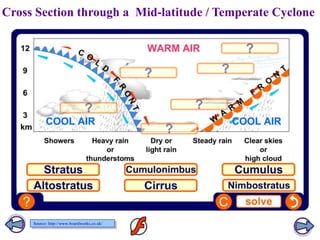
Cross Section through a Mid-latitude / Temperate Cyclone

Source: http://www.boardworks.co.uk/
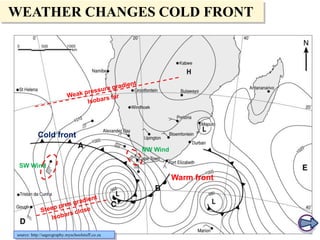
WEATHER CHANGES COLD FRONT

Cold front
NW Wind
SW Wind

Warm front

source: http://sageography.myschoolstuff.co.za
Cross section through a cold and warm front
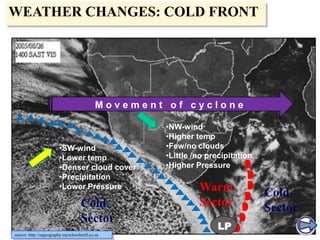
WEATHER CHANGES: COLD FRONT

Movement of cyclone

•SW-wind
•Lower temp
•Denser cloud cover
•Precipitation
•Lower Pressure

Cold
Sector
source: http://sageography.myschoolstuff.co.za

•NW-wind
•Higher temp
•Few/no clouds
•Little /no precipitation
•Higher Pressure

Warm
Sector
LP

Cold
Sector
Frontal rain

Source: http://www.boardworks.co.uk/
Weather conditions associated with the passage of a front
Describe the weather conditions that will be experience by

Temperature:
Pressure:
Cloud cover:
Precipitation:
Wind direction:
Wind speed:

in the next 24 hours.
Coriolis effect

Source: http://www.boardworks.co.uk/
Describe how the wind direction changes
when it Backs:
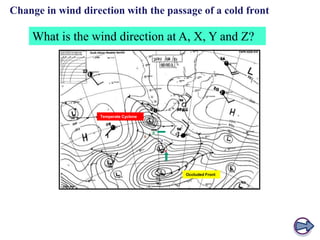
Change in wind direction with the passage of a cold front

What is the wind direction at A, X, Y and Z?

Temperate Cyclone

Occluded Front
Characteristics of a Temperate Cyclone!
Complete the following details! Go into editing mode to do so.

Originate (Latitude):
Movement (direction):

Rotation:
Wind belt:

Diameter:
Weather:
Life Cycle:
Caused by:
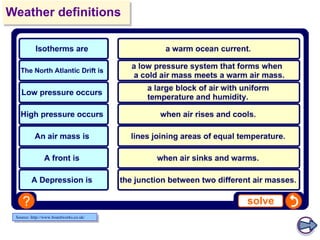
Weather definitions

Source: http://www.boardworks.co.uk/

Temperate Cyclones

  • 1.
    Mid-latitude Cyclone Temperate /Mid-latitude Cyclone Click here for playlist The different types of Air Masses and fronts. Areas where Temperate Cyclones form. Conditions necessary for their formation. The stages of development. Cross sectional diagrams and weather conditions. Characteristics of Temperate Cyclones. Reading and interpreting Satellite Images. Scoop It
  • 2.
    Kinds of AirMasses • Tropical – Warm air – Low air pressure • Polar – Cold air – High air pressure • Maritime – Forms over oceans – High humidity • Continental – Forms over land/continents – Dry air/low humidity
  • 3.
    MID LATTITUDE CYCLONES:CONCEPTS WARM FRONT COLD FRONT
  • 4.
    What happens whenair masses meet? The junction between two different air masses is called a front. A front is associated with a change in the weather. Cold air follows a cold front. Cold air pushes under the warm air, producing strong winds and heavy rain. Warm air follows a warm front. Warm air rises over cold air, usually producing clouds and rain. Depressions (low pressure systems) form when a cold air mass meets a warm air mass.
  • 5.
    Cold Front • Rapidlymoving cold air runs into slowly moving warm air, and the cold air slides under and pushes the warm air upwards • As the warm air rises, it cools, forming clouds and releasing heavy rain or snow • Quickly moving, can cause abrupt weather changes
  • 6.
    Cold Front 1. 2. 3. 4. Cold airadvances into the warm air, forcing the warm air the rise. Cold air is heavier than warm air, thus the warm overruns the cold air. Slope is 1:100, i.e. the frontal surface rise 1 km in height over 100 km distance on the ground. Intense precipitation over shorter period of time compared to warm front.
  • 7.
    Warm Front • Awarm air mass collides and with slowly moving cold air mass, and the warm air moves over the cold air • Can cause showers, light rain, and fog for several days
  • 8.
    Warm Front 1. 2. 3. 4. warm airadvances, pushing the cold air to retreat. Cold air is heavier thus more difficult for the warm air to displace. Slope is 1:200, i.e. the frontal surface rise 1 km in height over 200 km distance on the ground. Light-to-moderate rain over large area for an extended period.
  • 9.
    Cold Front and SquallLine This is a cold front seen from space. Due to the rapid lifting of warm air by the advancing cold air, a sharp line of cumulonimbus clouds can occur, called the squall line.
  • 10.
  • 11.
    Occluded Front • Awarm air mass is caught between two cooler air masses • The warm air mass is pushed upwards by the two denser cooler air masses • Weather may turn cloudy and rainy or snowy
  • 12.
    Occluded Front Cold FrontOcclusion Cold Front Occlusion
  • 13.
    Occluded Front Cold/ WarmFront Occlusions
  • 14.
    Stationary Front • Occurswhen cold and warm air masses meet, but neither one has enough force to move the other • Water vapor in the air condenses into rain, snow, fog, or clouds for many days
  • 15.
    What happens tothe weather when the air masses meet? Depressions (low pressure system) form when a cold air mass meets a warm air mass. The junction between these two different air masses is called a front. A front is associated with a change in the weather.
  • 16.
    What happens atfronts? A warm front means that warm air is coming. At a warm front, warm air is rising over cold air. This usually produces clouds and rain. A cold front means that cold air is coming. At a cold front, cold air pushes under the warm air. This produces strong winds and heavy rain.
  • 17.
  • 18.
    Label the LP,cold front, cold sector, warm sector, direction of movement, direction of rotation.
  • 19.
    MID-LATITUDE CYCLONE ANDHURRICANE TRACKS Where do Mid-latitude Cyclones occur?
  • 20.
    CONDITIONS NECESSARY FORTHE DEVELOPMENT OF MID-LATITUDE CYCLONES Two High Pressure systems are in contact at the polar front. The warm, subtropical high pressure contains a warm, moist maritime air mass. The polar high pressure contains a cold, dry air mass. The air flow converges from opposite directions on the two sides of the polar front. Disturbances on the polar front result in an unstable situation, creating a local low pressure into which air will flow and around which air will circulate.
  • 21.
    Formation of aTemperate / Mid-latitude Cyclone Click on the red labels find out more! Source: http://www.boardworks.co.uk/
  • 22.
    MIDLATITUDE CYCLONE: DEVELOPMENT 1INITIAL STAGE 2 DEVELOPMENT STAGE 3 MATURE STAGE 4 OCCLUSION FAMILY OF CYCLONES source: http://sageography.myschoolstuff.co.za
  • 23.
    Mid-latitude Cyclone Several factors candisturb the front and cause it to form a “wave” (1) Frictional drag between the 2 air masses. (2) Temperature contrast between land and sea masses. (3) Air is disturbed because it flows over an uneven surface e.g. a mountain. Figure 8.14
  • 24.
    Stages of aTemperate / Mid-latitude Cyclone
  • 25.
    MID-LATITUDE CYCLONE: DEVELOPMENT Describewhat happens in the Initial Stage. 1 INITIAL STAGE 2 DEVELOPMENT STAGE Describe what happens in the Development Stage.
  • 26.
    MID-LATITUDE CYCLONE: DEVELOPMENT 3MATURE STAGE 4 OCCLUSION Describe what happens in the Mature stage. Describe what happens in the Old Age / Occlusion stage.
  • 27.
    Passage of aTemperate / Mid-latitude Cyclone Source: http://www.boardworks.co.uk/
  • 28.
    Depressions – thechanging weather! Source: http://www.boardworks.co.uk/
  • 29.
    Passage of adepression Source: http://www.boardworks.co.uk/
  • 30.
    Cross section througha cold and warm front
  • 31.
    Cross section througha cold and warm front After the cold front passes (See no. 7) 6 deg During the warm sector (See no. 4) 2) As warm front Weather passes (See no. 3) conditions 16 deg 6 deg C Temperature 994 hPa 992 hPa 994 hPa Pressure Cumulus Sratus Nimbostratus Cloud type Light showers Drizzle or no rain Rain Precipitation Go into editing mode and fill in the missing information!
  • 32.
  • 33.
    Cross Section througha Mid-latitude / Temperate Cyclone Source: http://www.boardworks.co.uk/
  • 34.
    WEATHER CHANGES COLDFRONT Cold front NW Wind SW Wind Warm front source: http://sageography.myschoolstuff.co.za
  • 35.
    Cross section througha cold and warm front
  • 36.
    WEATHER CHANGES: COLDFRONT Movement of cyclone •SW-wind •Lower temp •Denser cloud cover •Precipitation •Lower Pressure Cold Sector source: http://sageography.myschoolstuff.co.za •NW-wind •Higher temp •Few/no clouds •Little /no precipitation •Higher Pressure Warm Sector LP Cold Sector
  • 37.
  • 38.
    Weather conditions associatedwith the passage of a front Describe the weather conditions that will be experience by Temperature: Pressure: Cloud cover: Precipitation: Wind direction: Wind speed: in the next 24 hours.
  • 39.
  • 40.
    Describe how thewind direction changes when it Backs:
  • 41.
    Change in winddirection with the passage of a cold front What is the wind direction at A, X, Y and Z? Temperate Cyclone Occluded Front
  • 42.
    Characteristics of aTemperate Cyclone! Complete the following details! Go into editing mode to do so. Originate (Latitude): Movement (direction): Rotation: Wind belt: Diameter: Weather: Life Cycle: Caused by:
  • 43.