Alex Aylward
What is atmospheric pressure?
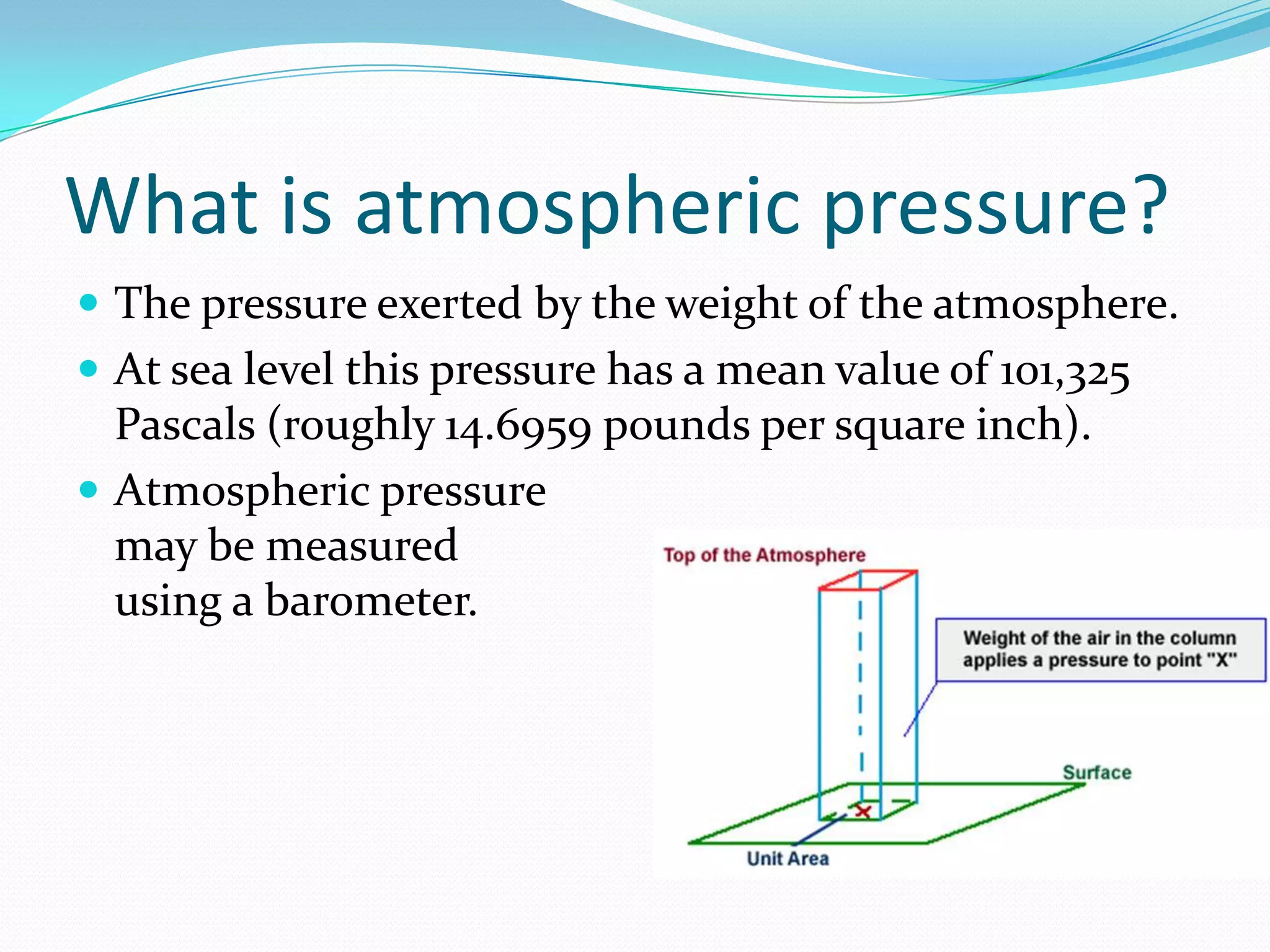
 The pressure exerted by the weight of the atmosphere.
 At sea level this pressure has a mean value of 101,325
  Pascals (roughly 14.6959 pounds per square inch).
 Atmospheric pressure
  may be measured
  using a barometer.
What is a barometer?
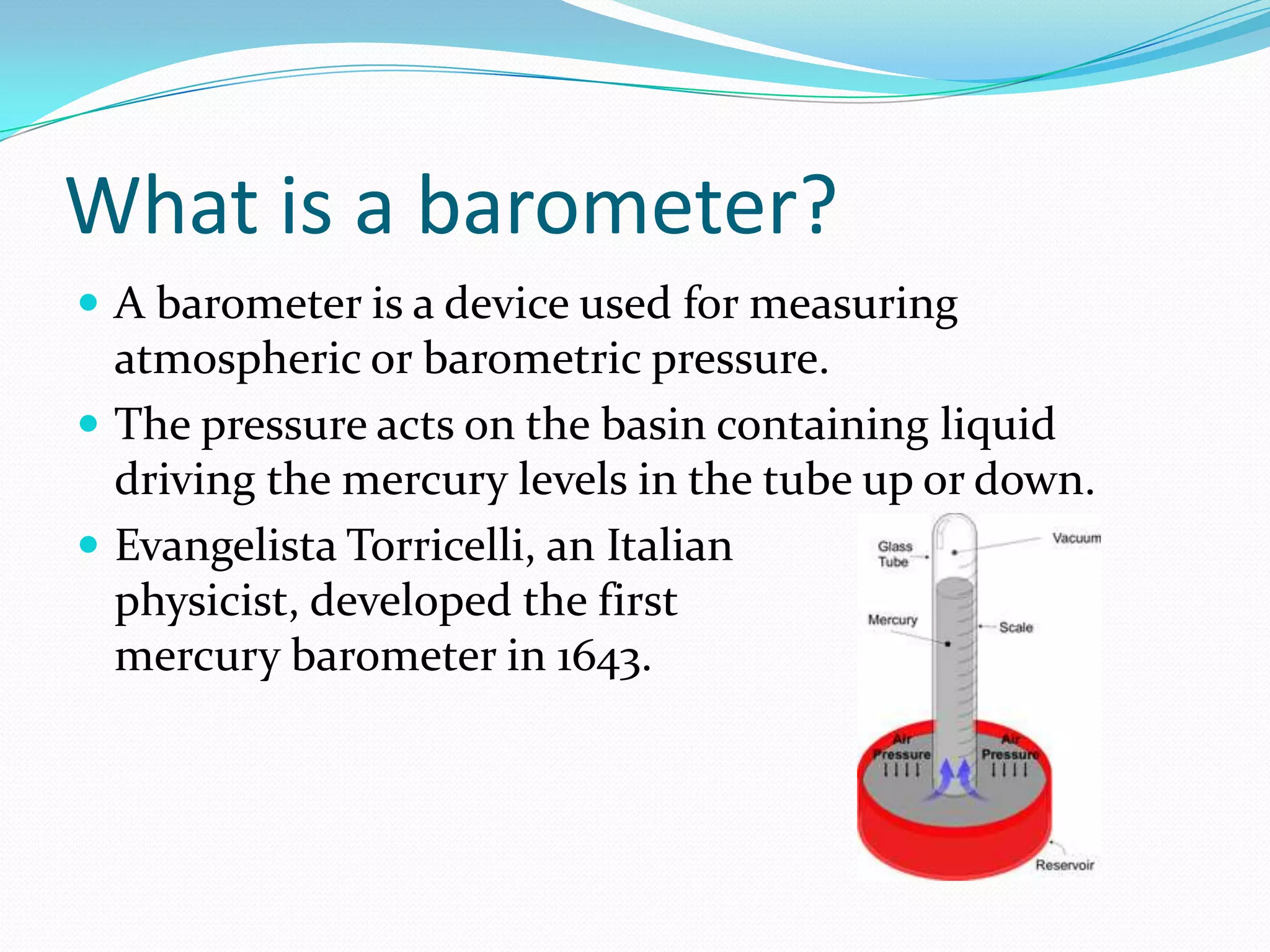
 A barometer is a device used for measuring
  atmospheric or barometric pressure.
 The pressure acts on the basin containing liquid
  driving the mercury levels in the tube up or down.
 Evangelista Torricelli, an Italian
  physicist, developed the first
  mercury barometer in 1643.
Cox’s timepiece
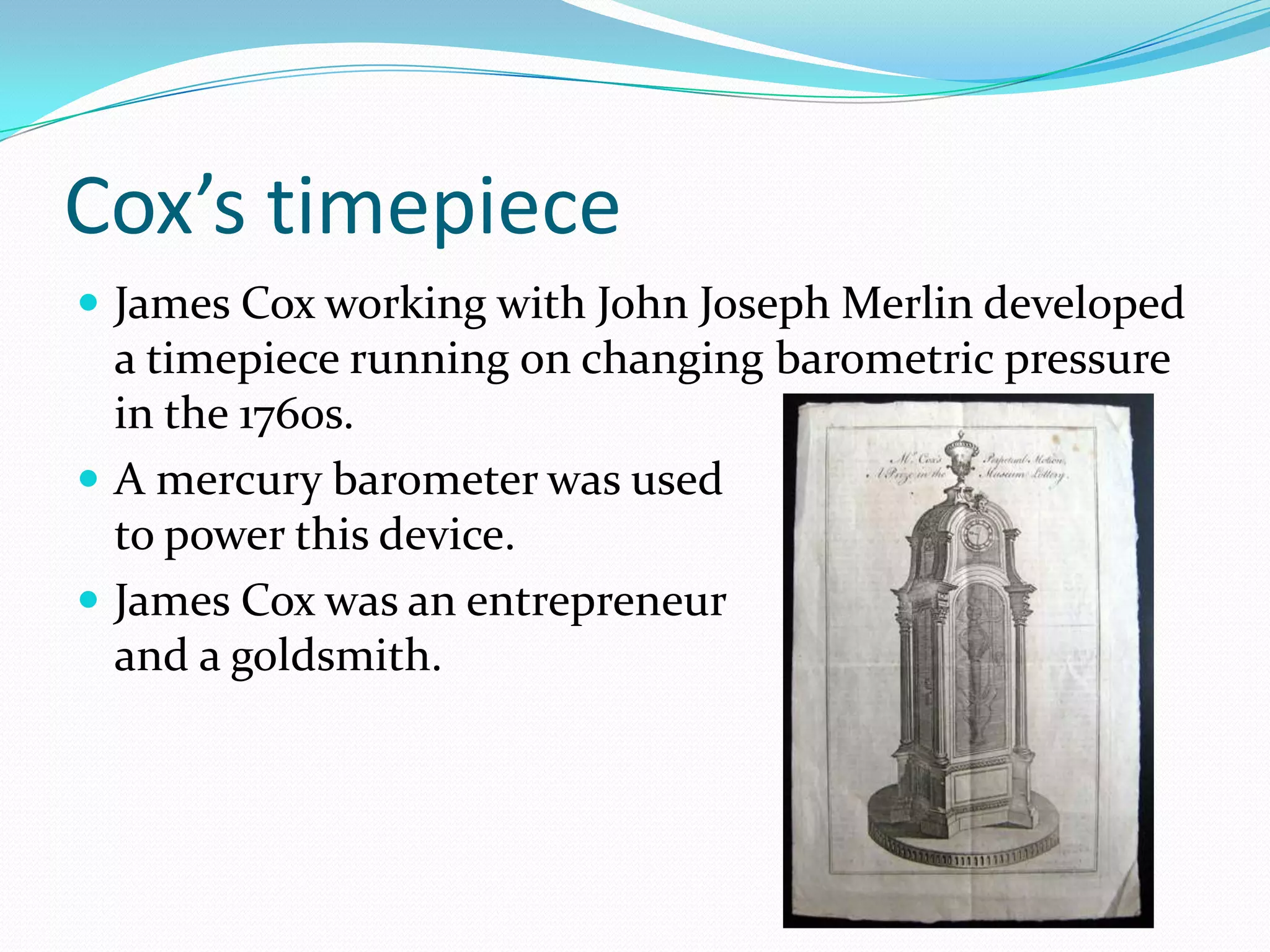
 James Cox working with John Joseph Merlin developed
  a timepiece running on changing barometric pressure
  in the 1760s.
 A mercury barometer was used
  to power this device.
 James Cox was an entrepreneur
  and a goldsmith.
Aneroid Barometers
 Aneroid barometers were invented by French scientist
  Lucien Viddie in 1843.
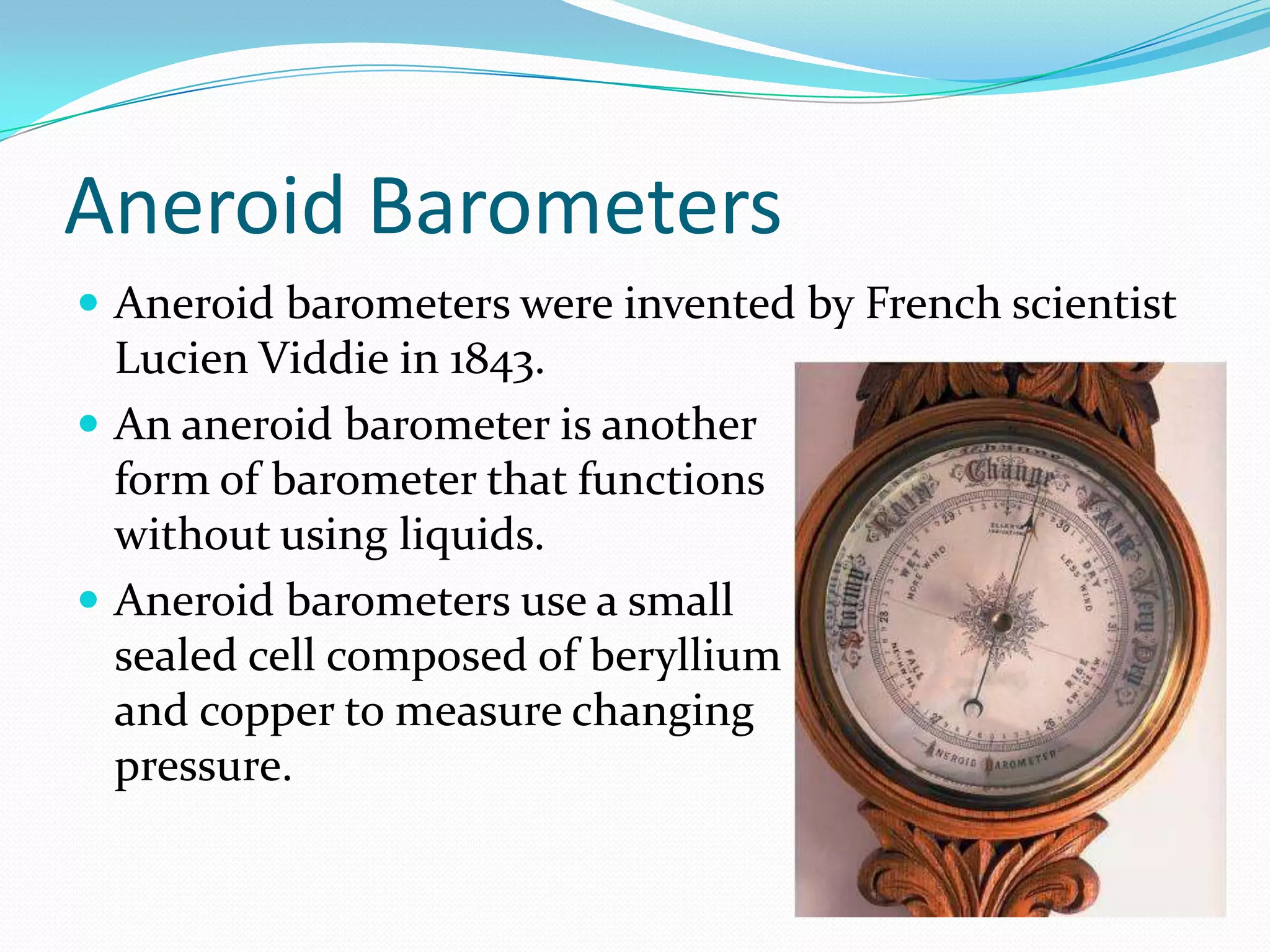
 An aneroid barometer is another
  form of barometer that functions
  without using liquids.
 Aneroid barometers use a small
  sealed cell composed of beryllium
  and copper to measure changing
  pressure.
More about atmospheric pressure
 Changing atmospheric pressures are responsible for
  our winds and weather patterns.
 Elevation and uneven temperatures affect pressure
  levels.
 Areas of high pressure will flow to areas of low
  pressure.
Cold Energy, LLC
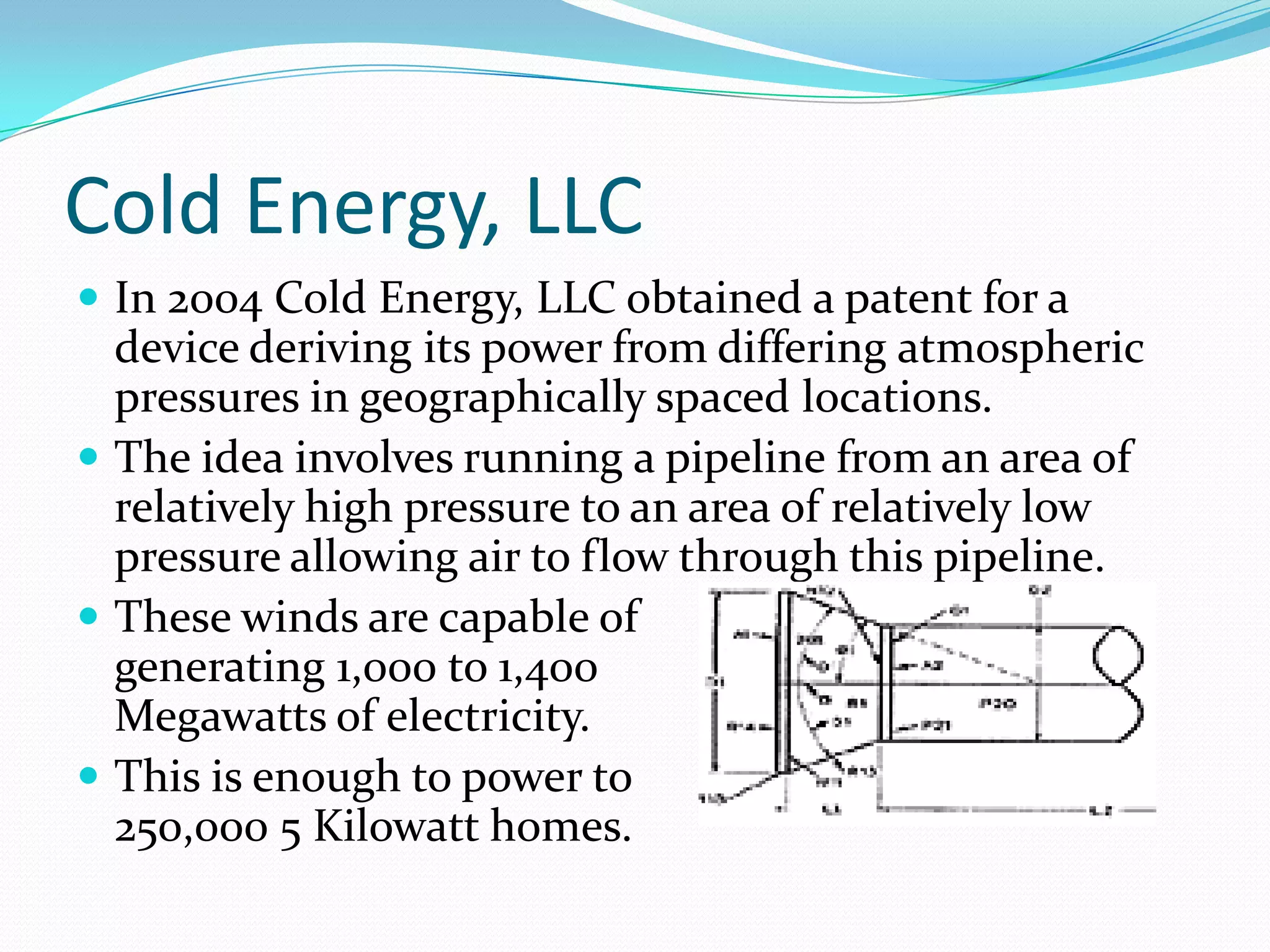
 In 2004 Cold Energy, LLC obtained a patent for a
  device deriving its power from differing atmospheric
  pressures in geographically spaced locations.
 The idea involves running a pipeline from an area of
  relatively high pressure to an area of relatively low
  pressure allowing air to flow through this pipeline.
 These winds are capable of
  generating 1,000 to 1,400
  Megawatts of electricity.
 This is enough to power to
  250,000 5 Kilowatt homes.
Conclusion
 Barometric pressure is a viable and clean source of
 renewable energy.

Pressure to powerpoint

  • 1.
  • 2.
    What is atmosphericpressure?  The pressure exerted by the weight of the atmosphere.  At sea level this pressure has a mean value of 101,325 Pascals (roughly 14.6959 pounds per square inch).  Atmospheric pressure may be measured using a barometer.
  • 3.
    What is abarometer?  A barometer is a device used for measuring atmospheric or barometric pressure.  The pressure acts on the basin containing liquid driving the mercury levels in the tube up or down.  Evangelista Torricelli, an Italian physicist, developed the first mercury barometer in 1643.
  • 4.
    Cox’s timepiece  JamesCox working with John Joseph Merlin developed a timepiece running on changing barometric pressure in the 1760s.  A mercury barometer was used to power this device.  James Cox was an entrepreneur and a goldsmith.
  • 5.
    Aneroid Barometers  Aneroidbarometers were invented by French scientist Lucien Viddie in 1843.  An aneroid barometer is another form of barometer that functions without using liquids.  Aneroid barometers use a small sealed cell composed of beryllium and copper to measure changing pressure.
  • 6.
    More about atmosphericpressure  Changing atmospheric pressures are responsible for our winds and weather patterns.  Elevation and uneven temperatures affect pressure levels.  Areas of high pressure will flow to areas of low pressure.
  • 7.
    Cold Energy, LLC In 2004 Cold Energy, LLC obtained a patent for a device deriving its power from differing atmospheric pressures in geographically spaced locations.  The idea involves running a pipeline from an area of relatively high pressure to an area of relatively low pressure allowing air to flow through this pipeline.  These winds are capable of generating 1,000 to 1,400 Megawatts of electricity.  This is enough to power to 250,000 5 Kilowatt homes.
  • 8.
    Conclusion  Barometric pressureis a viable and clean source of renewable energy.

Editor's Notes

  • #3 http://www.google.com/search?q=define+atmospheric+pressure&aq=f&oq=define+atmospheric+pressure&sugexp=chrome,mod=0&sourceid=chrome&ie=UTF-8#hl=en&safe=off&q=atmospheric+pressure&tbs=dfn:1&tbo=u&sa=X&ei=pz6PUL-XM5DbigLxooGgAw&ved=0CB4QkQ4&bav=on.2,or.r_gc.r_pw.r_qf.&fp=80d93921fbad9d7e&bpcl=36601534&biw=1366&bih=643http://ww2010.atmos.uiuc.edu/(Gh)/guides/mtr/fw/prs/def.rxml
  • #4 http://weather.about.com/od/weatherinstruments/a/barometers.htmhttp://inventors.about.com/od/tstartinventors/a/Barometer.htm
  • #5 http://books.google.com/books?id=022yYXnS_GQC&lpg=PA113&ots=0DMBPw4VYd&dq=Concerning%20those%20perpetual%20motions%20which%20are%20produced%20in%20machines%20by%20the%20rise%20and%20fall%20of%20the%20barometer%20or%20thermometrical%20variations%20in%20the%20dimensions%20of%20bodies&pg=PA115#v=snippet&q=james%20cox's%20timepiece%20was%20rendered%20self-winding%20by%20the%20attachment%20to%20it%20of%20a%20barometer%20arranged&f=falsehttp://inlineskating.about.com/od/inlineskatinghistory/a/j_merlin.htm?iam=dpile_100http://danielmitsui.tripod.com/blog2012/cox1.jpghttp://www.metmuseum.org/toah/hd/jcox/hd_jcox.htm
  • #6 http://inventors.about.com/od/tstartinventors/a/Barometer.htmhttp://www.stormdebris.net/Aneroid_Barometer.html
  • #7 http://geography.about.com/od/climate/a/highlowpressure.htm
  • #8 http://www.coldenergyllc.com/technology.htmlhttp://peswiki.com/index.php/Directory:Barometric_Pressure_Powerhttp://www.coldenergyllc.com/ACMPatent.pdf