lubricating oil additives 
SHIVAJI CHOUDHURY
Introduction 
1. The proper selection and use of lubricants, 
as well as the care and operation of 
lubricating systems, is an essential part of 
any maintenance program. 
2. To choose an appropriate lubricant for a 
particular application and to maintain the 
lubricant’s effectiveness, a basic 
understanding of lubrication theory and the 
characteristics of lubricants can be very 
beneficial.
Fundamentals of lubrication 
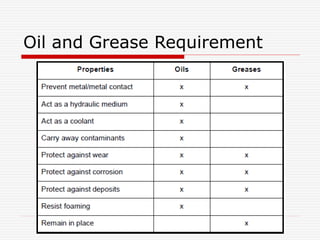
 The basic purpose of a lubricant is to 
reduce friction and wear between 
two surfaces moving relative to one 
another. 
 In most cases, a lubricant also 
dissipates heat, prevents rust or 
corrosion, acts as a seal to outside 
contaminants, and flushes 
contaminants away from bearing 
surfaces.
Oil and Grease Requirement
Lubricant oil 
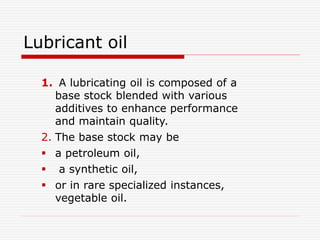
1. A lubricating oil is composed of a 
base stock blended with various 
additives to enhance performance 
and maintain quality. 
2. The base stock may be 
 a petroleum oil, 
 a synthetic oil, 
 or in rare specialized instances, 
vegetable oil.
Lubricating oil additives 
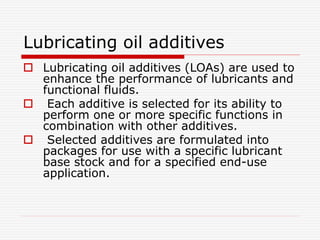
 Lubricating oil additives (LOAs) are used to 
enhance the performance of lubricants and 
functional fluids. 
 Each additive is selected for its ability to 
perform one or more specific functions in 
combination with other additives. 
 Selected additives are formulated into 
packages for use with a specific lubricant 
base stock and for a specified end-use 
application.
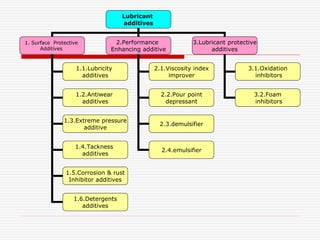
Lubricant 
additives 
1. Surface Protective 
Additives 
2.Performance 
Enhancing additive 
3.Lubricant protective 
additives 
3.1.Oxidation 
inhibitors 
3.2.Foam 
inhibitors 
2.1.Viscosity index 
improver 
2.2.Pour point 
depressant 
2.3.demulsifier 
2.4.emulsifier 
1.1.Lubricity 
additives 
1.2.Antiwear 
additives 
1.3.Extreme pressure 
additive 
1.4.Tackness 
additives 
1.5.Corrosion & rust 
Inhibitor additives 
1.6.Detergents 
additives
1.1.Lubricity additives 
 Lubricity, also referred to as oiliness, with 
respect to lubricating oil, is defined as the 
ability of an oil to reduce friction between 
moving surfaces. 
 Lubricity additives, usually vegetable or 
animal fats, enhance lubricity by 
tenaciously adhering to the metal’s surface, 
forming an adsorbed film of high lubricating 
value.
1.2.Antiwear additives 
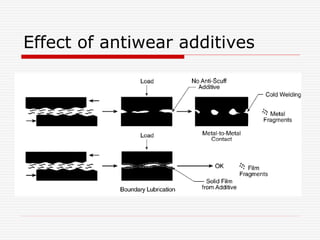
 Antiwear additives work by coating a 
metal’s surface. 
 If light metal-to-metal contact is made, the 
heat from the friction melts the additives, 
forming a liquid layer between the surfaces. 
 This molten additive layer, being softer 
than the metal, acts as a lubricant, 
preventing wear of the metal surfaces.
Effect of antiwear additives
1.3.Extreme Pressure additives 
 Extreme Pressure (EP) additives work by reacting 
with a metal to form a compound that acts as a 
protective layer on the metal’s surface. Because this 
layer is softer than the metal itself, under extreme 
pressure conditions, the compound layer wears away 
first, protecting the metal. 
 As this layer is removed, the EP additive acts to form 
another layer. 
 In contrast to the action of antiwear additives, EP 
additives control wear instead of preventing it.
1.4.Tackiness agent 
 Tackiness agents act to increase the 
adhesiveness of an oil or grease.
1.5.Corrosion and rust inhibitors 
 Rust inhibitors protect ferrous (iron 
or steel) parts by forming a film on 
the part that resists attack by water. 
 Corrosion inhibitors act in a similar 
way to protect nonferrous parts and 
also act to neutralize acids with a 
basic compound such as calcium 
carbonate.
1.6.Detergents and dispersants 
 Detergents and dispersants are used 
primarily in engine oils to keep 
surfaces free of deposits and keep 
contaminants dispersed in the 
lubricant.
2.1.Viscosity index improvers 
 Viscosity index improvers lower the 
rate of change of viscosity with 
temperature and are used to produce 
multigrade motor oils.
2.2.Pour point depressant 
 Pour point depressants enable 
lubricants to flow at low temperature.
2.3.Demulsifier 
 A demulsifier promotes the 
separation of oil and water in 
lubricants exposed to water.
2.4.Emulsifier 
 An emulsifier promotes the rapid mixing of oil and 
water to form a stable emulsion. Emulsifiers are used 
in motor oils to allow water, formed by combustion of 
fuel, to be kept in emulsion until engine heat can 
evaporate it. 
 Emulsifiers are also used in soluble oils used in some 
metal working operations and in fire-resistant 
hydraulic fluids. 
 Emulsification is usually not a desirable property in 
most hydraulic fluids or turbine oils.
3.1.Oxidation inibitors 
 Oxidation inhibitors, or antioxidants, 
lengthen a lubricant’s service or 
storage life by increasing its oxidation 
resistance by binding the free oxygen 
in the oil or by neutralizing the 
catalytic effect of metals.
3.2.Foam inhibitors 
 Foam inhibitors prevent lubricant 
foaming by decreasing the surface 
tension of air bubbles, allowing them 
to combine into large ones, which 
break more rapidly.
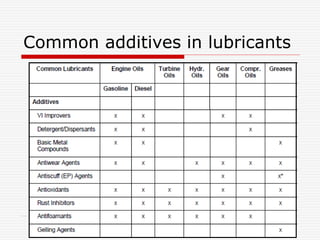
Common additives in lubricants
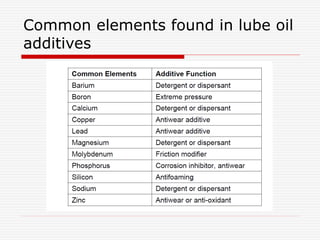
Common elements found in lube oil 
additives
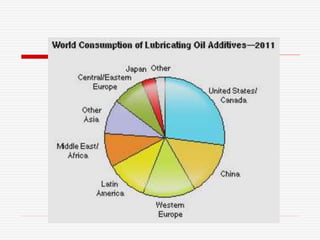
Lubricating oil additives-end user 
 The largest end use is in automotive engine 
crankcase lubricants. 
 Other automotive applications include hydraulic fluids 
and gear oils. 
 In addition, many industrial lubricants and 
metalworking oils also contain LOAs. 
 The major functional additive types are dispersants, 
detergents, oxidation inhibitors, antiwear agents, 
extreme-pressure additives and viscosity index 
improvers.
Government Regulation and LOA 
 Government regulations have had a 
major impact on the LOA business in 
the past and are likely to remain 
important in the future, as upgrading 
lubricants is part of the effort to 
improve fuel economy and to meet 
more stringent emission-control 
requirements.
THANKING YOU

Lubricanting oil additives

  • 1.
    lubricating oil additives SHIVAJI CHOUDHURY
  • 2.
    Introduction 1. Theproper selection and use of lubricants, as well as the care and operation of lubricating systems, is an essential part of any maintenance program. 2. To choose an appropriate lubricant for a particular application and to maintain the lubricant’s effectiveness, a basic understanding of lubrication theory and the characteristics of lubricants can be very beneficial.
  • 3.
    Fundamentals of lubrication  The basic purpose of a lubricant is to reduce friction and wear between two surfaces moving relative to one another.  In most cases, a lubricant also dissipates heat, prevents rust or corrosion, acts as a seal to outside contaminants, and flushes contaminants away from bearing surfaces.
  • 4.
    Oil and GreaseRequirement
  • 5.
    Lubricant oil 1.A lubricating oil is composed of a base stock blended with various additives to enhance performance and maintain quality. 2. The base stock may be  a petroleum oil,  a synthetic oil,  or in rare specialized instances, vegetable oil.
  • 6.
    Lubricating oil additives  Lubricating oil additives (LOAs) are used to enhance the performance of lubricants and functional fluids.  Each additive is selected for its ability to perform one or more specific functions in combination with other additives.  Selected additives are formulated into packages for use with a specific lubricant base stock and for a specified end-use application.
  • 7.
    Lubricant additives 1.Surface Protective Additives 2.Performance Enhancing additive 3.Lubricant protective additives 3.1.Oxidation inhibitors 3.2.Foam inhibitors 2.1.Viscosity index improver 2.2.Pour point depressant 2.3.demulsifier 2.4.emulsifier 1.1.Lubricity additives 1.2.Antiwear additives 1.3.Extreme pressure additive 1.4.Tackness additives 1.5.Corrosion & rust Inhibitor additives 1.6.Detergents additives
  • 8.
    1.1.Lubricity additives Lubricity, also referred to as oiliness, with respect to lubricating oil, is defined as the ability of an oil to reduce friction between moving surfaces.  Lubricity additives, usually vegetable or animal fats, enhance lubricity by tenaciously adhering to the metal’s surface, forming an adsorbed film of high lubricating value.
  • 9.
    1.2.Antiwear additives Antiwear additives work by coating a metal’s surface.  If light metal-to-metal contact is made, the heat from the friction melts the additives, forming a liquid layer between the surfaces.  This molten additive layer, being softer than the metal, acts as a lubricant, preventing wear of the metal surfaces.
  • 10.
  • 11.
    1.3.Extreme Pressure additives  Extreme Pressure (EP) additives work by reacting with a metal to form a compound that acts as a protective layer on the metal’s surface. Because this layer is softer than the metal itself, under extreme pressure conditions, the compound layer wears away first, protecting the metal.  As this layer is removed, the EP additive acts to form another layer.  In contrast to the action of antiwear additives, EP additives control wear instead of preventing it.
  • 12.
    1.4.Tackiness agent Tackiness agents act to increase the adhesiveness of an oil or grease.
  • 13.
    1.5.Corrosion and rustinhibitors  Rust inhibitors protect ferrous (iron or steel) parts by forming a film on the part that resists attack by water.  Corrosion inhibitors act in a similar way to protect nonferrous parts and also act to neutralize acids with a basic compound such as calcium carbonate.
  • 14.
    1.6.Detergents and dispersants  Detergents and dispersants are used primarily in engine oils to keep surfaces free of deposits and keep contaminants dispersed in the lubricant.
  • 15.
    2.1.Viscosity index improvers  Viscosity index improvers lower the rate of change of viscosity with temperature and are used to produce multigrade motor oils.
  • 16.
    2.2.Pour point depressant  Pour point depressants enable lubricants to flow at low temperature.
  • 17.
    2.3.Demulsifier  Ademulsifier promotes the separation of oil and water in lubricants exposed to water.
  • 18.
    2.4.Emulsifier  Anemulsifier promotes the rapid mixing of oil and water to form a stable emulsion. Emulsifiers are used in motor oils to allow water, formed by combustion of fuel, to be kept in emulsion until engine heat can evaporate it.  Emulsifiers are also used in soluble oils used in some metal working operations and in fire-resistant hydraulic fluids.  Emulsification is usually not a desirable property in most hydraulic fluids or turbine oils.
  • 19.
    3.1.Oxidation inibitors Oxidation inhibitors, or antioxidants, lengthen a lubricant’s service or storage life by increasing its oxidation resistance by binding the free oxygen in the oil or by neutralizing the catalytic effect of metals.
  • 20.
    3.2.Foam inhibitors Foam inhibitors prevent lubricant foaming by decreasing the surface tension of air bubbles, allowing them to combine into large ones, which break more rapidly.
  • 21.
  • 22.
    Common elements foundin lube oil additives
  • 23.
    Lubricating oil additives-enduser  The largest end use is in automotive engine crankcase lubricants.  Other automotive applications include hydraulic fluids and gear oils.  In addition, many industrial lubricants and metalworking oils also contain LOAs.  The major functional additive types are dispersants, detergents, oxidation inhibitors, antiwear agents, extreme-pressure additives and viscosity index improvers.
  • 25.
    Government Regulation andLOA  Government regulations have had a major impact on the LOA business in the past and are likely to remain important in the future, as upgrading lubricants is part of the effort to improve fuel economy and to meet more stringent emission-control requirements.
  • 26.