
Engr. Tarique Ahmed Memon
Lecturer, Department of Mechanical Engineering
Quaid-e-Awam University of Engineering , Sciences &
Technology (QUEST) Campus Larkano, Sindh, Pakistan.
Background
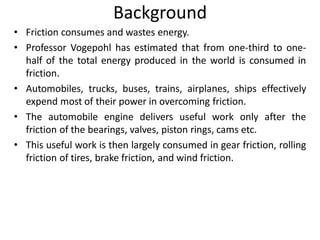
• Friction consumes and wastes energy.
• Professor Vogepohl has estimated that from one-third to one-
half of the total energy produced in the world is consumed in
friction.
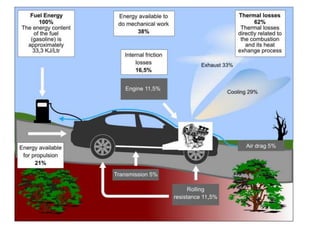
• Automobiles, trucks, buses, trains, airplanes, ships effectively
expend most of their power in overcoming friction.
• The automobile engine delivers useful work only after the
friction of the bearings, valves, piston rings, cams etc.
• This useful work is then largely consumed in gear friction, rolling
friction of tires, brake friction, and wind friction.
Friction
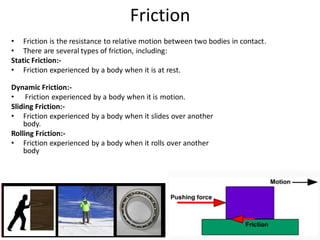
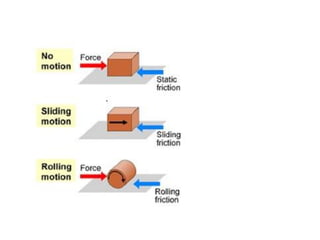
• Friction is the resistance to relative motion between two bodies in contact.
• There are several types of friction, including:
Static Friction:-
• Friction experienced by a body when it is at rest.
Dynamic Friction:-
• Friction experienced by a body when it is motion.
Sliding Friction:-
• Friction experienced by a body when it slides over another
body.
Rolling Friction:-
• Friction experienced by a body when it rolls over another
body
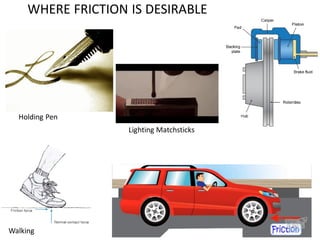
WHERE FRICTION IS DESIRABLE
Holding Pen
Lighting Matchsticks
Walking
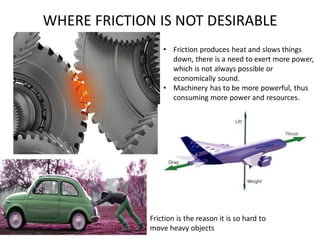
WHERE FRICTION IS NOT DESIRABLE
Friction is the reason it is so hard to
move heavy objects
• Friction produces heat and slows things
down, there is a need to exert more power,
which is not always possible or
economically sound.
• Machinery has to be more powerful, thus
consuming more power and resources.
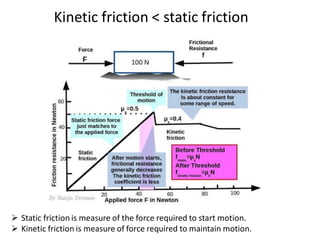
Kinetic friction < static friction
 Static friction is measure of the force required to start motion.
 Kinetic friction is measure of force required to maintain motion.
• The friction may further be classified as :
1. Friction between unlubricated surfaces, and
2. Friction between lubricated surfaces
Friction Between Unlubricated Surfaces
• The friction experienced between two dry and
unlubricated surfaces in contact is known as
dry or solid friction.
• It is due to the surface roughness.
• The dry or solid friction includes the sliding friction
and rolling friction.
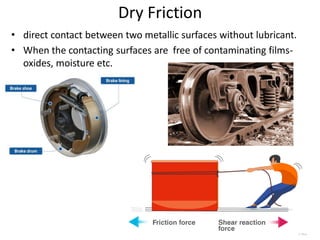
Dry Friction
• direct contact between two metallic surfaces without lubricant.
• When the contacting surfaces are free of contaminating films-
oxides, moisture etc.
Friction Between Lubricated Surfaces
• When lubricant (i.e. oil or grease) is applied
between two surfaces in contact, then the
friction may be classified into the following two
types depending upon the thickness of layer of a
lubricant.
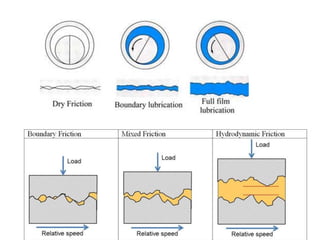
1. Boundary friction (or greasy friction or non-
viscous friction).
2. Fluid friction (or film friction or viscous friction
or Hydrodynamic Friction)
3. Semi fluid or mixed friction
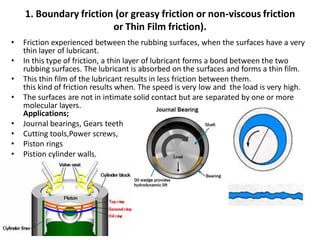
1. Boundary friction (or greasy friction or non-viscous friction
or Thin Film friction).
• Friction experienced between the rubbing surfaces, when the surfaces have a very
thin layer of lubricant.
• In this type of friction, a thin layer of lubricant forms a bond between the two
rubbing surfaces. The lubricant is absorbed on the surfaces and forms a thin film.
• This thin film of the lubricant results in less friction between them.
this kind of friction results when. The speed is very low and the load is very high.
• The surfaces are not in intimate solid contact but are separated by one or more
molecular layers.
Applications;
• Journal bearings, Gears teeth
• Cutting tools,Power screws,
• Piston rings
• Pistion cylinder walls.
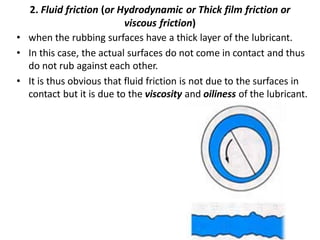
2. Fluid friction (or Hydrodynamic or Thick film friction or
viscous friction)
• when the rubbing surfaces have a thick layer of the lubricant.
• In this case, the actual surfaces do not come in contact and thus
do not rub against each other.
• It is thus obvious that fluid friction is not due to the surfaces in
contact but it is due to the viscosity and oiliness of the lubricant.
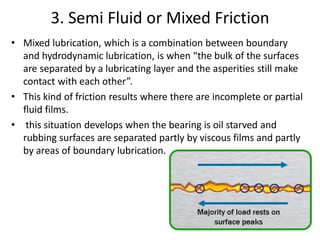
3. Semi Fluid or Mixed Friction
• Mixed lubrication, which is a combination between boundary
and hydrodynamic lubrication, is when “the bulk of the surfaces
are separated by a lubricating layer and the asperities still make
contact with each other”.
• This kind of friction results where there are incomplete or partial
fluid films.
• this situation develops when the bearing is oil starved and
rubbing surfaces are separated partly by viscous films and partly
by areas of boundary lubrication.
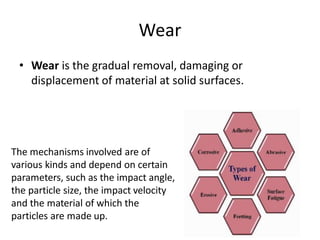
Wear
• Wear is the gradual removal, damaging or
displacement of material at solid surfaces.
The mechanisms involved are of
various kinds and depend on certain
parameters, such as the impact angle,
the particle size, the impact velocity
and the material of which the
particles are made up.
Abrasive Wear
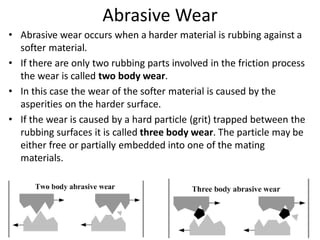
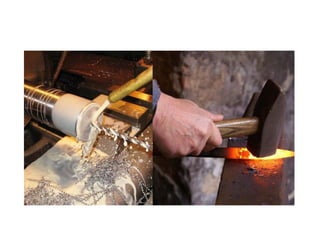
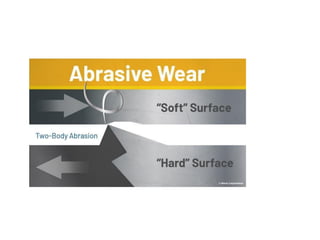
• Abrasive wear occurs when a harder material is rubbing against a
softer material.
• If there are only two rubbing parts involved in the friction process
the wear is called two body wear.
• In this case the wear of the softer material is caused by the
asperities on the harder surface.
• If the wear is caused by a hard particle (grit) trapped between the
rubbing surfaces it is called three body wear. The particle may be
either free or partially embedded into one of the mating
materials.
Adhesive Wear
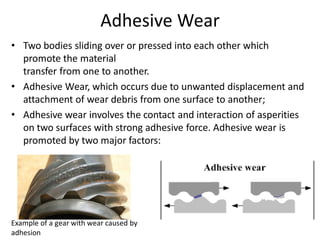
• Two bodies sliding over or pressed into each other which
promote the material
transfer from one to another.
• Adhesive Wear, which occurs due to unwanted displacement and
attachment of wear debris from one surface to another;
• Adhesive wear involves the contact and interaction of asperities
on two surfaces with strong adhesive force. Adhesive wear is
promoted by two major factors:
Example of a gear with wear caused by
adhesion
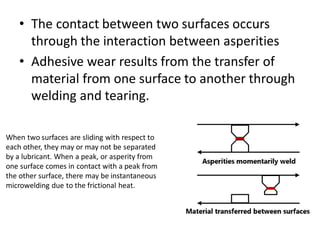
• The contact between two surfaces occurs
through the interaction between asperities
• Adhesive wear results from the transfer of
material from one surface to another through
welding and tearing.
When two surfaces are sliding with respect to
each other, they may or may not be separated
by a lubricant. When a peak, or asperity from
one surface comes in contact with a peak from
the other surface, there may be instantaneous
microwelding due to the frictional heat.
Behavior of the adhesive wear
• The behavior of the adhesive wear volume can be
described by means of three main laws.
• Law 1 – Distance
• The mass involved in wear is proportional to the
distance traveled in the rubbing between the surfaces.
• Law 2 – Load
• The mass involved in wear is proportional to the
applied load.
• Law 3 – Hardness
• The mass involved in wear is inversely proportional to
the hardness of the less hard material.
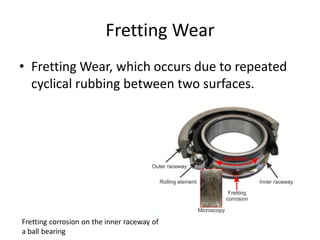
Fretting Wear
• Fretting Wear, which occurs due to repeated
cyclical rubbing between two surfaces.
Fretting corrosion on the inner raceway of
a ball bearing
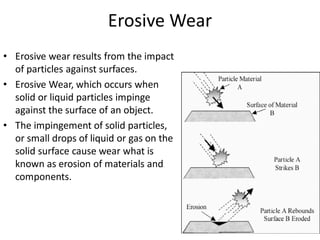
Erosive Wear
• Erosive wear results from the impact
of particles against surfaces.
• Erosive Wear, which occurs when
solid or liquid particles impinge
against the surface of an object.
• The impingement of solid particles,
or small drops of liquid or gas on the
solid surface cause wear what is
known as erosion of materials and
components.
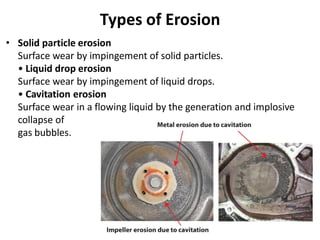
Types of Erosion
• Solid particle erosion
Surface wear by impingement of solid particles.
• Liquid drop erosion
Surface wear by impingement of liquid drops.
• Cavitation erosion
Surface wear in a flowing liquid by the generation and implosive
collapse of
gas bubbles.
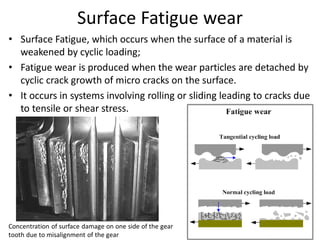
Surface Fatigue wear
• Surface Fatigue, which occurs when the surface of a material is
weakened by cyclic loading;
• Fatigue wear is produced when the wear particles are detached by
cyclic crack growth of micro cracks on the surface.
• It occurs in systems involving rolling or sliding leading to cracks due
to tensile or shear stress.
Concentration of surface damage on one side of the gear
tooth due to misalignment of the gear
Corrosive Wear
• Corrosion/Oxidation Wear, which occurs due to chemical reactions
between worn materials and a corroding medium.
• Chemical or corrosive wear occurs when rubbing takes place in a
corrosive environment.
• Chemical wear in air is generally called oxidative wear as oxygen is
the dominant corrosive medium for metals in air.
• Chemical wear requires both a chemical reaction and rubbing (by
sliding).
The End

Friction and wear

  • 1.
    Engr. Tarique AhmedMemon Lecturer, Department of Mechanical Engineering Quaid-e-Awam University of Engineering , Sciences & Technology (QUEST) Campus Larkano, Sindh, Pakistan.
  • 2.
    Background • Friction consumesand wastes energy. • Professor Vogepohl has estimated that from one-third to one- half of the total energy produced in the world is consumed in friction. • Automobiles, trucks, buses, trains, airplanes, ships effectively expend most of their power in overcoming friction. • The automobile engine delivers useful work only after the friction of the bearings, valves, piston rings, cams etc. • This useful work is then largely consumed in gear friction, rolling friction of tires, brake friction, and wind friction.
  • 4.
    Friction • Friction isthe resistance to relative motion between two bodies in contact. • There are several types of friction, including: Static Friction:- • Friction experienced by a body when it is at rest. Dynamic Friction:- • Friction experienced by a body when it is motion. Sliding Friction:- • Friction experienced by a body when it slides over another body. Rolling Friction:- • Friction experienced by a body when it rolls over another body
  • 6.
    WHERE FRICTION ISDESIRABLE Holding Pen Lighting Matchsticks Walking
  • 7.
    WHERE FRICTION ISNOT DESIRABLE Friction is the reason it is so hard to move heavy objects • Friction produces heat and slows things down, there is a need to exert more power, which is not always possible or economically sound. • Machinery has to be more powerful, thus consuming more power and resources.
  • 8.
    Kinetic friction <static friction  Static friction is measure of the force required to start motion.  Kinetic friction is measure of force required to maintain motion.
  • 9.
    • The frictionmay further be classified as : 1. Friction between unlubricated surfaces, and 2. Friction between lubricated surfaces
  • 10.
    Friction Between UnlubricatedSurfaces • The friction experienced between two dry and unlubricated surfaces in contact is known as dry or solid friction. • It is due to the surface roughness. • The dry or solid friction includes the sliding friction and rolling friction.
  • 11.
    Dry Friction • directcontact between two metallic surfaces without lubricant. • When the contacting surfaces are free of contaminating films- oxides, moisture etc.
  • 12.
    Friction Between LubricatedSurfaces • When lubricant (i.e. oil or grease) is applied between two surfaces in contact, then the friction may be classified into the following two types depending upon the thickness of layer of a lubricant. 1. Boundary friction (or greasy friction or non- viscous friction). 2. Fluid friction (or film friction or viscous friction or Hydrodynamic Friction) 3. Semi fluid or mixed friction
  • 13.
    1. Boundary friction(or greasy friction or non-viscous friction or Thin Film friction). • Friction experienced between the rubbing surfaces, when the surfaces have a very thin layer of lubricant. • In this type of friction, a thin layer of lubricant forms a bond between the two rubbing surfaces. The lubricant is absorbed on the surfaces and forms a thin film. • This thin film of the lubricant results in less friction between them. this kind of friction results when. The speed is very low and the load is very high. • The surfaces are not in intimate solid contact but are separated by one or more molecular layers. Applications; • Journal bearings, Gears teeth • Cutting tools,Power screws, • Piston rings • Pistion cylinder walls.
  • 14.
    2. Fluid friction(or Hydrodynamic or Thick film friction or viscous friction) • when the rubbing surfaces have a thick layer of the lubricant. • In this case, the actual surfaces do not come in contact and thus do not rub against each other. • It is thus obvious that fluid friction is not due to the surfaces in contact but it is due to the viscosity and oiliness of the lubricant.
  • 15.
    3. Semi Fluidor Mixed Friction • Mixed lubrication, which is a combination between boundary and hydrodynamic lubrication, is when “the bulk of the surfaces are separated by a lubricating layer and the asperities still make contact with each other”. • This kind of friction results where there are incomplete or partial fluid films. • this situation develops when the bearing is oil starved and rubbing surfaces are separated partly by viscous films and partly by areas of boundary lubrication.
  • 17.
    Wear • Wear isthe gradual removal, damaging or displacement of material at solid surfaces. The mechanisms involved are of various kinds and depend on certain parameters, such as the impact angle, the particle size, the impact velocity and the material of which the particles are made up.
  • 18.
    Abrasive Wear • Abrasivewear occurs when a harder material is rubbing against a softer material. • If there are only two rubbing parts involved in the friction process the wear is called two body wear. • In this case the wear of the softer material is caused by the asperities on the harder surface. • If the wear is caused by a hard particle (grit) trapped between the rubbing surfaces it is called three body wear. The particle may be either free or partially embedded into one of the mating materials.
  • 21.
    Adhesive Wear • Twobodies sliding over or pressed into each other which promote the material transfer from one to another. • Adhesive Wear, which occurs due to unwanted displacement and attachment of wear debris from one surface to another; • Adhesive wear involves the contact and interaction of asperities on two surfaces with strong adhesive force. Adhesive wear is promoted by two major factors: Example of a gear with wear caused by adhesion
  • 22.
    • The contactbetween two surfaces occurs through the interaction between asperities • Adhesive wear results from the transfer of material from one surface to another through welding and tearing. When two surfaces are sliding with respect to each other, they may or may not be separated by a lubricant. When a peak, or asperity from one surface comes in contact with a peak from the other surface, there may be instantaneous microwelding due to the frictional heat.
  • 23.
    Behavior of theadhesive wear • The behavior of the adhesive wear volume can be described by means of three main laws. • Law 1 – Distance • The mass involved in wear is proportional to the distance traveled in the rubbing between the surfaces. • Law 2 – Load • The mass involved in wear is proportional to the applied load. • Law 3 – Hardness • The mass involved in wear is inversely proportional to the hardness of the less hard material.
  • 24.
    Fretting Wear • FrettingWear, which occurs due to repeated cyclical rubbing between two surfaces. Fretting corrosion on the inner raceway of a ball bearing
  • 25.
    Erosive Wear • Erosivewear results from the impact of particles against surfaces. • Erosive Wear, which occurs when solid or liquid particles impinge against the surface of an object. • The impingement of solid particles, or small drops of liquid or gas on the solid surface cause wear what is known as erosion of materials and components.
  • 26.
    Types of Erosion •Solid particle erosion Surface wear by impingement of solid particles. • Liquid drop erosion Surface wear by impingement of liquid drops. • Cavitation erosion Surface wear in a flowing liquid by the generation and implosive collapse of gas bubbles.
  • 27.
    Surface Fatigue wear •Surface Fatigue, which occurs when the surface of a material is weakened by cyclic loading; • Fatigue wear is produced when the wear particles are detached by cyclic crack growth of micro cracks on the surface. • It occurs in systems involving rolling or sliding leading to cracks due to tensile or shear stress. Concentration of surface damage on one side of the gear tooth due to misalignment of the gear
  • 28.
    Corrosive Wear • Corrosion/OxidationWear, which occurs due to chemical reactions between worn materials and a corroding medium. • Chemical or corrosive wear occurs when rubbing takes place in a corrosive environment. • Chemical wear in air is generally called oxidative wear as oxygen is the dominant corrosive medium for metals in air. • Chemical wear requires both a chemical reaction and rubbing (by sliding).
  • 29.