1
Principles of Machining
Advanced Machining
Processes
2
Types of Advanced Machining
Processes
 Chemical Machining
 Electrochemical Machining
 Electrical Discharge Machining
 Wire EDM
 Laser Beam Machining
 Electron Beam Machining
 Plasma Arc Cutting
 Ultrasonic Machining
 Water Jet Machining
 Abrasive Jet Machining
3
The Need for Advanced
Machining Processes
 Traditional machining processes
• Material removal by mechanical means, such as chip
forming, abrasion, or micro-chipping
 Advanced machining processes
• Utilize chemical, electrical, and high-energy beams
 The following cannot be done by traditional processes:
• Workpiece strength and hardness very high, >400HB
• Workpiece material too brittle, glass, ceramics, heat-
treated alloys
• Workpiece too slender and flexible, hard to clamp
• Part shape complex, long and small hole
• Special surface and dimensional tolerance requirements
4
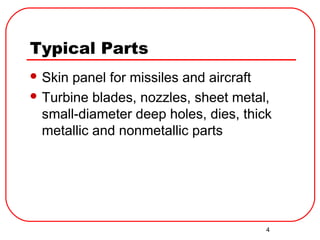
Typical Parts
 Skin panel for missiles and aircraft
 Turbine blades, nozzles, sheet metal,
small-diameter deep holes, dies, thick
metallic and nonmetallic parts
5
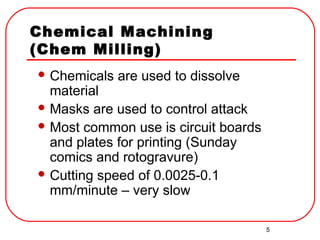
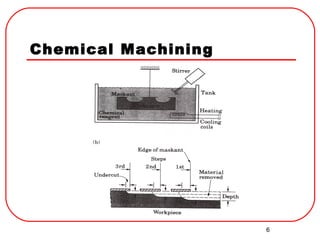
Chemical Machining
(Chem Milling)
 Chemicals are used to dissolve
material
 Masks are used to control attack
 Most common use is circuit boards
and plates for printing (Sunday
comics and rotogravure)
 Cutting speed of 0.0025-0.1
mm/minute – very slow
6
Chemical Machining
7
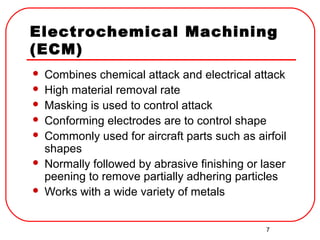
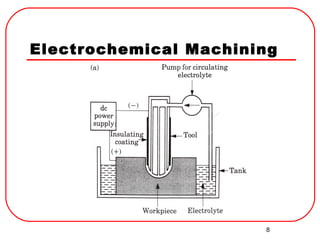
Electrochemical Machining
(ECM)
 Combines chemical attack and electrical attack
 High material removal rate
 Masking is used to control attack
 Conforming electrodes are to control shape
 Commonly used for aircraft parts such as airfoil
shapes
 Normally followed by abrasive finishing or laser
peening to remove partially adhering particles
 Works with a wide variety of metals
8
Electrochemical Machining
9
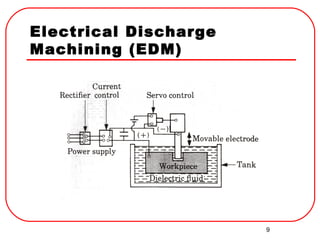
Electrical Discharge
Machining (EDM)
10
Electrical Discharge
Machining
 Successive electric arcs melt tiny droplets
from surface of workpiece
 Frozen droplets must be flushed away
 Electrodes are made from graphite,
copper or copper-tungsten alloy
 Material removed from electrode by arc
 Recast layer of approximately 0.001” in
depth left on surface
 Secondary process such as chemical
machining used to remove recast layer
11
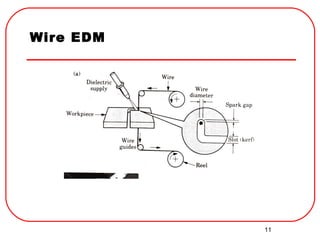
Wire EDM
12
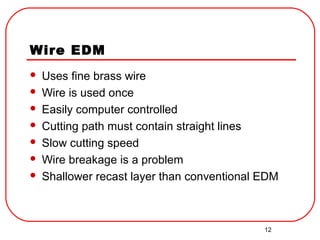
Wire EDM
 Uses fine brass wire
 Wire is used once
 Easily computer controlled
 Cutting path must contain straight lines
 Slow cutting speed
 Wire breakage is a problem
 Shallower recast layer than conventional EDM
13
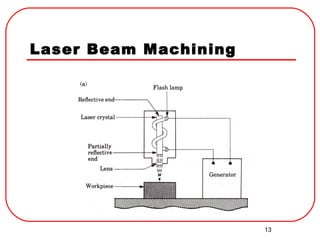
Laser Beam Machining
14
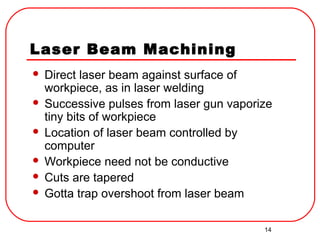
Laser Beam Machining
 Direct laser beam against surface of
workpiece, as in laser welding
 Successive pulses from laser gun vaporize
tiny bits of workpiece
 Location of laser beam controlled by
computer
 Workpiece need not be conductive
 Cuts are tapered
 Gotta trap overshoot from laser beam
15
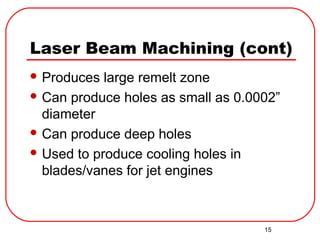
Laser Beam Machining (cont)
 Produces large remelt zone
 Can produce holes as small as 0.0002”
diameter
 Can produce deep holes
 Used to produce cooling holes in
blades/vanes for jet engines
16
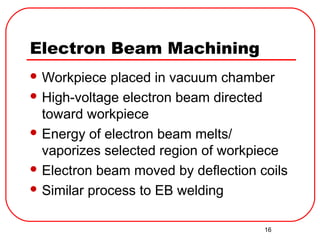
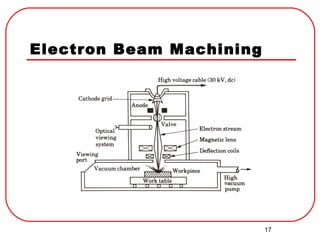
Electron Beam Machining
 Workpiece placed in vacuum chamber
 High-voltage electron beam directed
toward workpiece
 Energy of electron beam melts/
vaporizes selected region of workpiece
 Electron beam moved by deflection coils
 Similar process to EB welding
17
Electron Beam Machining
18
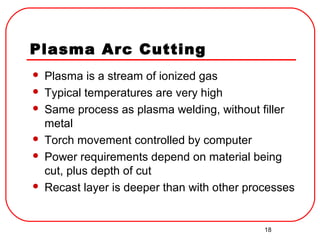
Plasma Arc Cutting
 Plasma is a stream of ionized gas
 Typical temperatures are very high
 Same process as plasma welding, without filler
metal
 Torch movement controlled by computer
 Power requirements depend on material being
cut, plus depth of cut
 Recast layer is deeper than with other processes
19
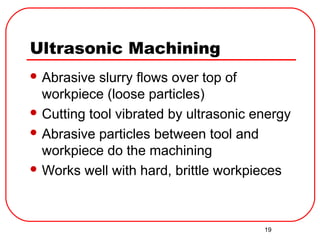
Ultrasonic Machining
 Abrasive slurry flows over top of
workpiece (loose particles)
 Cutting tool vibrated by ultrasonic energy
 Abrasive particles between tool and
workpiece do the machining
 Works well with hard, brittle workpieces
20
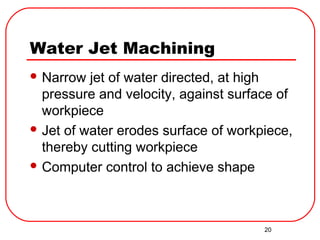
Water Jet Machining
 Narrow jet of water directed, at high
pressure and velocity, against surface of
workpiece
 Jet of water erodes surface of workpiece,
thereby cutting workpiece
 Computer control to achieve shape
21
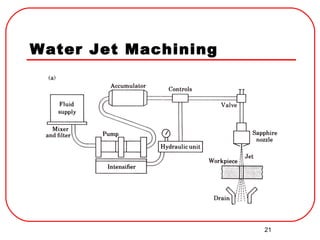
Water Jet Machining
22
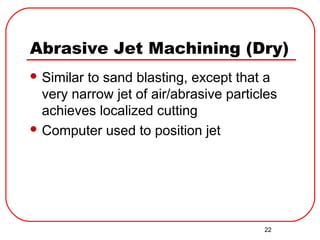
Abrasive Jet Machining (Dry)
 Similar to sand blasting, except that a
very narrow jet of air/abrasive particles
achieves localized cutting
 Computer used to position jet
23
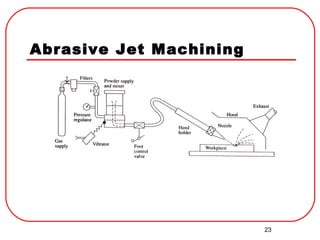
Abrasive Jet Machining
24
Nanofabrication Methods
 Typically used in the semiconductor
industry
 Combines the lithography technique of
chemical machining with an atomic force
microscope
 May incorporate plasma cutting, reduced
to nano scale
25
Economics of Advanced Machining
Processes
 High cost of equipment, which typically
includes computer control
 May use hard tooling, soft tooling, or both
 Low production rates
 Can be used with difficult-to-machine
materials
 Highly repeatable
 Typically requires highly skilled operators
26
Cincinnati Area Advanced
Machining Companies
 Graphel – Wire EDM and Electrodes
 Sermatech-Lehr Precision – Electrochemical
Machining
 Andrews Laser Works – Laser Cutting, Welding and
Drilling
 Meyer Tool – Laser Drilling and EDM
 Barnes Aerospace – EDM Grinding of Honeycomb
 Cincinnati, Inc – Laser and Plasma Arc Machines
 Enginetics – EB Welding
 Elano – Electrochemical Machining

Advanced Machining Processes

  • 1.
  • 2.
    2 Types of AdvancedMachining Processes  Chemical Machining  Electrochemical Machining  Electrical Discharge Machining  Wire EDM  Laser Beam Machining  Electron Beam Machining  Plasma Arc Cutting  Ultrasonic Machining  Water Jet Machining  Abrasive Jet Machining
  • 3.
    3 The Need forAdvanced Machining Processes  Traditional machining processes • Material removal by mechanical means, such as chip forming, abrasion, or micro-chipping  Advanced machining processes • Utilize chemical, electrical, and high-energy beams  The following cannot be done by traditional processes: • Workpiece strength and hardness very high, >400HB • Workpiece material too brittle, glass, ceramics, heat- treated alloys • Workpiece too slender and flexible, hard to clamp • Part shape complex, long and small hole • Special surface and dimensional tolerance requirements
  • 4.
    4 Typical Parts  Skinpanel for missiles and aircraft  Turbine blades, nozzles, sheet metal, small-diameter deep holes, dies, thick metallic and nonmetallic parts
  • 5.
    5 Chemical Machining (Chem Milling) Chemicals are used to dissolve material  Masks are used to control attack  Most common use is circuit boards and plates for printing (Sunday comics and rotogravure)  Cutting speed of 0.0025-0.1 mm/minute – very slow
  • 6.
  • 7.
    7 Electrochemical Machining (ECM)  Combineschemical attack and electrical attack  High material removal rate  Masking is used to control attack  Conforming electrodes are to control shape  Commonly used for aircraft parts such as airfoil shapes  Normally followed by abrasive finishing or laser peening to remove partially adhering particles  Works with a wide variety of metals
  • 8.
  • 9.
  • 10.
    10 Electrical Discharge Machining  Successiveelectric arcs melt tiny droplets from surface of workpiece  Frozen droplets must be flushed away  Electrodes are made from graphite, copper or copper-tungsten alloy  Material removed from electrode by arc  Recast layer of approximately 0.001” in depth left on surface  Secondary process such as chemical machining used to remove recast layer
  • 11.
  • 12.
    12 Wire EDM  Usesfine brass wire  Wire is used once  Easily computer controlled  Cutting path must contain straight lines  Slow cutting speed  Wire breakage is a problem  Shallower recast layer than conventional EDM
  • 13.
  • 14.
    14 Laser Beam Machining Direct laser beam against surface of workpiece, as in laser welding  Successive pulses from laser gun vaporize tiny bits of workpiece  Location of laser beam controlled by computer  Workpiece need not be conductive  Cuts are tapered  Gotta trap overshoot from laser beam
  • 15.
    15 Laser Beam Machining(cont)  Produces large remelt zone  Can produce holes as small as 0.0002” diameter  Can produce deep holes  Used to produce cooling holes in blades/vanes for jet engines
  • 16.
    16 Electron Beam Machining Workpiece placed in vacuum chamber  High-voltage electron beam directed toward workpiece  Energy of electron beam melts/ vaporizes selected region of workpiece  Electron beam moved by deflection coils  Similar process to EB welding
  • 17.
  • 18.
    18 Plasma Arc Cutting Plasma is a stream of ionized gas  Typical temperatures are very high  Same process as plasma welding, without filler metal  Torch movement controlled by computer  Power requirements depend on material being cut, plus depth of cut  Recast layer is deeper than with other processes
  • 19.
    19 Ultrasonic Machining  Abrasiveslurry flows over top of workpiece (loose particles)  Cutting tool vibrated by ultrasonic energy  Abrasive particles between tool and workpiece do the machining  Works well with hard, brittle workpieces
  • 20.
    20 Water Jet Machining Narrow jet of water directed, at high pressure and velocity, against surface of workpiece  Jet of water erodes surface of workpiece, thereby cutting workpiece  Computer control to achieve shape
  • 21.
  • 22.
    22 Abrasive Jet Machining(Dry)  Similar to sand blasting, except that a very narrow jet of air/abrasive particles achieves localized cutting  Computer used to position jet
  • 23.
  • 24.
    24 Nanofabrication Methods  Typicallyused in the semiconductor industry  Combines the lithography technique of chemical machining with an atomic force microscope  May incorporate plasma cutting, reduced to nano scale
  • 25.
    25 Economics of AdvancedMachining Processes  High cost of equipment, which typically includes computer control  May use hard tooling, soft tooling, or both  Low production rates  Can be used with difficult-to-machine materials  Highly repeatable  Typically requires highly skilled operators
  • 26.
    26 Cincinnati Area Advanced MachiningCompanies  Graphel – Wire EDM and Electrodes  Sermatech-Lehr Precision – Electrochemical Machining  Andrews Laser Works – Laser Cutting, Welding and Drilling  Meyer Tool – Laser Drilling and EDM  Barnes Aerospace – EDM Grinding of Honeycomb  Cincinnati, Inc – Laser and Plasma Arc Machines  Enginetics – EB Welding  Elano – Electrochemical Machining