wear
• Wear is the surface damage or removal of material from one or both of
two solid surfaces in a sliding, rolling, or impact motion relative to one
another. known as "wear“
• at asperities
• with no net change in weight or volume.
• Operating conditions
• Mechanical/chemical
 Zero wear: polishing process, desirable
 Measurable wear : noise or surface roughness, volume/mass reduction,
Undesirable
• Frictional junctions are broken,
• elastic displacement,
• plastic displacement,
• cutting,
• destruction of surface films and destruction of bulk material.
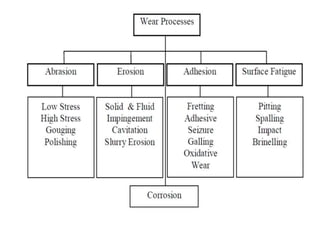
Mechanism of wear
• Abrasive Wear : polishing, scouring, scratching,
grinding, gouging.
• Adhesive Wear : galling, scuffing, scoring.
• Cavitation (interaction with fluid).
• Corrosive Wear (Chemical nature).
• Erosive Wear.
• Fatigue : delamination.
• Fretting Wear.
Adhesive wear
• Adhesive wear are caused by relative motion, "direct contact" and plastic
deformation which create wear debris and material transfer from one surface to
another.
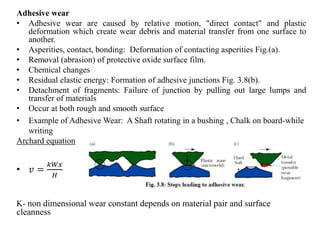
• Asperities, contact, bonding: Deformation of contacting asperities Fig.(a).
• Removal (abrasion) of protective oxide surface film.
• Chemical changes
• Residual elastic energy: Formation of adhesive junctions Fig. 3.8(b).
• Detachment of fragments: Failure of junction by pulling out large lumps and
transfer of materials
• Occur at both rough and smooth surface
• Example of Adhesive Wear: A Shaft rotating in a bushing , Chalk on board-while
writing
Archard equation
• 𝑣 =
𝑘𝑊𝑥
𝐻
K- non dimensional wear constant depends on material pair and surface
cleanness
Abrasive wear
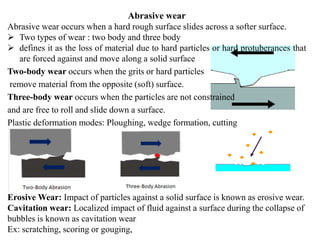
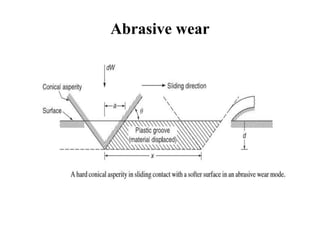
Abrasive wear occurs when a hard rough surface slides across a softer surface.
 Two types of wear : two body and three body
 defines it as the loss of material due to hard particles or hard protuberances that
are forced against and move along a solid surface
Two-body wear occurs when the grits or hard particles
remove material from the opposite (soft) surface.
Three-body wear occurs when the particles are not constrained
and are free to roll and slide down a surface.
Plastic deformation modes: Ploughing, wedge formation, cutting
Erosive Wear: Impact of particles against a solid surface is known as erosive wear.
Cavitation wear: Localized impact of fluid against a surface during the collapse of
bubbles is known as cavitation wear
Ex: scratching, scoring or gouging,
Abrasive wear
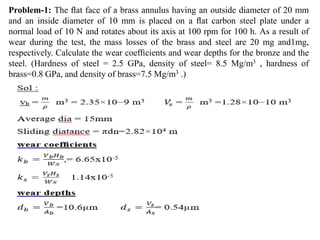
Problem-1: The flat face of a brass annulus having an outside diameter of 20 mm
and an inside diameter of 10 mm is placed on a flat carbon steel plate under a
normal load of 10 N and rotates about its axis at 100 rpm for 100 h. As a result of
wear during the test, the mass losses of the brass and steel are 20 mg and1mg,
respectively. Calculate the wear coefficients and wear depths for the bronze and the
steel. (Hardness of steel = 2.5 GPa, density of steel= 8.5 Mg/m3 , hardness of
brass=0.8 GPa, and density of brass=7.5 Mg/m3 .)
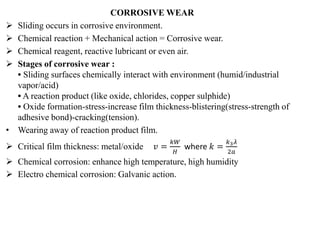
CORROSIVE WEAR
 Sliding occurs in corrosive environment.
 Chemical reaction + Mechanical action = Corrosive wear.
 Chemical reagent, reactive lubricant or even air.
 Stages of corrosive wear :
• Sliding surfaces chemically interact with environment (humid/industrial
vapor/acid)
• A reaction product (like oxide, chlorides, copper sulphide)
• Oxide formation-stress-increase film thickness-blistering(stress-strength of
adhesive bond)-cracking(tension).
• Wearing away of reaction product film.
 Critical film thickness: metal/oxide 𝑣 =
𝑘𝑊
𝐻
where 𝑘 =
𝑘3𝜆
2𝑎
 Chemical corrosion: enhance high temperature, high humidity
 Electro chemical corrosion: Galvanic action.
Fatigue Wear
• Contacts between asperities with very high local stress are repeated a large
number of times during sliding or rolling; with or without lubrication.
• High plastic deformation causes crack initiation, crack growth, and
fracture.
• Pitting: leave large pits.
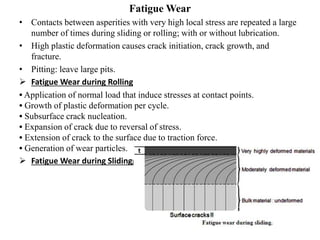
 Fatigue Wear during Rolling
• Application of normal load that induce stresses at contact points.
• Growth of plastic deformation per cycle.
• Subsurface crack nucleation.
• Expansion of crack due to reversal of stress.
• Extension of crack to the surface due to traction force.
• Generation of wear particles.
 Fatigue Wear during Slidingg
Fretting Wear
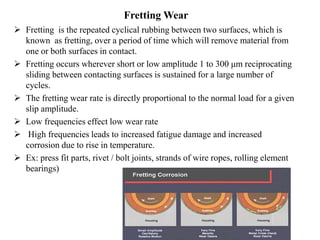
 Fretting is the repeated cyclical rubbing between two surfaces, which is
known as fretting, over a period of time which will remove material from
one or both surfaces in contact.
 Fretting occurs wherever short or low amplitude 1 to 300 μm reciprocating
sliding between contacting surfaces is sustained for a large number of
cycles.
 The fretting wear rate is directly proportional to the normal load for a given
slip amplitude.
 Low frequencies effect low wear rate
 High frequencies leads to increased fatigue damage and increased
corrosion due to rise in temperature.
 Ex: press fit parts, rivet / bolt joints, strands of wire ropes, rolling element
bearings)
DELAMINATION WEAR
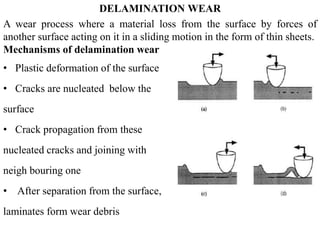
A wear process where a material loss from the surface by forces of
another surface acting on it in a sliding motion in the form of thin sheets.
Mechanisms of delamination wear
• Plastic deformation of the surface
• Cracks are nucleated below the
surface
• Crack propagation from these
nucleated cracks and joining with
neigh bouring one
• After separation from the surface,
laminates form wear debris
WEAR DEBRIS ANALSIS
• widely applied technology in machinery health monitoring
techniques
• Catastrophic component failure ….condition-based maintenance.
• Wear Debris: plate-shaped, Ribbon-shaped, Spherical Particles
• Method of collection: filtration, centrifuging, magnetically
• size, shape, structural, and chemical details… accurate analysis..
actual wear mechanism based on which suitable corrective measures
can be taken well in advance.
• Various Techniques:
• optical microscopy,
• scanning electron microscopy (SEM),
• Transmission and scanning transmission electron microscopy
(TEM/STEM),
• energy dispersive and wave length dispersive spectroscopy(EDS and
WDS),
• X-ray photoelectron spectroscopy (XPS),
• X-ray and electron diffraction.
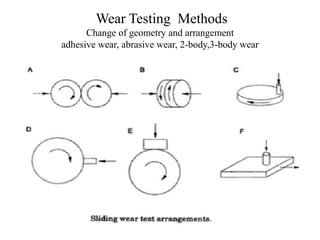
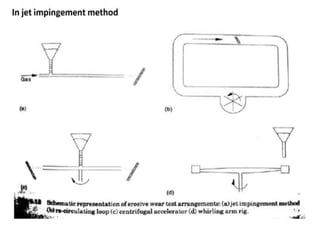
Wear Testing Methods
Change of geometry and arrangement
adhesive wear, abrasive wear, 2-body,3-body wear
CASE STUDY ON WEAR
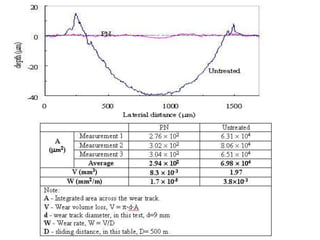
Aim: The aim of the study is to evaluate the wear performance of
the untreated and plasma nitrided (AISI 316) stainless steel.
Location: The University of Birmingham, UK
Wear test and method:
 Equipment: pin-on-disc tribometer
 Sample: untreated and plasma nitride AISI 316
 Contact Load: 10N
 Condition: in open air and without lubrication.
Wear measurement:
 Duration: 500 meters
 Measured: stylus profilometer ---wear track profiles
• Report of the results
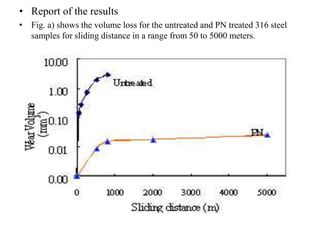
• Fig. a) shows the volume loss for the untreated and PN treated 316 steel
samples for sliding distance in a range from 50 to 5000 meters.
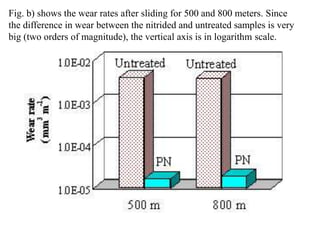
Fig. b) shows the wear rates after sliding for 500 and 800 meters. Since
the difference in wear between the nitrided and untreated samples is very
big (two orders of magnitude), the vertical axis is in logarithm scale.
Conclusion
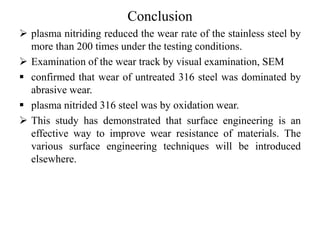
 plasma nitriding reduced the wear rate of the stainless steel by
more than 200 times under the testing conditions.
 Examination of the wear track by visual examination, SEM
 confirmed that wear of untreated 316 steel was dominated by
abrasive wear.
 plasma nitrided 316 steel was by oxidation wear.
 This study has demonstrated that surface engineering is an
effective way to improve wear resistance of materials. The
various surface engineering techniques will be introduced
elsewhere.
Thank you

FRICTION.pptx

  • 1.
    wear • Wear isthe surface damage or removal of material from one or both of two solid surfaces in a sliding, rolling, or impact motion relative to one another. known as "wear“ • at asperities • with no net change in weight or volume. • Operating conditions • Mechanical/chemical  Zero wear: polishing process, desirable  Measurable wear : noise or surface roughness, volume/mass reduction, Undesirable
  • 2.
    • Frictional junctionsare broken, • elastic displacement, • plastic displacement, • cutting, • destruction of surface films and destruction of bulk material. Mechanism of wear • Abrasive Wear : polishing, scouring, scratching, grinding, gouging. • Adhesive Wear : galling, scuffing, scoring. • Cavitation (interaction with fluid). • Corrosive Wear (Chemical nature). • Erosive Wear. • Fatigue : delamination. • Fretting Wear.
  • 3.
    Adhesive wear • Adhesivewear are caused by relative motion, "direct contact" and plastic deformation which create wear debris and material transfer from one surface to another. • Asperities, contact, bonding: Deformation of contacting asperities Fig.(a). • Removal (abrasion) of protective oxide surface film. • Chemical changes • Residual elastic energy: Formation of adhesive junctions Fig. 3.8(b). • Detachment of fragments: Failure of junction by pulling out large lumps and transfer of materials • Occur at both rough and smooth surface • Example of Adhesive Wear: A Shaft rotating in a bushing , Chalk on board-while writing Archard equation • 𝑣 = 𝑘𝑊𝑥 𝐻 K- non dimensional wear constant depends on material pair and surface cleanness
  • 4.
    Abrasive wear Abrasive wearoccurs when a hard rough surface slides across a softer surface.  Two types of wear : two body and three body  defines it as the loss of material due to hard particles or hard protuberances that are forced against and move along a solid surface Two-body wear occurs when the grits or hard particles remove material from the opposite (soft) surface. Three-body wear occurs when the particles are not constrained and are free to roll and slide down a surface. Plastic deformation modes: Ploughing, wedge formation, cutting Erosive Wear: Impact of particles against a solid surface is known as erosive wear. Cavitation wear: Localized impact of fluid against a surface during the collapse of bubbles is known as cavitation wear Ex: scratching, scoring or gouging,
  • 5.
  • 6.
    Problem-1: The flatface of a brass annulus having an outside diameter of 20 mm and an inside diameter of 10 mm is placed on a flat carbon steel plate under a normal load of 10 N and rotates about its axis at 100 rpm for 100 h. As a result of wear during the test, the mass losses of the brass and steel are 20 mg and1mg, respectively. Calculate the wear coefficients and wear depths for the bronze and the steel. (Hardness of steel = 2.5 GPa, density of steel= 8.5 Mg/m3 , hardness of brass=0.8 GPa, and density of brass=7.5 Mg/m3 .)
  • 7.
    CORROSIVE WEAR  Slidingoccurs in corrosive environment.  Chemical reaction + Mechanical action = Corrosive wear.  Chemical reagent, reactive lubricant or even air.  Stages of corrosive wear : • Sliding surfaces chemically interact with environment (humid/industrial vapor/acid) • A reaction product (like oxide, chlorides, copper sulphide) • Oxide formation-stress-increase film thickness-blistering(stress-strength of adhesive bond)-cracking(tension). • Wearing away of reaction product film.  Critical film thickness: metal/oxide 𝑣 = 𝑘𝑊 𝐻 where 𝑘 = 𝑘3𝜆 2𝑎  Chemical corrosion: enhance high temperature, high humidity  Electro chemical corrosion: Galvanic action.
  • 8.
    Fatigue Wear • Contactsbetween asperities with very high local stress are repeated a large number of times during sliding or rolling; with or without lubrication. • High plastic deformation causes crack initiation, crack growth, and fracture. • Pitting: leave large pits.  Fatigue Wear during Rolling • Application of normal load that induce stresses at contact points. • Growth of plastic deformation per cycle. • Subsurface crack nucleation. • Expansion of crack due to reversal of stress. • Extension of crack to the surface due to traction force. • Generation of wear particles.  Fatigue Wear during Slidingg
  • 9.
    Fretting Wear  Frettingis the repeated cyclical rubbing between two surfaces, which is known as fretting, over a period of time which will remove material from one or both surfaces in contact.  Fretting occurs wherever short or low amplitude 1 to 300 μm reciprocating sliding between contacting surfaces is sustained for a large number of cycles.  The fretting wear rate is directly proportional to the normal load for a given slip amplitude.  Low frequencies effect low wear rate  High frequencies leads to increased fatigue damage and increased corrosion due to rise in temperature.  Ex: press fit parts, rivet / bolt joints, strands of wire ropes, rolling element bearings)
  • 11.
    DELAMINATION WEAR A wearprocess where a material loss from the surface by forces of another surface acting on it in a sliding motion in the form of thin sheets. Mechanisms of delamination wear • Plastic deformation of the surface • Cracks are nucleated below the surface • Crack propagation from these nucleated cracks and joining with neigh bouring one • After separation from the surface, laminates form wear debris
  • 12.
    WEAR DEBRIS ANALSIS •widely applied technology in machinery health monitoring techniques • Catastrophic component failure ….condition-based maintenance. • Wear Debris: plate-shaped, Ribbon-shaped, Spherical Particles • Method of collection: filtration, centrifuging, magnetically • size, shape, structural, and chemical details… accurate analysis.. actual wear mechanism based on which suitable corrective measures can be taken well in advance. • Various Techniques: • optical microscopy, • scanning electron microscopy (SEM), • Transmission and scanning transmission electron microscopy (TEM/STEM), • energy dispersive and wave length dispersive spectroscopy(EDS and WDS), • X-ray photoelectron spectroscopy (XPS), • X-ray and electron diffraction.
  • 13.
    Wear Testing Methods Changeof geometry and arrangement adhesive wear, abrasive wear, 2-body,3-body wear
  • 15.
    CASE STUDY ONWEAR Aim: The aim of the study is to evaluate the wear performance of the untreated and plasma nitrided (AISI 316) stainless steel. Location: The University of Birmingham, UK Wear test and method:  Equipment: pin-on-disc tribometer  Sample: untreated and plasma nitride AISI 316  Contact Load: 10N  Condition: in open air and without lubrication. Wear measurement:  Duration: 500 meters  Measured: stylus profilometer ---wear track profiles
  • 17.
    • Report ofthe results • Fig. a) shows the volume loss for the untreated and PN treated 316 steel samples for sliding distance in a range from 50 to 5000 meters.
  • 18.
    Fig. b) showsthe wear rates after sliding for 500 and 800 meters. Since the difference in wear between the nitrided and untreated samples is very big (two orders of magnitude), the vertical axis is in logarithm scale.
  • 19.
    Conclusion  plasma nitridingreduced the wear rate of the stainless steel by more than 200 times under the testing conditions.  Examination of the wear track by visual examination, SEM  confirmed that wear of untreated 316 steel was dominated by abrasive wear.  plasma nitrided 316 steel was by oxidation wear.  This study has demonstrated that surface engineering is an effective way to improve wear resistance of materials. The various surface engineering techniques will be introduced elsewhere.
  • 20.