COMPUTERIZED MAINTENANCE
MANAGEMENT SYSTEM(CMMS)
Shivaji Choudhury
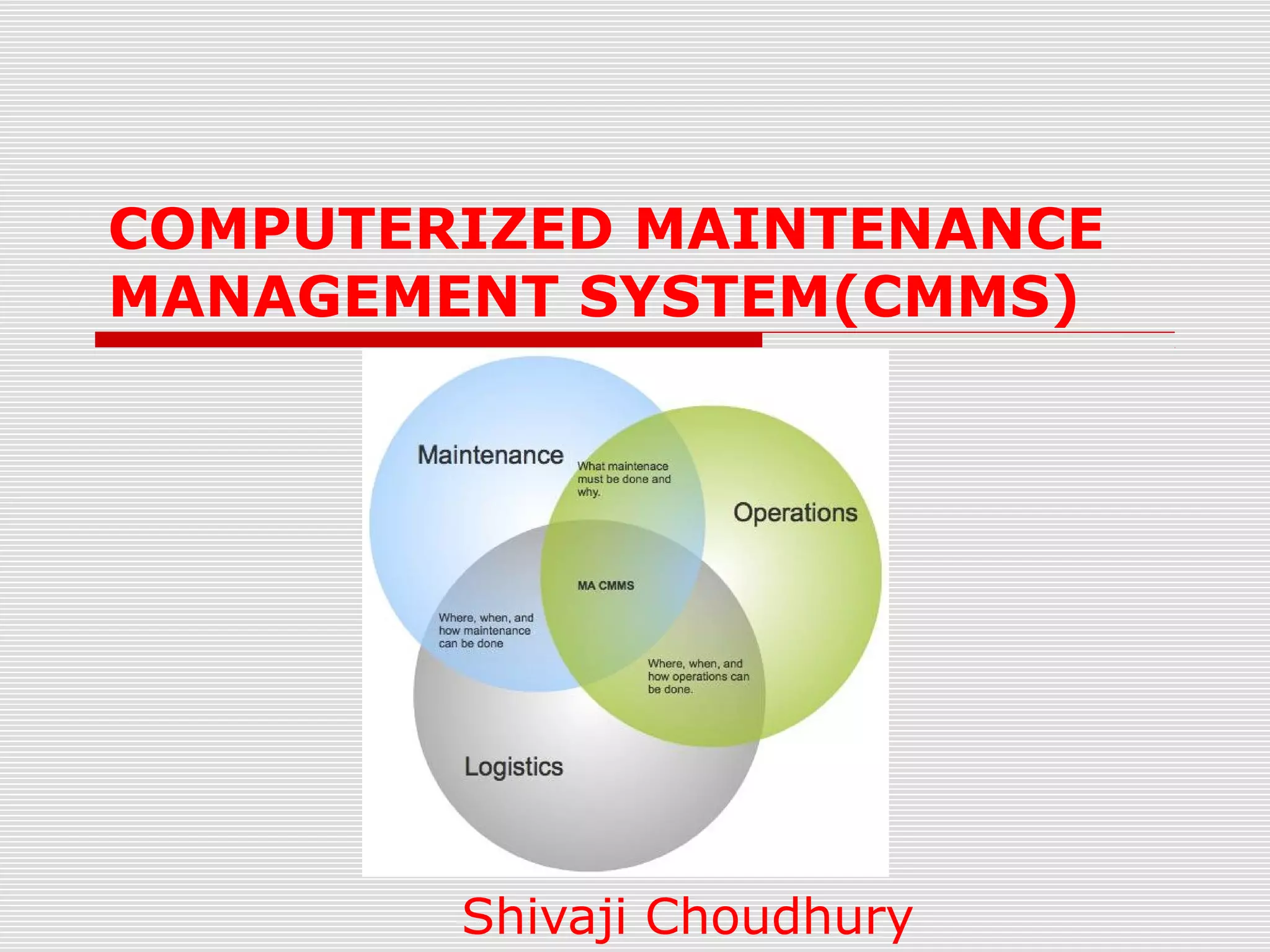
COMPUTERIZED MAINTENANCE
MANAGEMENT SYSTEM(CMMS)
 A CMMS software package maintains
a computer database of information
about an organization’s maintenance
operations.
 This information is intended to help
maintenance workers do their jobs
more effective.
Benefits
 Achieving high efficiency.
 Minimizing usage of parts and labor.
 Maximizing usage of equipments and
minimizing downtime.
 Maximizing equipments lifetime and
replacement period.
 Minimizing maintenance and operation
costs.
 Maximizing profits.
 Raising performance levels.
 Allows the safe and efficient functioning.
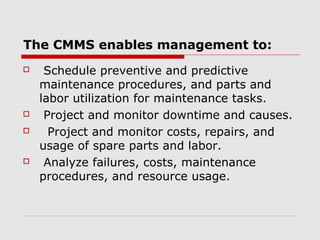
The CMMS enables management to:
 Schedule preventive and predictive
maintenance procedures, and parts and
labor utilization for maintenance tasks.
 Project and monitor downtime and causes.
 Project and monitor costs, repairs, and
usage of spare parts and labor.
 Analyze failures, costs, maintenance
procedures, and resource usage.
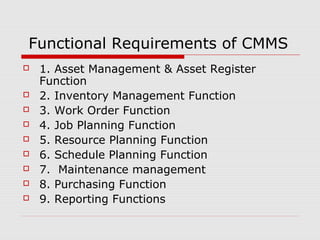
Functional Requirements of CMMS
 1. Asset Management & Asset Register
Function
 2. Inventory Management Function
 3. Work Order Function
 4. Job Planning Function
 5. Resource Planning Function
 6. Schedule Planning Function
 7. Maintenance management
 8. Purchasing Function
 9. Reporting Functions
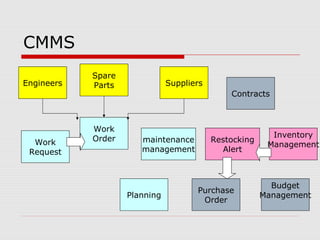
CMMS
Engineers
Spare
Parts Suppliers
Contracts
Work
Request
Work
Order maintenance
management
Restocking
Alert
Inventory
Management
Planning
Purchase
Order
Budget
Management
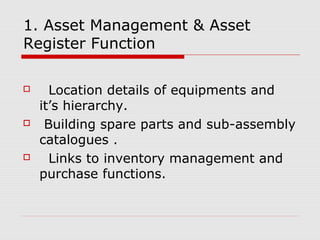
1. Asset Management & Asset
Register Function
 Location details of equipments and
it’s hierarchy.
 Building spare parts and sub-assembly
catalogues .
 Links to inventory management and
purchase functions.
2. Inventory Management Function
 Tracking of stocked and non-stocked
items through multiple stores.
 Tracking of items, costs and balances
by bin, lot and storeroom.
 Stock replenishment when inventory
falls below minimum levels
 ABC and XYZ analysis .
3. Work Order Function
 Viewing comprehensive and detailed planning
information such as
 • Work Plans
 • Target and scheduled date
 • Costs
 • Labour, materials, Skill set / crafts,
 • Failure analysis
 Predictive maintenance.
 Scheduling of work orders based on real time
criticality and logistics.
4. Job Planning Function
 Tracking of costs by operation or job
plan.
 Linking job plans sequentially, each
with it’s own parts, labour and tool
estimates.
5. Resource Planning Function
 Resource function shall allow to
maintain detailed resource
information to plan and analyze
maintenance work related to
company, service contract, tools etc.
6. Schedule Planning Function
 Scheduling function shall enable to
forecast future preventive
maintenance dates for resource
planning.
7. Maintenance Management
 Allows each asset / equipment to
have a defined maintenance profile
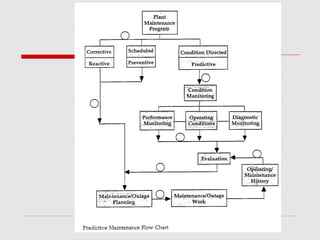
 Helps to schedule planned preventive
and predictive maintenance routines.
 Control maintenance procedures.
8. Purchasing Function
 Creation of purchase requisitions or
purchase orders either from scratch or
from the inventory or work order
modules.
 Analyzing of vendor performance before
ordering of part.
 Auto re-orders generation for the
spares, when stock falls below re-order
level.
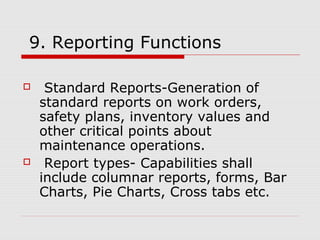
9. Reporting Functions
 Standard Reports-Generation of
standard reports on work orders,
safety plans, inventory values and
other critical points about
maintenance operations.
 Report types- Capabilities shall
include columnar reports, forms, Bar
Charts, Pie Charts, Cross tabs etc.
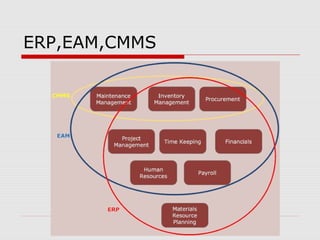
CMMS- Computerized Maintenance Management System
ERP –Enterprise Resource Planning
EAM -Enterprise Asset Management
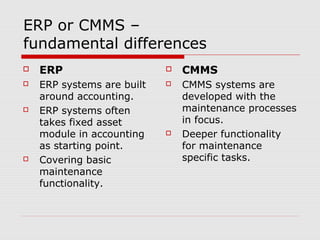
ERP or CMMS –
fundamental differences
 ERP
 ERP systems are built
around accounting.
 ERP systems often
takes fixed asset
module in accounting
as starting point.
 Covering basic
maintenance
functionality.
 CMMS
 CMMS systems are
developed with the
maintenance processes
in focus.
 Deeper functionality
for maintenance
specific tasks.
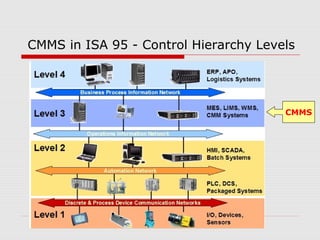
CMMS in ISA 95 - Control Hierarchy Levels
CMMS
Asset optimization and maintenance (CMMS) support
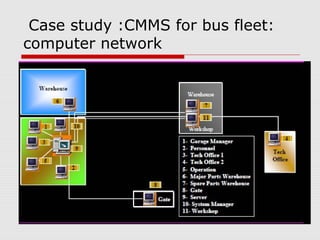
Case study :CMMS for bus fleet:
computer network
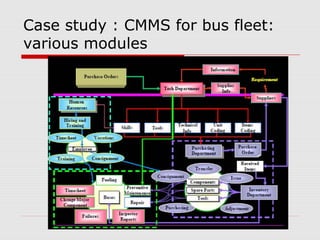
Case study : CMMS for bus fleet:
various modules
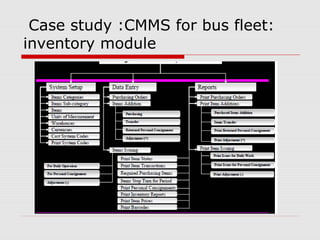
Case study :CMMS for bus fleet:
inventory module
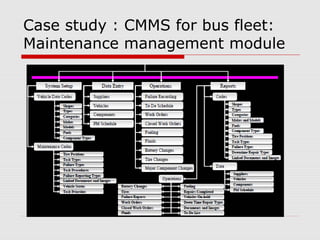
Case study : CMMS for bus fleet:
Maintenance management module
THANKING YOU

Computerized maintenance management system (cmms)

  • 1.
  • 2.
    COMPUTERIZED MAINTENANCE MANAGEMENT SYSTEM(CMMS) A CMMS software package maintains a computer database of information about an organization’s maintenance operations.  This information is intended to help maintenance workers do their jobs more effective.
  • 3.
    Benefits  Achieving highefficiency.  Minimizing usage of parts and labor.  Maximizing usage of equipments and minimizing downtime.  Maximizing equipments lifetime and replacement period.  Minimizing maintenance and operation costs.  Maximizing profits.  Raising performance levels.  Allows the safe and efficient functioning.
  • 4.
    The CMMS enablesmanagement to:  Schedule preventive and predictive maintenance procedures, and parts and labor utilization for maintenance tasks.  Project and monitor downtime and causes.  Project and monitor costs, repairs, and usage of spare parts and labor.  Analyze failures, costs, maintenance procedures, and resource usage.
  • 5.
    Functional Requirements ofCMMS  1. Asset Management & Asset Register Function  2. Inventory Management Function  3. Work Order Function  4. Job Planning Function  5. Resource Planning Function  6. Schedule Planning Function  7. Maintenance management  8. Purchasing Function  9. Reporting Functions
  • 6.
  • 7.
    1. Asset Management& Asset Register Function  Location details of equipments and it’s hierarchy.  Building spare parts and sub-assembly catalogues .  Links to inventory management and purchase functions.
  • 8.
    2. Inventory ManagementFunction  Tracking of stocked and non-stocked items through multiple stores.  Tracking of items, costs and balances by bin, lot and storeroom.  Stock replenishment when inventory falls below minimum levels  ABC and XYZ analysis .
  • 9.
    3. Work OrderFunction  Viewing comprehensive and detailed planning information such as  • Work Plans  • Target and scheduled date  • Costs  • Labour, materials, Skill set / crafts,  • Failure analysis  Predictive maintenance.  Scheduling of work orders based on real time criticality and logistics.
  • 10.
    4. Job PlanningFunction  Tracking of costs by operation or job plan.  Linking job plans sequentially, each with it’s own parts, labour and tool estimates.
  • 11.
    5. Resource PlanningFunction  Resource function shall allow to maintain detailed resource information to plan and analyze maintenance work related to company, service contract, tools etc.
  • 12.
    6. Schedule PlanningFunction  Scheduling function shall enable to forecast future preventive maintenance dates for resource planning.
  • 13.
    7. Maintenance Management Allows each asset / equipment to have a defined maintenance profile  Helps to schedule planned preventive and predictive maintenance routines.  Control maintenance procedures.
  • 15.
    8. Purchasing Function Creation of purchase requisitions or purchase orders either from scratch or from the inventory or work order modules.  Analyzing of vendor performance before ordering of part.  Auto re-orders generation for the spares, when stock falls below re-order level.
  • 16.
    9. Reporting Functions Standard Reports-Generation of standard reports on work orders, safety plans, inventory values and other critical points about maintenance operations.  Report types- Capabilities shall include columnar reports, forms, Bar Charts, Pie Charts, Cross tabs etc.
  • 17.
    CMMS- Computerized MaintenanceManagement System ERP –Enterprise Resource Planning EAM -Enterprise Asset Management
  • 18.
    ERP or CMMS– fundamental differences  ERP  ERP systems are built around accounting.  ERP systems often takes fixed asset module in accounting as starting point.  Covering basic maintenance functionality.  CMMS  CMMS systems are developed with the maintenance processes in focus.  Deeper functionality for maintenance specific tasks.
  • 19.
    CMMS in ISA95 - Control Hierarchy Levels CMMS
  • 20.
    Asset optimization andmaintenance (CMMS) support
  • 21.
    Case study :CMMSfor bus fleet: computer network
  • 22.
    Case study :CMMS for bus fleet: various modules
  • 23.
    Case study :CMMSfor bus fleet: inventory module
  • 24.
    Case study :CMMS for bus fleet: Maintenance management module
  • 25.