Abrasive and impact-abrasive wear testing of steels for mining, transporting, and mineral processing 
Hard rock tribology seminar 
4.11.2014 
Vilma Ratia Tampere University of Technology, Tampere Wear Center, 
Tampere, Finland
Contents 
•Wear – what is it? 
What are wear resistant steels? 
•How can wear resistance be controllably measured? 
•How wear is shown in steels? 
•Which factors affect wear of steels?
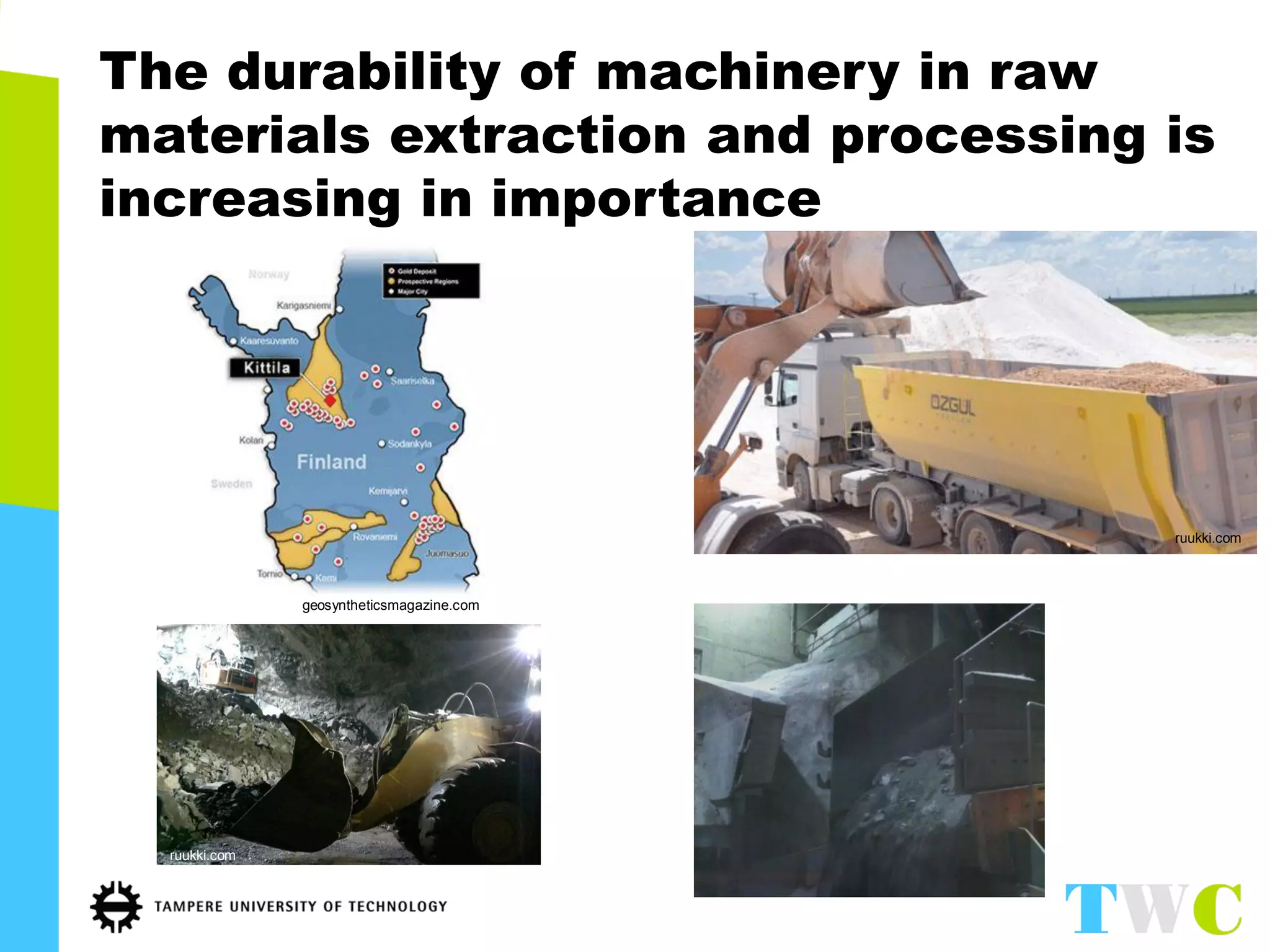
The durability of machinery in raw materials extraction and processing is increasing in importance 
geosyntheticsmagazine.com 
ruukki.com 
ruukki.com
0.142 
0.158 
0.163 
0.165 
0.172 
0.173 
0.176 
0.180 
0.186 
0.189 
0.192 
0.199 
0.202 
0.208 
0.216 
0 
100 
200 
300 
400 
500 
600 
700 
800 
900 
1000 
0.000 
0.050 
0.100 
0.150 
0.200 
0.250 
0 2 15 4 14 3 10 11 5 24 18 17 6 16 1 
Surface hardness [HV5] 
Mass loss [g] 
Wear resistant steels have higher 
strength and hardness than 
conventional structural steels 
• Commonly graded 
according to hardness 
in Brinell scale: 
400HB, 500HB, 600HB 
• Tensile strength 
typically 1200-1600 
MPa 
• Notch impact energy at 
-40C typically 30 J/cm2 
• Microstructure often 
martensitic, but bainite, 
ferrite, pearlite and 
austenite are also 
possible 
ruukki.com 
N. Ojala et al. WTC 2013 & Wear 317(2014)225-232
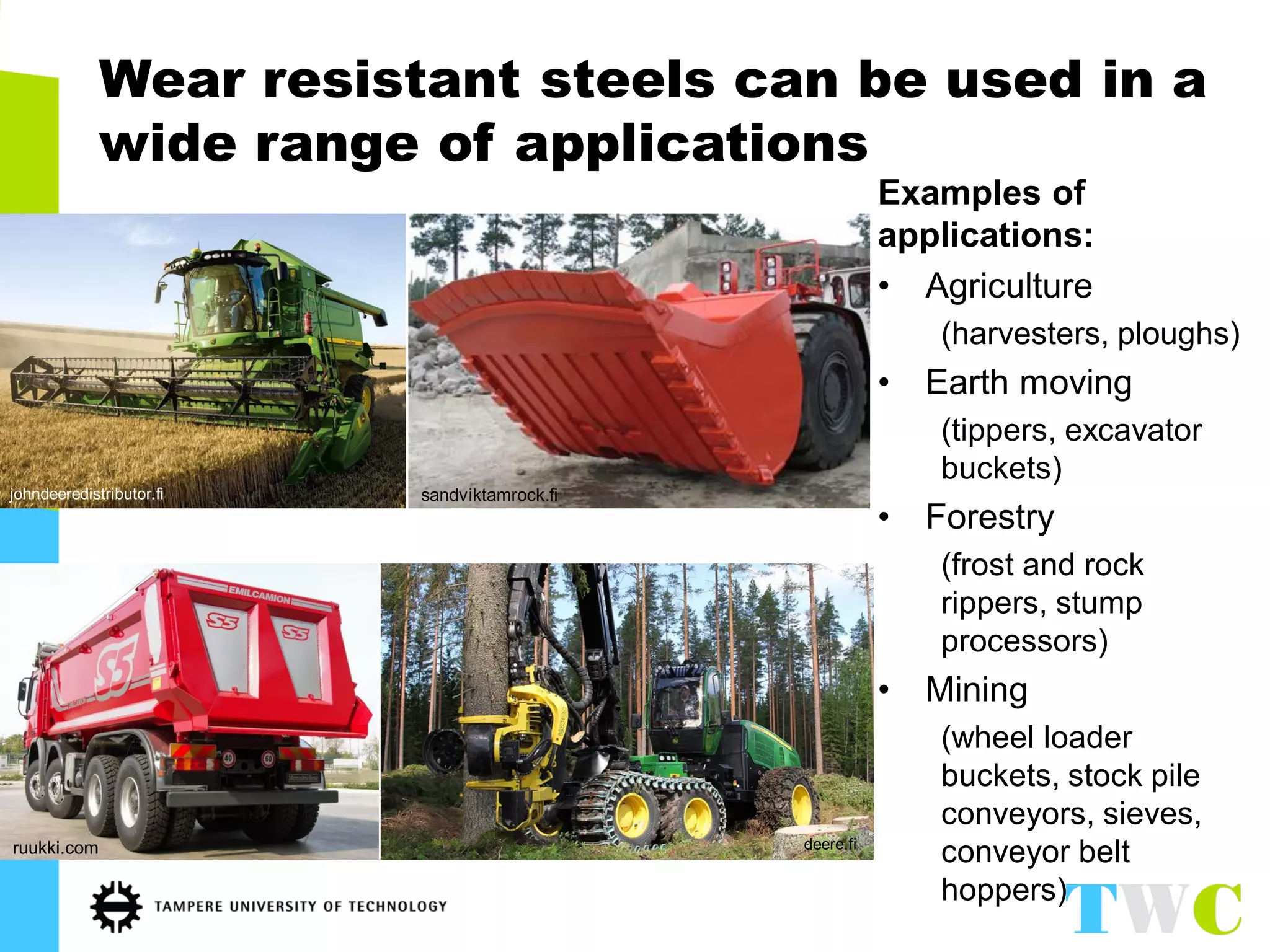
Wear resistant steels can be used in a wide range of applications 
Examples of applications: 
•Agriculture 
(harvesters, ploughs) 
•Earth moving 
(tippers, excavator buckets) 
•Forestry 
(frost and rock rippers, stump processors) 
•Mining 
(wheel loader buckets, stock pile conveyors, sieves, conveyor belt hoppers) 
johndeeredistributor.fi 
deere.fi 
ruukki.com 
sandviktamrock.fi
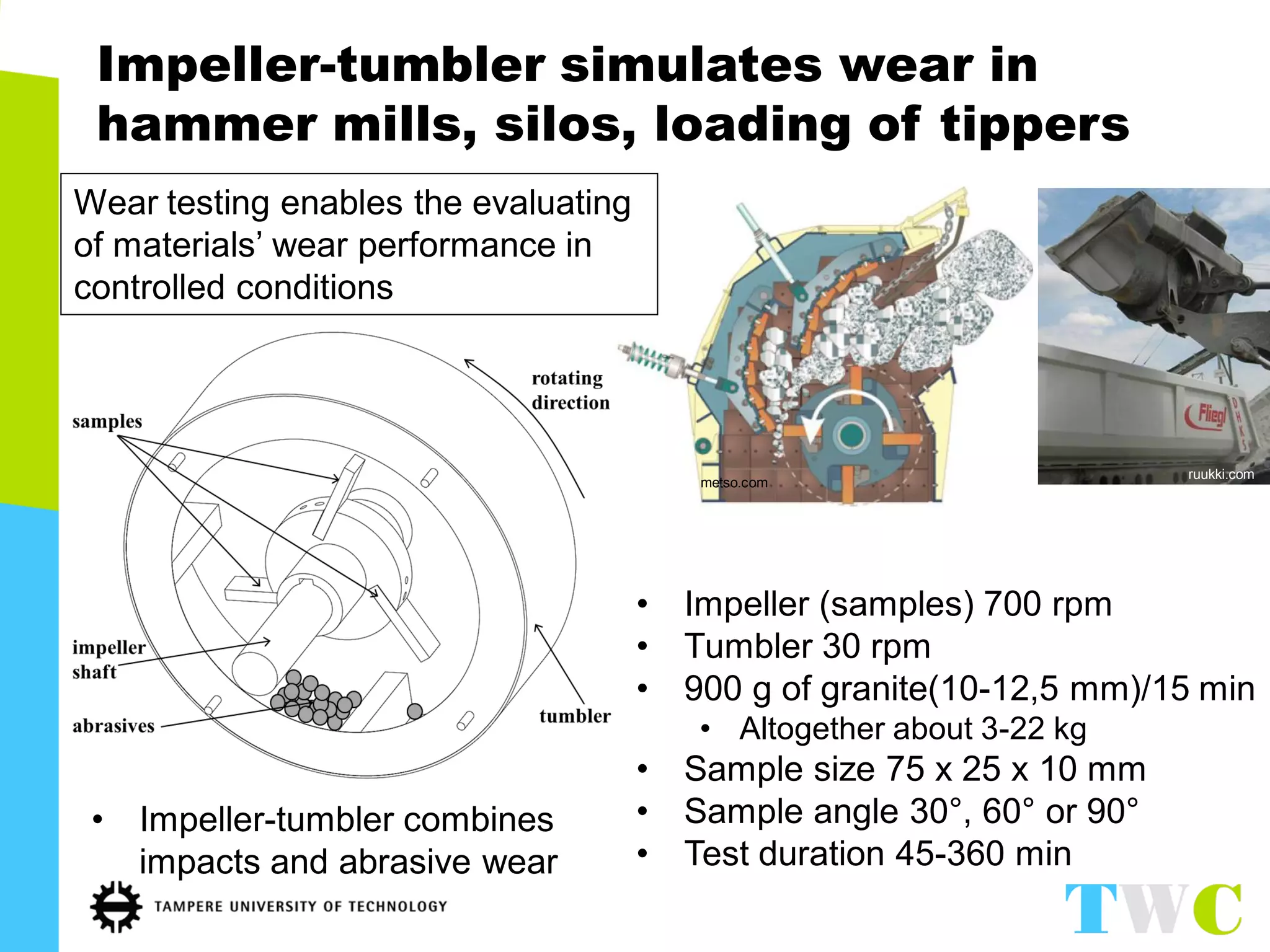
•Impeller (samples) 700 rpm 
•Tumbler 30 rpm 
•900 g of granite(10-12,5 mm)/15 min 
•Altogether about 3-22 kg 
•Sample size 75 x 25 x 10 mm 
•Sample angle 30°, 60° or 90° 
•Test duration 45-360 min 
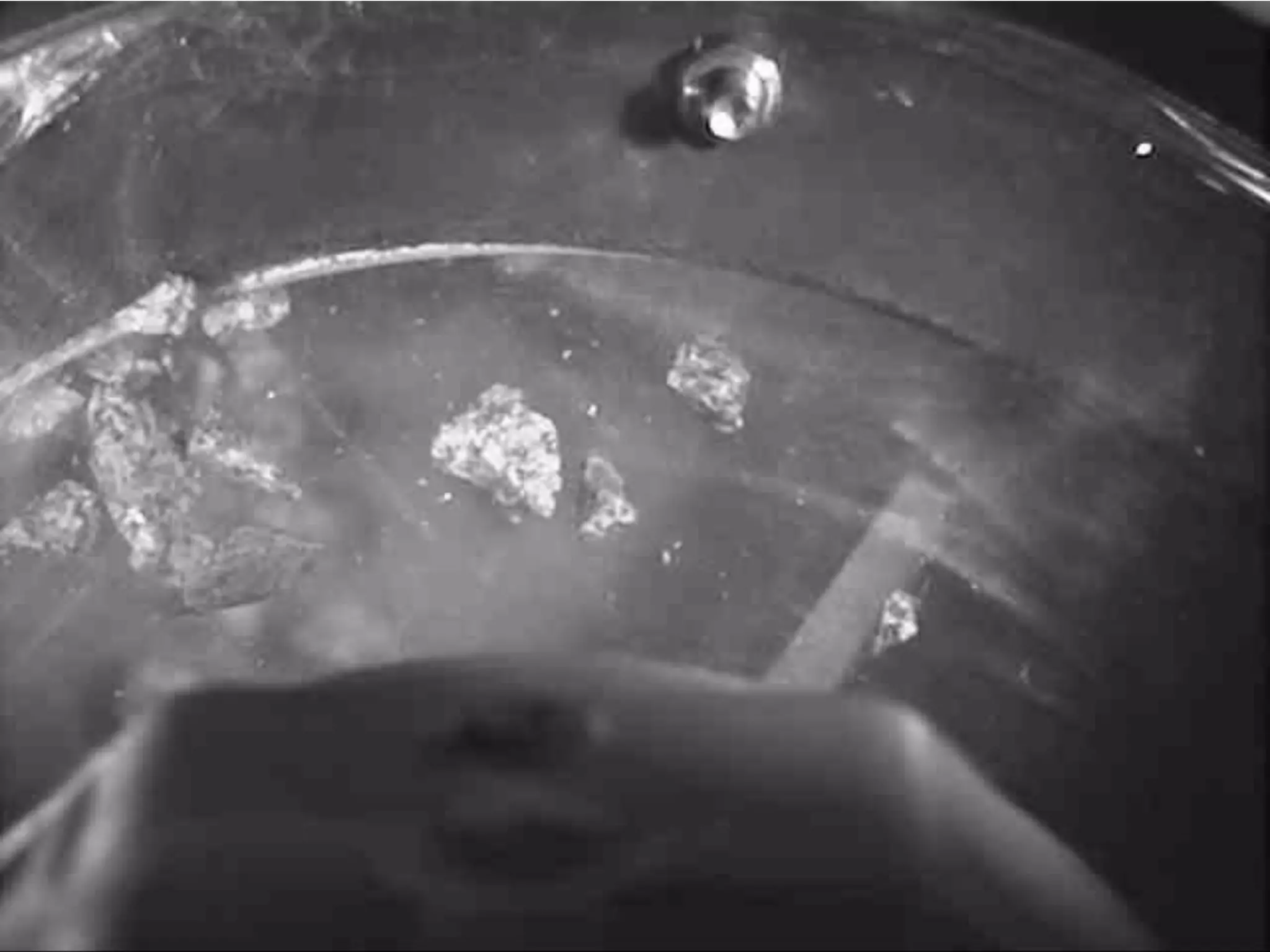
Impeller-tumbler simulates wear in hammer mills, silos, loading of tippers 
•Impeller-tumbler combines impacts and abrasive wear 
Wear testing enables the evaluating of materials’ wear performance in controlled conditions 
metso.com 
ruukki.com
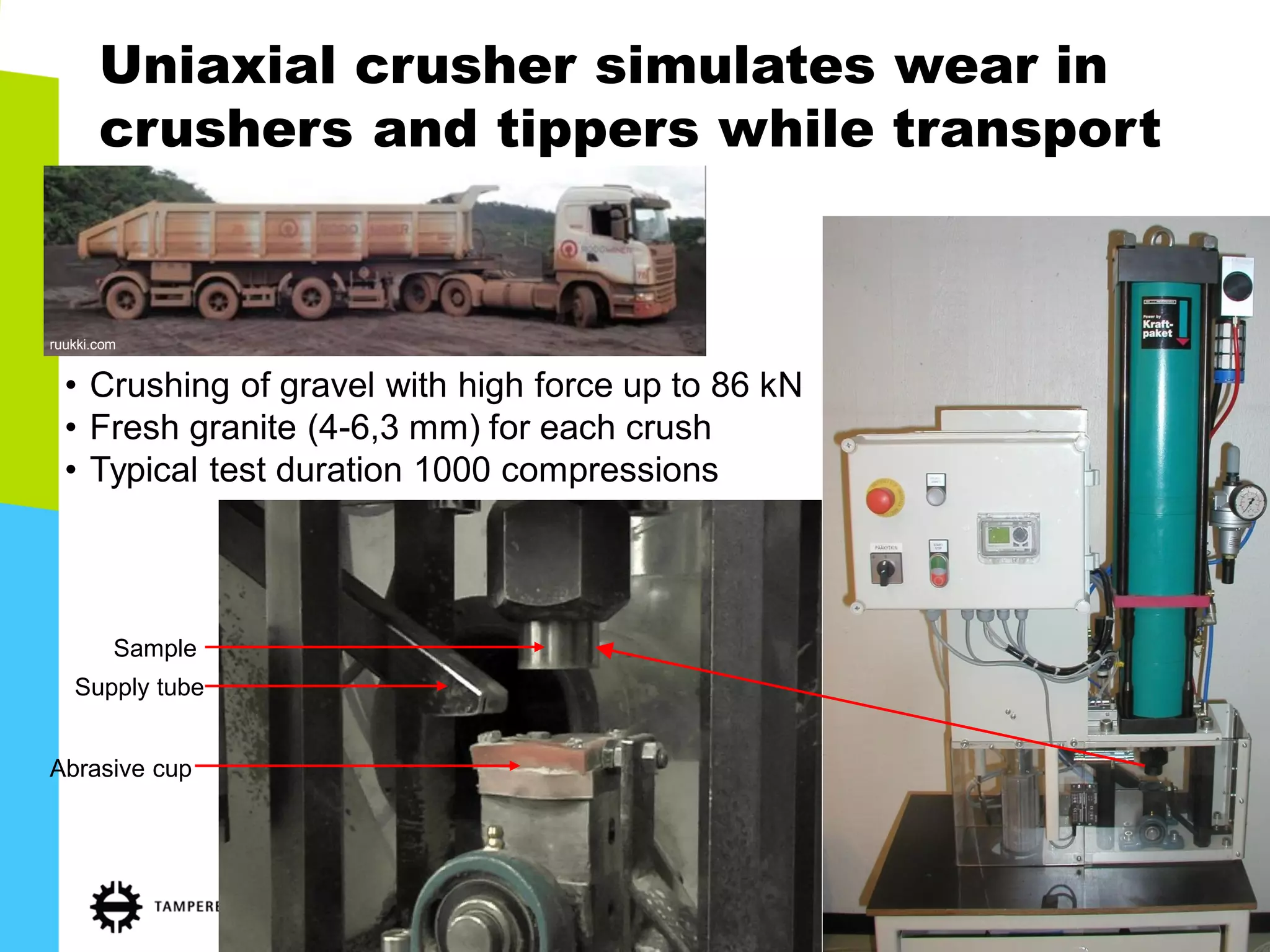
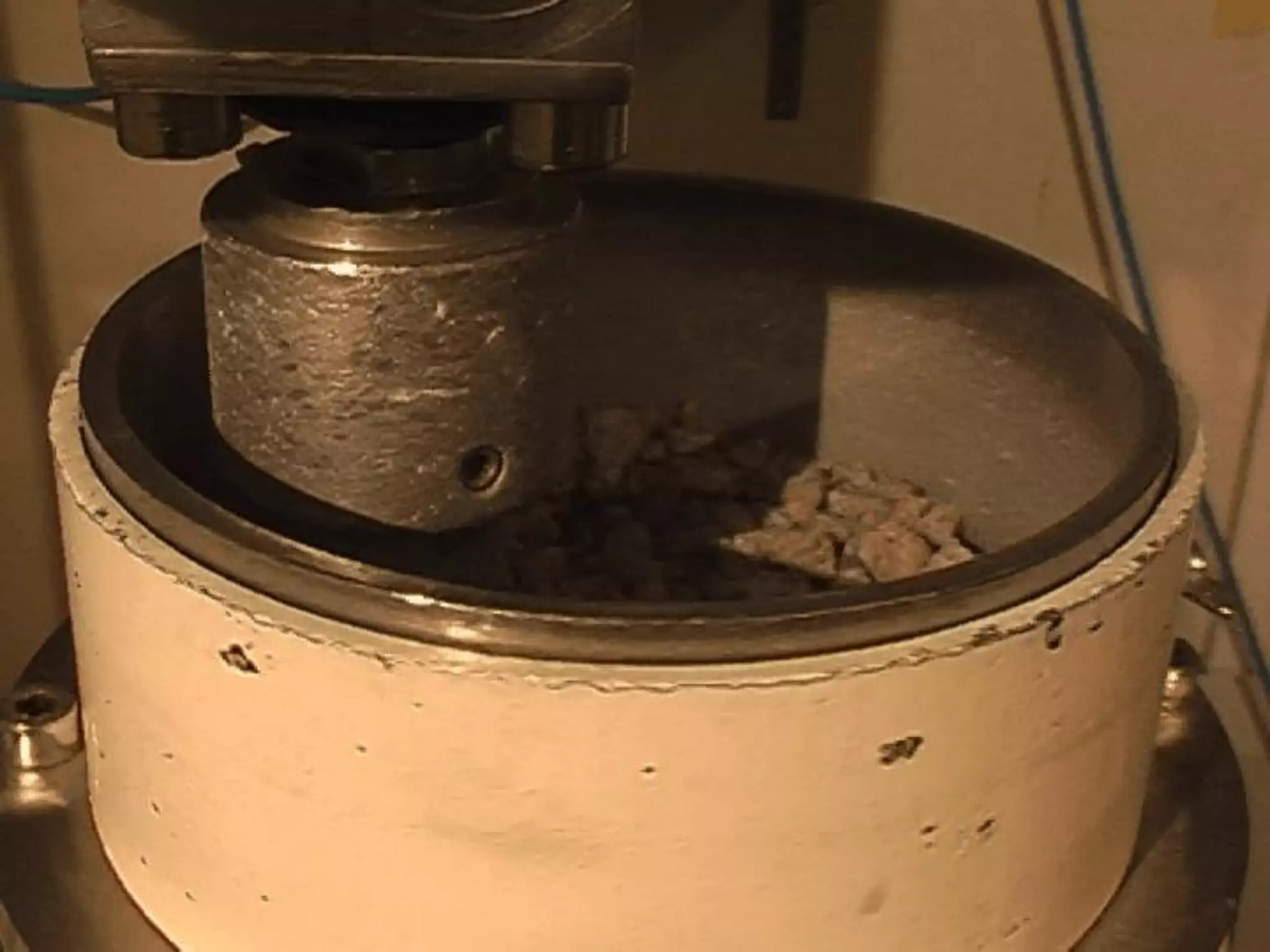
Uniaxial crusher simulates wear in crushers and tippers while transport 
•Crushing of gravel with high force up to 86 kN 
•Fresh granite (4-6,3 mm) for each crush 
•Typical test duration 1000 compressions 
Sample 
Abrasive cup 
Supply tube 
ruukki.com
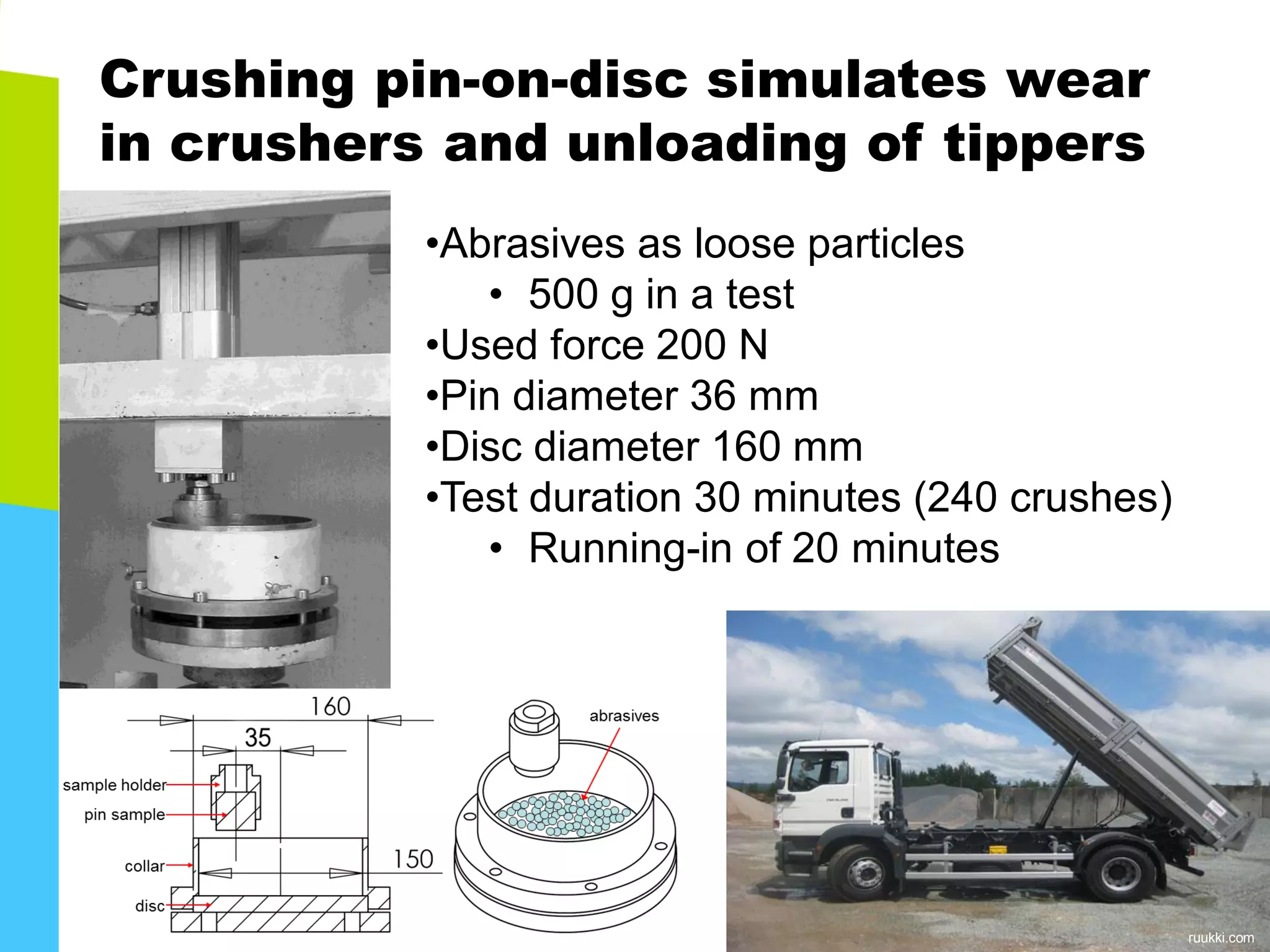
Crushing pin-on-disc simulates wear in crushers and unloading of tippers 
•Abrasives as loose particles 
•500 g in a test 
•Used force 200 N 
•Pin diameter 36 mm 
•Disc diameter 160 mm 
•Test duration 30 minutes (240 crushes) 
•Running-in of 20 minutes 
ruukki.com
10
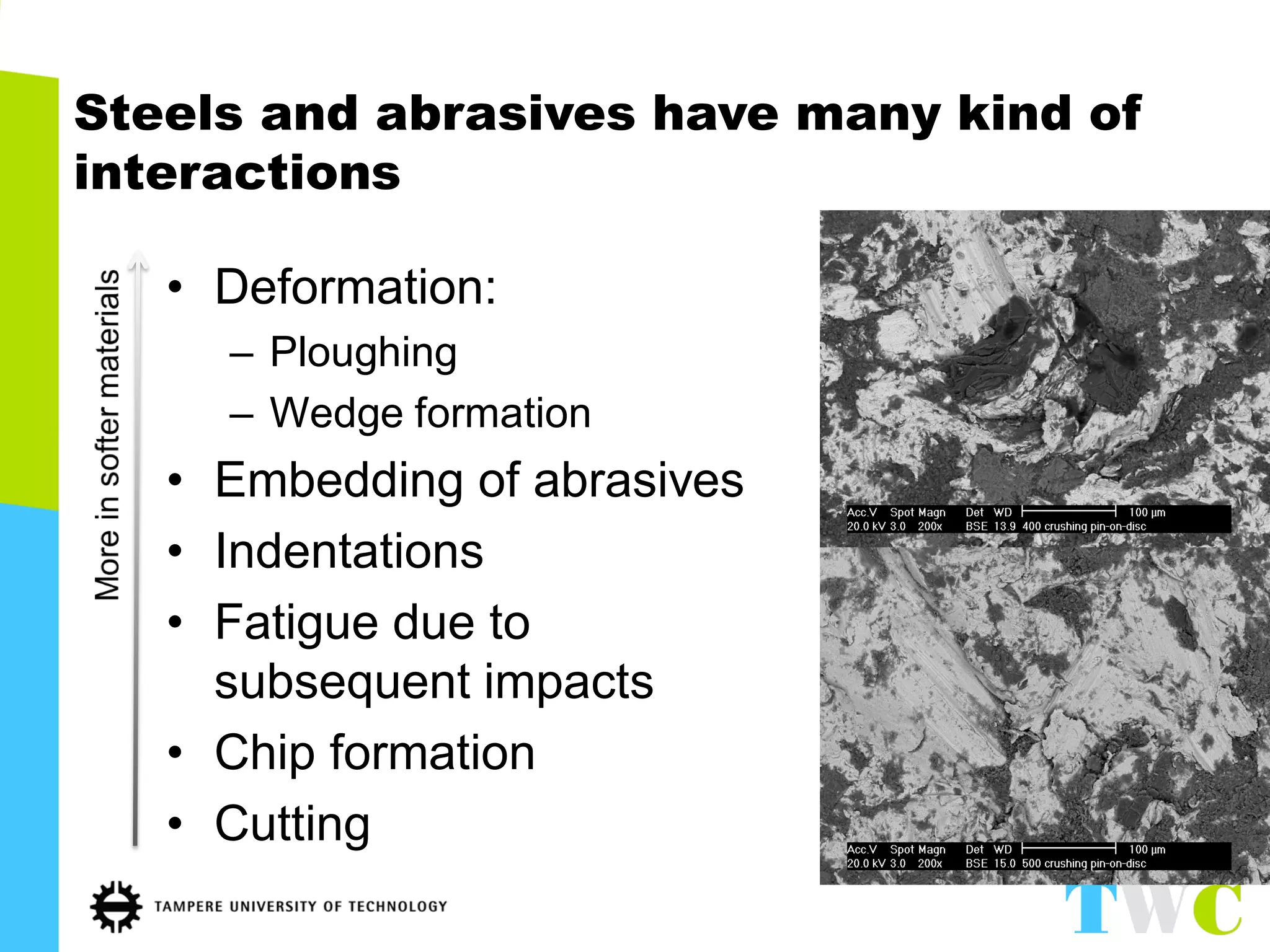
Steels and abrasives have many kind of interactions 
•Deformation: 
–Ploughing 
–Wedge formation 
•Embedding of abrasives 
•Indentations 
•Fatigue due to subsequent impacts 
•Chip formation 
•Cutting
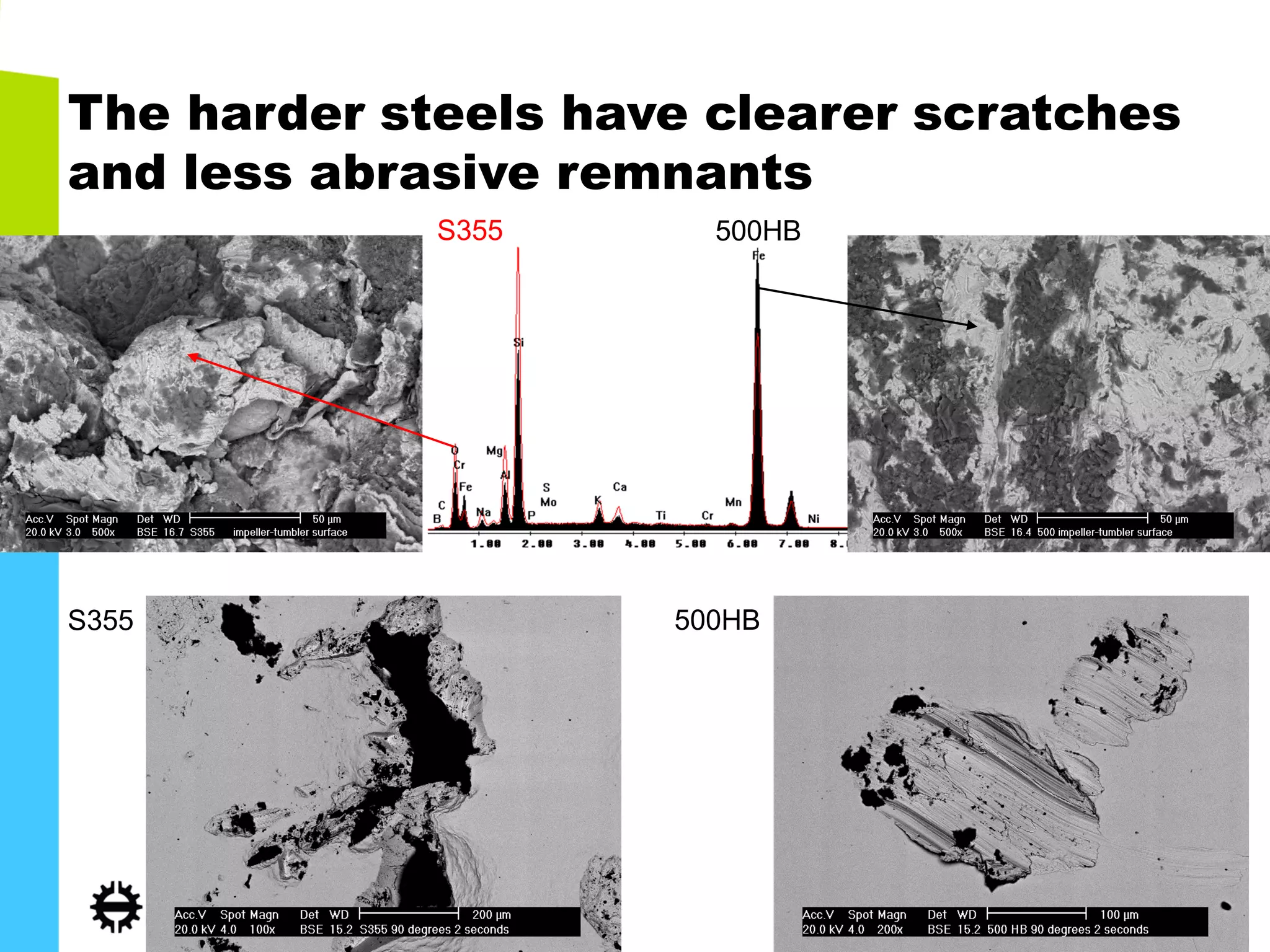
The harder steels have clearer scratches and less abrasive remnants 
S355 
500HB 
S355 
500HB
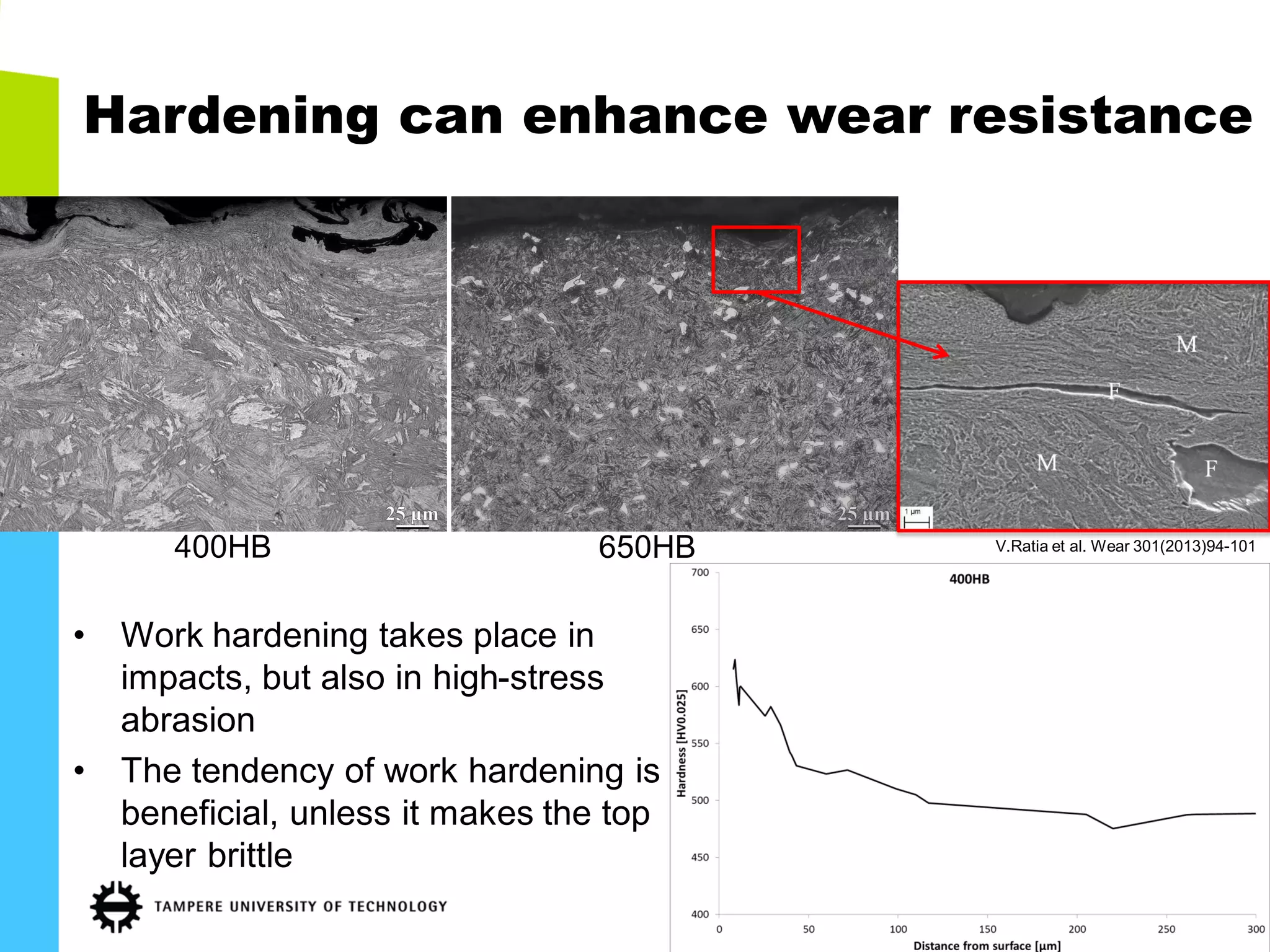
Hardening can enhance wear resistance 
•Work hardening takes place in impacts, but also in high-stress abrasion 
•The tendency of work hardening is beneficial, unless it makes the top layer brittle 
400HB 
650HB 
V.Ratia et al. Wear 301(2013)94-101
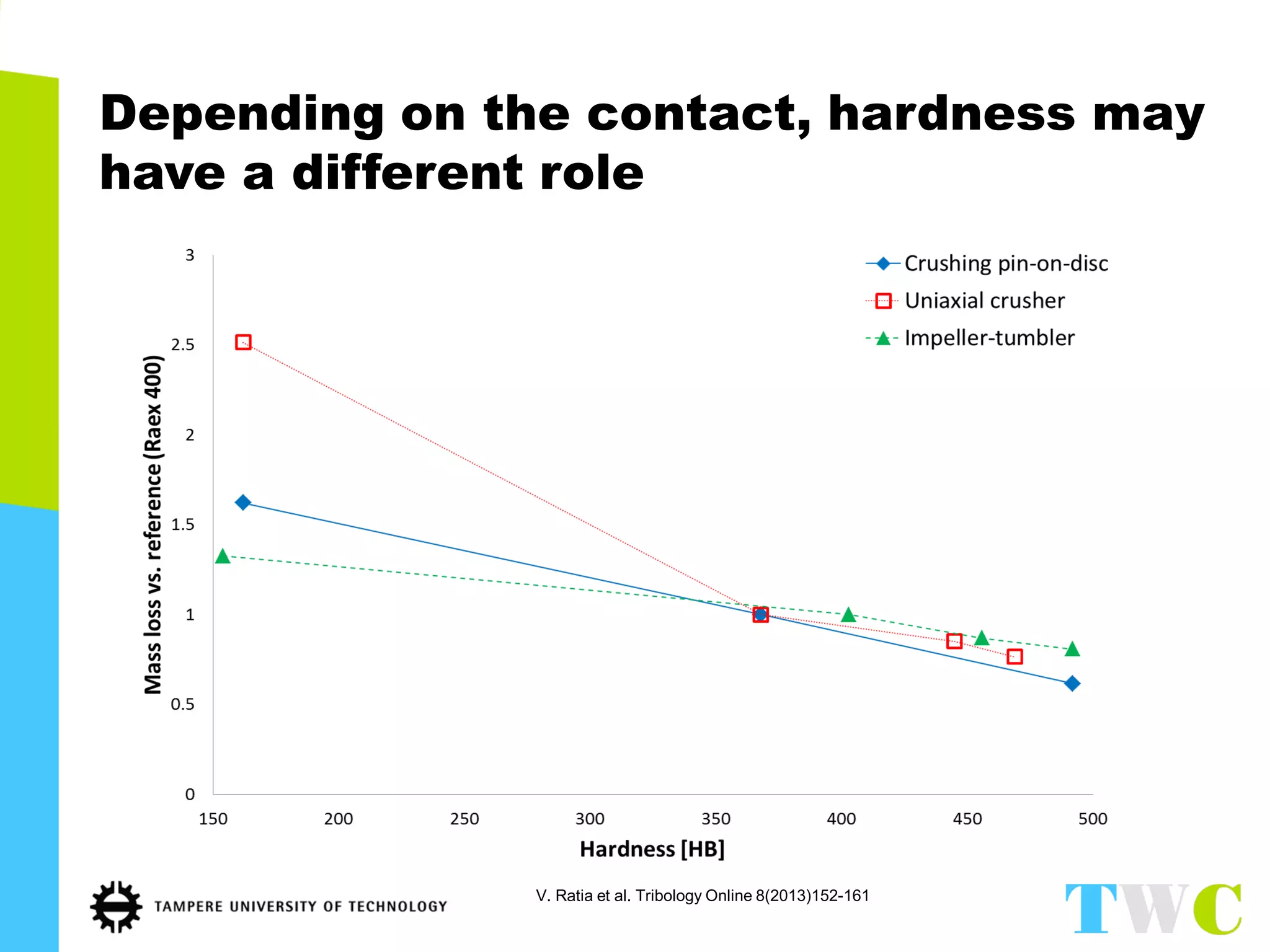
Depending on the contact, hardness may have a different role 
V. Ratia et al. Tribology Online 8(2013)152-161
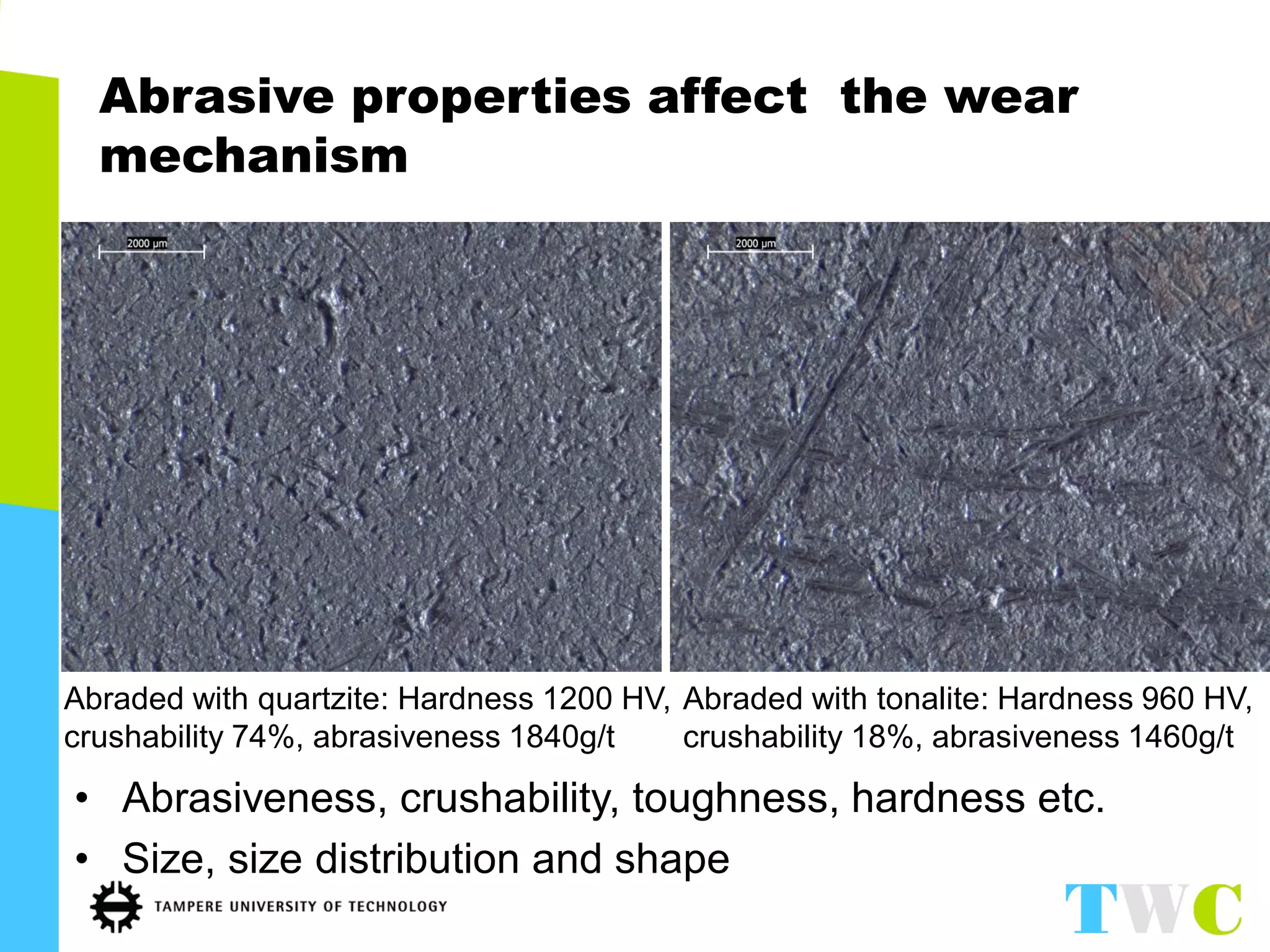
Abrasive properties affect the wear mechanism 
•Abrasiveness, crushability, toughness, hardness etc. 
•Size, size distribution and shape 
Abraded with quartzite: Hardness 1200 HV, crushability 74%, abrasiveness 1840g/t 
Abraded with tonalite: Hardness 960 HV, 
crushability 18%, abrasiveness 1460g/t
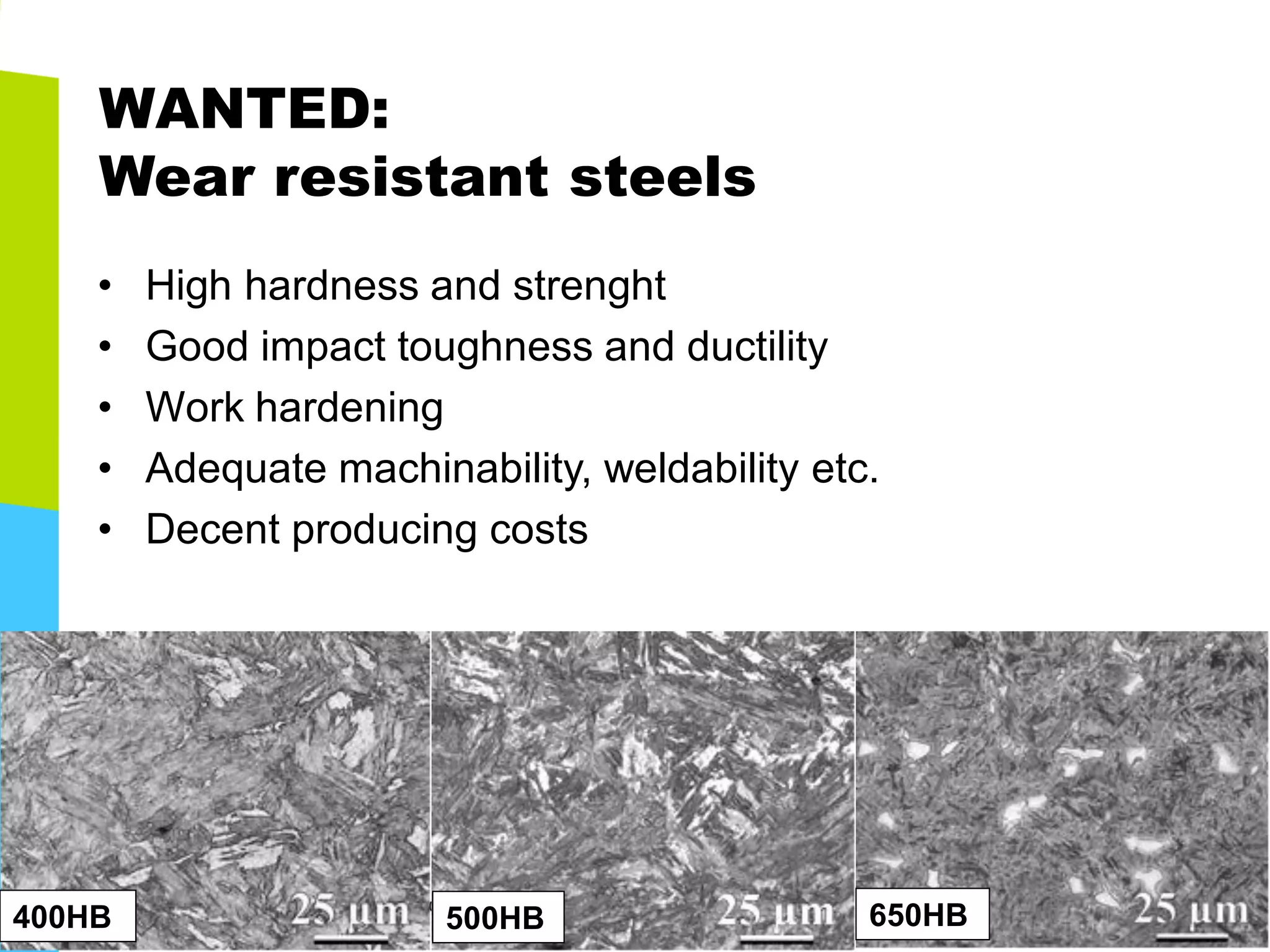
WANTED: Wear resistant steels 
•High hardness and strenght 
•Good impact toughness and ductility 
•Work hardening 
•Adequate machinability, weldability etc. 
•Decent producing costs 
400HB 
650HB 
500HB
Thank you for your attention! 
vilma.ratia@tut.fi 
FIMECC BSA

Abrasive and impact-abrasive wear testing of steels for mining, transporting, and minerals processing

  • 1.
    Abrasive and impact-abrasivewear testing of steels for mining, transporting, and mineral processing Hard rock tribology seminar 4.11.2014 Vilma Ratia Tampere University of Technology, Tampere Wear Center, Tampere, Finland
  • 2.
    Contents •Wear –what is it? What are wear resistant steels? •How can wear resistance be controllably measured? •How wear is shown in steels? •Which factors affect wear of steels?
  • 3.
    The durability ofmachinery in raw materials extraction and processing is increasing in importance geosyntheticsmagazine.com ruukki.com ruukki.com
  • 4.
    0.142 0.158 0.163 0.165 0.172 0.173 0.176 0.180 0.186 0.189 0.192 0.199 0.202 0.208 0.216 0 100 200 300 400 500 600 700 800 900 1000 0.000 0.050 0.100 0.150 0.200 0.250 0 2 15 4 14 3 10 11 5 24 18 17 6 16 1 Surface hardness [HV5] Mass loss [g] Wear resistant steels have higher strength and hardness than conventional structural steels • Commonly graded according to hardness in Brinell scale: 400HB, 500HB, 600HB • Tensile strength typically 1200-1600 MPa • Notch impact energy at -40C typically 30 J/cm2 • Microstructure often martensitic, but bainite, ferrite, pearlite and austenite are also possible ruukki.com N. Ojala et al. WTC 2013 & Wear 317(2014)225-232
  • 5.
    Wear resistant steelscan be used in a wide range of applications Examples of applications: •Agriculture (harvesters, ploughs) •Earth moving (tippers, excavator buckets) •Forestry (frost and rock rippers, stump processors) •Mining (wheel loader buckets, stock pile conveyors, sieves, conveyor belt hoppers) johndeeredistributor.fi deere.fi ruukki.com sandviktamrock.fi
  • 6.
    •Impeller (samples) 700rpm •Tumbler 30 rpm •900 g of granite(10-12,5 mm)/15 min •Altogether about 3-22 kg •Sample size 75 x 25 x 10 mm •Sample angle 30°, 60° or 90° •Test duration 45-360 min Impeller-tumbler simulates wear in hammer mills, silos, loading of tippers •Impeller-tumbler combines impacts and abrasive wear Wear testing enables the evaluating of materials’ wear performance in controlled conditions metso.com ruukki.com
  • 8.
    Uniaxial crusher simulateswear in crushers and tippers while transport •Crushing of gravel with high force up to 86 kN •Fresh granite (4-6,3 mm) for each crush •Typical test duration 1000 compressions Sample Abrasive cup Supply tube ruukki.com
  • 9.
    Crushing pin-on-disc simulateswear in crushers and unloading of tippers •Abrasives as loose particles •500 g in a test •Used force 200 N •Pin diameter 36 mm •Disc diameter 160 mm •Test duration 30 minutes (240 crushes) •Running-in of 20 minutes ruukki.com
  • 10.
  • 11.
    Steels and abrasiveshave many kind of interactions •Deformation: –Ploughing –Wedge formation •Embedding of abrasives •Indentations •Fatigue due to subsequent impacts •Chip formation •Cutting
  • 12.
    The harder steelshave clearer scratches and less abrasive remnants S355 500HB S355 500HB
  • 13.
    Hardening can enhancewear resistance •Work hardening takes place in impacts, but also in high-stress abrasion •The tendency of work hardening is beneficial, unless it makes the top layer brittle 400HB 650HB V.Ratia et al. Wear 301(2013)94-101
  • 14.
    Depending on thecontact, hardness may have a different role V. Ratia et al. Tribology Online 8(2013)152-161
  • 15.
    Abrasive properties affectthe wear mechanism •Abrasiveness, crushability, toughness, hardness etc. •Size, size distribution and shape Abraded with quartzite: Hardness 1200 HV, crushability 74%, abrasiveness 1840g/t Abraded with tonalite: Hardness 960 HV, crushability 18%, abrasiveness 1460g/t
  • 16.
    WANTED: Wear resistantsteels •High hardness and strenght •Good impact toughness and ductility •Work hardening •Adequate machinability, weldability etc. •Decent producing costs 400HB 650HB 500HB
  • 17.
    Thank you foryour attention! vilma.ratia@tut.fi FIMECC BSA