Indian Silk Sarees 
SHIVAJI CHOUDHURY
Silk Sarees 
 Silk sarees in India are very popular for any kind of 
occasion. 
 Silk sarees are most exotic and sensual. 
 Silk sari is a beautiful sari fabric. 
 A women's wardrobe is incomplete without a silk 
saree. Silk has been a highly revered fabric in India. 
 The softness, smoothness, luster and its graceful and 
sensuous folds of the fabric are marvels for designing 
silk sarees. 
 Silk saris are often created with zari. 
 Silk saris are popular all across India for their shine 
and glamour.
Pochampally Silk sarees 
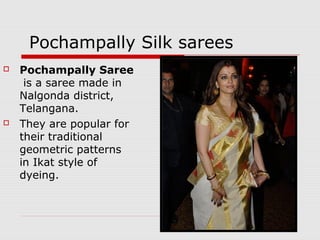
 Pochampally Saree 
is a saree made in 
Nalgonda district, 
Telangana. 
 They are popular for 
their traditional 
geometric patterns 
in Ikat style of 
dyeing.
Sarees from Assam 
:Muga silk sarees 
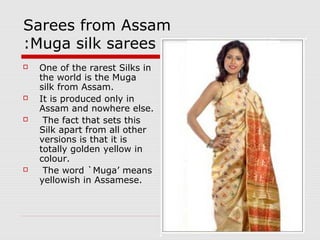
 One of the rarest Silks in 
the world is the Muga 
silk from Assam. 
 It is produced only in 
Assam and nowhere else. 
 The fact that sets this 
Silk apart from all other 
versions is that it is 
totally golden yellow in 
colour. 
 The word `Muga’ means 
yellowish in Assamese.
Chanderi silk sarees 
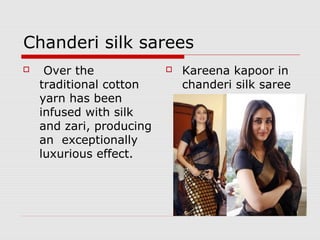
 Over the 
traditional cotton 
yarn has been 
infused with silk 
and zari, producing 
an exceptionally 
luxurious effect. 
 Kareena kapoor in 
chanderi silk saree
Tussar silk 
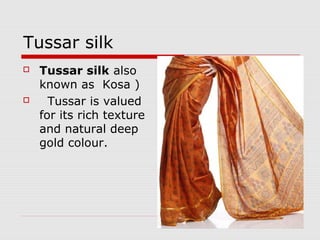
 Tussar silk also 
known as Kosa ) 
 Tussar is valued 
for its rich texture 
and natural deep 
gold colour.
Patola sarees 
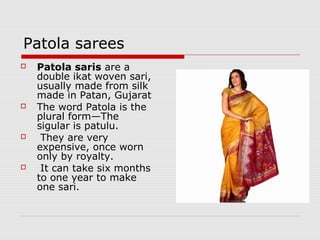
 Patola saris are a 
double ikat woven sari, 
usually made from silk 
made in Patan, Gujarat 
 The word Patola is the 
plural form—The 
sigular is patulu. 
 They are very 
expensive, once worn 
only by royalty. 
 It can take six months 
to one year to make 
one sari.
Paithani silk sarees 
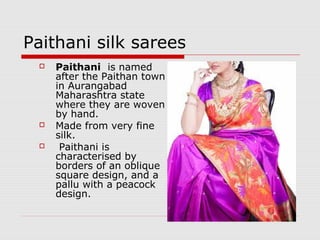
 Paithani is named 
after the Paithan town 
in Aurangabad 
Maharashtra state 
where they are woven 
by hand. 
 Made from very fine 
silk. 
 Paithani is 
characterised by 
borders of an oblique 
square design, and a 
pallu with a peacock 
design.
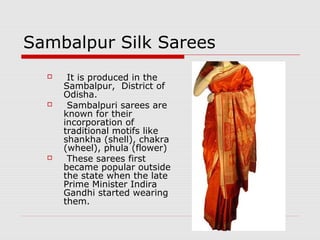
Sambalpur Silk Sarees 
 It is produced in the 
Sambalpur, District of 
Odisha. 
 Sambalpuri sarees are 
known for their 
incorporation of 
traditional motifs like 
shankha (shell), chakra 
(wheel), phula (flower) 
 These sarees first 
became popular outside 
the state when the late 
Prime Minister Indira 
Gandhi started wearing 
them.
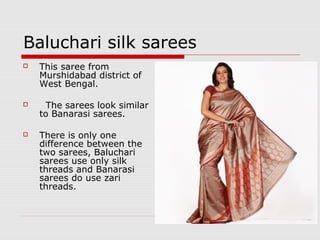
Baluchari silk sarees 
 This saree from 
Murshidabad district of 
West Bengal. 
 The sarees look similar 
to Banarasi sarees. 
 There is only one 
difference between the 
two sarees, Baluchari 
sarees use only silk 
threads and Banarasi 
sarees do use zari 
threads.
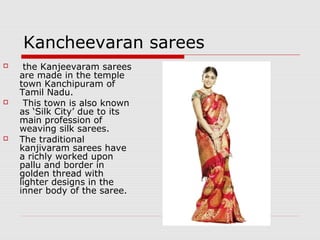
Kancheevaran sarees 
 the Kanjeevaram sarees 
are made in the temple 
town Kanchipuram of 
Tamil Nadu. 
 This town is also known 
as ‘Silk City’ due to its 
main profession of 
weaving silk sarees. 
 The traditional 
kanjivaram sarees have 
a richly worked upon 
pallu and border in 
golden thread with 
lighter designs in the 
inner body of the saree.
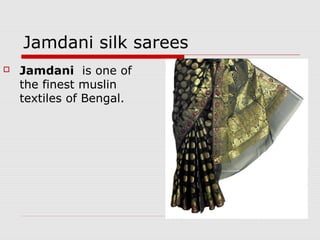
Jamdani silk sarees 
 Jamdani is one of 
the finest muslin 
textiles of Bengal.
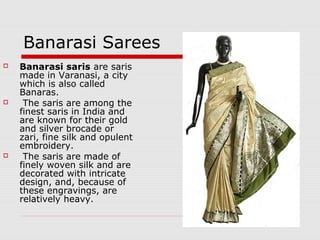
Banarasi Sarees 
 Banarasi saris are saris 
made in Varanasi, a city 
which is also called 
Banaras. 
 The saris are among the 
finest saris in India and 
are known for their gold 
and silver brocade or 
zari, fine silk and opulent 
embroidery. 
 The saris are made of 
finely woven silk and are 
decorated with intricate 
design, and, because of 
these engravings, are 
relatively heavy.
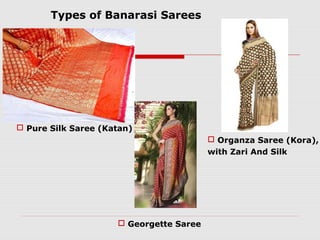
Types of Banarasi Sarees 
 Pure Silk Saree (Katan) 
 Organza Saree (Kora), 
with Zari And Silk 
 Georgette Saree
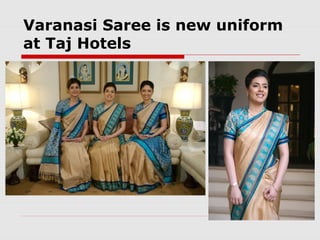
Varanasi Saree is new uniform 
at Taj Hotels
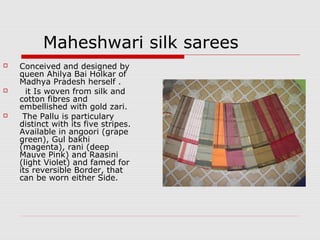
Maheshwari silk sarees 
 Conceived and designed by 
queen Ahilya Bai Holkar of 
Madhya Pradesh herself . 
 it Is woven from silk and 
cotton fibres and 
embellished with gold zari. 
 The Pallu is particulary 
distinct with its five stripes. 
Available in angoori (grape 
green), Gul bakhi 
(magenta), rani (deep 
Mauve Pink) and Raasini 
(light Violet) and famed for 
its reversible Border, that 
can be worn either Side.
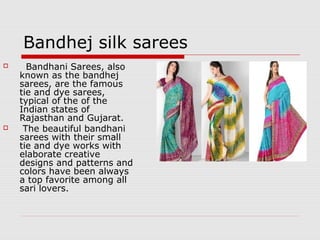
Bandhej silk sarees 
 Bandhani Sarees, also 
known as the bandhej 
sarees, are the famous 
tie and dye sarees, 
typical of the of the 
Indian states of 
Rajasthan and Gujarat. 
 The beautiful bandhani 
sarees with their small 
tie and dye works with 
elaborate creative 
designs and patterns and 
colors have been always 
a top favorite among all 
sari lovers.
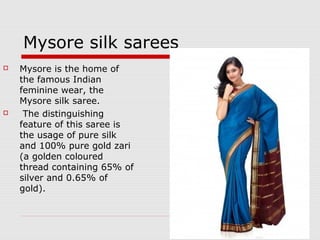
Mysore silk sarees 
 Mysore is the home of 
the famous Indian 
feminine wear, the 
Mysore silk saree. 
 The distinguishing 
feature of this saree is 
the usage of pure silk 
and 100% pure gold zari 
(a golden coloured 
thread containing 65% of 
silver and 0.65% of 
gold).
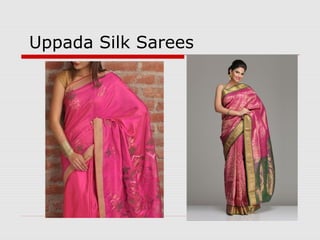
Uppada Silk Sarees
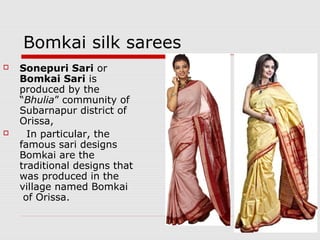
Bomkai silk sarees 
 Sonepuri Sari or 
Bomkai Sari is 
produced by the 
“Bhulia” community of 
Subarnapur district of 
Orissa, 
 In particular, the 
famous sari designs 
Bomkai are the 
traditional designs that 
was produced in the 
village named Bomkai 
of Orissa.
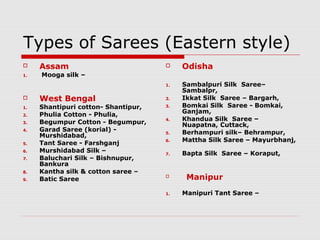
Types of Sarees (Eastern style) 
 Assam 
1. Mooga silk – 
 West Bengal 
1. Shantipuri cotton- Shantipur, 
2. Phulia Cotton - Phulia, 
3. Begumpur Cotton - Begumpur, 
4. Garad Saree (korial) - 
Murshidabad, 
5. Tant Saree - Farshganj 
6. Murshidabad Silk – 
7. Baluchari Silk – Bishnupur, 
Bankura 
8. Kantha silk & cotton saree – 
9. Batic Saree 
 Odisha 
1. Sambalpuri Silk Saree– 
Sambalpr, 
2. Ikkat Silk Saree – Bargarh, 
3. Bomkai Silk Saree - Bomkai, 
Ganjam, 
4. Khandua Silk Saree – 
Nuapatna, Cuttack, 
5. Berhampuri silk– Behrampur, 
6. Mattha Silk Saree – Mayurbhanj, 
7. Bapta Silk Saree – Koraput, 
 Manipur 
1. Manipuri Tant Saree –
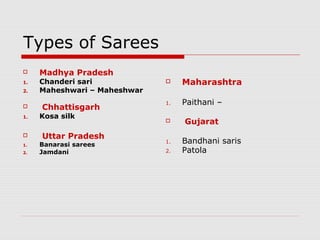
Types of Sarees 
 Madhya Pradesh 
1. Chanderi sari 
2. Maheshwari – Maheshwar 
 Chhattisgarh 
1. Kosa silk 
 Uttar Pradesh 
1. Banarasi sarees 
2. Jamdani 
 Maharashtra 
1. Paithani – 
 Gujarat 
1. Bandhani saris 
2. Patola
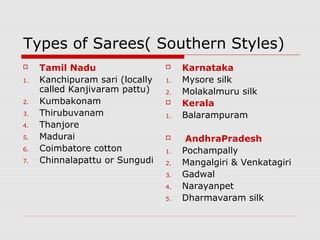
Types of Sarees( Southern Styles) 
 Tamil Nadu 
1. Kanchipuram sari (locally 
called Kanjivaram pattu) 
2. Kumbakonam 
3. Thirubuvanam 
4. Thanjore 
5. Madurai 
6. Coimbatore cotton 
7. Chinnalapattu or Sungudi 
 Karnataka 
1. Mysore silk 
2. Molakalmuru silk 
 Kerala 
1. Balarampuram 
 AndhraPradesh 
1. Pochampally 
2. Mangalgiri & Venkatagiri 
3. Gadwal 
4. Narayanpet 
5. Dharmavaram silk
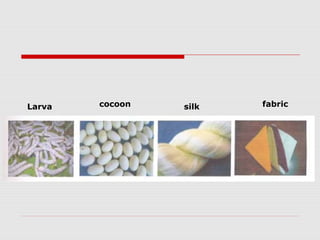
Larva cocoon silk fabric
THANKING YOU

Indian silk sarees

  • 1.
    Indian Silk Sarees SHIVAJI CHOUDHURY
  • 2.
    Silk Sarees Silk sarees in India are very popular for any kind of occasion.  Silk sarees are most exotic and sensual.  Silk sari is a beautiful sari fabric.  A women's wardrobe is incomplete without a silk saree. Silk has been a highly revered fabric in India.  The softness, smoothness, luster and its graceful and sensuous folds of the fabric are marvels for designing silk sarees.  Silk saris are often created with zari.  Silk saris are popular all across India for their shine and glamour.
  • 3.
    Pochampally Silk sarees  Pochampally Saree is a saree made in Nalgonda district, Telangana.  They are popular for their traditional geometric patterns in Ikat style of dyeing.
  • 4.
    Sarees from Assam :Muga silk sarees  One of the rarest Silks in the world is the Muga silk from Assam.  It is produced only in Assam and nowhere else.  The fact that sets this Silk apart from all other versions is that it is totally golden yellow in colour.  The word `Muga’ means yellowish in Assamese.
  • 5.
    Chanderi silk sarees  Over the traditional cotton yarn has been infused with silk and zari, producing an exceptionally luxurious effect.  Kareena kapoor in chanderi silk saree
  • 6.
    Tussar silk Tussar silk also known as Kosa )  Tussar is valued for its rich texture and natural deep gold colour.
  • 7.
    Patola sarees Patola saris are a double ikat woven sari, usually made from silk made in Patan, Gujarat  The word Patola is the plural form—The sigular is patulu.  They are very expensive, once worn only by royalty.  It can take six months to one year to make one sari.
  • 8.
    Paithani silk sarees  Paithani is named after the Paithan town in Aurangabad Maharashtra state where they are woven by hand.  Made from very fine silk.  Paithani is characterised by borders of an oblique square design, and a pallu with a peacock design.
  • 9.
    Sambalpur Silk Sarees  It is produced in the Sambalpur, District of Odisha.  Sambalpuri sarees are known for their incorporation of traditional motifs like shankha (shell), chakra (wheel), phula (flower)  These sarees first became popular outside the state when the late Prime Minister Indira Gandhi started wearing them.
  • 10.
    Baluchari silk sarees  This saree from Murshidabad district of West Bengal.  The sarees look similar to Banarasi sarees.  There is only one difference between the two sarees, Baluchari sarees use only silk threads and Banarasi sarees do use zari threads.
  • 11.
    Kancheevaran sarees the Kanjeevaram sarees are made in the temple town Kanchipuram of Tamil Nadu.  This town is also known as ‘Silk City’ due to its main profession of weaving silk sarees.  The traditional kanjivaram sarees have a richly worked upon pallu and border in golden thread with lighter designs in the inner body of the saree.
  • 12.
    Jamdani silk sarees  Jamdani is one of the finest muslin textiles of Bengal.
  • 13.
    Banarasi Sarees Banarasi saris are saris made in Varanasi, a city which is also called Banaras.  The saris are among the finest saris in India and are known for their gold and silver brocade or zari, fine silk and opulent embroidery.  The saris are made of finely woven silk and are decorated with intricate design, and, because of these engravings, are relatively heavy.
  • 14.
    Types of BanarasiSarees  Pure Silk Saree (Katan)  Organza Saree (Kora), with Zari And Silk  Georgette Saree
  • 15.
    Varanasi Saree isnew uniform at Taj Hotels
  • 16.
    Maheshwari silk sarees  Conceived and designed by queen Ahilya Bai Holkar of Madhya Pradesh herself .  it Is woven from silk and cotton fibres and embellished with gold zari.  The Pallu is particulary distinct with its five stripes. Available in angoori (grape green), Gul bakhi (magenta), rani (deep Mauve Pink) and Raasini (light Violet) and famed for its reversible Border, that can be worn either Side.
  • 17.
    Bandhej silk sarees  Bandhani Sarees, also known as the bandhej sarees, are the famous tie and dye sarees, typical of the of the Indian states of Rajasthan and Gujarat.  The beautiful bandhani sarees with their small tie and dye works with elaborate creative designs and patterns and colors have been always a top favorite among all sari lovers.
  • 18.
    Mysore silk sarees  Mysore is the home of the famous Indian feminine wear, the Mysore silk saree.  The distinguishing feature of this saree is the usage of pure silk and 100% pure gold zari (a golden coloured thread containing 65% of silver and 0.65% of gold).
  • 19.
  • 20.
    Bomkai silk sarees  Sonepuri Sari or Bomkai Sari is produced by the “Bhulia” community of Subarnapur district of Orissa,  In particular, the famous sari designs Bomkai are the traditional designs that was produced in the village named Bomkai of Orissa.
  • 21.
    Types of Sarees(Eastern style)  Assam 1. Mooga silk –  West Bengal 1. Shantipuri cotton- Shantipur, 2. Phulia Cotton - Phulia, 3. Begumpur Cotton - Begumpur, 4. Garad Saree (korial) - Murshidabad, 5. Tant Saree - Farshganj 6. Murshidabad Silk – 7. Baluchari Silk – Bishnupur, Bankura 8. Kantha silk & cotton saree – 9. Batic Saree  Odisha 1. Sambalpuri Silk Saree– Sambalpr, 2. Ikkat Silk Saree – Bargarh, 3. Bomkai Silk Saree - Bomkai, Ganjam, 4. Khandua Silk Saree – Nuapatna, Cuttack, 5. Berhampuri silk– Behrampur, 6. Mattha Silk Saree – Mayurbhanj, 7. Bapta Silk Saree – Koraput,  Manipur 1. Manipuri Tant Saree –
  • 22.
    Types of Sarees  Madhya Pradesh 1. Chanderi sari 2. Maheshwari – Maheshwar  Chhattisgarh 1. Kosa silk  Uttar Pradesh 1. Banarasi sarees 2. Jamdani  Maharashtra 1. Paithani –  Gujarat 1. Bandhani saris 2. Patola
  • 23.
    Types of Sarees(Southern Styles)  Tamil Nadu 1. Kanchipuram sari (locally called Kanjivaram pattu) 2. Kumbakonam 3. Thirubuvanam 4. Thanjore 5. Madurai 6. Coimbatore cotton 7. Chinnalapattu or Sungudi  Karnataka 1. Mysore silk 2. Molakalmuru silk  Kerala 1. Balarampuram  AndhraPradesh 1. Pochampally 2. Mangalgiri & Venkatagiri 3. Gadwal 4. Narayanpet 5. Dharmavaram silk
  • 24.
  • 25.